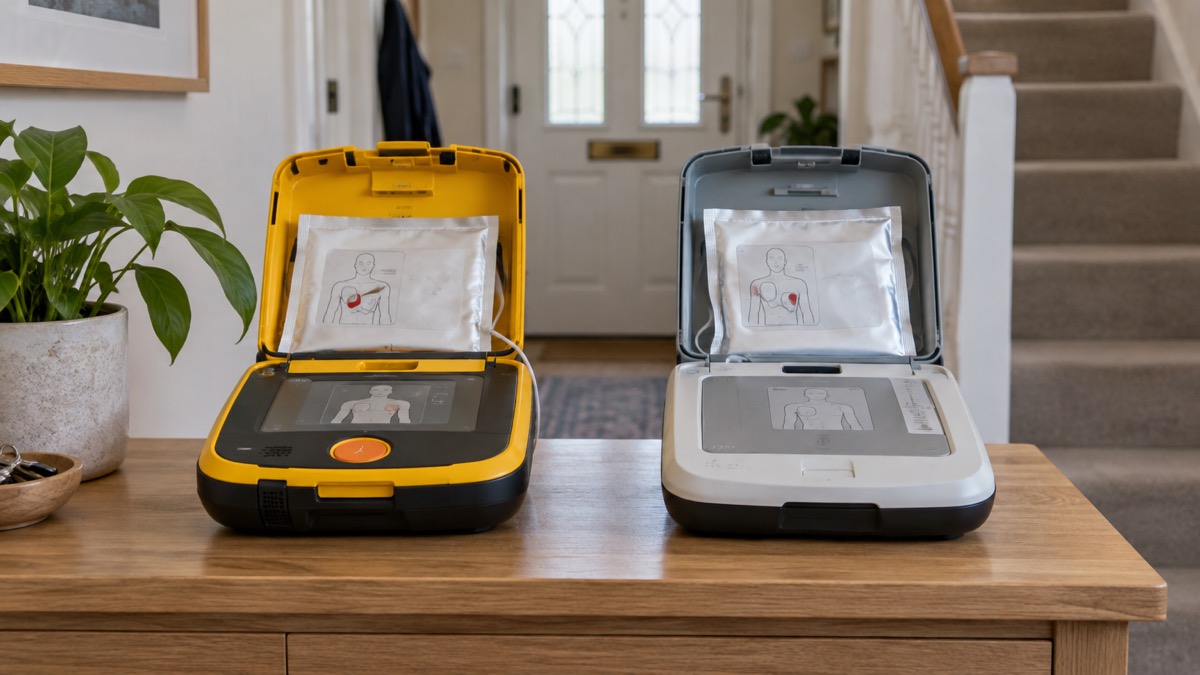
If someone collapses and is not breathing normally, a defibrillator can be the difference between life and death. The choice between a semi-automatic and a fully automatic model comes down to one moment: whether the machine asks a person to press the shock button, or gives the shock on its own. Both defibrillator types are designed to be safe and easy to use, with no difference in their effectiveness1.
For a home, a sports club or a village, either type will do the job. A semi-automatic AED prompts the user to press the shock button when a shock is advised2. A fully automatic AED uses a countdown or voice commands and delivers the shock without the user pressing a button2. The device itself decides whether a shock is needed: it is pre-programmed to assess the rhythm and shock only if required2.
What matters most is that the defibrillator is close at hand, in date and ready to use. Bystander CPR and use of an AED increase the chances of survival by two to four-fold3. In Northern Ireland, the ambulance service reports that survival chances rise to 57.1% when an AED is used during emergency first aid4. This page sets out how each type behaves, who each suits, what to check for children, where to keep a device and how to look after it.
How a semi-automatic AED behaves: you press the shock button
A semi-automatic AED does the thinking but leaves the final act to the rescuer. It senses and analyses the casualty's cardiac rhythm through the electrode pads and alerts the user to deliver a shock by pressing a button when it is ready1. The machine will only advise a shock if the rhythm needs one, because it is pre-programmed to assess the rhythm and provide a shock only if required2.
In use, the sequence is straightforward. Switch the defibrillator on, either with an on and off button or by opening its case, and follow the verbal or visual instructions9. If a shock is needed, tell people to stand back. The defibrillator will tell you when to press the shock button, and after the shock it will tell you to continue CPR for two minutes before it re-analyses9. The British Heart Foundation describes the same step: the defibrillator decides whether a shock is needed and, if so, tells you to press the shock button10.
The button press is not a judgement call. The device has already made the decision, and the flashing button simply indicates it is ready for shock delivery11. On the Mediana A16 semi-automatic, the unit is charged and ready in ten seconds or less from the start of analysis11. On the ZOLL AED Plus, the instruction is simply to press the flashing Shock button if a shock is advised12.
Some people find the button press reassuring, because it gives a clear moment of control and a reason to check that nobody is touching the casualty. Others worry about freezing at the critical moment. The device's prompts are designed to carry an untrained user through, and the machine will not shock unless the rhythm calls for it2.
How a fully automatic AED behaves: it shocks without a button press
A fully automatic AED removes the button press altogether. It analyses the cardiac rhythm and delivers the required shock on its own, requiring no intervention or button-pressing from the user1. The Scottish Ambulance Service describes it as using a countdown or voice commands and delivering the shock without the user pressing a shock button2.
The device still warns you. Fully automated defibrillators have no shock button, and they warn you that they are going to shock the patient, tell you when they have delivered a shock, and tell you when to continue chest compressions9. On the ZOLL AED 3 fully automatic, if a shock is advised the AED automatically delivers it after a countdown13. The iPAD SP1 fully automatic delivers a shock when the relevant irregular heartbeat is detected, once the pads are correctly placed14.
The advantage is that there is no moment where a panicking bystander has to act. The disadvantage is that there is also no pause for a person to check that everyone is clear, so the rescuer must listen for the warning and keep hands off when told. The machine detects whether the heart has restarted and gives further instructions if it has not15. A shock does not always mean the heart will restart15.
Both types are accurate. The Scottish Ambulance Service reports that AEDs make the correct "shock" decision more than 95 of 100 times, and a correct "no shock" decision more than 98 of 100 times, for unconscious, non-breathing casualties2. That accuracy is why the device, not the rescuer, decides whether a shock is given.
Which type suits a home or a community site
For most homes and community sites, the honest answer is that either type works, and the choice comes down to who will use it and how confident they are. Both are designed to be safe and easy to use, with no difference in their effectiveness1. The bigger questions are where the device lives, who can reach it and whether it is maintained.
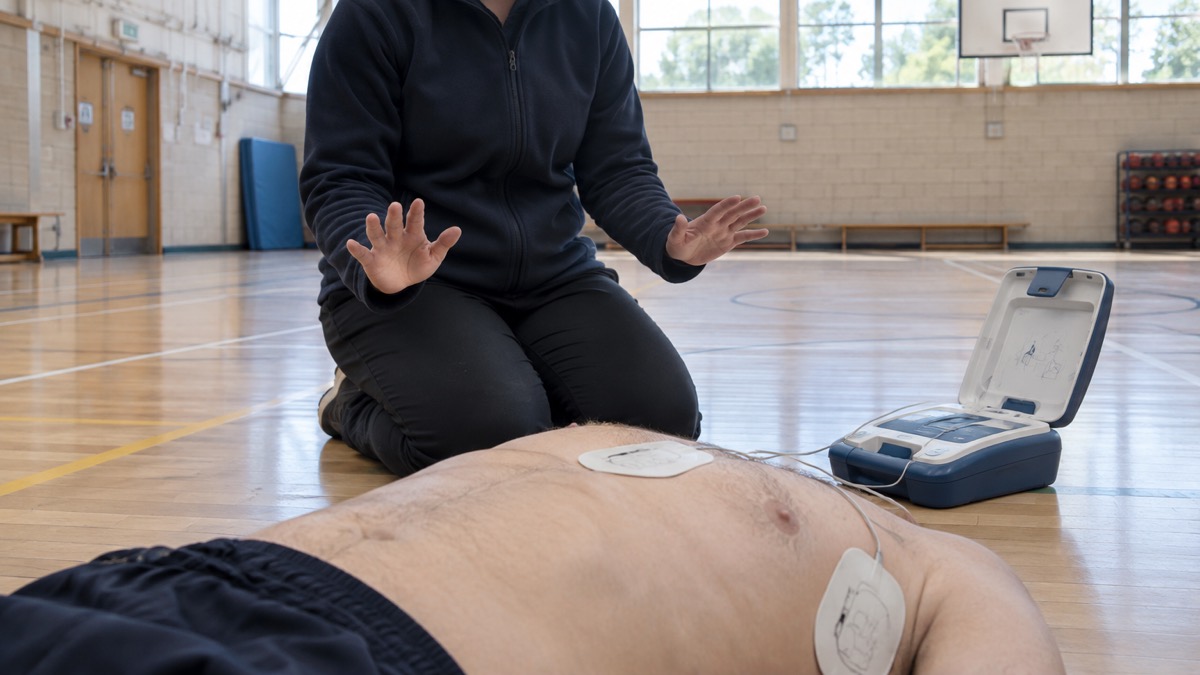
A semi-automatic model suits a site where at least some people are likely to have had first aid or CPR training, or where a named group of volunteers will act as guardians. The button press gives a deliberate final step and a natural pause to check that nobody is touching the casualty. A fully automatic model suits a site where the device may be used by whoever happens to be passing, with no training and no warning. The machine carries the whole sequence, and the rescuer's job is to follow the voice prompts and keep clear when told.
The Mediana A16 range is made in both configurations, and the maker lists the semi-automatic and fully automatic versions as ideal for workplaces, schools or public use16. The Mediana A16 semi-automatic is described as suitable for low-risk workplaces with one kit per 1-25 employees, or high-risk workplaces with one kit per 1-5 employees11. The Resuscitation Council UK advises that locations with a high population flow, such as airports, shopping centres and railway stations, should have on-site AEDs readily accessible for public use3.
For a village or a club, the practical test is simple: if the device will be mounted in a cabinet and used by whoever is nearest, a fully automatic model removes one decision. If a trained group will take responsibility for checks and drills, a semi-automatic model is equally sound. What matters is that the device is registered, maintained and known about locally. See Choosing a Defibrillator for a Home, Club or Village for the wider buying decisions.
| Question | Semi-automatic suits | Fully automatic suits |
|---|---|---|
| Who is likely to use it? | People with some training, or a named guardian group | Whoever is nearest, trained or not |
| Do you want a final check before the shock? | Yes, the button press is that moment | No, the machine shocks after a countdown |
| Where will it be kept? | Home, clubhouse, workplace | Village hall, public cabinet, busy site |
| What does the rescuer do? | Follow prompts, press the button when told | Follow prompts, keep clear when told |
Examples of each type sold in the UK
Several makers sell both configurations, often in the same product family. The Mediana A16 is available in both fully and semi-automatic options16. The Smarty Saver defibrillator is listed in semi automatic and fully automatic models18. The iPAD SP1 comes as a semi-automatic model, which prompts the user to press a button to deliver a shock, and as a fully automatic model19.
The ZOLL AED 3 is made in both versions. The semi-automatic model requires the rescuer to press a button to administer the shock13. The fully automatic model analyses the heart's rhythm and automatically delivers a shock if needed, without requiring the user to press a button13. The same replacement battery pack fits both, with a 5-year standby life20.
The HeartSine range splits across the two types. The samaritan PAD 500P is a semi-automatic AED, available with or without Wi-Fi connectivity21. The Samaritan 360P is a fully automatic defibrillator, designed with ease of use and portability in mind, with audio and visual instructions for the rescuer no matter what their level of training22.
The Defibtech Lifeline semi-automatic uses semi-automatic operation, enabling a shock to be administered with a simple press of a button23. It has pre-connected adult pads with a pad storage pouch at the back, and a choice of either a standard or high capacity battery23.
| Model | Type | Notable features |
|---|---|---|
| Mediana A16 | Semi and fully automatic options | One-button adult/child switch on the semi-automatic16 |
| iPAD SP1 | Semi and fully automatic | Semi prompts a button press; fully automatic shocks when the rhythm is detected19 |
| ZOLL AED 3 | Semi and fully automatic | Fully automatic shocks after a countdown; optional Wi-Fi13 |
| HeartSine samaritan PAD 500P | Semi-automatic | Available with or without Wi-Fi21 |
| HeartSine Samaritan 360P | Fully automatic | Audio and visual instructions for any level of training22 |
| Defibtech Lifeline | Semi-automatic | Pre-connected adult pads; standard or high capacity battery23 |
Where an AED can be kept: humidity from 5% to 95%
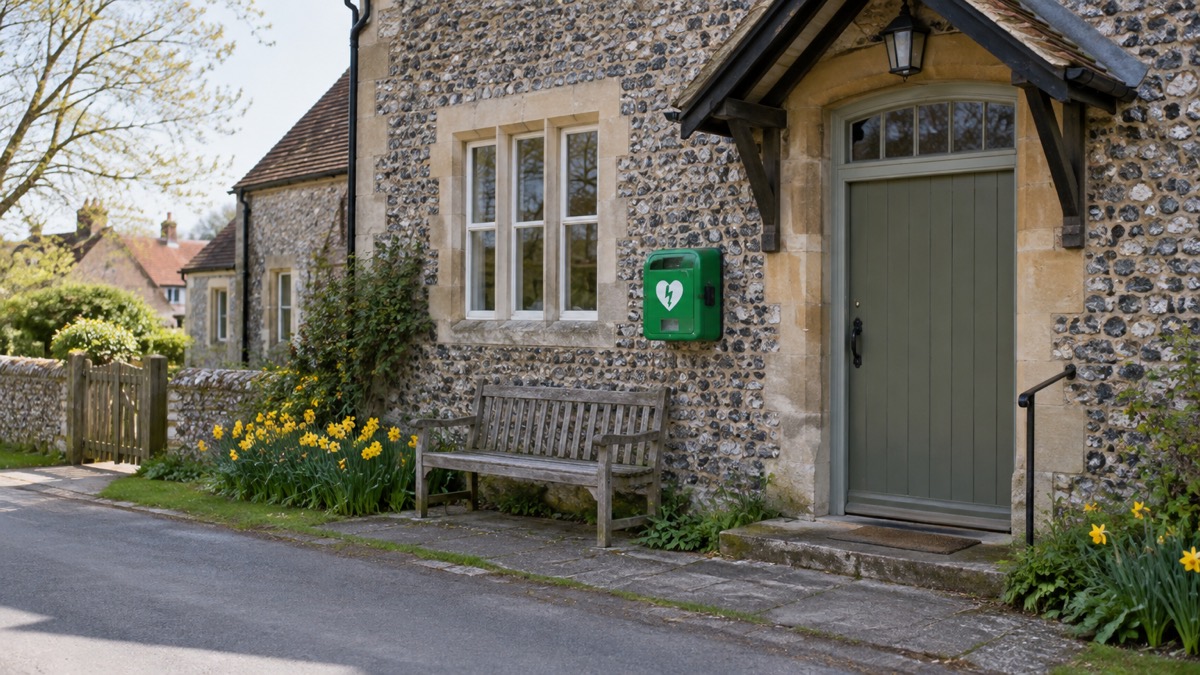
Where a defibrillator lives affects which model you choose and how well it lasts. AEDs stored in visible, secure cabinets are accessible 24/7 and protected from weather and vandalism4. That matters for a village hall or a sports ground, where the device may sit outside for years between uses.
The Resuscitation Council UK's minimum specification for a publicly accessible defibrillator says the device must be able to operate at non-condensing relative humidity levels of 10 to 95%7. Individual makers give their own figures. The ZOLL AED Plus is rated for 10 to 95% relative humidity, non-condensing12. The ZOLL AED 3 fully automatic is rated for 10% to 95% humidity, non-condensing13. The iPAD NFK200 semi-automatic is rated for 5% to 95% non-condensing24. The Defibtech Lifeline is listed at 5% to 95% relative humidity23.
In practice, a home device kept indoors will sit well within these ranges. An outdoor cabinet needs to keep the device dry and within its maker's limits, and the cabinet itself should be visible and secure4. The ZOLL AED 3 fully automatic carries an IP55 ingress protection rating and has been drop tested to 1 metre13, which matters if it is mounted in a busy or exposed spot.
Maintenance is the other half of storage. Batteries and pads have a long shelf life of between 2 and 5 years depending on the AED model2. The Defibtech Lifeline's pads are listed at 24 months and its battery standby life at 60 months23. The ZOLL AED 3 runs a configurable self-test, default every 7 days13, and the ZOLL AED Plus runs a weekly default self-test12. HeartSine connected AEDs use Wi-Fi to provide remote readiness information and complete weekly self-tests for every AED in a fleet21. A regular check routine is set out in the Defibrillator Guardian Checklist.
Adult use and what to check for children
An AED can be used on adults and children over 1 year5. For adults, place one pad on the upper right side of the chest, just beneath the collarbone, and the other on the lower left side, below the armpit9. For infants or smaller children, position one pad in the middle of the chest and the second on their back, between the shoulder blades9.
For children aged one to eight years old, paediatric pads should be used; if they are not available, use standard pads with one on the centre of the chest and one on the centre of the back15. The Resuscitation Council UK advises using an AED with a paediatric attenuator for children below eight years old if possible; if this is not available, use the standard AED for all ages25. The St John Ambulance guidance is blunt: if asked, turn on child mode if the child is less than eight years old, and if no child mode is available it is better to deliver a larger, adult shock than to wait for an ambulance26.
Some devices make the switch easy. The Mediana A16 semi-automatic has the ability to change from adult to child mode with one button11. The ZOLL AED 3 fully automatic has a child mode with energy selection of 50 J, 70 J and 85 J, against adult settings of 120 J, 150 J and 200 J13.
For a baby under one year, NHS Inform's baby CPR guidance says you can ask someone to get an AED if there is one nearby27. The same applies to a child aged one or over28. Do not delay CPR while someone fetches the device. The child CPR and baby CPR pages cover the compressions in detail, and Can You Use a Defibrillator on a Child or Baby? covers pad placement.
Supply, recycling and support from the makers
Availability varies by model and by maker, so check stock before you commit. The Mediana A16 semi-automatic is listed as in stock, with delivery within 7 working days from the point of order11. The ZOLL Powerheart G5 semi-automatic was listed as out of stock on the maker's page1.
Support comes in different forms. The Mediana A16 semi-automatic has an SD card and IR communication support, plus optional event review computer software11. The ZOLL AED Plus provides real-time, guideline-compliant CPR feedback with Real CPR Help12. The ZOLL AED 3 fully automatic offers optional Wi-Fi connectivity, enabling cloud-based device management13. HeartSine's Pad-Pak is an integrated battery and electrode single-use cartridge with one expiration date, which simplifies AED maintenance and does not require a separate battery21.
On recycling, the Defibtech Lifeline is listed as partially recyclable23. Ask the supplier or maker about take-back when you replace a device, and check with your local council about electrical waste. Batteries and pads are consumables with their own shelf life, so check the maker's guidance before disposing of anything.
Training is worth considering alongside the purchase. The British Heart Foundation sells a range of AEDs from leading brands and the accessories you will need for them29. The Resuscitation Council UK's guidance on adult basic life support and automated external defibrillation lists Lifesaver learning, Restart A Heart Day and its publication A guide to Automated External Defibrillators (AEDs) as related content3. The First Aid Courses and Learning CPR Free Online pages set out the options.
Sources (29)
- Schiller Fred EasyPort AED, Steroplast, 28 October 2026
- PAD Information Pack, South Central Ambulance Service NHS Foundation Trust, August 2026
- Adult basic life support guidelines 2025, Resuscitation Council UK, 27 October 2025
- AED, Northern Ireland Ambulance Service, 2026
- How to use an AED, NHS Inform, 2026
- Public access defibrillators, Scottish Ambulance Service, 29 October 2026
- Public access defibrillators: a guide for communities, Resuscitation Council UK, October 2025
- AED Guide, Resuscitation Council UK, 2026
- How to use a defibrillator, St John Ambulance, 2026
- Understanding defibrillators: what they are and how to use them, British Heart Foundation, 2026
- Mediana A16 semi-automatic AED, Red Cross First Aid Training, 29 October 2026
- ZOLL AED Plus semi automatic defibrillator, Steroplast, 29 October 2026
- ZOLL AED 3 fully automatic defibrillator, Steroplast, 28 October 2026
- iPAD SP1 fully automatic AED defibrillator, Steroplast, 29 October 2026
- Unresponsive and not breathing when an AED is available, British Red Cross, 2026
- Mediana A16 Pro HeartOn AED semi automatic, Reliance Medical, February 2026
- Mediana A16 Core HeartOn AED fully automatic, Reliance Medical, 25 February 2026
- Defibrillators guide, Steroplast, 28 October 2026
- iPAD SP1 semi-automatic AED defibrillator, Steroplast, 29 October 2026
- ZOLL AED 3 battery pack, Steroplast, 28 October 2026
- HeartSine samaritan PAD 500P, Stryker, 2026
- HeartSine Samaritan 360P fully automatic defibrillator with cabinet, Defib Store, 29 October 2026
- Defibtech Lifeline AED semi-automatic, Safelincs, 29 October 2026
- iPAD NFK200 semi-automatic defibrillator, Steroplast, 28 October 2026
- How to do CPR, North West Ambulance Service NHS Trust, 13 March 2025
- Child CPR, St John Ambulance, 28 October 2026
- How to give a baby CPR, NHS Inform, 24 July 2026
- How to give a child CPR, NHS Inform, 24 July 2026
- CPR training, British Heart Foundation, 29 October 2026
 Indoor or Outdoor Defib Cabinet
 Burn Gel vs Cling Film
 Saline Pods or Eyewash Bottle
 Instant or Reusable Ice Packs
 Ready-Made or Homemade Kit