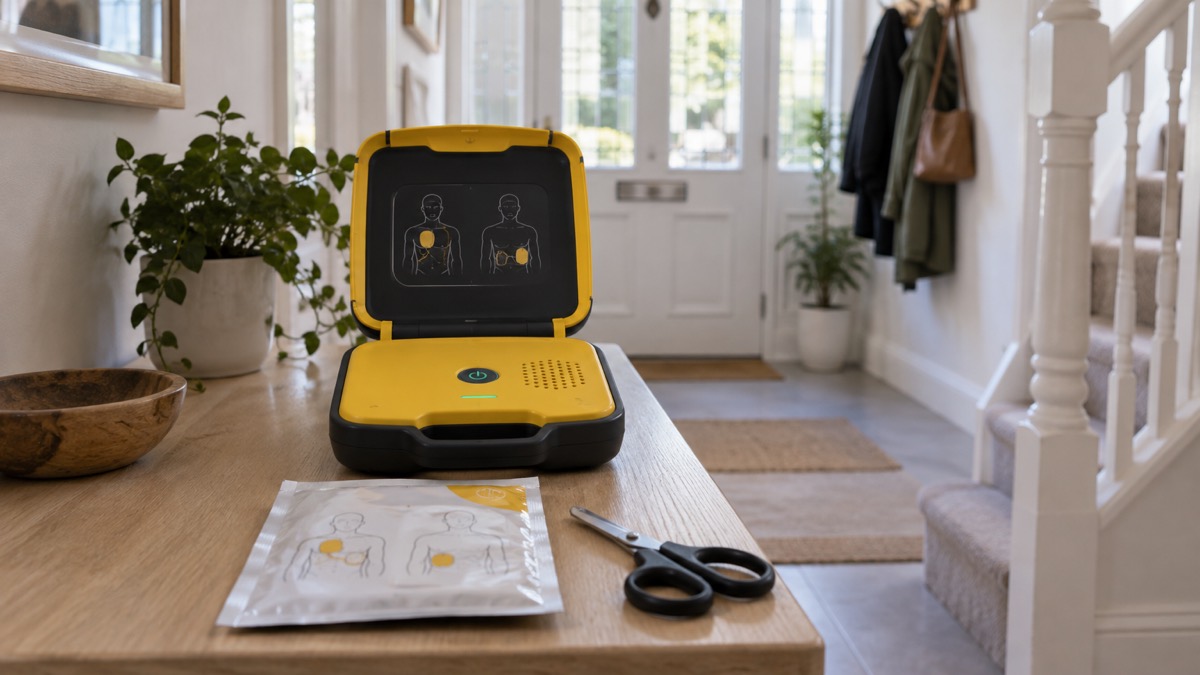
The HeartSine samaritan PAD 360P is a fully automatic defibrillator: it analyses the heart rhythm and delivers a shock itself if one is needed, so there is no shock button for the rescuer to press1. For a household, that is the whole point. In a cardiac arrest at home, the person helping may be a neighbour, a teenager or someone who has never touched a defibrillator. The 360P talks them through it with voice and visual prompts covering the entire resuscitation process, including CPR1.
It weighs 1.1 kg, carries an IP56 rating for protection from dust and water, and its battery and electrode pads are combined in one cartridge with a 4-year life2. It has an automatic self-test and one-button operation1. HeartSine publishes training videos for setting it up, using it on an adult and on a child, and maintaining it3.
Stock has been the practical obstacle. Defib Store states that Stryker has restarted production and that it expects stock of the HeartSine Samaritan 350P, 360P and 500P devices before the end of 20264. If you are buying, ask the supplier for the latest delivery time, and keep whatever defibrillator you already have in date while you wait. The 360P itself weighs 1.1 kg and has one of the most compact footprints, so it is easily transported and fits into constrained spaces3.
What the samaritan PAD 360P is, and the names it goes by
The 360P sits in HeartSine's range of public access defibrillators, and the maker describes it as suitable for public and professional use1. It is a fully automatic automated external defibrillator: the device analyses the heart rhythm and automatically delivers a shock if needed, eliminating the need for the rescuer to push a shock button1. That distinguishes it from a semi-automatic unit, where the rescuer presses the button when prompted. If you are weighing the two, our comparison of semi-automatic and fully automatic defibrillators sets out which suits a home or community setting.
The naming trips people up. HeartSine calls the device the HeartSine samaritan PAD 360P, and its own instructions shorten it to SAM 360P1. Retailers list it as the HeartSine Samaritan 360P Fully Automatic Defibrillator4, and a distributor describes the Samaritan PAD 360P as a fully automatic version suited to public spaces where users may lack formal training5. All of these are the same device. The "360P" part is what identifies it when you order a replacement Pad-Pak or check a serial number.
It is one of a family. The HeartSine samaritan PAD 350P is the semi-automatic sibling, and the HeartSine samaritan PAD 500P sits above it. The maker's own brand history and range are on the HeartSine page.
Where does it fit a household plan? A defibrillator is worth considering wherever people gather and help may be minutes away: a home with an older resident, a village hall, a sports club, a workplace. It does not replace calling 999 or starting CPR. It is used alongside them, and the prompts assume someone is doing compressions. Our guide to defibrillators and how to use one covers the wider picture, and choosing a defibrillator for a home, club or village helps with the decision.
Specifications: 1.1 kg, IP56 and a 4-year Pad-Pak
The figures that decide whether a device suits a household are weight, sealing, and how long the consumables last. The 360P is compact and light: the maker gives 1.1 kg and describes one of the most compact footprints, easily transported and able to fit into constrained spaces1. The IP56 rating means a high level of protection from dust and water ingress2, which matters if the unit lives in a porch, a workshop or a vehicle.
| Specification | Figure | Source |
|---|---|---|
| Type | Fully automatic AED | 1 |
| Weight | 1.1 kg | 2 |
| Dust and water protection | IP56 | 2 |
| Battery and electrode life | 4 years, combined Pad-Pak | 2 |
| Maintenance | Integrated battery and electrode, one-change maintenance | 2 |
| Self-test | Automatic | 2 |
| Controls | On/Off button only | 1 |
| ECG recording time | 90 minutes | 2 |
| Operating impedance range | 20 to 230 ohms | 2 |
| Shock protocol | Low energy escalating protocol (SCOPE) | 2 |
| Software | Field upgradeable | 2 |
| Paediatric use | Paediatric compatible | 2 |
| Carry case | Included | 2 |
The waveform is worth a line because it explains the low-energy design. The maker describes SCOPE (Self-Compensating Output Pulse Envelope) biphasic technology as a low energy escalating waveform that automatically adjusts for differences in patient impedance1, and lists an operating impedance range of 20 to 230 ohms2. In plain terms, the device measures how the current passes through the person and adjusts the shock to suit, rather than delivering one fixed dose.
The 4-year electrode and battery life is the figure that sets your household routine2. Because the battery and pads are one integrated cartridge, there is a single expiry date to watch rather than two, and a single part to replace. Our page on the HeartSine Pad-Pak explains the cartridge itself, and how long defibrillator batteries and pads last covers the general principle across devices.
Using it in an emergency: one button, voice and visual prompts, CPR metronome
In an emergency the sequence is the same as for any cardiac arrest: check for danger, check whether the person responds and is breathing normally, call 999, and start CPR. Our guide to the primary survey and hands-only CPR for adults cover those steps. Someone else should fetch the defibrillator while compressions continue.
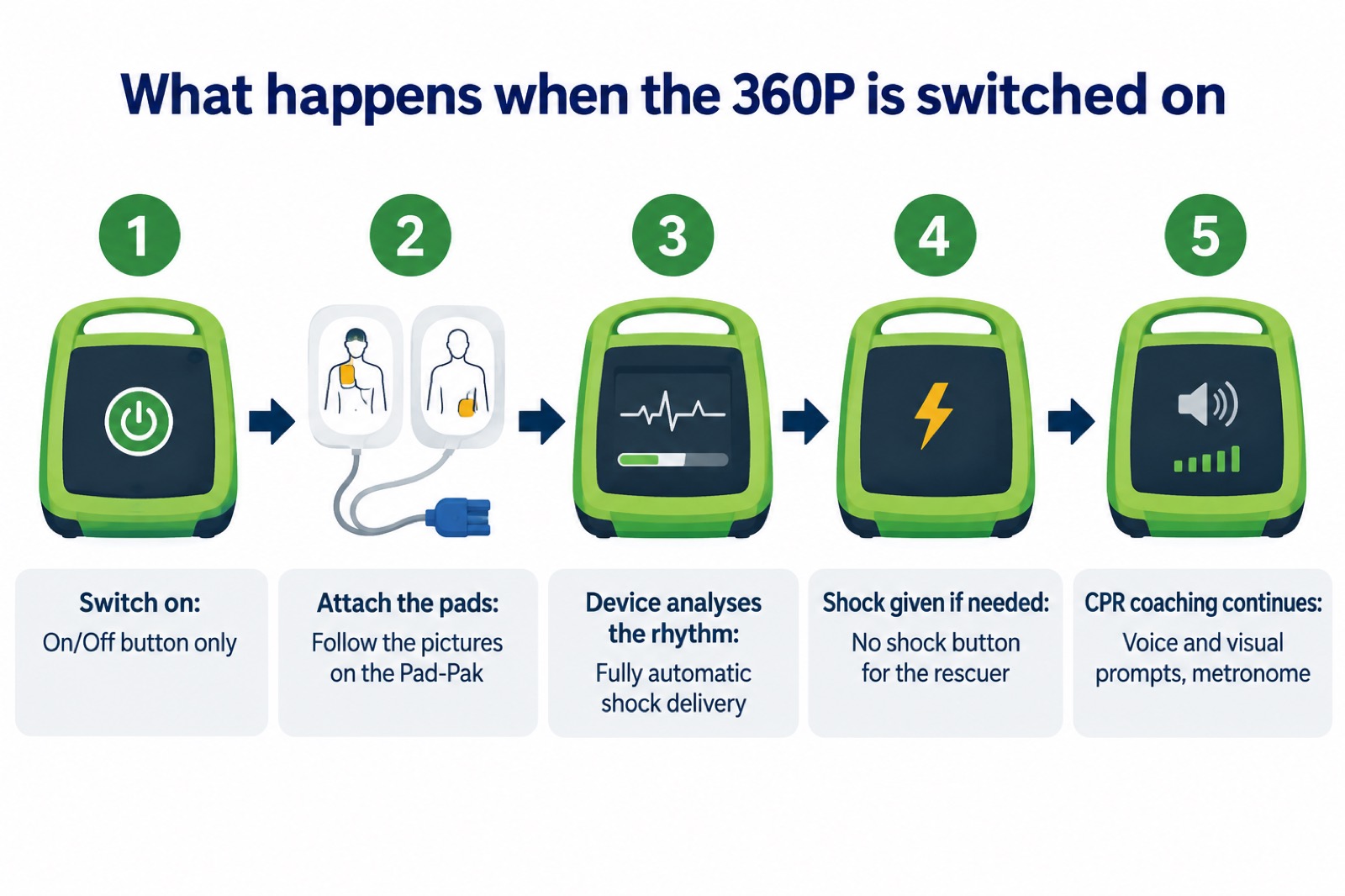
Once the device is on and the pads are attached, the 360P takes over the prompting. The maker states that easy-to-understand visual and voice prompts guide the rescuer through the entire resuscitation process, including CPR1. It has an audible and visual metronome for CPR rate guidance, and CPR coaching with the metronome2. The only control is an On/Off button1: there is no shock button, because the device decides and delivers the shock itself1.
One feature deserves explaining because it prevents a common error. The maker states that the SAM 360P detects motion, such as performing CPR or moving the patient, to reduce the likelihood that the user is touching the patient prior to shock delivery1. In other words, if someone is still doing compressions when a shock is due, the device is designed to hold back rather than shock through them. That is a safety backstop, not a reason to be casual: follow the voice prompts and stand clear when told.
For a child, the 360P is listed as paediatric compatible2, and HeartSine publishes a training video on using the SAM 360P on a child3. Our page on using a defibrillator on a child or baby sets out the pads and placement. Pad placement in general is covered in where do defibrillator pads go, and if you have had no training at all, can you use a defibrillator without training answers that directly.
Hand the device over as it is.
Keeping it ready: self-test, one-change maintenance and storage
A defibrillator that has sat untested in a cupboard for four years is a risk in itself. The 360P is designed to reduce that burden. It runs an automatic self-test2, and its integrated battery and electrode give one-change maintenance2: when the Pad-Pak reaches the end of its 4-year life, you replace the one cartridge2. There is no separate battery to track.
- Check the status indicator as part of a regular household routine, and note the Pad-Pak expiry date in a diary or on a calendar.
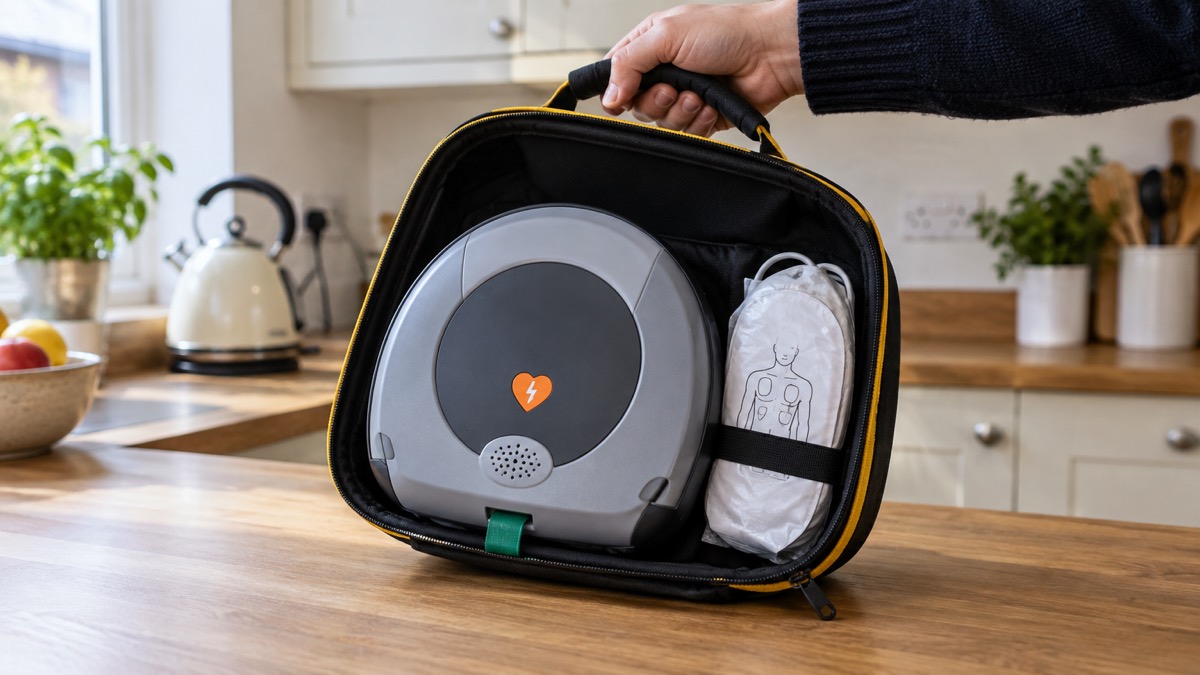
- Keep the carry case with it. The case is included2, and it protects a 1.1 kg device that may be moved between rooms or carried to a club.
- Store it where you would look for it in a hurry, and make sure everyone in the household knows where that is.
- Watch the temperature and damp. The IP56 rating covers dust and water ingress6, but a porch or shed that floods is still the wrong home for it.
- Register the device with the maker's programmes where they apply.
- Keep the paperwork. The maker's product page carries the document reference EC-HS-OTHW-2370002_REV-0_en_gb1, which helps when you contact support.
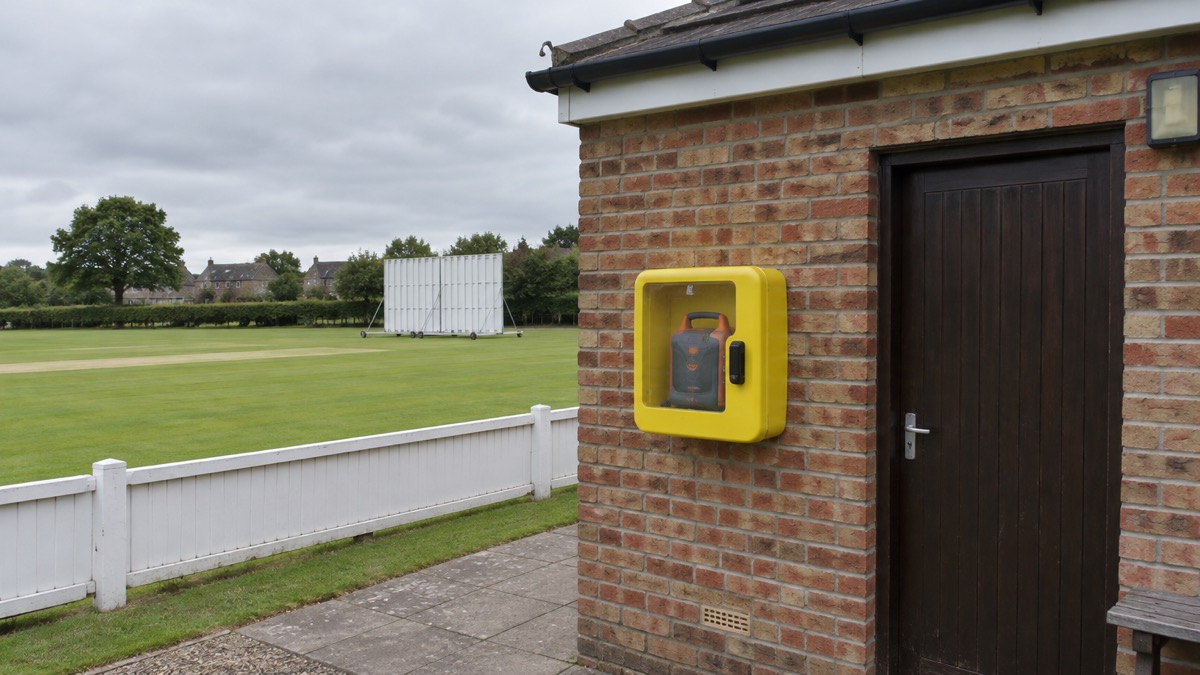
If the device is mounted outdoors in a public place, the cabinet matters as much as the defibrillator. Defib Store lists the 360P with a locked outdoor cabinet in yellow4, and our comparison of indoor and outdoor defibrillator cabinets covers which suits a site. If it is in a locked cabinet, how to get the code for a locked defibrillator cabinet explains the access arrangements. Whoever looks after it should work through our defibrillator guardian checklist.
Training, the trainer unit and software updates
You do not need to be trained to use the 360P, but familiarity helps. HeartSine publishes training videos covering setting up the SAM 360P, using it on an adult, using it on a child, and maintaining it3. Watching them once, and again when the device arrives, is a reasonable household routine. They sit alongside, not instead of, a first aid course: our guide to first aid courses covers types and length, and learning CPR free online covers free options.
For groups that want to practise hands-on, there is a trainer. The HeartSine Samaritan PAD 360P Trainer is a training defibrillator unit that helps trainees become familiar with the unique features and functions of the 360P7. It comes with a training unit, a training Pad-Pak, a wireless remote control and a user manual7. It is for practice only. Keep it clearly separate from a working device so nobody grabs the trainer in a real emergency.
The 360P also has field upgradeable software2, which means its software can be updated without replacing the unit. That is a matter for the maker and its service arrangements rather than something a household does itself. Keep the serial number and paperwork to hand, and follow the maker's instructions when an update is offered.
The 360P runs field upgradeable software2, so updates can be applied in the field rather than the unit being returned. The maker publishes training videos covering set up, use on an adult, use on a child and maintenance6, which are worth watching before you rely on the device.
Where to get help and what to do next
If someone collapses, call 999 first. The ambulance service will talk you through CPR and tell you where the nearest public defibrillator is; our guide to public access defibrillators explains how to find one, and how ambulance services prioritise 999 calls explains what happens after you ring. If you are helping someone and want to protect yourself, protecting yourself when helping covers gloves and masks.
For a household thinking about buying, the practical steps are:
- Decide where the device will live and who will check it.
- Ask the supplier for the latest delivery time, given that Defib Store expects stock before the end of 20264.
- Book a first aid course, or at least watch the maker's training videos6.
- Put the Pad-Pak expiry date in your household calendar.
- Tell the neighbours. A defibrillator that only one household knows about helps fewer people.
The first aid at home section covers the rest of the household picture, from first aid kits to preventing accidents at home. For the wider emergency plan a defibrillator sits inside, start with getting started and the health emergencies guide.
Sources (7)
- HeartSine samaritan PAD 360P product page, HeartSine, 2026-11-02
- HeartSine products, HeartSine, 2026-11-02
- AED training videos, HeartSine, 2026-11-02
- HeartSine Samaritan PAD 360P Defibrillator and Locked Outdoor Cabinet Package, Yellow, Defib Store, 2026-10-29
- Exploring HeartSine's innovative defibrillator range, Defibshop, 2026-10-29
- HeartSine SAM 350P, 360P and 450P user manual, HeartSine, 2022
- Samaritan PAD 360P Trainer with remote control, Defibshop, 2026-10-29

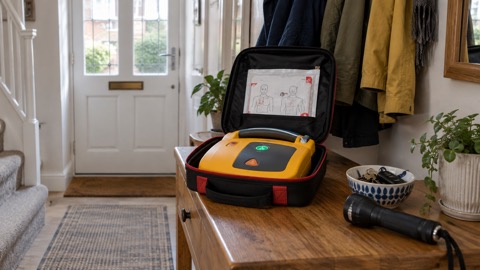 HeartSine samaritan PAD 350P
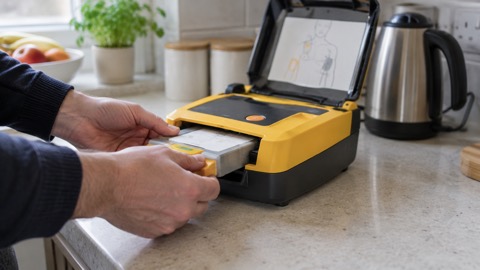 HeartSine Pad-Pak
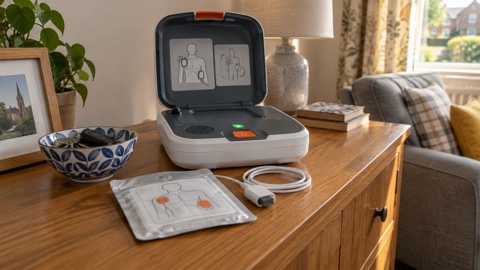 Stryker LIFEPAK CR2
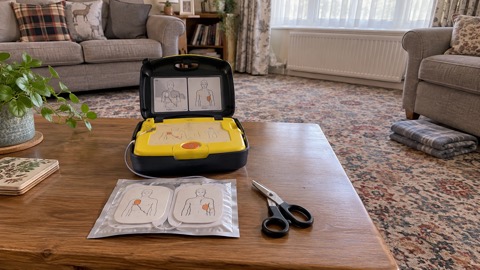 ZOLL AED 3 Defibrillator
 ZOLL AED Plus Defibrillator
 Cardiac Science Powerheart G5
 Philips HeartStart FRx AED
 LifeVac Anti-Choking Travel Kit
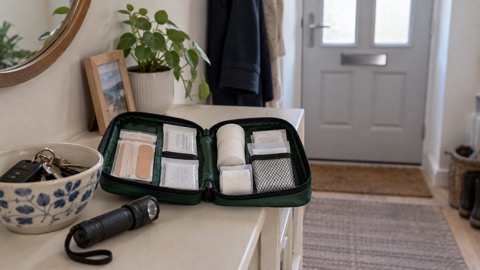 Wallace Cameron Family Kit
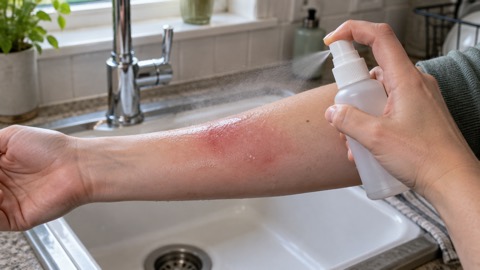 Burnshield Hydrogel Spray 125ml
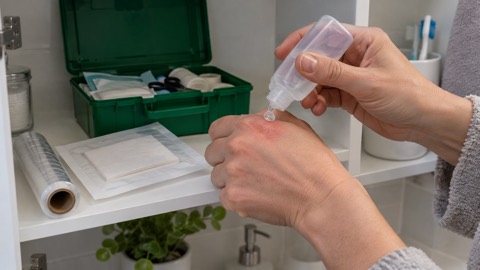 Burnshield Hydrogel Gel 50ml
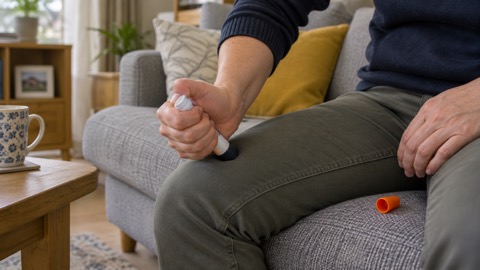 EpiPen Adrenaline Auto-Injector