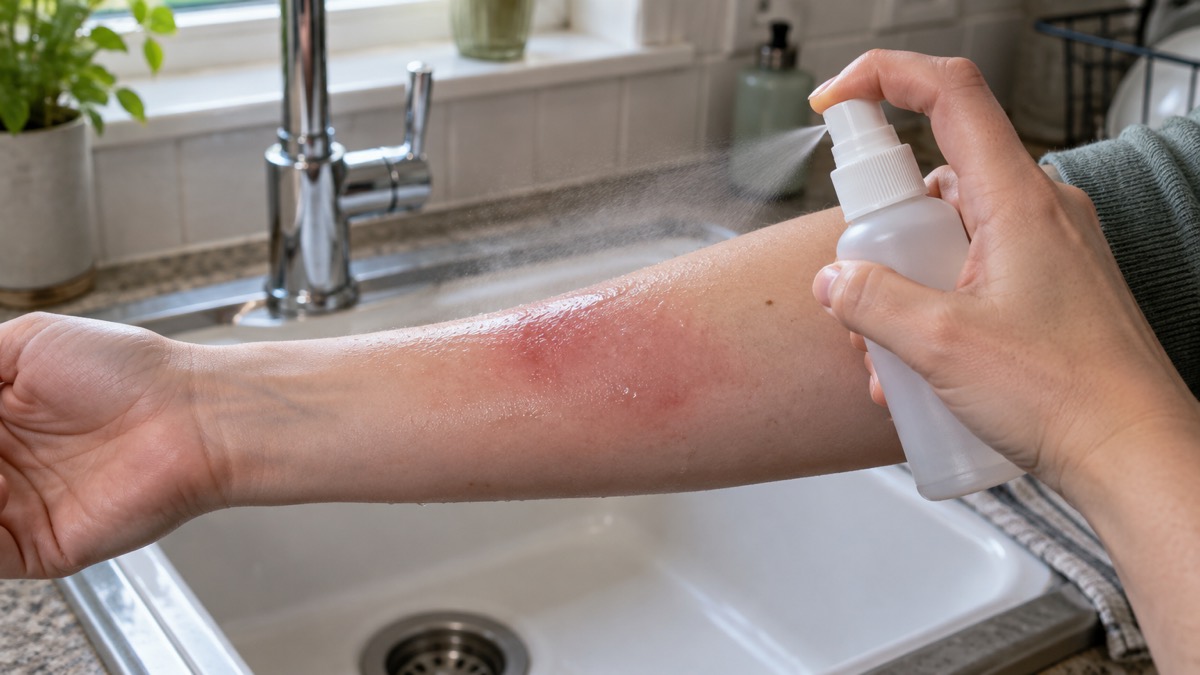
Burnshield Hydrogel Burn Spray is a sterile hydrogel burn spray in a 125ml bottle, made by Burnshield and sold for minor burns and sunburn1. It is not a substitute for the first and most important step in any burn: cooling the skin under cool running water for 20 minutes, as soon as possible after the injury2. The spray comes after that, to soothe and cover a minor burn while it heals.
The maker lists three ingredients: 1% tea tree oil, 96% purified water and 3% gelling agent1. It is sold alongside a 50ml gel in the same range3. The maker states it is safe for all age groups, including children, and that the hydrogel dries transparently so you can see the wound underneath1.
What it cannot do matters as much as what it can. It does not replace cooling, it does not treat a serious burn, and it does not remove the need to call 111 or go to A&E when a burn is deep, larger than the person's hand, or affects a child under 101. This page sets out what the spray is, how to use it, what to leave alone, and when to get help.
What the spray is and what it contains
Burnshield Hydrogel Burn Spray is a sterile hydrogel in a 125ml spray bottle, which the maker describes as convenient for both emergency and everyday use1. The maker's ingredient list is short and specific: 1% Melaleuca alternifolia, which is tea tree oil, 96% purified water and 3% gelling agent1. The water carries the cooling effect; the gelling agent holds it on the skin; the tea tree oil is the named active ingredient.
The maker states the spray provides a cooling sensation for minor burns and sunburn, and that the hydrogel dries transparently, allowing for easy wound assessment1. That transparency is the practical difference between a gel and a bulky dressing: you can look at the burn without lifting anything off it.
| Specification | Detail |
|---|---|
| Product type | Sterile hydrogel burn spray1 |
| Volume | 125ml1 |
| Range sizes | 125ml spray and 50ml gel1 |
| Ingredients | 1% tea tree oil, 96% purified water, 3% gelling agent1 |
| Intended use | Minor burns and sunburn1 |
| Suitability | Safe for all age groups, including children (maker)1 |
| Appearance as it dries | Transparent, allowing wound assessment (maker)1 |
| Storage | Cool, dry place (maker)1 |
The maker states that Burnshield hydrogel has been trusted and used by UK Emergency Services for over twenty years, and lists consumer, industrial, military, police and traffic services, correctional services, first aid kit manufacturers, and hospital, EMS and fire departments among the sectors that use its dressings1. That is the maker's account of its own product's history. It tells you the format is well established; it does not tell you that a burn at home is less serious than it is.
How to apply it to a minor burn or sunburn
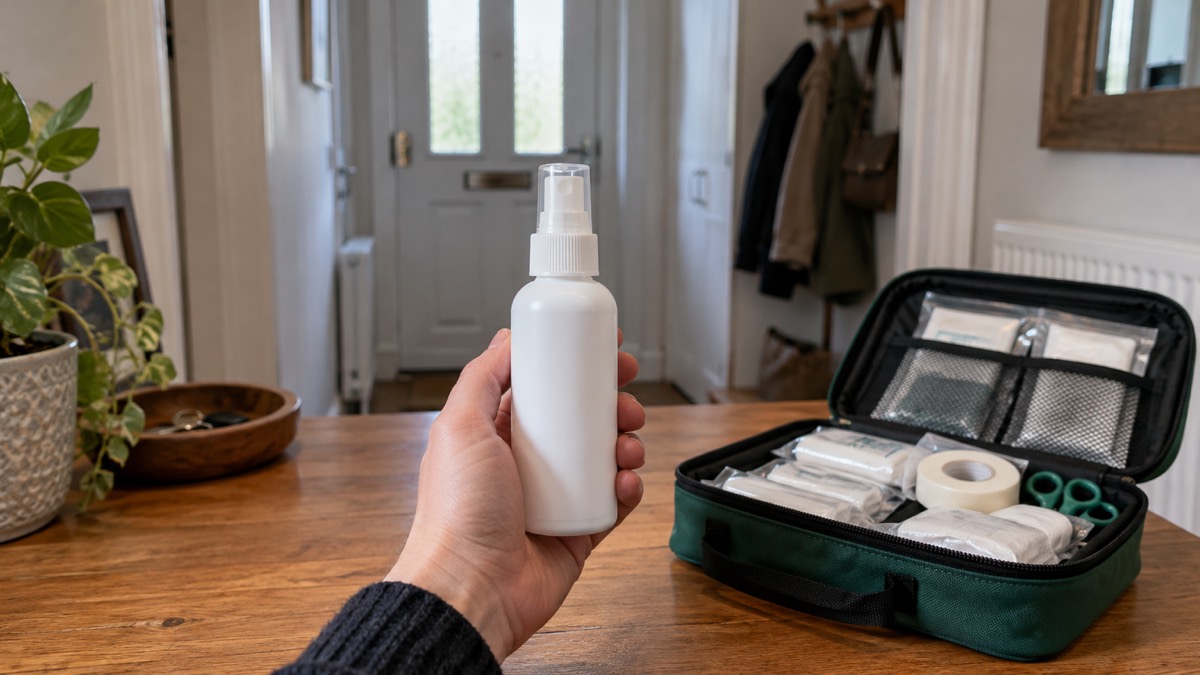
Cooling comes first, and the spray comes after. NHS Scotland advises cooling the burn with cold running water for 20 minutes, as soon as possible after the injury2. The NHS advises 20 to 30 minutes under cool running water for a child's burn or scald, to reduce the heat in the skin4. The fire and rescue service advice is the same: cool the burn under cold running water for at least 20 minutes5. The Northern Burn Care Network puts it plainly: cool the burn down immediately, placing the affected area in cool water or under a gently running cold tap for at least 20 minutes6.
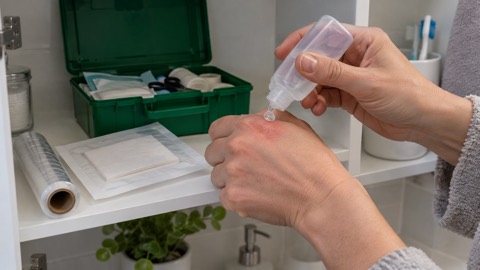
Once the burn has been cooled, the maker's instruction is to apply a generous amount of Burnshield Hydrogel directly onto the affected area, covering the surrounding skin as well1. For sunburn, NHS Wales advises sponging sore skin with cool water or taking a cool shower or bath, then applying a soothing after sun cream or spray7. The NHS adds that you should get out of the sun as soon as possible, cool the skin with a cool shower, bath or damp towel, apply aftersun cream or spray, drink plenty of water, and cover sunburnt skin from direct sunlight until healed8.
A few practical points from official guidance:
- Remove jewellery, rings and watches from the area before it begins to swell9.
- If you need to cover a minor burn, use a non-adhesive dressing for temporary coverage; burns can be left uncovered unless they are in a place where it is hard to keep clean6.
- Cling film, loosely wrapped, or a clean cloth or non-adherent dressing if cling film is not available, is the standard covering advice from burn care services10.
- Keep the area covered with cotton clothing and use a high-factor sun cream on healed skin2.
What not to do: blisters, debris and creams
The most common mistakes with a burn are made in the first few minutes, and most of them involve doing too much rather than too little.
Do not burst blisters. NHS Scotland advises keeping a minor burn clean and not bursting any blisters that form2. The NHS adds that you should not burst blisters as this can lead to infection, and that they will burst naturally4. The Northern Burn Care Network is equally direct: never burst or pop any blisters on a burn, as this can lead to an infection6. The South West Burn Care Network says the same: do not burst blisters or tamper with the burn10.
Do not pull at anything stuck to the burn. NHS Scotland advises not trying to remove anything that is stuck to the burnt skin, as this could cause more damage2. The maker's own instruction matches: do not burst any blisters or disturb the wound, and avoid removing debris or substances firmly stuck to the wound1.
Do not apply creams or greasy substances to a healing burn. NHS Scotland advises keeping the area clean and not applying any creams or greasy substances while the skin heals2. For sunburn specifically, the NHS advises against petroleum jelly, ice or ice packs, popping blisters, scratching or removing peeling skin, and tight-fitting clothes over sunburnt skin8.
Chemical burns: flush with water for 15 to 20 minutes first
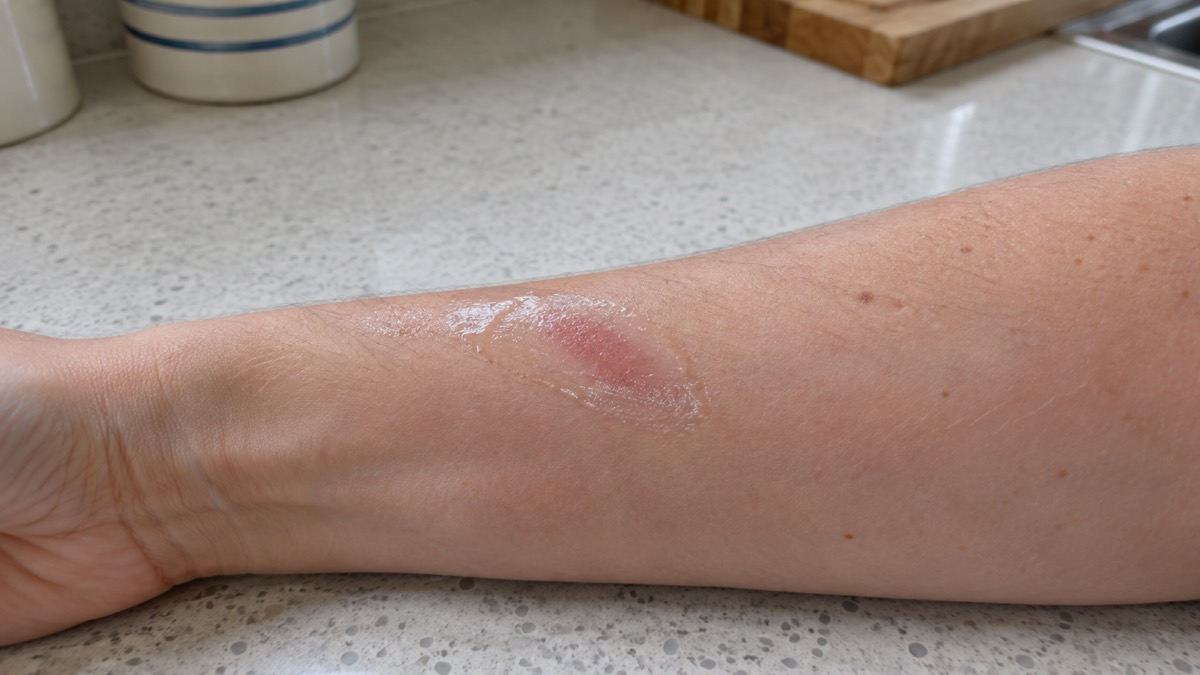
A chemical burn is not a burn you treat with a soothing spray and carry on. The chemical has to be removed first, and the maker's own instruction is to flush the affected area with water for 15 to 20 minutes to neutralise acids or alkalis1. If the eyes are affected, the maker advises flushing them for an additional 3 to 5 minutes1.
Official guidance agrees on the flushing and adds a step for dry chemicals. The Mid and South Essex NHS Foundation Trust advises rinsing the affected area thoroughly with cool water to remove the chemical, or brushing with powder11. NHS 111 Wales advises that if the chemical is dry, you should brush it off the skin, then use running water to remove any traces of the chemical from the burnt area9. For a chemical in the eye, NHS guidance is to flush the eye immediately with clean, cold water for at least 20 minutes, then lightly cover the eye to stop yourself rubbing it12.
Hydrofluoric acid is the exception that needs more than first aid. The maker advises that for hydrofluoric acid burns you should consult a healthcare professional for additional steps1. Flush as instructed and get professional advice.
Electrical burns: switch off the power before you touch anyone
An electrical burn is caused by high or low voltage currents, or by lightning strikes13. The first action is not the spray; it is making the scene safe. The maker's own advice for electrical burns is to turn off the power source and remove the person from the source, then check for both entry and exit points of the electrical arc or flash1.
The Health and Safety Executive sets out why this matters: the main hazards of working with electricity are electric shock and burns from contact with live parts, injury from exposure to arcing, fire from faulty electrical equipment or installations, and explosion caused by unsuitable apparatus14. If there is an electrical fire, North Wales Fire and Rescue Service advises pulling the plug out or switching off the power at the fuse box if it is safe to do so, which can sometimes stop the fire immediately15.
For a low-voltage source, up to 220 to 240 volts, such as a domestic supply, NHS 111 Wales advises safely switching off the power supply or removing the person using a material that does not conduct electricity, such as a wooden stick or chair9. For a high-voltage source of 1,000 volts or more, do not approach the person at all9. Anyone with an electrical burn should seek immediate medical attention at an A&E department9.
When a burn needs medical help
The spray is for minor burns. Knowing where minor ends is the most useful thing on this page.
The maker advises seeking immediate medical care for burns larger than the size of the affected person's hand, or for any deep burns that cause white or charred skin1. The maker also advises that children under the age of 10 should seek medical attention for burns, along with individuals with chronic health conditions such as heart, lung or liver disease, or diabetes1. The maker lists signs of shock, including cold, clammy skin, sweating, rapid shallow breathing, weakness or dizziness, as a reason to seek emergency care1.
Official guidance is consistent that a severe burn needs help quickly9. If a burn injury is serious or meets the criteria for specialised burn care, the emergency doctor will contact the Specialised Burns Service for advice and possible transfer to the most appropriate burn service6. That is a decision for clinicians, but it starts with you deciding to call.
| Situation | What to do |
|---|---|
| Burn larger than the person's hand | Seek immediate medical care (maker)1 |
| Deep burn with white or charred skin | Seek immediate medical care (maker)1 |
| Child under 10 with a burn | Seek medical attention (maker)1 |
| Signs of shock: cold, clammy skin, rapid shallow breathing, weakness, dizziness | Emergency care (maker)1 |
| Electrical burn | Immediate attention at A&E9 |
| Smoke or fume inhalation with symptoms | Go to hospital (maker)1 |
Smoke inhalation is its own emergency. NHS guidance lists coughing, a sore throat, difficulty breathing and facial burns, and notes that some symptoms may be delayed16. The maker advises that anyone who has inhaled smoke or fumes and shows symptoms such as coughing, sore throat, difficulty breathing, singed nasal hair or facial burns should go to hospital1. Get the person away from the smoke first, and call 999 if there is a fire.
Storing the spray in a home first aid kit
A burn spray is only useful if it is where you can reach it, in date, and stored so it still works when you need it. The maker's storage instruction is simple: store in a cool, dry place1.
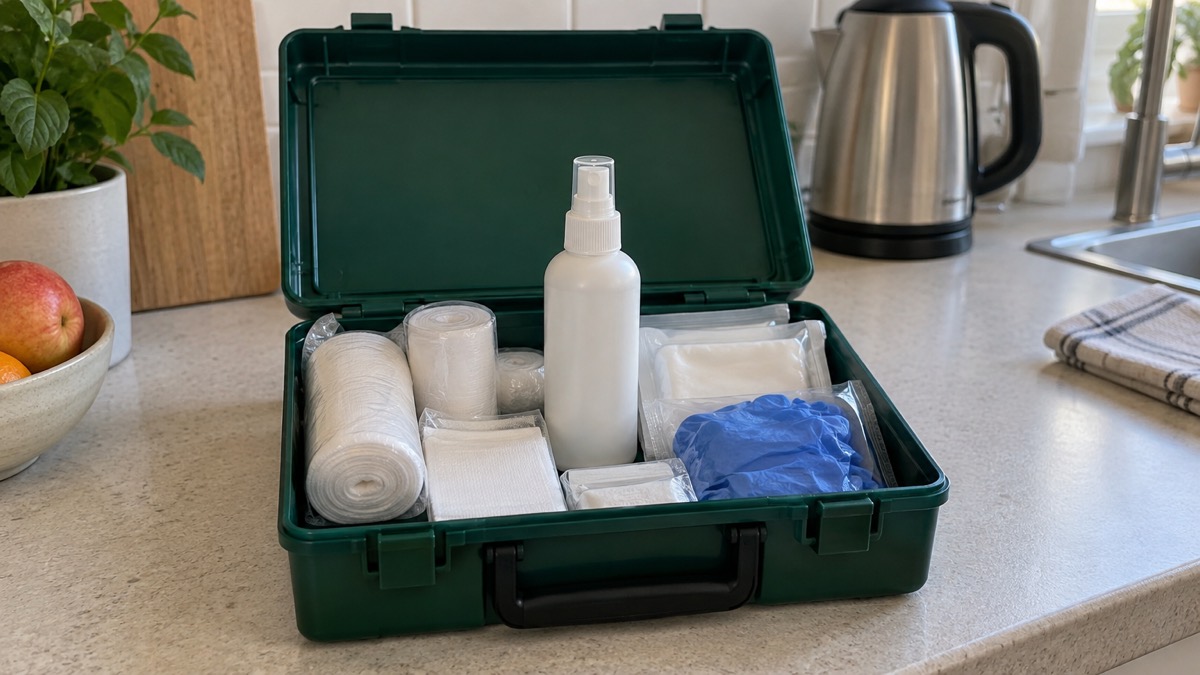
Official advice on first aid kits is consistent across the UK. A first aid kit should be locked and kept in a cool, dry place out of the reach of children17. You can keep a home or car first aid kit by buying a ready-made one or putting together your own in a clean, waterproof box18. Household emergency kit guidance from councils across the UK lists a first aid kit as a core item, kept in a safe place at home where you can reach it easily, in a waterproof bag19.
A practical checklist for the kit:
- A first aid kit in a clean, waterproof box, locked and out of reach of children18
- The Burnshield spray stored cool and dry, as the maker instructs1
- Spare medication, where anyone in the household takes it23
- A non-adhesive dressing for temporary coverage of a minor burn6
- Cling film, which burn care services advise wrapping loosely around a burn10
Sources (24)
- Burnshield Hydrogel Burn Spray 125ml, Steroplast, 2026-10-28
- Burns and scalds, NHS inform, 2026-07-31
- Burnshield Hydrogel Burn Gel 50ml, Steroplast, 2026-10-28
- What to do if your child has an accident, NHS, 2025-12-18
- Burn awareness, Cheshire Fire and Rescue Service, 2026-05-20
- First aid, Northern Burn Care Network, 2022-03-11
- Sun and heat safety, NHS Wales, 2026-10-29
- Staying safe over the summer, Healthier Together, 2026-10-29
- Burns and scalds, NHS 111 Wales, 2021
- First Aid for Burns and Scalds, South West Burn Care Network, 2026-10-28
- Burns prevention and tips, Mid and South Essex NHS Foundation Trust, 2026-10-25
- Poisoning and accidental swallowing, Healthier Together, 2026-10-29
- Burns first aid, NHS inform, 2026-07-24
- Electricity and electrical equipment hazards, Health and Safety Executive, 2026
- Looking after the electrics, North Wales Fire and Rescue Service, 2026-10-25
- Burns and Scalds - Andaman Surgery, Andaman Surgery (NHS)
- Accidents, first aid and treatments, Collingwood Surgery, 2026-10-28
- What should I keep in my first aid kit?, NHS, 2026-10-25
- Get prepared, Carmarthenshire County Council, 2026-10-25
- Health advice for public holidays, NHS inform, 2026-09-15
- Preparing for an emergency, Nottinghamshire County Council, 2026-10-29
- Be prepared, Argyll and Bute Council, 2026
- Planning for an emergency kit, Wiltshire Council, 2026-10-29
- Get help and advice in an emergency, Lincolnshire County Council, 2026-10-29
 Burnshield Hydrogel Gel 50ml