Use a sunscreen with a sun protection factor (SPF) of at least 30, and make sure it also carries 4 or 5 star UVA protection. That is the NHS recommendation for adults and children alike, repeated across official guidance from England, Wales, Scotland and Northern Ireland1. Apply it generously before you go out, reapply it frequently, and reapply it straight after swimming, sweating or towelling dry1.
Sunscreen alone is not enough. The Welsh Ambulance Service is blunt about it: do not rely on sunscreen alone to protect yourself from the sun2. Combine it with clothing, a hat, sunglasses and time in the shade, especially between 11am and 3pm, when UV levels are at their highest1. And remember that this is a UK problem, not just a holiday one: the sun's rays can be strong enough to burn in the UK from around April to September, and in many cases sunburn actually happens here at home, often when people are out and about3.
This page sets out what the official advice says for families: which sunscreen to choose and how to use it, how to cover up, how the UV index works and where its forecasts fall short, how to recognise and treat sunburn, and when to stop treating it at home and get medical help.
What SPF sunscreen should I use?
The NHS recommends a sunscreen with a sun protection factor (SPF) of at least 30 to protect against UVB, and at least 4 star UVA protection1. The two ratings do different jobs, and you need both. SPF measures protection against UVB, the radiation that burns the outer layer of skin. The star rating measures protection against UVA, which penetrates deeper and contributes to skin ageing and skin cancer. Northern Ireland's official advice puts it the same way: experts recommend a sunscreen with an SPF of at least 30 and a UVA rating of four or five stars6.
Choose a broad-spectrum brand, one that protects against both UVA and UVB rays7. Most sunscreen designed for children has an SPF of between 30 and 50 and is effective against both UVA and UVB, so a child-specific product is not essential as long as the ratings are right8.
How you apply it matters as much as the number on the bottle. Apply sunscreen generously and reapply it frequently, especially after swimming or towelling1. Guy's and St Thomas' NHS Foundation Trust advises applying sun cream before going outside in the sun, not once you are already out in it9. For babies, NHS guidance is to use plenty of sunscreen and apply it regularly, every 2 hours, reapplying immediately after swimming or sweating10. Check the expiry date too: Warwickshire County Council's summer advice is to make sure sunscreen is at least factor 30, not past its expiry date, and applied regularly when outdoors11.
You will see lower figures in some places. A few local resilience and medicine-cabinet guides list SPF 15 or higher as a minimum12, and NI Direct's first aid guidance suggests sun block of factor 25 or higher for children14. These are not wrong, but they are the floor, not the target. Where the NHS speaks directly, its recommendation is SPF 30 with 4 or 5 star UVA, and that is the figure to shop for1.
Cover up and stay in the shade as well as using sunscreen
Sunscreen is one layer of protection among three. The Met Office's advice is to protect yourself and your family from sunburn by using a combination of shade, clothing and at least SPF 30 sunscreen3. The Welsh Ambulance Service says the same: do not rely on sunscreen alone; wear suitable clothing and spend time in the shade when the sun is at its hottest2.
Timing matters most of all. UK Health Security Agency guidance for hot weather is to try to stay in the shade between 11am and 3pm, when UV levels are highest, and to try to avoid direct sunlight in that window1. NI Direct's heat exhaustion advice matches it: keep out of the sun between 11.00 am and 3.00 pm15.
What to wear, from the official guidance:
- Lightweight, loose-fitting, light-coloured, close-weave clothes1
- A wide-brimmed hat, or a peaked cap, to protect the face and head1
- Wraparound or wide-armed sunglasses, to reduce UV exposure to the eyes1
- Sunscreen on the areas clothing cannot cover: face, ears, feet and backs of hands17
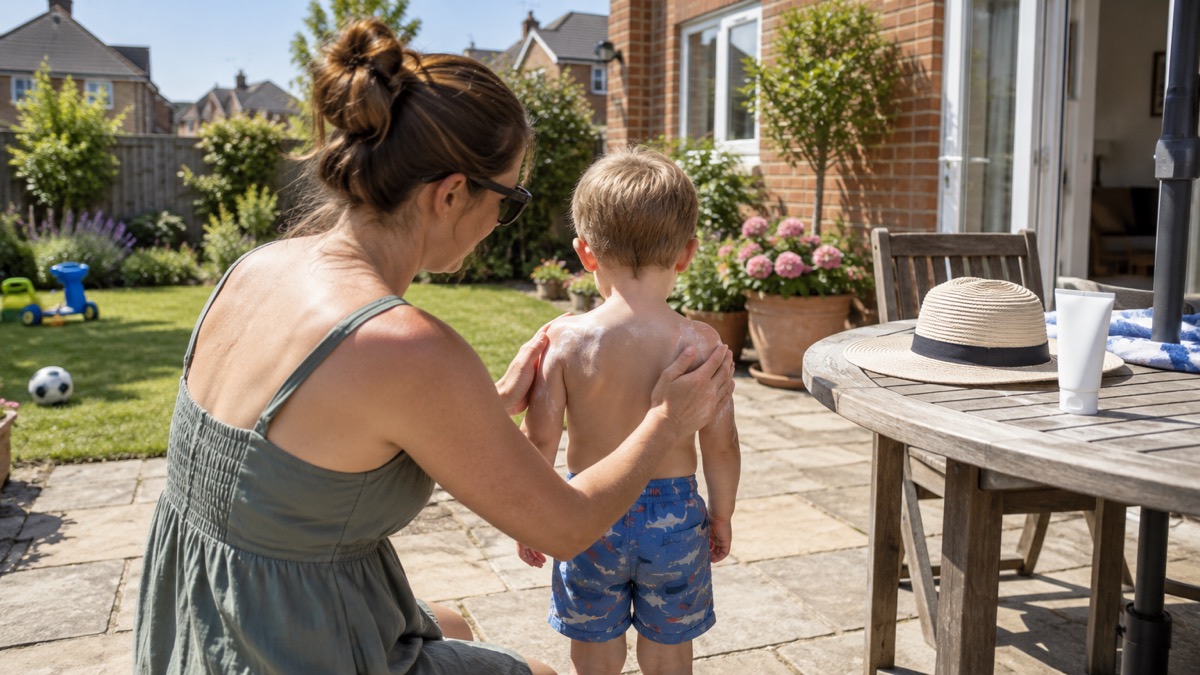
For children, NHS guidance for the UK is specific about the season as well as the hours: from March to October, children should cover up with suitable clothing, spend time in the shade particularly from 11am to 3pm, and wear at least SPF30 sunscreen applied to areas not protected by clothing17. Government guidance for schools and early years settings in England adds that children should have sunblock or broad-band sunscreens with high protection factors, of at least SPF 30 and a UVA rating of 4 or more stars18.
If you are planning around hot weather more broadly, our heatwaves and drought guide covers the whole picture, and how to keep your home cool in hot weather helps with the hours when you are indoors.
You can burn in the UK, not just on holiday
NHS guidance is unambiguous on this point:
The Met Office adds the detail on timing: the sun's rays can be strong enough to burn in the UK from around April to September3. That is a six-month window, far longer than most people assume, and it covers the school run, the allotment, the weekend walk and the sports field as much as the beach. In many cases sunburn actually happens in the UK, often when people are out and about rather than deliberately sunbathing3.
Cloud changes less than people expect. The sun is often strong enough in the UK to cause sunburn even when it is cloudy1, and the UV index can be strong through cloud even when the sun is not directly shining19. So the habit worth building is not "sunscreen on sunny days" but "sunscreen on exposed skin from spring to autumn", with NHS 111 Wales guidance noting you should cover exposed parts of your child's skin with sunscreen even on cloudy or overcast days8.
Temperature is a poor guide too. The UV index can be high at many times of the year; it does not have to be hot, and there may be cloud cover20. A cool, bright April day can carry enough UV to burn unprotected skin.
How UV damages skin and raises the risk of skin cancer
Sunburn occurs when your skin is overexposed to UV radiation20. The damage is not just to the surface. The Met Office explains the mechanism: excessive UV radiation directly damages the DNA in your skin cells, and if that DNA does not correctly repair itself, this can lead to skin cancer20. Continued overexposure dramatically increases the risk of developing skin cancer20.
That is why the official advice treats every burn as meaningful, not just the severe ones. Even brief exposure to the sun can cause sunburn and increase your risk of skin cancer21. Overexposure to the sun is dangerous in a range of ways, with effects ranging from mild sunburn to skin cancer, and it does not have to be hot for the UV index to be high19.
There is no safe way to acquire a tan, and a tan does not protect your skin from the sun's harmful effects4. This matters for teenagers in particular, who may see tanning as protective or harmless; the guidance says otherwise, and the DNA damage that leads to skin cancer accumates across years of exposure.
Checking the UV index forecast
The UV index is a measure of the strength of the sun's ultraviolet radiation, and the Met Office publishes a UV forecast for the UK alongside its weather forecasts. It is the most useful single check before a day outdoors, because it tells you the risk directly rather than leaving you to guess from temperature or cloud.
Two things are worth knowing about how the forecast is made, because they change how you should use it.
First, the UV index can be high at many times of the year; it does not have to be hot, and there may be cloud cover20. Check it from spring onwards, not only during heatwaves.
Second, the forecast has a known limitation around ozone. The Met Office's UV model currently accounts for sun angle and forecast cloud amounts, but uses a "climatological" value, meaning the average concentration for the time of year over the UK, to estimate the total ozone concentration3. During low ozone events, the UV index could be higher than currently indicated in the forecasts, particularly if forecast cloud amounts are low, and the forecast can still be lower than actual levels despite the Met Office rounding up its UV values3. The Met Office is exploring ways to incorporate low ozone events into its models to improve the UV index forecast3. Until then, treat the forecast as a floor rather than a ceiling: protect skin on moderate-forecast days as well as high ones.
During heatwaves, the UV risk sits alongside heat itself. Our pages on heat-health alerts and heat exhaustion and heatstroke cover the heat side of a hot day.
Sunburn in babies and young children
Young skin needs the same protection as adult skin, applied more carefully. NHS guidance for babies is to apply a sunscreen with an SPF of at least 30 that protects against both UVA and UVB rays, and to reapply it regularly10. If your baby is 6 months or over, apply a sunscreen with a sun protection factor (SPF) of at least 30 to their skin10. Use plenty of it and apply it regularly, every 2 hours, reapplying immediately after swimming or sweating10.
For children, the same SPF 30 minimum applies, with UVA and UVB protection and regular reapplication23. Most sunscreen designed for children has an SPF of between 30 and 50 and is effective against UVA and UVB8. From March to October in the UK, children should cover up with suitable clothing, spend time in the shade particularly from 11am to 3pm, and have sunscreen applied to the areas clothing does not cover, such as the face, ears, feet and backs of hands17.
Children burn without noticing, because they are busy. NHS guidance for children lists what sunburn looks like: the skin may feel hot to touch, feel sore or painful, and flake or peel a few days afterwards; severe sunburn may blister23. If a child under 5 has sunburn, call your GP, NHS 111 or 999 to seek medical advice, or if you are worried at any age24. Our page on keeping babies and young children safe in hot weather covers the wider heat risks for the youngest, and how to treat sunburn, including in children goes deeper on treatment.
Signs of sunburn: what to look for
Sunburn does not always announce itself at the time. Most people initially experience mild symptoms, such as hot red skin and fatigue20. NHS guidance for children adds that the skin may feel hot to touch, feel sore or painful, and flake or peel a few days after the sunburn, and that severe sunburn may blister23. Being exposed to the sun for too long can cause painful sunburn25.
The practical point for a household is that the person who "feels fine" at 2pm may be in pain by the evening. Do not wait for symptoms before acting: get children out of the sun at the first sign of reddening, and treat the day's exposure as done.
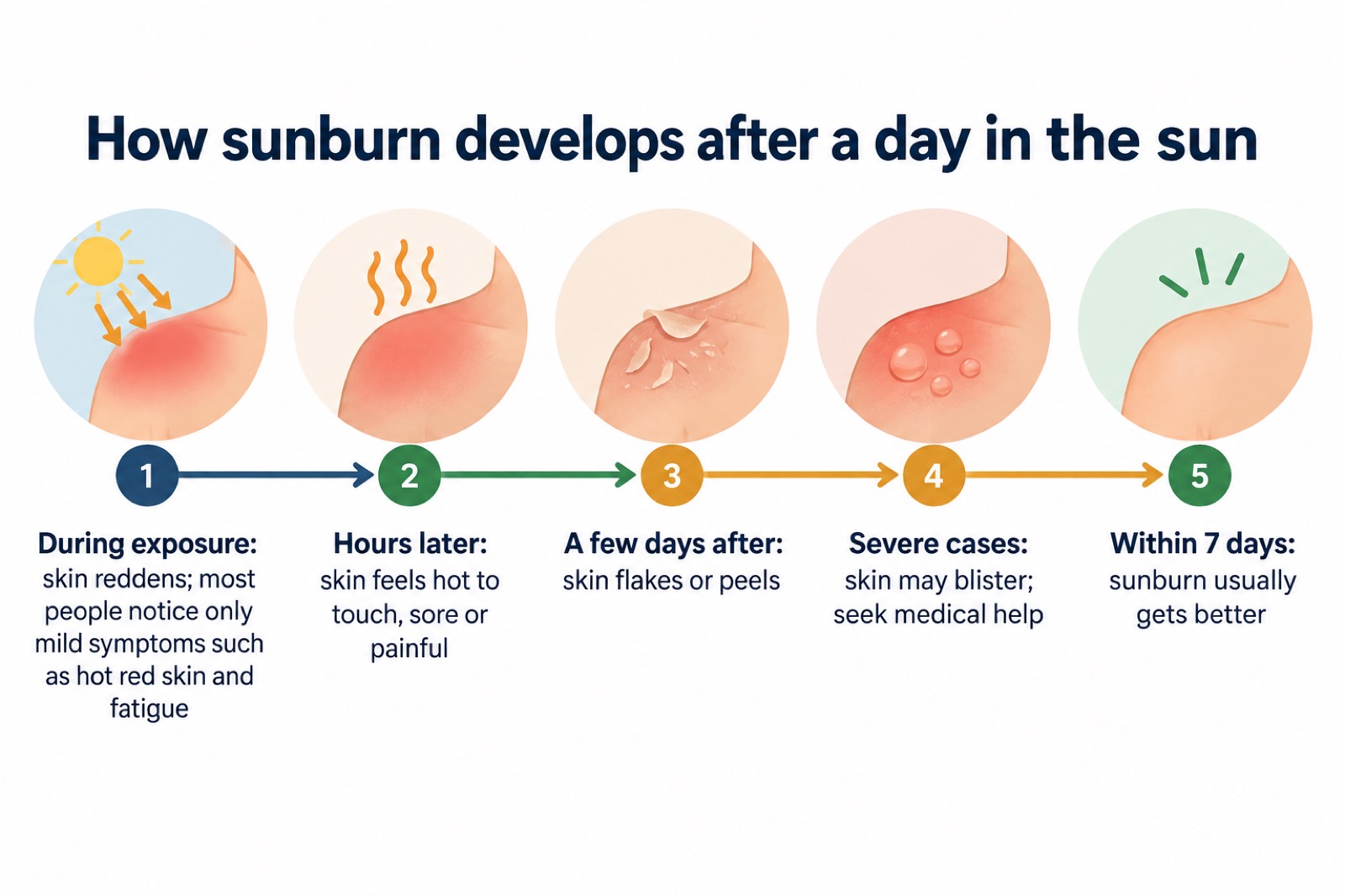
Sunburn usually gets better in 7 days5. Flaking and peeling in that window are normal; blisters, swelling and feeling generally unwell are not, and they are the signals to move from self-care to medical help.
Treating sunburn: cool the skin
The first-aid sequence from NHS guidance, in order:
- Get out of the sun as soon as possible23
- Cool the skin with a cool shower, bath or damp towel23
- Apply after sun cream or spray23
- Drink plenty of water23
- Take painkillers such as paracetamol or ibuprofen if needed23
- Cover sunburnt skin from direct sunlight until it has healed23
On cooling, the guidance gives slightly different figures, and it is worth knowing both. NHS 111 Wales advises taking a cool bath or shower for 10 minutes to cool down the burnt area of skin8. Other NHS burns guidance goes further: cool the burn with cool or lukewarm running water for at least 10 minutes24, or for 20 to 30 minutes26. The Welsh Ambulance Service offers the same range of methods for mild sunburn treated at home: cooling the skin with a cold bath or shower, sponging it with cold water, or holding a cold flannel to it16. Then apply soothing after sun cream or spray2.
After sun cream or spray is part of the standard treatment, not an optional extra: sponge sore skin with cool water or take a cool shower or bath, then apply soothing after sun cream or spray2. It soothes the skin but does not reverse the underlying damage, which is why prevention carries the weight in all of this guidance.
Once burnt, the skin needs protection while it heals. NHS Inform's burns guidance is to keep the area covered with cotton clothing, wear a peaked cap or wide-brimmed hat if the burn is on your face, and use sun cream with a high sun protection factor27. Burnt skin is more vulnerable to further damage, so the recovery period is not a licence to skip the sunscreen.
Pain relief: paracetamol or ibuprofen, never aspirin under 16
For the pain of sunburn, NHS guidance is straightforward: take painkillers such as paracetamol or ibuprofen23. NHS 111 Wales says the same: if you have any pain, paracetamol or ibuprofen should help relieve it8.
This matters at the point of use, not just at the point of purchase: many household medicine cabinets contain aspirin alongside paracetamol and ibuprofen, and on a hot, painful evening it is easy to reach for the wrong packet. Leicester, Leicestershire and Rutland's NHS guidance on what to keep in your medicines box makes the distinction explicit: pain relief means paracetamol, ibuprofen, and aspirin, which mustn't be given to children under 1628.
While you are treating the pain, keep up the fluids. Drinking plenty of water is part of the sunburn treatment sequence23, and it matters because sunburn and heat illness often arrive together on the same day. Our page on dehydration in hot weather covers the signs that someone is not drinking enough.
When sunburn needs medical help
Most sunburn can be treated at home, but there are clear thresholds for getting help. The Welsh Ambulance Service's advice: seek medical help if you feel unwell or the skin swells badly or blisters2. NHS guidance adds that you can get help from NHS 111 for advice about a burn or scald at any point where you are unsure26.
For children, the list of red flags is longer. Seek emergency medical care if a child's sunburn causes blisters or is extremely painful, causes facial swelling, covers a large area, or if the child has fever or chills, headache, confusion, faintness, or signs of dehydration such as increased thirst, less pee, or dry eyes and mouth23. And if a child under 5 has sunburn, call your GP, NHS 111 or 999 to seek medical advice, or if you are worried at any age24.
| Situation | What to do |
|---|---|
| Mild sunburn, no blisters, feeling well | Treat at home: cool, after sun, water, paracetamol or ibuprofen23 |
| Skin swells badly or blisters, or you feel unwell | Seek medical help2 |
| Child under 5 with sunburn | Call your GP, NHS 111 or 99924 |
| Child with blisters, extreme pain, facial swelling, large area, fever, chills, headache, confusion, faintness or dehydration signs | Seek emergency medical care23 |
| Unsure at any point | Get help from NHS 111 for advice about a burn or scald26 |
In Wales, you can also visit the NHS 111 Wales website for further advice2. Our page on when to call 999 or NHS 111 for heat illness covers the emergency end of the same spectrum, and heat exhaustion and heatstroke explains the signs that the problem is heat rather than sunburn.
Getting into good habits before the summer
Sun safety works best as a routine rather than a reaction. The recurring advice across every official source is the same small set of habits: sunscreen of at least SPF 30 with 4 or 5 star UVA protection, applied generously before going out and reapplied every couple of hours and after swimming1; shade between 11am and 3pm1; clothing, a wide-brimmed hat and wraparound sunglasses1; and a check of the UV forecast, remembering that it can underestimate on low ozone days3.
A few practical checks before the season starts:
- Sunscreen in the cupboard is at least factor 30 and not past its expiry date11
- It carries 4 or 5 star UVA protection and covers both UVA and UVB1
- The medicine cabinet has paracetamol and ibuprofen, and aspirin is kept away from children under 1628
- After sun cream or spray is in stock for treatment2
- Hats and sunglasses that children will actually wear are to hand1
Scotland's NHS Inform summer health campaign gives the same core instruction: put on sunscreen with at least SPF 3030, and the South Western Ambulance Service NHS Foundation Trust adds simply: wear sunscreen of at least SPF 30 and reapply regularly31. The message does not vary between the four nations, which makes it easy to hold onto: factor 30 or more, four or five stars, twice as much as you think, and shade in the middle of the day.
Sources (31)
- Beat the heat: staying safe in hot weather, UK Health Security Agency, 2026-07-21
- Sun and heat safety advice, Welsh Ambulance Service NHS Trust, 2026-10-29
- UV levels and sunburn risk in the UK, Met Office, 2026-10-29
- How to cope in hot weather, NHS North West London, 2026-10-29
- Keeping your child safe in summer, Healthier Together NHS, 2026-10-28
- Hot weather advice, nidirect (Northern Ireland government), 2026-10-05
- Heat Health Risk: advice note for Wales, Public Health Wales, 2023-07-03
- Burns and scalds, NHS 111 Wales, 2021
- Heatwave advice, Guy's and St Thomas' NHS Foundation Trust, 2026-06
- Safety in the sun for babies, NHS, 2024-09-27
- Staying well in summer, Warwickshire County Council, 2026-10-29
- Heatwave, drought and water shortages, Dorset Prepared, 2026-10-16
- Extreme weather advice, Flintshire County Council, 2026-10-29
- First aid, nidirect (Northern Ireland government), 2025-12-04
- Heat exhaustion and heatstroke, nidirect (Northern Ireland government), 2025-12-02
- Staying safe in the sun, North West Ambulance Service NHS Trust, 2025-03-13
- Summer safety for children, Cheshire and Wirral Partnership NHS Foundation Trust, 2026-10-29
- Looking after children in early years settings in hot weather, UK Health Security Agency, 2024-12-19
- Hot weather and its impacts, Met Office, 2026-10-29
- Sunburn: causes, symptoms and risks, Met Office, 2026-10-29
- Self-care advice, NHS Cornwall and Isles of Scilly Integrated Care Board, 2024-01-11
- Burns and scalds prevention in children, Healthier Together NHS, 2026-10-25
- Staying safe over the summer, Healthier Together NHS, 2026-10-29
- Burns and scalds in children, Cambridgeshire and Peterborough Children's Health NHS, 2026-06-23
- Summer preparedness, NHS Lanarkshire, 2024-06-26
- Burns and scalds: self-help, Andaman Surgery NHS, 2026
- Burns and scalds, NHS Inform Scotland, 2026-07-31
- What should you have in your medicines box, NHS Leicester, Leicestershire and Rutland Integrated Care Board, 2025-09
- What should I keep in my first aid kit, Collingwood Surgery NHS, 2026-10-28
- Summer health campaign, NHS Inform Scotland, 2026-08-06
- Heatwave: how to cope in hot weather, South Western Ambulance Service NHS Foundation Trust, 2026-10-29
 Baby and Child Hot Weather
 Hot Weather Preparation
 Flood Warning Checklist
 Air Pollution and Hay Fever
 Babies and Children in Heat
 Blue-Green Algae Risks
 Dehydration Signs and Prevention
 Evaporative Coolers and Fans
 Electric Fans Guide
 Heat Exhaustion and Heatstroke
 UK Heatwave Definition
 Who Is at Risk in Hot Weather
 Portable Air Conditioners Guide
 Why UK Summers Are Hotter
 Swimming Outdoors Safely