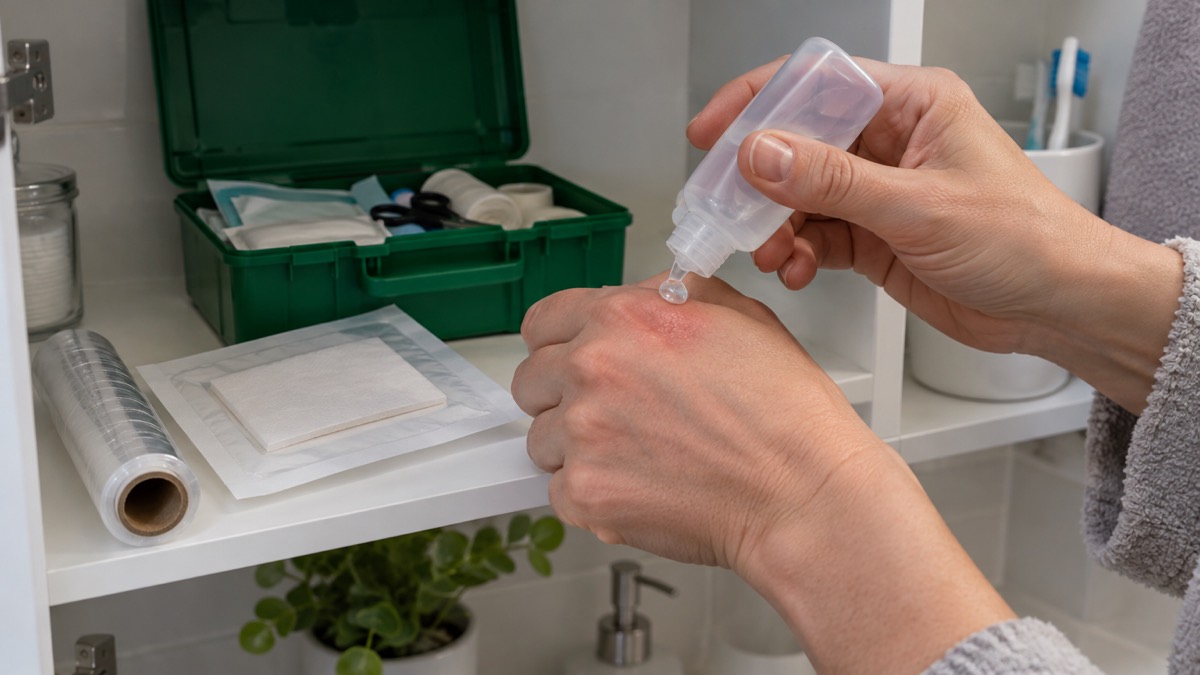
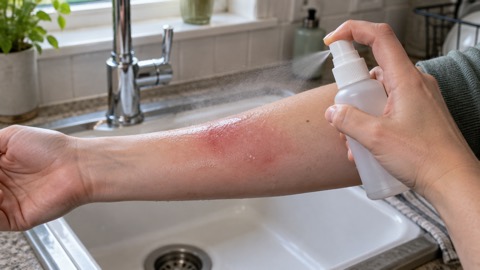
Burnshield Hydrogel Burn Gel is a sterile hydrogel in a 50ml squeeze bottle, made by Burnshield and sold in the UK. The maker lists three ingredients: 96% purified water, 3% gelling agent and 1% tea tree oil1. It is designed to cool a burn, keep the area moist and form a protective barrier over injured skin, and it can go directly on the skin or over a burn dressing1.
Before you reach for the bottle, cool the burn. NHS guidance is to cool a burn with running water and then cover it with cling film or a clean, non-fluffy dressing2. The maker's own instruction is that the gel is designed to cool burn wounds quickly, ideally within the first 24 hours of the injury1. So the gel is a step in burn first aid, not a replacement for cooling, and it does not decide whether a burn needs medical help.
Get help early if the burn is serious. The maker says to seek immediate medical care for burns larger than the size of the affected person's hand, or for any deep burns that cause noticeable damage such as white or charred skin1. NHS guidance adds a list of people who should get medical help straight away, including anyone under 10 and anyone with a condition such as heart, lung or liver disease or diabetes3.
What the 50ml bottle is and what it suits
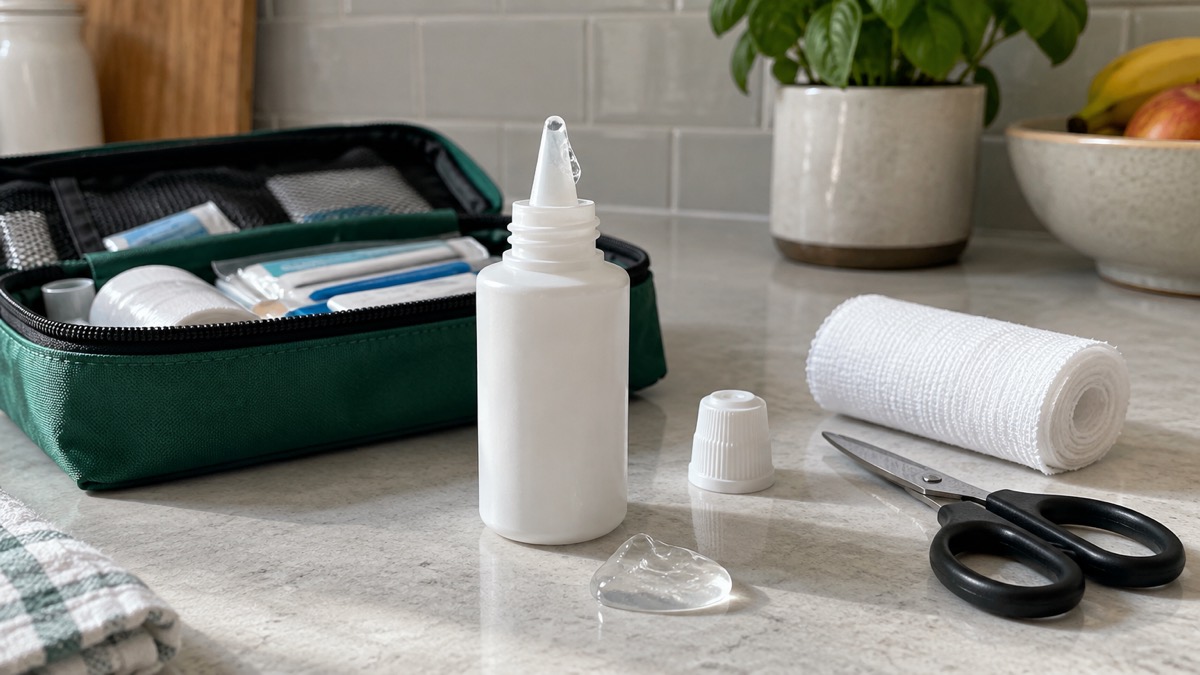
The 50ml squeeze bottle is the smaller of the maker's two gel sizes. The maker lists the gel in 50ml and 125ml bottles, and also describes a 125ml spray1. The 50ml bottle suits a household first aid kit, a car kit or a small workplace kit, where you want a compact bottle that is easy to find and easy to squeeze onto a burn. A larger bottle or the spray may suit a bigger kit or a setting with more people.
The maker states the gel is appropriate for all age groups, including children1. That is the maker's suitability statement for its own product. It does not override the general rule that a child with a burn should be assessed, and it does not change the NHS advice on what to put on a burn, which is covered below.
The maker describes the gel as cooling, calming and moisturising burns and forming a protective barrier over injured areas4. The dressings in the same range use a sterile, water-based gel that the maker says is free from toxins, irritants, fats or greases, with moisturising properties and soothing tea tree oil5. The maker also states that Burnshield products undergo sterilisation by gamma irradiation1.
Specifications at a glance
| Specification | Detail |
|---|---|
| Product type | Sterile hydrogel burn gel in a squeeze bottle1 |
| Volume | 50ml1 |
| Other sizes | 125ml gel bottle and 125ml spray1 |
| Primary ingredients | 96% purified water, 3% gelling agent, 1% tea tree oil1 |
| Sterilisation | Gamma irradiation1 |
| Application | Directly onto the skin or over burn dressings1 |
| Suitability | All age groups, including children1 |
| Cooling window | Ideally within the first 24 hours of the injury1 |
| Storage | Cool, dry place1 |
| Availability | In stock1 |
The maker's product page is the source for every figure in this table. Where a retailer lists a specification differently, the maker's figure is the one to rely on.
Using the gel on a burn: cool first, then cover
Cooling comes first. NHS inform's burns first aid says to remove jewellery, rings, watches and anything else from the area before it begins to swell2. It also says to cover the burn with cling film or a non-fluffy, clean dressing to protect the area6. The maker's gel is then applied on top of that care, not instead of it.
The maker says the gel can be applied directly onto the skin or over burn dressings to help keep the area moist1. For larger burn areas, the maker says to place a Burnshield Dressing over the burn and secure it with a bandage1. The maker also states that if a dressing is kept moist with the hydrogel, it can remain effective for up to 48 hours1.
A simple order of steps, using the maker's instructions alongside official first aid:
- Make the area safe and stop the burning process.
- Cool the burn with running water, following NHS first aid guidance2.
- Remove jewellery, rings and watches before swelling starts2.
- Gently remove tight clothing or jewellery near the area, but do not pull off anything stuck to the wound1.
- Cover the burn with cling film or a clean, non-fluffy dressing7.
- Apply the gel directly to the skin or over the dressing to keep the area moist1.
- For a larger area, place a Burnshield Dressing over the burn and secure it with a bandage1.
- Get medical help if the burn meets any of the criteria below.
The maker's instruction not to burst blisters or disturb the wound is worth repeating because it is easy to get wrong1. NHS guidance on sunburn makes the same point: do not pop blisters, scratch or try to remove peeling skin9. A blister is part of the body's response to a burn, and breaking it opens the door to infection.
Chemical and electrical burns need extra steps first
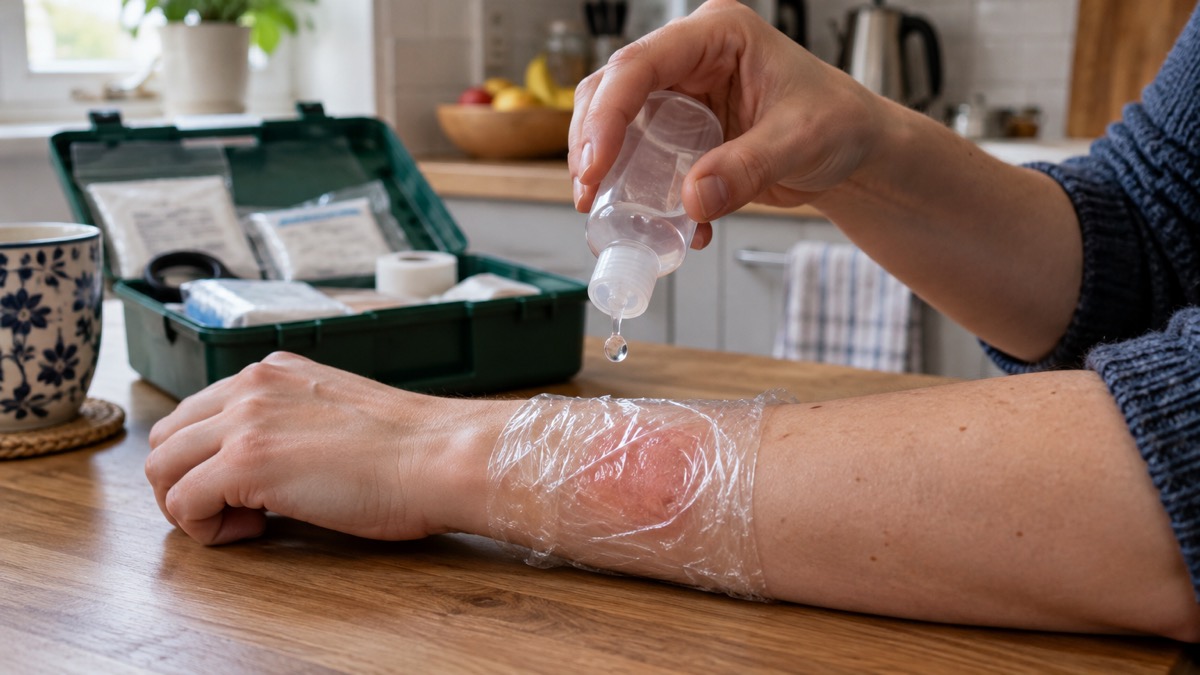
A chemical burn is not a case for gel first. St John Ambulance says to make sure the area around you and the casualty is safe, and to wear protective gloves and, if available, an apron and eye protection too10. The maker's own instruction for a chemical burn is to rinse the affected area with water for 15 to 20 minutes to dilute any acid or alkaline substances1. If eyes are involved, the maker says to rinse for an additional 3 to 5 minutes1.
The maker also says that for hydrofluoric acid burns, professional guidance often involves using calcium gluconate before following the usual protocol1. That is a clinical decision, not something to attempt at home. Treat a hydrofluoric acid burn as an emergency and get help.
For an electrical burn, the maker says to ensure the power source is turned off and remove the individual from the source1. The South West Burn Care Network's first aid guidance says to isolate the electrical source11. Do not touch someone who is still in contact with a live source.
The South West Burn Care Network says burn gel wraps may provide useful analgesia, but should be applied only after first aid cooling11. That is the same order the maker describes: cool, then gel. The UK government's advice on chemical emergencies says blister agents are rapidly absorbed through the skin and eyes, and that symptoms may be delayed12. If you suspect exposure to an industrial chemical, follow the emergency services' instructions and do not rely on a household gel.
When to get medical help straight away
The maker's rule is clear: seek immediate medical care for burns larger than the size of the affected person's hand, or for any deep burns that cause noticeable damage such as white or charred skin1. NHS inform says it is important to get medical help quickly if someone has a severe burn2.
NHS inform also lists people who should get medical help straight away even if the burn looks minor: anyone under the age of 10, anyone with a medical condition such as heart, lung or liver disease or diabetes, anyone with a weakened immune system, anyone with singed nasal hair, and anyone with facial burns13. Cheshire Fire and Rescue Service puts the routes to help simply: call for help if needed, on 999, 111 or your GP14.
| Situation | What to do |
|---|---|
| Minor burn, no red flags | Cool, cover, and use the gel as the maker describes1 |
| Burn larger than the person's hand, or white or charred skin | Seek immediate medical care1 |
| Person under 10, or with heart, lung or liver disease, diabetes or a weakened immune system | Get medical help straight away3 |
| Singed nasal hair or facial burns | Get medical help straight away3 |
| Serious burn | Go to the nearest Emergency Department or dial 99915 |
| Unsure | Call NHS 111 or your GP for advice15 |
The Northern Burn Care Network says that in the case of more serious burns you should visit your nearest Emergency Department or dial 999 as soon as possible, and that if in doubt you should call NHS 111 or your GP for advice15. It also says that if a burn is serious or meets the criteria for specialised burn care, the emergency doctor will contact the specialised burns service for advice and possible transfer15. You do not need to arrange that yourself.
In Wales, the NHS 111 Wales service covers burns and scalds and is the route to advice when you are unsure13. The emergency number is 999 across the UK.
Signs of shock after a burn
A serious burn can be accompanied by shock, and the signs are worth knowing because they change what you do next. NHS inform says that at first shock may cause a fast pulse, pale, cold and clammy skin, and sweating16. As shock develops it can cause rapid, shallow breathing, a weak pulse, grey-blue skin especially inside the lips, weakness and dizziness, nausea and vomiting, and thirst17.
The maker lists symptoms that may indicate a need for emergency care after a burn: cold, clammy skin, sweating, rapid, shallow breathing, and feelings of weakness or dizziness1. St John Ambulance adds restlessness and aggressive behaviour, yawning and gasping for air, and possible unresponsiveness to the signs of shock18.
If you see these signs after a burn, call 999. Keep the person warm and comfortable while you wait, and follow the call handler's instructions. The shock page sets out what to do while help comes.
Storing the bottle in your first aid kit
The maker says to store the gel in a cool, dry place1. Collingwood Surgery's patient guidance goes further for the kit as a whole: your first aid kit should be locked and kept in a cool, dry place out of the reach of children19. That matters with a gel bottle, because a child old enough to open a squeeze bottle is old enough to squeeze it.
A first aid kit is a standard part of an emergency kit. Nottinghamshire County Council lists a first aid kit among the things to prepare for an emergency20, and Lincolnshire County Council lists a first aid kit in its emergency advice21. The NHS also sets out what a household first aid kit should contain22. The first aid kits page covers contents and how to choose one.
A few practical points for the bottle itself:
- Keep it in the kit, not loose in a bathroom cabinet where it can be forgotten.
- Check the expiry date before you rely on it, and replace it when it passes.
- Keep the cap clean and closed so the gel does not dry out or pick up dirt.
- Store it away from heat, as the maker says, so it is in good condition when you need it1.
Where the gel fits in a household kit
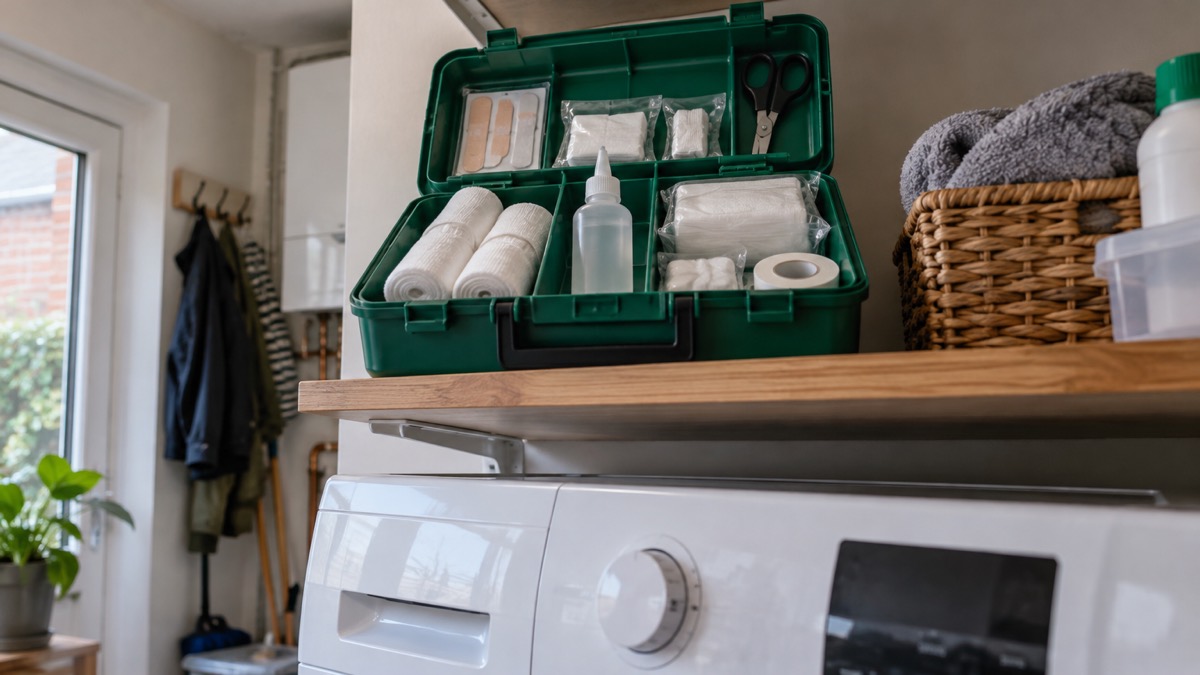
Burnshield makes a wider range than the single bottle. The maker lists Burnshield dressings, which it says should be applied directly to the wound and covered with a protective bandage5, and a large limb burn dressing23. It also lists a burn care kit4. The maker states that Burnshield products have received accreditations and approvals from ISO, TGA, CE and the FDA5.
For a household, the choice is usually between a small gel bottle, a larger bottle or spray, and a dressing for bigger areas. The Burnshield Hydrogel Burn Spray 125ml page covers the spray, and the burn gel or cling film comparison sets out the two ways of covering a burn side by side. The burns and scalds guide covers cooling, covering and getting help in full.
If you are building a kit from scratch, the ready-made or homemade kit comparison and the baby and child kit checklist are useful next steps. For a burn in the eye, the chemical burns and eye splashes page covers how long to rinse.
Sources (23)
- Burnshield Hydrogel Burn Gel 50ml Squeeze Bottle, Steroplast, 2026-10-28
- Burns first aid, NHS inform, 2026-07-24
- Burns and scalds, NHS inform, 2021
- Steroburn Burncare Kit, Steroplast, 2026-10-28
- Burnshield Dressings 2.5 x 50cm, Steroplast, 2026-10-29
- Burns prevention and tips, Midlands and South West Burns Network? (www.mse.nhs.uk)
- Burns and scalds, Andaman Surgery, 2026
- What to do if your child has an accident, NHS, 2025-12-18
- Staying safe over the summer, Healthier Together, 2026-10-29
- Chemical burn, St John Ambulance, 2026-10-28
- First aid for burns and scalds, South West Burn Care Network, 2026-10-28
- What to do in a chemical emergency, GOV.UK, 2024-10-10
- Burns and scalds, NHS 111 Wales, 2021
- Burn awareness, Cheshire Fire and Rescue Service, 2026-05-20
- First aid, Northern Burn Care Network, 2022-03-11
- Shock first aid, NHS inform, 2026-07-24
- Shock, NHS inform, 2026-07-24
- Shock, St John Ambulance, 2026-10-28
- What should I keep in my first aid kit, Collingwood Surgery, 2026-10-28
- Preparing for an emergency, Nottinghamshire County Council, 2026-10-29
- Get help and advice in an emergency, Lincolnshire County Council, 2026-10-29
- What should I keep in my first aid kit, NHS, 2026-10-25
- Burnshield Large Limb Burn Dressing, Steroplast, 2026-10-29
 Burnshield Hydrogel Spray 125ml