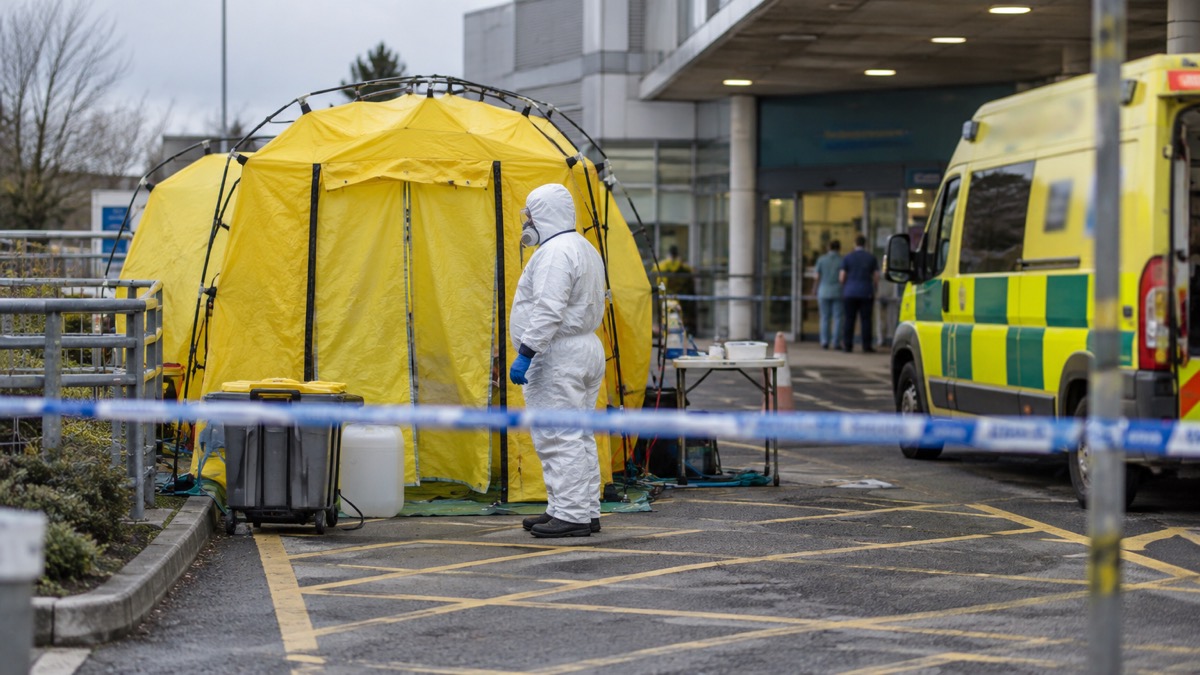
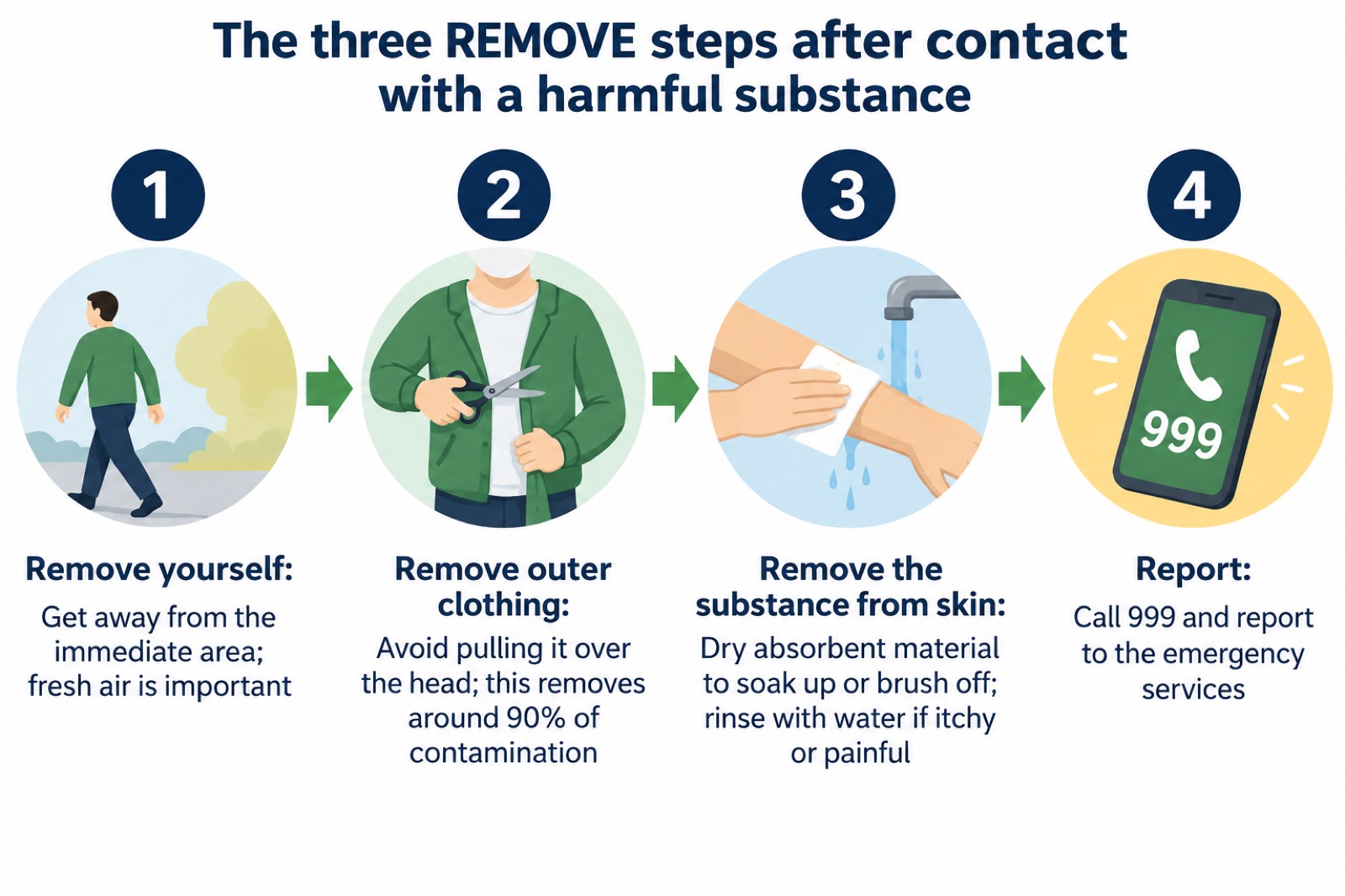
If you think you have been exposed to a hazardous substance, whether deliberately or accidentally, there are three actions to take, in order: remove yourself from the hazard, remove your outer clothing, and remove the substance from your skin. The guidance is called REMOVE. REMOVE. REMOVE.1. It applies to a suspected exposure to a hazardous substance, and the first step is to remove yourself from the immediate area to avoid further exposure, because fresh air is important1.
The reason the steps matter so much is simple: taking off your outer clothing alone can remove around 90% of the contamination2. Everything you do in the first minutes, before the emergency services reach you, limits how much of the substance stays on your body and how much harm it can do. ProtectUK describes the REMOVE protocol as the most effective method of limiting the health effects of a chemical, biological or radiological (CBR) incident3.
This page sets out each step in order, what not to do while you are contaminated, how to handle clothing that is stuck or difficult to remove, and why helping other people can spread the contamination rather than reduce it.
The three steps in order
The REMOVE. REMOVE. REMOVE. advice gives three actions, and the order matters. Each step reduces the hazard before you move to the next, so that you are not carrying the substance with you as you go.
- Remove yourself. Get away from the immediate area to avoid further exposure. Fresh air is important. If your skin is itchy or painful, find a water source. Report to the emergency services4.
- Remove outer clothing. Take off any outer clothing affected by the substance. Try to avoid pulling clothing over the head if possible. Do not smoke, eat or drink, and do not pull off any clothing stuck to the skin4.
- Remove the substance from skin. Use a dry absorbent material to either soak the substance up or brush it off. Rinse continually with water if the skin is itchy or painful4.
The same three steps appear in guidance used across the UK. Local resilience forums, the partnerships that plan for emergencies in each region, publish the identical sequence: remove yourself from the hazard, remove outer clothing if affected, remove the substance from skin if affected, and call 999 in an emergency5. Essex Prepared, a community preparedness partnership, gives the same advice for anyone who thinks they have been deliberately or accidentally exposed to a hazardous substance, or attacked with an acidic or corrosive substance6.
The advice is deliberately simple so that anyone can follow it under stress. ProtectUK notes that it can be implemented without specialist protective equipment and is relevant for any potential hazardous substance exposure, and that security personnel and other staff may be the first responders to such an incident1. You do not need to identify the substance first. You do not need to know whether it is chemical, biological or radiological. The steps are the same, and they work because they remove the substance from your body rather than trying to neutralise it.
Get away from the substance and into fresh air
The first step is to remove yourself from the immediate area to avoid further exposure, because fresh air is important4. Every second you stay near the source, whether that is a spilled liquid, a cloud of vapour or a cloud of powder, is a second in which more of the substance can settle on you or be breathed in.
If the substance has been released into the air and you can tell which way the wind is blowing, official chemical emergency guidance from the UK government says you should ideally move upwind, in the direction the wind is coming from, avoiding the source, to reduce your overall exposure2. A vapour or gas drifts with the wind, so walking into the wind takes you away from the cloud rather than along with it. If you cannot tell the wind direction, simply put distance between yourself and the source and get to open air.
If the release has happened indoors, get outside. If it has happened outdoors, move away from the immediate area before you do anything else. Do not stop to gather belongings, and do not go back towards the source to help others until you have made yourself safe. Once you are clear of the hazard, report to the emergency services, and call 999 if you are dealing with an emergency5.
This first step is also where you look for water. The guidance says that if the skin is itchy or painful, find a water source4. You do not need to find it before you leave the area; you need to leave first, then find water for rinsing. Any clean water source will do while you wait for the emergency services, who will carry out full decontamination when they arrive.
For a wider release affecting your street or neighbourhood, the advice changes from removing yourself to sheltering indoors, which is covered separately in Go In, Stay In, Tune In. The REMOVE steps on this page are for when the substance is on you or your clothing.
Take off outer clothing: around 90% of contamination goes with it
The second step is to remove any outer clothing affected by the substance4. This is the single most effective part of the whole sequence, and the figures behind it come from government guidance for both chemical and radiation emergencies.
- UK government chemical emergency guidance: "Simply taking off your outer clothing can remove around 90% of the contamination."2
- UK government radiation emergency guidance: "Studies show that simply taking off your outer clothing can remove around 90% of the contamination."7
- The government's self-decontamination guidance for radioactive material states that taking off your outer layer of clothing can remove up to 90% of radioactive material8.
The reason is physical rather than chemical. Most of a substance that lands on you sits on the outer surface of what you are wearing: a coat, a jacket, a scarf, gloves, shoes. Taking that layer off takes most of the contamination with it, and it does so immediately, without water, without soap and without knowing what the substance is. That is why this step comes before any attempt to wash.
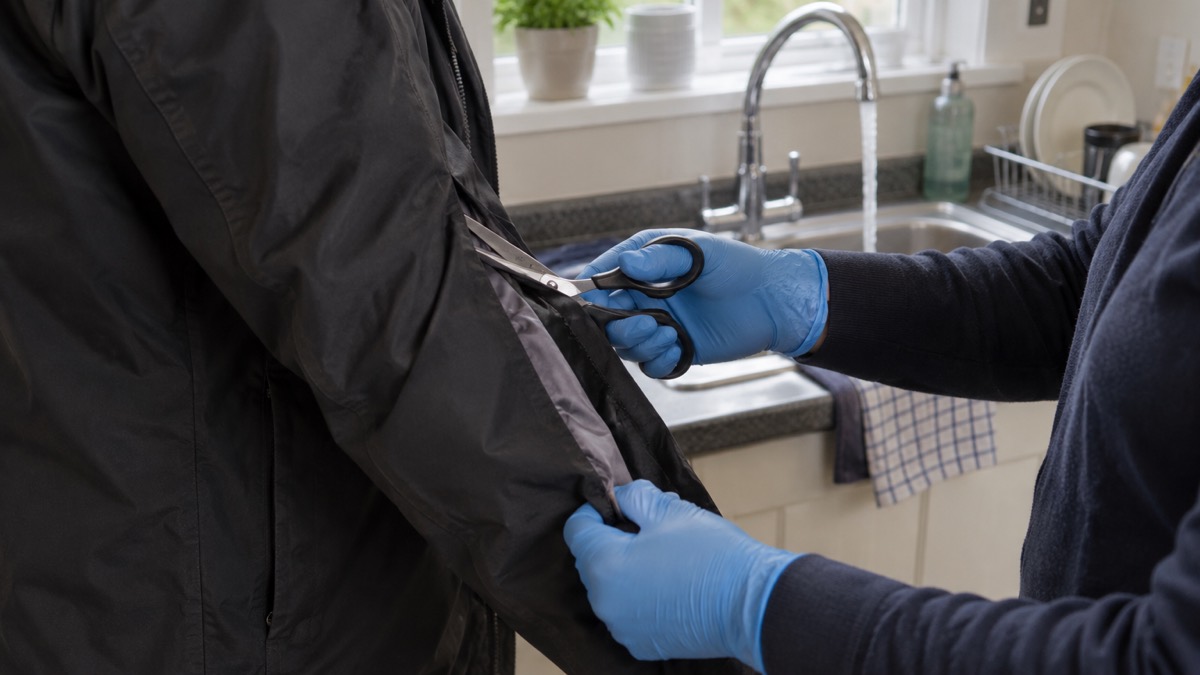
How you take the clothing off matters. Try to avoid pulling clothing over the head if possible4, because dragging a contaminated jumper or shirt across your face transfers the substance to your skin, eyes, hair and mouth. The government's radioactive self-decontamination guidance is more specific still: cut clothing off rather than pulling it over the head, and avoid touching the outside of the clothing with your skin8. If you have help from someone who is not contaminated, they can cut the garment away from you.
Once the clothing is off, do not drop it on the ground where people will walk. Seal it, along with shoes and any face covering, in a plastic bag or sealable container placed away from people8. Discarded clothing may present a hazard to anyone nearby, because it may be covered in or have absorbed the substance and may give off harmful fumes or particles6. Contact your local authority for advice on disposal of the clothing9.
What not to do while you are contaminated
The guidance is as clear about what to avoid as about what to do. The prohibitions exist because each of these actions either moves the substance deeper into your body or moves it onto someone else.
- Do not smoke, eat or drink.4 Substances on your hands and face can be transferred to your mouth, and everyone present at the scene should refrain from eating or drinking3.
- Do not pull off any clothing stuck to the skin. It may damage that skin. A trained medical professional will remove it when safe to do so6.
- Do not scrub your skin or wounds. The government's self-decontamination guidance says so directly8.
- Do not touch the outside of removed clothing with your bare skin.8
- Do not move around too much or have close contact with other people until you have been decontaminated8.
The instruction not to scrub is worth pausing on, because it runs against instinct. Scrubbing sore or contaminated skin can drive the substance into the skin and into any wounds, and can abrade the skin so that it absorbs more. The same guidance adds that if you use a sponge or wash cloth, you should dispose of it in a sealed bag placed away from people, so that the contamination on it does not reach anyone else8.
If you have been exposed to radioactive material, the government's self-decontamination guidance adds a further instruction: get inside a building as soon as possible, limit your movement and contact with others until you are decontaminated, and put on a clean face mask if one is available8. Movement stirs up particles that have settled on you, and being indoors reduces the chance of spreading them to other people or re-inhaling them.
Clothing stuck to the skin, or that has to go over the head
Two problems come up again and again with the clothing step, and both have specific answers.
Clothing stuck to the skin. Do not pull it off. It may damage the skin underneath, and a trained medical professional will remove it when safe to do so6. The same rule appears in burn care: leave any melted or adherent clothing near a burned area if you are able10, and NHS first aid guidance for children says to remove clothing and jewellery near a burnt area, including nappies, socks and shoes, but not to try to remove anything that is stuck to the burnt skin11. Whether the clothing is stuck by a chemical or by heat, the principle is the same: the fabric is doing less harm where it is than it would if torn away.
Clothing that has to come off over the head. Try to avoid pulling clothing over the head if possible4. If a garment cannot be removed any other way, the government's radioactive self-decontamination guidance says to cut it off rather than pull it over the head, keeping the contaminated outer surface away from your face, hair and eyes as it comes away8. If you have scissors or a knife to hand and can use them safely, cutting down the sleeves and side seams lets the garment fall away from you. If someone uncontaminated is helping you, let them do the cutting.
For children, the practical adaptation is straightforward: an adult who is not contaminated should do the cutting and the removal, following the same rules, and the child's clothing, shoes and anything used to clean them should be bagged and kept away from people in the same way8. NHS guidance on childhood accidents covers the general principle of removing clothing near affected skin without forcing anything stuck to it11.
Remove the substance from your skin with dry absorbent material
The third step is to remove the substance from skin using a dry absorbent material to either soak it up or brush it off4. This applies when the substance is not causing pain or itching: if the skin is itchy or painful, the instruction changes to rinsing continually with water, covered in the next section.
UK government chemical emergency guidance gives examples of what counts: use any available dry absorbent material, such as a paper towel or any fabric material, to soak up or brush off the chemical2. The point is that this is not specialist kit. A paper towel, a clean cloth, a scarf, a handful of tissue from a pocket will all do the job. What matters is that the material is dry and absorbent, so that it lifts the substance off the skin rather than smearing it across a wider area.
Work deliberately. Soak up or brush off liquids rather than wiping them around, using any available dry absorbent material such as a paper towel or fabric, and brush or pat powders off and away from your face, eyes and mouth8. If the skin becomes itchy or painful, rinse continually with water8.
There is one situation with its own variant of this step. Public Health Wales advises that if you have asbestos fibres on your skin and clothes, you should remove all visible dust and fibres from the body, clothing and footwear using a damp cloth and a gentle patting action9. The damp cloth and the patting, rather than dry brushing, stop dry asbestos fibres from being lifted back into the air and breathed in. If you know or suspect the dust is asbestos, follow that variant, and contact your local authority for advice on disposal of the clothing9.
Rinse continually with water
If the skin is itchy or painful, the guidance changes: rinse continually with water4. Itching or pain is the signal that the substance is actively irritating the skin, and continuous rinsing dilutes it and carries it away.
UK government chemical emergency guidance puts it in these terms: if the chemical is irritating to the skin, eyes or lungs and water is available, wash with copious amounts of water2. The word copious matters. A wet wipe or a splash from a bottle is not enough; you are trying to dilute and flush, which takes a sustained flow. A tap, a hose, a shower or a clean water source found at step one all work.
Keep rinsing until the emergency services take over. They will carry out structured decontamination when they arrive, and the rinsing you do in the meantime limits how much of the substance sits on your skin in the interim. Do not scrub while you rinse8, and if you use a sponge or wash cloth, dispose of it in a sealed bag placed away from people afterwards8.
When it comes to washing more fully, including your hair, the government's radiation emergency guidance is specific about what to use. Simple soaps or mild shampoos are effective, and you should not use conditioner when washing your hair, because conditioner can bind contamination to the hair7. Wash with soap or mild shampoo and plenty of water, and treat anything you used to wash with as contaminated waste, sealed in a bag away from people8.
Why helping others can spread contamination
The instinct to run to someone who has been splashed or doused is one of the hardest things to override, and the guidance is firm about it. ProtectUK states that assisting other affected people may mean more people become contaminated: contact with affected persons and their property should be avoided3. If you think someone has been exposed to a hazardous substance, use caution and keep a safe distance to avoid exposure yourself12.
The mechanism is plain. A person who is contaminated is, for the purposes of the next few minutes, the source. Their clothing, skin, hair and belongings carry the substance, and it may be giving off harmful fumes or particles6. Touching them, handling their clothes or standing close enough for them to brush against you transfers it to you, and then there are two contaminated people where there was one, and one fewer person able to call for help.
What you can do instead, from a safe distance:
- Call 999 and tell the operator what you can see: people affected, a liquid, powder or vapour, and where it is5.
- Tell the affected person, from a distance, to follow the REMOVE steps: get away from the source, take off outer clothing, remove the substance from skin with dry absorbent material, and rinse continually with water if their skin is itchy or painful4.
- Keep other people back and away from any discarded clothing6.
- Wait for the emergency services, who have the protective equipment and decontamination equipment to help safely.
The exception is someone whose life is in immediate danger, and even then the calculus is about what you can do without becoming a casualty yourself. For the specific case of an acid or corrosive attack, where flushing the affected person with water is time-critical, the steps are set out in Acid or Corrosive Attack: How to Help Straight Away.
Why this is the most effective first response
ProtectUK describes the REMOVE protocol as the most effective method of limiting the health effects of a CBR incident3. That claim rests on the physics of contamination rather than on any special equipment: the substance has to be on you to harm you, and each REMOVE step takes a large share of it off.
The clothing figure is the anchor. Taking off your outer layer of clothing removes around 90% of contamination in a chemical emergency2 and up to 90% of radioactive material in a radiation emergency8. What remains is mostly on exposed skin and hair, which the dry absorbent material and rinsing then address. No other action available to an ordinary person in the first minutes comes close to that reduction, and none of it requires anything you would not find in a kitchen, a pocket or a workplace.
The guidance is also consistent across the hazards. Whether the exposure is chemical, biological or radiological, and whether it is a vapour, a powder or a liquid, the same three steps apply1. That consistency is deliberate. In a real incident nobody knows at first what the substance is, and advice that changed depending on the hazard would be unusable. REMOVE works precisely because it does not require that knowledge.
It is worth knowing where these steps sit in the wider picture of protective actions. Government radiation emergency guidance notes that evacuation, if it is undertaken before a release occurs, is the only urgent protective action with the potential to prevent virtually all exposure7. Once a release has happened and the substance is on you, that moment has passed, and self-decontamination becomes the most effective thing you can do. For releases that affect a whole area rather than an individual, the protective action is sheltering indoors, covered in Go In, Stay In, Tune In, and for recognising the signs of a deliberate CBR attack, see Chemical, Biological and Radiological Attacks: Recognising the Signs.
When to use this advice
Follow the REMOVE REMOVE REMOVE advice if you think you have been deliberately or accidentally exposed to a hazardous substance, or if you think you have been attacked with an acidic or corrosive substance6. ProtectUK frames the same trigger as a suspected deliberate or accidental exposure to a hazardous substance in vapour, powder or liquid form, or an acid attack1.
You do not need to be certain. The guidance is written for suspicion, not proof, because the cost of the steps is a few minutes and some clothing, while the cost of not taking them can be a far greater exposure. An unexplained liquid on your sleeve, a powder that has settled on you, a sudden irritation of your skin, eyes or lungs near a suspicious event: each is enough to act on.
If the event looks like a deliberate attack, the REMOVE steps sit alongside the wider response to a terrorist incident. Once you are safe and decontaminated, follow Run, Hide, Tell if there is any continuing threat, and report what you saw through the channels in How to Report Suspicious Activity or Terrorism Concerns. The overall picture of major incidents and how households should prepare for them is on the Major Incidents page.
Sources (12)
- REMOVE. REMOVE. REMOVE. guidance on hazardous substance exposure, ProtectUK, 2021
- What to do in a chemical emergency, GOV.UK, 2024
- Chemical, biological and radiological (CBR) attacks, ProtectUK, 2022
- Remove, Remove, Remove: terrorist attack advice, Lancashire Prepared, 2026
- Community Risk Register, West Midlands Local Resilience Forum, 2023
- Hazardous substance exposure: REMOVE advice, Essex Prepared, 2026
- What to do in a radiation emergency, GOV.UK, 2024
- How to remove radioactive material from your skin and clothes: self-decontamination guidance, GOV.UK, 2024
- Asbestos: environmental public health, Public Health Wales, 2026
- Burns and scalds: first aid guidance, London and South East Burns Network, 2026
- What to do if your child has an accident, NHS, 2025
- Chemical, Biological and Radiological (CBR) incidents, ProtectUK, 2024
 Run, Hide, Tell
 ACT Awareness Training
 Living Near a COMAH Site
 Air Quality After a Release
 Go In, Stay In, Tune In
 Nuclear Site Planning Zones
 Naval Base Radiation Plans
 UK Radiation Monitoring