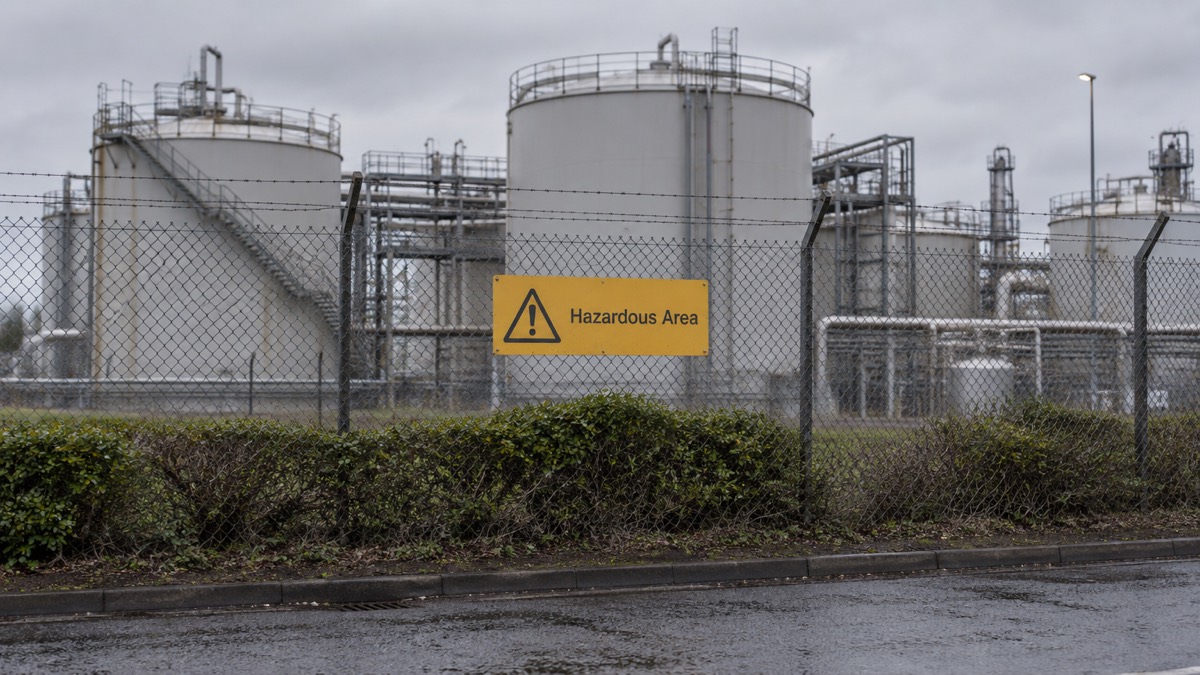
If you live near a chemical plant, an oil depot, a refinery or even a large distillery, you may have heard the term "COMAH site" and wondered what it means for you. COMAH stands for the Control of Major Accident Hazards Regulations 2015, a set of UK regulations that apply to any establishment storing or handling large quantities of industrial chemicals of a hazardous nature1. There are approximately 950 such sites located all across Great Britain, monitored under the regulations1. They are not exotic or rare: they include distribution centres, gasholders and power stations, and many sit unobtrusively on industrial estates next to ordinary streets.
The regulations exist for two reasons: to prevent major accidents involving dangerous substances, and to limit the consequences to people and the environment of any accidents that do occur1. The Buncefield fuel depot fire is the example official guidance gives of the kind of event the regime is designed to prevent1. For you as a nearby resident, the practical questions are what the rules require of the site operator, who checks that they comply, and how you find out what is planned for your area if something goes wrong. All three have clear answers, and this page sets them out.
What a COMAH site is, and why the rules exist
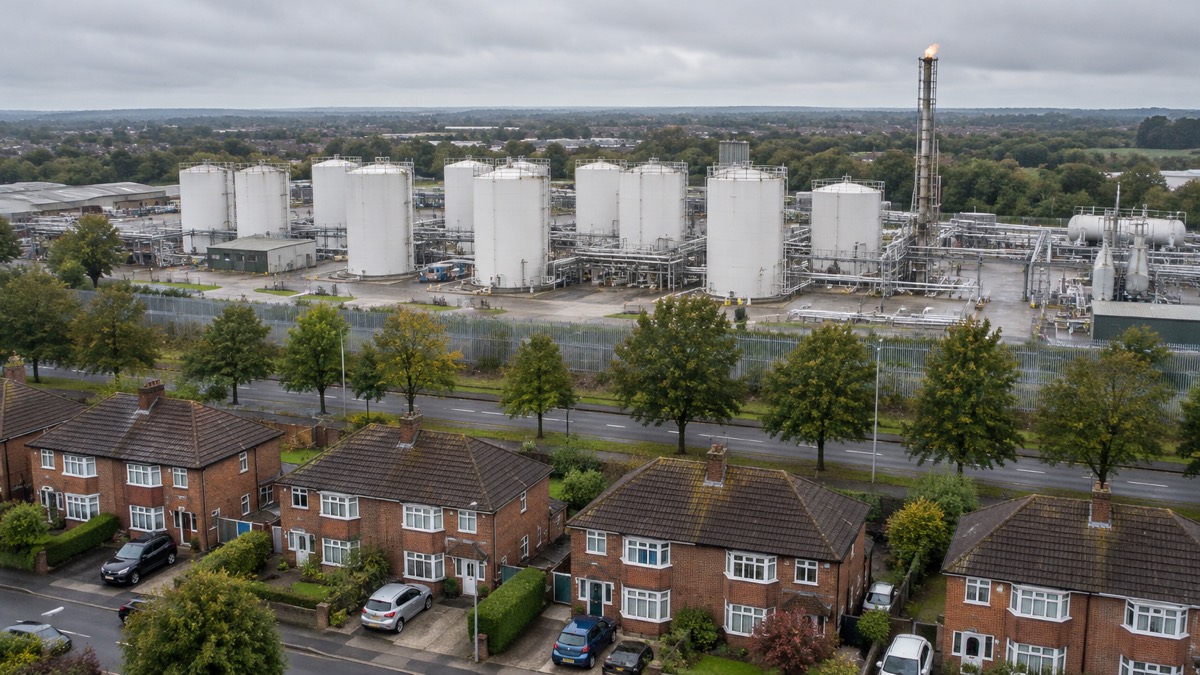
COMAH is a set of regulations in the United Kingdom that apply to any establishment storing or handling large quantities of industrial chemicals of a hazardous nature1. The threshold is about quantity: a business can hold the same substance as its neighbour, but only the one holding it in large enough amounts comes within the regulations. They apply to any site storing or handling large quantities of industrial chemicals, as the West Mercia risk register puts it5.
The regulations are designed to prevent major accidents involving dangerous substances such as Buncefield, and to limit the consequences to people and the environment of any accidents that do occur1. Buncefield, the Hertfordshire fuel depot fire, is the reference point officials use when explaining why the regime matters. It is cited in official guidance as an example of a major accident involving dangerous substances that the COMAH regulations are designed to prevent1.
The scale of the regime is easy to underestimate. There are approximately 950 sites located all across Great Britain which are monitored under the Control of Major Accident Hazards Regulations 20151. Individual counties give a sense of the spread: Lancashire alone has thirteen industrial sites which require special plans to deal with hazards under COMAH legislation6, while West Mercia has only two top tier sites5. So the density varies enormously by area, and a county with refineries or major ports will carry far more than a rural one.
If a major accident does happen near you, the immediate actions are the same as for any chemical release: go indoors, shut windows and doors, and tune in to local radio and official information. Our pages on chemical leaks and toxic smoke and on sheltering indoors during a release cover that step by step.
Upper Tier and Lower Tier: the two regimes side by side
COMAH sites are split into either the Upper Tier or the Lower Tier COMAH regime, which is dependent on the quantities of material the site processes1. The tier matters to you because it determines how much planning and public information the law requires around the site.
| Upper Tier | Lower Tier | |
|---|---|---|
| What it covers | Facilities that store, handle or process significant quantities of hazardous substances, such as oil refiners1 | A diverse range of businesses such as logistic and distribution centres, smaller oil terminals, gasholders and some power stations1 |
| What decides it | The quantities of material the site processes1 | The quantities of material the site processes1 |
| Risk to neighbours | Highest quantities, so the fullest planning duties | Deemed less hazardous, but poorly managed Lower Tier sites have the potential to cause serious harm and damage1 |
Upper Tier COMAH sites are those facilities that store, handle, or process significant quantities of hazardous substances, such as oil refiners1. These carry the heaviest duties, including the off-site emergency planning that involves your local authority and emergency services. Lower Tier COMAH sites cover a diverse range of businesses such as logistic and distribution centres, smaller oil terminals, gasholders and some power stations1.
One point official guidance is careful to make: although Lower Tier sites are deemed to be less hazardous, poorly managed Lower Tier COMAH sites have the potential to cause serious harm and damage1. The tier tells you about the scale of the legal duties, not that a site is risk-free. If you want to know which tier a site near you falls into, your Local Resilience Forum's risk register, covered below, is the place to look, since it assesses the sites in its area. West Mercia's register, for example, names its two top tier sites: W H Bowker Ltd, chemical storage and warehousing based in Droitwich, and Roxel (UK Rocket Motors) Ltd, chemical manufacture, production and disposal based in Kidderminster5.
Which industries and substances are covered
The regulations mainly apply to businesses within the chemical industry as well as on-land oil and gas refineries. However, they also apply to many seemingly inconspicuous sites, including those involved in the Scotch whisky industry1. That last example surprises most people: the quantities of flammable spirit held in maturation warehouses bring distilleries within the rules.
The sectors likely to be designated under COMAH include1:
- Chemical manufacturing and storage
- Oil and gas production and storage
- Petrochemical plants
- Explosives manufacturing
- Nuclear power generation
- Large-scale storage of hazardous or dangerous substances
The dangerous substances covered by the COMAH regulations include named substances such as hydrogen and ammonium nitrate, as well as substances with health hazards (including acute toxics), physical hazards (including explosives and flammable liquids and gases), environmental hazards (acute and chronic hazards to the aquatic environment), and others that react with water, including those that evolve toxic or flammable gases1. In plain terms, that covers poisons, things that catch fire or explode, things that harm rivers and wildlife, and things that become dangerous when wet.
Nuclear sites deserve a note of their own. Nuclear power generation is listed among the sectors likely to be designated under COMAH1, but nuclear sites also fall under a separate regime, the Radiation (Emergency Preparedness and Public Information) Regulations 2019, known as REPPIR. Sellafield's emergency booklet, for instance, is produced under both the Radiation (Emergency Preparedness and Public Information) Regulations 2019 and the Control of Major Accident Hazards (COMAH) Regulations 20157. If you live near a nuclear site, our page on emergency planning zones and information booklets explains what you should have been given.
Who regulates COMAH sites
COMAH is enforced by the Health and Safety Executive (HSE) and the relevant regional environmental agencies, such as the Environment Agency (EA), the Scottish Environment Protection Agency (SEPA), and Natural Resources Wales (NRW), working together as the COMAH Competent Authority (CCA)1. In practice this means two kinds of regulator look at every site: one concerned with safety, the HSE, and one concerned with the environment, which differs by nation.
Facilities are regulated by authorities such as the Environment Agency and the Health and Safety Executive to minimise risks8. The split of responsibilities reflects the two ways a major accident can harm people: fire, explosion and toxic release on the one hand, and pollution of rivers, groundwater and land on the other. In a nuclear emergency, the environment agencies consider the impacts on the environment, while the food standards agencies oversee the safety of food9, so several bodies come into play depending on what has been released.
The Environment Agency's role goes well beyond COMAH inspection. It is a Category One responder under the Civil Contingencies Act, meaning it has duties during emergencies, not just a regulatory role before them10. Before an incident, its staff carry out routine monitoring and enforcement, community engagement and advice on risks, and joint training and exercising with partner agencies10. During a live incident, its duties include Warning and Informing duties with local communities, deploying pumps, barriers and other equipment during flooding, sampling and monitoring during pollution incidents, and deploying booms to prevent the spread of oil or pollutants through a watercourse10. After an incident, its work continues: supporting partners to help communities return to normal, efforts to return the environment to its original state, and supporting enforcement or prosecution where relevant10. So if a COMAH site near you has a release that reaches a river, the same body that regulates the site will be on the ground sampling and containing it.
Finding out about risks near you: your Local Resilience Forum
Your Local Resilience Forum will publish information online about the risks in your local area2. Local Resilience Forums identify potential risks and produce emergency plans to either prevent or lessen the impact of any incident on their local communities11. They are partnerships made up of representatives from local public services, including the emergency services, local authorities, the NHS, the Environment Agency and other organisations involved in emergency preparedness, such as utilities providers2. The geographical area each forum covers is based on police areas12.
Each Local Resilience Forum publishes a Community Risk Register which sets out the different risks most likely to cause disruption in your region2. This is the single most useful document for a household near a COMAH site, because it rates the industrial risks where you live. Two examples show what you will find:
- The London Risk Register rates an accidental large toxic chemical release from a COMAH site as a medium risk13, and an accidental fire or explosion at an onshore major hazard (COMAH) site as likelihood 1 on a 1 to 5 scale, with an impact rated 4 on the same scale13.
- Surrey's Community Risk Register names the Surrey Fire and Rescue Service as lead agency for both an accidental fire or explosion at an onshore major hazard (COMAH) site and an accidental large toxic chemical release, with site inspections to be carried out by operational crews in line with the fire and rescue service inspection process14.
Local Resilience Forums in Essex coordinate risk assessments and response plans for industrial accidents and pollution events8, so this is not a paper exercise: the forum is where the off-site planning for the sites in your police area is brought together. LRFs are supported by organisations known as Category 2 responders, such as the Highways Agency and public utility companies, who have a responsibility to co-operate with Category 1 organisations and share relevant information with the LRF12. The government has also added to this list: a Statutory Instrument laid in February 2023 made the Meteorological Office and the Coal Authority Category 2 responders under the Civil Contingencies Act15.
The arrangements differ across the four nations, and it is worth knowing which applies to you:
| Nation | Arrangement | Where to look |
|---|---|---|
| England | 38 Local Resilience Forums16 | Your LRF's Community Risk Register, published online2 |
| Wales | Four regional Local Resilience Forums17 | Details of the Welsh LRFs and Community Risk Registers are published online11 |
LRFs may also coordinate with the military in certain circumstances where specialised capabilities are needed16. Each LRF brings together all responder organisations who have a duty to assess risks and plan for emergencies under the Civil Contingencies Act 200417.
Site warnings and information you should be given
Operators of the highest-hazard sites have duties to inform the people around them. Sellafield, Europe's largest single nuclear site, which stores and handles industrial size quantities of radioactive material7, distributes an emergency booklet to nearby households produced under both REPPIR 2019 and the COMAH Regulations 20157. That booklet explains the site's emergency arrangements, including what an alert state means. For example, an Off-Site Chemical Emergency is defined as an alert state based on the fact a chemical emergency, such as a toxic gas release, has occurred which is directly impacting activity on the Sellafield site but also has the potential to affect an area just beyond the site boundary fence, or has already done so7.
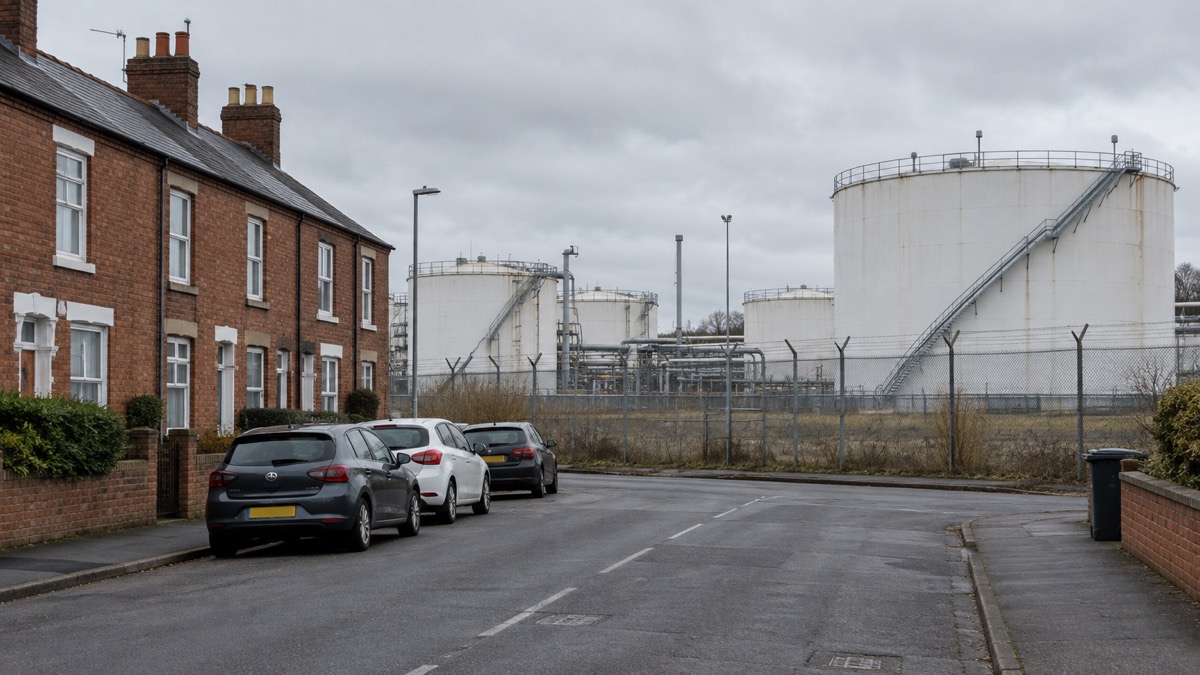
If you live near a major site and have never received or cannot find such information, contact the site operator or your local authority's emergency planning team. Our pages on sirens and phone warnings near nuclear and chemical sites and on how to stay informed in an emergency cover the warning systems themselves.
For nuclear sites specifically, the planning duty sits with local authorities: under the Radiation (Emergency Preparedness and Public Information) Regulations 2019, Local Authorities must plan for mitigating the consequences of a nuclear off-site emergency18. Lancashire, which contains two nuclear facilities, Heysham and Springfields6, publishes these plans and stresses that the possibility of such emergencies occurring is remote, and that the design and operation of all plants on all sites are independently monitored by the Office for Nuclear Regulation and the Environment Agency18. That reassurance is worth holding onto: the same pattern of independent monitoring applies across the COMAH regime.
How a local emergency near a site is managed
When an incident happens at or near a COMAH site, the response is not improvised. It follows plans written in advance by the Local Resilience Forum and the agencies named in the Community Risk Register. As noted above, Surrey's register names Surrey Fire and Rescue Service as the lead agency for both a fire or explosion and a toxic release at a COMAH site, with operational crews carrying out site inspections in line with the fire and rescue service inspection process14. Your own area's register will name the equivalent lead agency where you live.
The Environment Agency's incident work shows what the environmental side of a response looks like in practice. During a live incident its team carries out Warning and Informing duties with local communities, engages with LRF partners, deploys pumps, barriers and other equipment during flooding, samples and monitors during pollution incidents, and deploys booms to prevent the spread of oil or pollutants through a watercourse, with staff on the ground to advise, support and reassure communities10. It delivers training internally all-year round across all incident roles to keep that capability ready10.
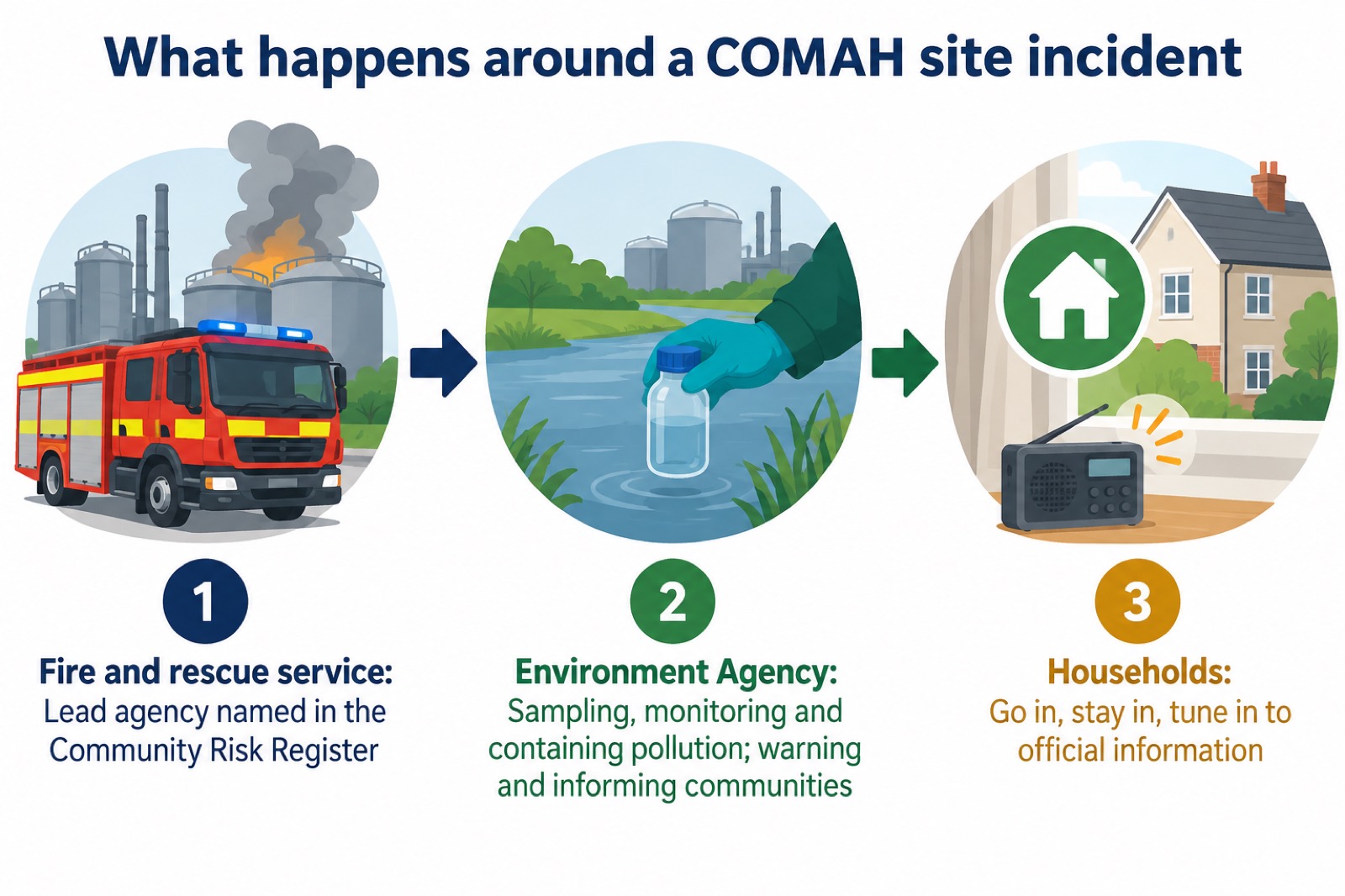
For your household, the practical response to a chemical release is covered in detail on our chemical releases page and our page on go in, stay in, tune in. The short version: go indoors, close windows and doors, and follow official instructions rather than leaving the area unless told to, since leaving can expose you to the plume. If anyone has come into contact with a harmful substance, follow the remove, remove, remove steps.
Reporting pollution or an incident
If you see pollution, a spill reaching a watercourse, or anything at a nearby site that looks wrong, report it. The Environment Agency incident hotline is 0800 80 70 60, a 24-hour service for reports of environmental pollution3. Local community resilience plans pass the same number on: the pollution and incident hotline, 0800 80 70 60, 24-hour service20. You do not need to be certain before calling; the hotline exists to take reports at any hour and send officers where needed.
| Contact | Number | Use it for |
|---|---|---|
| Environment Agency incident hotline | 0800 80 70 60 | Environmental pollution, 24-hour service3 |
| Floodline | 0345 988 1188 | Flood alerts and warnings4 |
| Local Environment Agency office | 03708 506506 | Concerns about river or stream water quality, or flooding information21 |
For concerns about river or stream water quality, or flooding information, contact your local Environment Agency office on 03708 50650621. The Environment Agency is also on X as @EnvAgency20, which carries incident updates during major events. In an immediate danger to life, always call 999 first.
Sources (21)
- COMAH sites, Essex Prepared, Essex Prepared
- Check the risks where you are, beready.campaign.gov.uk
- Report flooding and burst water mains, GOV.UK
- Community Resilience Plan, Wiltshire and Swindon Prepared
- West Mercia Risk Register V4, West Mercia local resilience partners, 2025-01
- Risks in Lancashire, Lancashire County Council
- Sellafield emergency booklet, Cumbria County Council, 2023-09
- Industrial accidents and environmental pollution, Essex Prepared
- Nuclear emergencies: information for the public, GOV.UK
- Spotlight on the Environment Agency's incident response, Wiltshire and Swindon Prepared, 2026-10-25
- Check the risks where you are, prepare.campaign.gov.uk
- Early warning and weather forecasts, GOV.UK, 2024-12-19
- London Risk Register v14, public version, London Resilience Forum, 2025-07
- Community Risk Register 2026, Surrey Local Resilience Forum, 2026
- UK Government Resilience Framework 2023 implementation update, GOV.UK
- What is a Local Resilience Forum?, Essex Prepared
- Resilience: risks in Wales, Welsh Government
- REPPIR plans, Lancashire County Council
- Annex F - NATIONAL_RISK_REGISTER_NRR.pdf, Cabinet Office (hosted by City of York Council democracy site)
- ICE template, Surrey Prepared, Surrey Prepared
- Private water supplies, Cornwall Council
 Run, Hide, Tell
 ACT Awareness Training
 Air Quality After a Release
 Remove, Remove, Remove
 Go In, Stay In, Tune In
 Nuclear Site Planning Zones
 Naval Base Radiation Plans
 UK Radiation Monitoring