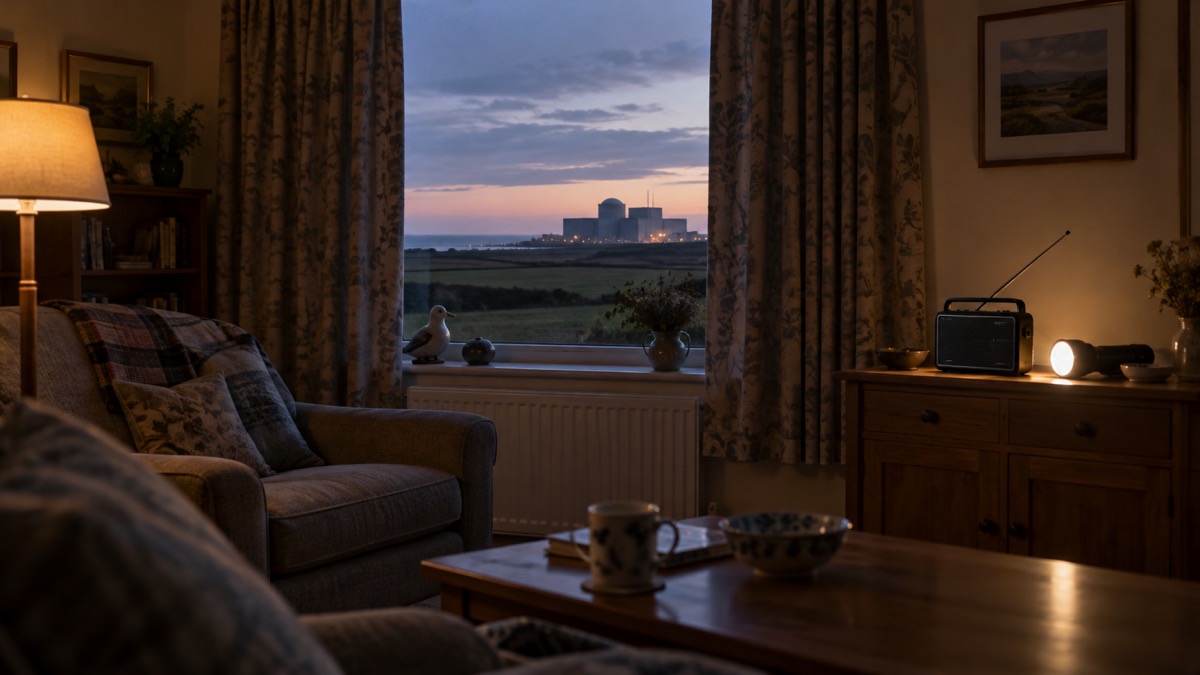
If you live near a nuclear licensed site in the UK, whether a power station, a fuel plant or a naval base where nuclear-powered submarines berth, the law requires detailed plans to exist for protecting your household in a radiation emergency, and requires you to be told about them in advance. That is why some homes receive a booklet through the door about what to do in a radiation emergency, and why councils publish maps of the areas those plans cover.
The single most important instruction, repeated by every official source, is simple: go in, stay in, tune in. Go indoors as soon as you can, close doors and windows, stay as far away from external walls as possible, and listen to local radio, television or official online channels for instructions1. Stay indoors until the emergency services or local radio tell you otherwise3.
This page explains the planning zones around these sites: what a detailed emergency planning zone is, how far they reach at specific sites, how to check whether your home is inside one, what the booklet you may have received covers, who writes and tests the plans, and what help exists for people who would find it hard to shelter or evacuate. For the full actions in an incident, see what to do in a radiation emergency and Go In, Stay In, Tune In.
If there is a radiation emergency: go in, stay in, tune in
The advice for a radiation emergency is the same sheltering drill used for most major emergencies in the UK. The UK Health Security Agency's advice, carried on the government's Prepare campaign, is to go indoors as soon as you can, stay there, and monitor the news and follow official advice on GOV.UK1. Essex Prepared puts the reasoning plainly: the most important thing to do if you are told you are near a radiation emergency is to go indoors as soon as you can and stay there, close the doors and windows, and stay as far away from external walls as possible2.
The three parts of the drill work together:
- Go in. Get inside a safe building without delay. If your children are at school, do not set out to collect them: schools more than 1.5km from the Portsmouth naval base, for example, will be told about any accident by the council and will look after pupils whose parents live within the zone and may not be able to collect them5. See should you collect children from school in a radiation emergency.
- Stay in. Remain indoors until you are told otherwise by the emergency services or local radio3. The Portsmouth residents' booklet is clear that the best thing to do is stay at home: you will be much safer indoors with your windows and doors shut4.
- Tune in. Listen to local radio or television, and follow official advice online, for information and instructions about what actions to take9. Keep listening and looking for announcements and updates on the news, watch for long-term safety information in the news and in leaflets, and wait for the all clear announcement4.
If you are ever advised to leave, the Portsmouth booklet sets out what follows: stay with friends or relatives outside the affected area if you can, or the council will make special arrangements; use your own transport if you have it, or transport will be provided; and entry to evacuated areas is carefully controlled until the emergency has ended4. The decision to shelter or evacuate is made by the responders, not by you, which is why tuning in matters: see radiation emergency: should you shelter or evacuate.
What a detailed emergency planning zone is

A detailed emergency planning zone, usually shortened to DEPZ, is a pre-determined area around a nuclear site within which the local authority will activate its off-site emergency plan to protect the public should a radiation emergency be declared8. In other words, it is the area for which the detailed work has already been done: who warns residents, how, what protective actions are triggered, and which agencies do what. Should a radiation emergency be declared, the local authority activates that plan for everyone inside the zone8.
The zones exist because of the Radiation (Emergency Preparedness and Public Information) Regulations 2019, known as REPPIR. These regulations establish a framework for the protection of members of the public and workers from, and in the event of, radiation emergencies that originate from premises10. Under REPPIR, local authorities must plan for mitigating the consequences of a nuclear off-site emergency11, and legislation requires operators of nuclear licensed sites to have plans to deal with emergencies on their side of the fence10.
Two features of the zones are worth knowing:
- The size differs site by site. Cumberland Council notes that the size of the emergency planning area differs site by site in the UK, with consideration given to individual factors associated with each site6. There is no single national radius.
- The boundary follows real geography. At Portsmouth, zones are shown as circles on maps, but the actual zone goes out to the nearest natural or landscape boundary5. Do not measure a circle on a map and assume; check the official boundary.
Some sites also have an Inner Emergency Planning Zone (IEPZ), which sits within the detailed emergency planning zone. The Cumbria booklet for the Sellafield area requires all people within the DEPZ and the IEPZ to immediately find shelter indoors and stay there, and notes that given the proximity of several properties within the IEPZ there is an elevated risk from a radiation emergency and therefore a possibility of the need to evacuate during an emergency12. An area up to 2km from the centre of the Sellafield Site could be the most likely area to be directly affected during and following a chemical emergency there12.
The revision of detailed emergency planning zones followed an Office for Nuclear Regulation review in January 2014, drawing on lessons learnt from the Fukushima Daiichi Nuclear Power Plant incident in 20116. The zones you see today reflect that review.
How far a zone reaches: from 1.5km at submarine berths to 8km at Sellafield
The distances vary considerably, and the best way to see the range is side by side. The figures below come from the councils and plans that determined each zone.
| Site | Zone | Distance | Source |
|---|---|---|---|
| Portsmouth naval base | Detailed Emergency Planning Zone | 1.5km from the berth5 | Portsmouth City Council |
| Southampton Docks nuclear vessel berth | Booklet distribution area | 1.5km radius of the berth13 | Southampton City Council |
| Devonport Site, Plymouth | Detailed Emergency Planning Zone | A minimum distance of 1.5km from the operational submarine berths7 | Plymouth City Council |
| Heysham Power Stations | Detailed Emergency Planning Zone | Ranging from 2.3km from the centre of site11 | Lancashire County Council |
| Westinghouse Springfields, Salwick, Preston | Detailed Emergency Planning Zone | Ranging from 2.4km from the centre of site11 | Lancashire County Council |
| Sellafield | Detailed Emergency Planning Zone | Ranging from 6.1km to 8km from the centre of site6 | Cumberland Council |
At the naval bases, the 1.5km figure is a legal threshold as well as a planning one. Southampton City Council explains that legislation requires people living up to 1.5km away from an operational berth to be given prior information about a nuclear emergency, and its leaflet is being distributed to all households within a 1.5-kilometre radius of the section of the Docks where nuclear-powered vessels would berth13. The Portsmouth booklet is likewise distributed to all households within a 1.5-kilometre radius of the nuclear berths, in accordance with emergency regulations4. Both booklets are currently valid: Southampton's runs from July 2024 to July 202713, and Portsmouth's to July 20274.
The scale of a realistic incident at a berth is smaller than the zone. Southampton's leaflet states that if an accident happened, it is unlikely this would affect people more than half a kilometre (500 yards) from the vessel13. The zone is drawn larger than the likely effect so that plans and warnings cover a margin of safety.
The outline planning zone: the wider ring
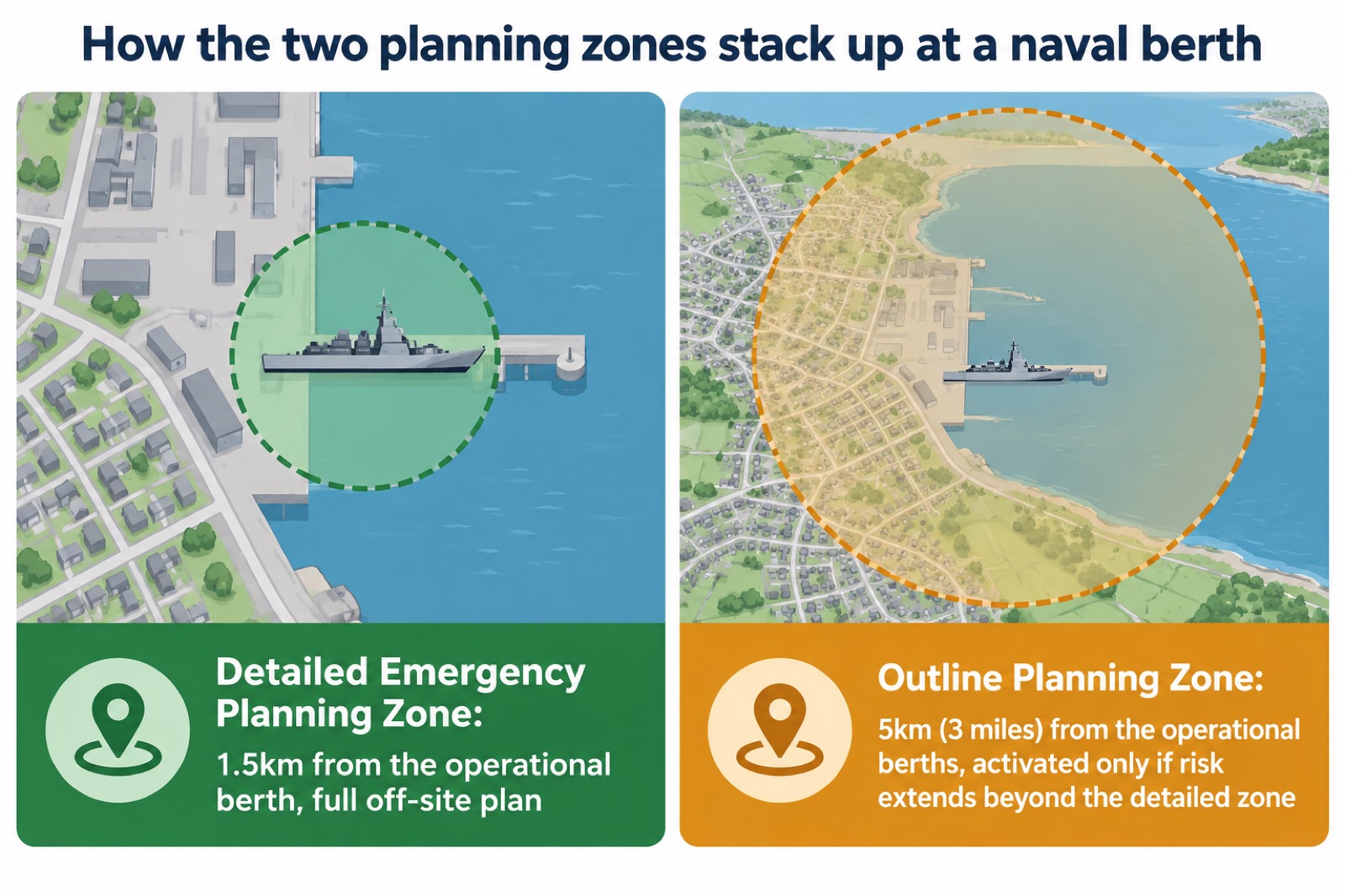
REPPIR 2019 also requires Outline Planning Zones (OPZs) for some sites, which require strategic level planning beyond the DEPZ for extremely unlikely but more severe events8. At Portsmouth, the Outline Planning Zone covers everything within 5km (3 miles) of the naval base's operational berths, including anchorages in the Solent5. At the Devonport Site, the outline planning zone extends to a distance of 5km from a central point in the site7. At Heysham Power Stations it reaches 30km from the centre of site11.
Protective actions for people in the Outline Planning Zone would only be activated if it were determined that the risk from the event extended beyond the 1.5km area for which detailed emergency plans already exist5. The OPZs are areas intended to support responding agencies' decision making and allow detailed planning to extend to particularly vulnerable groups in the outline planning zone7. By law, information is also provided to everyone who lives in the Outline Planning Zone at Portsmouth5.
For the naval sites specifically, see radiation emergency plans at Portsmouth, Devonport and Southampton, and for Sellafield see Sellafield: warnings, planning zone and what nearby residents should do.
How to find out whether your home is inside a zone
Start with the booklet. If a radiation emergency booklet has come through your door, you are in a planning zone: distribution is tied to the zone boundaries by law4. If you are not sure, or you have moved house, there are three reliable routes:
- Your local council's emergency planning pages. Councils that host a nuclear site publish their off-site emergency plan and zone maps. Lancashire County Council, as the designated Lead Local Authority, publishes its REPPIR plans with maps of the Heysham and Springfields zones11. Plymouth City Council publishes the Devonport off-site emergency plan7. Cumberland Council publishes its chemical and nuclear sites information6.
- The site operator or the booklet itself. The booklet for the Barrow area includes a map giving details of the area within which information is to be distributed, as determined by Cumbria County Council in 202014. The Sellafield booklet divides its area into sectors, which the emergency services may use when issuing messages or instructions during an emergency, and notes there is no Sector I12.
- Your local resilience forum. Local resilience forums coordinate emergency planning across an area; Northumbria's, for example, publishes household advice on emergencies including the Go In, Stay In, Tune In drill15.
Remember that the drawn boundary follows natural or landscape features rather than a perfect circle5, so a home just outside a mapped circle may still be inside the zone, and vice versa. If in doubt, contact the council's emergency planning team directly and ask.
Some sites also operate warning systems you can join. Lancashire's plan encourages people living within the Detailed Emergency Planning Zone for Heysham Power Stations to sign up to a free automated telephone warning system provided by EDF Energy, giving a warning in the highly unlikely event of an emergency at the Heysham site11. In Cumbria, a public telephone warning system is available, but only to householders and premises within the Detailed Emergency Planning Zone12. See sirens and phone warnings near nuclear and chemical sites.
The information booklet: what it covers and why you get one
The booklet is not junk mail. It is prior information required by law. The Radiation (Emergency Preparedness and Public Information) Regulations 2019 require that people in the planning zones are informed in advance about the risks and about what to do10. At Southampton, legislation requires people living up to 1.5km away from an operational berth to be given prior information about a nuclear emergency13.
A site booklet typically covers:
- The site and the emergencies it plans for, and the zone the plan covers4
- The Go In, Stay In, Tune In drill and what each part means in practice13
- What happens if evacuation is advised, including transport and rest arrangements4
- Arrangements for children at schools inside and outside the zone4
- How you will be warned, and where to find updates after the emergency has ended4
The Portsmouth booklet was produced by Portsmouth City Council, Gosport Borough Council and Hampshire County Council in consultation with the NHS, the Royal Navy and the Ministry of Defence4. Southampton's leaflet was issued by Southampton City Council with New Forest District Council and Hampshire County Council, and paid for by the Ministry of Defence13. The Devonport booklet, "What You Should Do if There Is a Radiation Emergency at the Devonport Site", is published every three years and distributed to households and businesses in the detailed emergency planning zones, with an Easy Read version available7.
Councils elsewhere produce general emergency booklets on the same principle. Wiltshire's "Preparing for an Emergency" booklet, released in January 2026, is designed to help you understand the types of emergencies that may occur in the UK and locally, and how best to prepare for, respond to, and recover from them16. It will be available in paper format in public locations across the county in due course, and Braille and large-print versions will also be available to ensure the information is accessible to everyone16. Somerset's guidance similarly advises residents to shelter, stay there until more advice is given by the emergency services, and listen to the local media stations for more information18.
Keep the booklet somewhere you can find it in the dark, and note the local radio stations it names. If you did not receive one and believe you are in a zone, contact your council's emergency planning team and ask for it.
Who runs the off-site emergency plan
GB law places a legal duty on the relevant local authority to produce plans to deal with off-site emergencies at nuclear sites8. The plan is drawn up by the relevant local authority, working with the site operator and other agencies including the Office for Nuclear Regulation8. The arrangements that are to be followed by emergency responders if they are addressing the consequences of an incident at the site are detailed in an Off-Site Emergency Plan9.
Who the "relevant local authority" is depends on the site:
- Devonport: the plan is drawn up by Plymouth City Council, and Plymouth City Council, Cornwall Council and Devon County Council have determined specific areas around the Devonport Site, the offshore berths and anchorages7. REPPIR requires the MOD and DRDL, the Devonport Site operators, to have emergency plans in place7.
- Heysham and Springfields: Lancashire County Council is the designated Lead Local Authority and must produce an Off-Site Emergency Plan11.
- Barrow: the booklet for the BAE Systems site is issued under the same regulations14.
The operator's role is on-site: legislation requires operators of nuclear licensed sites to have plans to deal with emergencies at the site itself10. The off-side plan is the council's. If you have a question about the off-site plan for Heysham, Lancashire's document directs residents to the EDF Energy Off-Site Emergency Planning Lead11.
Behind both sit the wider resilience structures. Emergency plans are prepared and maintained under the Civil Contingencies Act 2004 by Category 1 and 2 Responders, coordinated through regional and local resilience partnerships. In Wales, for example, the Regional Emergency Planning Service assists Isle of Anglesey County Council in fulfilling statutory duties under the Civil Contingencies Act 2004, working out of two hubs, Llandudno Junction and North East, based in County Hall Mold19. Nottinghamshire's council emergency plans include an emergency accommodation plan detailing how the council provides emergency accommodation, including setting up and running a rest centre when homes and communities need to be evacuated, working with Police, Fire, Ambulance, District and Borough Councils and voluntary agencies20.
Plans are tested every three years
A plan on a shelf is not a plan. The regulations require the arrangements to include a test of the off-site emergency plans every three years8. Somerset's guidance describes its off-site emergency plan as regularly reviewed and tested by all agencies involved to make sure it is up to date and fit for purpose9, and the Devonport booklet is published every three years on the same cycle7.
The three-yearly test is a full exercise of the off-site arrangements, not a paper review. It is one of the things the Office for Nuclear Regulation formally assesses, as covered below. Beyond that statutory test, the off-site plan is regularly reviewed and tested by all the agencies involved to make sure it is up to date and fit for purpose3.
You can do the same at household level on a much shorter cycle. Community plan templates advise reviewing your plan on an annual basis and checking all the details are still correct21. A household version is simple: once a year, check the booklet is still where you keep it, the radio still works and has batteries, and everyone in the house knows the drill. Our radiation emergency checklist: the first hour at home gives you a starting list.
Where the Office for Nuclear Regulation fits in
The Office for Nuclear Regulation (ONR) is the regulator, not the responder. Its role in these arrangements is to formally assess the adequacy of the local emergency arrangements8. It does not write the off-site plan and it does not run the response.
Two other ONR roles matter to households:
- Transport. The ONR has a duty to provide prior information to members of the public who may be affected by a radiation emergency when radioactive material is transported by road, rail or inland waterway in Great Britain22. Planning zones are not only about fixed sites.
- Public statements. The ONR does not have formal media-facing responsibilities in relation to the incident response, but it may choose to comment publicly on relevant regulatory matters as required, and in the event of a radiation emergency it would seek to support local and national messaging through the appropriate communication channels22. In an incident, follow the local responders' instructions first.
The ONR also monitors the sites themselves. Lancashire's plan stresses that the possibility of such emergencies occurring is remote, and that the design and operation of all plants on all sites are independently monitored by the Office for Nuclear Regulation and the Environment Agency11. Cumberland Council says the same of Sellafield: the possibility of emergencies occurring is remote, and plants on the site are independently monitored by the ONR, HSE and EA6. The BAE Systems Barrow booklet states that the design of all plant is to the highest standards of safety and is independently monitored by the Office for Nuclear Regulation and the Ministry of Defence14.
Vulnerable people and the zone
Planning for people who need extra help is built into how the zones are drawn and exercised. REPPIR's Regulation 8(1) requires the local authority to determine the detailed emergency planning zone on the operator's recommendation, and it may extend the area considering local issues, avoiding bisection of communities, and the inclusion of vulnerable groups immediately adjacent to the proposed area23. The outline planning zones likewise allow detailed planning to extend to particularly vulnerable groups in the outline planning zone7.
The official definition is broad. People who are vulnerable in an emergency are people who are less able to help themselves in the circumstances of an emergency, who must be given special consideration in plans23. That covers people with mobility, sensory or cognitive impairments, people who depend on medical equipment or care visits, and others whose circumstances change what sheltering or evacuation means for them. Our extra help in an emergency page sets out what such households can do in advance.
If you would struggle to respond to an emergency in your home, tell someone now:
- Tell your council's emergency planning team that you are in the zone and would need help to shelter or evacuate. Local arrangements are well established and publicised to residents within the DEPZ8.
- If you live in a flat or a managed building, contact your landlord, managing agent or building owner and tell them you would like to be assessed for a Residential Personal Emergency Evacuation Plan. They will offer to do a Person-Centred Fire Risk Assessment, talk with you about your needs, agree an evacuation plan with you, and give you a copy of it24. The plan is recorded by the landlord, managing agent or building owner and securely stored in the Secure Information Box on the outside of your building24.
- If you are a carer, Nottinghamshire's easy-read carers' booklet tells you about support in an emergency and planning for an emergency, and is part of a set of 19 easy read documents25.
The government's consultation response on personal emergency evacuation plans shows this is an area still being refined: a third of respondents (33%, or 113) thought plans should be reviewed every 12 months, and 13% (44 respondents) thought information in the boxes should be reviewed every 6 months26. If you agree a plan, ask how often it will be reviewed.
Where to get help and more information
Your first stops, in order:
- Your booklet. It is distributed to households and businesses in the detailed emergency planning zone, and its publication is required under the Radiation (Emergency Preparedness and Public Information) Regulations 20194.
- Your council's emergency planning team. The relevant local authority holds the off-site arrangements, working with the site operator and other agencies including the Office for Nuclear Regulation11.
- GOV.UK. The Radiation (Emergency Preparedness and Public Information) Regulations 2019 establish a framework for the protection of members of the public and workers from, and in the event of, radiation emergencies that originate from premises10.
- In an emergency: go in, stay in, tune in, and follow the instructions of the emergency services1.
For neighbouring subjects, see living near a hazardous industrial site (COMAH), stable iodine tablets and how radiation is monitored in the UK. If you are just starting to prepare your household for any emergency, begin with getting started: preparing your household for an emergency.
Sources (26)
- Hazardous materials incident: be informed about hazards, Prepare campaign (UK government)
- Hazardous substance exposure: protecting your family, Essex Prepared
- Emergency advice for residents, Warwickshire County Council
- Radiation emergency residents booklet 2024, Portsmouth City Council, 2024
- Radiation emergency guide: resident leaflet, November 2023, Portsmouth City Council, 2023
- Chemical and nuclear sites, Cumberland Council
- Devonport off-site emergency plan, Plymouth City Council
- Local emergency arrangements, Office for Nuclear Regulation
- Radiation emergencies, Somerset Council, 2025
- Nuclear emergencies: information for the public, GOV.UK, updated 2026
- REPPIR plans, Lancashire County Council
- Cumbria radiation emergency information booklet, Cumbria County Council, 2023
- Radiation leaflet 2024 for residents, Southampton City Council, 2024
- BAE Systems Barrow: What to do in an Emergency booklet 2023 to 2027, Westmorland and Furness Council, 2023
- Northumbria Local Resilience Forum, Northumberland County Council
- Preparing for an Emergency booklet, Wiltshire and Swindon Prepared, 2026
- Preparing for an Emergency booklet: accessibility, Wiltshire and Swindon Prepared, 2026
- Preparing for emergencies, Somerset Council, 2026
- Civil emergencies and emergency planning, Isle of Anglesey County Council
- Council emergency plans, Nottinghamshire County Council
- Community emergency plan template, North Yorkshire Local Resilience Forum, 2025
- Public communications in an emergency, Office for Nuclear Regulation
- Identifying and supporting persons who are vulnerable in an emergency, GOV.UK, 2025
- Residential Personal Emergency Evacuation Plan: a guide, London Fire Brigade
- Carers booklet 6: help in an emergency, easy read, Nottinghamshire County Council, 2026
- Personal Emergency Evacuation Plans consultation: response document, GOV.UK, 2024
 Run, Hide, Tell
 ACT Awareness Training
 Living Near a COMAH Site
 Air Quality After a Release
 Remove, Remove, Remove
 Go In, Stay In, Tune In
 Naval Base Radiation Plans
 UK Radiation Monitoring