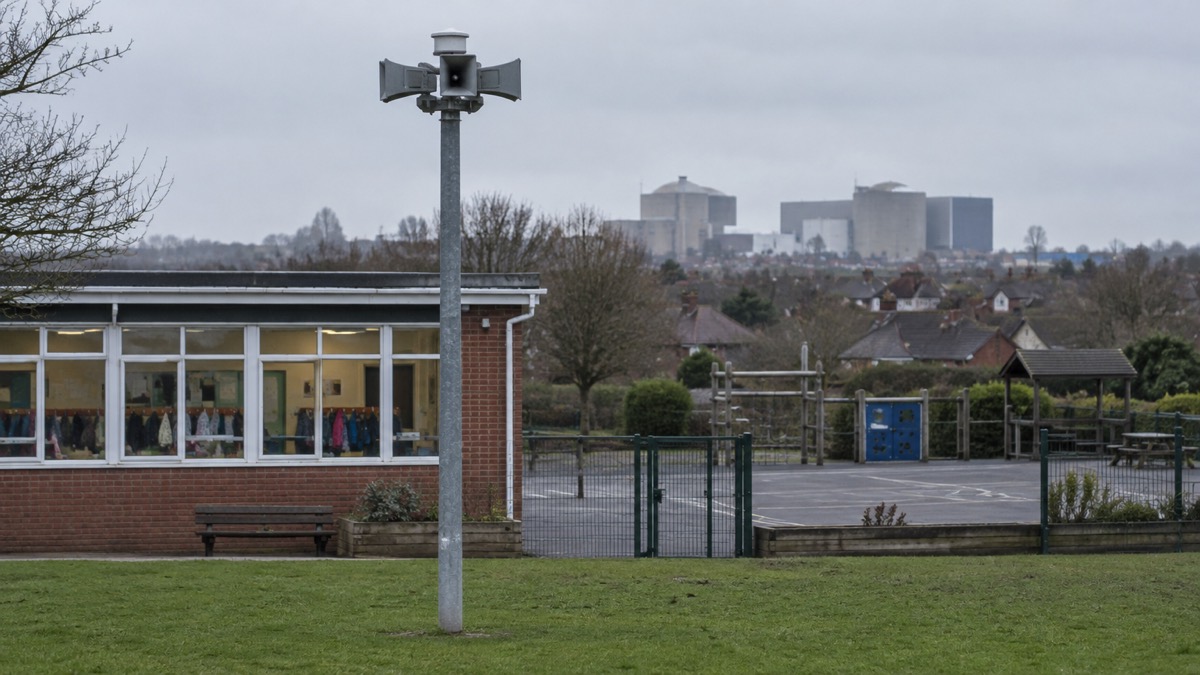
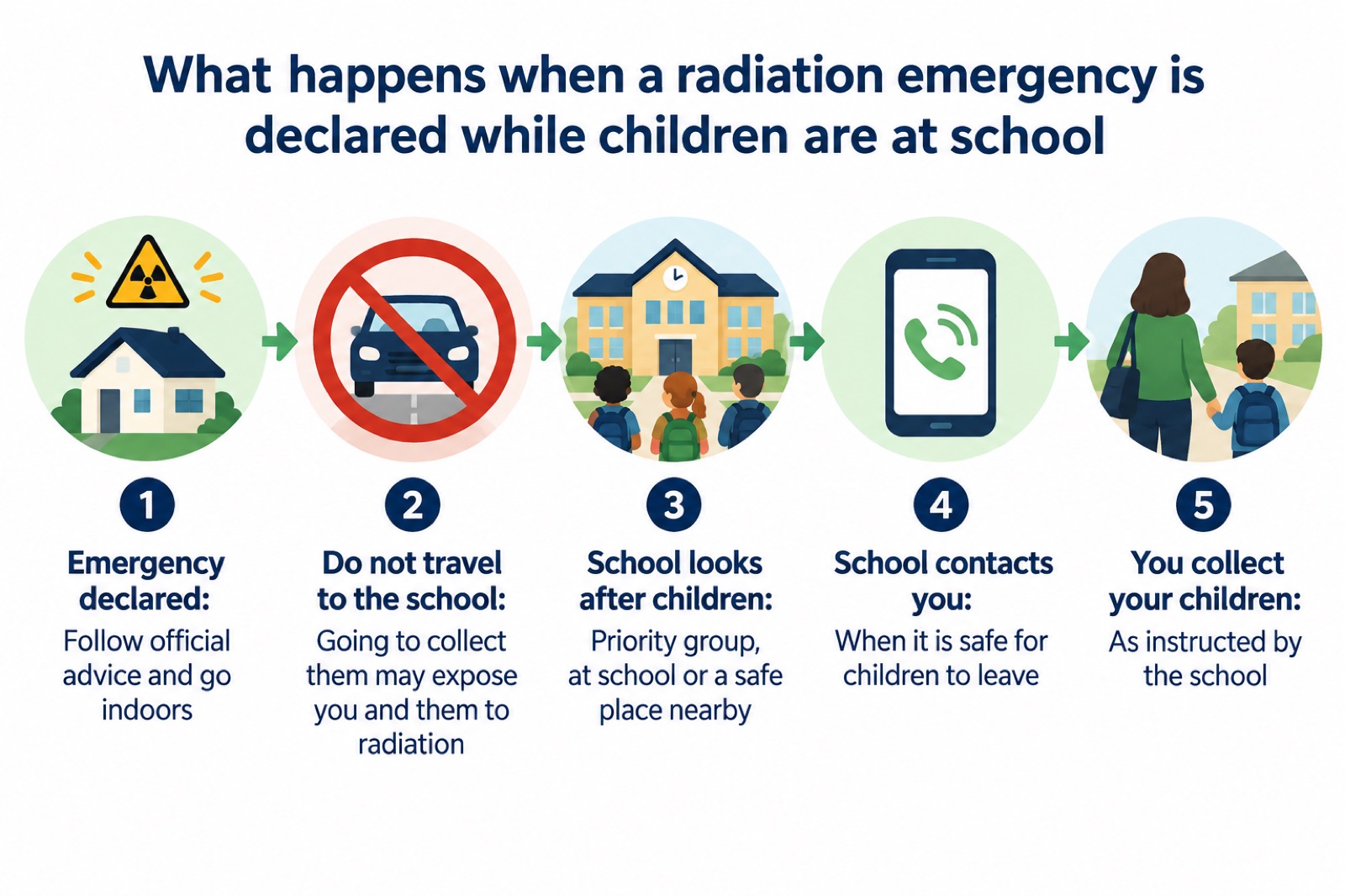
If there is a radiation emergency while your children are at school, the single most important thing you can do is not go to collect them. Official guidance for households near nuclear sites is consistent on this point: going to the school may expose you and your children to radiation, and the school will look after them until it is safe for them to leave1.
The school will contact you when it is safe to collect your children. Until then, your job is to shelter where you are, follow official advice, and keep the phone line free for the school to reach you. Children are treated as a priority group: they will be looked after either at the school or evacuated to a safe place, supervised by school staff and those responding to the emergency3.
This page sets out what the official guidance says, what the school will do, how you will be contacted, and what you can arrange now so that a frightening day is a manageable one.
Do not collect children from school during a radiation incident
The advice is the same across the official booklets issued to households near nuclear sites. Fareham Borough Council's guidance on the Michelmersh radiation emergency is blunt: "Do not collect your children from school unless instructed to do so as they will be looked after"6. Warwickshire's advice under the go in, stay in, tune in principle says the same: do not collect children from school unless you have been told to do so, because they will be properly cared for7.
The reason is exposure. Portsmouth's radiation emergency guide for residents explains that going to collect your children may expose you and them to radiation1. Southampton's 2024 leaflet repeats it: if your children are at school, the school will look after them, and going to collect them may expose you and them to radiation2. In a radiation emergency the safest place for most people is indoors, away from the plume and the routes around it. A journey to school and back puts you and your child on those routes.
The same principle applies to any emergency at a school, not only a radiation one. Lewisham Council's advice to parents is that if you hear there is an emergency at your child's school, please do not go to the school as it may not be safe to do so8.
The school will look after your children until it is safe
Schools plan for emergencies. Belfast City Council notes that all schools have plans to deal with local emergencies such as fire and flooding5, and Nottinghamshire's "Coping with a school emergency" provides guidance for schools on how to prepare for emergencies and produce their own emergency plan9. A radiation incident is one of the situations those plans cover.
For children near a nuclear site, the arrangements are more specific. The BAE Systems emergency booklet for the Barrow area states that schoolchildren will be looked after as a priority group, either at the school or evacuated to a safe place, where they will be looked after by school staff and those responding to the emergency3.
In the Portsmouth area, schools more than 1.5km from the naval base will be told about any incident by the council, and will look after any pupils whose parents live within the 1.5km zone and who may not be able to collect them1. Southampton's guidance is similar: students in schools well outside the 1.5km zone will be told about any incidents by the council, and the council will look after any pupils whose parents live within the 1.5km zone who may not be able to collect them2.
Some settings hold stable iodine tablets for the children in their care. Portsmouth's 2024 residents' booklet names St George's Primary School, Portsmouth Grammar School and Top Tots Day Nursery in the John Pounds Centre as settings that hold stable iodine tablets for all children and staff and will look after children in an incident10. If you live near a nuclear site, ask your child's school whether it holds tablets and what its plan says. For more on how tablets are used, see Stable Iodine Tablets: When to Take Them, Doses and Where to Get Them.
The school will contact you when it is safe to collect them
You will not be left guessing. The Portsmouth guidance says the school will look after your children and contact you when it is safe for children to leave1. If the school needs to be evacuated, children will be taken to a safe place nearby and the school will contact you to let you know what to do8.
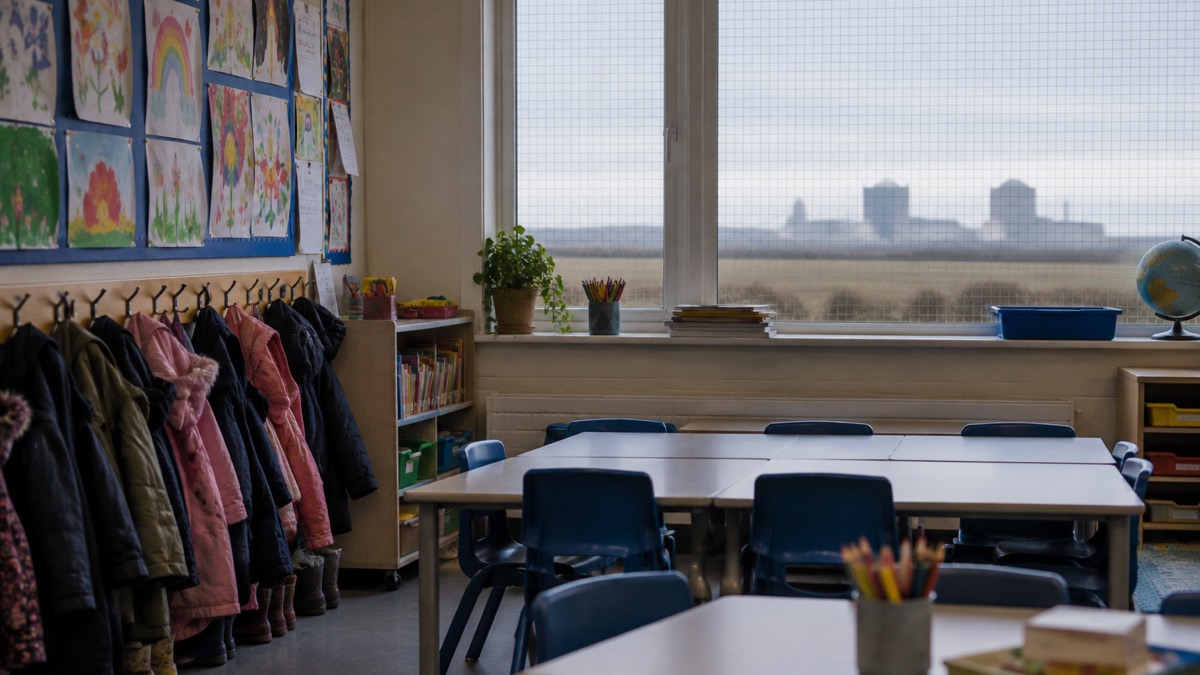
That contact depends on the school having the right numbers. The government's Be Ready campaign advises checking that your child's school has the correct contact numbers for you, and that it has plans for emergencies such as severe weather, loss of utilities and fire4. Do this now, before anything happens, and update it whenever your number changes.
During an incident, keep the line free. Portsmouth's booklet notes that its published number is for non-emergency queries only, and that in the event of an emergency you should check local news and social media for emergency helpline numbers, as a telephone helpline number will be released in the event of an emergency10. Lewisham's advice to parents is to contact your emergency contact at the school and look at the school's website8.
| What to do | Why |
|---|---|
| Check the school has your current numbers | If the school needs to be evacuated, children will be taken to a safe place nearby and the school will contact you to let you know what to do1 |
| Look at the school's website and local news | If you cannot collect your children from school, the school will follow their own emergency plans to keep your children safe2 |
| Contact your emergency contact at the school | The school's own route for parent queries2 |
| Keep calls short | The line needs to stay free for the school to reach you |
Plan now: who collects your children, and what they need
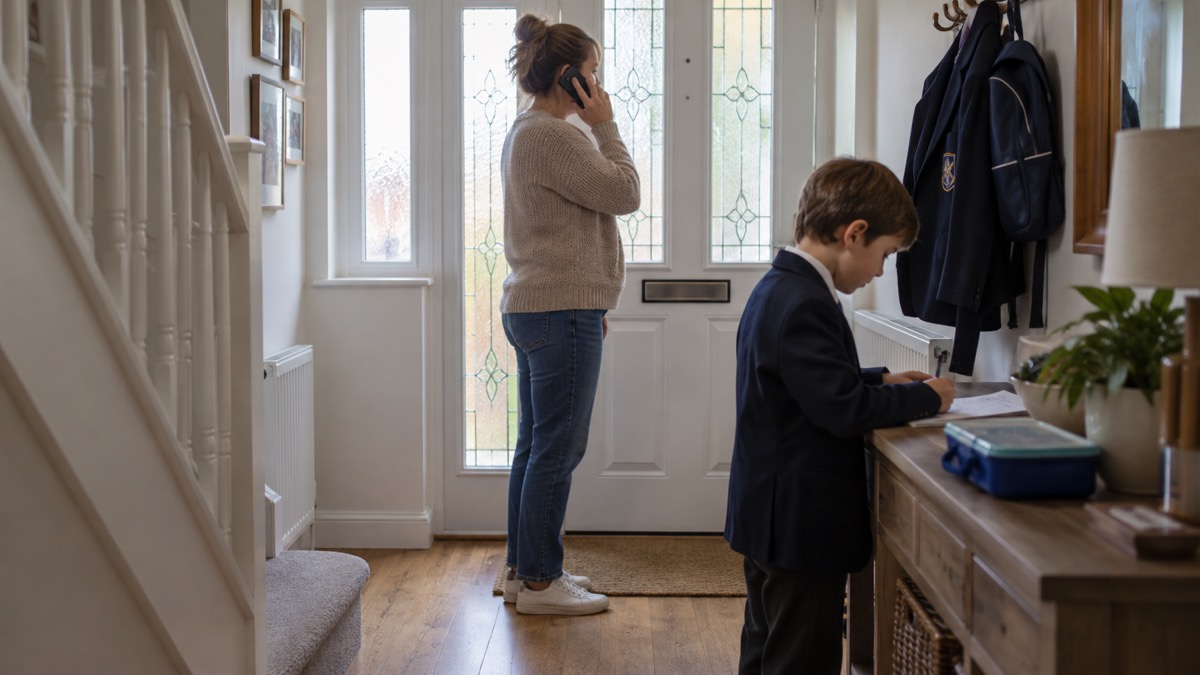
The time to decide who collects your children is before an emergency, not during one. Belfast City Council advises planning who you will ask to collect your children from school in an emergency if you are unable to do so5. Tell the school who that person is, and make sure they know too.
The same planning applies to nursery and childminding. The Portsmouth booklet's list of settings holding stable iodine tablets includes a day nursery, which shows that early years settings are part of the same arrangements10. Ask your nursery or childminder what its plan is and whether it holds tablets.
For older children who travel home alone, Cornwall Council's school travel guidance says that if providers do not consider it safe to travel, parents and carers are asked to make alternative arrangements for their child to get home12. Agree in advance where your child should go if transport is disrupted. Teach them how and when to call 999 and what to do in an emergency such as a fire at home13, and make sure they know how to reach you.
Medication is the other thing to settle. Wiltshire Council recommends spare medication in the household emergency kit14, and Dumfries and Galloway lists medication among the items to include15. Make sure the school knows about your child's medication and has what it needs. If your child has swallowed something they should not have, take them straight to A&E or phone 999 for an ambulance, and do not delay16. Go to the nearest A&E department or phone 999 if your child has red-flag symptoms such as choking, severe breathing difficulty, pale or blue skin, a seizure, severe tummy pain or difficulty swallowing, and bring the substance with you16.
Check your emergency booklet is the current edition
Households near nuclear sites receive information booklets through the door. Cumberland Council provides emergency information for Sellafield17, and the Devonport booklet, "What You Should Do if There Is a Radiation Emergency at the Devonport Site", is published every three years and distributed to households and businesses in the detailed emergency planning zones, with an Easy Read version available18.
Editions change, and old ones should not be kept as if current. Cumberland Council issued a new Sellafield emergency booklet in September 2023, replacing the 2021 green booklet, which should be recycled via your kerbside box19. Radiation emergency booklets carry a validity period: the Portsmouth residents' booklet runs from July 2024 to July 202710.
For more on the booklets and the zones they cover, see Living Near a Nuclear Site: Emergency Planning Zones and Information Booklets.
What to do on the day, step by step
- Stay where you are. Follow the official advice for your area, including going indoors and staying in if told to7.
- Do not go to the school. Going to collect your children may expose you and them to radiation1.
- Check local news and social media for emergency helpline numbers, which are released in an emergency10.
- Look at the school's website and contact your emergency contact at the school if you need to8.
- Wait to be contacted. The school will contact you when it is safe for children to leave1.
- If the school is evacuated, children will be taken to a safe place nearby and the school will contact you to let you know what to do8.
Where to get help and more information
If you need support after an emergency, seek it once you are home20. For households with extra needs, including children with medical conditions, see Extra Help in an Emergency: Older, Disabled and Medically Dependent Households.
For the wider picture on radiation emergencies, including sheltering and stable iodine, see What to Do in a Radiation Emergency and Go In, Stay In, Tune In: Sheltering From a Chemical or Radiation Release. If you live near a naval base, the arrangements for Portsmouth, Devonport and Southampton are set out in Radiation Emergency Plans at Portsmouth, Devonport and Southampton, and for Sellafield in Sellafield: Warnings, Planning Zone and What Nearby Residents Should Do.
Sources (20)
- Radiation emergency guide for residents, November 2023, Portsmouth City Council, 2023-11
- Radiation emergency leaflet for residents, 2024, Southampton City Council, 2024-07
- What to do in an Emergency Booklet 2023 to 2027, Westmorland and Furness Council, 2023
- Get prepared for emergencies, UK Government
- Emergency planning, Belfast City Council
- Michelmersh radiation emergency advice, Fareham Borough Council
- Emergency advice for residents, Warwickshire County Council
- Emergencies at school, Lewisham Council
- Council emergency plans, Nottinghamshire County Council
- REPPIR residents' booklet 2024, Portsmouth City Council, 2024-08
- Be ready for emergencies, UK Government
- Severe weather procedures for student travel, Cornwall Council
- Prepare yourself, Greater Manchester Combined Authority
- Planning for an emergency kit, Wiltshire Council
- Prepare for emergencies, Dumfries and Galloway Council
- Poisoning and accidental swallowing, Aneurin Bevan University Health Board
- Chemical and nuclear sites, Cumberland Council
- Devonport offsite emergency plan, Plymouth City Council
- Sellafield emergency booklet 2023, Cumbria County Council, 2023-09
- Recovering from an emergency, Essex Prepared
 Bomb Threat Calls
 Radiation Checklist First Hour
 Power Cut Kit Checklist
 Where to Hide in an Attack
 When Armed Police Arrive
 Young People in a Terror Attack
 Family Caught in an Attack
 Suspicious Letters and Parcels
 Reporting Terrorist Content
 Corrosive Attack First Aid
 Tap Water Safety
 Shelter or Evacuate
 Food After a Nuclear Accident
 Martyn's Law at Venues
 Sellafield Emergency Advice