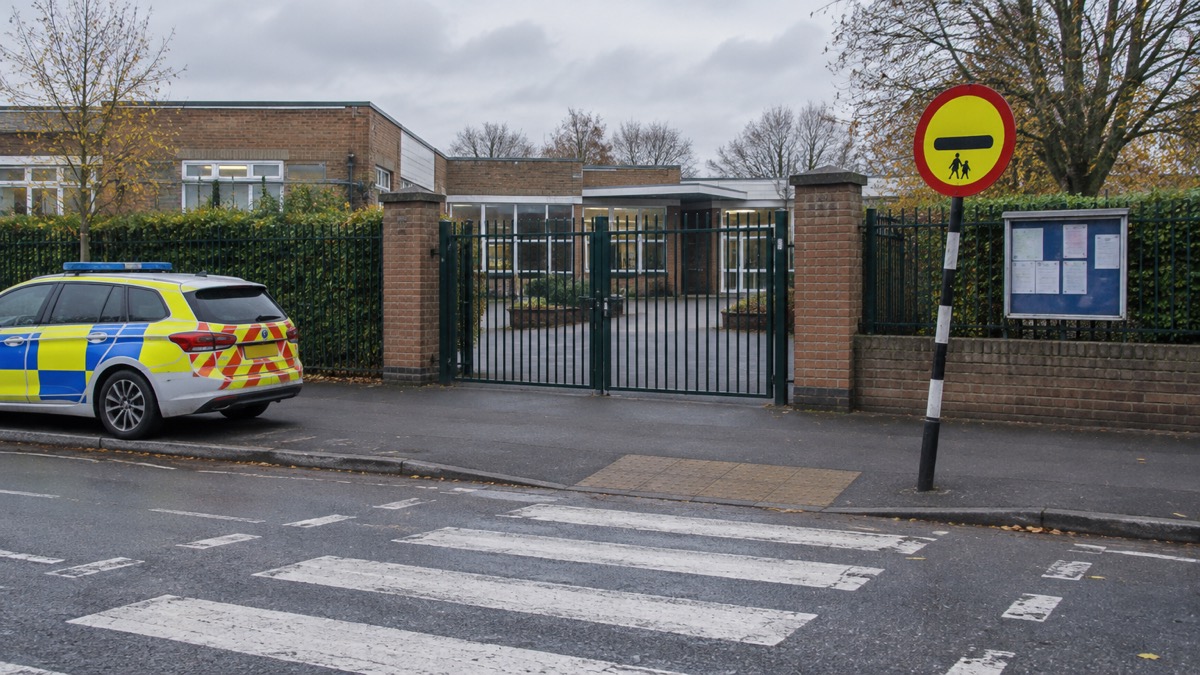
If something happens at your child's school, the first thing to do is nothing dramatic: do not drive to the gates. The school's main priority is the safety of the children, and staff will already be following the school's own emergency plan1. If the school has to be evacuated, children are taken to a safe place nearby and the school will contact you to let you know what to do1. Your job is to be reachable, to check the school's website and messages, and to follow the instructions you are given.
The preparation that matters most happens before anything goes wrong. Check that your child's school has your up-to-date contact details, and that it has plans for emergencies such as severe weather, loss of utilities and fire2. Every school should have plans and procedures in place for different types of emergencies, and all schools have plans to deal with local emergencies such as fire and flooding2. Knowing that, and knowing how your area's wider plan works, takes most of the worry out of the unknown.
Behind the school sits a local planning system. In England, Local Resilience Forums identify potential risks and produce emergency plans to either prevent or lessen the impact of any incident on their local communities4. Each forum publishes a Community Risk Register setting out the risks most likely to cause disruption in your region5. You do not need to memorise it, but a glance tells you what is most likely near your child's school, whether that is flooding, severe weather or something else.
Keep your contact details current, and know how the school will reach you
The single most useful thing a parent can do is make sure the school can reach them. Official guidance is consistent on this: check your child's school or childcare provider has your up-to-date contact details2. The same advice appears in the Scottish Government's household planning guidance7. It sounds trivial until the day it matters, when a school needs to tell you that children are being kept on site or moved somewhere safe.
Schools are expected to have plans in place. Your child's school should have plans and procedures to deal with different types of emergencies, for example severe weather, loss of utilities and fire2. In Lewisham, all schools are responsible for developing plans on how they will manage local emergencies such as fire and flood1. In Belfast, all schools have plans to deal with local emergencies such as fire and flooding3. The detail varies by school and by nation, but the principle does not: the school plans, and you are told what to do.
It also helps to know the school's procedures before you need them. Household emergency advice suggests you know the emergency procedures for your workplace and your child's school8. Ask at the office, or look on the school website, for how it would contact you and where children would go if the building had to be evacuated.
What to do while an incident is happening
The temptation in any school incident is to go and collect your child. Resist it. The school's plan will already have moved children to safety if needed, and the school will contact you to let you know what to do1. Arriving at the school can add to the congestion the emergency services are trying to manage, and it separates you from the information the school is trying to give you.
Instead, work through a short list:
- Check your phone for calls, texts and emails from the school, and check the school's website.
- If you have signed up for school closure alerts, watch for the notification by text or email when your school reports a closure6.
- Do not call the school repeatedly; the office may be dealing with the incident itself.
- Follow the instructions you are given, including where and when to collect your child if collection is arranged.
If the incident is wider than the school, such as severe weather or flooding, the same discipline applies. Local responders will be working to their plans, and the school will be working to its own. Your role is to stay contactable and to act on the instructions that reach you.
Who decides what happens near your child's school
Schools plan for their own buildings and children, but the wider response around them is planned by a local partnership. In England, a Local Resilience Forum is a multi-agency partnership that brings together Category 1 and Category 2 responders under the Civil Contingencies Act 2004 to coordinate planning, preparation and response for emergencies and major incidents within a specific geographical area10. You can read more about how these partnerships are built in our guide to Local Resilience Forums.
The membership is broader than most parents expect. Each region has a Local Resilience Forum made up of local authorities, the emergency services, the NHS and health bodies, and environment-related government agencies, set up to warn, inform and advise the public in the event of an emergency11. Most emergencies in the UK are handled at the local level by the emergency services, local authorities and other relevant organisations such as utility companies and transport operators10.
| Nation | Local planning body | How many |
|---|---|---|
| England | Local Resilience Forums | 3810 |
| Wales | Local Resilience Forums | 410 |
| Scotland | Regional Resilience Partnerships (the equivalent) | 35 |
| Northern Ireland | Emergency Preparedness Groups | Details from the Northern Ireland Civil Contingencies Policy Branch5 |
Most Local Resilience Areas follow police force boundaries, though not all do13. The North Wales Local Resilience Forum, for example, is based on the local police force area and brings together all the organisations involved14. If you are not sure which forum covers your child's school, your council's emergency planning pages will usually point you to it, and your forum publishes information online about the risks in your local area5.
Sign up for alerts before you need them
Alerts are the difference between hearing about a closure from the school and finding out at the gate. Some Local Resilience Forums offer a sign-up option for alerts to receive news and information about emergencies in your local area15. It is worth checking your forum's website once and signing up if the option exists.
School-specific alerts are separate. If you have signed up for alerts, you will also receive a notification by text or email when your school reports a closure6. Ask the school office how its closure notifications work, and make sure the mobile number and email address it holds are the ones you actually check.
Other alert schemes exist locally and are worth knowing about:
- Residents in some areas can sign up for free to receive alarms by SMS or email, for example where groundwater flooding is a risk16.
- Residents within the areas surrounding the Atomic Weapons Establishment can sign up for emergency notification alerts17.
- Official advice for storms and heatwaves alike is to sign up to receive alerts and information about risks in your area18.
Read your area's Community Risk Register
Every Local Resilience Forum publishes a Community Risk Register which sets out the different risks most likely to cause disruption in your region4. The register describes the risks present in the community and assesses how likely they are to lead to an emergency and the potential impact they would have5. For a parent, it is a short read that tells you what to plan for.
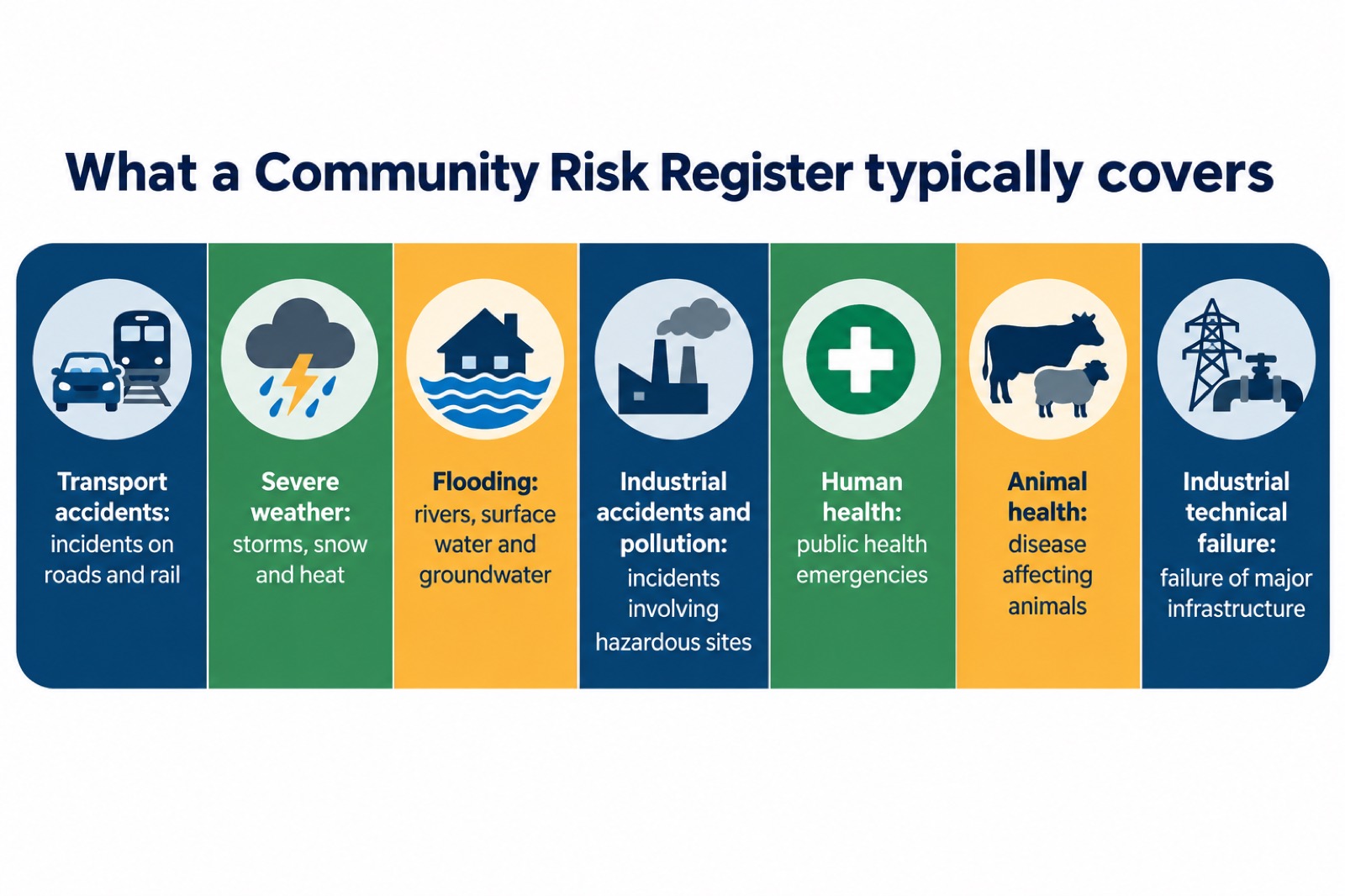
Typical hazard scenarios considered in a register include transport accidents, severe weather, flooding, industrial accidents and environmental pollution, human health, animal health, and industrial technical failure20. West Yorkshire's register, for example, provides an overview of the main risk areas for the area and aims to help communities be better informed, prepared and able to respond to an emergency21.
One caution from local guidance: the register mainly talks about relatively high-level threats, so use your own local knowledge to identify other local risks not included22. A school on a busy road, or at the bottom of a hill that floods, has risks the register will not name street by street.
Where to get help in England, Wales, Scotland and Northern Ireland
Help is organised differently in each nation, and knowing the right door saves time.
England. Your Local Resilience Forum publishes local risk information online5. For flooding, the Environment Agency provides the latest information, and Floodline is on 0345 988 118823. Your council's emergency planning team is the local contact for wider incidents, and many councils provide emergency planning guidance to schools25.
Wales. Natural Resources Wales provides flooding information23. Local Resilience Forums cover Wales, with four in total10, and your council's emergency planning pages set out local arrangements.
Scotland. The Scottish Environment Protection Agency provides flooding information23. The equivalent of Local Resilience Forums are Regional Resilience Partnerships, and details can be found on the Scottish Government's Ready Scotland website4.
Northern Ireland. NI Direct provides flooding information23. Details for the Emergency Preparedness Groups are available from the Northern Ireland Civil Contingencies Policy Branch4. The Education Authority can be reached on 028 9056 400026, and NI Direct's Be ready as a community page has information and resources on how communities can plan for emergencies27.
If your child has additional needs, ask your energy and water suppliers about priority help in an emergency28. The Priority Services Register is free and can mean you are contacted first when supplies fail.
Sources (28)
- Emergencies at school, Lewisham Council, 2026-09-14
- Be ready for emergencies, UK Government, 2026-10-21
- Emergency planning, Belfast City Council, 2026-10-29
- Check the risks where you are, UK Government, 2026-10-20
- Risks in Lancashire, Lancashire County Council, 2026-10-29
- Emergency school closures, Staffordshire County Council, 2026
- Emergency plan, Scottish Government, 2026-10-29
- Preparing for an emergency, Nottinghamshire County Council, 2026-10-29
- Surrey's Local Resilience Forum, Surrey County Council, 2026-10-28
- What is a Local Resilience Forum?, Essex Prepared, 2026-10-29
- Emergency alerts, Denbighshire County Council, 2026-10-26
- Who responds in Scotland, Scottish Government, 2026-03
- Local Resilience Forums, House of Commons Library, 2026-09-04
- Civil emergencies and emergency plan, Isle of Anglesey County Council, 2026-10-29
- Alerts, UK Government, 2026-10-20
- Local water alarm system, Lincolnshire County Council, 2026-10-29
- Emergency, Basingstoke and Deane Borough Council, 2026-10-29
- Storms and gales, Lancashire Prepared, 2026-10-29
- Heatwave, Lancashire Prepared, 2026-10-29
- Get prepared, Carmarthenshire County Council, 2026-10-25
- Know your risks, West Yorkshire Prepared, 2026-10-29
- Making your plan, Argyll and Bute Council, 2026
- Community resilience, Met Office, 2026-10-25
- Get flood warnings, UK Government, 2026-10-29
- Our role in emergency planning, Nottinghamshire County Council, 2026-10-29
- Emergency contact numbers, Belfast City Council, 2026-10-29
- Information for communities and community groups, UK Government, 2026-10-16
- Priority Services Register, Surrey County Council, 2026-10-28
 30-Day Household Checklist
 Emergency Plan Template
 Supply Interruption Checklist
 Housing After an Emergency
 Humanitarian Assistance Centre
 Be Ready Campaign