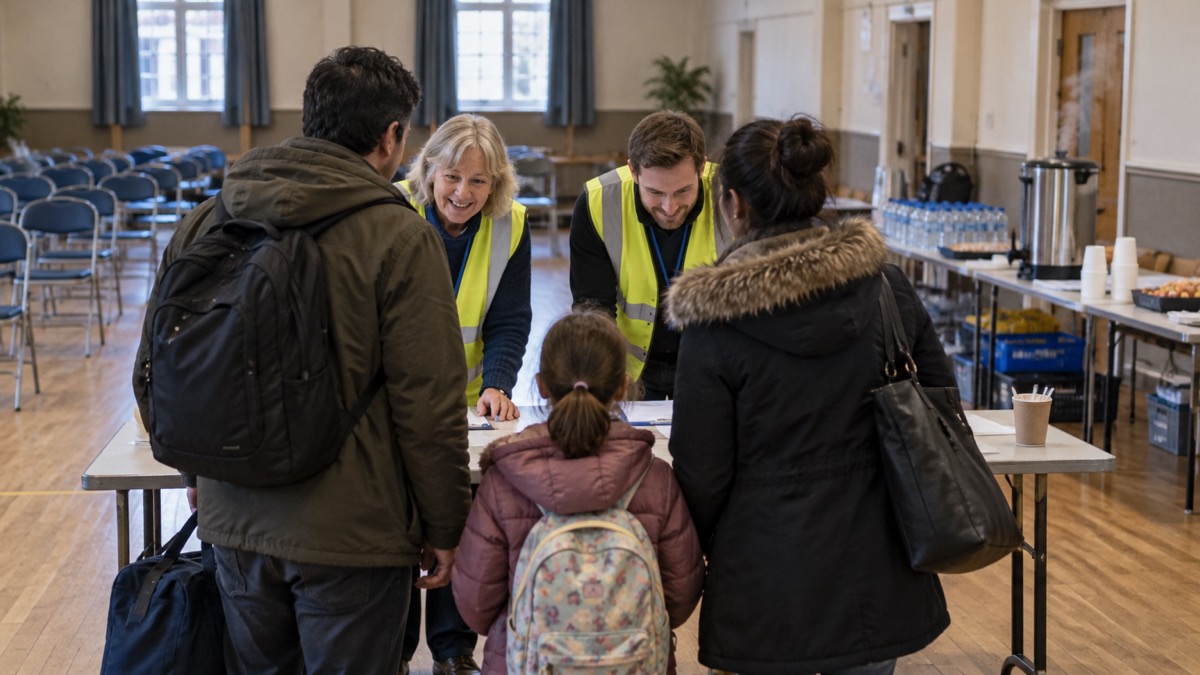
If a major emergency touches you or your family directly, the help you need is brought together in one place: a Humanitarian Assistance Centre. Its purpose is to act as a focal point for information and assistance to families and friends of those missing, injured or killed, and to survivors1. It is a one-stop shop, a safe and secure site for bereaved families, survivors and the wider community2.
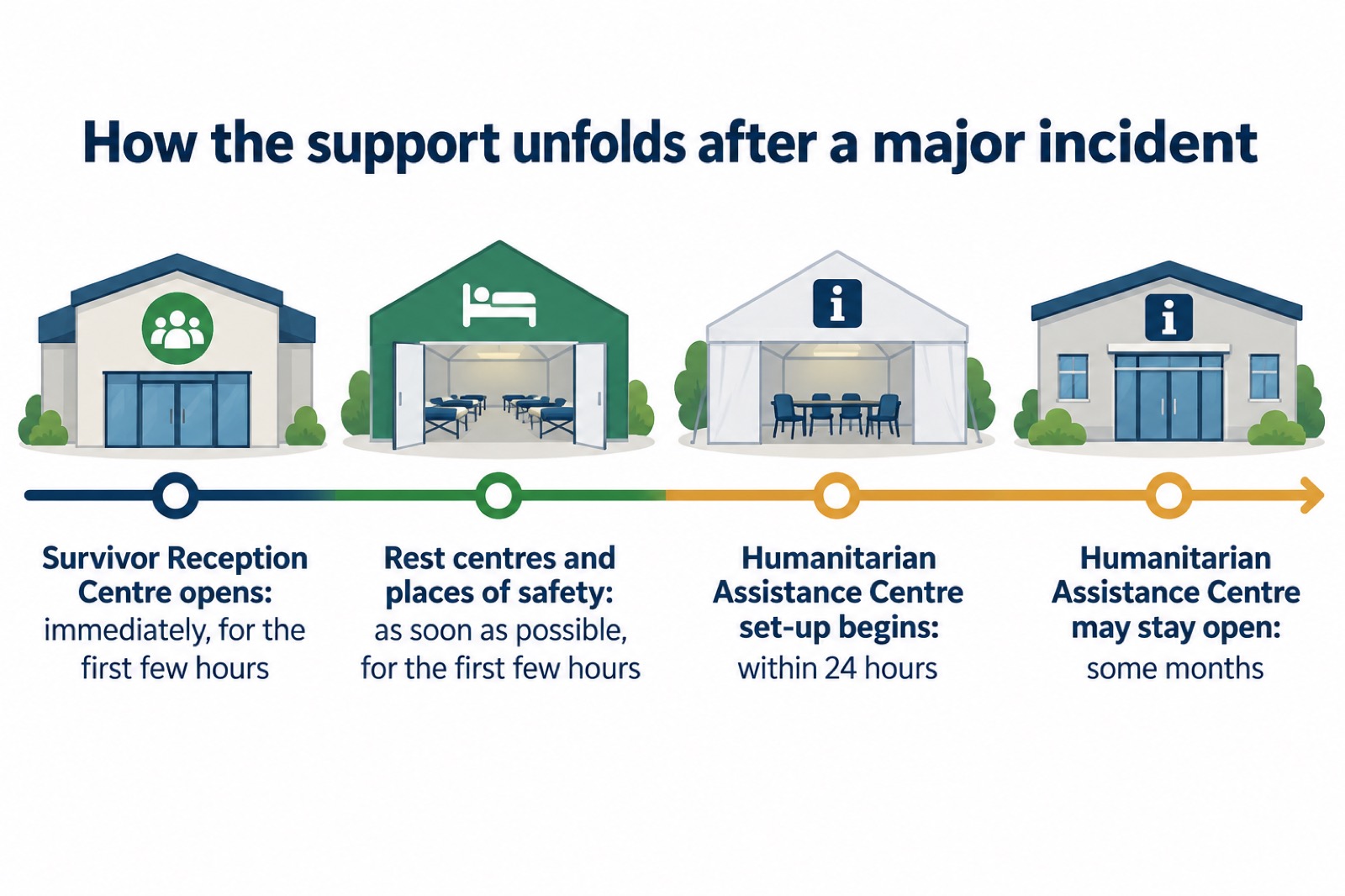
It is not the first place you go in the first hours. A Humanitarian Assistance Centre is set up within 24 hours of the incident and may stay open for some months2. In the immediate aftermath, other centres do different jobs: a Survivor Reception Centre opens straight away for people who do not need hospital treatment, and a Friends and Family Reception Centre gives family and friends arriving at the scene a secure place to be interviewed3.
Knowing the difference matters because it tells you where to go and when. If you are caught up in an incident, follow the instructions of the police and other responders on the day. If you are bereaved, worried about someone missing, or affected over the longer term, the Humanitarian Assistance Centre is the place built for you.
A focal point for families and survivors after a major emergency
The core of the idea is simple: rather than send people from office to office, a Humanitarian Assistance Centre brings information and assistance to one place. Cornwall Council describes it as a formally developed structure offering a one-stop-shop for information and assistance, with the focus on a safe and secure site for bereaved families and friends of those missing, injured or killed, survivors and the wider community2. Nottinghamshire's plan uses almost the same words: a focal point for information and assistance to families and friends of those missing, injured or killed, and to survivors, and to all those directly affected by an emergency or major incident1.
That "all those directly affected" is wider than it sounds. It covers the person who was there, the relative waiting for news, the neighbour who saw what happened, and the wider community that feels the shock of it. The centre exists so that none of them has to work out alone which organisation holds which piece of information.
It also exists because information is the thing people most need and least have in the aftermath of a disaster. A centre gives one place where the police, the council, health services and voluntary organisations can share what is known, and where you can ask a person rather than chase a phone line.
Who a centre helps: the missing, injured and bereaved, and those close to them
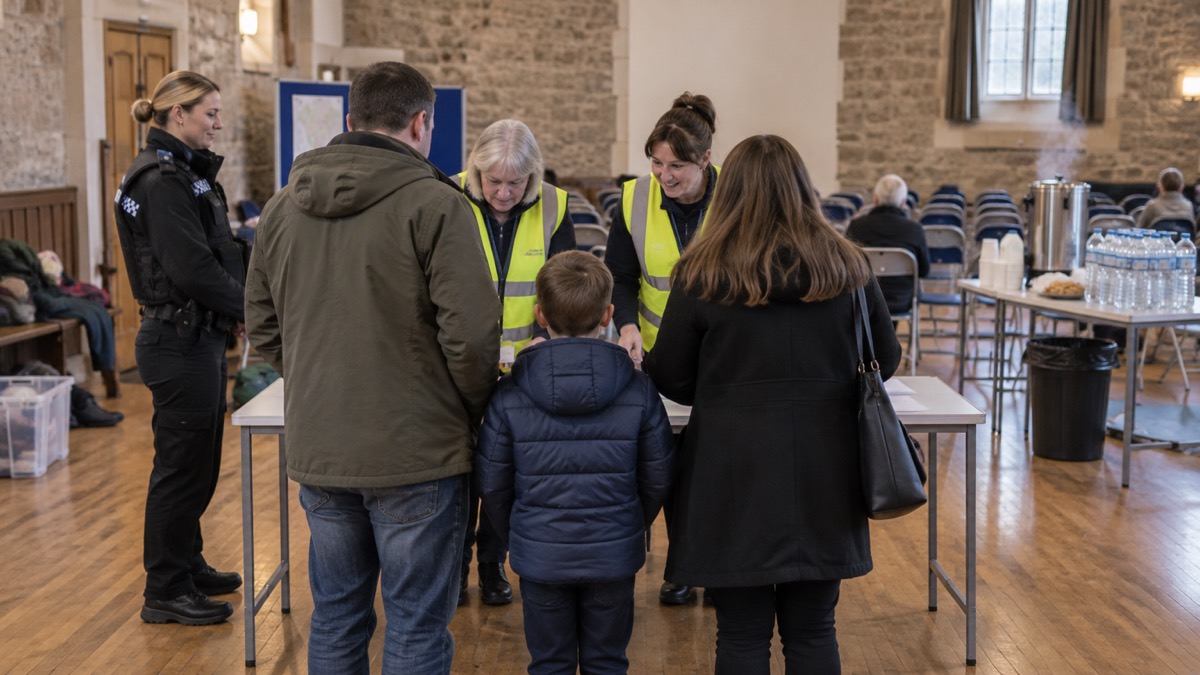
The people a Humanitarian Assistance Centre is built for are named plainly in council plans: the families and friends of those missing, injured or killed, and survivors5. If you are in any of those positions, the centre is for you, and you do not need to prove anything to walk in.
Around that core group, other support is arranged. Rest centres, which shelter people evacuated from their homes, provide registering and recording of evacuees so they receive appropriate support, catering, help arranging longer-term accommodation, first aid, a way to contact family and friends, and information on the emergency and its impacts6. Those functions overlap with what an assistance centre does for people affected more deeply.
Some households need more than information. Social services are responsible for looking after elderly, infirm and vulnerable people7, and community and voluntary organisations such as faith groups, Community Councils and resident groups may provide hot food or shelter8. If someone in your household depends on electricity for medical equipment or has mobility needs, ask your energy supplier about priority help in an emergency9, and see our guide to extra help in an emergency for the wider picture.
| Centre | Who it is for | When it operates |
|---|---|---|
| Survivor Reception Centre | Survivors not needing acute hospital treatment, for short-term shelter, first aid, interviews and documentation3 | Opened immediately, for the first few hours2 |
| Friends and Family Reception Centre | Family and friends arriving at the scene or a related location such as an airport or port3 | Immediate aftermath3 |
| Rest Centre | People evacuated from their homes, needing shelter, warmth, food and refreshment10 | As soon as possible, for the first few hours2 |
| Humanitarian Assistance Centre | Bereaved families, friends of the missing, survivors and the wider community2 | Set-up begins within 24 hours, may last some months2 |
Larger than a rest centre: when a Humanitarian Assistance Centre opens
A Humanitarian Assistance Centre is a bigger thing than a rest centre, and it opens for a bigger reason. Reigate and Banstead's plan puts it directly: Humanitarian Assistance Centres are much larger and may be necessary when there is a wider area, or areas, impacted by a catastrophic event3. A rest centre is the response to a street or a neighbourhood being evacuated. An assistance centre is the response to an event that has touched a whole district or more.
The timing follows from that. Set-up begins within 24 hours, and the centre may be of some months in duration2. Compare that with the centres that run in the first hours: a Survivor Reception Centre is opened immediately and remains in operation for the first few hours following an event2. The assistance centre is the long arm of the response, there for the weeks and months when the immediate emergency is over but the consequences are not.
The same plan describes a Community Assistance Centre, which is also a one-stop shop for survivors, families, friends and all those impacted by a disaster, through which they can access support, care and advice3. The two names describe the same kind of help at different scales.
Who runs it: your Local Resilience Forum and its partners
No single organisation runs a Humanitarian Assistance Centre. It is a multi-agency effort, and the body that coordinates it is your Local Resilience Forum. Each region across the country has one, made up of local authorities, the emergency services, the NHS and health bodies, and environment-related government agencies, set up to warn, inform and advise the public in the event of an emergency4. In England, these partnerships include representatives from local public services, the emergency services, local authorities, the NHS, the Environment Agency and other organisations involved in emergency preparedness, such as utilities providers11.
The work is shared. Nottinghamshire County Council contributes to the running of assistance centres5, and its emergency accommodation plan sets out how the council will work with the police, fire and ambulance services, district and borough councils and voluntary agencies where a rest centre needs to be set up1. Highland Council's emergency planning team supports multi-agency arrangements that provide emergency accommodation, welfare support and transportation for people evacuated from their homes12.
Voluntary organisations are part of the picture too. The Salvation Army can respond to emergencies by providing on-site refreshments and emotional support to responders and those affected, support at rest centres or Humanitarian Assistance Centres, support to family and friends at an emergency mortuary viewing area, and personnel to assist at any support helpline set up following an emergency13. Councils also call out voluntary agencies such as the British Red Cross and the Royal Voluntary Service14.
For the wider machinery behind this, see Local Resilience Forums: What They Do and How to Find Yours and Category 1 and Category 2 Responders: Who They Are.
Finding out what is planned for your area
You cannot know in advance where a centre would be set up, but you can find out how your area plans to look after people, and you can make sure you would hear about it. Start with your Local Resilience Forum, which will publish information online about the risks in your local area15. Each forum publishes a Community Risk Register setting out the different risks most likely to cause disruption in your region15.
Then look at your council. Nottinghamshire's emergency plans, for example, set out how the council works with other agencies where a rest centre needs to be set up1. If you are involved in a community group, you can talk with the council to see what help the community could give to set up places of safety or rest centres16. Community venues such as village halls, faith group meeting places, sports clubs or parish halls are the kind of places used for community emergency information hubs17.
Make sure alerts can reach you. Some Local Resilience Forums offer a sign-up option for alerts to receive news and information about emergencies in your local area18, and the Government's Prepare website keeps a list of trusted sources of alerts and warnings19. Your Local Resilience Forum will also publish information online about the risks in your local area20.
- Check your risk: read your Local Resilience Forum's Community Risk Register15
- Sign up for alerts: use your forum's sign-up if it has one, or the trusted sources listed by Prepare18
- Know your council's plan: look at your council's emergency planning pages1
- Ask about community plans: contact your council to find out what community plans already exist21
- Join a community effort: community flood warden schemes and information hubs are supported by councils21
What a Community Risk Register tells you
The Community Risk Register is the document that tells you what your area is actually planning for. It informs you about the highest risks in the county and their consequences, details steps to become better prepared and more resilient, and provides links to organisations and websites to find out more22. It is based on a combination of the UK Government's National Risk Register, professional judgement, historical evidence, scientific input and expert analysis22.
Different forums publish theirs in different forms. West Yorkshire Prepared's register provides an overview of the main risk areas for West Yorkshire and aims to help communities be better informed, prepared and able to respond to an emergency23. Reading yours is the single most useful thing you can do to understand why a Humanitarian Assistance Centre might one day be needed near you, and what kind of event would trigger it.
For more on reading these documents, see The National Risk Register: What It Says and How to Read It and Likelihood and Impact: How Emergency Risks Are Scored.
The law and the partners behind the centre
The framework that requires local organisations to plan for this is the Civil Contingencies Act 2004. The Act and supporting regulations and statutory guidance, Emergency Preparedness, establish a clear set of roles and responsibilities for those involved in emergency preparation and response at the local level24. The Met Office, for example, has a key role under the Act to provide information to Category 1 and 2 responders25.
Local Resilience Forums are multi-agency partnerships26, and their purpose is to identify potential risks and produce emergency plans to either prevent or lessen the impact of any incident on their local communities15. In Greater Manchester, emergency services, local authorities and a wide range of partner agencies come together to coordinate and oversee emergency planning27. Lincolnshire's forum works closely with partner organisations including the emergency services, voluntary groups, community groups and local authorities to coordinate a fast, effective response28.
Utility companies sit inside this structure as well. A flood response plan is produced by the Local Resilience Forum, consisting of representatives from the Environment Agency, emergency services, local authorities, utility providers and many other organisations1. Water companies will assist where possible to reduce the amount of water escaping from the system and will tidy up areas where sewage has been deposited once flooding has subsided7.
For the legal background, see The Civil Contingencies Act 2004: What It Requires.
How the four nations differ
The Humanitarian Assistance Centre model is described in the same terms in English council plans, but the structures around it vary across the UK.
In Wales, there are four Local Resilience Forums, which complement the oversight and leadership provided through the Wales Resilience Forum and Wales Resilience Partnership29. Your local resilience forum can tell you about the local arrangements for flooding, as well as other emergencies30. The North Wales Local Resilience Forum is based on the local police force area and brings together all the organisations involved24.
In Scotland, community emergency planning guidance points people to their local authority, Community Council, local councillors, the emergency services and voluntary organisations active in the area such as mountain rescue teams, St Andrews First Aid, the Royal Voluntary Service and the British Red Cross28. Highland Council's emergency planning team supports multi-agency arrangements providing emergency accommodation, welfare support and transportation for evacuees12.
In Northern Ireland, the Northern Ireland Ambulance Service operates from one Emergency Operations Centre in Belfast31, and the Red Cross and St John Ambulance offer first aid training courses32.
| Nation | Who to look to for local arrangements |
|---|---|
| England | Your Local Resilience Forum and its Community Risk Register15 |
| Wales | One of four Local Resilience Forums, alongside the Wales Resilience Forum and Wales Resilience Partnership29 |
| Scotland | Your local authority, Community Council, councillors, emergency services and voluntary organisations28 |
| Northern Ireland | The Northern Ireland Ambulance Service and voluntary organisations such as the Red Cross and St John Ambulance31 |
Where to get help on the day
If an incident happens, the first instruction is to follow what the emergency services tell you. Beyond that, the help available to an affected household comes from several directions at once.
Your council coordinates the local response, including alerting and calling out other council officers and voluntary agencies such as the British Red Cross and the Royal Voluntary Service, and liaising with the emergency services or utility providers14. Social services look after elderly, infirm and vulnerable people7. Community and voluntary organisations may provide hot food or shelter8. The Salvation Army can support family and friends at an emergency mortuary viewing area and act as a conduit for relevant faith support13.
If you have lost your home, see Who Houses You If an Emergency Leaves You Homeless. If you have pets, West Yorkshire Prepared's guidance on animals is a useful starting point10. And if you are unsure what has happened or what to do next, the Major Incidents: A Household Guide to Terror Attacks, Chemical and Radiation Emergencies sets out the general steps.
Sources (32)
- Council emergency plans, Nottinghamshire County Council, 2026-10-29
- Reception centres, Cornwall Council, 2026-10-29
- Emergency plan, Reigate and Banstead Borough Council, 2026-10-29
- Emergency alerts, Denbighshire County Council, 2026-10-26
- Our role in emergency planning, Nottinghamshire County Council, 2026-10-29
- Emergency preparations you can do, Moray Council, 2026
- Flooding advice, Mid and West Wales Fire and Rescue Service, 2026-10-29
- Partnership working in a real emergency, Ready Scotland, 2026-03
- Priority Services Register, Surrey County Council, 2026-10-28
- Pets, West Yorkshire Prepared, 2026-10-29
- Check the risks where you are, Prepare, 2026-10-20
- Emergency planning, Highland Council, 2026-10-29
- Community involvement, Dorset Prepared, 2026-03-25
- Roles and responsibilities of emergency responders, Argyll and Bute Council, 2026
- Be ready for emergencies: check the risks where you are, Be Ready, 2026-10-20
- Making your plan, Argyll and Bute Council, 2026
- Set up a community emergency information hub, Surrey County Council, 2026-06-01
- Alerts, Prepare, 2026-10-20
- Prepare your community, Greater Manchester Combined Authority, 2026-10-29
- Emergency, Basingstoke and Deane Borough Council, 2026-10-29
- Community flood planning, Thurrock Council, 2026-10-29
- Community Risk Register, Gloucestershire County Council, 2026-05-19
- Know your risks, West Yorkshire Prepared, 2026-10-29
- Civil emergencies and emergency plan, Isle of Anglesey County Council, 2026-10-29
- Online community resilience training prospectus, Met Office, 2026-02
- Local Resilience Forums, House of Commons Library, 2026-09-04
- Pandemic and infectious disease, Greater Manchester Combined Authority, 2026-10-29
- Who to work with, Ready Scotland, 2026-03
- Statement on resilience and emergency preparedness, Welsh Government, 2026-10-13
- Community flood plan, Natural Resources Wales, 2026-10-29
- Emergency response, Northern Ireland Ambulance Service, 2026-10-29
- Household emergency kit, nidirect, 2026-07-06
 30-Day Household Checklist
 Emergency Plan Template
 Supply Interruption Checklist
 Housing After an Emergency
 School Emergency for Parents
 Be Ready Campaign