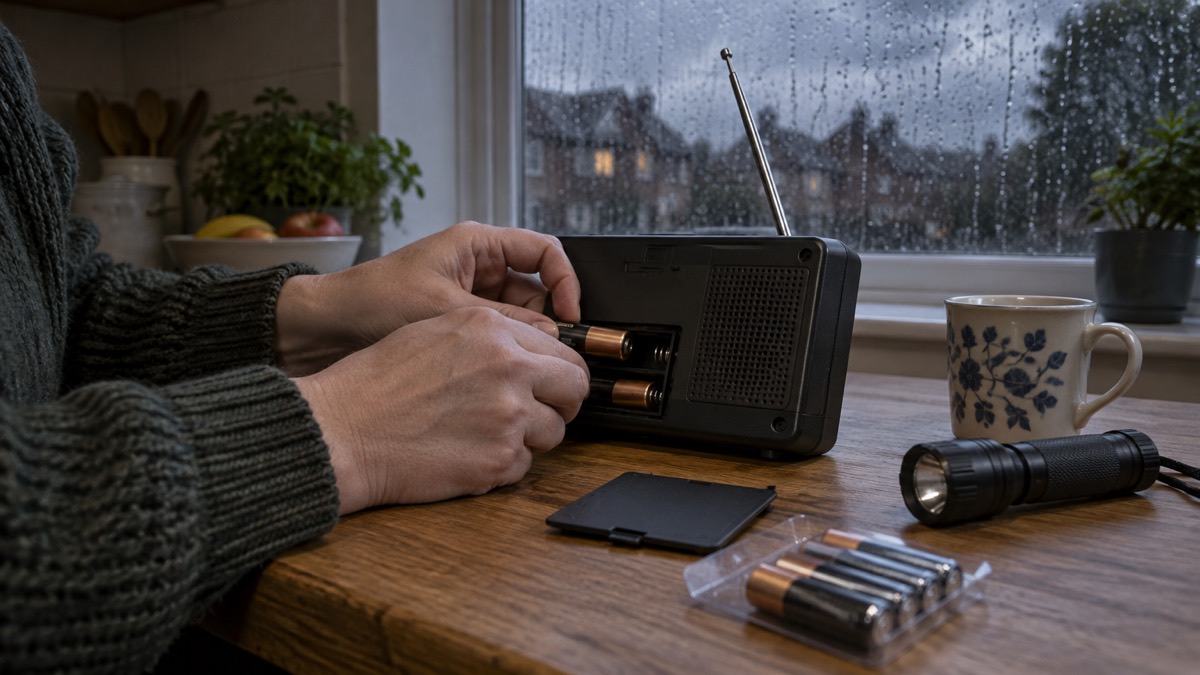
When an emergency is unfolding, the single most useful thing a household can do is know where to look. The UK government's advice is simple: in an emergency, pay attention to official sources of information, meaning the websites and social media accounts of local authorities, government agencies and emergency services, plus messages sent to your mobile phone by the UK Government Emergency Alerts service1. In Scotland, the Ready Scotland campaign adds local radio, TV and the internet to that list2.
Most of this you can set up in advance, and that is the real work. The Met Office issues weather warnings 24 hours a day, 365 days a year3, and you can have them pushed to you free by email or app4. Emergency Alerts arrive on your phone automatically when lives are in danger, with no sign-up and no need to enable location services5. Your Local Resilience Forum publishes the risks most likely to disrupt your area6, and if you are at risk of flooding there is a free warning service you can register with by phone, text or email7.
This page walks through each of those sources in turn: what it is, what it tells you, how to sign up, and how to keep receiving it when the power or the mobile network is down.
The official sources to check first
When something is happening, start with the sources the government itself names. The Prepare campaign, the UK government's emergency preparedness guidance, tells households to pay attention to the websites and social media accounts of local authorities, government agencies and emergency services, and to messages on your mobile phone from the UK Government Emergency Alerts service1. Ready Scotland gives the same list and adds local radio, TV and the internet2.
In practice that means a short list you can check in a few minutes:
- The Met Office warnings page or app, for weather warnings covering your area3
- Your local council's website and social media accounts, for local incident news, road closures and rest centres1
- Your police force and fire and rescue service social media accounts, for incident updates1
- Local radio, which Argyll and Bute Council notes will broadcast up-to-date information on the situation, including advice on what you should do and where to get further details10
- Your phone, for an Emergency Alert if lives are in danger5
Moray Council describes how this works in a real emergency: information will be available on local radio stations, on social media, at Rest Centres or other facilities, and on emergency services and council websites11. That is worth remembering for the worst case: if you have to leave your home and go to a rest centre, that is one of the places official information will be posted.
The reason for sticking to official sources is not bureaucracy. During a fast-moving incident, rumour travels faster than fact, and acting on wrong information can put you in more danger, not less. The government's own guidance is to treat official channels as the ones to act on1. For help judging what you see on social media, see our page on how to avoid false information in an emergency.
If the power is out or the mobile network is down, the same sources still exist but you reach them differently. A battery or wind-up radio gets you local radio, and our guides on emergency radios and which radio stations to tune into during a power cut cover that in detail. For everything else, see what to do when phones and the internet go down.
Met Office weather warnings: what the colours mean
The Met Office is the UK's official weather service and is responsible for issuing weather warnings, which warn of impacts caused by severe weather12. Its National Severe Weather Warning Service issues yellow, amber and red warnings, which advise when to be aware, be prepared and take action13. The colour is set by a combination of the impact the weather may have and the likelihood of that impact occurring14.
| Colour | What it means | What to do |
|---|---|---|
| Yellow | Yellow warnings can be issued for a range of weather situations, and people in the warning area will see disruption to a greater or lesser extent15 | Check the details of the forecast and consider taking steps to minimise impacts for you and your household16 |
| Amber | Disruption is more likely and more widespread16 | Change plans that could be impacted by the weather and take action to protect yourself and your property16 |
| Red | Very dangerous weather with a high level of certainty; likely risk to life and substantial disruption to travel and infrastructure16 | Take direct action to keep yourself and others safe from the impacts of the weather16 |
Two points from the Met Office are worth dwelling on. First, yellow warnings can cover very different weather situations, so the warning text matters as much as the colour: a yellow warning for thunderstorms is a different proposition from a yellow warning for snow, and the warning text tells you which. Second, the warnings are based on impacts, not on raw weather numbers: the Met Office issues local weather warnings based on the level of impacts and the likelihood of them occurring17. That is why the same snowfall can be a red warning in one county and no warning at all in another.
Wiltshire and Swindon Prepared, a Local Resilience Forum, spells out what an amber warning tends to mean in practice: the possibility of travel delays, road and rail closures, power cuts and the potential risk to life and property18. If you see amber for your area, that is the moment to act on the practical steps in our power cuts and storms, snow and ice guides rather than simply watching the forecast.
The warnings are designed for people, businesses, emergency responders and governments12, so the advice in them is written with households in mind. You can find current warnings on the Met Office website at weather.metoffice.gov.uk/warnings-and-advice/uk-warnings3, and the site also shows warnings for coming days15.
Warnings are issued 24 hours a day, 365 days a year
The Met Office operates 24 hours a day, 365 days a year, so warnings can be issued at any time, day or night14. The Met Office makes the same point in its own seasonal advice in more human terms: it is a 24 hour organisation and therefore warnings can be issued at any point, even Christmas Day18.
This matters for two reasons. The first is that a warning can arrive overnight. A storm that intensifies at 3am can produce an amber warning at 3am, and if you only check the forecast in the morning you may have missed several hours of notice. Having alerts pushed to you, rather than relying on remembering to look, closes that gap.
The second is that severe weather does not respect holidays. The practical habit to build is the one Essex Prepared recommends: check the weather forecast regularly, because the Met Office provides forecasts for locations around the country19. Lancashire Prepared's storm advice is similar: stay informed, look at the weather forecast and check the Met Office for weather warnings and details of risk in your area17.
How to get Met Office alerts by email, app and social media
Rather than checking, you can have warnings come to you. The National Severe Weather Warning Service is accessible through the Met Office app and website, social media, TV and radio14, and the Met Office recommends signing up to its email alerts or downloading its Weather App to stay updated with the latest forecast details12.
Email alerts. The Met Office offers a free email alert service. You enter your email address and choose your subscription options, which include news releases, blogs and weather warnings4. For weather warnings you can choose the regions you want: the list covers all of the UK, from Orkney and Shetland, Highlands and Eilean Siar, Grampian, Strathclyde, Central Tayside and Fife, and SW Scotland, Lothian Borders, through Northern Ireland and Wales, to the English regions including North West England, Yorkshire and Humber, the West Midlands, East of England, South West England, and London and South East England4. Pick your own region and any you travel through regularly. One limitation to know: the email contains a hyperlink to the warning, so as long as you are connected to the internet you will be able to access the information by clicking it4. The email itself is a nudge, not the full warning.
The app. Surrey's sign-up guidance for residents is to get the Met Office App, including alerts, on your smartphone20. The app shows you the warning map and the full warning text without needing email.
Social media, TV and radio. The Met Office publishes warnings through its social media accounts, and warnings are also carried on TV and radio14. Local radio is the fallback that works without any internet connection at all, which is why councils point to it during emergencies10.
Moray Council's emergency preparations guidance sums up the sign-up route: you can sign up for free email alerts to keep up to date with weather warnings11. For a fuller checklist of alert services worth registering with before anything happens, see our page on free alert services to sign up for before an emergency.
Emergency Alerts on your phone
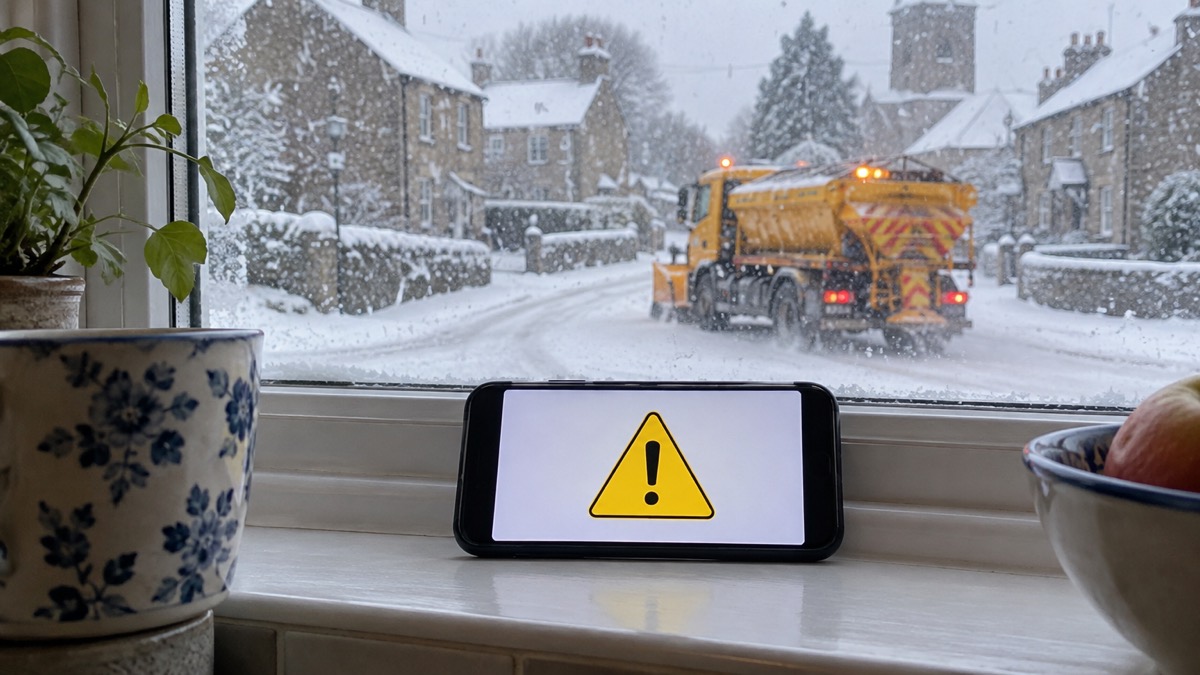
Emergency Alerts is a UK government service that will warn you if there is a danger to life nearby21. It is used to warn people about serious incidents where there is a risk to life22, and examples of situations that may lead to an alert include severe flooding, fires and extreme weather5. You may get alerts about any type of life threatening emergency, such as wildfires, severe flooding and extreme storms23.
The system works without any effort on your part. Alerts are sent to your mobile phone or tablet based on your current location, and you do not need to turn on location services to receive alerts5. The organisations sending them do not need to know your phone number or location21. Alerts can be sent by the UK Government, the Scottish Government or other public bodies that deal with emergencies, for example the police or your local council2.
When an alert arrives, it will include a phone number or a link to the GOV.UK website for more information23. To check that an alert is genuine, go to gov.uk/alerts9. Denbighshire Council adds a sensible fallback: if in doubt, contact neighbours, friends or family in the nearby area to check whether they have received it too24.
You can opt out of receiving emergency alerts, with instructions for different devices at www.gov.uk/alerts/opting-out24, though the government's position is that the system warns you about life-threatening emergencies and gives advice on what to do2. If an alert sounds while you are driving and there is nowhere safe and legal to stop and no one in the vehicle to read it for you, you can listen to news on live radio to find out about the emergency5.
We cover this system in much more detail on our Emergency Alerts page, including which phones are compatible, what to do when you receive one, what to do if one sounds while driving and how to get warnings without a mobile phone.
Your Local Resilience Forum: local risks and emergency plans
Most emergencies in the UK are handled at the local level by the emergency services, local authorities and other relevant organisations such as utility companies and transport operators25. The body that coordinates that local planning is your Local Resilience Forum. Local Resilience Forums identify potential risks and produce emergency plans to either prevent or lessen the impact of any incident on their local communities6. Each is made up of local authorities, the emergency services, the NHS and health bodies, and environment-related government agencies, set up to warn, inform and advise the public in the event of an emergency24.
The most useful thing a Local Resilience Forum publishes for households is its Community Risk Register, which sets out the different risks most likely to cause disruption in your region6. Reading it tells you what your area actually plans for, whether that is flooding, severe weather, industrial sites or loss of essential services, and that is a sound basis for deciding what your own household prepares for. Anglesey Council describes the equivalent North Wales register as providing information on the biggest emergencies that could happen in the region26.
Some Local Resilience Forums go further and offer a sign-up option for alerts, to receive news and information about emergencies in your local area21. Check your local forum's website for that option. Thames Valley's forum, for example, publishes further information at www.thamesvalleylrf.org.uk27.
Your council's emergency planning team is the other local contact. Argyll and Bute Council invites residents to contact its Civil Contingencies Unit by email for further information, help or guidance on preparing for emergencies10, and the Royal Borough of Windsor and Maidenhead publishes an emergency planning email address alongside its home emergency plan28. Look for the equivalent contact on your own council's website.
Who runs local emergency planning in each nation
The structure differs across the UK, and it is worth knowing which body covers you so you are looking in the right place.
| Nation | Body | Notes |
|---|---|---|
| England | Local Resilience Forums | There are 38 Local Resilience Forums in England25; each publishes a Community Risk Register6 |
| Wales | Local Resilience Forums | Four Local Resilience Forums in Wales25; the Welsh Government works with its 4 regional LRFs, each bringing together responder organisations with a duty to assess risks and plan under the Civil Contingencies Act 200429; details of the Welsh forums and their Community Risk Registers are published online6 |
| Scotland | Community Risk Registers | Community Risk Registers for Scotland can be found on the FireScotland website6 |
| Northern Ireland | Emergency Preparedness Groups | Details for the Emergency Preparedness Groups are available from the Northern Ireland Civil Contingencies Policy Branch6 |
The legal foundation is the same across Great Britain: Local Resilience Forums bring together responder organisations who have a duty to assess risks and plan for emergencies under the Civil Contingencies Act 200429. The Met Office itself has a key role under that Act, to provide information to Category 1 and 2 responders and to warn and inform the public around severe weather12, which is why its warnings are the ones your local responders are working from too.
In Wales, the regional forums work closely with other responding agencies, such as the emergency services, Natural Resources Wales and the Maritime and Coastguard Agency26. In Northern Ireland, the equivalent bodies are the Emergency Preparedness Groups rather than Local Resilience Forums25, so search for that term if you live there.
Flood warnings: which service covers your nation
Flooding has its own warning services, separate from weather warnings, and they are organised by nation. The Met Office's community resilience guidance sets out where to check the latest flooding information for your part of the UK: the Environment Agency for England, NI Direct for Northern Ireland, the Scottish Environment Protection Agency for Scotland, and Natural Resources Wales for Wales12.
England. If your home or organisation in England is at risk of flooding, you can get messages about flooding from rivers, the sea or groundwater, depending on your area30. The service is free: Surrey County Council describes free flood warning messages for your area, available by signing up online or by calling Floodline, a 24 hour service, on 0345 988 11887. You can register through the GOV.UK flood warning service31, and current flood alerts and warnings are published at check-for-flooding.service.gov.uk/alerts-and-warnings32.
Scotland, Wales and Northern Ireland. Follow the body for your nation: the Scottish Environment Protection Agency, Natural Resources Wales or NI Direct12. The GOV.UK sign-up service itself is for England31, so households in the other nations should register with their own service.
If you are not sure whether you are at risk, check first: the sign-up service is for homes and organisations in England at risk of flooding30, and our flooding guide covers how to assess your risk and what to do when a warning comes.
Why checking warnings matters more as extreme weather increases
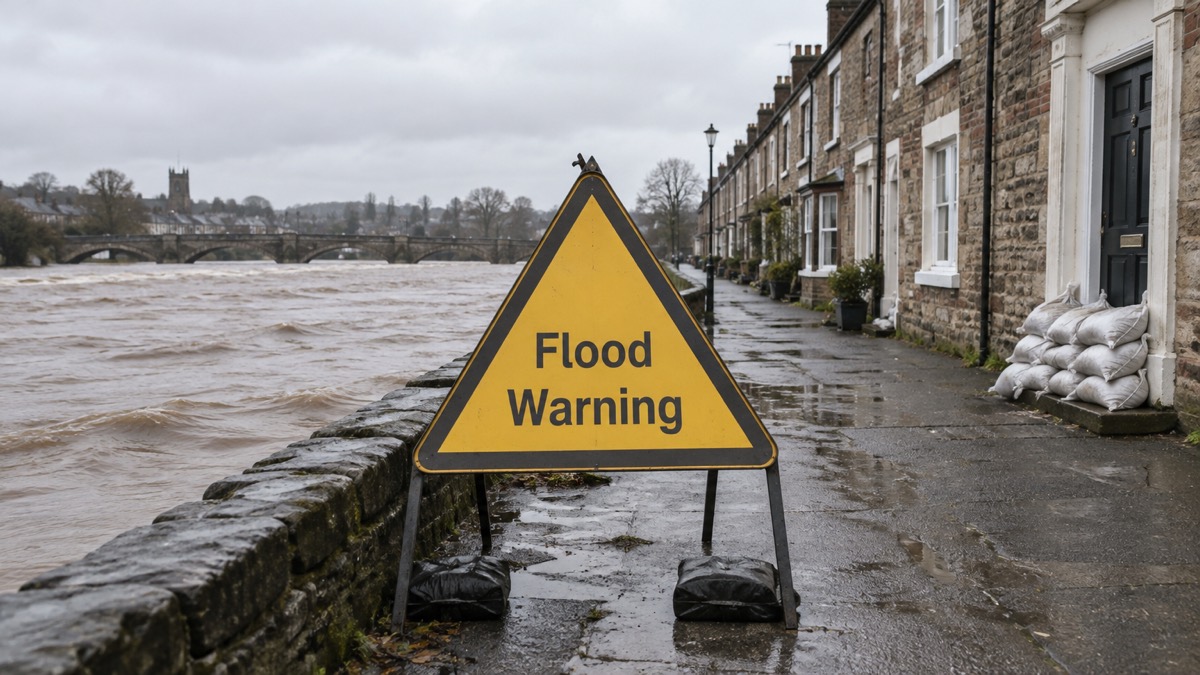
The case for building the habit now is that the weather these systems warn about is changing. Derbyshire County Council, drawing on Met Office analysis, notes that the Met Office has charted higher annual temperatures, increased days with very heavy rainfall and record-breaking high temperatures since the 1961 to 1990 period33. According to the Met Office, the UK is likely to have hotter, drier summers and warmer, wetter winters33. Extreme weather events such as heatwaves and heavy downpours are likely to become more frequent and more intense33.
That trend is already changing what the authorities ask of households. Severe weather events are likely to become more common as the effects of climate change are felt, and the Met Office expects extreme weather such as heatwaves and heavy downpours to become more frequent and more intense. Checking warnings regularly, rather than only when a storm is already forecast, is the habit that follows from it.
The practical conclusion is not to worry more, but to make the checking automatic. A household with the Met Office app installed, email alerts for its region, a flood warning registration if it is at risk, and a battery radio in the drawer is connected to every official channel that matters, whatever the weather does. The rest of our staying informed guide covers how to keep those channels working when networks fail, and our getting started guide puts warning sign-up in the context of everything else worth preparing.
Sources (33)
- Be informed about hazards, Prepare (UK Government campaign)
- Find and share information in an emergency, Ready Scotland (Scottish Government campaign)
- UK weather warnings, Met Office
- Subscribe to email alerts, Met Office
- Alerts and warnings, Be Ready (UK Government campaign)
- Check the risks where you are, Prepare (UK Government campaign)
- Preparing for flooding, Surrey County Council
- How are weather warnings categorised? - Met Office, Met Office
- Emergency Alerts, Isle of Anglesey County Council
- Preparing for civil emergencies in Argyll and Bute, Argyll and Bute Council
- Emergency preparations you can do, Moray Council
- Community resilience, Met Office
- Severe weather, West Yorkshire Prepared
- Weather warnings guide, Met Office
- UK weather warnings, Met Office
- When and why do we issue warnings, Met Office
- Storms and gales, Lancashire Prepared
- Weather warnings guide, Wiltshire and Swindon Prepared
- Met Office weather warnings, Essex Prepared
- Sign up to warnings and alerts, Surrey County Council
- Alerts, Prepare (UK Government campaign)
- Emergency alerts service, Croydon Council
- Emergency Alerts, GOV.UK
- Emergency alerts, Denbighshire County Council
- What is a Local Resilience Forum, Essex Prepared
- Civil emergencies emergency plan, Isle of Anglesey County Council
- Are You Ready booklet, Thames Valley Local Resilience Forum
- Home emergency plan, Royal Borough of Windsor and Maidenhead
- Resilience and risks in Wales, Welsh Government
- Sign up for flood warnings, GOV.UK
- Get flood warnings by text, phone or email, GOV.UK
- Household emergency plan, London Borough of Hillingdon
- Adapting to extreme weather, Derbyshire County Council
 Free Alert Services
 Emergency Apps
 Digital Switchover Checklist
 When Phones and Internet Fail
 Emergency Radios
 Telecare on Digital Phone Lines
 Mobile Networks in Power Cuts
 Broadband Outages
 Router and Hub Power Cuts
 Wi-Fi Calling
 Satellite Messaging and SOS
 Satellite Messengers
 Calling 999 and 112
 Non-Emergency Numbers
 Getting Your Phone Ready