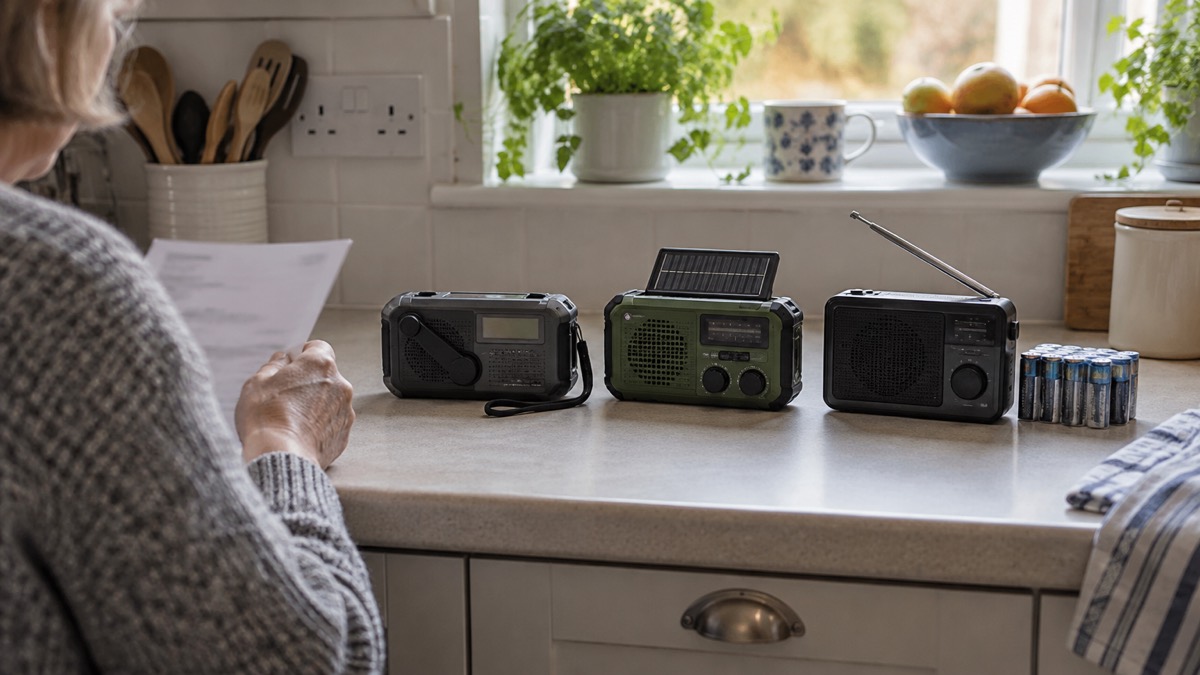
When the power goes out and the mobile network goes down with it, a radio is often the last thing in your house that still receives official information. Preparedness advice across the UK is consistent on this point: keep a battery or wind-up radio, with spare batteries, at home, because during a power cut updates may be broadcast by local BBC stations and by BBC Radio 2 and Radio 4 in the event of a national power outage1. In the most serious circumstances your mobile phone, landline and broadband connection could all be down at once, meaning you may not be able to contact the emergency services on 9992.
The reason radio holds up when other systems fail is simple: it does not depend on your home's electricity supply, your broadband line or a mobile mast near you. UK Government public health planning for a national power outage states that emergency communications to the public would be limited to radio, on BBC Radio 2 and Radio 4, which it describes as the most power resilient form of communication, and that anyone with access to a battery-powered, wind-up or car radio, while the battery lasts, would be able to access the advice3. That is the case for every household in this guide: a small radio, kept ready with spare batteries, is a dependable way to stay informed.
Why a radio matters when the power or mobile network goes down
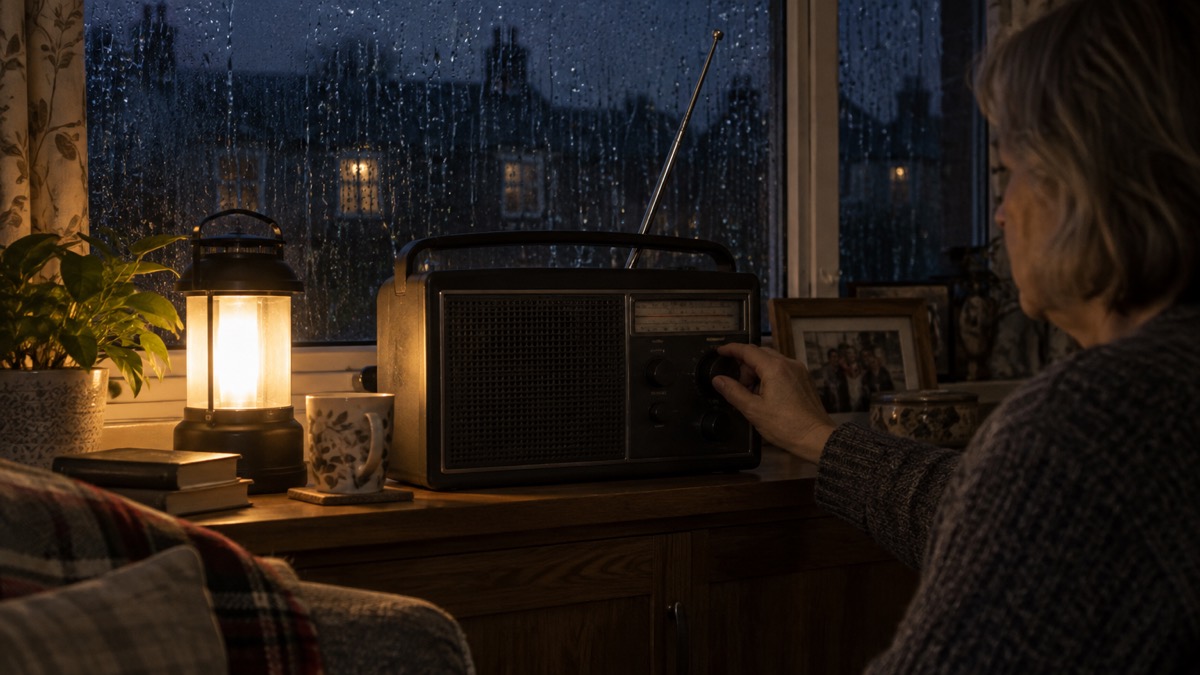
Most of the ways we receive information today depend on electricity at some point along the chain. Your mobile phone needs a charged battery and a working mast. Your cordless home phone needs mains power to its base station. Your broadband router needs power, and so does your internet-connected TV. Official preparedness advice asks households to consider how the family will stay in touch in an emergency, because mobile networks may be jammed and cordless telephones need power to work7.
A power cut can take out several of these at once. Your mobile phone might stop working if your local mast is in the affected area6. If you have a power cut and no back-up power to your landline phone, and you have a life-threatening emergency, official advice is to attempt to call 999 or 112 using a mobile: you might receive overlapping signal from a nearby area that is unaffected, because emergency calls automatically roam onto all available networks6. That works when the problem is local, but in a widespread outage the phone network itself may be unavailable, which is exactly when broadcast radio comes into its own.
Radio reaches you differently. A battery-powered set receives a signal through the air on AM, FM or DAB, with no dependence on your home's wiring, your broadband line or a mobile mast. UK Government broadcast scripts prepared for a national power outage are explicit that emergency communications to the public would be limited to radio, on BBC Radio 2 and Radio 4, and that anyone with access to a battery-powered, wind-up or car radio, while the battery lasts, would be able to access the advice3. Local resilience advice points to local stations too: in Greater Manchester, updates during a power cut may be communicated by BBC Radio Manchester as well as Radio 2 and Radio 4 nationally1.
If you rely on medical or personal alarm devices that use phone or internet connections, check with the provider or manufacturer how they would work if the network is down, for example how your personal alarm or diabetes sensor would function if mobile or broadband service is lost8. A radio does not replace those devices, but it is how you would hear official advice about the outage itself, including how long it is expected to last and what to do. For more on what fails and what keeps working, see what to do when phones and the internet go down and mobile networks in a power cut.
Storms can knock out TV, radio and phone reception
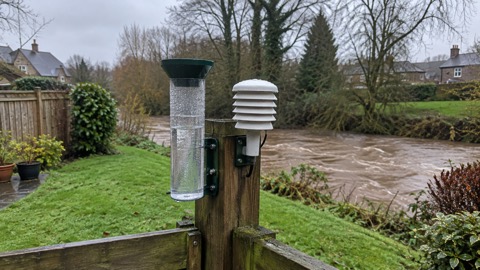
Storms do not only cut power: they can damage the networks themselves. Severe weather causes telecommunications failures through damage to telephone masts and fibre-optic cables9. When that happens, mobile signal, broadband and internet-based TV can all degrade or disappear even in homes that still have electricity, and repairs take time because engineers must reach and fix physical damage across a wide area.
Storms, gales and high waves bring a familiar cascade of consequences: loss of electricity affecting telephone, internet and cooking at home, and road and travel disruption that can slow network repairs further10. This is why storm-specific advice treats a radio as standard kit. North Yorkshire Fire and Rescue Service includes a battery or wind-up radio in its emergency flood kit11, and Ofcom advises that AM/FM/DAB radios working on batteries, wind-up or solar will help you receive weather warnings, news updates and information from your local authority or the UK Government during severe weather4.
Two practical points follow from this. First, a radio that runs only on mains power is no use in a storm outage, so the power source matters as much as the radio. Second, a radio with several bands gives you more ways to receive a signal: FM and DAB for local and national stations, and AM (also called LW or MW on many sets) as an alternative when conditions are poor. For more on why reception itself fails, see why TV, radio and phone signal fail in storms, and for how networks are repaired afterwards, see how phone and broadband networks respond to storms and outages.
Wind-up, solar or battery: how each type keeps running
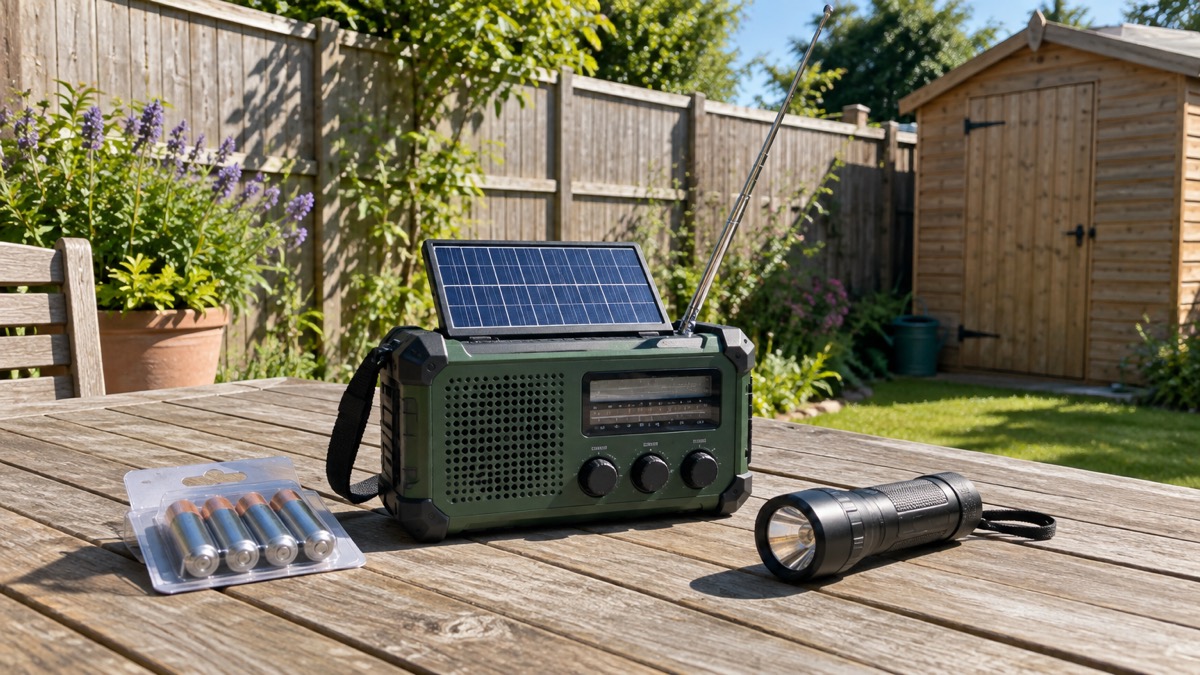
Every emergency radio on the UK market is one of three types, or a combination of them, and the official advice covers all three. Ofcom's severe weather guidance says to use AM/FM/DAB radios that work on batteries, wind-up or solar to receive warnings and updates4, and the Scottish Government's emergency kit advice says to include a battery-operated radio and spare batteries, or a wind-up radio12. Here is what each power source does for your household.
| Power type | How it keeps running | What it suits | What to watch |
|---|---|---|---|
| Battery | Replaceable batteries, with spares kept in the kit | The simplest set-up; official kit advice lists a battery-operated radio with spare batteries, checked regularly12 | Batteries run down and spares age, so check them regularly |
| Wind-up | A hand crank charges an internal battery | A back-up when batteries run out; official kit advice says to consider a wind-up model alongside spare batteries12 | Winding takes effort; many sets also take batteries as backup |
| Solar | A panel charges the internal battery from daylight | Outages in daylight, and keeping a set topped up between emergencies | Less useful in winter or after dark; usually combined with wind-up or batteries |
| Car radio | Runs from the car's battery | Listening from a vehicle when the home power is off; UK Government planning notes anyone with access to a car radio, while the battery lasts, can receive the advice3 | Only while the car battery lasts; do not run the engine just for the radio |
Many emergency radios combine two or all three of these sources, which is the most practical arrangement for a household: batteries for everyday listening, wind-up for when they run out, and solar to keep the set charged on the windowsill between incidents. Wiltshire and Swindon Prepared adds that wind-up radios often have a point where you can plug in your mobile phone to keep its battery topped up13, which we cover below.
The choice between them is about your circumstances rather than any ranking. A battery radio with fresh spares suits anyone who will check it occasionally. A wind-up radio suits a household that wants something that will still work days into a prolonged outage with nothing to consume. A solar or solar-assisted set suits a home with a bright windowsill and a preference for leaving the radio permanently ready. If you are weighing the two most common options in more detail, see wind-up or battery radios for emergencies.
Features that decide a good emergency radio
The features that matter are the ones that determine whether the radio can actually receive official information during the specific emergencies your household might face. Based on the official guidance, these are the points to check before you choose.
- Bands: AM, FM and DAB. Ofcom's advice is to use AM/FM/DAB radios to receive weather warnings, news updates and information from your local authority or the UK Government4.
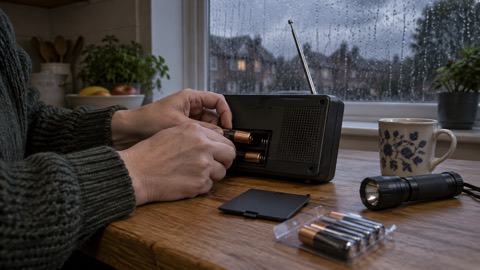
- A power source that works without mains. Battery with spares, wind-up, solar, or a combination4. A radio that only plugs into the wall fails at the first power cut.
- Spare batteries in the kit. The Scottish Government's emergency kit advice pairs the battery radio with spare batteries12, and Greater Manchester's resilience advice says the same1.
- A phone charging point, if you want one. Wind-up radios often have a socket for plugging in a mobile phone to top up its battery13.
- Portability. Nottinghamshire's emergency guidance says to keep a battery-powered or wind-up radio in your emergency kit and tune in to local stations during disruption or emergencies14, so a set that can move to wherever the household is gathered, or into a car, is more useful than one fixed in place.
Beyond the radio itself, think about where official information would actually be broadcast in your area, because that determines what you will be tuning into. In a national power outage, the planning assumption is BBC Radio 2 and BBC Radio 43. Locally, the stations vary: West Yorkshire's community risk register advises tuning into BBC Radio 2, BBC Radio 4 or BBC Radio Leeds (92.4 FM, 95.3 FM, 102.7 FM, 103.9 FM, 774 AM, and DAB) if a major power outage occurs15. Around Southampton, a radiation emergency would be broadcast on BBC Radio Solent (96.1 and 103.8 FM), Hits Radio South Coast (107.8 FM), Heart FM (96.7 FM), Greatest Hits Radio South Coast (105.2 FM) and Capital FM (103.2 FM), alongside BBC1, BBC2 and ITV Meridian on television16. Find your local equivalents now and write them on a card kept with the radio. For the band question in more depth, see DAB or FM radios in an emergency, and for station lists, see which radio stations to tune into during a power cut.
Wind-up and solar chargers for topping up phones
A radio that can also charge your phone turns one piece of kit into two. Wiltshire and Swindon Prepared notes that wind-up radios often have a point where you can plug in your mobile phone to keep the battery topped up during a prolonged outage13. Nottinghamshire's preparedness advice goes further and lists a mobile phone and a wind-up or battery-powered charger among the contents of an emergency kit7.
This matters because a charged phone is not just for calls. Emergency Alerts, which we cover below, arrive on mobile phones through 4G and 5G networks5, and if your home has no power for a day or more, keeping even a small charge in one phone preserves that channel alongside the radio. The UK Government's household emergency plan advice is to keep a portable power bank to charge your phone and medical devices, if compatible17. North Yorkshire Fire and Rescue Service gives similar advice for storms: take a fully charged mobile phone with an in-car charger or battery pack11.
Be realistic about what wind-up and solar charging can do. A hand crank or a small solar panel delivers a slow top-up, enough to keep a phone alive for essential messages rather than to restore it to full charge quickly, and solar charging needs daylight. Treat these as ways to stretch a phone's battery across an outage, not as a substitute for starting the outage with everything charged. Before any forecast severe weather, charge your phone, your power bank and any spare radio batteries; see what to keep charged before a power cut and how to save your phone battery in a power cut. For larger backup power options at home, see backup power at home.
Emergency Alerts reach phones, not radios
The UK Government's Emergency Alerts service is used to warn people about serious incidents where there is a risk to life18. It is important to understand what it is and is not, because it changes how your radio fits into your preparations. Alerts are sent using mobile phone networks to compatible mobile phones and tablets in a specific geographical area18, and they work on all 4G and 5G phone networks in the UK5. You do not need Wi-Fi or mobile data to receive one18, and the emergency services and the UK Government do not need your phone number to send you an alert5. The alerts do not track your location, need your phone number, or collect personal data19.
When an alert arrives, your device may play a loud siren-like sound even if it is set to silent, vibrate for around 10 seconds, read the alert aloud if accessibility settings are enabled, and display information about the emergency and the actions to take18. Examples of situations that may lead to an alert include severe flooding, fires and extreme weather20.
The key point for this page is that Emergency Alerts will not replace local news, radio, television or social media21. Alerts are short warnings; radio is where the continuing advice lives. And because alerts depend on mobile networks, a widespread outage or mast damage can take them out while broadcast radio keeps going, which is exactly why the two belong together in your plans. If you do not want to receive emergency alerts, you can change your phone settings; the UK Government explains how at gov.uk/alerts/opting-out22. For the full picture, see Emergency Alerts: how the UK phone warning system works, and if a phone is not an option for someone in your household, see how to get emergency warnings without a mobile phone.
Where to keep your radio and how to check it works
Nottinghamshire's guidance is direct: keep a battery-powered or wind-up radio in your emergency kit and tune in to local stations during disruption or emergencies14. That means the radio lives with the rest of your household emergency kit, not on a shelf as an everyday appliance, and it means the kit as a whole is somewhere every adult in the house can find it in the dark. The Scottish Government's emergency kit list places the battery-operated radio and spare batteries alongside the other basics, including a torch and a reflective warning sign for the car12.
Checking it works is a small routine:
- Once every few months, turn the radio on and tune across FM, DAB and AM to confirm it receives stations on every band it has.
- Check the spare batteries at the same time; official kit advice pairs the radio with spare batteries, checked regularly12.
- If the set is wind-up or solar, give it a short wind or a day on the windowsill so its internal battery is not left fully flat.
- Keep your list of local radio station frequencies with the radio, so you can go straight to the stations that carry news during an outage15.
One further check applies to households near certain industrial sites. If you live within a detailed emergency planning zone, you may already have been sent printed information about radiation emergencies. The booklet "What You Should Do if There Is a Radiation Emergency at the Devonport Site" has been distributed to households and businesses in the area24, and similar information leaflets have been prepared and distributed to households within the detailed emergency planning zones outlined in the Clyde Off-Site Emergency Plan in Argyll and Bute. Keep any such leaflet with the radio, because it names the stations that would carry official information in your area. For the wider kit, see emergency kit: what a UK household should keep ready.
What to listen for during an emergency
When an incident is under way, the radio is your line to official information, and there are some consistent patterns in what the guidance tells you to expect. In a national power outage, listen to BBC Radio 2 and BBC Radio 4, the most power resilient channels, for public health advice and information about the outage3. Locally, tune to your regional station: BBC Radio Manchester in Greater Manchester during a power cut1, or BBC Radio Leeds in West Yorkshire during a major outage15. Around Southampton, a radiation emergency would be announced by the police or through news broadcasts, with information carried on the local stations listed earlier in this guide16.
The Southampton radiation leaflet also carries a piece of advice that applies to any major emergency: don't use the telephone unless you urgently need help, because in an emergency the telephone system could become very busy, and if you have to make a call, keep it short16. Keeping phone lines free matters most in exactly the situations where you are relying on the radio for information.
If you hear an alert or news while driving, the advice is consistent across sources: do not read or respond to an alert while driving or riding21; if there is nowhere safe and legal to stop and no one is in the vehicle to read it for you, you can listen to news on live radio to find out about the emergency20. To check whether an alert is genuine, alerts include a link to gov.uk/alerts where you can check, or you can contact neighbours, friends or family nearby to check whether they received it too23; see also how to tell if an emergency alert is genuine.
For people who cannot use a voice phone, there are established alternatives: 999 BSL, emergencySMS and Relay UK are alternative ways to contact the emergency services25. The emergencySMS service lets deaf, hard of hearing and speech-impaired people in the UK send an SMS text message to the UK 999 service, where it is passed to the police, ambulance, fire and rescue, or coastguard, and the emergency services can reply26. Note that during a widespread communications outage these services may also be affected, in which case official advice is to seek help directly from emergency responders or go to your nearest police station, fire station, ambulance station or hospital8. See emergencySMS: how to register and text 999 and 999 BSL and Relay UK.
Two numbers worth keeping on paper alongside the radio, from Devon and Somerset Fire and Rescue Service's after-an-incident guidance: the gas emergency line 0800 111 999 and the electricity emergency line 0800 40 40 9027. For a full list, see emergency and non-emergency numbers to keep on paper.
Frequently asked questions
When is the UK testing the Emergency Alerts system? The second public national test of the Emergency Alerts system took place at 3pm on Sunday 7 September 202522, following the first test in April 202329. The test message was sent to every compatible phone nationwide on all 4G and 5G networks in the UK and made clear that it was a test and no further action was required28. The test was announced on 7 July alongside a new Resilience Action Plan30. Future tests are announced in advance at gov.uk/alerts.
Can I text 999 instead of calling? Yes, if you are deaf, hard of hearing or speech-impaired. The emergencySMS service lets you send an SMS text message to the UK 999 service, where it is passed to the police, ambulance, fire and rescue, or coastguard, and the emergency services can reply to you26. 999 BSL and Relay UK are other established alternative ways to contact the emergency services25. During a widespread communications outage these services may also be affected, in which case seek help directly from emergency responders or go to your nearest police station, fire station, ambulance station or hospital8.
Why did I get a leaflet about a radiation emergency? Households within detailed emergency planning zones around certain sites receive prior information. The booklet "What You Should Do if There Is a Radiation Emergency at the Devonport Site" is published every three years and distributed to households and businesses in the detailed emergency planning zones24, with an Easy Read version available. In Argyll and Bute, information leaflets on what to do in a radiation emergency have been distributed to households within the zones outlined in the Clyde Off-Site Emergency Plan. Keep the leaflet with your radio: it names the stations that would carry official information.
What does the SOS button in my car do? Since April 2018, most cars and vans have been fitted with an emergency call system known as eCall. When activated, eCall contacts a 999 operator and provides your vehicle's exact location directly to the emergency services31. Remember too that a car radio can receive news and official advice during an emergency while the car battery lasts3. See what the SOS button in your car does.
Can storms really knock out radio and phone reception? Yes. Severe weather causes telecommunications failures through damage to telephone masts and fibre-optic cables9, and storms, gales and high waves can bring loss of electricity affecting telephone, internet and cooking at home10. A battery, wind-up or solar radio keeps receiving through much of this because it depends on none of those things4.
How do networks respond after a big storm? Operators repair damaged masts and cables, but the work takes time and your mobile phone might stop working if your local mast is in the affected area6. This is why official advice across the UK says to keep a battery or wind-up radio at home: it does not depend on the networks being restored1. See how phone and broadband networks respond to storms and outages.
Sources (31)
- Loss of essential services: prepare yourself, Greater Manchester Combined Authority
- Planning for phone and broadband outages, Wiltshire and Swindon Prepared
- Keeping warm or cool in extreme weather: scripts for broadcast media, UK Government
- Stay connected in severe weather, Ofcom
- How alerts work, UK Government
- Power cuts: be informed about hazards, Prepare Campaign
- Preparing for an emergency, Nottinghamshire County Council
- Phone and broadband outages: be informed about hazards, Prepare Campaign
- Utility failure: ongoing risks, Essex Prepared
- Storms, gales and high waves, Dorset Prepared
- Keeping safe during high winds and heavy rain, North Yorkshire Fire and Rescue Service
- Emergency kit, Ready Scotland
- Failure of national electricity, Wiltshire and Swindon Prepared
- What to do in an emergency, Nottinghamshire County Council
- Community Risk Register, West Yorkshire Prepared
- Radiation emergency leaflet for residents, Southampton City Council
- Be Ready Household Emergency Plan, UK Government
- Emergency Alerts service, Croydon Council
- Emergency Alerts, Isle of Anglesey County Council
- Alerts and warnings, Be Ready Campaign
- Emergency Alerts, UK Government
- Emergency Alerts test: easy read, UK Government
- National Emergency Alert System: what is it?, Essex Prepared
- Devonport Off-Site Emergency Plan, Plymouth City Council
- Additional advice for people with a hearing impairment, Manchester Fire and Rescue Service
- emergencySMS service, East Midlands Ambulance Service NHS Trust
- Fire: after an incident, Devon and Somerset Fire and Rescue Service
- Emergency Alert test Sunday 7 September at 15:00, Wiltshire and Swindon Prepared
- UK Government Resilience Action Plan, UK Government
- Get prepared for emergencies: alerts, Prepare Campaign
- eCall: driving advice, National Traffic Information Service
 Free Alert Services
 Emergency Apps
 Digital Switchover Checklist
 When Phones and Internet Fail
 Official Warnings and News
 Telecare on Digital Phone Lines
 Mobile Networks in Power Cuts
 Broadband Outages
 Router and Hub Power Cuts
 Wi-Fi Calling
 Satellite Messaging and SOS
 Satellite Messengers
 Calling 999 and 112
 Non-Emergency Numbers
 Getting Your Phone Ready