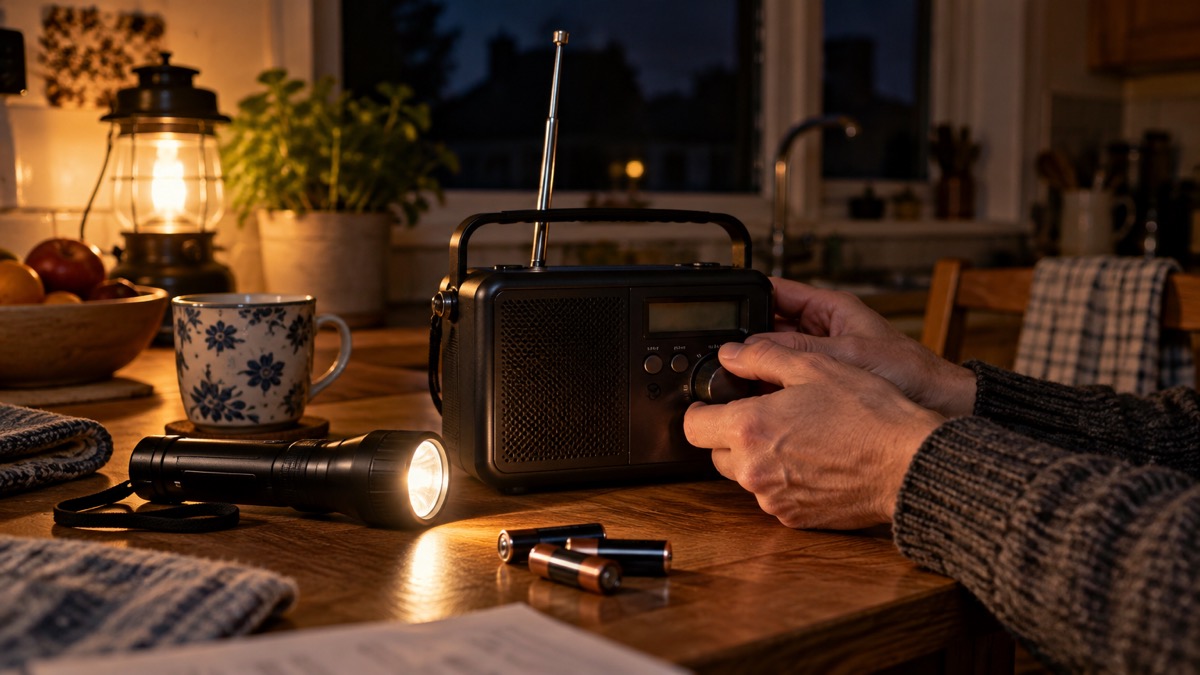
If the power goes off and the mobile network drops, a battery or wind-up radio is the simplest way to keep hearing official advice. Councils across the UK tell households to keep one at home, and the government's own public health advice for a national power outage says emergency communications to the public would be limited to radio, which it calls the most power resilient form of communication1. The advice is consistent: keep a battery or wind-up radio with spare batteries, and know how to tune into your local stations3.
The choice between DAB and FM is not really a choice between good and bad. It is a question of what happens when signal is weak. Official guidance says to try both digital and FM stations when the power is out, and Ofcom points to AM, FM and DAB radios as the way to receive weather warnings, news and information from your local authority or the UK Government4. A set that receives both, and runs on batteries or a handle, covers the most ground.
This page sets out how each type behaves, what power options keep a set running, which features decide whether a radio is useful in an outage, and where a radio falls short. It is written for an ordinary household with no prepping background: what to do now, what to get ready, and how to stay safe.
Why a radio still matters when the power and mobile network go down
A radio is the one receiver that does not depend on the mains, the broadband line or a mobile mast. That matters because the things that knock out power also knock out the networks. The UK National Risk Register notes that particularly large-scale electricity failures may prevent landline telephones and mobile phone transmitters from working, which also affects mobile internet9. Phone and broadband outages are usually short or localised, but after severe weather disruption can last for a number of days10.
Radio fills that gap. The government's public health advice for a national power outage states that emergency communications to the public would be limited to radio, naming BBC Radio 2 and BBC Radio 4, and that anyone with access to a battery-powered, wind-up or car radio would be able to hear the advice while the battery lasts2. Local councils say the same in their own plans: keep a battery or wind-up radio and spare batteries at home, because updates may be given on the radio during an outage1.
A radio also works when the phone does not. Emergency Alerts reach compatible 4G and 5G phones in an area of risk, but a phone that is flat, damaged or out of signal cannot receive them11. A radio needs no account, no SIM and no signal contract, just a charged battery or a few minutes on the handle.
DAB or FM: how each behaves when signal is weak
The practical difference between the two is how they fail. FM is an older, simpler signal: a weak station may sound hissy or fade, but you can often still make out speech, and a set with a telescopic aerial can be moved around the room to improve reception. DAB is digital: it either decodes or it does not, so a marginal signal can drop out entirely or produce silence rather than a noisy but usable voice. That is why official guidance says to try both digital and FM stations rather than relying on one4.
Coverage is the other half of the picture. DAB coverage is not universal, particularly in rural areas and in valleys, and a power cut can take local transmitters off air. FM and long wave carry further and are more forgiving of a weak signal, which is why official plans name FM and long wave frequencies alongside DAB. West Yorkshire's community risk register, for example, tells residents to tune to BBC Radio Leeds on 92.4 FM, 95.3 FM, 102.7 FM, 103.9 FM, 774 AM and DAB12. Richmond's guidance names BBC Radio 4 on 92-95 FM, 103-105 FM and long wave 19813.
The sensible approach for a household is a set that receives FM and DAB, so you can try both, and to know your local BBC station's FM frequency before you need it. If you live somewhere DAB is patchy, FM will usually be the one that keeps working.
| Feature | FM | DAB and DAB+ |
|---|---|---|
| Behaviour when signal is weak | Fades and hisses but often still audible | May drop out or go silent |
| Coverage | Wide, including rural areas | Good in most towns, patchier in rural areas and valleys |
| Aerial | Telescopic aerial can be repositioned | Often needs a good position for a stable signal |
| Official plans | FM and long wave frequencies named alongside DAB12 | Named as an option alongside FM4 |
FM and long wave keep working where DAB coverage drops out
The reason official plans keep naming FM and long wave is resilience. A local radio station on FM can be received on a simple set with a long aerial, and long wave carries a long way, which is why BBC Radio 4's long wave frequency appears in council guidance13. When a local DAB transmitter loses power, an FM service from a different site may still be on air.
That does not make DAB useless. Ofcom lists AM, FM and DAB radios together as the way to receive warnings and official information, and many households will find DAB gives clearer sound and more stations in normal times5. The point is to have both, and to know which one works where you live.
A practical test now, before anything goes wrong: tune your radio to your local BBC station on FM, note the frequency, then switch to DAB and see whether the same station appears. If one works and the other does not, you know which to reach for in an outage. Do this in the room where you would actually use the radio, because reception varies from room to room and upstairs often beats downstairs.
Power options: batteries, wind-up handle and solar panel
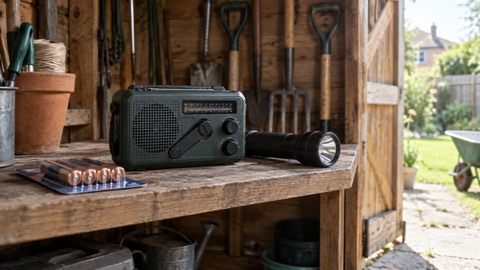
How a radio is powered decides how long it keeps working. There are three options, and the best choice for most households is a set that takes standard batteries and also has a wind-up handle, so one backs up the other.
- Batteries. The most common recommendation. Councils say to keep a battery-powered radio and extra batteries, or a wind-up radio, and to keep spare batteries with the set14. Batteries are simple, but they run down, and in a long outage the shops may be shut.
- Wind-up handle. A handle turns a small generator inside the set. Councils describe a wind-up radio as a good purchase for a prolonged outage, and note that many have a socket to plug in a mobile phone to keep its battery topped up7. Winding is tiring and gives short listening bursts, so treat it as the backup to batteries.
- Solar panel. Some sets have a small solar panel. Ofcom lists battery-powered, wind-up and solar radios together as options for staying informed5. A solar panel needs daylight and time, so it is a slow top-up rather than an instant fix.
A car radio is a fourth option, and official guidance says it can be used, though in severe weather it may be safer to stay indoors4. The car battery is a large reserve, but you have to be in the car to use it.
Features that decide an emergency radio
Most radios will play a station. The features that matter in an outage are the ones that keep it playing and make it usable when you are stressed, tired or in the dark.
- Both FM and DAB. So you can try both when one is weak4.
- Battery and wind-up power. Batteries for everyday listening, the handle for when they run out7.
- A phone charging socket. Some wind-up sets have one, which lets you top up a mobile phone7.
- A headphone socket. Useful for hearing-impaired households and for listening without disturbing others.
- A clear tuning display or dial. You need to find your local station quickly, in the dark, possibly by torchlight.
- A sturdy aerial. A telescopic aerial that extends and swivels makes a real difference to weak FM reception.
- A torch built in. Many emergency radios include one, which saves hunting for a separate light.
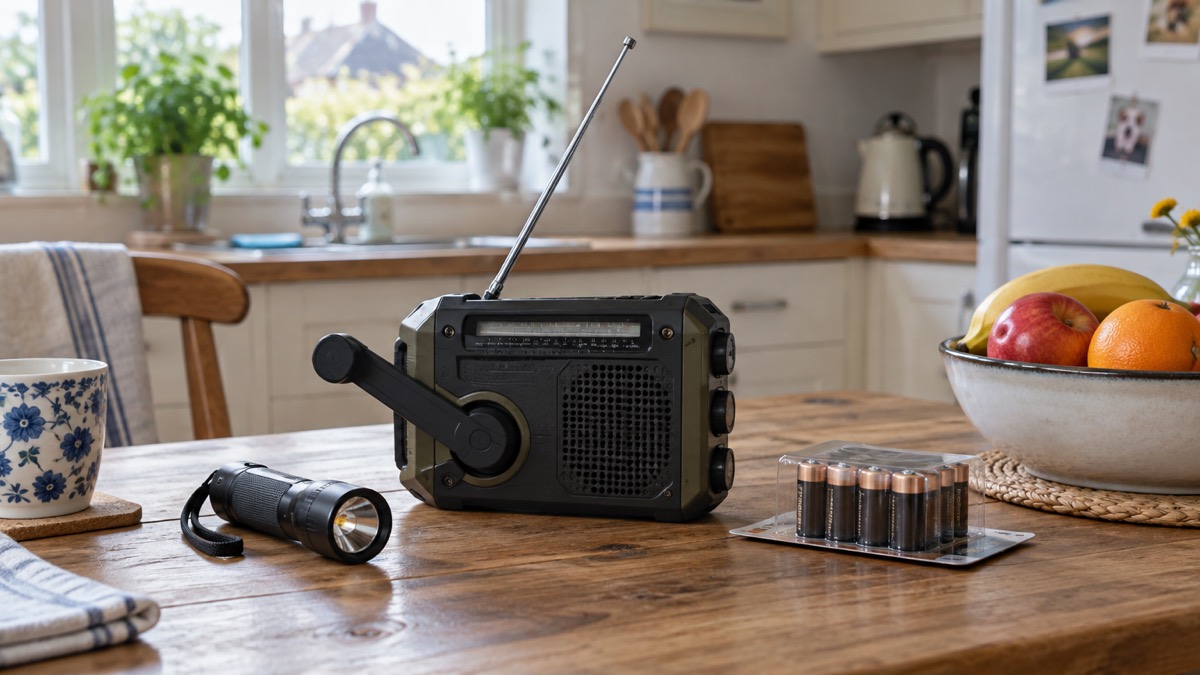
What you do not need is a large, complicated set with features you will never use. A simple radio you know how to work beats a sophisticated one you have to learn in an outage.
Where to tune for official updates in an emergency
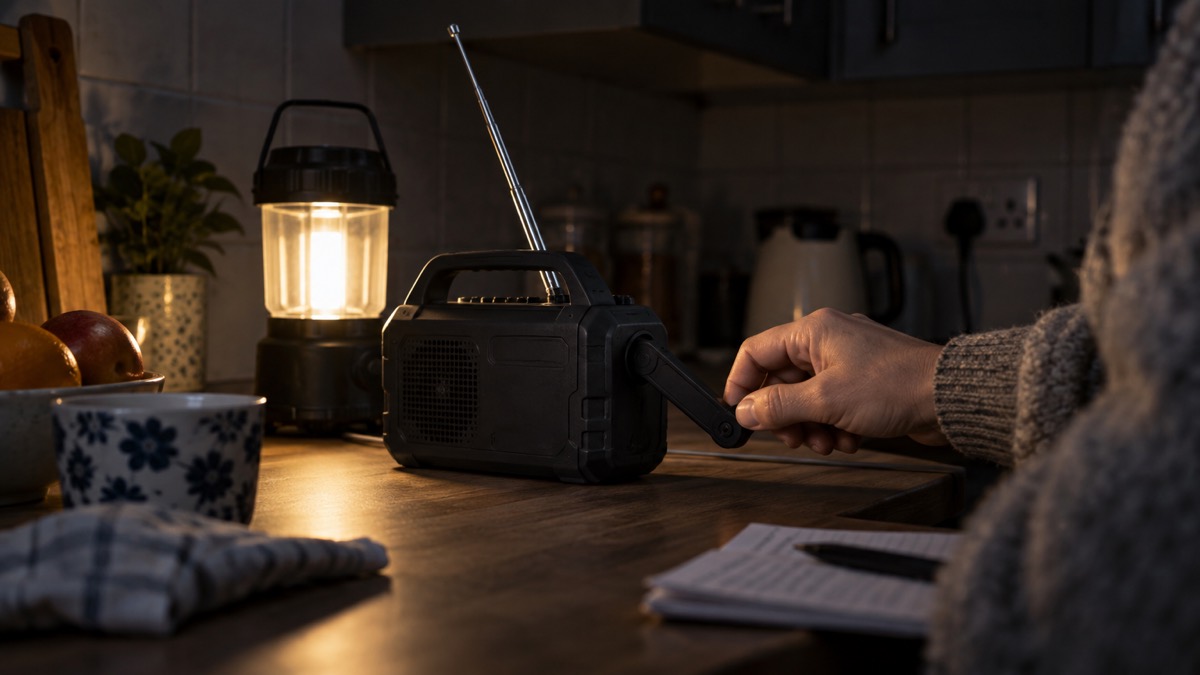
The stations named in official guidance are consistent. For a national power outage, the government's public health advice names BBC Radio 2 and BBC Radio 4 as the channels for emergency communications2. Local councils add their local BBC station: Greater Manchester names BBC Radio Manchester alongside Radio 2 and Radio 43, and West Yorkshire names BBC Radio Leeds on its FM, AM and DAB frequencies12.
For a radiation emergency, Portsmouth's residents' booklet lists local commercial stations alongside the BBC, including Hits Radio South Coast, Heart FM, Greatest Hits Radio and Capital FM, each with its FM frequency16. That is a reminder that in a local incident the station giving advice may be a commercial one, so it is worth knowing which local stations serve your area.
| Situation | Where official guidance says to tune |
|---|---|
| National power outage | BBC Radio 2 and BBC Radio 42 |
| Local power cut (Greater Manchester) | BBC Radio Manchester, Radio 2 and Radio 43 |
| Local power cut (West Yorkshire) | BBC Radio Leeds on FM, AM and DAB12 |
| Radiation emergency (Portsmouth area) | BBC Radio Solent and local commercial stations16 |
Write your local BBC station's FM frequency on a card and keep it with the radio. In an outage you may not be able to look it up.
Keeping the radio ready: storage, spare batteries and regular checks
A radio that has sat in a cupboard for two years with leaking batteries is worse than no radio, because you will reach for it and find it dead. A little routine keeps it usable.
- Store spare batteries with the radio, not in it. Keep them in their packaging so they cannot corrode the contacts.
- Store lithium batteries safely. Surrey Fire and Rescue Service advises storing lithium batteries in a shed or garage where possible8.
- Check the set every few months. Switch it on, tune to your local station on FM and on DAB, and wind the handle to confirm it still generates power.
- Keep the aerial extended and undamaged. A bent aerial weakens reception.
- Keep a card with your local frequencies and the stations named in official guidance2.
- Keep the radio where you would use it, not at the back of a cupboard.
Where a radio falls short
A radio is a receiver, not a transmitter. It tells you what is happening; it does not let you call for help. If you need the emergency services, a radio is no substitute for a phone, and official guidance is clear that if you have a life-threatening emergency and no working landline, you should try 999 or 112 on a mobile, because emergency calls can roam onto any available network17. People with additional communication needs should keep using Relay UK, Emergency SMS and 999 BSL where available, though during a widespread outage these may also be affected10.
A radio also depends on someone broadcasting. If local transmitters are down and the national network is stretched, there may be less to hear. And a radio gives you information, not warnings targeted at your street: Emergency Alerts reach compatible phones in an area of risk, and the government says people without a compatible device will still be informed through other means used by the emergency services11.
Finally, a radio is only as good as its power. A wind-up set gives short bursts, a solar set needs daylight, and batteries run down. That is why the advice is to have more than one way to power it, and to check it before you need it.
For the wider picture of staying informed when networks fail, see What to Do When Phones and the Internet Go Down and Where to Get Official Warnings and News in an Emergency. For the different radio types side by side, see Emergency Radios: Wind-Up, Solar and Battery Types and How to Choose, and for a direct comparison of the two power types, Wind-Up or Battery Radios for Emergencies. If you want to know which stations to tune to in a cut, see Which Radio Stations to Tune Into During a Power Cut.
Sources (18)
- Prepare: emergency plan, Ready Scotland, 2026
- Keeping warm or cool in extreme weather: scripts for broadcast media, UK Government, 2025
- Loss of essential services, Greater Manchester Combined Authority, 2026
- Emergency plan, Ready Scotland, 2026
- Stay connected in severe weather, Ofcom, 2026
- Failure of national electricity, Wiltshire and Swindon Prepared, 2026
- Loss of utilities, Birmingham City Council, 2026
- Lithium batteries, Surrey County Council, 2026
- UK National Risk Register 2017, UK Government, 2017
- Phone and broadband outages, Prepare campaign, UK Government, 2026
- Emergency alerts, UK Government, 2026
- Community Risk Register, West Yorkshire Prepared, 2025
- Utilities failure, Richmond Council, 2026
- Get help and advice in an emergency, Lincolnshire County Council, 2026
- Preparing for an emergency, Nottinghamshire County Council, 2026
- REPPIR residents booklet 2024, Portsmouth City Council, 2024
- Power cuts, Prepare campaign, UK Government, 2026
- Emergency alerts: opting out, UK Government, 2026
 Satellite Messenger vs Phone SOS
 Corded or Cordless Phones
 Wind-Up and Battery Radios