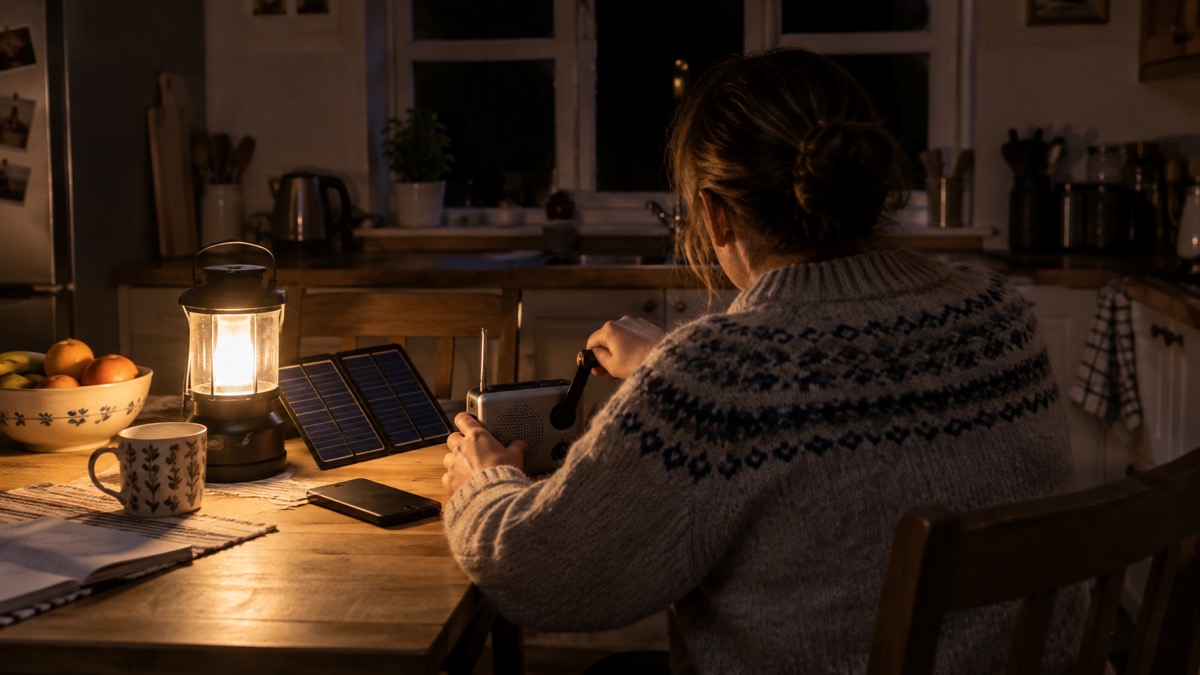
When the mains fails, the devices most households want to keep alive are small ones: a phone for calls and information, and a radio for news. Wind-up chargers and small solar panels are two of the ways people try to do that, and both work, within limits. A wind-up torch or lantern needs no batteries at all, according to Wiltshire and Swindon Prepared, which makes it a reliable last-resort light source1. A small folding solar panel can genuinely charge a phone: EcoFlow states that on a clear day, its portable panel charged an iPhone 15 from 20% to 80% in 50 minutes, though the maker notes results vary with conditions2.
The honest picture is this: a small solar panel is a slow but steady trickle charger that needs daylight; a wind-up device is a human-powered backup that works whatever the weather but demands effort; and a charged power bank holds the most usable energy for the least fuss. Most households are best served by a combination: keep a power bank charged, keep a wind-up torch or lantern in the drawer, and use a small solar panel to top things up when the outage stretches on. This page explains what each can do, how to charge safely, and where the real risks lie.
What a small charger has to match: how phones and tablets charge
Phones, tablets and most rechargeable radios contain lithium-ion batteries, and those batteries have rules. London Fire Brigade's advice is blunt: always use the charger that came with your phone, tablet, e-cigarette or mobile device7. If you need a replacement, the Brigade's easy-read fire safety booklet says to get it from the maker of the device8. The reason is that a charger is matched to the battery it feeds: the wrong one can push in current at the wrong rate, and a lithium-ion battery that is charged incorrectly can become a fire risk, as Devon and Somerset Fire and Rescue Service warn in their heatwave guidance9.
That matters for wind-up and solar charging because these devices sit in the chain between a power source and your phone's battery. Whatever turns the crank or catches the sun, the last step is a USB cable into your phone, and the phone's own charging circuit takes over from there. The practical points are:
- Use a good quality cable between the charger and your phone. A reviewer of one large power bank reported that its flimsy inbuilt cable put out only 2 to 3W of input charge, while a good quality cable on the other ports managed about 45W10. Cables are not all equal, and a poor one can waste most of what your panel or crank produces.
- Follow the maker's instructions for charging times and never overcharge the battery, as Scottish Fire and Rescue Service advises11.
- If you spot signs of wear and tear or damage on a charger or cable, buy an official replacement from a reputable seller, as North Yorkshire Fire and Rescue Service recommends12.
For most households, the simplest match is a power bank charged from the mains before trouble arrives, topped up by a small solar panel if the outage lasts. If you want to understand the numbers behind charging speeds, see watts, watt-hours and surge and USB-C charging, power delivery and cables explained.
Follow the maker's instructions for your phone and charger
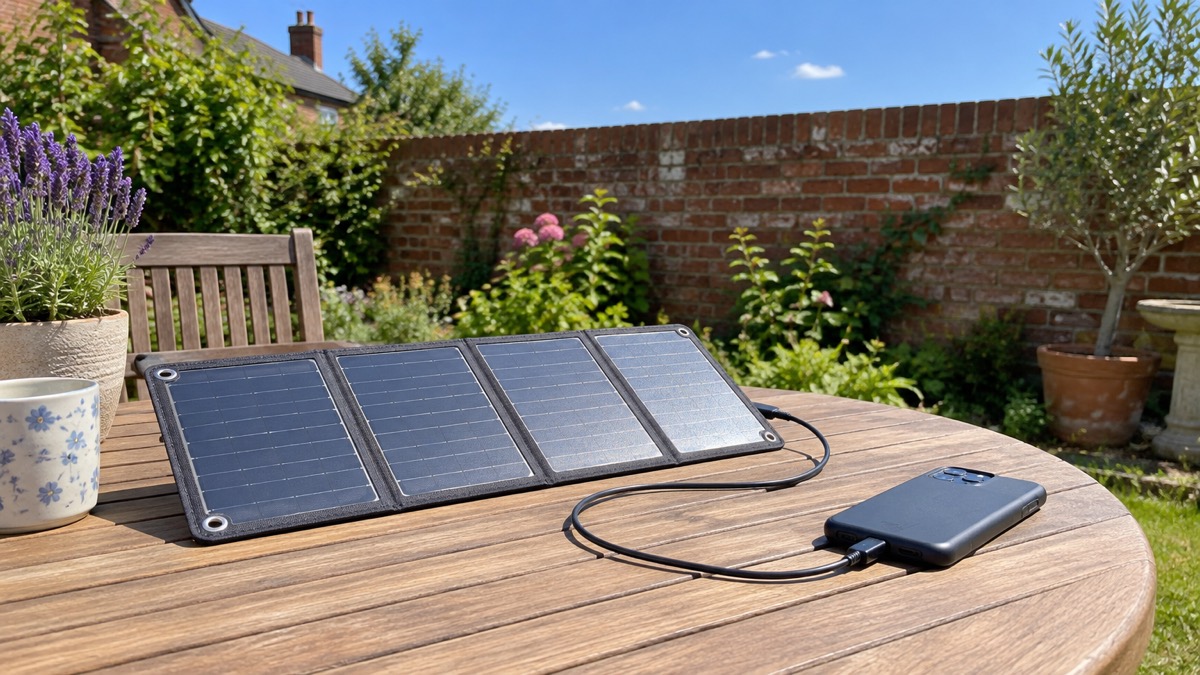
Every fire and rescue service that publishes guidance on batteries says the same thing in slightly different words, and it applies to wind-up and solar chargers as much as to mains ones. The government's Prepare campaign advises: when charging electrical goods, including phones, "follow the manufacturer's instructions, use a compatible charger and do not charge them along your escape route"13. Devon and Somerset Fire and Rescue Service put it simply: always follow the manufacturer's instructions for charging and using your product10.
The instructions that matter most with a small charger are usually about how long to charge, what to connect it to, and what not to do with it in heat or damp. The National Fire Chiefs Council's guidance adds a habit worth building: follow the manufacturer's instructions when charging, and always unplug your charger when it is finished charging14. North Yorkshire Fire and Rescue Service's Charge Safe campaign repeats the same instruction12.
Two habits follow from this. First, read the leaflet or product page that came with your wind-up charger, solar panel or rechargeable radio, and follow its charging times rather than guessing. Second, keep your escape route clear: a device on charge in a hallway or across a doorway is a device in the way if you need to get out quickly. If you keep several rechargeable items for emergencies, our safe battery charging checklist walks through a sensible set-up.
Keeping a phone dry and safe while you charge it
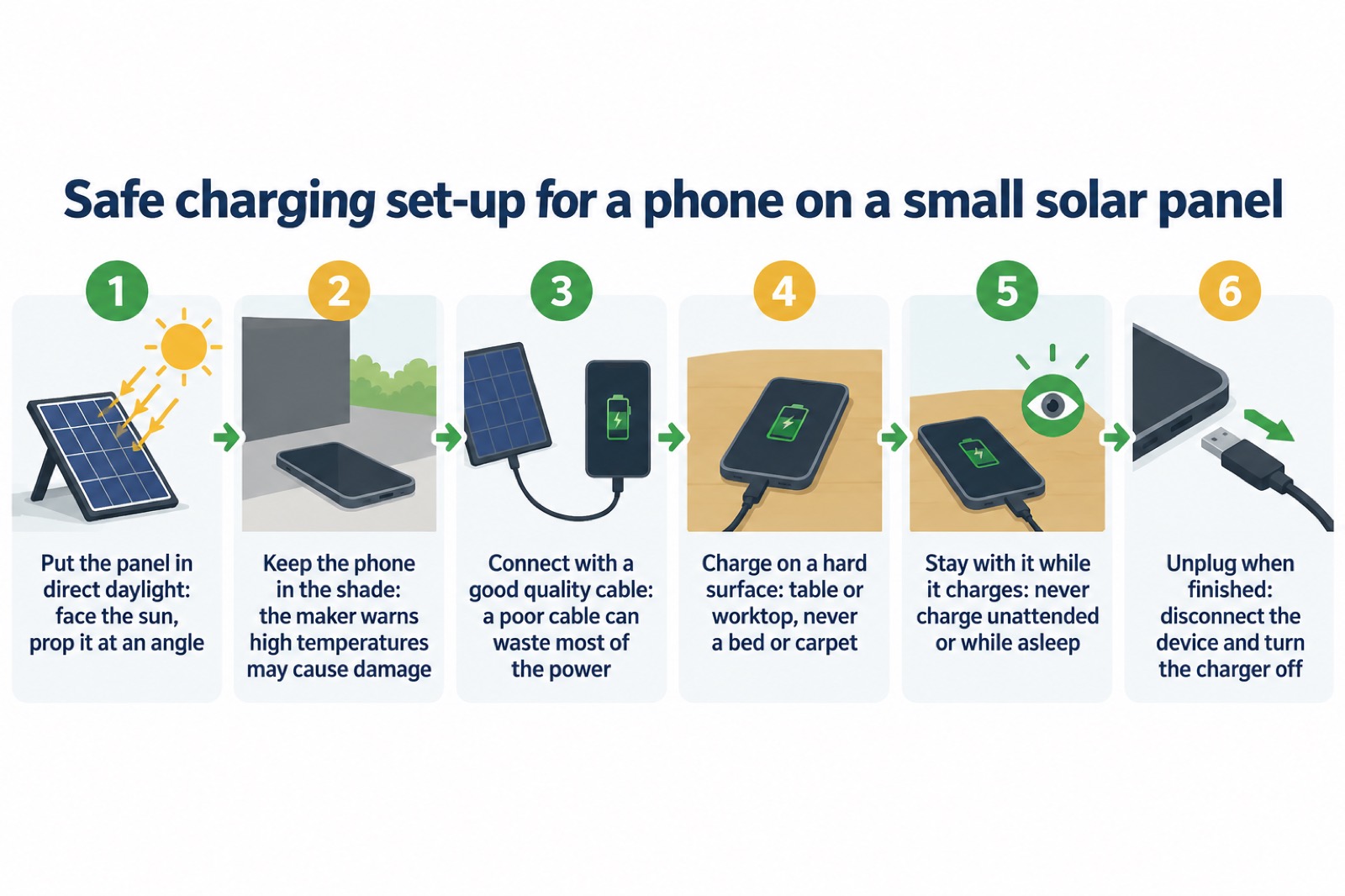
Charging safety is mostly about heat, surfaces and attention, and the advice is consistent across the UK's fire services. Devon and Somerset Fire and Rescue Service, in advice for parents and guardians, say that if you are charging any sort of device, always charge it on a hard surface, and never on a carpet or bed, never under a pillow, and never leave it unattended4. Their student safety advice adds: always charge your phone or laptop on a hard surface like a table or worktop, never on a soft surface like a bed or carpet, as it can easily overheat and catch fire15. The Northern Ireland Fire and Rescue Service makes the same point about flammable surfaces: do not charge devices on bedding, as this increases the risk of fire spread16.
The rules that follow apply to every charger, including wind-up and solar ones:
- Charge on a hard surface: a table or worktop, not a bed, carpet, pillow or settee15
- Never cover a charger: North Yorkshire Fire and Rescue Service warn that a charger may build up heat during the charging process17
- Do not leave a device charging unattended: never when you are out of the house or asleep5
- Unplug when finished: when devices are fully charged, disconnect them and turn the charger off17
- Do not leave a phone charger plugged in and turned on when not in use17
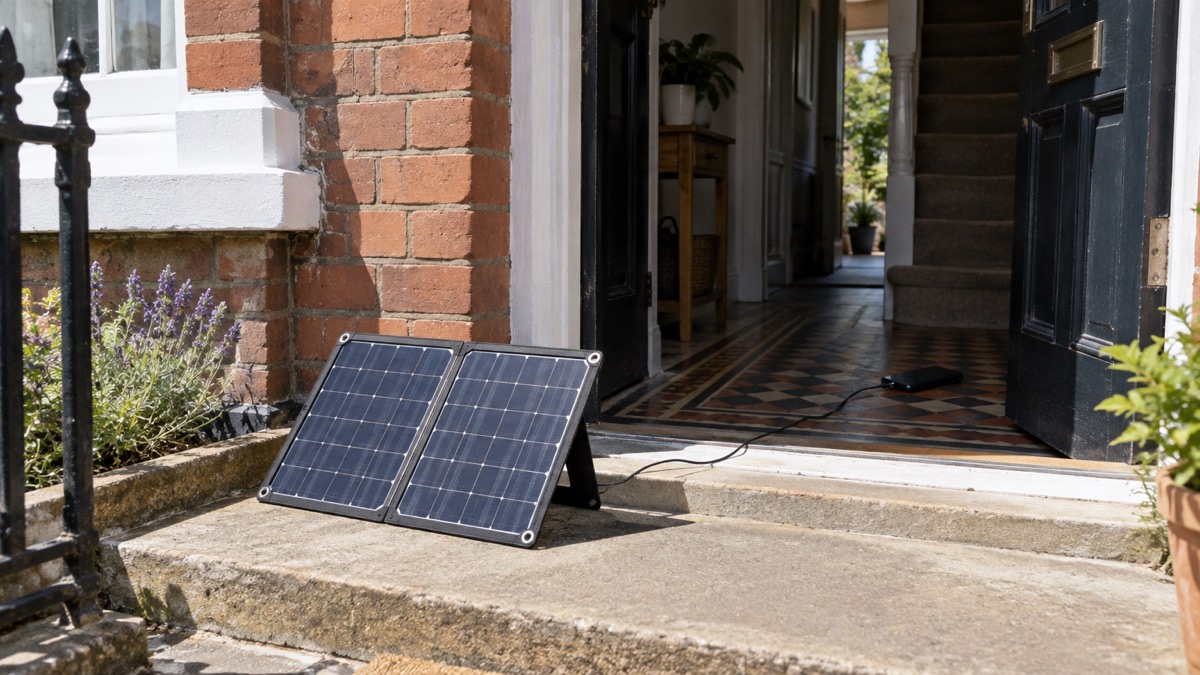
Heat and sunlight deserve special mention with solar charging. EcoFlow's own safety instruction for its portable panel is: "Avoid exposing smartphones or tablets to direct sunlight while charging, as high temperatures may cause damage"2. In practice that means putting the panel in the sun but the phone in the shade, connected by a cable long enough to let you do both. Devon and Somerset Fire and Rescue Service also warn that lithium-ion batteries in phones can become a fire risk when exposed to high temperatures or charged incorrectly9.
Water is the other hazard. The Met Office's WeatherReady advice, developed with the Royal Life Saving Society, is to take a phone in a waterproof pouch when you are out near water, because a charged phone lets you call 999 and ask for the Coastguard in an emergency18. The same logic applies at home during a flood or a storm: keep your charging set-up well away from water, and if a device or charger gets wet, do not plug it in to test it. The Met Office also advises charging mobile phone devices ahead of thunderstorms19, and making sure your phone is fully charged before you go out if you rely on its torch20.
A few related habits round this out. The Met Office's winter car kit advice is to have an in-car phone charger so you can top up your battery even when you are out and about21, and the Scottish Government's emergency kit advice is to include a mobile phone charger in your home kit too22. If you use your phone's torch during a power cut, remember it drains the battery fast, and keep a wind-up torch as the fallback that never runs flat1.
Small solar panels: keep the surface clean so they keep producing
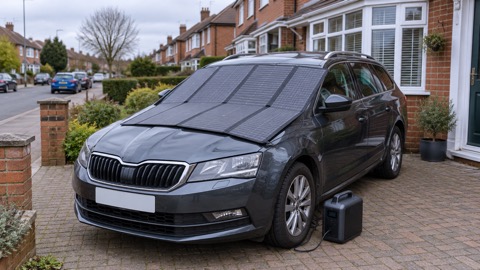
A small folding solar panel only works as well as its face is clean, and the maker's own instructions show what ordinary maintenance looks like. EcoFlow's advice for its portable panel is to use a soft-bristled brush to remove any debris from the surface, then wipe the surface with a damp cloth, and to remove bird excrement or other stuck debris as soon as possible to avoid performance issues2. That last point matters more than it sounds: a panel left on a windowsill, balcony or campsite table collects dust, pollen and bird droppings quickly, and anything sitting on the face blocks the light that panel exists to catch.
The routine for a household panel is short:
- Brush off loose debris with a soft-bristled brush before wiping, so grit does not scratch the face2
- Wipe with a damp cloth, not a soaking one, and let the panel dry before use2
- Remove bird excrement or other stuck debris as soon as you notice it2
- Check the cable and connections for damage each time you set the panel out3
For a panel that lives outdoors or on a roof rather than in a drawer, the stakes are higher. Electrical Safety First notes that most panels have a self-cleaning coating which, when installed at a suitable angle, allows rain to clear dirt and debris3. That coating handles ordinary dust, but it does not handle everything, and the next section explains why.
Why a dirty panel produces less power
The reason a dirty panel produces less power is simple: the dirt sits between the sun and the solar cells, so less light reaches them. Electrical Safety First says periodic cleaning by a specialist company can help remove accumulated dirt, dust and debris, including lichen and guano, improving sunlight absorption, maximising energy production and preventing "hotspots" which can result in a panel failing3. A hotspot is a patch of a panel that is shaded while the rest of it works: the shaded cells heat up unevenly, and over time that can damage the panel itself.
The size of the effect is worth knowing. Electrical Safety First states that keeping solar panels clean and maintained could increase energy production by up to 15 per cent, benefiting you through savings on energy costs3. For a small panel charging a phone in a power cut, 15 per cent is the difference between a phone that reaches evening with charge and one that does not. For a rooftop system, it is a meaningful slice of everything the system produces.
For a portable panel, the fix is the brush-and-cloth routine above. For a rooftop system, the question is whether to clean it yourself or bring in a specialist, and Electrical Safety First's guidance points to specialist cleaning for accumulated dirt, lichen and guano, partly because working at height is its own hazard3. If you want to go deeper on what a panel can deliver in UK conditions, see how long does solar charging take in the UK and what size solar panel do I need to charge a power station.
Rooftop solar is a different job: it needs a registered installer
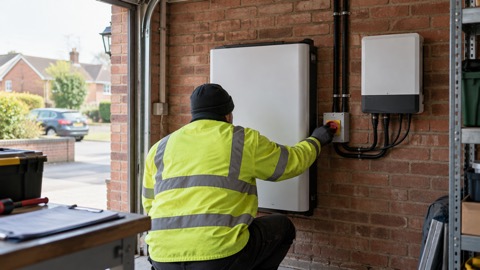
A folding panel that charges your phone through a USB port is a plug-in device anyone can use. Rooftop solar is a different job entirely, and the rules reflect that. Electrical Safety First is clear: it is vitally important to use a skilled, trained and qualified solar PV installer who is registered with a competent person scheme (CPS)3. Companies registered with MCS, the certification scheme, also offer an additional level of assurance3.
There is paperwork that only a proper installer will handle. The building owner is responsible for registering a solar PV system with the Distribution Network Operator (DNO), and a credible installer should be able to take care of this for you by submitting G98 or G99 forms on your behalf3. If an installer cannot or will not do that, it is a warning sign.
The comparison with gas work makes the principle plain. The Health and Safety Executive allows a non-registered person to carry out "wet work", installing water pipes and radiators for a heating system, but any work on the gas boiler itself and the final connection of the water pipework to the boiler must be done by a Gas Safe registered engineer23. The logic is the same for solar: the parts of the job that connect to the home's electrical system belong to someone registered and accountable.
On choosing an installer, Electrical Safety First gives two pieces of consumer advice. Reputable solar panel installers should be signed up to a consumer code, such as the RECC, to prevent pressure-selling3. And be suspicious if you are contacted by solar panel companies out of the blue or put under pressure to buy quickly, especially with time-limited or "one-off" discounts3. Low prices or high savings may not include all necessary parts and services, and extremely short payback times are another warning sign3.
| What to check | What good looks like |
|---|---|
| Installer registration | Registered with a competent person scheme (CPS)3 |
| Certification | MCS registration offers an additional level of assurance3 |
| Consumer code | Signed up to a consumer code such as the RECC3 |
| DNO registration | Installer submits G98 or G99 forms on your behalf3 |
| Sales approach | No cold calls, no pressure, no time-limited discounts3 |
If you are weighing up whether rooftop panels would even help you in a power cut, read do home solar panels work in a power cut and home battery storage: does it keep the lights on.
Where solar panel fire risk comes from
The fire risk from solar panels is low, and it is worth saying that plainly, because the fear is often larger than the fact. Electrical Safety First states that although the risk of fire from solar panels is low, known problems can occur through bad installations, poor quality connections and cable damage through vermin and weathering3. In other words, the risk comes not from the panels themselves but from how they are installed and maintained, which is why the registered-installer rule in the previous section matters so much.
The warning signs to act on are specific. Electrical Safety First's advice is not to ignore burn marks, "arcing" sounds described as buzzing or crackling, fuses blowing, circuit-breakers tripping, or a system that feels hot to touch. If you notice any of these, unplug and contact the retailer, manufacturer, or a qualified repair technician3. Regular visual checks are the way to catch problems early: look for cracks, breaks, loose connections, and any cable damage caused by vermin and weathering3. Electrical Safety First also recommends having your system inspected and tested at least every five years to ensure it remains safe3.
The same battery chemistry sits in your phone, and the same cautions apply. Scottish Fire and Rescue Service warn that where a lithium-ion battery is damaged, it can overheat and catch fire without warning11. London Fire Brigade, on disposing of batteries, note that if they get damaged or overheat, they may cause a fire24. And a real recall shows the stakes: a Bromley council safety notice on two Belkin power banks states that "the product presents a risk of fire as the lithium-ion batteries can overheat whilst in use. This can lead to localised smoking, melting and/or a risk of a fire"25.
One further household point from Devon and Somerset Fire and Rescue Service's home safety partnerships guidance: the biggest risk of electrical fire comes from damaged or overloaded sockets, or "daisy-chained" extension leads that have been plugged into each other26. If your emergency charging set-up grows into a tangle of leads, read extension leads and overloading with backup kit. For the wider picture on batteries at home, see lithium-ion battery safety and what to do if a battery starts swelling.
Wind-up and solar lights
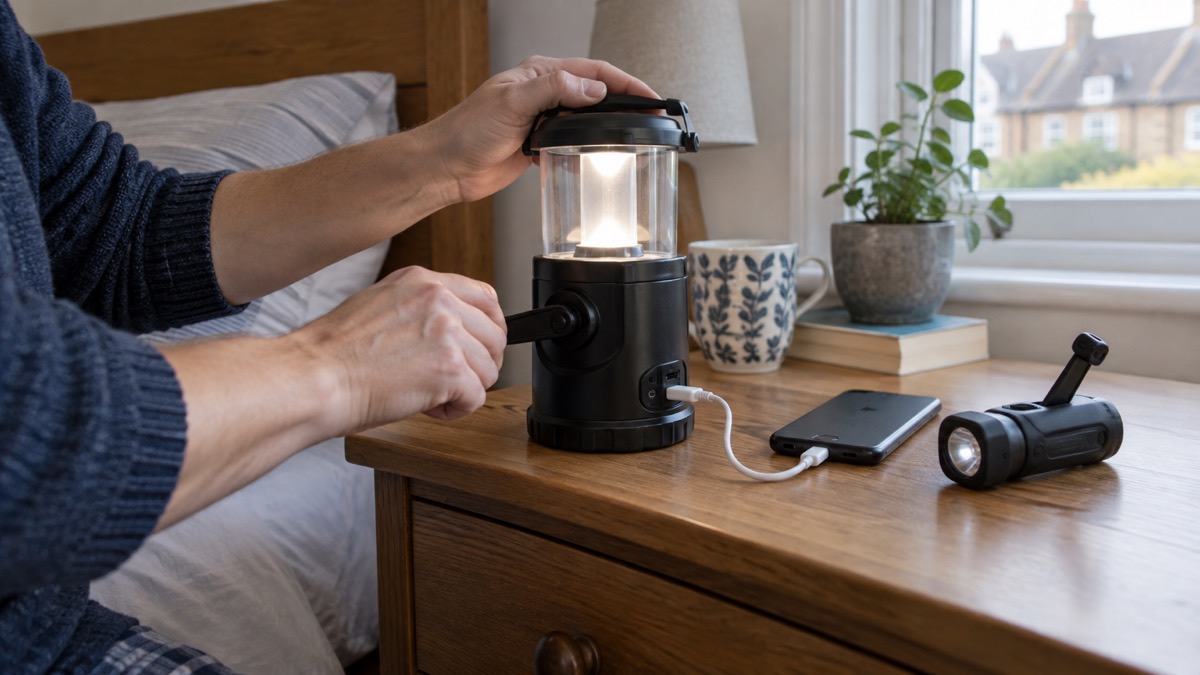
Wind-up and solar devices come into their own for lighting, where the demands are smaller than for phone charging. Wiltshire and Swindon Prepared, in their guidance on preparing for the loss of electricity, say that wind-up torches or lanterns are available which require no batteries at all, and call them "better still" than battery lights for that reason1. A wind-up light cannot run flat in a drawer, cannot be caught out by a dead battery, and needs nothing but a few seconds of winding.
Solar lights work on the same principle as solar chargers, just with a smaller job: they charge a small internal battery by day and give light by night. The same care applies as with any rechargeable device: follow the maker's instructions, keep the solar face clean, and do not leave the light charging on a flammable surface. Some torches show how charging set-ups vary: the Ledlenser P7R SE charges in a wall-mounted cradle that installs with included 3M tape without tools27, while the Olight Seeker Ultra charges through an MCC3 magnetic charger or a USB-C port28. Whatever the method, the fire service rules on hard surfaces and never charging unattended still apply15.
For a full guide to torches, lanterns and candles for power cuts, see emergency lighting at home. If you are building a whole power cut kit, our power cut backup power checklist and backup power checks before winter pull everything together.
Recalls: registering your phone and charger so you hear about problems
Recalls only protect you if you hear about them, and most people never do, because they never registered the product. Devon and Somerset Fire and Rescue Service recommend the Register My Appliance service to register your appliances and get a notification if a product gets recalled6. The National Fire Chiefs Council guidance adds a reason that applies directly to anything with a battery: register your product with the manufacturer to validate any warranties, because batteries are usually included in warranties, and registering makes it easier for manufacturers to contact you in the event of safety or recall information14.
For a household with emergency kit, this is worth ten minutes. Register the phones, tablets, power banks, rechargeable torches and radios you would rely on in a power cut. Then, if a charger or battery is recalled for a fire risk, as the Belkin power banks were25, you will get the notification instead of finding out the hard way. Our page on UKCA, CE and battery safety markings explains what to look for when you buy, and are batteries and chargers from online marketplaces safe covers the risks of unverified sellers.
Getting the balance right for your household
Putting it together, the practical order for an ordinary household is this. First, keep a power bank charged and a wind-up torch in a known place; both are cheap insurance and the torch never runs flat1. Second, keep a phone charger in your home emergency kit, as the Scottish Government's Ready Scotland advice recommends22, and an in-car charger for topping up away from home21. Third, if outages in your area run long, add a small solar panel and keep its face clean with a soft brush and a damp cloth2. Fourth, store the power cut helpline number, 105, on your phone, as the Met Office's WeatherReady advice suggests, along with a separate battery charger29.
And whatever you charge from, the safety rules are the ones the fire services repeat: the maker's instructions, a compatible charger, a hard surface, no covering, no charging unattended or while asleep, and nothing on charge along your escape route13. Follow those and a wind-up or solar charger is a safe, useful part of getting through a power cut.
Sources (29)
- How to prepare for the loss of electricity, Wiltshire and Swindon Prepared, 2026
- EcoFlow 28W Portable Solar Panel, EcoFlow, 2026
- Solar panels safety advice, Electrical Safety First, 2026
- Advice for parents and guardians, Devon and Somerset Fire and Rescue Service, 2026
- Reminder not to cut corners with electrical safety this Christmas, Wiltshire and Swindon Prepared, 2026
- Top ways to reduce your risk of having a fire at home, Devon and Somerset Fire and Rescue Service, 2026
- Batteries and chargers, London Fire Brigade, 2026
- Easy-read fire safety booklet, London Fire Brigade, 2026
- How to stay safe during a heatwave, Devon and Somerset Fire and Rescue Service, 2026
- Rapid Pro 20K power bank, EcoFlow, 2026
- Lithium-ion batteries, Scottish Fire and Rescue Service, 2025
- E-scooter, e-bike and mobility scooter fire safety advice, North Yorkshire Fire and Rescue Service, 2026
- Domestic fire: be informed about hazards, Prepare campaign, 2026
- E-bikes and e-scooters fire safety guidance, National Fire Chiefs Council, 2025
- Student safety, Devon and Somerset Fire and Rescue Service, 2026
- Community safety: other safety advice, Northern Ireland Fire and Rescue Service, 2026
- Electrical safety at home, North Yorkshire Fire and Rescue Service, 2026
- WeatherReady weather hacks (seasonal advice), Met Office, 2026
- Stay safe in a thunderstorm, Met Office, 2026
- WeatherReady weather hacks, Met Office, 2026
- Winter car kit, Met Office, 2026
- Emergency kit, Ready Scotland, 2026
- Landlord gas safety checks: who can carry them out, Health and Safety Executive, 2026
- How to dispose of batteries from your e-bike or e-scooter, London Fire Brigade, 2026
- Belkin power bank product safety notice, London Borough of Bromley, 2025
- Home safety partnerships, Devon and Somerset Fire and Rescue Service, 2026
- P7R SE torch special edition, LedLenser, 2026
- Seeker Ultra high power torch, Olight, 2026
- Top tips to be WeatherReady, Met Office, 2026
 Power Cut Backup Power Checklist
 Backup Power Before Winter
 Safe Battery Charging at Home
 What to Keep Running in a Cut
 Power During an Outage
 Watts and Watt-Hours
 Portable Power Stations
 Portable Generator Types
 Generator Safety
 LPG Cylinders and Regulators
 Connecting to Your Home's Wiring
 Home Battery Storage
 Portable Solar Panels
 12V Inverters
 Leisure and LiFePO4 Batteries