The size of solar panel you need is set first by what your power station will accept, not by the biggest panel you can buy. A power station has an input window for voltage and current, and a connector it expects. A panel outside that window will not charge it, however many watts it claims. Once the panel fits, the question becomes how much it will actually deliver in UK weather, which is far less in winter than the label suggests.
The Caravan and Motorhome Club's figures show the gap plainly. A 100W panel can produce 600 to 700Wh in summer, but a 25W panel produces only 20Wh in winter1. If you are sizing a panel to keep a small power station topped up through a winter power cut, plan around the winter column, not the summer one.
So the practical answer is: match the panel to your power station's stated input range and connector, then choose a wattage that covers your daily use with a margin for grey days. Check the panel against the power station's own stated input range and connector before you buy, and do regular visual checks on any panels you already have to identify cracks, breaks, loose connections and cable damage caused by vermin and weathering2. This page sets out how to check the match, what panels really deliver, and when a fixed roof system needs a qualified installer.
Match the panel to your power station's input: voltage, connector and watts
Start with the label on your power station, not the panel. Every maker states an input window, and a panel outside it will either refuse to charge or charge poorly. EcoFlow states that its RIVER mini needs a solar panel hitting 11 to 39V, 8A, up to 100W4. The DELTA Max accepts panels using a solar connector with voltage and current under 11 to 100V, 13A max9. Anker's SOLIX PS100X connects to power stations that support an 11 to 60V MC4 input3.
The connector matters as much as the voltage. Anker states that its SOLIX C300X should only be used with solar panels between 11 and 28V and with an XT60 connector10. The same instruction applies to the C200 DC, which recommends a 100W panel6, and to the C300 DC, which recommends 100W or 60W panels11. If your station specifies XT60 and your panel has an MC4 plug, you need the right adapter, and the maker's own instruction is the one to follow.
There is a second layer to this. A solar panel produces direct current (DC), and to use it to power something that uses a three-pin 230V socket you need an inverter to convert DC into alternating current (AC)8. Most portable power stations have that inverter built in, which is why you plug the panel into the station and the appliance into the station. If you are charging a battery directly rather than through a power station, Sterling Power states that a solar regulator is required, and that you divide your total solar panel wattage by your battery voltage to get the minimum regulator amp rating12.
| Power station | Solar input it accepts | Connector | Source |
|---|---|---|---|
| EcoFlow RIVER mini | 11 to 39V, 8A, up to 100W | Solar input | 4 |
| EcoFlow DELTA Max | 11 to 100V, 13A max | Solar connector | 9 |
| Anker SOLIX PS100X panel | Fits stations with 11 to 60V input | MC4 | 3 |
| Anker SOLIX C300X | 11 to 28V | XT60 | 10 |
| Anker SOLIX C200 DC | 11 to 28V, 100W panel recommended | XT60 | 6 |
| Anker SOLIX C300 DC | 11 to 28V, 100W or 60W panel recommended | XT60 | 11 |
Smaller power stations of 200 to 500Wh and the panels that suit them
For a compact power station, the panel question is really about how much energy you can put back in a day. The Caravan and Motorhome Club's 24-hour generation figures give a realistic picture of what different panel sizes deliver1:
| Panel size | Summer | Winter |
|---|---|---|
| 10W | 60 to 70Wh | 8Wh |
| 25W | 150 to 175Wh | 20Wh |
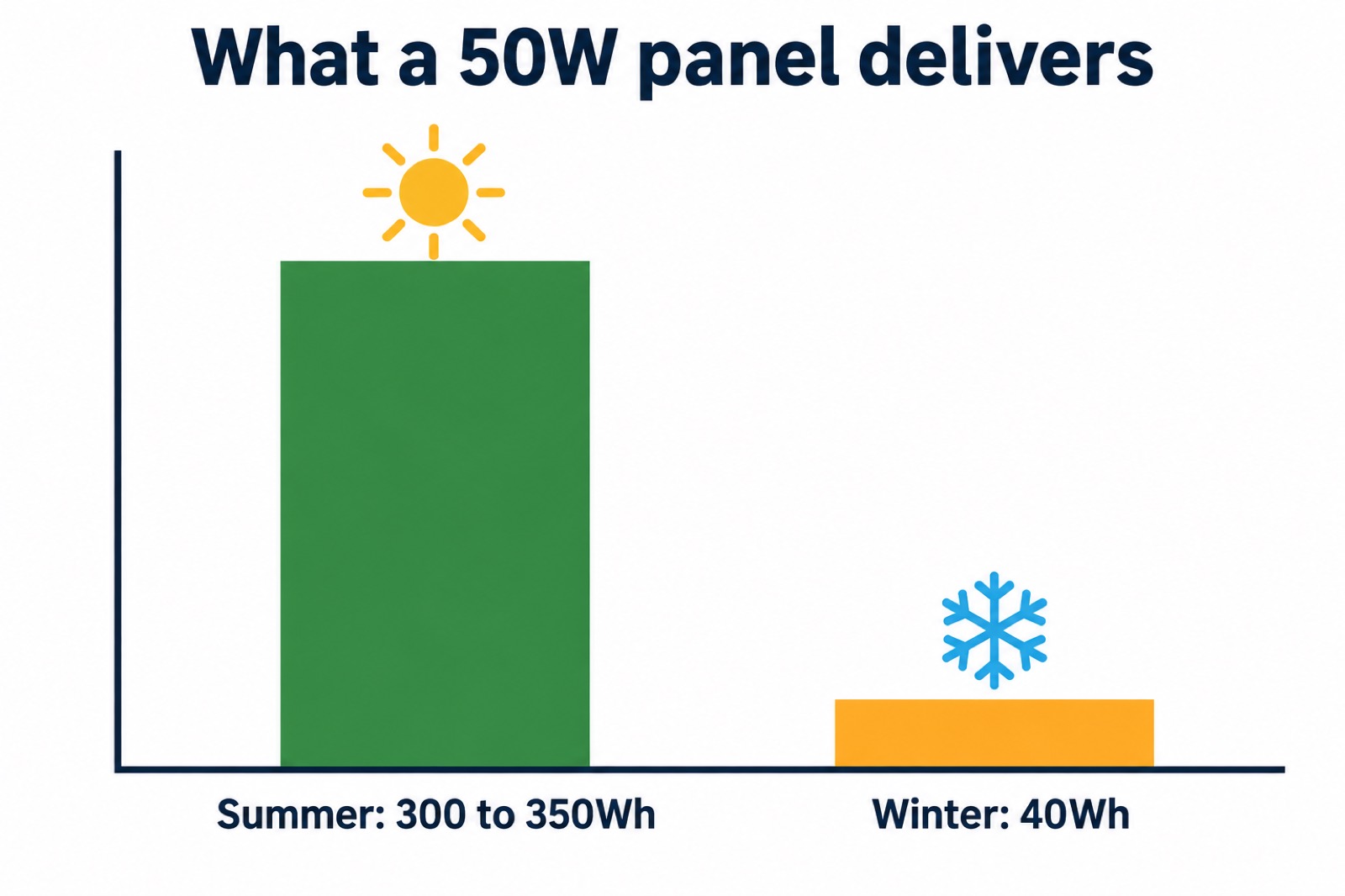
| 50W | 300 to 350Wh | 40Wh |
| 90W | 480Wh | Not given |
| 100W | 600 to 700Wh | Not given |
| 150W | 900 to 1050Wh | 120Wh |
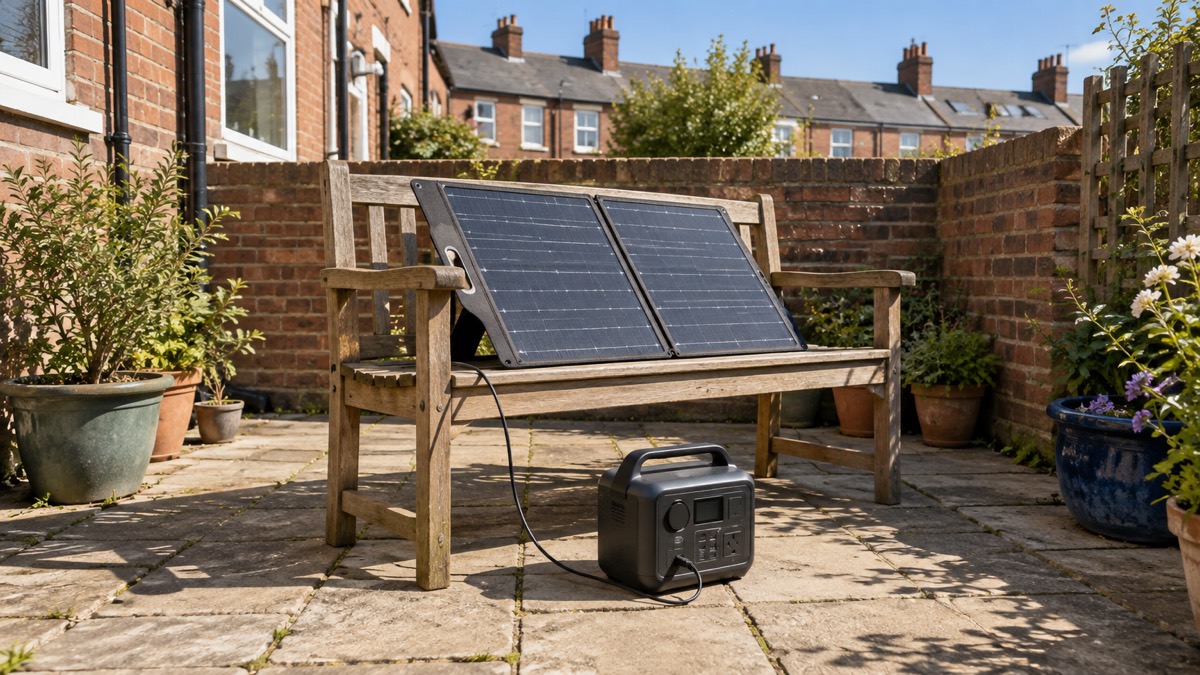
Read the winter column carefully. A 50W panel that looks generous in July delivers 40Wh in a winter day, which is a small fraction of a 200 to 500Wh battery. That is why a panel sized only for summer will disappoint you in a January power cut. If your power station is in the 200 to 500Wh range, a 100W panel is the common recommendation from makers: Anker recommends its 100W panel for the C300 DC11 and pairs the C300 with a 100W panel5. A 60W panel is also offered as a pairing for smaller stations10.
The Caravan and Motorhome Club also notes that to keep a caravan or motorhome battery topped up while on-site, you would need at least a 40W panel1. That is a useful floor for thinking about maintenance charging: below about 40W you are trickling, not refilling.
What a panel really delivers: weather, dirt and angle
A panel's rated wattage is a laboratory figure. Anker states that solar panel output varies with sunlight intensity, panel orientation and angle, and that actual power may be lower than rated, so you should test under full, unobstructed sunlight for best results13. BioLite states that solar panels always need direct sunlight to charge, and that charging works on cloudy days but at a slower rate, with the higher the UV index the faster the charge14.
Angle is the thing you can control most easily. EcoFlow's 110W panel has an integrated solar angle guide, and the maker advises keeping sunlight at a 90 degree angle to get the most sunshine at all times15. In practice that means moving the panel through the day, or at least tilting it towards the sun rather than leaving it flat.
Rain is not the enemy. BioLite states that its panel can be left out in the rain, and that rain helps keep the panel clear of dust for better performance, but you should check after heavy storms that the panel is clear of debris and has not shifted into shade16. Electrical Safety First notes that most panels have a self-cleaning coating which, when installed at a suitable angle, allows rain to clear dirt and debris8.
Keeping panels clean so they keep producing
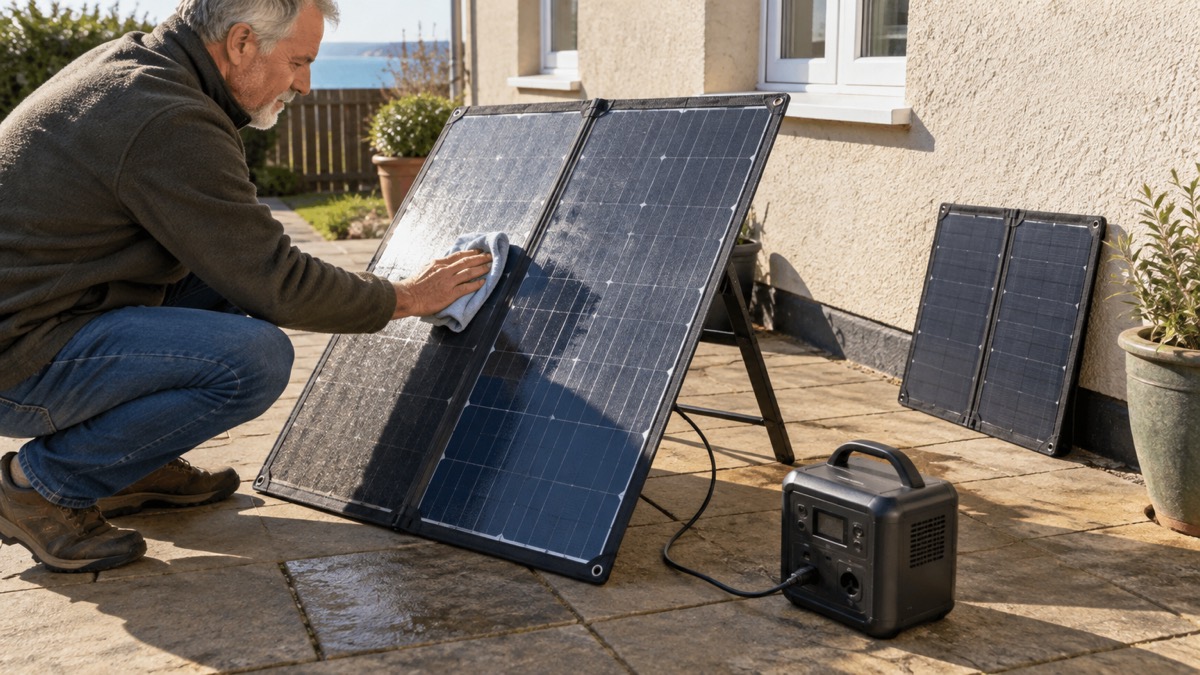
Dirt costs you output. Electrical Safety First states that keeping solar panels clean and maintained could increase energy production by up to 15 per cent7. For a portable panel that lives in a shed or a cupboard, the main enemies are dust, pollen and bird droppings, and the fix is simple.
EcoFlow advises regular cleaning with soft materials, and warns against hard materials scratching the surface17. A soft cloth and water is enough for a portable panel. For a fixed roof array, Electrical Safety First notes that periodic cleaning by a specialist company can help remove accumulated dirt, dust and debris, including lichen and guano, improving sunlight absorption, maximising energy production and preventing hotspots which can result in a panel failing7.
Portable panels or a fixed roof system: when you need a qualified installer
These are two different jobs. A portable panel is a plug-in accessory you can move, store and take with you. A fixed roof system is a building installation, and the rules and risks are different.
For a fixed system, Electrical Safety First states it is vitally important to use a skilled, trained and qualified solar PV installer who is registered with a competent person scheme (CPS)8. Companies registered with MCS also offer an additional level of assurance, and reputable installers should be signed up to a consumer code such as the RECC to prevent pressure-selling7. Be suspicious if you are contacted by solar panel companies out of the blue or put under pressure to buy quickly, especially with time-limited or one-off discounts, and watch out for low prices or high savings that may not include all necessary parts and services7.
For portable panels, the maker's guidance decides the choice. EcoFlow states that flexible panels suit smaller vans or boats and can be moulded to fit any shape, while rigid panels are better for permanent mounting, such as on the roof of a home, off-grid cabin or flat-roofed RV18. A rigid panel is bulkier: EcoFlow's 100W rigid panel measures 172.2 by 113.3 by 3.5cm19, while Sterling Power's 100W semi-flexible panel measures 950 by 550 by 2mm12. A folding panel is smaller again: Anker states its PS100X folds down to A4-size paper3.
Warranty periods are worth checking before you buy. EcoFlow lists a 24-month warranty on its 400W portable panel20 and on its 160W portable panel19.
Plug-in solar and USB-C panels: what the rules and makers say
Plug-in solar panels that feed a household circuit are a separate case from a panel charging a power station. Electrical Safety First recommends having your electrical installation assessed by a competent electrician registered with a competent persons scheme before purchasing or using a plug-in solar system, particularly in older properties or where the condition of the installation and type of protective devices is unknown21. Homes with Type AC RCDs should not use plug-in solar systems without first upgrading to a minimum Type A bidirectional RCD on those circuits21.
USB-C solar panels are a different matter again, and the maker's compatibility list is decisive. Anker states that its SOLIX C300 power station is not compatible with the SOLIX PS30 or other 5V/3A USB-C solar panels, and should be paired with its 100W solar panel5. The PS30 itself has a USB-C port at 5V/3A and a USB-A output port at 5V/2.4A23. A small USB-C panel like that is fine for charging a phone directly, but it is not a substitute for a panel matched to a power station's solar input.
If you are extending a panel run, Anker's extension cable guidance gives recommended cable sizes: 4 mm² for 1 to 4 panels, and 6 mm² for 5 or more panels24.
Where to get help and what to check before you buy
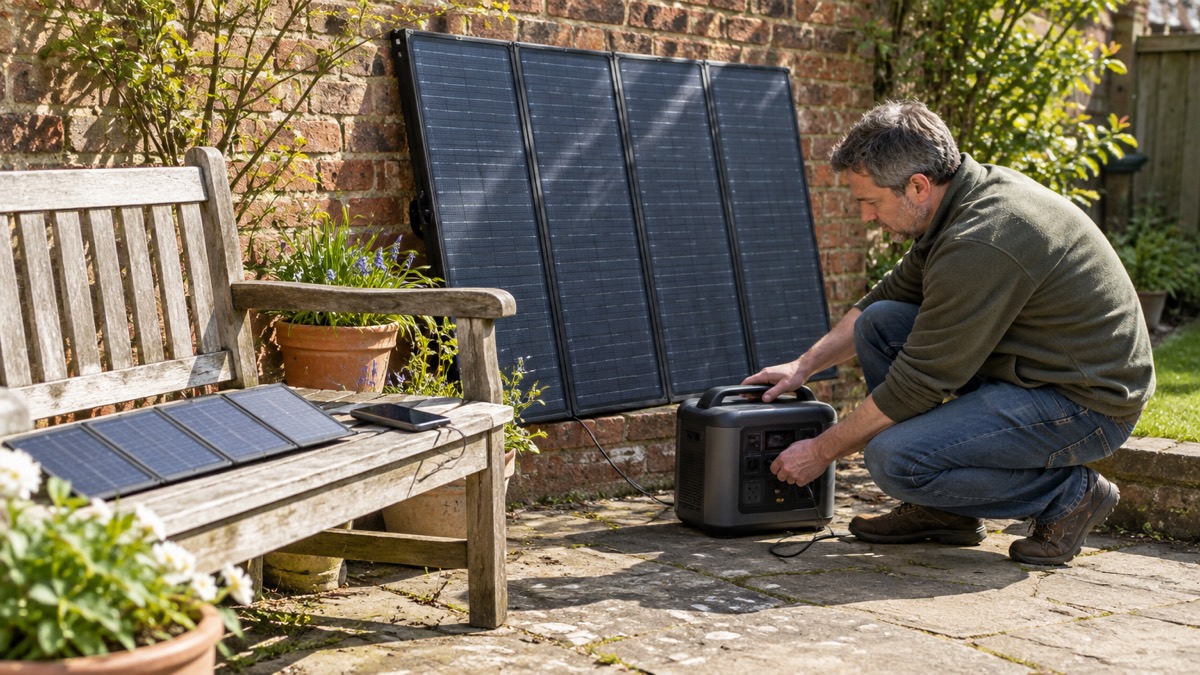
Before you buy a panel, check three things on your power station: the voltage range, the current limit and the connector. Then check the panel's own figures against them. If the maker lists a recommended panel, that is the safest pairing, because the maker has tested it with its own product5.
For a fixed installation, use a qualified installer registered with a competent person scheme, and look for MCS registration and a consumer code such as the RECC8. Keep up the visual checks and the five-yearly inspection7.
For more on matching kit to your household, see Portable Solar Panels for Charging in a Power Cut, Portable Power Stations: What They Do and How to Choose, and How Long Does Solar Charging Take in the UK?. If you are weighing a panel against other charging routes, Can You Charge a Power Station from Your Car? and Plug-In Solar Panels: Are They Safe to Connect? cover the alternatives.
Sources (25)
- Solar power advice, Caravan and Motorhome Club, 2026-10-25
- Emergency kit packing list, Which?, 2026-09-30
- Anker SOLIX PS100X Portable Solar Panel, Anker SOLIX, 2026-10-25
- EcoFlow RIVER mini Portable Power Station, EcoFlow, 2026-10-25
- Anker SOLIX C300 DC and C300, Anker SOLIX, 2026-10-25
- Anker SOLIX C200 DC with 60W portable solar panel, Anker SOLIX, 2026-10-25
- Solar panels safety advice, Electrical Safety First, 2026-10-26
- Solar panels safety, Electrical Safety First, 2026-10-25
- EcoFlow DELTA Max 400W Portable Solar Panel, EcoFlow, 2026-10-25
- Anker SOLIX C300X with 60W solar panel, Anker SOLIX, 2026-10-25
- Anker SOLIX C300 DC Portable Power Station, Anker SOLIX, 2026-10-25
- Solar Panel 100W Semi Flexible ETFE, Sterling Power, 2026-10-25
- Anker SOLIX 100W Portable Solar Panel, Anker SOLIX, 2026-10-25
- BioLite Solar Site Lights, BioLite, 2026-10-25
- EcoFlow 110W Lightweight Portable Solar Panel, EcoFlow, 2026-10-25
- BioLite SolarHome 625+, BioLite, 2026-10-25
- EcoFlow 175W Rigid Solar Panel, EcoFlow, 2026-10-25
- Flexible solar panels, EcoFlow, 2026-10-25
- EcoFlow portable solar panels, EcoFlow, 2026-10-25
- EcoFlow 400W Portable Solar Panel, EcoFlow, 2026-10-25
- Plug-in solar panels, Electrical Safety First, 2026-10-25
- Anker SOLIX C300 DC with 100W solar panel, Anker SOLIX, 2026-10-25
- Anker SOLIX PS30 Portable Solar Panel, Anker SOLIX, 2026-10-25
- Anker SOLIX Solar Panel Extension Cable, Anker SOLIX, 2026-10-25
- Tips to help you during a power cut, Electricity North West, 2026-10-25
 Power Cut Backup Power Checklist
 Backup Power Before Winter
 Safe Battery Charging at Home
 Running a Generator Indoors
 Carbon Monoxide from Generators
 Generator Sizing for a Power Cut
 Generator Run Time on a Tank
 Storing Petrol at Home
 Diesel Storage at Home
 Storing a Generator
 Generators in Cold Weather
 Generator Noise and Neighbours
 Power Station Capacity Sizing
 Power Station Run Time
 Power Station for a Gas Boiler