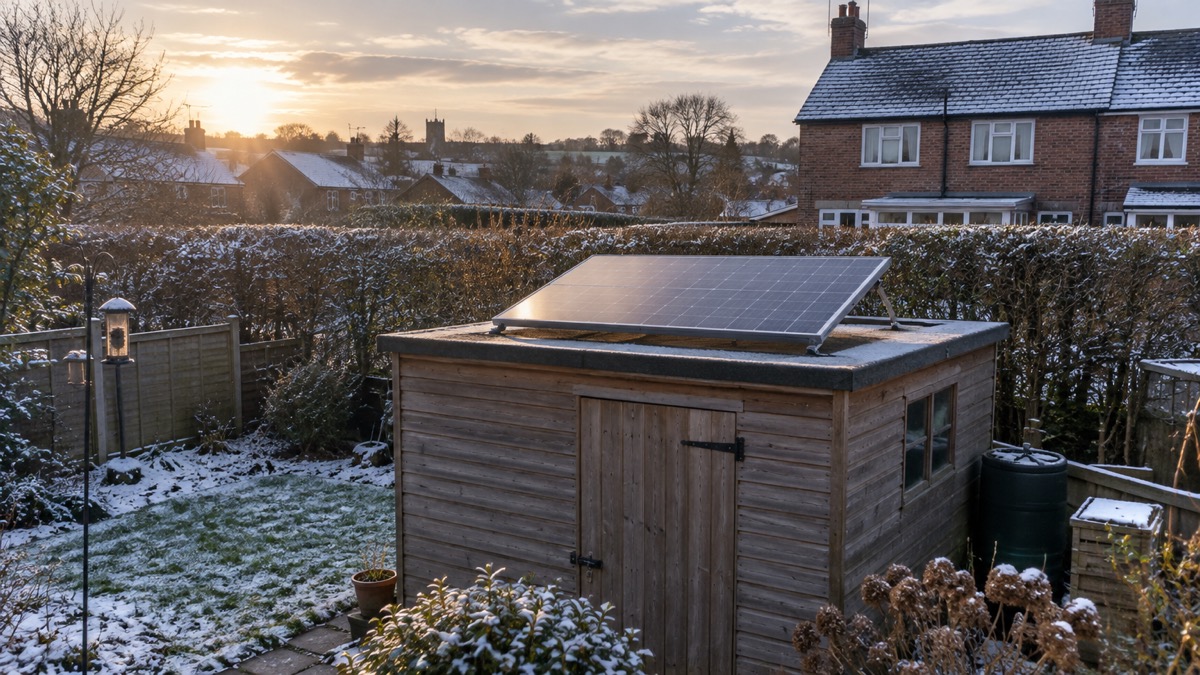
A rigid solar panel is the part of a backup power plan that keeps working after the batteries have gone flat. The EcoFlow 100W Rigid Solar Panel is a framed, glass-covered monocrystalline panel rated at 100W, with a conversion efficiency of 23% and a weight of about 6.2 kg1. It is built to be fixed down: pre-drilled slots take EcoFlow's mounting feet, and the anti-corrosive aluminium frame is designed for a permanent outdoor position rather than being carried in and out of a cupboard1.
For a household, its job is to put charge back into a power station or battery when the mains is off and the sun is out. EcoFlow says it can connect to existing third-party solar systems, 48V power systems and portable power stations, using an all-inclusive solar connector, with one or several panels1. That makes it a way to top up a portable power station over a multi-day outage, or to keep a leisure battery charged in a shed or van.
It is not a whole-house solution and it will not run a kettle on its own. What it does is add a slow, steady trickle of energy that costs nothing to run and needs no fuel, which is exactly what a long power cut or a storm with several days of disruption calls for. This page sets out what the panel is, what it produces, how heat and weather change that, how to wire and mount it, and how to keep it ready.
What the panel is and what it does for a household
The EcoFlow 100W Rigid Solar Panel is a rigid monocrystalline solar panel: silicon cells, a protective lamination and tempered glass on the front, held in an anti-corrosive aluminium frame1. EcoFlow says the cells are coated with highly protective lamination and tempered glass to enhance performance and protect them outdoors1. The frame is what separates it from a folding portable panel: it holds its shape, it can be bolted down, and it is meant to stay where you put it.
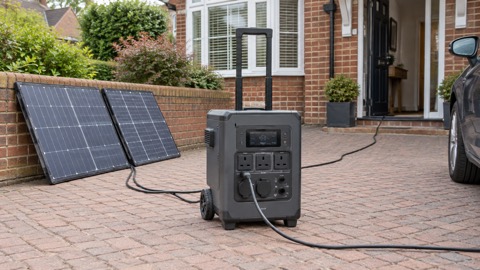
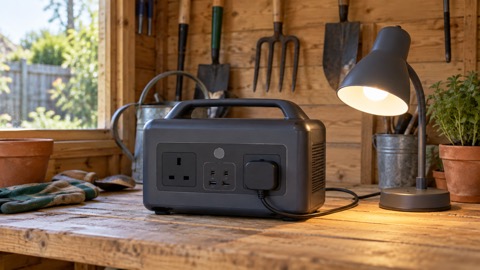
That shape suits particular jobs in a household plan. A panel fixed to a shed roof, a garage roof, a fence or a van roof can be left in place and connected whenever you need it, so there is nothing to unfold and prop up in the rain. EcoFlow describes stringing several 100W rigid panels together to quickly charge LFP batteries and power an RV for days2. The same logic applies at home: a small array on an outbuilding can keep a battery topped up through a long outage.
It also suits a household that wants a solar input ready before an emergency rather than buying one during it. Because it is rigid and weatherproof, it can be installed as a permanent fixture and simply switched into the power station when the mains fails. For the wider picture of how solar fits a backup plan, see Portable Solar Panels for Charging in a Power Cut.
What it does not do is store energy. It only produces while light falls on it, so it needs a battery or power station behind it, and its output falls away in cloud, rain and short winter days. Treat it as a way to stretch a battery, not as a replacement for one.
Specifications: 100W output, 23% efficiency and 6.2 kg
The headline figures are straightforward. EcoFlow rates the panel at 100W and gives it a conversion efficiency of 23%, which it describes as an excellent conversion rating that allows faster charging1. The 2023 EcoFlow product catalogue gives the same 23% efficiency figure4. One EcoFlow page also lists the rating as 100 W with a tolerance of plus or minus 5W; the maker's documents give both forms and they are not reconciled, so treat 100W as the nominal figure and allow for a small variation between panels.
| Specification | EcoFlow figure |
|---|---|
| Power rating | 100W1 |
| Cell type | Monocrystalline silicon2 |
| Conversion efficiency | 23%1 |
| Dimensions | 98 x 58.6 x 3 cm1 |
| Weight | Approximately 6.2 kg1 |
| Open circuit voltage | 20.3 V1 |
| Maximum operating voltage | 17.1 V2 |
| Maximum operating current | 5.9 A2 |
| Short circuit current | 6.3 A1 |
| Maximum system voltage | 600 VDC (UL)1 |
| Maximum fuse current | 15 A1 |
| Frame | Anti-corrosive aluminium1 |
| Front cover | Tempered glass over laminated cells1 |
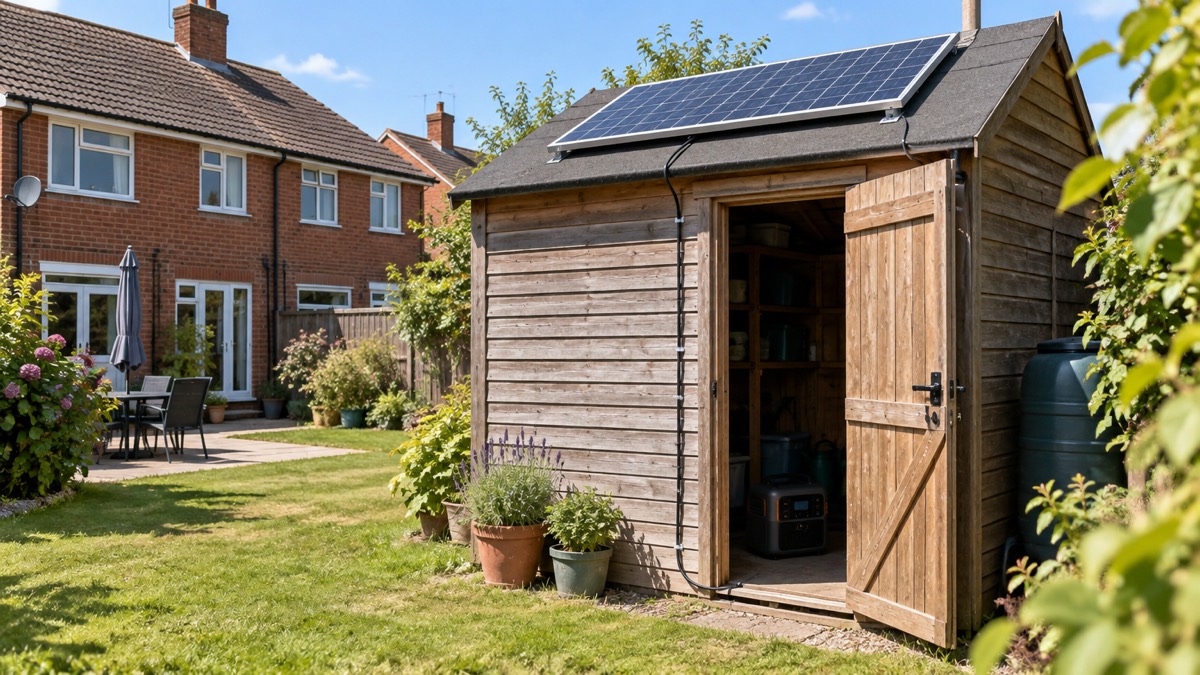
The physical size matters as much as the electrical figures. EcoFlow gives the panel's dimensions as 98 by 58.6 by 3 cm and its weight as approximately 6.2 kg1. The weight is carried by the frame, so the surface it is fixed to has to take both the weight and the wind load.
The bundle EcoFlow sells contains two 100W rigid solar panels, two mounting feet, a user manual and a warranty card; the solar to XT60i charging cable is not included1. If you are buying the bundle to charge an EcoFlow power station, check what cable that station needs before you plan the install.
Electrical ratings and how heat changes them
A solar panel's ratings are measured under standard test conditions, and real conditions move them. EcoFlow publishes temperature coefficients that tell you which way. The rated power coefficient is minus 0.39% per degree Celsius, and the open circuit voltage coefficient is minus 0.33% per degree Celsius, so both power and voltage fall as the panel gets hotter1. The short circuit current coefficient is plus 0.06% per degree Celsius, so current rises slightly with heat1.
In practice, a panel on a hot summer roof produces less than its rated 100W, and a cold, bright winter day can produce closer to the rating than a warm one. That is normal behaviour, not a fault. It also means the panel's best days in the UK are often the clear, cold ones, when the sun is low but the panel is cool.
The voltage figures are the ones to watch when you plan a system. The open circuit voltage of 20.3 V is what the panel produces with no load connected, and it is the figure that matters for checking a charge controller's maximum input1. The maximum operating voltage of 17.1 V and maximum operating current of 5.9 A are the working figures2. The short circuit current of 6.3 A is what flows if the output is shorted, and it is the figure a fuse has to cope with1.
EcoFlow lists a maximum fuse current of 15 A1. That is the maker's ceiling for protecting the circuit, and it is the number to work from when you size a fuse for a single panel or a string. If you are not confident about sizing and fitting fuses and isolators, have the work checked by someone competent before you connect the panels.
Connecting it to a power station or solar system
EcoFlow says the panel can be readily connected with existing third-party solar systems, 48V power systems and portable power stations, with one or multiple panels, using an all-inclusive solar connector1. When it is combined as part of a Power Kits setup or an EcoFlow portable power station, EcoFlow states that the integrated MPPT algorithm optimises the solar input1. MPPT, or maximum power point tracking, is the electronics that constantly adjusts the load to squeeze the most power from the panel as light and temperature change.
The practical steps for a household are these:
- Check what solar input your power station or charge controller accepts, in volts and amps, before you buy or connect anything.
- Decide whether you are using one panel or several, because that changes the voltage and current the controller sees.
- Use the correct cable for your device. The bundle does not include the solar to XT60i charging cable, so confirm which connector your power station needs1.
- Connect the panel to the controller or power station first, then position it in the light, and disconnect in the reverse order where the maker's instructions say so.
- Keep the cable run as short as you reasonably can, and keep connections out of standing water.
EcoFlow states that, using an all-inclusive solar connector, the panel can be readily connected with any of your existing third-party solar systems, including 48V power systems and portable power stations, with one or multiple panels1. Series connection adds voltages together and keeps the current the same; parallel connection keeps the voltage the same and adds the currents. Which one you need depends on the controller, and the controller maker's instructions take priority.
If you are charging a power station rather than a fixed system, the solar panel sizing and solar charging time pages explain how panel output translates into charging time in UK conditions. For the wider question of what a solar generator is and how the parts fit together, see What Is a Solar Generator?.
Mounting and stringing panels together
EcoFlow says the panel has pre-cut holes and is ready to mount on a van or off-grid build, and that it should be paired with the 100W Rigid Solar Panel Mounting Feet for a secure attachment to any surface1. The bundle includes two mounting feet with two panels1. The feet are the interface between the panel frame and whatever you are fixing it to, so the strength of the job depends on both.
A sound mounting job has a few parts:
- A solid surface. Fix into rafters, purlins or a proper frame, not just roof cladding or a thin panel.
- The right fixings. Use fixings suited to the material, and check them again after the first strong wind.
- Room to breathe. Leave a gap behind the panel so air can move and heat can escape, which helps with the temperature losses described above.
- A safe cable route. Keep cables clipped and out of the way of feet, tools and water, and avoid leaving loops where water can collect.
- A tilt that suits the season. A steeper angle sheds rain and snow and catches low winter sun better than a flat mount.
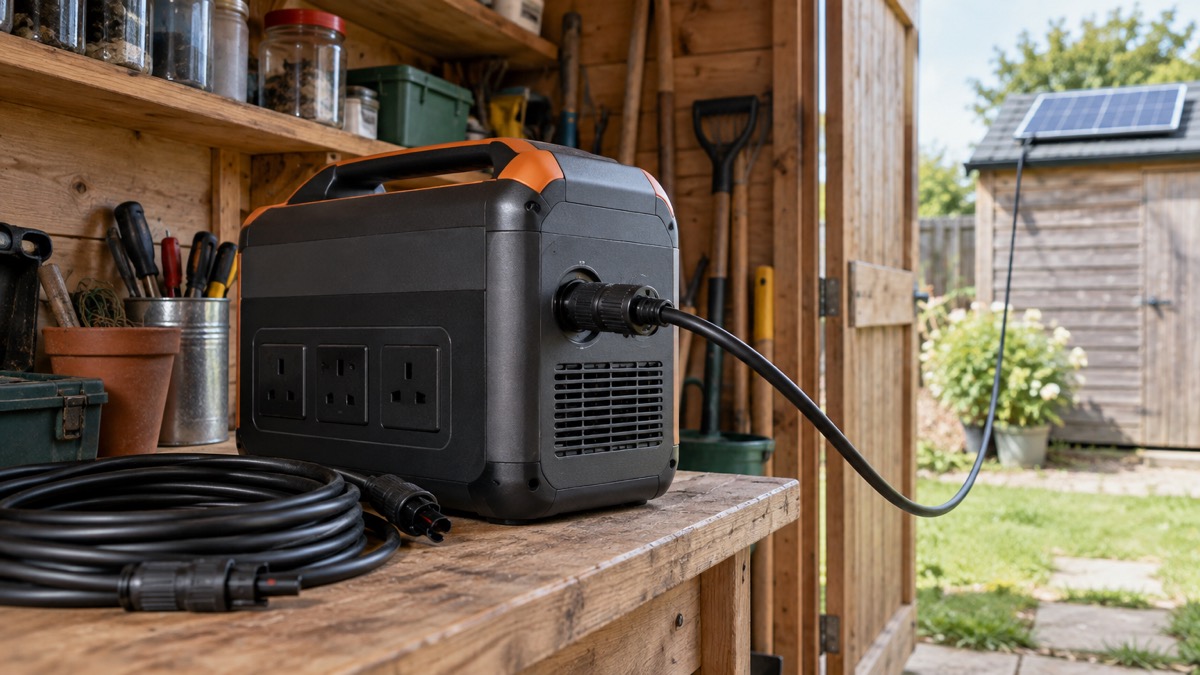
Stringing several panels follows the same electrical logic as any solar array. EcoFlow suggests stringing several 100W rigid panels together to charge LFP batteries faster2. Each panel's open circuit voltage is 20.3 V and its maximum operating voltage is 17.1 V, so two panels in series give roughly double the voltage and the same current, while two in parallel give the same voltage and roughly double the current1. The total must stay within what your controller or power station accepts, and within the panel's maximum system voltage of 600 VDC1.
If you are mounting on a home's wiring rather than plugging into a power station, that is a different job with different rules. See Connecting a Generator or Battery to Your Home's Wiring and Plug-In Solar Panels: Are They Safe to Connect? before you go further.
Weatherproofing: IP68, 130 mph winds and tempered glass
The panel is rated IP68 for water and dust under IEC standard 60529, tested to a maximum water depth of 1 metre for up to 72 hours1. EcoFlow says it can withstand dirt, low-pressure water jets, extreme winds of up to 130 mph and heavy snowfalls1. EcoFlow also states that all its solar panels, including the flexible ones, are waterproof with an IP68 rating5, and describes IP68 as a top-ranking weatherproof rating on its solar generator pages6.
What that means for a UK household is that the panel itself is built for permanent outdoor life. Rain, sleet, snow and hose-downs are within its rating. The weak points in a real installation are rarely the panel: they are the fixings, the frame joints, the cable entries and the connectors. A panel that survives 130 mph of wind in a test will still leave the roof if the brackets are undersized or the screws pull out.
Snow is worth a mention for UK winters. EcoFlow states that the panel can withstand dirt, low-pressure water jets, extreme winds of up to 130 mph, and even heavy snowfalls1. A steep tilt helps snow slide off, and a soft brush used carefully from the ground, never a scraper on the glass, will restore output. Do not climb onto a roof in icy conditions to clear a panel.
The 10-year warranty EcoFlow gives the panel reflects a product intended to stay outside3. Keep the warranty card that comes in the bundle and keep a note of the date and place of purchase, because a warranty claim is easier with the paperwork to hand.
Keeping it ready for an emergency
A solar panel that is already mounted and wired is worth far more in an outage than one still in its box. The work of getting ready is mostly done once, before you need it:
- Mount the panel where it gets sun for the longest part of the day, and check the fixings before each winter.
- Keep the cable and connector clean and dry, and check the connector for corrosion.
- Test the whole chain on a sunny day: panel, cable, controller or power station. Confirm the power station shows an input.
- Clear leaves, bird mess and snow when you can, because shading on part of a panel cuts output more than its area suggests.
- Store any spare cable, fuses and the manual together, so a dark evening does not mean hunting for them.
The panel's role in a plan is to extend the time a battery can keep going. A power station charged from the mains will run down over a long outage; a panel gives it a daily top-up whenever the sun appears. How much that top-up amounts to depends on the season, the weather and the angle of the mount, and it will be modest in a UK December. Plan for the panel to slow the drain rather than to refill the battery.
For the wider kit that goes with it, see the Power Cut Backup Power Checklist and Backup Power Checks Before Winter. If you are deciding what to keep running first, Deciding What to Keep Running When the Mains Fails sets out the order most households find useful.
Support, warranty and what owners report
EcoFlow gives the 100W Rigid Solar Panel a 10-year warranty3. The bundle includes a user manual and a warranty card, so keep both with your paperwork1. For support, use the contact details on EcoFlow's own site and have your order details and the panel's serial information ready.
On owner feedback, EcoFlow's product page shows a verified customer stories rating of 4.73 stars from 921 reviews for the bundle1. A separate review summary on the same page shows 2 reviews, both five-star1. The two figures cover different review sets, so read them as the maker's own published ratings rather than an independent test. They tell you that buyers are broadly positive; they do not tell you how the panel performs in a UK winter, which is why the mounting, angle and shading advice above matters more than any star rating.
EcoFlow's wider range is covered on the EcoFlow brand page, and the Backup Power at Home section explains how solar, batteries and power stations fit together in a household plan.
Sources (6)
- EcoFlow 100W Rigid Solar Panel product page, EcoFlow, 2026-10-25
- Rigid Solar Panels, EcoFlow, 2026-10-25
- Portable Solar Panels, EcoFlow, 2026-10-25
- EcoFlow 2023 Product Catalogue, EcoFlow, 2023
- Flexible Solar Panels, EcoFlow, 2026-10-25
- Solar Generators, EcoFlow, 2026-10-25

 BLUETTI Apex 300 Power Station
 BLUETTI Elite 100 V2
 Anker SOLIX C2000 Gen 2
 Anker SOLIX C1000 Power Station
 EcoFlow DELTA Pro
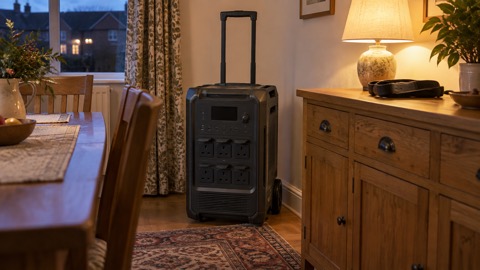 BLUETTI Elite 400
 Anker SOLIX C300 Power Station
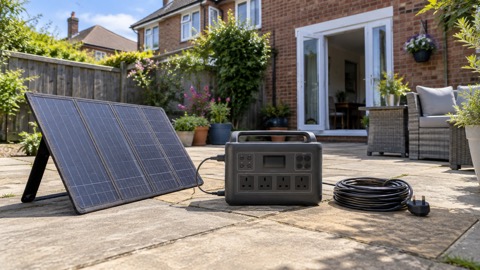 EcoFlow DELTA 3
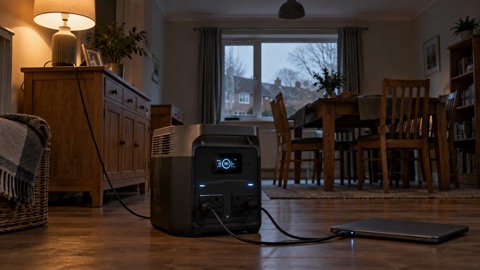 EcoFlow DELTA 2 and DELTA 2 Max
 EcoFlow DELTA and DELTA Max
 EcoFlow RIVER 3 and RIVER 3 Plus
 EcoFlow RIVER 2 and RIVER 2 Max