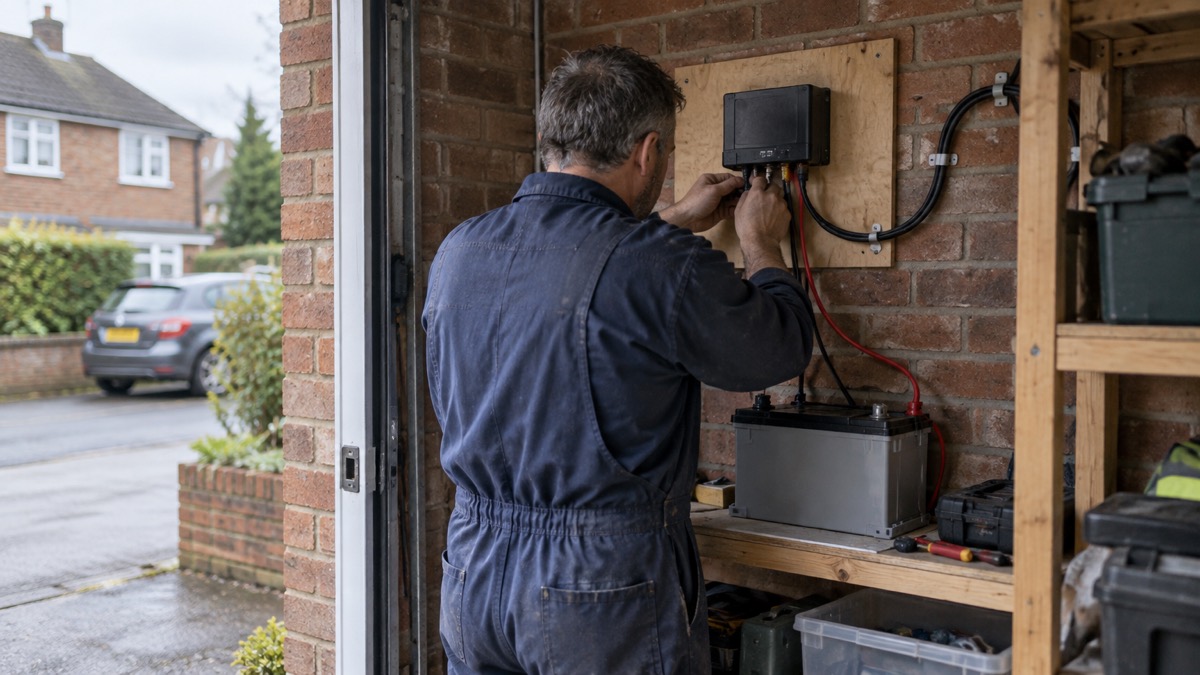
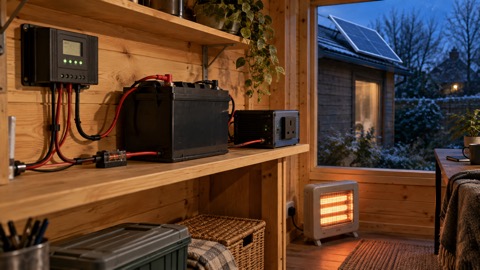
If you are fitting a solar panel to charge a battery, at a caravan, a boat, a shed or as part of a home backup power set-up, the small box between the panel and the battery matters as much as either of them. A solar charge controller, also called a regulator, is required for all solar panels over 10W, because it controls the voltage and current between the panel and the battery, preventing overcharging and reverse current flow1. Without one, a battery left charging unattended can be damaged by over voltage2.
The choice mainly comes down to two technologies. PWM controllers are simple, cheap and well suited to connecting solar panels to one leisure battery1. MPPT controllers track the panel's most efficient operating point and convert surplus voltage into extra charging current, with one maker's manual reporting an energy harvest improvement of up to 30% compared with PWM charge controllers3. This page explains what a controller does, how the types differ, how to match one to your panels and battery, and how to wire it safely.
Why any panel over 10W needs a controller
The rule from solar equipment guidance is simple: a solar charge controller, or regulator, is required for all solar panels over 10W1. The reason is what a panel does when the battery behind it is already full. A panel keeps producing whenever light falls on it, and that energy has to go somewhere. The controller stands in the path and decides how much passes through.
To see why the threshold sits where it does, look at what small panels actually produce. Independent caravan and motorhome guidance gives the summer daily generation of a 4W panel as 24 to 28Wh, a 10W panel as 60 to 70Wh, and a 25W panel as 150 to 175Wh6. In winter the same 10W panel yields around 8Wh a day6. A very small trickle panel pushes little enough current that many set-ups tolerate it, but once you are past 10W the panel can push the battery's voltage above safe limits on a good sunny day, particularly if nobody is there to disconnect it.
The controller also earns its place when you are away. A solar regulator fitted to your system will ensure the system operates automatically and prevents damage to your batteries through over voltage, so if the batteries become fully charged in your absence from the site the batteries will not be overcharged2. For a household that keeps a battery charged as backup power or as part of an off-grid solar system, that unattended operation is the whole point: the panel works through the day and the battery is held ready, without anyone watching it.
What a charge controller does for your battery
A controller's job has three parts: control the charge, protect the battery, and stop the battery draining back through the panel at night.
On charging, a microcontroller intelligently controls multi-stage charging from bulk through to float phase, ensuring batteries are optimally charged, especially when unattended, and remain float charged ready for use5. In practice that means the controller pushes hard while the battery is low, then eases off as it fills, then holds it at a maintenance level indefinitely. Marlec's support guidance describes the same behaviour in its regulators: once the bulk and absorption charging regime brings the battery up to full charge at 14.4V (or 28.8V on a 24V system), the regulator adopts regulating mode to maintain the batteries at 13.8V (or 27.6V)4.
On protection, better controllers guard against more than overcharge. One maker's solar regulator range is fully protected against reverse polarity, short circuit, overcurrent, high temperatures, and reverse current at night, with no mechanical fuses7. Reverse current at night is the quiet failure mode: after dark a panel becomes a load, and without protection the battery can slowly discharge back through it. All solar controllers in one maker's range are diode protected to prevent reverse current in darkness and to allow other charge sources to feed the same battery2, which matters if you also charge from a mains charger or an alternator.
PWM controllers: simple, cheap and suited to one battery
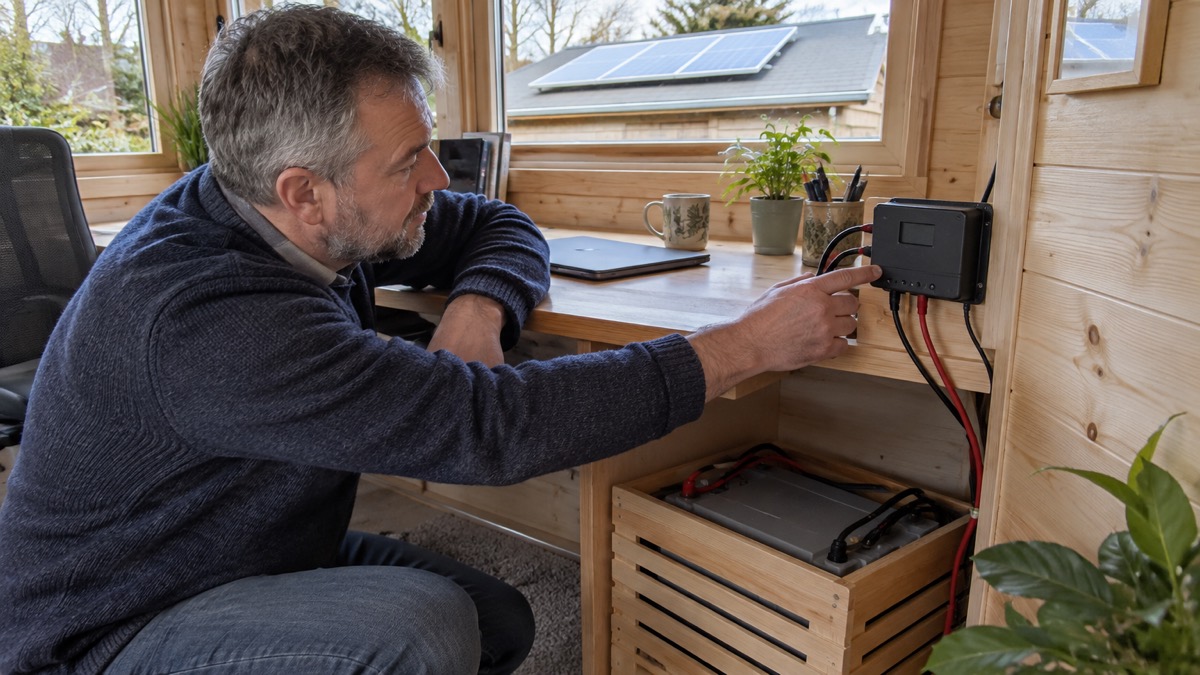
PWM stands for pulse width modulation. The controller connects the panel to the battery and rapidly switches the connection on and off, limiting the average voltage and current the battery sees. Marlec's support guidance notes that all its regulators use PWM technology to limit the speed of the turbine and slow it to an idle as batteries reach full charge, the same principle applied to wind4.
For solar, PWM controllers in the 5A to 60A range are described by one supplier as perfect for connecting solar panels to one leisure battery1. That is the honest summary of where they belong: a single battery, a modest panel, a set-up where simplicity and low cost matter more than squeezing every available watt-hour out of a dull sky.
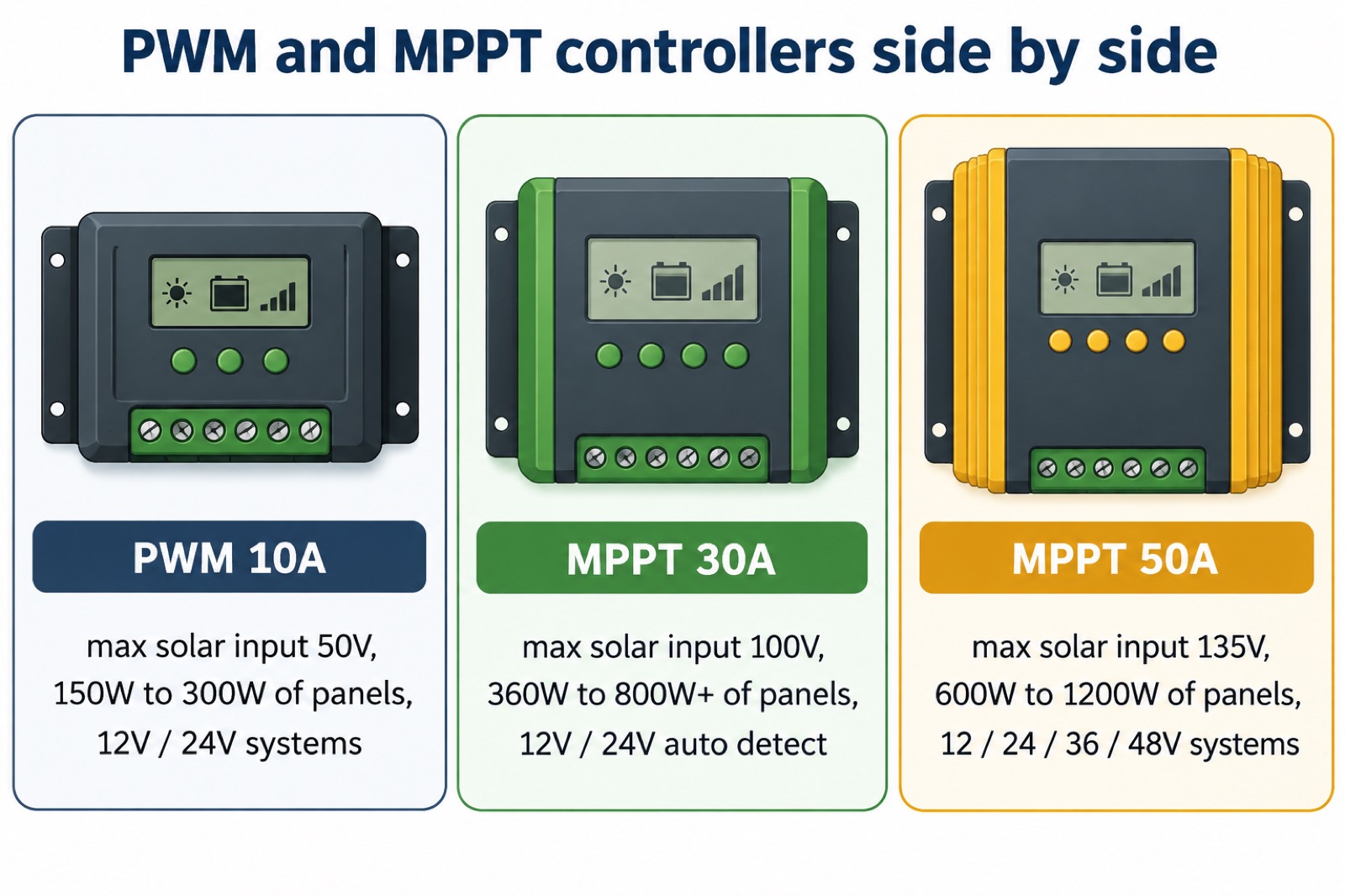
A typical 10A PWM controller gives a sense of the specification class. One maker's PWM10 model lists a system voltage of 12V / 24V, a maximum solar input voltage of 50V, a maximum solar input power of 150W to 300W, a load output of 10A max, a USB output of 5 V / 2.4 A, three LEDs to display operation and faults, and no WiFi8. The same supplier's clearance listing of a 10A PWM controller carries matching figures: PWM performance category, 12V / 24V system voltage, 50V maximum solar input voltage, 150W to 300W maximum solar input power, 10A max load output, 5 V / 2.4 A USB output, three LEDs, no WiFi9. Where a maker and a retailer disagree on a specification, take the maker's figure; here they agree.
One thing to understand about PWM charging is that the battery's own state shapes the charge. Independent battery guidance notes that a 75 per cent charged battery may only take a few hours to charge fully, whereas a fully discharged battery may take more than 24 hours10. A PWM controller passes what the battery will accept at its own voltage, so a battery that spends its life partly full charges gently and slowly. That is a limitation, not a fault, and it is one of the reasons MPPT exists.
MPPT controllers: more energy, most of all in poor weather
MPPT stands for maximum power point tracking. Instead of being tied to the battery's voltage, the controller searches for the panel's most efficient operating point and converts the surplus voltage into extra charging current. One supplier describes the result as increasing the amps output, allowing the solar panel to work at up to 95% efficiency1. Marlec's Spectra MPPT range uses full digital technology to track the Max Power Point at 99.9%11, and is offered in 10A, 20A and 40A options for achieving even higher energy yield from a solar panel11.
The headline gain comes from Victron's SmartSolar MPPT RS manual, which states that a fast MPPT algorithm will improve energy harvest by up to 30% compared with PWM charge controllers3. The words "up to" matter: the gain is largest when the panel's voltage is well above the battery's, which happens in cold conditions and under broken cloud, and smallest when the panel is hot and the sky clear. For a UK household sizing a system for winter reliability, that is exactly when the extra harvest is most wanted.
MPPT controllers also accept much higher panel input voltages, which changes what panels you can use. One maker's MPPT30 model lists a system voltage of 12V / 24V auto detect, a maximum solar input voltage of 100V, a maximum solar input power of 360W to 800W+, a load output of 30A max, WiFi operation, and an LCD display8. Its 50A model lists a system voltage of 12 V / 24 / 36 / 48V, a maximum solar input voltage of 135V, a maximum solar input power of 600W to 1200W, and a load output of 50A max8. The clearance listing of the same controllers carries matching figures, including 30A and 50A rated outputs9.
Choosing by amps and voltage: matching the controller to your panels
All solar charge controllers are rated in amps, for example a 5A controller, and show the voltage tolerance, for example 12V1. Matching a controller comes down to three checks: the amps the panels can push, the voltage of the battery, and the maximum panel input voltage the controller accepts.
One supplier's guidance gives a straightforward pairing of panel wattage to controller size1:
| Solar panels up to | Standard controller | Other options |
|---|---|---|
| 60W | 5A | Waterproof 10A, 10A dual battery, 10A MPPT |
| 130W | 10A | Waterproof 10A, 10A dual battery, 10A MPPT |
| 160W | 20A | Waterproof 10A, 10A dual battery, 20A MPPT |
The logic behind the table is that a 12V panel roughly produces its wattage divided by twelve in amps, so bigger panels need a bigger controller, and the controller's amp rating should exceed what the panels can deliver. Oversizing the controller slightly costs little and leaves room to add a panel later; undersizing it means the controller clips the charge or, at worst, trips its protections on a bright day.
Voltage is the second check. A PWM controller works at the battery's nominal voltage, so a 12V battery needs the controller set or rated for 12V, and the panel must suit that arrangement. An MPPT controller is more flexible: with maximum solar input voltages of 100V or 135V on the 30A and 50A models above8, a higher-voltage panel can be used and the surplus voltage converted into charging amps. Always check the controller's stated maximum input voltage before connecting, because exceeding it can destroy the controller.
Some panels arrive with no controller at all, which is worth knowing before you order. One maker states plainly of two of its panel models that they do NOT come with any solar regulator, and recommends its 30A MPPT solar charge controller for them12. Check the kit contents rather than assuming: one 240W semi-flexible solar charging kit includes a 240W panel, a 20A MPPT controller with inbuilt LCD display, 5m solar cables with MC4 connectors and a 5m 6.0mm dual core battery cable fitted with a 20A fuse13, while a 30W kit includes a 5A controller with USB port, 5m of 2.5mm solar extension cables and 5m of 2.5mm dual core battery cable fitted with a 10A fuse, fuse holder and 8mm ring terminals13.
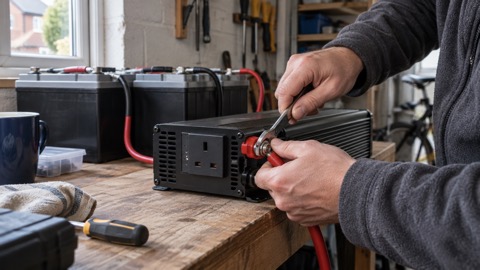
If you plan to run ordinary mains items from the battery, remember the controller is only half the electrical chain. To use the electricity generated by solar panels, you need an inverter to convert the direct current (DC) into alternating current (AC)14, and caravan guidance says the same: the power generated by a solar panel is DC, so an inverter is needed to power anything that uses a three-pin 230V socket6. Our page on off-grid inverters covers that side.
Wiring a controller: four connections, battery first
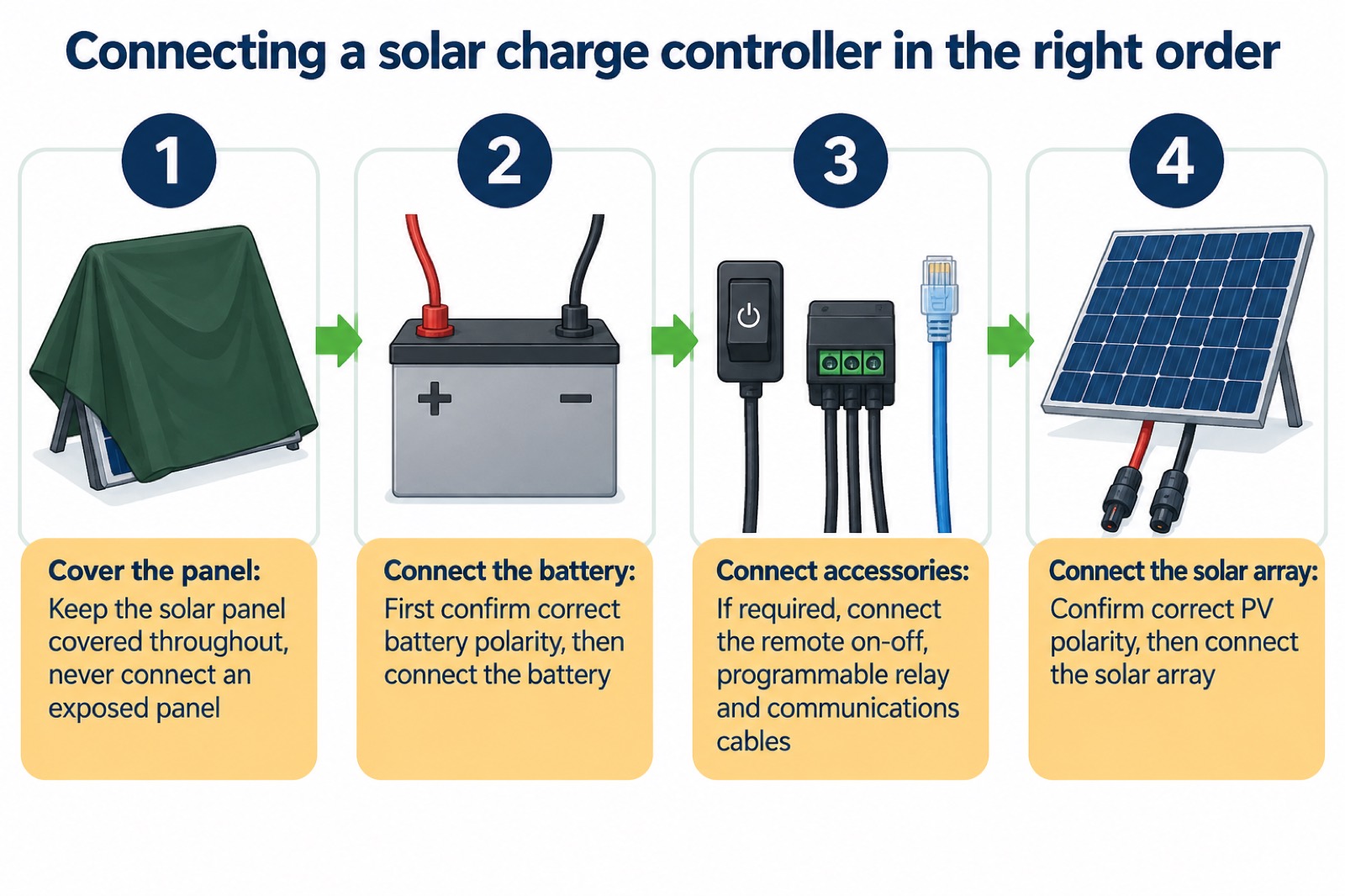
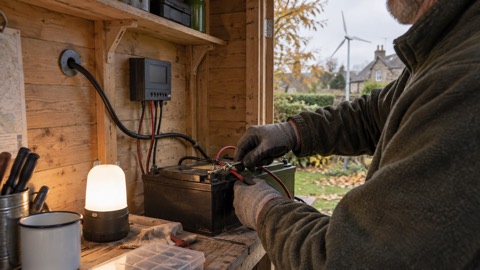
A basic solar charging set-up has four connections: two from the panel to the controller, and two from the controller to the battery. The order you make them in matters, and both the makers' manuals and support guidance agree on it.
Victron's SmartSolar MPPT RS manual sets the sequence out explicitly: first, confirm correct battery polarity and connect the battery; second, if required, connect the remote on-off, programmable relay and communications cables; third, confirm correct PV polarity, and then connect the solar array3. Marlec's support guidance is blunter about why: it is essential that the battery is the first live connection4.
The same care applies to the rest of the system. London Fire Brigade's safety advice for residents with plug-in solar panels says never to tamper with cables, plugs, inverters, batteries or any other part of the system, as altering equipment can expose live electrical components, cause faults and significantly increase fire and shock risks, and to keep any combustible materials away from your solar panels, batteries, inverters or electrical connections15. Greater Manchester Fire and Rescue Service adds a rule that bears on any battery installation: never modify or tamper with batteries16.
Cable size and voltage drop
The cables between the controller and the battery are part of the charging system, and thin cables cost you charge. Every metre of cable has a small resistance, and the charging current flowing through it drops the voltage the battery actually receives. If the drop is large, the controller thinks the battery is more charged than it is, or the charge arrives too weak.
Some MPPT controllers can correct for this automatically, within limits. The SmartSolar MPPT RS manual states that the charger will compensate the voltage drop over the DC cables up to a maximum of 1 Volt, meaning 1V over the positive connection and 1V over the negative connection3. Beyond that limit the controller cannot help, so the cables themselves must be adequate.
Practical guidance follows from the kits suppliers actually ship. A 240W kit, whose controller can carry far more current than a small one, is supplied with a 5m 6.0mm dual core battery cable fitted with a 20A fuse13. A 30W kit, carrying a fraction of the current, is supplied with 5m of 2.5mm dual core battery cable fitted with a 10A fuse, fuse holder and 8mm ring terminals13. The pattern is simple: more amps means thicker cable, and every battery cable in these kits is fused at the battery end. Follow the fuse rating the kit or controller maker specifies, and fit the fuse as close to the battery as you can.
Charge and float voltages for 12V and 24V systems
The voltages a controller aims for are standard across lead-acid type systems, and knowing them helps you check that a controller is working. Marlec's support guidance gives the full charge level after bulk and absorption charging as 14.4V or 28.8V for 12V and 24V systems, and the float, or regulating maintenance level, as 13.8V or 27.6V4. Its Rutland controller page lists the same float settings at 25°C: 13.8V for nominal 12V and 27.6V for nominal 24V5.
These figures assume a battery temperature of 25°C, and that is where temperature compensation comes in. All Marlec regulators incorporate temperature compensation to ensure that batteries charge to the correct levels wherever used in the world4; its Rutland controller automatically adjusts the voltage settings to take account of varying temperatures, ensuring maximum charging efficiency5; and the HRDi controller offers temperature compensation using an internal sensor or an external sensor also supplied17. The SmartSolar MPPT RS manual gives the base temperature for the compensation as 25°C (77°F)3. In a battery box that runs cold in winter and warm in summer, a compensated controller charges correctly in both, where a fixed-voltage one would undercharge in the cold and overcharge in the heat.
If your battery is lithium, do not assume these voltages apply: lithium batteries need a charge profile specific to their chemistry, and the controller must state that it supports it. Check the controller's stated battery compatibility before buying, and if in doubt, ask the supplier's technical line before wiring anything.
Regulators for wind turbines
A wind turbine cannot simply be connected to a solar controller. A turbine must always see a load: if its output is simply switched off when the batteries fill, the turbine can overspeed. That is why wind regulators work differently, and Marlec's guidance describes how: all Marlec regulators use PWM technology to limit the speed of the turbine and slow it down to an idle operation as the batteries reach full charge4.
Combined controllers exist for households running both sources. The HRDi Charge Controller is described by its maker as the latest wind and solar regulator, designed for use with the Rutland 504, 914i or FM910-4 Windchargers and up to 160W of solar panels17. It offers auto configuration to 12 or 24V supply, connection to two independent battery banks, and temperature compensation using an internal or external sensor17. All Rutland windcharger controllers include LEDs for simple indication of the system's operation and a shutdown switch5, which lets you stop the turbine safely before working on the system.
The safety rule from the same maker's troubleshooting guidance applies with full force here: never connect a running turbine or exposed solar panel to a controller, damage will occur4. Stop the turbine, or use its shutdown switch, before making any connection. Our page on small wind turbines covers choosing and siting one.
USB and load outputs, waterproof and dual battery models
Beyond the core job, controllers differ in the extras they carry, and these are worth choosing deliberately rather than by accident.
USB outputs. Some 10A PWM controllers include a USB output of 5 V / 2.4 A8, enough to charge a phone or head torch directly from the controller without touching the battery circuit. Small kits build this in: the 30W semi-flexible kit above includes a 5A controller with a USB port13.
Load outputs. A load output lets you run 12V equipment through the controller, which can then protect the battery from being drawn too far down. Ratings scale with the controller: 10A max on the PWM108, 30A max on the MPPT308, and 50A max on the MPPT508. Check the rating before connecting anything, and remember the load output is for DC equipment, not for mains items, which need an inverter6.
Waterproof models. Waterproof 10A controllers appear throughout one supplier's pairing guidance as an option at every panel size1, and folding solar charging kits described by the same supplier are completely waterproof battery-charging kits made of two rigid panels, a controller and cables that can be erected quickly on sunny days and folded away when you are back on the road1. These suit boats and outdoor set-ups where the equipment stays out in British weather.
Dual battery models. Dual battery controllers are needed for multiple batteries in a solar power system1. The Morningstar SunSaver Duo is a two battery solar controller with an optional remote meter for caravans and boats; solar charge current is shared between the two batteries based on a user selectable priority, and when one battery is fully charged, all of the charge current flows to the other battery7. The Marlec HRDi connects to two independent battery banks17. A 100W dual battery kit pairs a 10A dual battery controller with the panel and cables in one package13. These suit caravans and boats with an engine starter battery and a leisure battery that both need to stay charged.
Displays and WiFi. The 10A PWM controllers above show operation and faults on three LEDs8. The MPPT30 adds an LCD display and WiFi operation8, so you can check the charge state from a phone. Whether that matters depends on whether the battery lives somewhere you can walk to.
Getting help choosing a model
If your set-up does not match the neat tables, ask before buying. Marlec publishes a sales engineer line on its solar controllers page for exactly this purpose: to speak to a sales engineer to help you select the right model, call +44 (0) 1536 2015882. Have three things ready when you call: your panel wattage, your battery voltage, and your battery type, since those determine the controller you need. Suppliers that sell complete kits, like the semi-flexible charging kits above13, have already matched the controller to the panel, which removes the guesswork if your plans fit one of their packages.
For the wider picture of how a panel, controller, battery and inverter fit together, see our guides to off-grid solar systems, sizing a system from your daily watt-hours, battery banks and looking after a battery bank safely.
Sources (17)
- Solar power for caravans and motorhomes, Photonic Universe, 2026
- Solar controllers, Marlec, 2024
- SmartSolar MPPT RS manual, Victron Energy, 2026
- Troubleshooting a Windcharger system, Marlec, 2025
- Rutland charge controllers, Marlec, 2025
- Solar power technical advice, The Caravan Club, 2026
- Morningstar PV controllers, Marlec, 2026
- Solar charge controllers and regulators 10A, 30A, 50A, Sterling Power, 2026
- Clearance solar charge controllers and regulators, Sterling Power, 2026
- Batteries technical advice, The Caravan Club, 2026
- Spectra MPPT solar regulators, Marlec, 2026
- CSP solar panels, Sterling Power, 2026
- Flex solar charging kits, Photonic Universe, 2026
- Solar panels safety advice, Electrical Safety First, 2026
- Plug-in solar panels safety advice for residents and homeowners, London Fire Brigade, 2026
- Battery safety, Greater Manchester Fire and Rescue Service, 2026
- HRDi charge controller, Marlec, 2026
 Off-Grid Solar Kit Checklist
 Hydroponic System Parts List
 Year-Round Sowing Calendar
 Off-Grid Battery Banks
 Off-Grid Battery Care
 G98 DNO Notification
 Off-Grid Inverters
 Mounting and Wiring Solar Panels
 Solar Panel Types
 Sizing an Off-Grid Solar System
 Solar Water Pumping
 Off-Grid System Types
 Small Wind Turbines