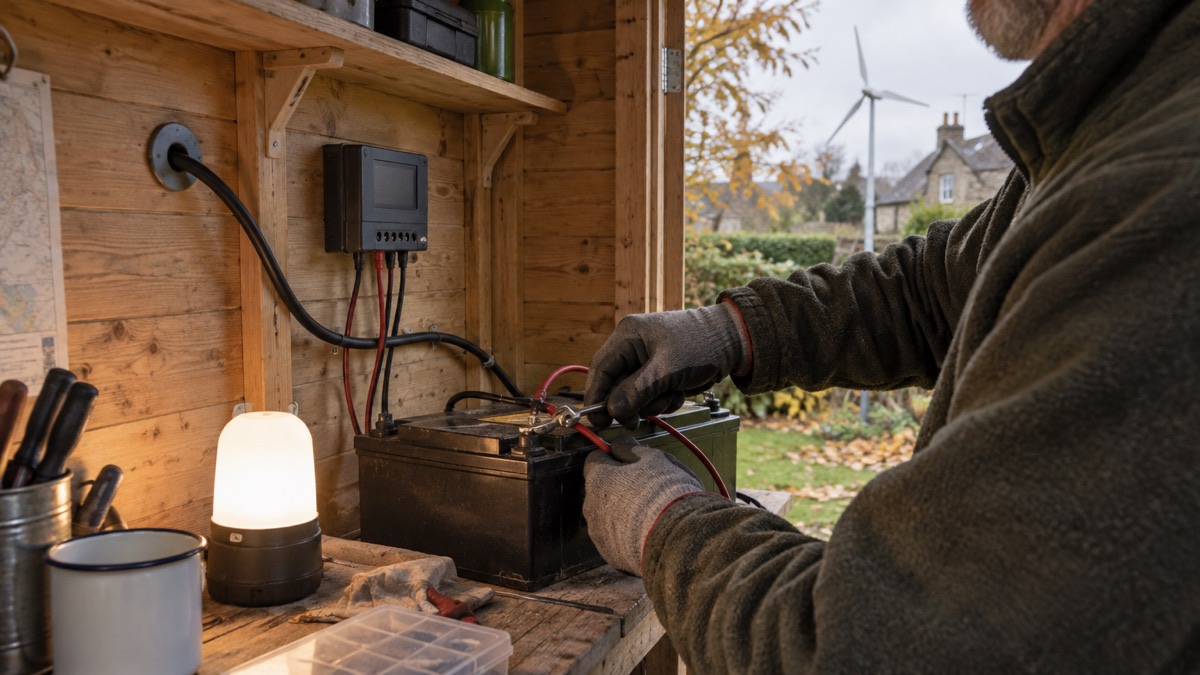
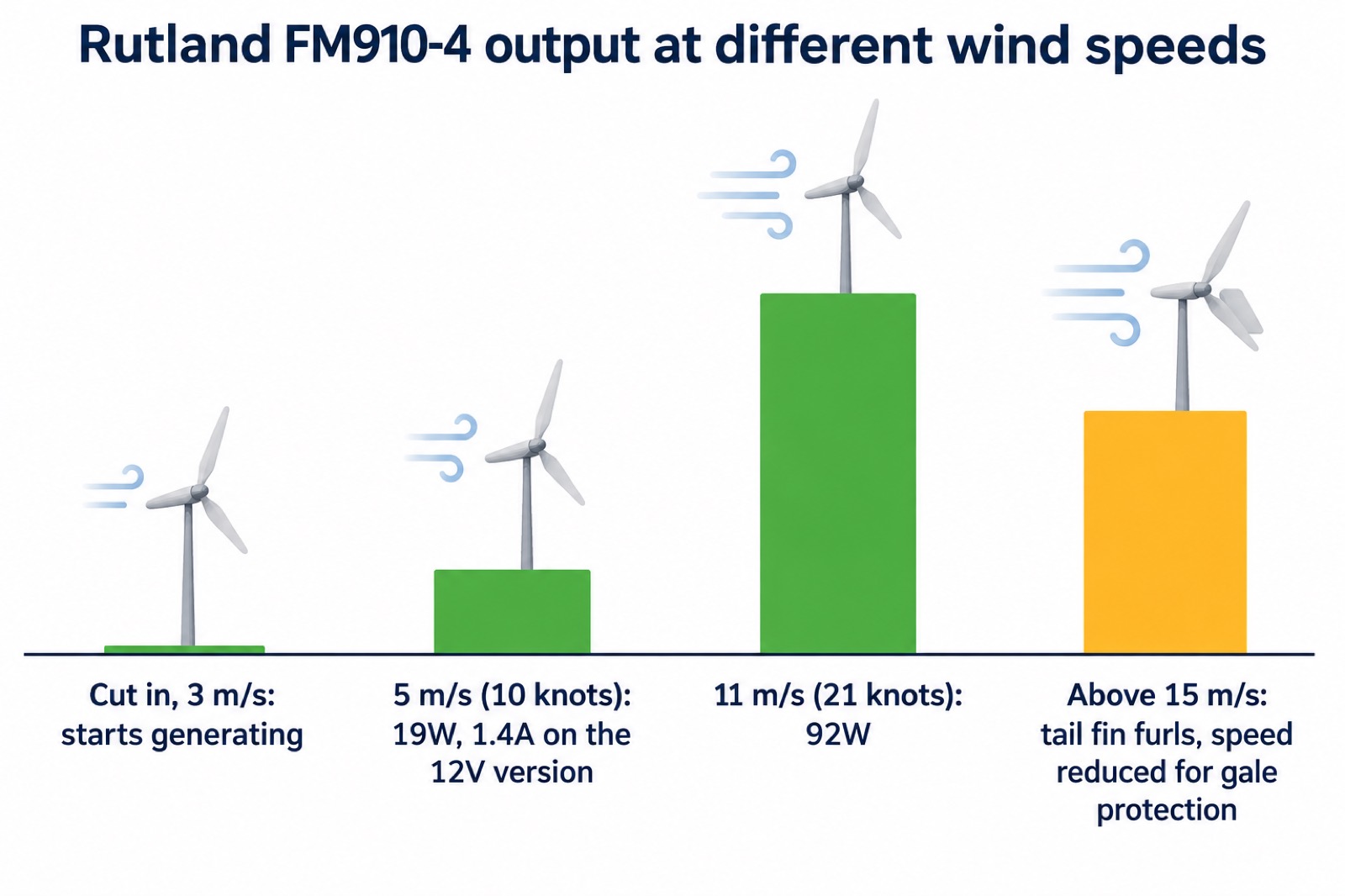
A small wind turbine for a UK home is not a miniature version of the machines you see on hilltops. In household sizes it is a battery charger: a device that tops up a 12V or 24V battery bank whenever the wind blows, so that stored power is there when you need it. The best known British example, the Rutland FM910-4 Furlmatic Windcharger, starts generating at a wind speed of 3 m/s and produces 19W at 5 m/s on a 12V system, rising to 92W at 11 m/s1. Those are useful numbers for charging batteries, and far too small to run a house.
Whether one is worth fitting depends almost entirely on your site. The Centre for Alternative Technology, which advises households on off-grid living, is blunt about the requirement: you need an unshaded and roughly south-facing site for solar, and somewhere with strong, consistent wind speeds for a turbine2. If your garden is sheltered by houses and trees, a windcharger will disappoint, and solar plus a battery will serve you better. If you are exposed on a hill or near the coast, wind fills the gap that solar leaves in winter, and the maker of the Rutland range often recommends combining wind and solar charging precisely to smooth out the daily energy yield1.
This page explains how a windcharger works, what the two names mean, what the Rutland FM910-4 delivers at real UK wind speeds, how to mount and control one safely, and how to judge whether a small turbine earns its place in your household's backup power arrangements.
What a small wind turbine does for an off-grid household
For most UK households, electricity arrives through a chain of infrastructure: high voltage lines, a primary substation that steps the voltage down, then a distribution substation serving your local area4. A windcharger belongs to a different way of doing things. It generates where you use the power, stores it in a battery bank, and keeps a small set of essentials alive when the mains is unavailable or unwanted.
The realistic role is narrow and worth stating plainly. Solar PV panels and small wind turbines usually operate at low voltages, for example 12 or 24 volts2, so a windcharger feeds the same kind of off-grid battery bank that solar does. What it can run is whatever that battery bank can run: lighting, phone and radio charging, a small pump, perhaps a router. What it cannot do is power a modern household. Contemporary homes have much greater demands on electricity than 20 years ago, and the average UK home today has a TV in most rooms and any number of computers, printers, scanners and games consoles5. No micro turbine will carry that load.
That limit is not unique to wind. London Fire Brigade, advising on plug-in solar panels, makes the same point about small solar kits: they don't generate enough energy to power your home entirely, but they could save you some money6. Which?, reviewing generators, says of battery generators that they are smaller and more portable than fuel-tank generators, but only really useful if you have low power demand7. Small wind sits in the same family: a trickle charger for a modest battery, valuable for the right household, modest for everyone else.
Where wind earns its keep is timing. Solar output in a UK winter is low exactly when storms arrive, and wind is strongest then. A household that combines the two gets charging from the wind on the short, dull days when panels contribute little. That complementarity, rather than raw output, is the strongest practical argument for a small turbine on an exposed site, and it is why the maker recommends the combination1. Our pages on off-grid solar systems and solar charge controllers cover the solar half of that pairing.
How a windcharger turns wind into battery charge
The principle is the same at every scale. Wiltshire and Swindon Prepared, explaining how the power system works, describes it simply: when the wind blows, it moves the blades on the turbine capturing energy, which is then sent through a gearbox to a generator converting it into electricity8. That description fits the large turbines on the grid. A household windcharger simplifies it, and the difference matters to you because it changes what can wear out.
In the Rutland FM910-4, there is no gearbox to service. The maker's manual describes a three phase AC generator driven directly by the aerofoil blades, rotating permanent magnets around a fixed stator winding, with the output rectified via sliprings and brushes3. The blades turn, magnets sweep past the windings, alternating current comes out, and a rectifier turns it into direct current that a battery can accept. The product page adds that the generator is low friction, three phase and brushless in its design intent, with a slipring allowing 360 degrees of free rotation so the machine can turn to face the wind without twisting its cable1.
From the battery's point of view, a windcharger looks much like a solar panel: a low voltage DC source that must be controlled so it does not overcharge the bank. Marlec's own charge regulator for its Rutland turbines includes a shutdown switch, and the maker's guidance is to use that regulator with the turbine3. The regulator holds the battery voltage within safe limits: as peak voltages are reached the charge current is tapered, gradually reducing from bulk charging to float stage, which slows the turbine to an eventual "idle" and extends its working life; as the battery discharges, the turbine speeds up again to deliver more power9. The manual shutdown switch lets you stop the windcharger deliberately: the turbine slows to an idle, no power is delivered to the battery, and you can safely brake the machine for maintenance or to park it in a storm9. Do not substitute an unmatched regulator: the turbine maker's own unit is matched to the machine's output, and the manual's shutdown procedure depends on it.
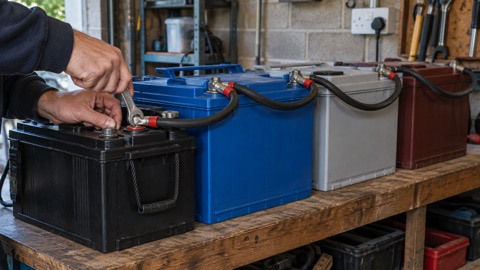
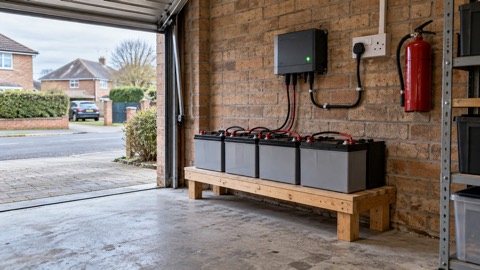
The rest of the chain is standard off-grid practice. The battery bank, whether lead-acid or lithium, stores the charge; our page on off-grid battery banks compares the types. If you need mains-style AC for ordinary plugs, an inverter converts the battery's DC, as explained in our guide to off-grid inverters and inverter chargers. Keep the whole system at its designed low voltage and keep the wiring tidy, and the installation stays within the scope of a careful householder.
Windcharger or wind turbine: what the two names mean
You will meet both words, and they describe the same machine seen from two angles. "Wind turbine" is the generic term: blades driving a generator. "Windcharger" is the older, more specific term for a small wind turbine whose whole purpose is charging a battery, a usage that comes from the marine and rural world where these machines earned their keep keeping boat and farmhouse batteries topped up.
The Rutland Furlmatic FM910-4 is described by its own maker as a wind turbine battery charger, a Windcharger, designed for use on permanent land based applications where low power is needed for professional and domestic devices3. That definition tells you what to expect from anything sold under the windcharger name: a permanently mounted machine, a DC output at battery voltage, and a modest charge current rather than a supply you can plug a kettle into.
The naming also signals what these machines are not. A windcharger is not a grid-connected turbine exporting to the network, and it is not a wind farm turbine. It belongs to the small, self-contained end of the spectrum, alongside 12V solar panels, and it is bought and installed for what it does to a battery bank. When a retailer or maker uses the word windcharger, expect battery-charging specifications: cut in wind speed, amps at a given wind speed, and battery voltage. When a listing talks in kilowatts and grid export, you are looking at a different class of machine altogether, with planning and connection obligations our page on planning permission and building regulations touches on.
The Rutland FM910-4 Furlmatic: a micro turbine for off-grid battery charging
The Rutland range is a sensible one to examine in detail because it is designed, developed and manufactured in the UK by Marlec, in Corby1, so its published figures are aimed at British conditions, and its manual is written for the person who will actually mount it. The FM910-4 Furlmatic charges 12V or 24V battery banks3 and is available direct from Marlec1.
| Specification | Rutland FM910-4 Furlmatic |
|---|---|
| Product type | Wind turbine battery charger for permanent land based use3 |
| Battery voltage | 12V or 24V battery bank3 |
| Cut in wind speed | 3 m/s1 |
| Output at 5 m/s (10 knots) | 19W (1.4A), 12V version1 |
| Output at 11 m/s (21 knots) | 92W (3.3A), 24V version1 |
| Generator | Three phase AC, rectified via sliprings and brushes; low friction design3 |
| Overspeed protection | Tail fin mechanically furls above 15 m/s3 |
| Yaw rotation | Slipring for 360 degree free rotation, low brush wear1 |
| Tower tube | Fits inside aluminium, stainless or steel tube, 41mm internal diameter, minimum wall 3mm, maximum outside diameter 50mm3 |
Two features deserve explanation because they change what you do. The first is furling. In a gale, an unprotected small turbine can spin destructively fast, so the FM910-4's tail fin is arranged to turn the turbine out of the wind automatically: the manual describes the "furling" tail fin directing the turbine out of the wind above 15 m/s for gale protection3, and the product page confirms the tail fin mechanically furls at 15 m/s to reduce turbine speed1. You do not need to climb the tower in a storm; the machine protects itself, and your job is to have mounted it on a pole that can take the load.
The second is the slipring. Because a wind turbine must rotate to face shifting winds, a fixed cable would wind itself up and snap. The slipring lets the head rotate a full 360 degrees freely with low brush wear1, which is why these machines can run unattended for years.
What arrives in the box also tells you how the installation works: one main generator assembly, one tail fin assembly, six aerofoil blades, 24 special self-tapping screws, a fuse and fuse holder, a two-way terminal block, two M10 hex head screws and two tab washers3. The tower tube is not supplied; you source a tube to the specification above, and the machine fits inside it. The fuse and terminal block are there because the maker expects you to wire the turbine to the battery through protection, and the manual's advice on stopping the machine completes the picture: in low wind, orient the tail fin upwind, secure it to the pole with rope, cover it or store it in a dry location, and use a Marlec charge regulator with a shutdown switch3.
What decides how much a windcharger gives you
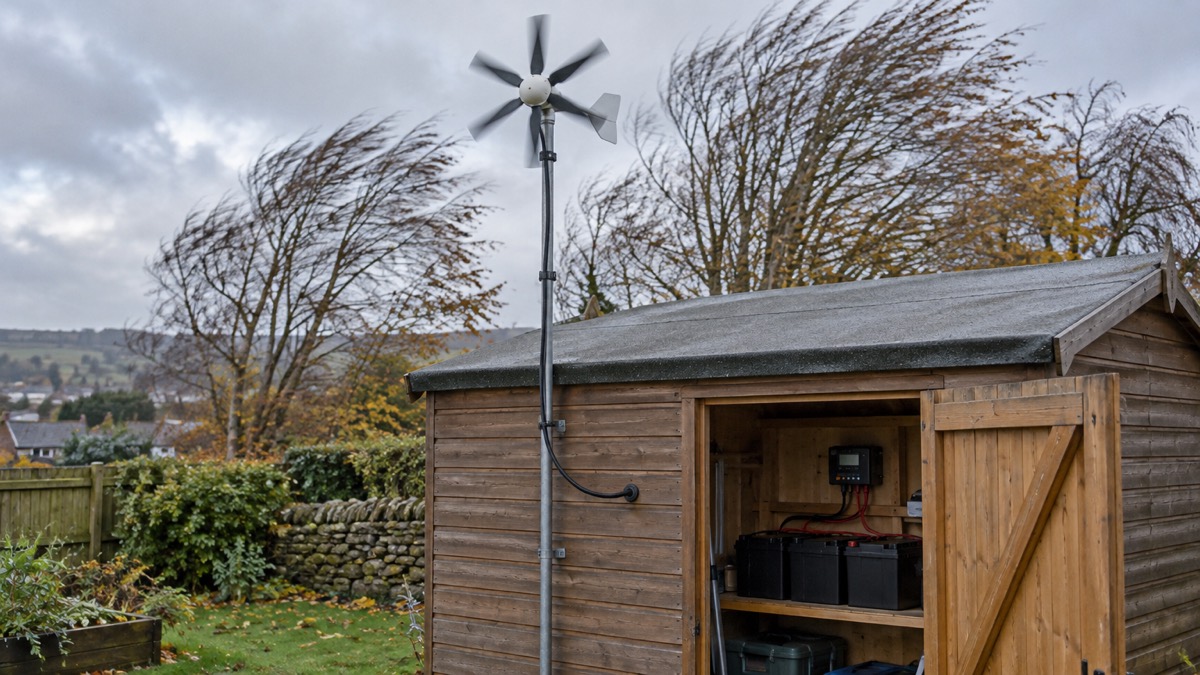
Three things set your daily charge: the wind at your site, the height and clarity of the tower, and the machine's own power curve. Get the first two wrong and the third is irrelevant.
Wind at your location. The Centre for Alternative Technology's requirement for strong, consistent wind speeds2 is the gate you must pass. Average conditions matter more than storms: a machine that cuts in at 3 m/s1 produces nothing on a still day however exposed you are. It is also worth knowing that the UK is not becoming steadily stormier. The Met Office reports that UK wind observations show fewer occurrences of gusts exceeding 40, 50 and 60 knots in the last two decades compared with the 1980s and 1990s, and that wind observations do not suggest the UK is getting stormier10. Plan around your everyday wind, not your worst.
Tower height and siting. Wind near the ground is slowed and tangled by every building, hedge and tree it passes. The higher the turbine sits above those obstructions, the closer the wind it sees to the free flowing air above them. The FM910-4's mounting requirement is about strength rather than a stated height: a tube with 41mm internal diameter, minimum wall thickness 3mm and maximum outside diameter 50mm, in aluminium, stainless or steel3. A taller pole of that tube needs guying or a rigid bracket to resist the sideways thrust of a machine that furls only above 15 m/s3, so plan the support before you plan the height. Keep the turbine clear of buildings and trees on the prevailing wind side, and remember that a pole near a home must not create a hazard if it fails; our page on planning permission and building regulations covers what permissions may apply.
The power curve. Output rises steeply with wind speed. At 5 m/s the 12V FM910-4 gives 19W (1.4A); at 11 m/s the figure is 92W1. The practical consequence is that a site averaging the lower figure yields a trickle, and only genuinely windy sites see the higher numbers for long. When you size your expectations, work from the wind you actually have.
Storms and damage. Gales test every installation. A Met Office yellow wind warning for Scotland, Northern Ireland and Northern England carried a low (10 to 25%) likelihood but significant impact, with a slight chance of damage to buildings such as tiles blown from roofs, as well as damage to trees11, and the same warning was published through the accessible warnings service12. Wind damage to energy infrastructure is real: the Porth Wen solar farm in Anglesey, the UK's largest, reported many of its solar panels damaged by the sheer strength of the wind in December 202413. Strong winds and storms also cause impacts around the UK coastline, with large waves throwing beach material and sea water onto transport routes, walkways and properties, particularly when they coincide with high tides14. Before each named storm, check the turbine is furling freely, the pole guys are taut, and the shutdown switch on the regulator works, and follow the manual's procedure to stop and secure the machine if you expect an exceptional blow3. Our guide to storms, snow and ice covers the wider household preparations.
Is a small wind turbine worth it for a UK home?
Honesty serves you better than enthusiasm here, and the official advice is sober. Wiltshire and Swindon Prepared, discussing generators, notes that for many households the expense of installing a generator may not be worth the costs, and that having torches and lanterns is a suitable alternative for the few hours you may be without power15. The same logic applies to a windcharger bought purely as power cut insurance. Most UK power cuts are short, and for those, emergency lighting and a charged power bank cost less and do the job.
The sums on storage sharpen the point. The Centre for Alternative Technology notes that if you could have exported electricity for, say, 10 to 15 pence per unit instead of putting it in a battery, the actual benefit of storing it shrinks; historically, when electricity prices were about 15 pence per kWh, the net benefit of storing energy to use later may have been only £250 to £300 per kWh of capacity over a full ten years of use2. The Centre for Sustainable Energy adds that using a domestic battery to store solar energy has the potential to save money but is not likely to have a clear beneficial impact on the environment at the moment16. A windcharger and battery bought for financial return is therefore a slow proposition; one bought for independence on an exposed site is a different matter.
So the worth-it test comes down to your situation:
- Off grid or frequently cut off, exposed site: a windcharger plus solar is a genuine charging solution, and the wind and solar combination is what the maker recommends to smooth the daily yield1.
- Grid connected, sheltered garden, occasional cuts: torches, lanterns and a small battery pack are the proportionate answer15, and a windcharger will underperform in the shelter.
- Grid connected but wanting backup for essentials: compare a windcharger against the alternatives in our backup power guide before committing to a pole in the garden.
If you do experience power cuts, know your rights alongside your kit. Ofgem sets out that you can get £100 for homes or £195 for businesses if fewer than 5,000 properties are affected for more than 12 hours, or more than 5,000 properties are affected for more than 24 hours17, and its planning advice helps you prepare for outages in advance19. Households that need extra support during outages can join the Priority Services Register; in South Wales, for example, the Energy Saving Trust provides power advice to customers, offering information about favourable tariffs and directing them to local support services20. Our page on extra help in emergencies explains who qualifies.
Matching turbine size to the power you use
Size the turbine to the load, not the other way round. Start by listing what you actually want to keep alive, then add up its daily consumption, then choose a machine and battery bank that can deliver it. Our guide to sizing an off-grid solar system from your daily watt-hours walks through the arithmetic, and the same method applies to wind.
The scale gap is the thing to grasp. A 4 kilowatt PV roof generates about 2 to 3 times as much as average daily electricity use in a UK summer, or 4 or 5 times more in a very energy efficient home2. A micro windcharger's tens of watts1 sit three orders of magnitude below that. So the honest matching exercise looks like this:
| What you want to run | Is a micro windcharger suitable? |
|---|---|
| LED lighting, phone and radio charging, a small pump | Yes, this is the machine's designed purpose: low power for professional and domestic devices3 |
| A fridge, a router and a laptop for a few hours a day | Possible with a large enough battery bank and a good wind site, but solar will carry more of it2 |
| Whole house including heating, washing and cooking | No; contemporary home demand far exceeds what a micro turbine produces5 |
Two further facts help you judge the battery side. The Centre for Sustainable Energy notes that a household without a battery might use only 30% of a 3.5kW solar PV system's generation, with the rest exported to the grid16, which is why storage, not generation, is usually the binding constraint off grid. And storage technology is moving: a UK trial was the first to use Tesla Powerwall 2 batteries without solar PV, charged only from the grid using off-peak electricity to reduce household daytime peak-rate energy costs21. That grid-charged pattern is the opposite of off-grid wind, but it shows the range of approaches households now take.
Installing it yourself, and the safety points that matter
A windcharger is one of the few generating installations a competent householder can mount, because it is low voltage and self-contained. The FM910-4's parts list is short and its assembly is blades, tail fin and generator on a specified tube3. But low voltage does not mean no rules, and the safety points below come from official guidance.
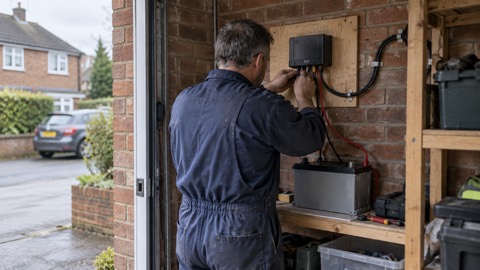
Electrical work and cheap kit. If your installation touches the home's fixed wiring, have a qualified electrician do that part of the work rather than attempting it yourself. Follow the turbine maker's instructions for the regulator, fusing and connections, and do not economise on the cable or connections between turbine and battery.
Battery safety. If your bank is lithium, treat it with respect. South Wales Fire and Rescue Service notes that rechargeable lithium-ion batteries range from mobile phones, vaping devices, e-bikes and scooters to vacuum cleaners, tablets, iPads and ear pods22, and fire services in Wales advise that some local councils offer kerbside collection for small portable batteries, so check your local authority's website for safe disposal23. Charge and store batteries per the maker's instructions, and see our guide to charging and looking after an off-grid battery bank safely.
Generators alongside wind. If you keep a fuel generator as well, official advice from Armagh City, Banbridge and Craigavon Borough Council is to "Only operate generators outdoors at least 6 metres/20 feet away from windows/doors/vents. Partially open spaces, garages" are unsuitable25. Carbon monoxide from a generator brought indoors kills; a windcharger, by contrast, produces no fumes, which is one of its genuine advantages.
Working at height. Mounting and maintaining a pole-mounted turbine means working above the ground. Follow the manual's procedure: stop the turbine in low wind by orienting the tail fin upwind, secure it to the pole with rope, then cover it or store it in a dry location3. Never work on a spinning machine, and get help with the pole raise.
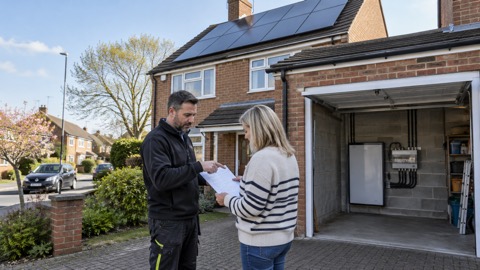
Permissions. Check whether your pole needs permission before you buy the tube; our planning permission page explains the position for turbines and panels. And if your system ever grows to include grid connection or a large battery, the network operator must be told, as our page on G98 notification explains.
Where to get help and more information
Help exists at several levels. For energy advice generally, what is available varies by area: your own council or a local fuel advice charity will be able to point you to the services where you live. For health advice through winter, the NHS publishes its Stay Well This Winter guidance26.
For power cuts specifically, Ofgem's help pages tell you what to do and what you may be owed17, and the lessons of past events are documented in official reviews: the Storm Arwen review examined the response to that storm's outages27. Those events are a reminder that widespread cuts, while rare, do happen, and that a modest, well sited windcharger keeping a battery topped up is one reasonable part of a household's preparations, alongside the basics in our getting started guide.
Sources (27)
- Rutland FM910-4 Furlmatic Windcharger product page, Marlec, 2026-08-07
- Battery storage and off-grid energy information, Centre for Alternative Technology, 2025-06-27
- Rutland Furlmatic FM910-4 Windcharger installation manual, Marlec, 2013-11-01
- Electricity substations explained, Electricity North West, 2026-10-25
- How safe is your house?, Electrical Safety First, 2026-10-25
- Plug-in solar panels safety advice, London Fire Brigade, 2026-10-25
- How to buy the best generator, Which?, 2026-01-20
- How the power system works in the UK, Wiltshire and Swindon Prepared, 2026-10-25
- Windcharger Controllers | Solar Charge Controllers | Marlec, Marlec
- UK wind observations and storm trends, Met Office, 2025-09-04
- Yellow wind warning for Scotland, Northern Ireland and northern England, Met Office, 2026-10-24
- Accessible UK weather warnings, Met Office, 2026-10-24
- Monthly weather report, December 2024, Met Office, 2024-12
- Severe weather advice, Met Office, 2026-10-25
- Generators: advice for households, Wiltshire and Swindon Prepared, 2026-10-25
- Battery storage advice for households, Centre for Sustainable Energy, 2025-10
- Help for consumers during a power cut, Ofgem, 2026
- Check if you can get a payment for a power cut, Ofgem, 2026
- Plan for a power cut, Ofgem, 2026
- Priority Services and power advice, National Grid, 2026
- Tesla Powerwall 2 batteries trial without solar PV, National Energy Action, 2019-04-30
- Lithium-ion battery fire safety guidance, South Wales Fire and Rescue Service, 2026-01-13
- Lithium battery fire safety in your home, Torfaen and Countryside (TAN) guidance, 2026-10-29
- Lithium battery fire safety in your home, Mid and West Wales Fire and Rescue Service, 2026-10-26
- Safe use of heaters and generators, Armagh City, Banbridge and Craigavon Borough Council, 2026-10-29
- Stay Well This Winter, NHS England, 2025
- Storm Arwen Review main report, Ofgem, 2022-06
 Off-Grid Solar Kit Checklist
 Hydroponic System Parts List
 Year-Round Sowing Calendar
 Off-Grid Battery Banks
 Off-Grid Battery Care
 Solar Charge Controllers
 G98 DNO Notification
 Off-Grid Inverters
 Mounting and Wiring Solar Panels
 Solar Panel Types
 Sizing an Off-Grid Solar System
 Solar Water Pumping
 Off-Grid System Types