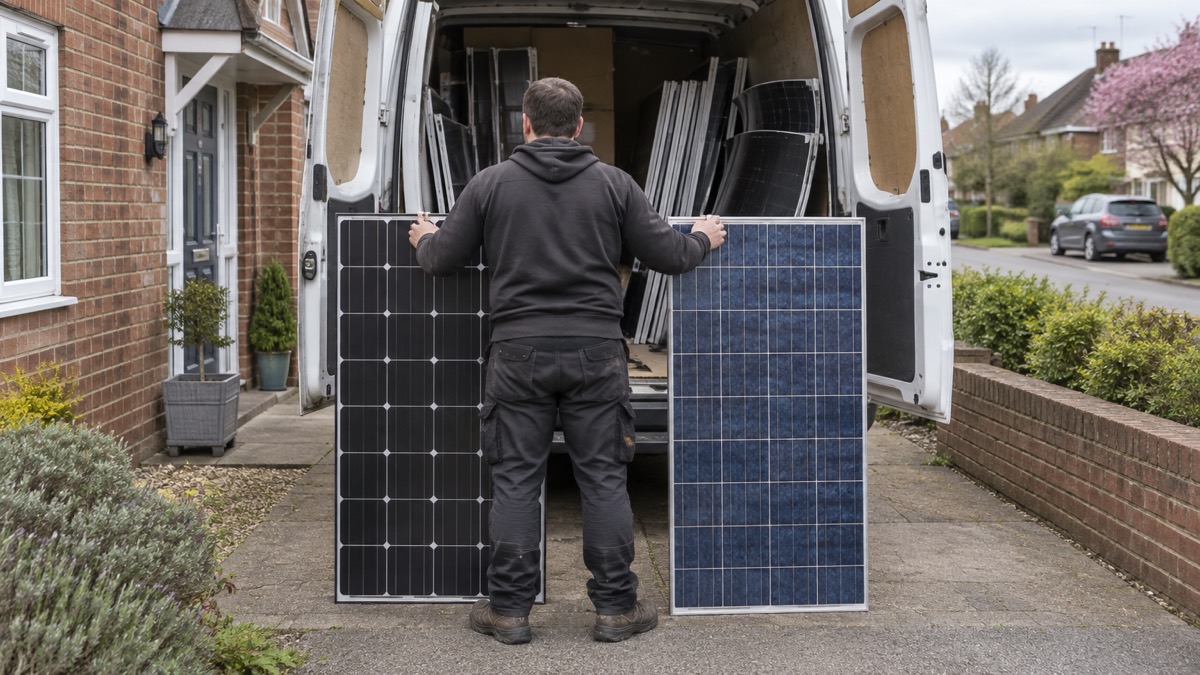
A solar panel is a box of silicon cells that turns daylight into direct current electricity. The type of panel you choose, monocrystalline or polycrystalline cells, rigid or flexible construction, decides how much power you get per square metre, where you can mount it, and how long it lasts. Keeping panels clean and maintained could increase energy production by up to 15 per cent, and periodic cleaning by a specialist company can help remove accumulated dirt, dust and debris, including lichen and guano, improving sunlight absorption and preventing hotspots that can cause a panel to fail1.
The practical differences are smaller than the marketing suggests but they are real. Monocrystalline panels are the most efficient and the most expensive; polycrystalline panels are slightly less efficient per watt and make up the majority of panels on UK caravans, motorhomes and campervans today2. Rigid panels in aluminium frames carry warranties of around 10 years3, while flexible and semi-flexible panels bend onto curved roofs, vans and boats, with shorter warranties of around 36 months on some models3.
What catches most people out is output. A panel's wattage is measured under laboratory conditions, and in a British winter a 100W panel delivers roughly 90Wh a day, against 600 to 700Wh on a summer day2. This page explains each panel type, how to size one honestly, and how to install and check it safely.
How a solar panel turns daylight into power
Every solar panel, whatever its type, works the same way. Light from the sun strikes the panel's cells and generates energy, which flows into the electrical circuit it is connected to1. The cells are photovoltaic: they absorb sunlight and convert it into electricity. The same principle runs the small solar-powered garden lights many households already own, which use photovoltaic cells to charge a battery by day and power the light at night6.
Two practical points follow from this that shape everything else on this page.
First, the electricity a panel produces is direct current (DC). That is fine for charging a 12V battery, which is why panels pair so naturally with caravans, boats and battery banks. But household appliances that plug into a three-pin 230V socket need alternating current (AC), so to run them from solar you need an inverter to convert the DC into AC7. A panel on its own charges things; a panel plus a battery plus an inverter powers things.
Second, the panel only works while there is daylight, and it works hardest in direct sun. A typical 12V battery system fed by a panel can run lighting, a television, pumps, navigation equipment, laptops, phone chargers and many other devices4, but only in the quantities the panel and battery together can supply, which varies hour by hour and season by season.
One safety point belongs here rather than later: London Fire Brigade warns that solar panels may continue generating electricity during daylight hours, even when switched off indoors8. A panel is never truly "dead" while the sun is on it, so treat the cables as live at all times during daylight.
Monocrystalline or polycrystalline: how the two cell types differ
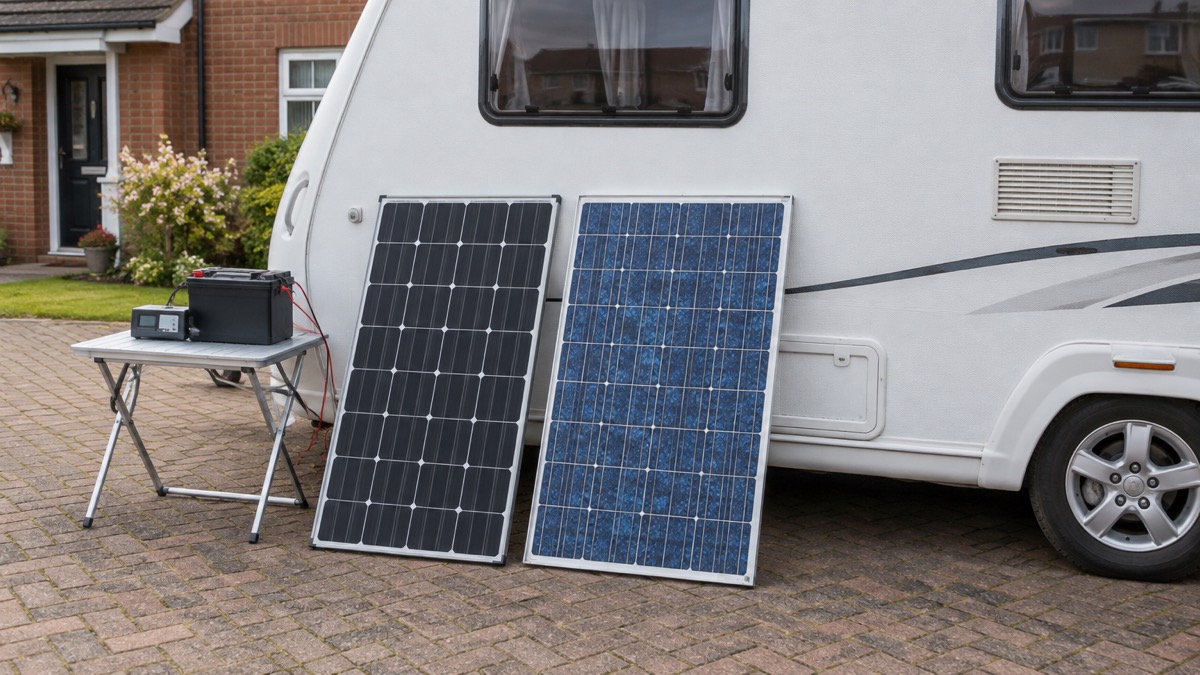
The silicon cell inside the panel comes in two main forms, and the difference is in the crystal structure.
A monocrystalline panel is made from a single silicon crystal. It is the most efficient form of solar panel, but also the most expensive2. Visually, its cells produce a continuous colour throughout, and panels built from them may be slightly smaller for the same output9. A polycrystalline panel is made from many crystals bundled together, giving the cells a textured, flaked metal appearance; these panels may be slightly larger for the same output9.
Efficiency here means output per cell area. The divisions between the crystals in a polycrystalline panel reduce the output of the panel as a whole, so if you choose polycrystalline you need a higher wattage panel than a monocrystalline one to get the same power2. Despite that, polycrystalline panels are the majority in use on caravans, motorhomes and campervans today2, which tells you the efficiency gap is not decisive for most leisure uses: if roof space is plentiful and the budget matters, the cheaper cell type wins.
| Monocrystalline | Polycrystalline | |
|---|---|---|
| Cell structure | Single silicon crystal2 | Many crystals bundled together2 |
| Appearance | Continuous colour throughout9 | Textured, flaked metal appearance9 |
| Efficiency | Most efficient form of solar panel2 | Crystal divisions reduce output; a higher wattage panel is needed to match a mono panel2 |
| Cost | The most expensive2 | Cheaper per watt2 |
| Panel size for same output | May be slightly smaller9 | May be slightly larger9 |
| Typical use | Higher-output rigid panels, for example EcoFlow's 400W and 450W rigid panels10 | The majority of panels on UK caravans and motorhomes2 |
A newer development worth knowing about is the back-contact cell. Marlec's SpectraLite semi-flexible panels use LONGi HPBC cells with an efficiency of up to 26.4 per cent, no reflective metal lines on the cell faces, an anti-reflective treatment for better light capture, and a low UV degradation rate of 0.35 per cent, which the maker states gives a longer operational life12. Anker describes the N-type cells in its PS100 bifacial portable panel as minimising energy loss while performing in high temperatures13. These cell designs are appearing in both rigid and semi-flexible panels, so cell type and panel construction are separate choices.
Rigid panels: aluminium frame, four mounting holes, longest life
A rigid panel is the familiar type: a flat laminate of cells in glass, held in a strong aluminium frame. Photonic Universe describes the construction plainly: a strong aluminium frame with four mounting holes for installation, and the rigid panels fit four metal brackets that screw securely into your roof9. EcoFlow's rigid panels use a robust anti-corrosive aluminium frame that the maker says makes them suitable for outdoor use14, and its 400W rigid panel comes with mounting feet included10. Marlec's Alpex panels go further, with rugged frames of heavy duty anodised aluminium in a box and key design built to withstand forces over long term installation15.
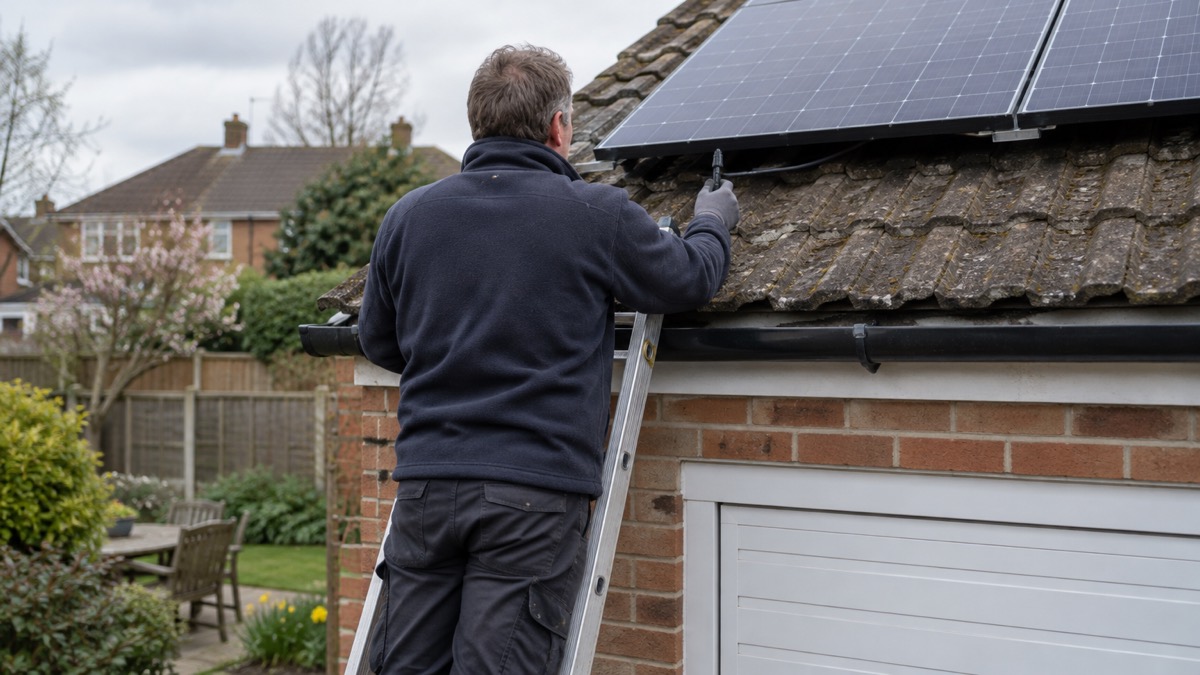
For a household, the rigid panel's advantages are longevity and security. It is the panel type with the longest warranties: EcoFlow lists a 10 year warranty on its 100W rigid panel3. It is also the natural choice for a permanent, fixed mounting on a house roof, a shed, a garage or a ground frame, where the frame takes the wind load and the mounting holes take the bolts. The trade-off is that it cannot follow a curve and it needs real brackets, sealant and, on a house roof, a competent installer. Electrical Safety First says it is vitally important to use a skilled, trained and qualified solar PV installer registered with a competent person scheme, and that companies registered with MCS offer an additional level of assurance5.
If you want panels you can move rather than fix, a folding solar charging kit is the middle path: Photonic Universe describes these as completely waterproof battery-charging kits made of two rigid panels, a controller and cables that can be erected quickly on sunny days and folded away when you are back on the road9. You keep the rigid panel's cell quality and get portability, at the cost of having to set it out each time.
Flexible and semi-flexible panels bend to fit curved roofs, vans and boats
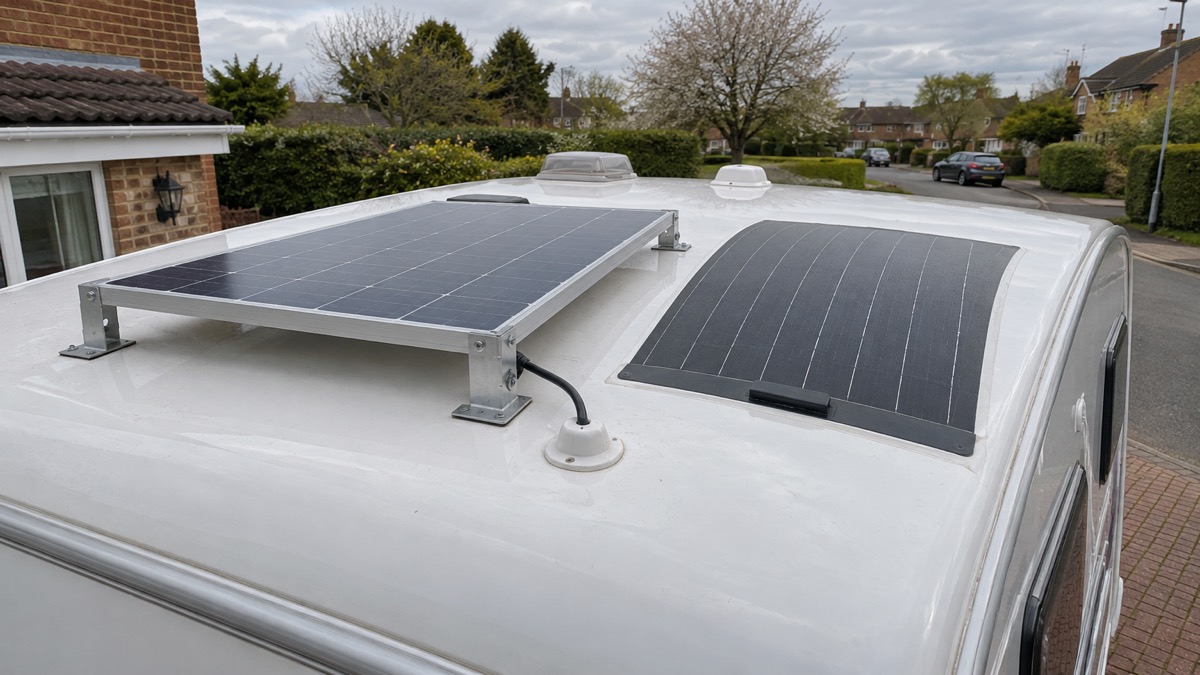
Where a rigid panel cannot go, a flexible or semi-flexible one can. EcoFlow's guidance on panel types notes that flexible solar panels are lightweight, perfect for mounting on smaller vans or boats, and can be moulded to fit any shape14. That is the whole case for them: a curved motorhome roof, a boat deck, a cabin top, a bimini or canopy.
Within the flexible family there are grades of bend. A truly flexible panel moulds and attaches to any surface, and some are described by Photonic Universe as able to be walked on without damage, waterproof and salt water resistant9. A semi-flexible panel, such as Marlec's SpectraLite range, can be slightly flexed without cell damage, unlike conventional panels, and thanks to their robust design the maker states they are tough enough to be walked on12. Semi-flexible panels for maintaining and recharging deep cycle batteries are aimed at leisure and professional use on boats and vehicles12. At the softest end, SunWare's textile solar panels, built with high-performance crystalline solar cells, are foldable fabric panels that attach quickly to a boat canopy to charge batteries16.
A representative specification shows what a semi-flexible panel looks like on paper: Sterling Power's SP100 is a 100W semi-flexible panel, ETFE coated, waterproof, with MC-4 cables, monocrystalline cells and a Vmp of 24.8V17.
| Rigid panel | Semi-flexible panel | Flexible / textile panel | |
|---|---|---|---|
| Mounting | Four mounting holes, metal brackets screwed to the roof9 | Slightly flexed to follow gentle curves12 | Moulded to any surface, or attached to a canopy9 |
| Typical use | Permanent fixing on a home roof, shed or caravan9 | Curved van and boat roofs, walk-on decks12 | Smaller vans, boats, canopies14 |
| Walking on | Not stated | Tough enough to be walked on (maker's statement)12 | Some can be walked on without damage9 |
| Warranty example | 10 years (EcoFlow 100W rigid)3 | Not stated for SpectraLite | 36 months (EcoFlow 100W flexible)3 |
The honest trade-off is life expectancy. Flexible panels carry shorter warranties than rigid ones: EcoFlow's 100W flexible panel has a 36 month warranty against 10 years on the rigid equivalent3. Flexible panels also forgo the protective glass and air gap of a rigid laminate, so long-term UV and wear matter more. The LONGi HPBC cells in the SpectraLite range, with their low UV degradation rate of 0.35 per cent, are the maker's answer to that concern12. If your mounting surface is flat and permanent, choose rigid; if it is curved or you need to save weight, semi-flexible or flexible is the practical option. Our rigid or flexible panels comparison goes deeper on this choice.
Output depends on sunlight, temperature and angle
The wattage printed on a panel is not a promise; it is a laboratory measurement. Marlec explains that the rated output of all panels is measured under a standard illumination of 1 kW per square metre (1 sun) at a temperature of 25 degrees Celsius4. Real British conditions rarely match that, so actual power is usually lower than rated.
Three things move the needle most:
- Sunlight intensity and weather. Anker states plainly that solar panel output varies with sunlight intensity, panel orientation and angle, and that due to varying conditions, actual power may be lower than rated13. Output depends on both the weather and the area of direct sunlight18.
- Angle and orientation. For maximum output, adjust the position and angle of the panel18. Marlec advises that a steeper angle in winter and a flatter angle in summer will improve output, and that a system where the angle can be manually altered seasonally will generate more power overall4.
- Where you put it. Keep the panel outdoors. Anker notes that output may be low behind a window due to weak sunlight, so for best results the panel should be outside20.
Location matters too, and the UK's geography shows up in the numbers. Marlec's summer daily yield figures for modules mounted at the optimum tilt angle facing south are 3.51 Ah per day for a 10W module, 10.4 Ah for a 30W module and 20.9 Ah for a 60W module in London, against 3.21 Ah, 9.55 Ah and 19.1 Ah respectively for the same modules in Edinburgh4. Edinburgh's weaker figures are the more honest planning basis for anywhere in Scotland or northern England.
Sizing a panel: daily watt-hours divided by peak sun hours
Sizing is arithmetic, and doing it honestly is what separates a useful system from a disappointing one. The rule from Photonic Universe is that the average daily power generated by your solar panel should be equal to or more than the average daily power consumption of your appliances21.
Work it in three steps:
- Add up your daily consumption in watt-hours. Multiply each appliance's wattage by the hours you use it. Photonic Universe's worked example, four 10W LED lights for 3 hours, a 40W LCD TV for 2 hours and a 20W water pump for half an hour, comes to 210 watt-hours per day21.
- Divide by the sunshine you can rely on. The same guidance assumes 5 hours of sunshine on a typical day, so a 50W panel generates approximately 50W multiplied by 5, or 250 watt-hours per day21. In winter, use the winter figures from the table below instead.
- Add margin for losses. Losses in the solar charge controller, cables and battery self-discharge are typically kept within 20 per cent of total output, so Photonic Universe advises choosing a panel offering a daily power rate approximately 20 per cent higher than your daily consumption21.
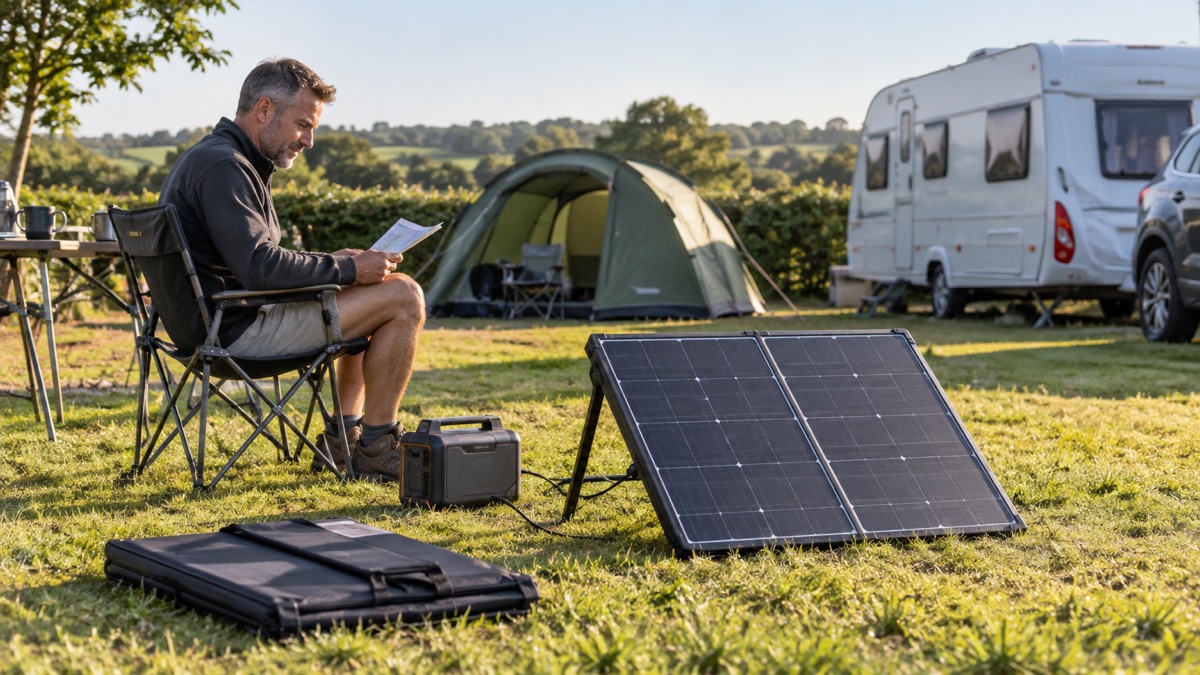
For common leisure loads, Photonic Universe gives ready-made answers: for small loads such as energy saving lighting, a stereo, phone charging and low computer use of 2 to 3 hours a day, a 40W to 50W panel or charging kit; for larger loads such as non-energy-saving bulbs, large TVs and frequent water pump use, an 80W to 100W kit or panel21. For trickle charging a stored caravan battery against self-discharge, a small 5W to 10W panel is enough, while the Caravan and Motorhome Club advises at least a 40W panel to keep a battery topped up while on site2.
Battery matching matters as much as panel size. Photonic Universe asks you to think about whether your battery capacity is adequate to the size of the panel and how quickly it will charge the battery to 100 per cent: if a 12V panel starts charging the battery in the morning and completes the job in 2 to 3 hours, the rest of the energy generated throughout the day is wasted21. And the Caravan and Motorhome Club warns that solar panels can overcharge a leisure battery, which is just as bad for the battery as undercharging it2, which is why a charge controller is not optional. Photonic Universe grades controllers by panel wattage: for panels up to 60W, a 5A standard controller, a waterproof 10A controller, a 10A dual battery controller or a 10A MPPT controller for maximum efficiency; for panels up to 260W, a 20A MPPT controller as standard, or a 350W 12V dual battery MPPT controller9.
Our page on sizing an off-grid solar system works through this in more detail.
A 100W panel gives about 100Wh on a winter day and 600Wh in summer
This is the single most useful table on the page. The Caravan and Motorhome Club's guidance gives realistic daily generation figures for UK leisure panels over a full day2:
| Panel size | Summer day | Winter day |
|---|---|---|
| 10W | 60 to 70Wh | 8Wh |
| 25W | 150 to 175Wh | 20Wh |
| 50W | 300 to 350Wh | 40Wh |
| 90W | 480Wh | 64Wh |
| 100W | 600 to 700Wh | 90Wh |
| 150W | 900 to 1050Wh | 120Wh |
Read the winter column before buying. A 100W panel that yields 600 to 700Wh on a long summer day yields about 90Wh, roughly a seventh as much, in winter2. If you need 210Wh a day in December, a 100W panel will not cover it; even a 150W panel gives only 120Wh on a winter day2. Anyone prepping for winter power cuts, when days are short and the sun is low, should size for the winter column or plan a mains or generator top-up.
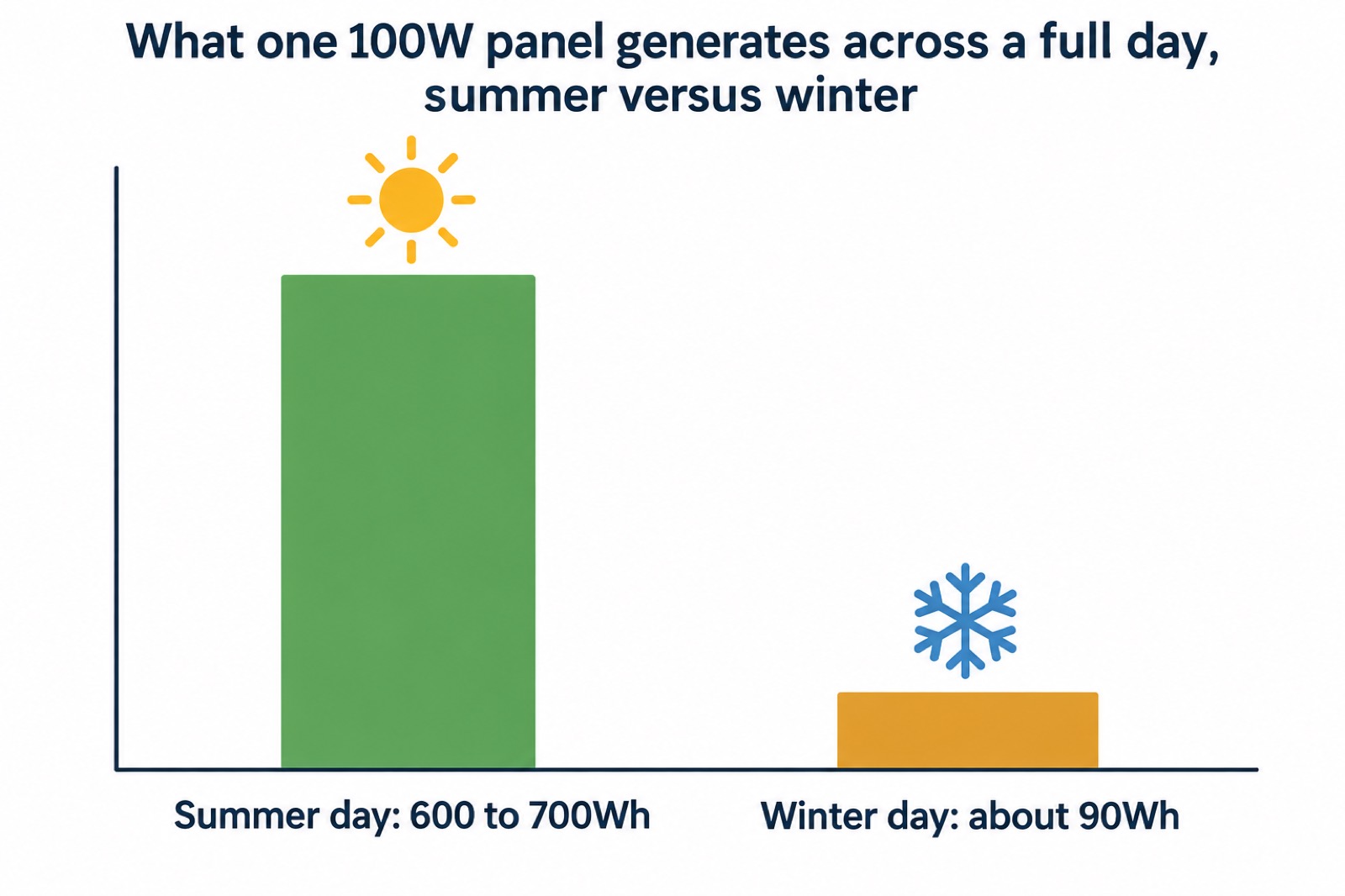
Current output behaves the same way. A 100W motorhome solar panel normally produces 4 to 5A per hour in bright sunshine21, and the current of 12V panels or charging kits is typically proportionate to their wattage21, so a 50W panel produces roughly half that current.
Solar panels stop working in a power cut unless set up with a battery
If you are considering solar as backup power for power cuts, this is the section to read before spending anything.
Grid-tied solar panels stop working during a power cut, for safety reasons22. The network operators explain that during a cut, systems like solar panels, heat pumps, EV chargers and batteries automatically switch off to protect the home and engineers, and should not be damaged; they usually restart on their own once power returns23. This is deliberate: a panel feeding electricity into dead network cables would endanger the engineers working on them. Under the Emergency Power Cut Rota, customers with solar panels or small generators cannot export electricity from their own generation to the wider network during their rota disconnection24.
The exception is a battery. The government's Prepare campaign guidance states that if you have solar panels and a battery storage system with power backup capability, some installations can continue to provide power during a cut if they are designed and configured to operate independently of the grid, which may help keep essential appliances running25. Network operator guidance says the same in different words: batteries will usually switch off unless they have a backup or "island mode" that can power parts of the home23. So the household that wants solar for outages needs a panel, a battery and an inverter configured as an islanded system, not panels alone.
Two further cautions. For a planned power cut where your outage letter says you will be connected to a temporary generator, turn off your solar panels before the outage and turn them back on once mains power has been restored, because panels left on may feed electricity into the generator and cause it to stop working26. And for plug-in solar panels specifically, London Fire Brigade recommends that you do not connect plug-in solar panels to batteries to store energy for later use8; plug-in panels are small systems that plug into a standard socket27, and they do not generate enough energy to power your home entirely, though they could save you some money1. Our page on connecting plug-in solar panels to a battery covers that in detail.
Safe installation, checks and cleaning
Solar panel fire risk is low, but Electrical Safety First notes that known problems can occur through bad installations, poor quality connections and cable damage through vermin and weathering5. Almost all of that is preventable.
Installation. London Fire Brigade's advice is to always install, operate and maintain the system following the manufacturer's guidance, because incorrect installation or misuse can increase the risk of fire and electric shock8. For a fixed home installation, use a skilled, trained and qualified solar PV installer registered with a competent person scheme; companies registered with MCS also offer an additional level of assurance5. If you are plugging a panel into an outdoor socket, the fire and rescue service requires that it is a minimum IP65-rated installation fitted by a competent person8. Do not run plug-in panels through extension leads, cable reels, multiway adaptors or travel adaptors: Electrical Safety First warns these accessories can overheat, become overloaded and create additional safety risks28.
Weather protection. Check the IP rating of what you are buying and where you will use it. Anker's PS30 portable panel has IP65 weather-resistant protection against spraying and rain20, while its PS200 panel carries IP67 certification and can be used in wet weather18. Match the rating to the exposure: a panel left out in British weather year-round wants the higher rating.
Routine checks. Do regular visual checks to identify any cracks, breaks, loose connections, and any cable damage caused by vermin and weathering5. Have the system inspected and tested at least every five years to ensure it remains safe5. For caravans, periodic inspection and testing of the electrical installation is recommended every 3 years, and for swimming pools annually5, so a caravan solar set-up can be checked alongside the caravan's own schedule.
Cleaning. Most panels have a self-cleaning coating which, when installed at a suitable angle, allows rain to clear dirt and debris5. Where dirt builds up anyway, Electrical Safety First notes that periodic cleaning by a specialist company can remove accumulated dirt, dust and debris, including lichen and guano, improving sunlight absorption, maximising energy production and preventing "hotspots" which can result in a panel failing; keeping panels clean and maintained could increase energy production by up to 15 per cent5.
Batteries. If your system charges a lithium battery pack or power station, London Fire Brigade's battery safety advice applies: if a battery becomes swollen, turn off the device29. Anker's portable power stations can be recharged via AC mains, solar panels or a car socket30, so a solar-fed power station is a common and workable arrangement when used to the maker's instructions.
Warning signs and pressure selling to watch for
Know the fault signs before you need them. Surrey County Council's fire and rescue guidance lists the warning signs of a plug-in solar panel fault: overheating, burning smells, buzzing or crackling sounds, visible damage, and repeated electrical tripping27. Electrical Safety First says the same for plugs and sockets: do not ignore burn marks, "arcing" (buzzing or crackling) sounds, fuses blowing, circuit-breakers tripping, or a plug that feels hot to touch; unplug and contact the retailer, manufacturer, or a qualified repair technician5. If you smell burning from a panel, our page on what to do if a solar panel smells of burning sets out the steps.
"Overheating; Burning smells; Buzzing or crackling sounds; Visible damage; Repeated electrical tripping."
On the buying side, Electrical Safety First's advice is firm: be suspicious if you are contacted by solar panel companies out of the blue or put under pressure to buy quickly, especially with time-limited or "one-off" discounts, and avoid buying from a cold caller or if you feel under pressure to buy7. Reputable solar panel installers should be signed up to a consumer code, such as the RECC, to prevent pressure-selling tactics7. Be wary of receiving a quote from a salesperson rather than a specialist surveyor, and ensure it includes ongoing costs such as maintenance7. And scrutinise the numbers: low prices or high savings may not include all necessary parts and services, and watch out for extremely short payback times7.
For the small, self-fitted panels this page is mostly about, the same instinct applies: buy on specification and warranty, from a maker or retailer that publishes both, and treat any seller rushing you as a reason to stop.
Where to go next
A panel is one link in a chain. To make it useful you will need a charge controller between panel and battery, a battery bank sized to the panel, and, for household appliances, an inverter. Our pages on off-grid solar systems, mounting and wiring solar panels and the off-grid solar kit checklist take each of those in turn, and telling your network operator about solar panels covers what you must report if you install generation at home.
Sources (30)
- Plug-in solar panels, London Fire Brigade
- Solar power technical advice, The Caravan and Motorhome Club
- Portable solar panels, EcoFlow
- Solar power explained, Marlec
- Solar panels safety advice, Electrical Safety First
- Outdoor lighting safety advice, Electrical Safety First
- Solar panels safety advice, Electrical Safety First
- Plug-in solar panels safety advice for residents and homeowners, London Fire Brigade
- Caravans and motorhomes solar applications, Photonic Universe
- 400W Rigid Solar Panel, EcoFlow
- 450W Rigid Solar Panel, EcoFlow
- SpectraLite SemiFlex HPBC Solar Panels, Marlec
- PS100 Bifacial Portable Solar Panel, Anker SOLIX
- Rigid solar panels, EcoFlow
- Alpex Solar Panels, Marlec
- SunWare Textile Solar Panels, Marlec
- Solar Panel 100W Semi Flexible ETFE, Sterling Power
- PS200 Portable Solar Panel, Anker SOLIX
- PS400 400W Solar Panel, Anker SOLIX
- PS30 Portable Solar Panel, Anker SOLIX
- How to choose a 12V solar panel, Photonic Universe
- Tips to help you during a power cut, Electricity North West
- Planned power cuts, SSEN
- Emergency planning portal, residential, SSEN
- Power cuts: be informed about hazards, Prepare Campaign
- Planned power cuts - SSEN, Scottish and Southern Electricity Networks (SSEN)
- Fire safety at home, Surrey County Council
- Plug-in solar panels safety advice, Electrical Safety First
- Batteries and chargers, London Fire Brigade
- How to buy the best generator, Which?
 Off-Grid Solar Kit Checklist
 Hydroponic System Parts List
 Year-Round Sowing Calendar
 Off-Grid Battery Banks
 Off-Grid Battery Care
 Solar Charge Controllers
 G98 DNO Notification
 Off-Grid Inverters
 Mounting and Wiring Solar Panels
 Sizing an Off-Grid Solar System
 Solar Water Pumping
 Off-Grid System Types
 Small Wind Turbines