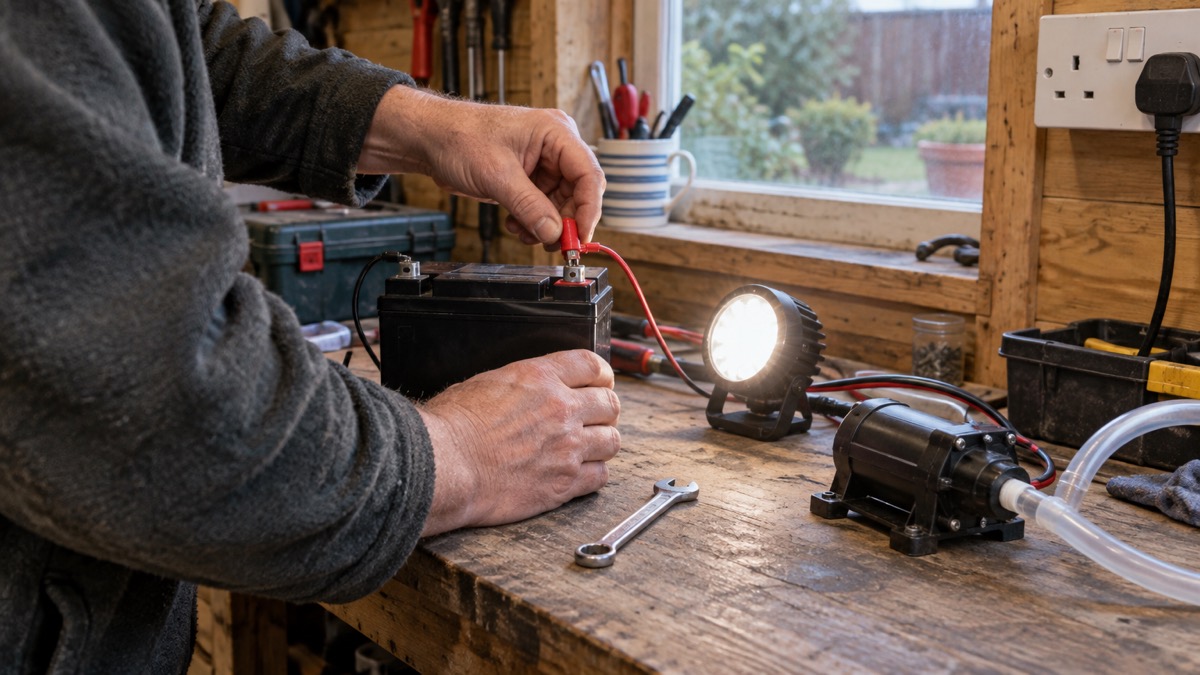
If you want power that does not depend on the mains, there are three basic ways to arrange it. The smallest is a 12V DC system: one battery, some low-voltage lights and devices, and a charging source such as a solar panel. The next step up is a DC/AC system: still a low-voltage battery, usually 12 or 24V, but with an inverter added so ordinary 230V household appliances can run1. The largest is an AC-coupled system, where a battery and its inverter sit on the same AC wiring as the solar panels, so panels, battery and house all meet at 230V2.
Which of the three you choose is decided mostly by what you need to run. Domestic off-grid battery systems store low voltage DC electricity, up to 48V, and need a suitable controller to protect them from over and under charging1. To run some appliances you need an inverter to convert from 12 volts DC to 230 volts AC1. And if you already have solar panels on your roof, an AC-coupled battery is generally the easier retrofit, according to the Centre for Sustainable Energy2.
One point worth making before anything else: if a grid connection is already in place or available close by, the Centre for Alternative Technology advises that it makes more sense to generate renewable energy and buffer it with the grid, because there is rarely a benefit in going off grid when you do not need to1. Off-grid systems earn their keep where the mains is unreliable, unavailable, or where you want a defined backup that works through any outage. For the wider picture of what off-grid solar can power, see off-grid solar systems.
The three layouts side by side
| 12V DC system | DC/AC system with inverter | AC-coupled system | |
|---|---|---|---|
| Battery voltage | 12V (or 24V) | 12V or 24V, up to 48V for larger banks1 | Part of a battery storage system meeting the house at 230V AC |
| What it runs | Lighting, water pump, fridge and other DC equipment6 | The same DC loads plus 230V mains appliances through the inverter1 | Household AC loads, with solar panels feeding the same AC side2 |
| Best suited to | A shed, caravan, small outbuilding or one room6 | A small off-grid home or a household wanting defined backup | A home with existing solar panels that should keep working in a power cut2 |
| Key extra parts | Charge controller and DC wiring1 | Inverter sized to the loads1 | Battery inverter and isolators on the AC side4 |
The rows of that table are really a ladder. Each step up adds cost and complexity but runs more of a normal household. The sections below take each layout in turn, then look at how an AC-coupled system is built and how to match a system to your loads.
Small DC systems: a battery at 12 or 24V
The classic small off-grid system is the one caravans have used for decades. The Caravan Club describes it plainly: the battery powers the caravan's 12-volt system, "basically the lighting, water pump and fridge"6. That is the honest description of what a 12V system does well: lights, a pump, a fridge, phone charging and similar low-draw equipment, all running directly on DC with no inverter in the way.
The same approach works in a fixed building. The Centre for Alternative Technology, advising on off-grid sanitation, notes that using low voltage, 12 or 24 volt DC, will reduce equipment costs when off grid, and that a motion detector minimises power demand for something like toilet lighting7. That second point matters more than it looks: on a small system, choosing DC equipment and cutting the hours it runs is often the difference between a battery that lasts the weekend and one that does not.
Charging and control kit for this class of system is widely available. Marlec's HRDi charge controller provides charge control and power splitting for an off-grid system with two independent batteries, such as the cranking battery and leisure battery on a boat8. Sterling Power's Power Management Panel is built for 12 and 24V DC systems9, and its BB122430 unit takes a 12V input and gives a 24V DC output, letting a 12V charging source feed a 24V system10.
One protective device is worth knowing about at this stage. Sterling Power's HVDC12 has two studs: one connects to the 12V battery or system you want to protect, the other to the risky device, which can be a solar regulator, a wind generator or other high voltage equipment11. It protects the battery and system from instant or sustained high DC voltage spikes from malfunctioning solar charge controllers and wind regulators, which the maker states can dump 16V to 35V or more onto a 12V battery and system11. On any small system that charges from wind or solar, protection of this kind is cheap insurance for the equipment downstream.
Running household appliances through an inverter at 230V AC
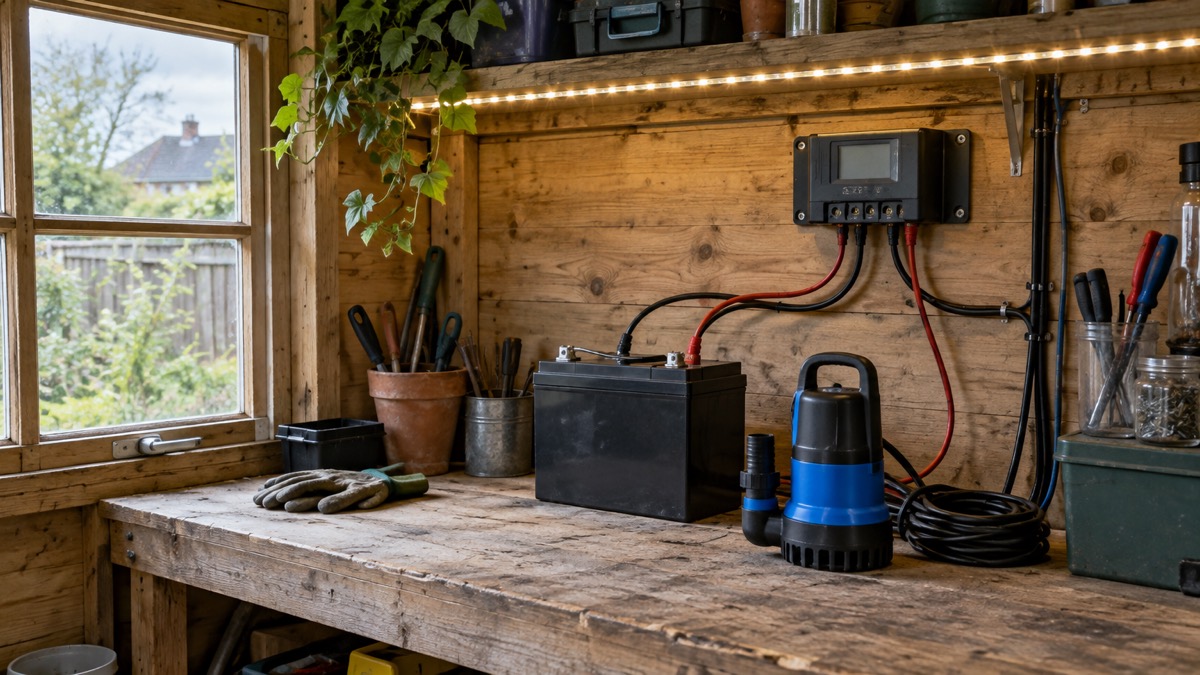
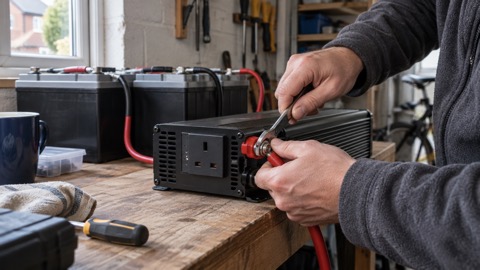
The moment you want to run a normal household appliance, a kettle, a microwave, a washing machine, you need an inverter. An inverter is a small device that converts battery power, which is DC, into standard 230V mains electricity, AC12. The Centre for Alternative Technology puts the same point in system terms: to run some appliances you will need an inverter to convert from 12 volts DC to 230 volts AC1. Marlec, describing its off-grid inverters, says an inverter "enables you to operate mains appliances using the energy stored in your batteries" when travelling and off grid13.
Not all inverters produce the same output. Pure sine wave inverters are designed to replicate mains AC closely: Sterling Power says its PS Series pure sine inverters are "designed to perfectly replicate AC as you get it from your mains supply, ensuring that all of your" 230V appliances run as expected14. The maker also lists the output as 230V/240V on its product page, so treat the nominal figure as 230V with 240V also quoted14. Modified sine wave inverters exist at lower cost, and the differences between the two types are covered in off-grid inverters and inverter chargers.
Sizing is the next decision. Victron Energy's Energy Storage System design manual offers a useful benchmark for a family household: "a 3000VA inverter/charger can run most appliances - as long as not more than one of them is running at the same time"4. That single sentence captures how small-system households actually live off-grid: not everything at once, but any one thing when you need it. Against that benchmark, Bluetti's off-grid power calculator lists a microwave at 1200W15, which gives a feel for how quickly individual appliances eat into an inverter's rating.
Two further points about inverters in practice. First, the Caravan Club warns that some appliances need an inverter to work off the 12-volt system and that this "will also increase the rate at which the battery is drained"6: conversion is not free, and a DC system with an inverter bolted on drains faster than the same loads on DC equipment. Second, some inverters are combined units. CyberPower's all-in-one off-grid inverter is designed with a built-in solar charger and AC charger16, an integrated MPPT charge controller so extended batteries can be charged without an additional solar charger16, and compatibility with generators as an alternative input power source to ensure power continuity when solar power is insufficient16. An all-in-one of that kind replaces several separate boxes in a small or medium system.
Medium off-grid AC systems: battery banks at 24 or 48V DC
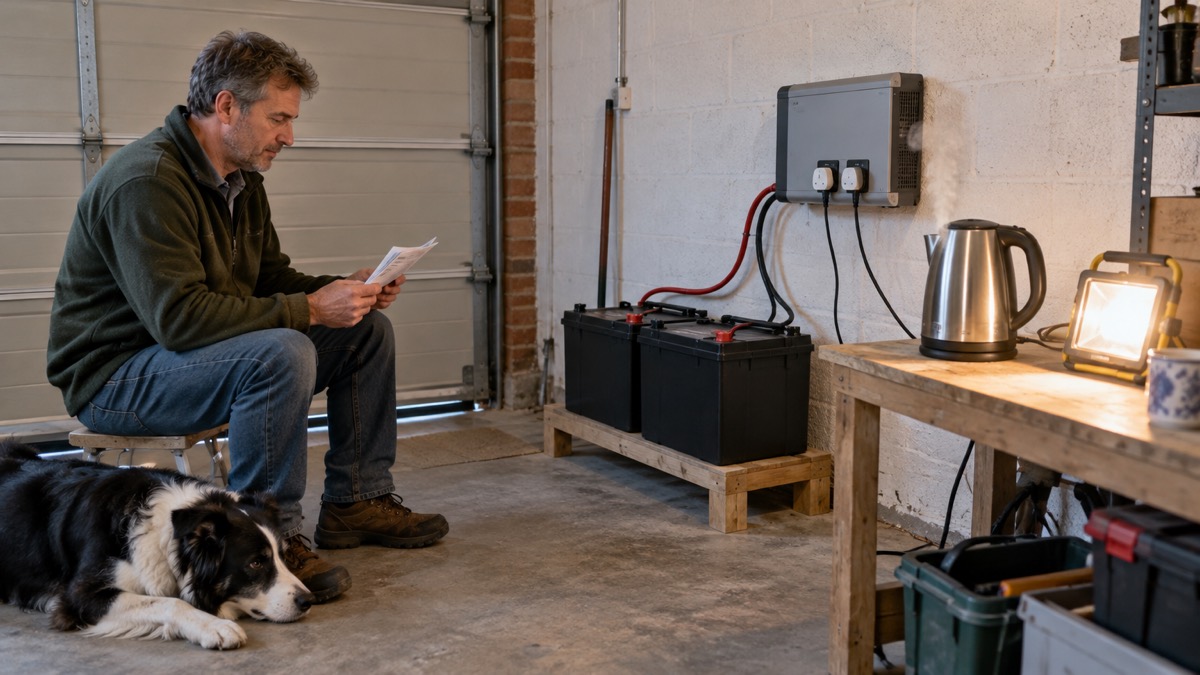
As the loads grow, so does the battery bank, and medium off-grid AC systems are built around banks at 24 or 48V DC feeding a larger inverter. The Centre for Alternative Technology gives the ceiling for domestic off-grid battery storage: these systems "store low voltage (up to 48V) DC electricity and need to be protected from over and under charging with a suitable" controller1. That protection requirement does not change with size; if anything it matters more, because a 48V bank feeding a big inverter moves more energy than a 12V caravan battery.
How the battery and inverter interact is where medium systems get interesting. EcoFlow's STREAM AC 5000 illustrates the pattern: in off-grid situations, adding one Expansion Battery increases the host's off-grid power from 2500 to 3000, and adding more expansion batteries will not further increase the power but can expand the capacity17. Read that carefully, because it is a general truth about expandable systems: extra batteries add hours, not watts. The power you can draw at any instant is set by the inverter; the capacity decides how long you can draw it.
One caution from the maker's own manual is worth repeating for anyone mixing equipment. Victron Energy states clearly where its Energy Storage System should not be used: "In off-grid systems, with or without a generator • In marine systems • In automotive systems • Inverter priority, also k"nown as intentional islanding or ignore AC input, systems4. The lesson generalises: system types are not interchangeable, and a product designed for grid-connected storage may be explicitly unsuited to full off-grid use. Check the maker's stated use cases before building around any unit.
Medium systems can also be grid-charged deliberately rather than off-grid at all. A UK trial documented by National Energy Action used Tesla Powerwall 2 batteries without solar PV, charged from the grid overnight using cheaper off-peak rate electricity, with the stored energy then used to reduce daytime peak-rate costs for homes at risk of fuel poverty because of the higher cost of electric heating18. That is a grid-buffered arrangement rather than an off-grid one, but it shows the same hardware serving a different purpose: the battery is the flexible part, and how you charge and use it is a design choice.
How an AC-coupled off-grid system works
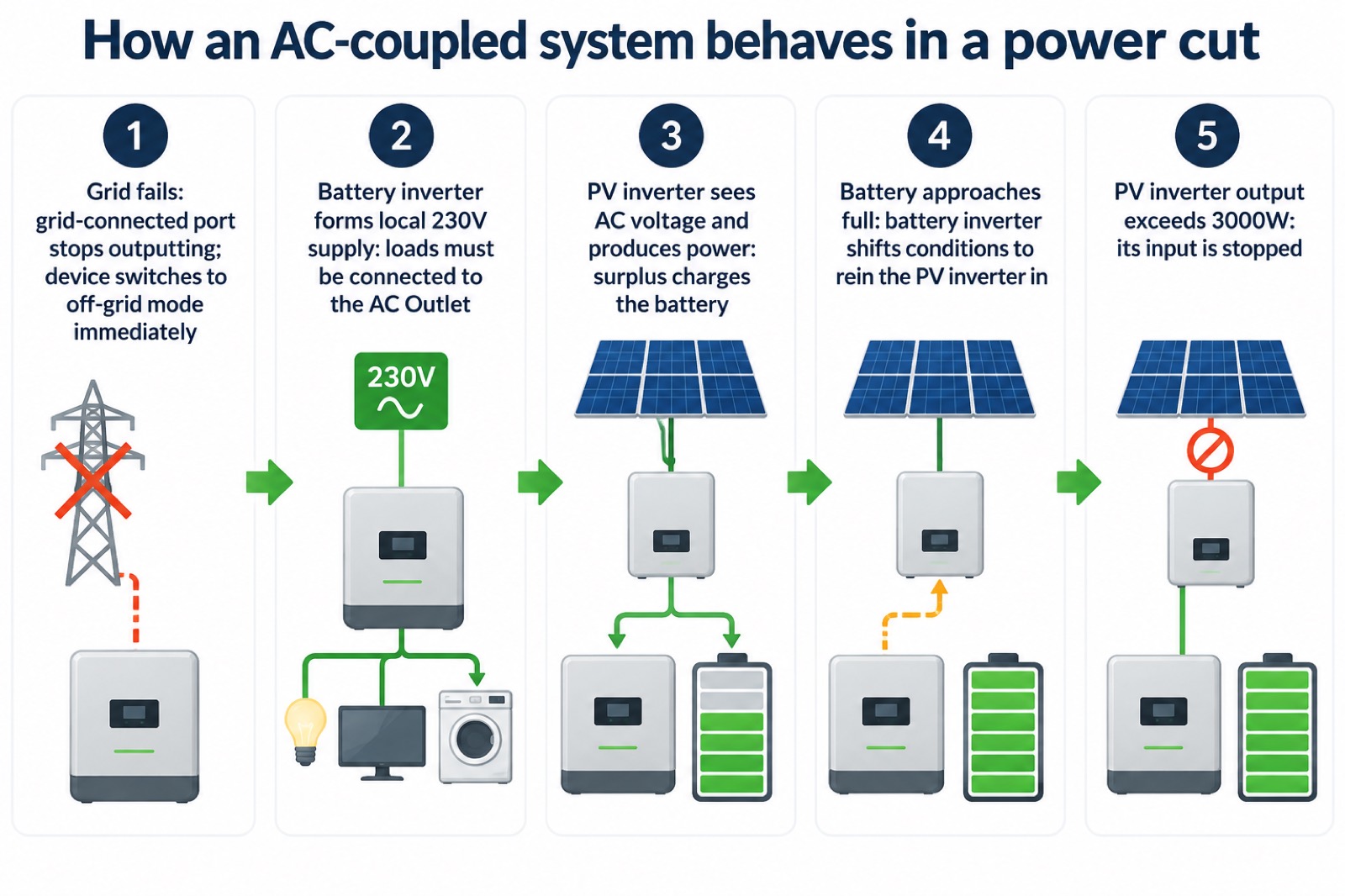
In a DC system, solar panels feed the battery through a charge controller, and the inverter feeds the loads. In an AC-coupled system the order is reversed: the solar panels have their own grid-tie inverter producing 230V AC, and a separate battery inverter also connects to that AC wiring. When there is grid power, or when the battery inverter is forming a local 230V supply, the panels' inverter sees a normal AC voltage and produces power. That power goes straight to the loads, and any surplus is taken by the battery inverter to charge the bank.
The reason AC coupling exists for retrofit is simple. The Centre for Sustainable Energy advises that "AC-coupled batteries are probably better if you already have PV as they are easier to retrofit"2. Instead of rewiring the DC side of an existing solar installation, the battery system connects on the AC side, which is why AC-coupled batteries have become the common choice for adding storage to a home that already has panels.
The behaviour in a power cut is what most households care about. Ordinary grid-tied solar does not work in an outage: as Jackery explains, "It happens due to an automatic switch that ensures no solar system connected to the grid sends energy" during a power outage3. That switch protects the engineers working on the lines, but it leaves the house dark. The government's Prepare campaign guidance says solar panels and a battery storage system with power backup capability can continue to provide power during a power cut "if they are designed and configured to operate independently of the electricity grid", which may help keep essential appliances running during an outage19. An AC-coupled system with off-grid capability is exactly that design.
EcoFlow describes the switch-over for its STREAM 5000: "When there is a power outage, the STREAM 5000 will immediately switch to off-grid mode, the grid-connected port will sto"p outputting and the device supplies power to the loads connected to the AC Outlet17. Note the wording: off-grid, the loads must be connected to the AC Outlet of the unit, not to the general house wiring. The maker's prerequisites are that there must be sufficient remaining power in the battery and the load needs to be connected to the AC Outlet17. Not every product in a range has this capability: EcoFlow lists off-grid use as yes for the STREAM AC Pro20 and the STREAM Ultra X21, but no for other models in the same range20, so check the specific model.
The heart of AC coupling off-grid is stopping the panels' inverter from overcharging the batteries. The panels' inverter will keep producing as long as it sees an AC voltage, so the battery inverter must control that voltage: when the batteries are full, it shifts the AC voltage so the grid-tie inverter backs off. Victron's design manual states the sizing rule for a grid-tie inverter connected on the AC out: "When connected on the AC out, the factor 1.0 rule must be adhered to. There are no exceptions to this"4. EcoFlow gives the operational equivalent for its STREAM system: in off-grid situations the third-party inverter is directly connected to the AC Outlet, and "if the output power of the thir"d-party inverter exceeds 3000W, the input of the third-party inverter will be stopped5. In other words, the system does not just throttle an over-sized PV inverter, it disconnects it.
Components of an AC-coupled system, from panels to isolators
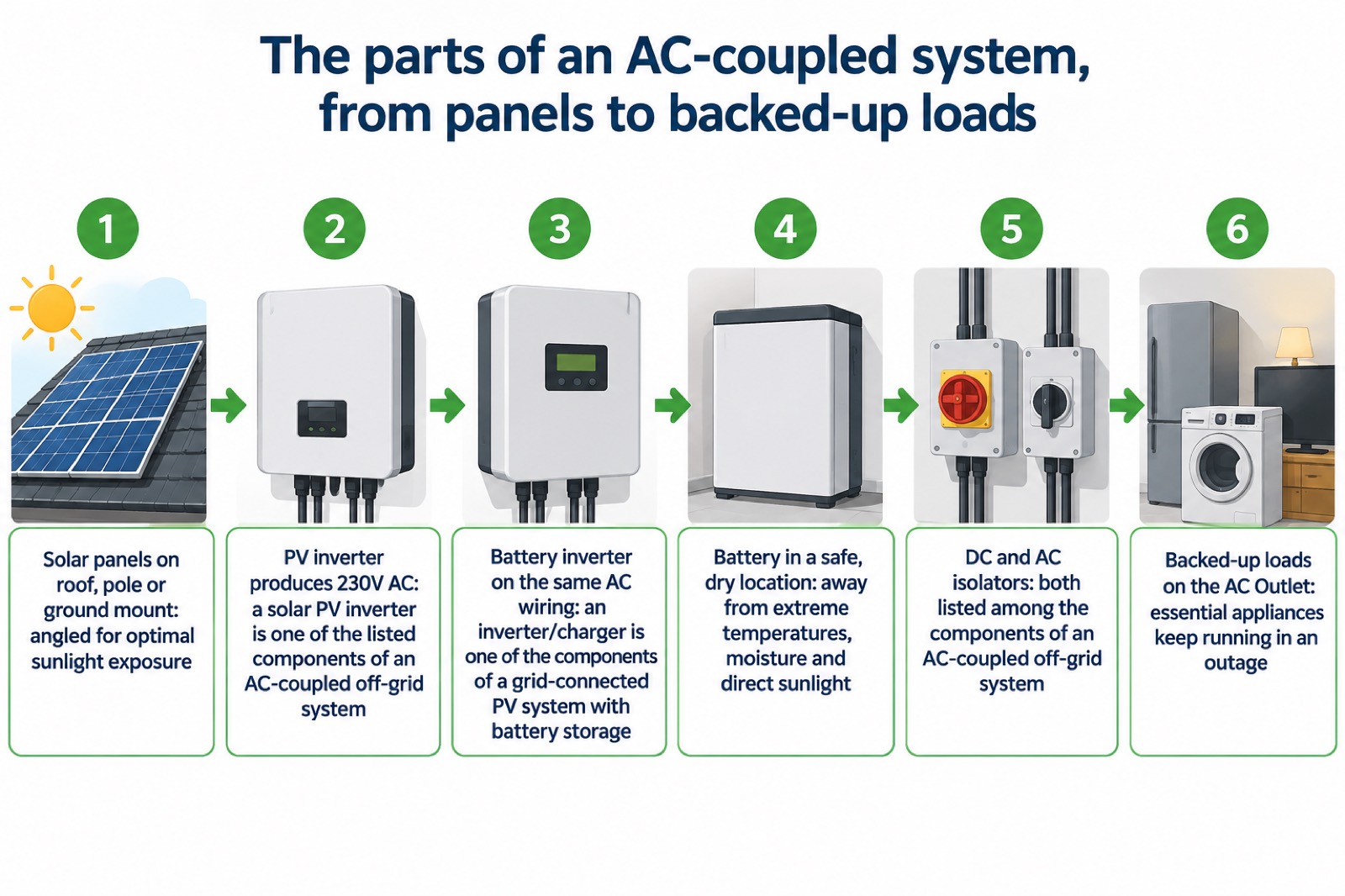
Working from the sun inward, an AC-coupled system has these parts, and each has a job worth understanding.
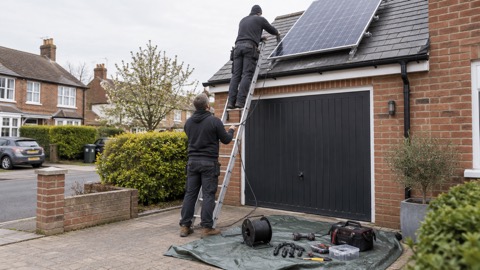
Panels and their mounting. Bluetti's installation guidance is to position the solar panels in a well-lit area and securely mount them on a roof, pole or ground mount, ensuring they are angled for optimal sunlight exposure, then connect the panels directly to the charging input15. Panel types and mounting choices are covered in solar panel types and mounting and wiring solar panels.
Panel-level electronics. Electrical Safety First notes that micro-inverters and power-optimisers separate panels so one panel failing does not impact the whole system, but may be more expensive22. In an AC-coupled design, micro-inverters on the roof are already producing AC, which fits the layout naturally.
The battery and its location. Bluetti's step two is to select a safe, dry location for the energy storage battery, away from extreme temperatures, moisture and direct sunlight, and to connect the solar panel's DC cable to the DC/PV input port on the battery15. That guidance is written for a portable power station, but the conditions are the same for any battery in any system.
The battery inverter. This is the unit that charges the bank from the AC side and forms the local 230V supply in an outage. Sterling Power's A2000, an example of the class, offers 2000W of AC inverter power at 230VAC 50Hz, with two 230VAC outlets, one in and one out23. The AC-in and AC-out connections are what define the topology: AC in from the grid or a generator, AC out to the backed-up loads.
Isolators, DC and AC. Every properly built system can be safely disconnected. On the DC side, an isolator separates the battery bank from the charging and inverter wiring; on the AC side, an isolator separates the inverter output from the loads and the grid. The HVDC12 protection device described earlier shows the DC-side principle in miniature: one terminal to the battery and system being protected, the other to the risky device11. Bluetti's step three shows the discipline that isolation supports: AC devices plugged into the AC port, DC devices into the DC port, with the total wattage not exceeding the battery's capacity, before powering on15. To legally build an off-grid home, Bluetti advises checking local building codes, getting required permits for land use, construction and septic systems, and ensuring your systems meet safety standards15. Planning matters are covered in planning permission and building regulations.
Parallel operation. Where one inverter is not enough, some units work in parallel: CyberPower states that when its all-in-one off-grid inverter is operating in parallel, "it increases power capacity and helps optimize solar panel performance", for selected models only16.
Panels with their own inverter, the battery inverter, isolators on both sides, and the loads that stay powered.
Choosing a system by the loads you need to run
Start at the appliances, not the equipment. List what must run during an outage or off-grid, note each item's wattage, and only then ask what battery voltage, inverter size and coupling arrangement can deliver it. Bluetti's calculator listing a microwave at 1200W15 is the kind of figure to gather for every essential load. The method for turning that list into a system size is set out in sizing an off-grid solar system from your daily watt-hours.
For a small load list, a 12V or 24V DC system is enough, and low voltage keeps equipment costs down7. For a load list that includes mains appliances, add an inverter and treat Victron's benchmark as a reality check: a 3000VA inverter/charger can run most appliances for a family, as long as not more than one of them is running at the same time4. For a whole-house list, or a home with existing PV, AC coupling comes into its own2.
The makers' own off-grid specifications show how much the details matter. EcoFlow's STREAM AC 5000 has a maximum load capacity of 3600W on its AC Outlet in grid-connected bypass operation17, but off-grid its behaviour is governed by the battery's remaining charge and the requirement that the load sits on the AC Outlet17. Anker's SOLIX X1 range makes the on-grid/off-grid gap explicit: the single-phase system offers 6kW of AC output on-grid24, the hybrid three-phase system 12kW on-grid25, and up to 6 systems can run in parallel on-grid but only 1 system off-grid25. Off-grid, the maker states, "both of the systems support only single-system output power ratings"25, and for the three-phase and single-phase systems off-grid, only dual-system and single-system output power ratings respectively are supported26. The practical lesson: a storage system's off-grid output can be a fraction of its grid-connected output, and the off-grid figure is the one that matters in a power cut.
If your aim is backup rather than full off-grid living, the Centre for Alternative Technology adds a financial and environmental angle: the best setup is one that allows you to charge the battery from the grid as well as from solar panels, and to export from the battery to the grid during chosen periods1. Which?, advising on battery-powered generators, suggests calculating how long the battery takes to charge from flat to full and factoring in current electricity prices, noting that some can be hooked up to a solar panel for free off-grid charging, usually with the panel bought separately27. Northern Powergrid's energy advice service takes the household-level view: its partners explain how insulation, solar panels, heat pumps and batteries work and help you make a plan to get them installed28. If a power cut has already happened, National Grid's advice includes checking your trip switch: if it is in the off position, turn off anything plugged into the sockets, or pull out the plugs, and turn the switch back on29.
Wind and diesel: charging an off-grid system when the sun is not enough
Two charging sources sit alongside solar in most off-grid designs. The first is wind. Marlec's Green Column System, a wind and solar powered off-grid lighting column, shows the combination working as a package: the columns are powered by a combination of a Rutland wind turbine and a solar photovoltaic panel to deliver a balanced supply, with the energy stored in a battery ready to be consumed30. The HRDi controller mentioned earlier manages charging and power splitting for systems with two independent batteries8. Any wind-charged 12V system should carry protection against voltage spikes from malfunctioning regulators, which can dump 16V to 35V or more onto the battery11. Small wind turbines and windchargers are covered in small wind turbines and windchargers for off-grid battery charging.
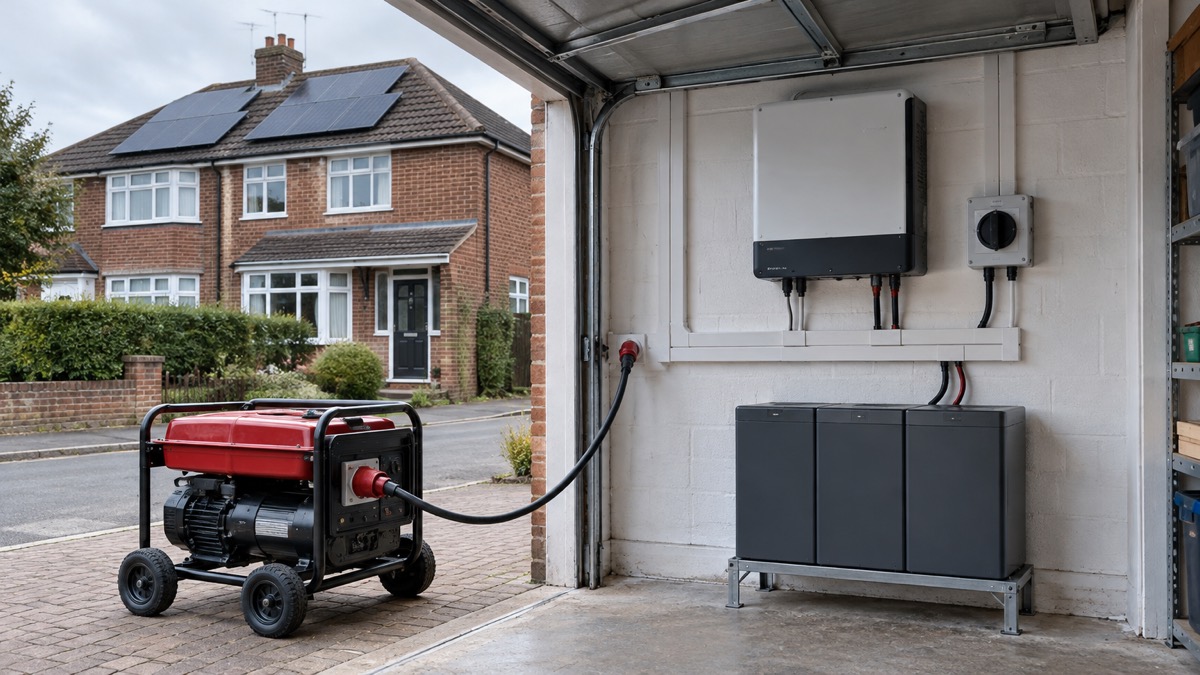
The second is the diesel generator. Ofgem's report on the networks' response to Storm Arwen describes them plainly: "Generators are units that produce electricity using diesel engines"31. Current UK-market models illustrate what is available. Champion Power Equipment's Bimson Power diesel generator with wireless remote start is diesel powered, has overload protection, and offers one 120V 32amp and one 240V 32amp outlet; the maker notes the Wireless Remote Start model does not support connecting to an Automatic Transfer Switch32. The three-phase version adds a 12V battery charging outlet and 415V three-phase and 240V single-phase output sockets as standard, with overload protection, and likewise does not support an ATS connection33. The larger Bimson Power three-phase model is supplied with an Automatic Transfer Switch input port, compatible with the maker's ATS panel, "to automatically start the generator when loss of power is detected and stop it when mains is restored"34.
That ATS distinction is the one to check if you want unattended backup: the remote-start models must be started by hand, while the three-phase model with the ATS input port can start itself. Whichever generator you consider, an all-in-one off-grid inverter that is compatible with generators as an alternative input power source can tie the generator into the system so power continues when solar is insufficient16.
Sources (34)
- Battery storage, Centre for Alternative Technology, 2025-06-27
- Battery storage advice, Centre for Sustainable Energy, 2025-10
- How to use solar panels during a power outage, Jackery, 2026-09-28
- ESS design and installation manual, Victron Energy, 2024-10
- STREAM series solar battery storage, EcoFlow, 2026-10-25
- Batteries technical advice, The Caravan Club, 2026-10-25
- Composting toilets, Centre for Alternative Technology, 2025-06-27
- HRDi charge controller, Marlec, 2026-10-29
- Power Management Panel, Sterling Power, 2026-10-25
- BB122430 12V/24V 30A input, Sterling Power, 2026-10-25
- 12V battery high voltage protection device, 60A rated, Sterling Power, 2026-10-25
- Caravans and motorhomes applications, Photonic Universe, 2026-10-25
- Off-grid inverters, Marlec, 2026-08-26
- PS Series 12V 3000W twin socket inverter, Sterling Power, 2026-10-25
- Off-grid solar power, Bluetti, 2026-10-25
- All-in-one off-grid inverter, CyberPower, 2026-10-29
- STREAM AC solar battery, EcoFlow, 2026-10-25
- Tesla Powerwall 2 batteries, CP1139, National Energy Action, 2019-04-30
- Power cuts: be informed about hazards, Prepare Campaign, 2026-10-21
- STREAM AC Pro AC, EcoFlow, 2026-10-25
- STREAM Ultra X, EcoFlow, 2026-10-25
- Solar panels safety advice, Electrical Safety First, 2026-10-26
- A2000, Sterling Power, 2026-10-25
- X1 Energy Storage System, Anker SOLIX, 2026-10-25
- X1 Hybrid Three-Phase Energy Storage System, Anker SOLIX, 2026-10-25
- X1 three-phase system, Anker SOLIX, 2026-10-25
- How to buy the best generator, Which?, 2026-01-20
- Northern Powergrid energy advice, Northern Powergrid, 2026-10-29
- What to do in a power cut, National Grid, 2026
- Green Column System, Marlec, 2024-10-09
- Interim report on the review into the networks' response to Storm Arwen, Ofgem, 2022-02-17
- Bimson Power diesel generator, wireless start, Champion Power Equipment, 2026-10-25
- Bimson Power diesel generator, 3 phase wireless remote start, Champion Power Equipment, 2026-10-25
- Bimson Power diesel generator, 3 phase, Champion Power Equipment, 2026-10-25
 Off-Grid Solar Kit Checklist
 Hydroponic System Parts List
 Year-Round Sowing Calendar
 Off-Grid Battery Banks
 Off-Grid Battery Care
 Solar Charge Controllers
 G98 DNO Notification
 Off-Grid Inverters
 Mounting and Wiring Solar Panels
 Solar Panel Types
 Sizing an Off-Grid Solar System
 Solar Water Pumping
 Small Wind Turbines