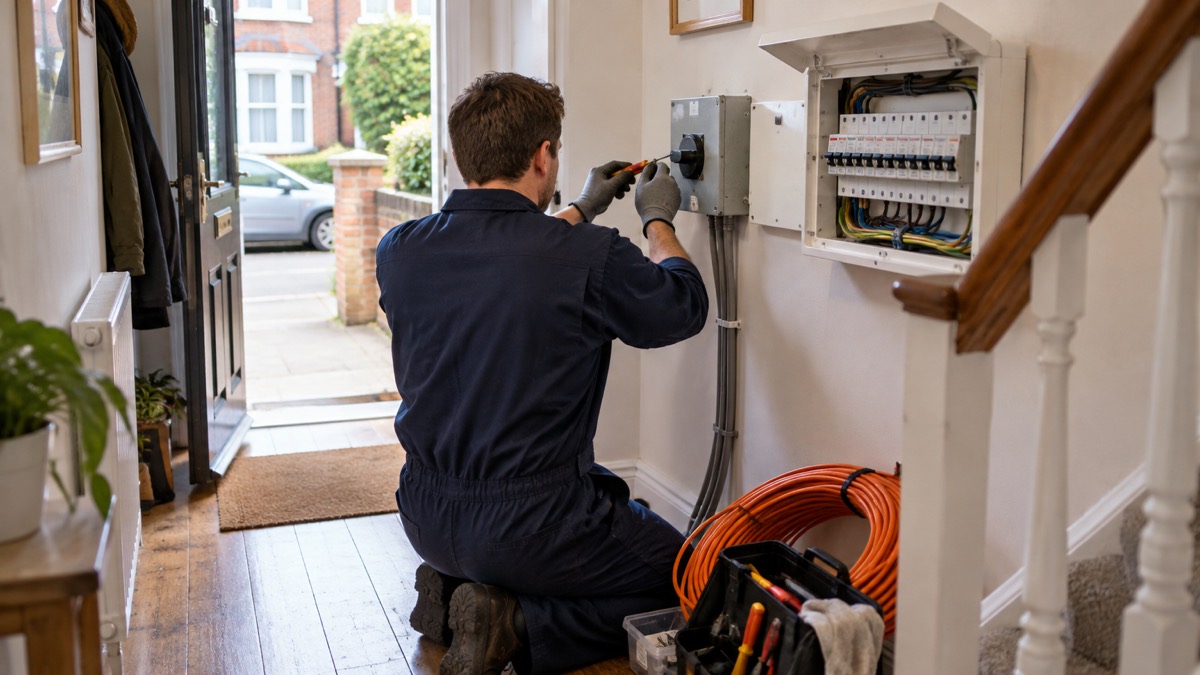
If you want a generator or a battery power station to run your household wiring during a power cut, the single most important rule is this: never plug it into a wall socket. Feeding power back through an ordinary socket is unsafe, and no official guidance will tell you how to do it.
There are only two safe ways to use backup power. The first is to run extension leads from the generator or power station to individual appliances, keeping everything at plug level. The second is to have a proper connection fitted by a qualified electrician, who can install the switching needed to isolate your home from the mains safely1. Anything in between, feeding power backwards through a socket, is unsafe and is not something this page or any official guidance will tell you how to do.
This page explains why, what the hazards are, what a portable generator can realistically run, and who to contact when the power goes off. For the wider picture of choosing and running backup kit, see Backup Power at Home.
Never plug a generator into a wall socket
Back-feeding means pushing electricity from your generator into your home's wiring through an ordinary socket, in the hope that it will spread through the house. It is the method people ask about most often, and every piece of official safety guidance points the other way.
The fire and rescue services' warnings about sockets are consistent across the UK. North Yorkshire Fire and Rescue Service advises households never to tamper with gas equipment7. Devon and Somerset Fire and Rescue Service lists never overloading sockets among the top ways to reduce fire risk in the home8. Fire Scotland advises plugging appliances straight into a wall socket and avoiding adaptors, because they can result in electricity overloads9. The Northern Ireland Fire and Rescue Service is equally direct about the electrical risk: never allow water to touch electrics, as this can cause electrocution or fire10.
A generator connected through a socket breaks all of these rules at once. The socket, the wiring behind it and the circuit it sits on were designed to carry power in one direction, at a set current, protected by a fuse or circuit breaker rated for mains supply. A generator feeding power backwards through that same point can overload the socket, defeat the protection, and put live voltage on parts of the system that are not switched off with the rest of the house. It also leaves no safe way to isolate the connection.
The same limits apply to high-draw appliances generally. Devon and Somerset Fire and Rescue Service states that washing machines, tumble dryers and dishwashers should never be used with extension leads or multi-plug sockets, and that only one appliance should be used per socket, because overloading can cause a fire8. The same guidance applies to white goods such as these: they are plugged straight into a wall socket, and adaptors are avoided because they can result in electricity overloads11. The plug-in parts of a home's electrical system have firm limits, and a generator is not a way around them.
If you want to understand how much current appliances actually draw before you plan any connection, see Watts, Watt-Hours and Surge Explained, and for the leads themselves, Extension Leads and Overloading With Backup Kit.
The two safe ways to connect: appliance leads or a qualified electrician
Wiltshire and Swindon Prepared, the local resilience forum's public guidance, is blunt about what installing a generator for a household actually involves: it takes research by you, and the advice and expertise of a qualified electrician, before a generator may help you12. That is the second safe route in one sentence. A proper connection to your wiring is not a DIY job, and it is not a plug-in job.
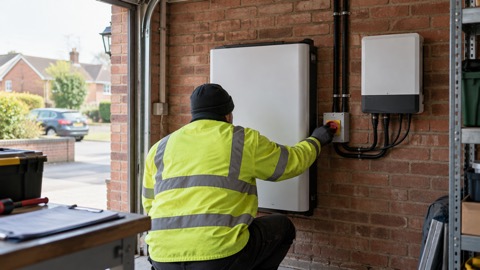
What a qualified electrician fits is a form of changeover or transfer switching: a means of disconnecting your home from the mains before the generator is connected, so the two supplies can never meet. The details of the installation, and any notification to your network operator that a connection requires, are exactly the things the electrician handles as part of the work. Ask them to confirm what they will install, what standard applies, and whether your network operator needs to be told. If you are a private tenant in England and safety work in your home is not compliant, your local housing authority is responsible for enforcing the regulations7.
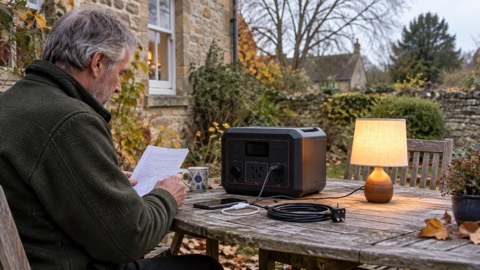
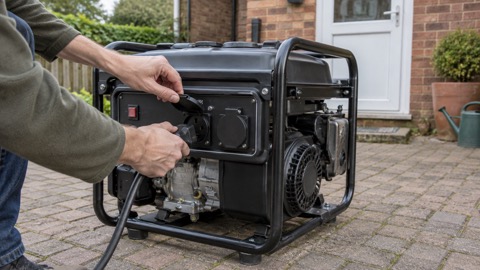
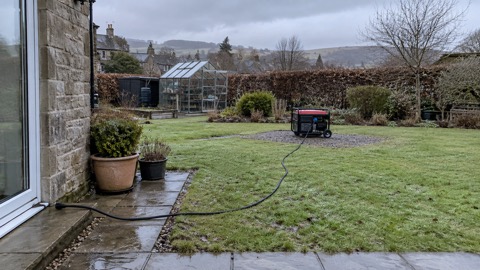
The first safe route needs no electrician at all: run suitably rated extension leads from the generator or power station, placed outside and away from the house, to the individual appliances you want to keep running. One appliance per lead, nothing daisy-chained, and no high-draw appliances on thin leads. This is how most households should use a portable generator during a short power cut, and it is the approach our Using Generators and Power Stations During an Outage page walks through step by step.
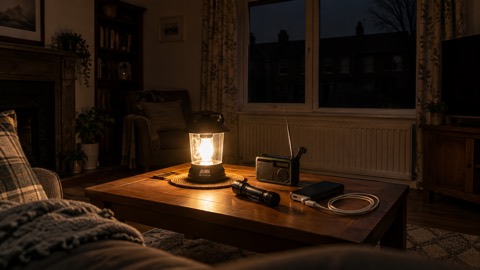
Wiltshire and Swindon Prepared also raises a question worth answering honestly before you spend anything: for short power cuts, the expense of installing a generator for a household may not be worth the costs, and torches and lanterns are a suitable alternative for the few hours you may be without power12. Most UK power cuts are short. A torch, a charged power bank and a battery radio cover most of them, and a generator bought for rare long outages needs storing, fuelling and testing to be worth having. See our Power Cut Backup Power Checklist for the low-cost version.
Carbon monoxide, electric shock and fire: the three generator hazards
The reason a generator must never come indoors, and the reason its placement matters so much, is carbon monoxide. This is the hazard that official guidance returns to again and again, and it applies to every petrol or diesel generator regardless of size or price.
The Health and Safety Executive warns that using petrol powered equipment, such as generators, indoors or in enclosed spaces can create significant levels of carbon monoxide which can kill even after a few minutes3. The Northern Ireland direct government storm advice says never use standby generators indoors, as the fumes from the engine can be lethal, and that if you are using a generator, be careful where you put it in case of carbon monoxide poisoning2. London Fire Brigade's after-a-flood advice is equally firm: never run a petrol or diesel-powered generator indoors, as they can produce fatal levels of carbon monoxide13.
"Even after a few minutes this can create significant levels of carbon monoxide which can kill."
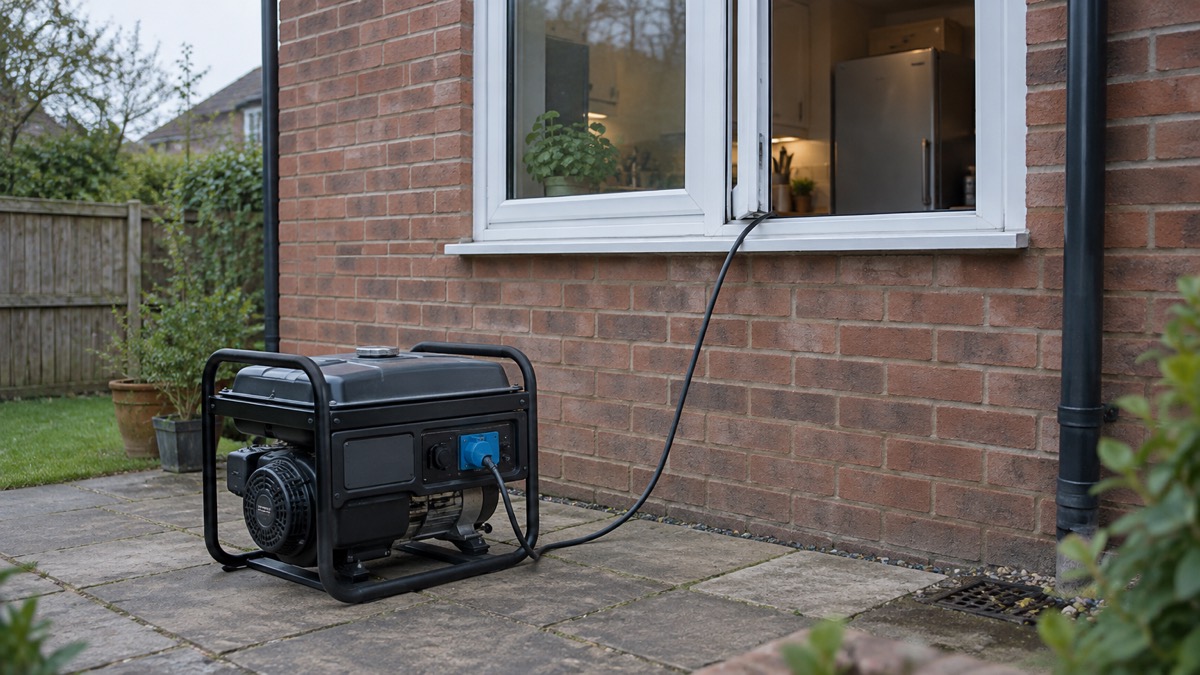
North Wales Fire and Rescue Service lists portable generators alongside gas boilers, gas cookers, gas or paraffin heaters, and wood, gas and coal fires as appliances that can cause carbon monoxide, and warns that faulty, poorly ventilated or incorrectly used appliances can produce dangerous levels of it14. The NHS in Wales gives the same list and the same warning15. Wiltshire and Swindon Prepared's flood cleaning guidance explains the mechanism: do not use petrol or diesel generators or other similar fuel-driven equipment indoors because their exhaust gases contain carbon monoxide, which can poison at high concentrations in the air12.
The protection is a carbon monoxide alarm. Devon and Somerset Fire and Rescue Service's guidance on gas heaters, which carry the same carbon monoxide risk, is that a carbon monoxide alarm belongs in the same room as the heater16. A household that owns a generator is one where a CO alarm is fitted whether or not the generator is ever connected to anything, and tested alongside the rest of the smoke alarms. For the warning signs of exposure, see Carbon Monoxide from Generators: Warning Signs.
Electric shock and fire complete the picture. The Northern Ireland Fire and Rescue Service warns never to allow water to touch electrics, as this can cause electrocution or fire10, which matters outdoors in British weather. Fuel stored and handled carelessly adds fire risk of its own. Our Generator Safety: Carbon Monoxide, Fuel and Electric Shock page covers the full set of precautions, and How Much Petrol Can I Store at Home Safely? covers the fuel side.
Where a generator must never be run
The list of forbidden locations is longer than many people expect, and every entry on it comes from official guidance.
- Indoors, in any room. Exhaust gases contain carbon monoxide, which can kill2
- Garages and enclosed outbuildings. These are enclosed spaces, and the carbon monoxide risk applies to them just as it does to living rooms2
- Tents, caravans, houseboats and any confined space. A fuel-burning engine in a confined space concentrates the same exhaust gases, with the same carbon monoxide risk2
- Anywhere being used to dry out a room. Do not use a fuel-burning engine to heat or dry out a room; the exhaust stays with the air you breathe2
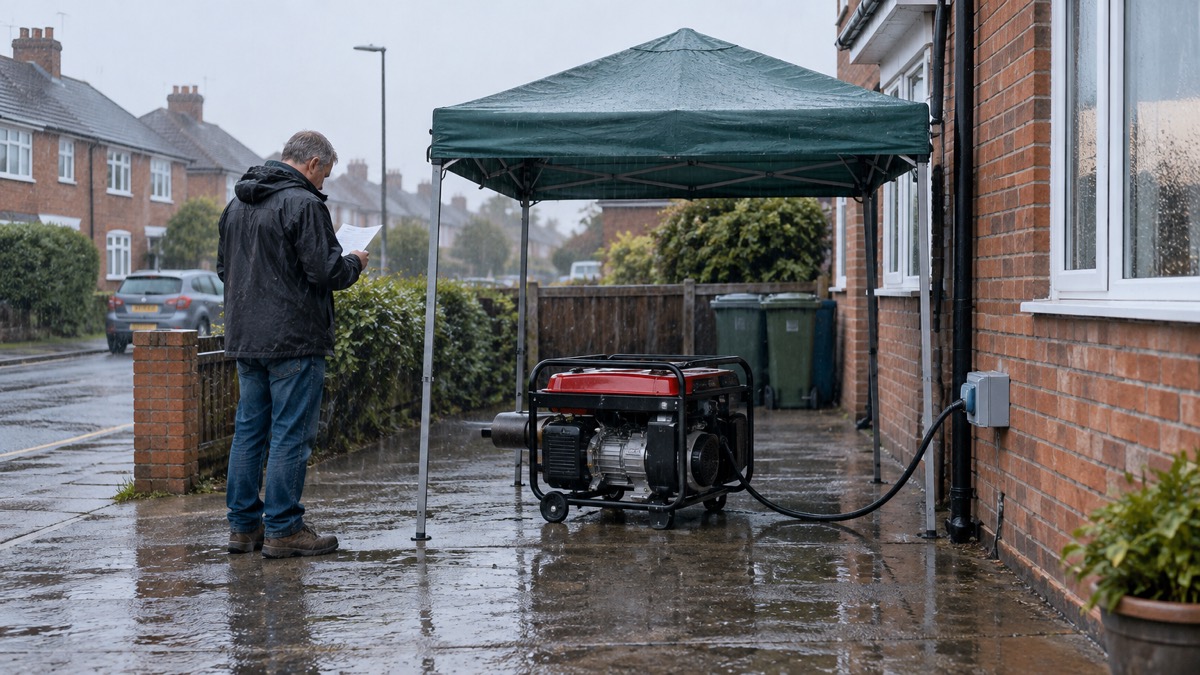
The flood context deserves special care, because that is when generators are most often brought out. The Northern Ireland direct government after-a-flood guidance says to make sure you put the generator outside to avoid carbon monoxide poisoning from the exhaust17. London Fire Brigade's after-a-flood advice says the same: never indoors, because they can produce fatal levels of carbon monoxide13. If you are pumping floodwater, the generator powering the pump stays outside, and the lead comes in.
One more placement point from the resilience guidance: check and test backup generators and equipment before storms, not during them2. A generator that has sat in a shed for a year may not start when you need it, and discovering that in a power cut in the dark is the worst possible time. Our Backup Power Checks Before Winter checklist covers the routine.
What a portable generator can actually run
Before you plan any connection, you need to know what the output can carry, and the honest answer is: less than a house, and often less than a kitchen.
Electrical Safety First publishes typical power ratings for household appliances, and they set the shape of what backup power has to cover6:
| Appliance | Typical power draw |
|---|---|
| Kettle | 2200 to 3000W |
| Portable air conditioner | 900 to 2000W |
| Battery charger for tools | 50 to 350W |
| Charger for battery-operated devices | Up to 75W |
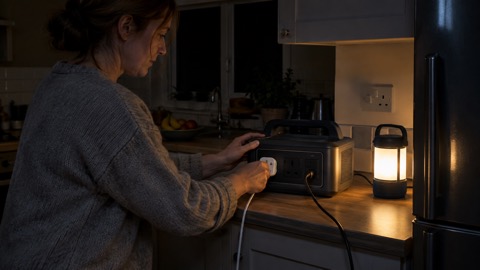
A kettle alone can draw 2200 to 3000W6. That single figure explains why running a whole house from a portable generator is unrealistic for most households, and why the appliance-leads approach usually means choosing a fridge, some lighting and phone chargers rather than business as usual. It also explains why the electrician route matters: a proper changeover installation lets you pick circuits, but you still pick. Our What Size Generator Do I Need for a Power Cut? page works through the arithmetic, and Deciding What to Keep Running When the Mains Fails helps you make the choices.
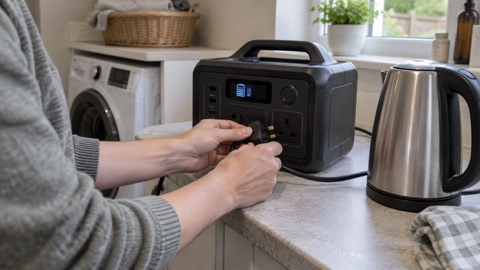
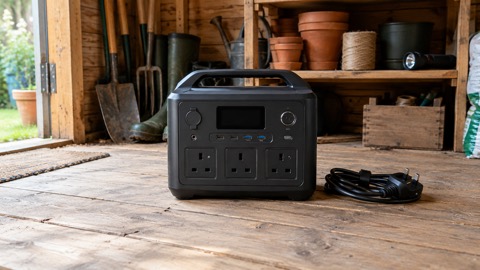
Battery power stations change the picture rather than remove it. A power station feeding appliances through its own outlets is plug-level by design, so there is no wiring question at all, but the same watt limits apply to what it can run and for how long. See Portable Power Stations: What They Do and How to Choose and What Capacity Power Station Do I Need?.
Batteries bring their own safety rules. Portsmouth City Council's battery safety guidance advises not charging devices when sleeping or not at home18. North Wales Fire and Rescue Service notes that the average UK household has many rechargeable items containing lithium ion batteries, such as laptops, mobile phones, e-scooters, e-cigarettes and mobility vehicles19, so these rules apply to kit you already own, not just to prepping purchases. Our Lithium-Ion Battery Safety at Home page covers them in full.
Your distribution network operator and power cuts
When the mains fails, the company that matters is not the one on your energy bill. Your local network operator is responsible for fixing power cuts in your area, in England, Scotland and Wales4. The National Energy System Operator explains the structure: distribution network operators reduce the voltage and deliver electricity to homes and businesses across the country20, and there are 14 Distribution Network Operators across the country, carrying electricity at much lower voltages than the transmission networks21.
The two can easily be confused. Wiltshire and Swindon Prepared gives a worked example: if you live in Wiltshire, you might be supplied by EDF, but the local network that carries your electricity is SSE; in Margate the local network carrier is UK Power Networks21. Your supplier sells you energy; your network operator owns the wires. Ofgem's consumer advice makes the same point: your gas or electricity network operator is responsible for the wires and pipes which carry energy to your home, and they also fix power cuts and attend reports of gas leaks22.
To reach them, call 105. Ofgem's advice is to call 105 for free, and you will be put through to your electricity network operator4. Horsted Keynes Parish Council's power cut tips explain what the number does: calling 105 connects you to your distribution network operator, who owns and maintains the power lines that connect to homes or businesses23. You can also report a power cut directly to your local network operator using their website5. Save the number in your phone now; during a cut is a bad time to look it up.
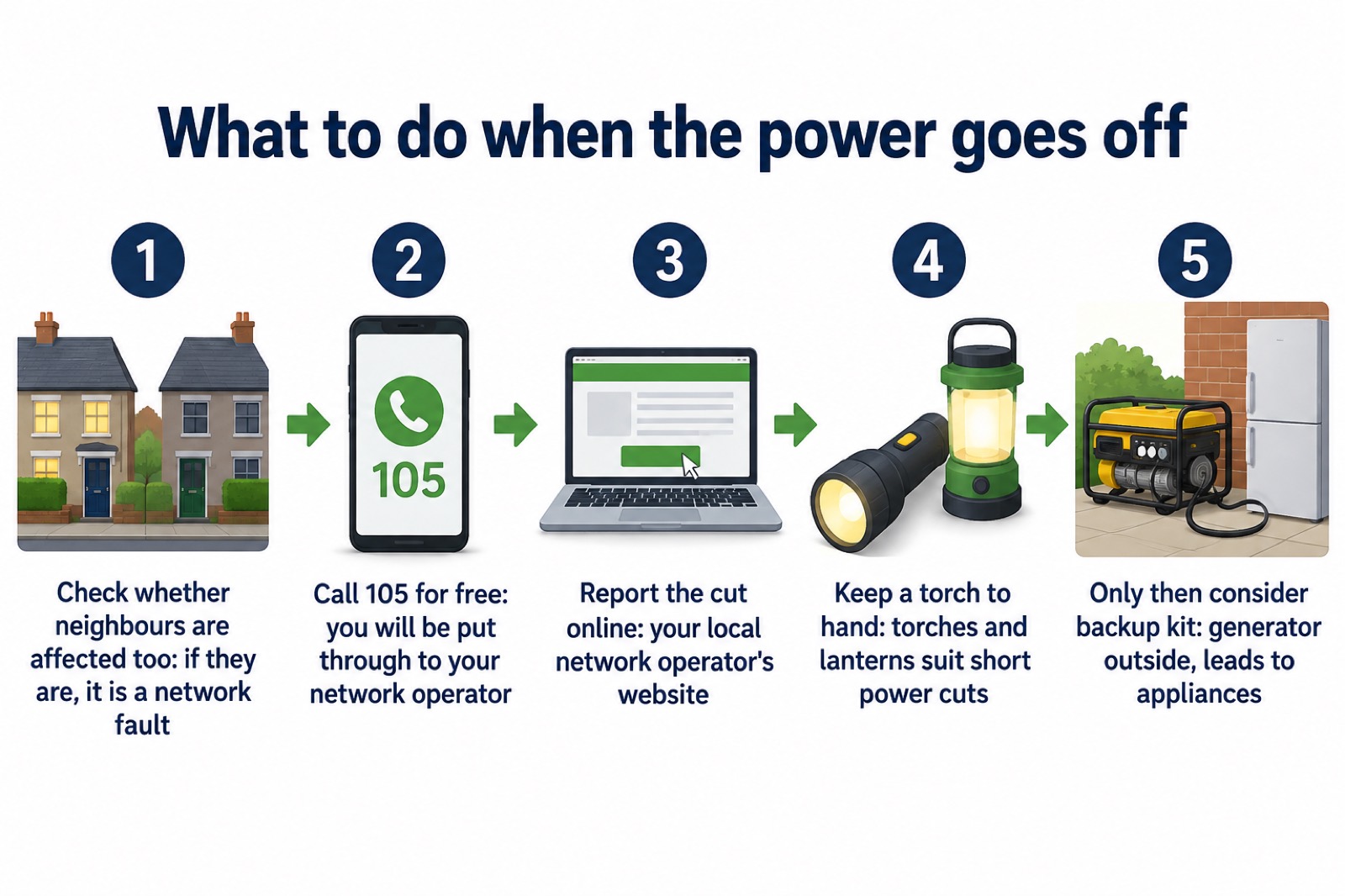
What to do when the power goes off, in order.
Who restores your power, and how long it can take
The National Energy System Operator states it plainly: if your home or business loses power, your local DNO is responsible for restoring it20. That responsibility does not shift to your supplier, to the government, or to you. In some cases the network company brings in generators of its own: Wiltshire and Swindon Prepared notes that generators are used for faults by power companies where there is a failure of equipment that cannot be repaired immediately12. So if you see a large generator running in your street during an outage, it is likely the network operator's, not a neighbour's.
If your power is off for a long period, it is worth knowing where you stand. Ofgem's power cut payment page is where to check what you may be entitled to and how to claim5.
Two related points are worth knowing. First, the system has demand-management tools short of a power cut: distribution network operators may reduce voltage to manage demand without affecting supply, or in more severe situations temporarily disconnect some consumers through a controlled process24. Lights that dim at a peak time without going off are likely deliberate balancing, not a fault in the home. Second, households that rely on any device connected to a landline, such as a telecare or alarm system, are affected by the move to digital landlines: the communication provider, the company listed on the bill, is the one to contact for anyone who identifies as vulnerable or has such devices connected25. The network operator's Priority Services Register is the route to extra support during outages, and households that need it are best registered before an emergency, not during one.
For the wider picture of what causes cuts and how to prepare, see Power Cuts: A Household Guide.
Sources (25)
- Product Safety Guidance – Hyundai PP, Hyundai Power Products
- Strong winds and heavy rain warning: information and advice, nidirect (Northern Ireland government)
- Carbon monoxide in construction and other work, Health and Safety Executive
- Plan for a power cut, Ofgem
- Check if you can get payment for a power cut, Ofgem
- Ratings of electrical appliances, Electrical Safety First
- Student and rented accommodation safety, North Yorkshire Fire and Rescue Service
- Top ways to reduce your risk of having a fire in the home, Devon and Somerset Fire and Rescue Service
- Kitchen safety, Scottish Fire and Rescue Service
- Other safety advice, Northern Ireland Fire and Rescue Service
- White goods safety, London Fire Brigade
- Generators, Wiltshire and Swindon Prepared
- After a flood, London Fire Brigade
- Carbon monoxide safety at home, North Wales Fire and Rescue Service
- Carbon monoxide poisoning, NHS 111 Wales
- Heater safety, Devon and Somerset Fire and Rescue Service
- After a flood: clearing up, nidirect (Northern Ireland government)
- Battery safety, Portsmouth City Council
- Lithium ion batteries at home, North Wales Fire and Rescue Service
- Energy outages, National Energy System Operator
- How the power system works in the UK, Wiltshire and Swindon Prepared
- Energy domestic consumer advice, England and Wales, Ofgem, November 2023
- 12 tips to prepare for a power cut, Horsted Keynes Parish Council
- What are system notices, National Energy System Operator
- Moving landlines to digital technologies, UK Government, 28 May 2025
 Power Cut Backup Power Checklist
 Backup Power Before Winter
 Safe Battery Charging at Home
 What to Keep Running in a Cut
 Power During an Outage
 Watts and Watt-Hours
 Portable Power Stations
 Portable Generator Types
 Generator Safety
 LPG Cylinders and Regulators
 Home Battery Storage
 Portable Solar Panels
 12V Inverters
 Leisure and LiFePO4 Batteries
 Power Banks for Phone Charging