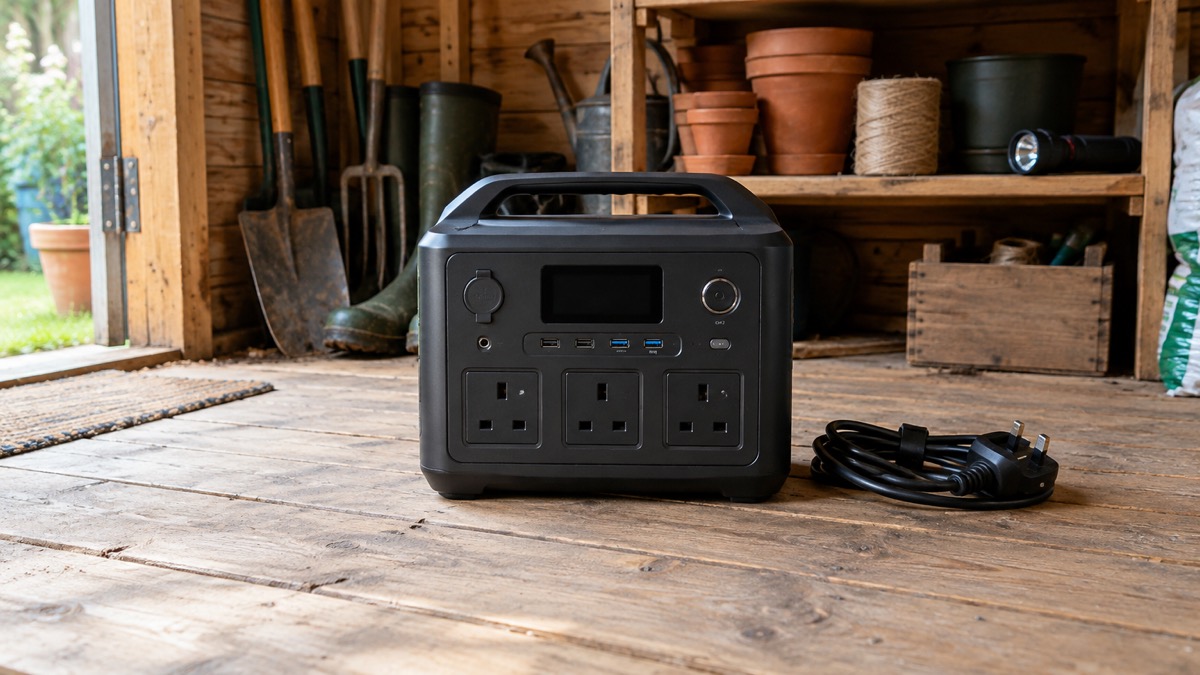
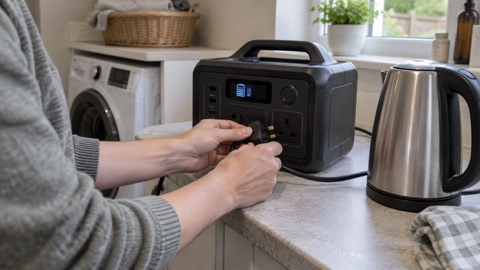
A portable power station is a large rechargeable battery in a box, with ordinary plug sockets, USB ports and sometimes a car-style socket on the outside. You charge it from the mains while the power is on, then run your lights, phone chargers, radio or fridge from it when the power goes off. Unlike a petrol generator it makes no noise, needs no fuel and is safe to use indoors, which is why preparedness advice treats a charged power pack as one of the essentials for coping with a power cut1.
What it cannot do is run your whole home as normal. Independent testing guidance is clear that small, portable backup devices have a limited output capacity, and some models will not power every appliance1. A power station suits a household that wants to keep a few specific things running for a few hours: a phone, a torch or lamp, a router, a fridge overnight. If you need heat, hot water or everything at once, read our page on deciding what to keep running when the mains fails first, because the right answer may be to run less rather than to buy bigger.
This page explains how to choose a power station by what it must actually run: its capacity, its continuous and surge output, its sockets, its inverter type, its battery chemistry, and how it recharges. It also covers the safety rules that come with any large lithium battery: how to charge and store it, what to do if it is damaged, and what to do if it catches fire.
What a power station actually does in a power cut
When the mains fails, a power station does one job: it takes the energy you stored earlier and turns it back into mains-style electricity at your sockets. There is no engine, no fuel to store and no fumes, so you can carry it into the living room and plug a lamp straight in. Wiltshire and Swindon Prepared, an official resilience partnership, puts a charged power pack among the things that are "very helpful in an emergency or power cut"2, and the Met Office's power cut essentials list includes a mobile phone power pack alongside torches and battery candles6. A power station is the larger relation of that power pack: same idea, enough capacity to run mains appliances rather than just a phone.
Independent guidance from Which? on backup for power cuts is that most households are well served by a temporary portable device small enough to carry around and store away, with the honest caveat that it will not power the whole home as normal1. That is the right expectation to start with. A power station buys you hours of normal life for a few small things, not days of everything.
Two things follow from that. First, decide before you buy which items you actually need in an outage, because that decision sets the capacity and output you have to pay for. Our page on watts, watt-hours and surge explains the units involved. Second, keep the station charged and somewhere you can find it in the dark, because a flat battery in a cupboard is no use at all. Electricity network guidance also suggests households consider devices such as uninterruptible power supplies and surge protectors to maintain the flow of electricity and prevent damage to appliances during short interruptions7, which is a different job from a power station but solves a related problem for computers and other sensitive kit.
Matching capacity to what you need to run
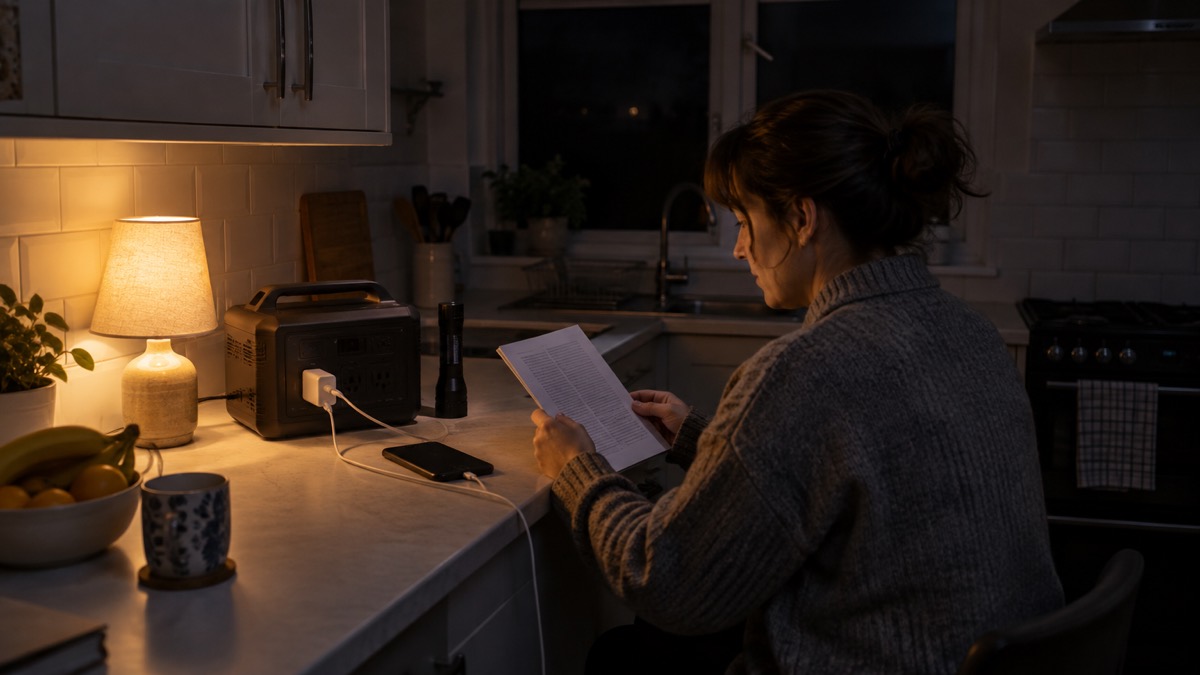
Capacity, measured in watt-hours (Wh), is how much energy the station holds; output, measured in watts (W), is how fast it can deliver it. Both matter, and they are not the same number. A station can have a huge battery and still refuse to run a high-power appliance, or have a high output and empty in an hour.
The honest starting point is your appliances' ratings. Electrical Safety First's guidance on appliance ratings explains how to find the wattage on the label or plate of anything with a plug8. As a worked example of how steep the top end is, a portable air conditioner typically draws 900 to 2000W, with higher BTU models drawing more8. That single figure tells you most of what you need to know about running cooling or heating from a portable station: the very biggest appliances are mostly out of reach, and the ones that matter are the small, essential ones.
Independent guidance is blunt about this: battery generators are smaller and more portable than fuel-tank generators, but "only really useful if you have low power demand"1. For sizing in practice:
- Phones, torches, radios and a router: well within any station, and the job most households actually need done.
- A fridge or freezer overnight: possible with a mid-size or larger station. Which? notes that makers claim substantial fridge run times from their mid-size units, for example DJI claiming its Power 500 can run a refrigerator for up to the sort of duration makers advertise, while warning that solar recharging "will take a while to charge"9.
- High-draw appliances like air conditioning, kettles or heaters: mostly impractical; a portable air conditioner alone can draw up to 2000W8, which is at or beyond the continuous output of many stations and would drain even a large battery quickly.
If your needs are genuinely larger than a station can meet, the alternative is a fuel generator: our pages on portable generators and what size generator you need cover that route, and our comparison of power stations against petrol generators sets the two side by side.
Continuous and surge output: why a fridge or a drill needs more than its label says
Every power station quotes a continuous output in watts, and most also quote a surge or boost figure for the few seconds an appliance takes to start. Motors, compressors and anything with a heating element draw more at switch-on than their rated power, and if the station cannot supply that peak it will simply trip or refuse to start the appliance.
Maker specifications show how this works in practice. EcoFlow's DELTA 3 1500, a mid-to-large portable station, offers 1800W of AC output across 13 outlets, rising to up to 2400W with the maker's X-Boost feature3. The boost figure is the one that decides whether a demanding appliance will start, so check both numbers in the maker's specification before you buy3.
For high-draw tools and appliances, the check before you buy is simple:
- Find the appliance's rated wattage on its label or plate10.
- Compare it with the station's continuous output, not its surge figure.
- Check the appliance's start-up draw against the station's surge or boost rating.
- Remember that running anything near the station's maximum empties the battery fastest.
One further wrinkle affects motors and compressors: the type of inverter inside the station. Sterling Power, a maker of inverters, notes that inefficiencies on modified sine wave inverters lead to a larger battery bank being required for appliances such as fridges and microwaves11. In other words, a cheaper inverter type wastes some of your stored energy on exactly the appliances you most want to run.
How long a station will actually run things
Run time is capacity divided by what you plug in, and makers' claims should be read with that in mind. Which?'s emergency kit guidance reports that manufacturers such as DJI claim its Power 500 can run a refrigerator for an extended period, while cautioning that recharging, particularly from solar, "will take a while to charge"9. Treat maker run-time claims as best-case figures for a new battery running one efficient appliance.
The practical consequences for a household:
- Small loads last longest. A phone or a LED lamp draws so little that even a small station will keep it going for a very long outage.
- A fridge is the realistic big job. It cycles on and off, so it draws power in bursts rather than continuously, which is why makers quote long fridge run times as their headline claim9.
- Heaters and cooling are the short end. An appliance drawing up to 2000W, like a portable air conditioner8, will exhaust a portable station in a fraction of the time a fridge would.
- Recharging during an outage is slow. Solar charging works but takes a while9, so plan on the charge you stored beforehand, not on topping up as you go.
Our page on how long a power station will run a fridge or laptop works through the arithmetic, and what capacity power station you need helps you turn your appliance list into a target number.
The sockets and ports to check before you buy
A power station is only as useful as the outlets on its front panel, and the mix varies a lot between models. Compare what you actually need to plug in against what the station offers.
Jackery's Explorer 2000 v2, a large station, gives a typical layout: 3 AC outlets, USB-A at 18W, and USB-C ports at 100W and 30W4. That combination covers a household's realistic needs: mains plugs for lamps and appliances, fast USB-C for laptops and modern phones, and USB-A for older cables and small devices.
| Outlet type | What it is for | What to check |
|---|---|---|
| AC sockets (230V) | Anything with a normal plug: lamp, fridge, router, TV | The number of sockets, and the total watts they can share4 |
| USB-C | Laptops, tablets, modern phones | The wattage per port: one large station offers 100W and 30W USB-C ports4 |
| USB-A | Older phones, torches, small devices | Port count and per-port watts, for example 18W4 |
| 12V DC / car socket | Car accessories, some lights and pumps | Whether the station has one at all; a petrol inverter generator example offers a 12V DC outlet alongside its sockets1 |
Two cautions on ports. First, check how the maker divides the total output across the outlets, because the figures in the specification describe the station as a whole, not each socket individually. Second, some USB-C ports are output only while others accept input for charging, so if you plan to charge the station over USB-C, check the maker's specification for which port does it. Our page on USB-C charging, power delivery and cables explains the standards behind these numbers.
Pure sine wave or modified sine wave
Inside every power station is an inverter that converts the battery's direct current into the alternating current your appliances expect. The two types you will see named are pure sine wave and modified sine wave, and the difference is the shape of that output.
Sterling Power's guidance on inverters is the clearest statement of the choice: choose a pure sine wave inverter "if you're concerned with the efficiency or would just like to not worry about what you can and can't plug in", bearing in mind the usual wattage restrictions still apply11. A pure sine wave output mimics mains electricity closely, so anything you could plug into a wall socket can plug into the station.
A modified sine wave inverter is cheaper but rougher. Some appliances run hotter or less efficiently on it, and Sterling Power notes that these inefficiencies on modified sine wave inverters lead to a larger battery bank being required for fridges and microwaves11. For a household buying one station to cover whatever the outage brings, pure sine wave is the safer specification, because you do not have to audit every appliance before plugging it in. Our page on 12V inverters covers the same distinction for inverters run from a car or leisure battery.
LiFePO4 or ordinary lithium-ion: what the chemistry changes
Most power stations use one of two lithium battery chemistries, and the maker states which on the product page. Which?'s generator guidance describes one portable power station as "powered by lithium iron phosphate (LiFePO4) batteries"1, and LiFePO4 has become common in larger stations because it trades some energy density for stability and a longer working life.
Ordinary lithium-ion batteries, the kind used in most power banks, e-bikes and many smaller stations, have their own profile. Mid and West Wales Fire and Rescue Service describes them as "lightweight, energy dense and long-lasting but can be more volatile than traditional batteries"12. That is not a reason to avoid them; it is the reason the safety rules later on this page exist. The same fire service warns that the ferocity of a fire caused by a lithium-ion battery can be significant and prevent you from escaping from your home13, which applies to any large battery kept in your house, whatever its chemistry.
For choosing, the practical differences are:
- LiFePO4 is the chemistry you will most often see named in power station specifications; compare the maker's stated figures for weight and cycle life before you buy.
- Lithium-ion is lighter and more energy dense, which suits small and portable units, but is described by fire services as more volatile than traditional batteries12.
- Either way, the storage and charging rules in the rest of this page apply, because both chemistries store a lot of energy in a small box.
If you want the deeper background on lithium batteries at home, see our page on lithium-ion battery safety.
Charging it: mains, car socket or solar panels
The point of a power station is that it is full when you need it, so charging is not an afterthought. Which?'s guidance notes that portable power stations can be recharged in several ways: one Anker model is "rechargeable via AC mains, solar panels or car socket"1.
- Mains charging is the everyday method: plug it into a wall socket and leave it. One maker's large station specifies a wall charging time of 1.7 hours for its emergency super charge mode4, though full charges at ordinary speeds take longer; check the maker's own figures for the model you buy.
- Car socket charging works away from home or if the outage outlasts your battery, but it is slow and depends on the car's own fuel. Our page on charging a power station from your car covers the details.
- Solar panel charging is what turns a power station into what sellers call a "solar generator". Which? cautions that it "will take a while to charge"9, so treat solar as a way to extend an outage slowly rather than a quick refill. Our pages on portable solar panels and how long solar charging takes in the UK set out what to expect.
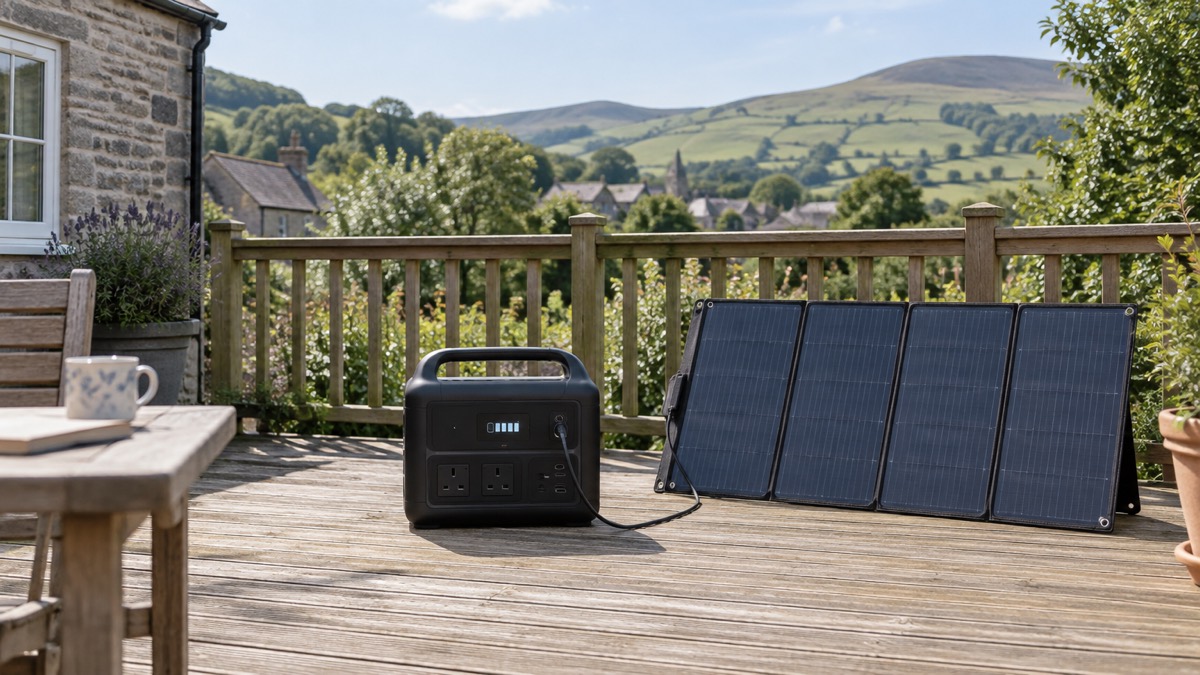
One related point if you are tempted by plug-in solar panels that feed your house wiring: a panel charging your power station through its own input is a different thing, and it is that kind of set-up this page covers. If you are considering anything that connects to your home's wiring, check the current regulations before you proceed.
Charging and using it safely indoors
A power station's great advantage over a generator is that it is safe to run indoors: no exhaust, no carbon monoxide, no fuel. But it is still a large lithium battery, and fire services across the UK give consistent advice about charging one.
The rules that follow apply to charging and using any lithium battery device at home:
- Charge in a safe place. Store and charge batteries in a cool, dry place, away from exits and escape routes14.
- Do not charge where you sleep, and do not block your way out with a charging station15.
- Watch while charging where you reasonably can, and unplug when charged15.
- If a fire occurs: get out, stay out, call 99917. Our page on whether batteries and chargers from online marketplaces are safe covers charger safety in detail.
- Do not overload sockets when charging; our page on extension leads and overloading applies to backup kit as much as to anything else.
The Met Office's storm and power cut advice adds a simple habit: charge your devices, including any power pack, before severe weather arrives, so you are not doing it during the outage6.
Storing it between power cuts
A power station spends almost all its life in storage, and how you store it decides whether it works when you need it.
Fire services' storage advice for lithium batteries applies directly: store and charge them in a cool, dry place14, and the Scottish Fire and Rescue Service advises storing the product and its batteries in a cool place, avoiding extreme heat or cold13. Makers put numbers on this. Jackery specifies an operating range for its Explorer 2000 v2 of -10 to 40 degrees Celsius for supplying power, with charging limited to 0°C to 45°C and discharging to -10°C to 45°C, and warns that operating outside these ranges "may restrict its charging and discharging capabilities, or even render it unable to charge or discharge"4. In practice that means a shed that freezes in winter or a loft that bakes in summer is the wrong home for it; a cool indoor cupboard is right.
Two habits complete storage:
- Recharge it periodically so it is full when an outage comes; a station left flat for months may not be ready when you need it.
- Check it before winter, when power cuts are most likely; our backup power checks before winter page is a checklist for exactly this.
Our page on how to store a power station when not in use and the one on what temperature batteries should be stored at go into more detail.
Damaged units, and getting rid of an old one
Lithium batteries fail in ways that matter to a household, and the two rules are about damage and disposal.
On damage: the Scottish Fire and Rescue Service warns that batteries can be damaged by dropping them, or by a crash in the case of e-bikes and e-scooters13. A power station knocked off a table or dropped down stairs should be treated as suspect: stop using it, stop charging it, and keep it away from anything flammable while you get advice. Warning signs of a dangerous battery are covered on our page on warning signs a lithium battery is dangerous, and what to do about a swelling battery has its own page too.
On disposal: never put a power station, or any lithium battery, in household waste or normal recycling. The Scottish Fire and Rescue Service warns that damaged or end-of-life batteries, if punctured or crushed, can cause fires in bin lorries, recycling and waste centres18, so take the unit to a proper electrical or battery recycling point. If the battery is damaged or swollen, do not put it in your car and drive it around: ask your council or fire service how to hand it over safely, and see our page on how to dispose of a damaged lithium battery.
If it overheats or catches fire
Every fire service that publishes lithium battery guidance gives the same instruction, in almost the same words: get out, stay out and call 999. The National Fire Chiefs Council's Charge Safe campaign tells people to get out, stay out and call 9995. South Wales Fire and Rescue Service says that if at any time you feel unsafe or unsure, call 999 for information and advice19. North Wales Fire and Rescue Service says that in the event of a fire, do not try and tackle it yourself, leave and call 99916. London Fire Brigade's easy-read booklet spells out the steps: as soon as you are safely outside, use your mobile phone to dial 999, ask for the fire brigade, give the address, and do not go back inside20.
Do not attempt to put out a lithium battery fire yourself. A battery fire can reignite after it appears to be out, which is why the fire service, not you, decides when it is safe. If a fire occurs, get out, stay out and call 99921. If someone's escape is affected, close doors as you go: North Yorkshire Fire and Rescue Service advises that if you have a fire you should get everyone out of the property, close any doors you pass, and then call the fire service22.
One further official caution is worth knowing if you care for someone with medical equipment: London Fire Brigade warns that the emergency back-up battery on some pressure-relieving mattresses can continue to pump air, which can cause a fire to burn longer and with greater intensity23. If you keep backup power for medical reasons, our page on powering CPAP, oxygen and other medical devices from a battery covers the planning, and official preparedness advice is to make sure any essential medical equipment has a battery back-up so you can keep using it even if the power is out24, with the Government's Be Ready checklist adding that a charged power bank should be kept to charge phones or compatible medical devices25.
Where to get help
- In a fire, or if a battery is smoking or overheating: call 999 and ask for the fire service5.
Sources (25)
- How to buy the best generator, Which?, 2026-01-20
- Prepare yourself for emergencies, Wiltshire and Swindon Prepared, 2026-10-25
- EcoFlow DELTA 3 Series portable power stations, EcoFlow, 2026-10-25
- Jackery Explorer 2000 v2 Portable Power Station (Refurbished), Jackery, 2026-10-25
- Charge Safe campaign, National Fire Chiefs Council, 2026-10-09
- Stay safe in a thunderstorm, Met Office, 2026-10-25
- Short duration interruptions, Electricity North West, 2026-10-25
- Ratings of electrical appliances, Electrical Safety First, 2026-10-25
- Emergency kit packing list, Which?, 2026-09-30
- Power Station Runtime Calculator: How Long Will It Last? | Jackery, Jackery
- Inverters: DC to AC, Sterling Power, 2026-10-25
- Lithium battery fire safety, Mid and West Wales Fire and Rescue Service, 2026-10-26
- Lithium-ion batteries at home, Scottish Fire and Rescue Service, 2025-11-27
- Charge Safe campaign: lithium-ion batteries, National Fire Chiefs Council, 2026-10-09
- Lithium-ion batteries: general guidance, South Wales Fire and Rescue Service, 2026-01-13
- Lithium-ion batteries, North Wales Fire and Rescue Service, 2026-10-25
- Charging safety at home, Oxfordshire County Council Fire and Rescue Service, 2026
- E-bike and e-scooter batteries, Scottish Fire and Rescue Service, 2026-10-25
- In the event of a fire, South Wales Fire and Rescue Service, 2026-10-25
- Easy-read fire safety booklet, London Fire Brigade, 2026
- What to do if there's a fire caused by an e-bike or e-scooter, London Fire Brigade, 2026-10-25
- Fire safety frequently asked questions, North Yorkshire Fire and Rescue Service, 2026-08-18
- Specialist health equipment: guidance for carers, London Fire Brigade, 2026-10-25
- 12 tips to prepare for a power cut, Horsted Keynes Parish Council, 2026
- Get prepared for emergencies, UK Government Prepare campaign, 2026-10-21
 Power Cut Backup Power Checklist
 Backup Power Before Winter
 Safe Battery Charging at Home
 What to Keep Running in a Cut
 Power During an Outage
 Watts and Watt-Hours
 Portable Generator Types
 Generator Safety
 LPG Cylinders and Regulators
 Connecting to Your Home's Wiring
 Home Battery Storage
 Portable Solar Panels
 12V Inverters
 Leisure and LiFePO4 Batteries
 Power Banks for Phone Charging