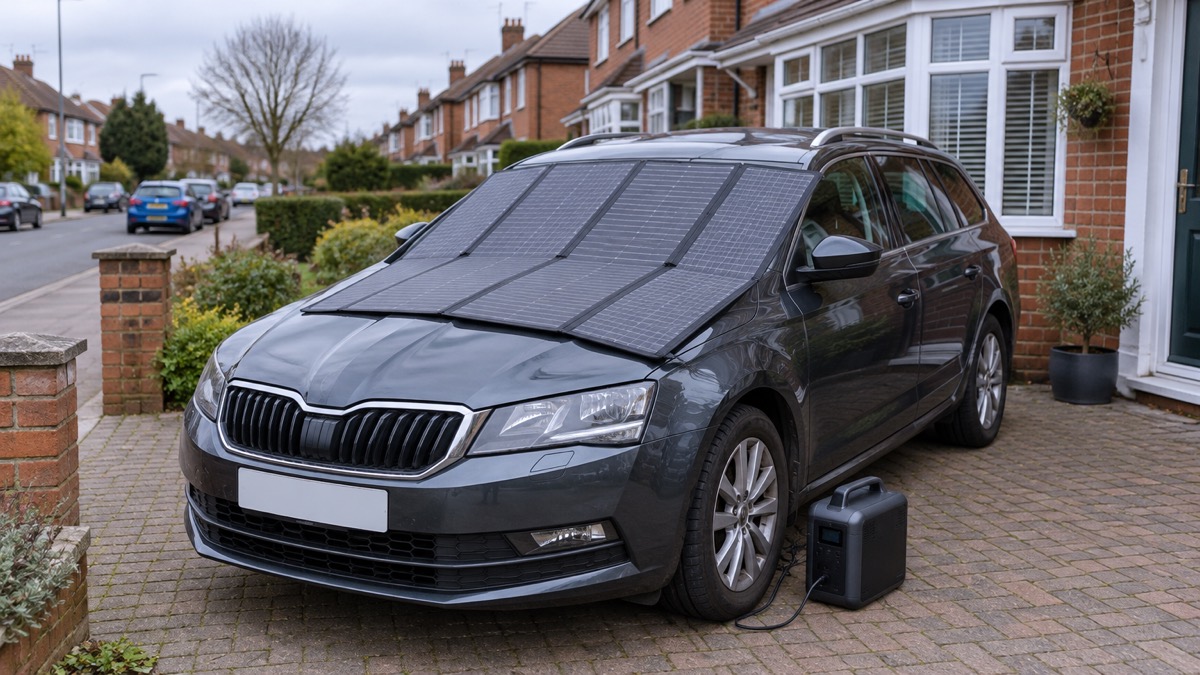
A portable solar panel is the only way to refill a portable power station when the mains is off for more than a few hours and the battery runs down. It is a folding panel, usually between 45W and 400W, that plugs into the power station's solar input socket and turns daylight into electricity to recharge the battery. No fuel, no fumes, and nothing to run out of as long as the sun comes up.
The catch is speed. In UK conditions a 100W panel generates roughly 600 to 700Wh over a full summer day, according to the Caravan and Motorhome Club's technical advice1, and a single 110W panel takes 14 to 28 hours to fully charge EcoFlow's DELTA power station even in what the maker calls perfect sunlight2. So a panel is not a substitute for the mains: it is a slow, steady trickle that keeps a modest amount of equipment going day after day through a long outage.
This page explains how the charging actually works, how to match a panel to your power station, what a solar-charged station can realistically run, and where the safety rules bite, including the government's new plans for plug-in solar.
How the panel, the sun and the power station fit together
A folding solar panel is a set of solar cells hinged together so it folds into a parcel you can carry and opens into a large collecting surface. You prop it up facing the sun, run its cable to your power station's solar input, and the panel feeds direct current (DC) electricity into the station's charging circuit, which stores it in the battery. To power anything that uses a three-pin 230V socket, that direct current must be converted to alternating current (AC), which is what an inverter does.
The connection itself is simple, but it has rules. Power stations specify a voltage range their solar input accepts, and going outside it can at best fail to charge and at worst damage the station. Anker states that for the SOLIX C300 you should only use solar panels between 11 to 28V and with an XT60 connector3. The same 11 to 28V range with an XT60 connector applies to the C300X and the C300X DC7. Larger stations accept more: Anker's F3000 supports panels between 11 and 60V on its low PV input, or between 11 and 165V on its high PV input9.
The XT60 connector named in those instructions is the round, yellow- or black-bodied plug used on most panels and stations in this class. Check your station's manual for its voltage window and connector before buying a panel, because the two must match. Anker's C800 manual recommends using the maker's own 200W or 400W panels "to get the best compatibility", and caps solar input at 300W from up to two panels11.
Most stations can also be charged from the wall and from a car's 12V socket, and some let you combine sources. Jackery states its power stations support simultaneous AC and solar charging for faster recharging, though most models do not support car and solar charging at the same time12. During an outage the wall socket is dead, so solar becomes the only refill option besides a car engine or a generator.
Solar charging is slow: plan around the weather
The headline figure to hold in your head is the Caravan and Motorhome Club's estimate of what a panel actually delivers across a British summer day: a 100W panel produces 600 to 700Wh, and a 50W panel 300 to 350Wh1. That is a fraction of the panel's nameplate rating, because the rating assumes strong direct sun, and UK daylight is spread across long periods of weak light, cloud and shade.
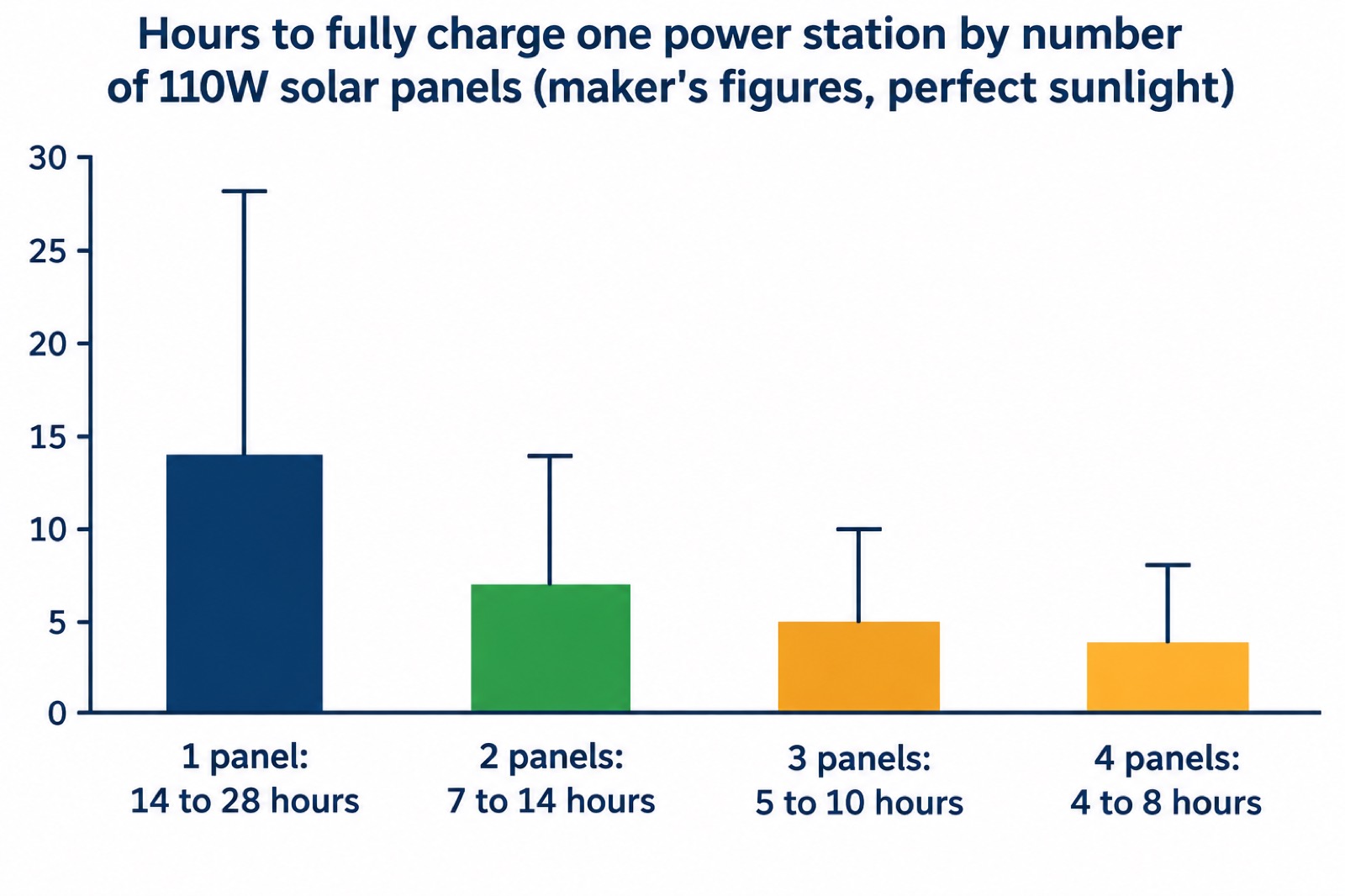
Maker charge times confirm it. EcoFlow's DELTA, charged by solar, takes 14 to 28 hours from a single 110W panel in what the maker calls perfect sunlight conditions; two panels in series cut that to 7 to 14 hours, three to 5 to 10 hours, and four in parallel to 4 to 8 hours2. Even the fastest examples are hours, not minutes: Anker's F3000 claims a 1.5-hour full solar recharge9, and its C1000 Gen 2 a 1.8-hour recharge with 600W of solar13, but both assume a large panel array in good sun.
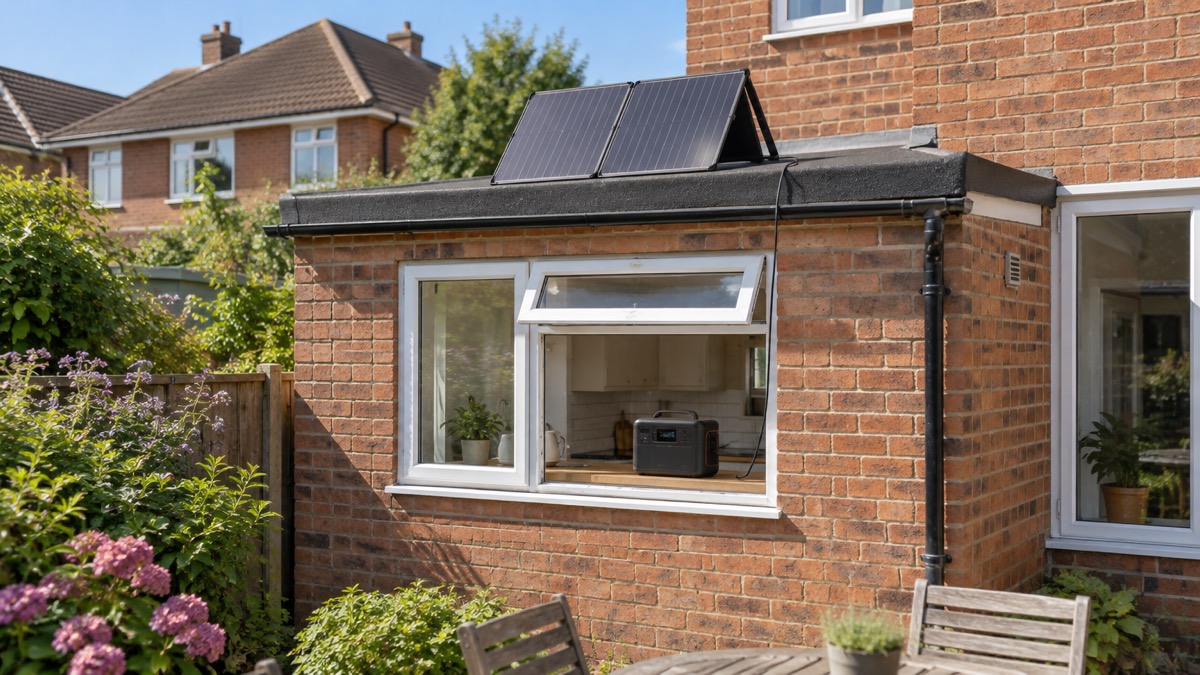
What does this mean in practice? Treat the panel as a daytime top-up, not an on-demand supply. Put it out every morning of a long outage, angle it towards the sun, and move it if shade falls across it. Which?'s emergency kit guidance is blunt that a power station charged by solar "will take a while to charge"14. If your household needs more energy than the panel puts back each day, the battery will slowly run down no matter how large it is, and you may need a generator as well. Our page on how long solar charging takes in the UK works through the arithmetic.
Matching a panel to your power station
The right panel depends on the size of the station you are refilling. A small station of around 300Wh, such as the Anker SOLIX C300, is paired by its maker with a single 100W panel3. A mid-size station like the Anker C800 accepts up to two panels and 300W of solar input11. A large station like the F3000, expandable from 3 to 12kWh with expansion batteries10, is designed to take up to four 400W panels in series for 1,600W of input9.
| Station size | Example | Maker's panel guidance |
|---|---|---|
| Small, around 300Wh | Anker SOLIX C300 | One 100W panel, 11 to 28V, XT60 connector3 |
| Mid, around 800Wh | Anker SOLIX C800 | Up to two panels, 300W maximum solar input11 |
| Large | Anker SOLIX C1000 Gen 2 | 600W solar, 60V maximum, 1.8-hour recharge claimed13 |
| Very large, 3 to 12kWh | Anker SOLIX F3000 | Up to four 400W panels in series, 1,600W, 11 to 165V9 |
Two practical points follow. First, a bigger panel charges a small station faster but cannot exceed the station's input limit, so there is a ceiling beyond which extra watts are wasted. Second, a panel that is too small for a big station will take a very long time to refill it, so match the panel's output to the size of the station you need to keep charged. Our page on what size solar panel you need goes into this in more detail.
Note also that small USB solar chargers are a different product entirely. Anker's PS30 panel, with its USB-C port at 5V/3A and USB-A at 5V/2.4A, is designed for "low-power devices, such as mobile phones and tablets"15, and Anker states plainly that its C300 power station "is not compatible with Anker SOLIX PS30 or other 5V~3A USB-C solar panels"16. For phone-only charging, see our page on wind-up and small solar chargers.
What a solar-charged station can run, and for how long
What the combination delivers depends on the battery you are refilling, not the panel. The panel's job is to put energy back; the station's job is to run your appliances from it. Which? notes that makers claim their stations can run a refrigerator for hours on a charge, while cautioning that solar recharging is slow14. Fogstar describes its 2.2kWh station, with a 2400W pure sine wave inverter, as suited to "home backup, off-grid systems, campervans, workshops and mobile energy applications"17.
To work out run times for your own appliances, you need the wattage of each device and the watt-hour capacity of the station, which is exactly what our page on watts, watt-hours and surge explains, and our power station run time page applies to specific kit. The panel then sets how quickly that capacity comes back: at the Caravan Club's 600 to 700Wh per summer day for a 100W panel1, a day of good sun restores only that much, so a solar-charged setup suits low, steady loads rather than a fridge plus a kettle.
Continuous and surge output: reading the specification
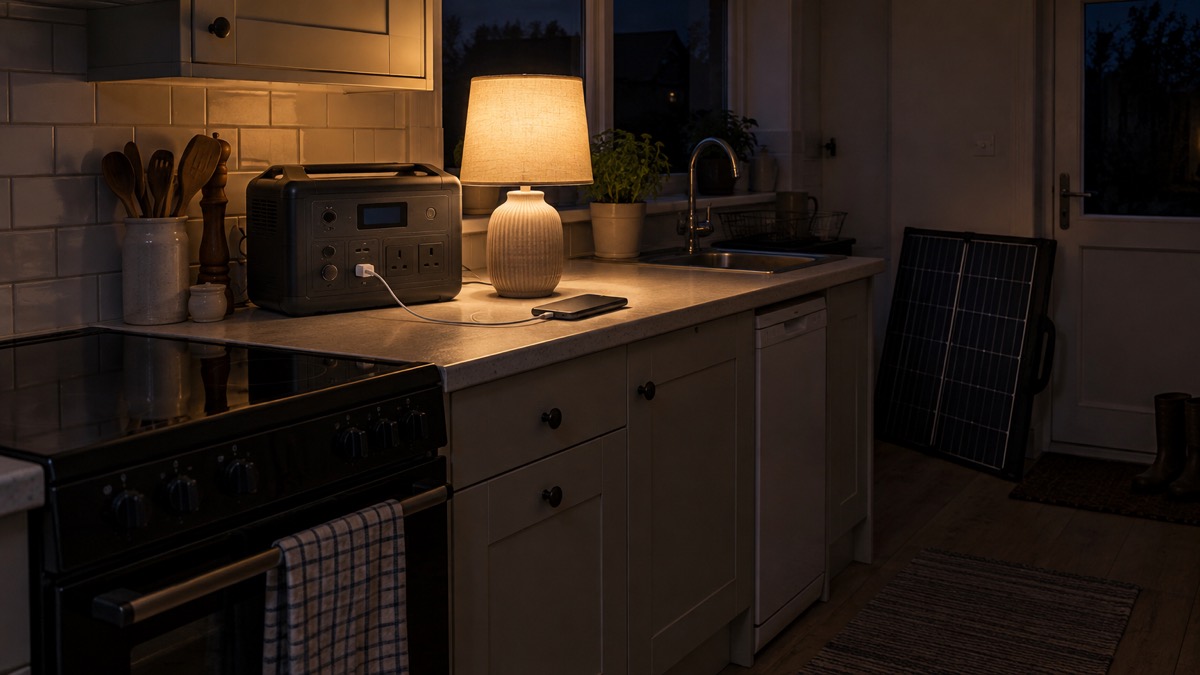
Two figures in a power station's specification decide what it can run. The continuous output, in watts, is what it can supply steadily. The surge output is the brief extra burst it can deliver when a motor starts, which matters because fridges, freezers and anything with a compressor draws several times its running power for a moment at switch-on. A station whose continuous rating covers your fridge but whose surge rating does not will trip or shut down when the compressor kicks in.
The Fogstar 2.2kWh station's 2400W pure sine wave inverter17 is an example of the continuous figure. Pure sine wave matters too: it means the inverter replicates mains-style AC rather than a rougher waveform, which sensitive electronics and motor-driven appliances prefer.
On the panel side, the specification that matters most is the voltage window, covered above, plus the panel's own electrical figures. EcoFlow's 160W panel lists an open circuit voltage of 21.4V (Vmp 18.2V) and a short circuit current of 9.6A (Imp 8.8A)18, and its 60W panel an open circuit voltage of 25.6V19. Anker's PS100 bifacial panel lists a PV output of 21.6V at 4.63A20. These figures tell you whether the panel sits inside your station's accepted range. Anker also cautions that "Solar panel output varies with sunlight intensity, panel orientation, and angle. Due to varying conditions, actual power may be lower than rated."20 Treat the wattage on the box as a best case, not a promise.
Safe indoors: no fuel, no fumes, almost silent
This is the clearest advantage over a petrol generator. Jackery states its solar generators have "zero emissions, making them safe for indoor and outdoor use"4. There is no carbon monoxide risk from a panel or a power station, no fuel to store, and almost no noise. You can run the station in the living room and the panel outside the window, which is exactly how these setups are meant to be used during an outage.
That does not mean no precautions at all. The battery inside the station is a lithium battery, and the general rules of lithium-ion battery safety at home apply: charge it where you can see it, on a hard surface, away from exits, and stop using it if it swells, gets hot or smells odd. Anker also warns that its PS100 panel's black metal frame "may heat up after prolonged exposure to sunlight. Avoid touching it directly and wear protective gloves when adjusting or moving the panel to prevent burns"20. And the Caravan and Motorhome Club notes that solar panels can overcharge a leisure battery, "which is just as bad for the battery as undercharging it"1, which is why proper stations regulate the charge internally rather than feeding the panel straight to the battery.
One distinction worth being clear on: a portable panel charging a power station is entirely separate from your home's wiring, so it keeps working in a power cut. Fixed roof solar is different. Electricity North West states that "Your solar panels will stop working during a power cut for safety reasons", because a grid-connected system must not feed electricity back into dead lines5. Our page on whether home solar panels work in a power cut covers that in full.
Keeping panels clean: dirt can cost you 15 per cent
Electrical Safety First reports that keeping solar panels clean and maintained could increase energy production by up to 15 per cent6. Most panels have a self-cleaning coating which, when the panel is set at a suitable angle, lets rain clear dirt and debris6, so a panel propped at a slant in British weather largely looks after itself. Flat-lying panels and panels kept indoors gather dust that rain never reaches.
For routine cleaning, follow the maker's instructions. Jackery advises for its SolarSaga panels: "Please use a soft cloth to remove the dust and dirt on the surface. Use a damp cloth to wipe the surface of the solar module to remove any remaining dust or dirt."12 Nothing abrasive, and no high-pressure hoses. Electrical Safety First adds that periodic cleaning by a specialist company can remove accumulated dirt, dust, lichen and guano, improving sunlight absorption and preventing hotspots that can cause a panel to fail6, though for a portable panel you take in and out, a soft cloth is usually all it needs.
Check the panel each time you deploy it: bird droppings and leaves cast hard shade, and shade on even part of a panel cuts output disproportionately. Efficiency figures are worth a glance when comparing panels: EcoFlow claims up to 25 per cent conversion for its 160W lightweight panel21 and 22 per cent for its standard 160W panel18, while Anker's 400W panel claims 23 per cent conversion efficiency and an IP67 waterproof rating13. Higher efficiency means more power from the same folded size, which matters if you carry the panel anywhere.
Portable panel or fixed roof system
A portable panel and a roof installation are different purchases with different rules. A folding panel needs no installer, no permissions and no wiring work: EcoFlow's 45W panel can be laid flat, tilted on a stand, or hung by its four pre-cut eyelets, and folds down to fit in a backpack22. That flexibility is the point. You store it in a cupboard and deploy it only when needed.
A fixed roof system is permanent, generates far more, and comes under installation rules. Electrical Safety First says it is "vitally important to use a skilled, trained and qualified solar PV installer who is registered with a competent person scheme (CPS)"23, that companies registered with MCS offer an additional level of assurance6, and that reputable installers should be signed up to a consumer code such as the RECC to prevent pressure-selling6. A fixed system should also be inspected and tested at least every five years6.
One maker's caution applies if you are tempted to leave a portable panel hanging permanently: EcoFlow states that "If you need to hang solar panels for extended periods, please use rigid solar panels. Lightweight portable solar panels are not recommended for this scenario."21 Portable panels are built for occasional deployment, not permanent exposure.
Plug-in solar: what the government's plans mean
The Government has announced plans to make plug-in solar systems more widely available. These are small panel kits that plug into an ordinary socket and feed the home's circuits. London Fire Brigade explains how they work: "Light from the sun hits the panels and generates energy, which flows into the electrical circuit for the home, providing electricity", and notes they can be placed in sunny outdoor spots such as a terrace, shed or outhouse roof, or balcony24. The Brigade also notes they "don't generate enough energy to power your home entirely, but they could save you some money"24.
Electrical Safety First has welcomed the plans with a caution: "The Government has announced plans to make plug-in solar systems more widely available, but please be aware that, at present, these systems supply power to household circuits in a way currently not permitted by regulations."23 It adds two specific rules for households: only one plug-in solar panel system is permitted per household, because installing multiple units could reduce the effectiveness of protective devices25, and homes with Type AC RCDs should not use plug-in solar systems without first upgrading to a minimum Type A bidirectional RCD on those circuits25. It also warns against running them through extension leads, cable reels, multiway adaptors or travel adaptors, which "can overheat, become overloaded and create additional safety risks"25.
Two further points matter for prepping. First, roof-mounted solar panels will stop working during a power cut for safety reasons, so grid-connected solar is a bill-saving product, not an outage product. Second, if you have any grid-connected solar and your network operator writes to you about a planned power cut, Scottish and Southern Electricity Networks advises: "Turn off your solar panels before the planned outage, and Turn them back on once mains power has been restored", because panels left on may feed electricity into a temporary generator and cause it to stop working26. Our page on plug-in solar panels covers the safety questions in detail.
Choosing well: a short checklist
Before buying a panel for your station, check these points, each drawn from the makers' own documentation:
- Voltage window: the panel's output voltage must sit inside the station's accepted range, such as 11 to 28V for the Anker C3003 or 11 to 165V for the F3000's high PV input9.
- Connector: most stations in this class take an XT60 connector3; confirm yours and buy the right cable, as some makers sell charging cables separately27.
- Panel count and input cap: check the maximum solar input, such as 300W and two panels for the Anker C80011.
- Wattage against station size: a 100W panel suits a roughly 300Wh station3; bigger stations need proportionally more panel9.
- Folding size and mounting: check the folded dimensions and whether it has a stand or hanging eyelets22.
- Warranty: EcoFlow offers 24 months on its standard 160W panel18 but 5 years on its 160W lightweight panel21; check what the maker commits to.
If you are still deciding between a solar-charged power station and a petrol generator for outages, our comparison of generators and power stations sets out the trade-offs, and connecting backup power to your home's wiring covers what is involved if you want more than extension leads.
Sources (27)
- Solar power technical advice, The Caravan and Motorhome Club, 2026-10-25
- EcoFlow DELTA Portable Power Station, EcoFlow, 2026-10-25
- Anker SOLIX C300 and 100W Solar Panel offer, Anker SOLIX, 2026-10-25
- Jackery small generators, Jackery, 2026-10-25
- Tips to help you during a power cut, Electricity North West, 2026-10-25
- Solar panel safety advice, Electrical Safety First, 2026-10-26
- Anker SOLIX C300X Portable Power Station, Anker SOLIX, 2026-10-25
- Anker SOLIX C300X DC Portable Power Station, Anker SOLIX, 2026-10-25
- Anker SOLIX F3000 Portable Power Station, Anker SOLIX, 2026-10-25
- Anker SOLIX F3000 Expansion Battery, Anker SOLIX, 2026-10-25
- Anker SOLIX C800 Portable Power Station user guide, Anker SOLIX, 2026-10-26
- Jackery buying guide, Jackery, 2026-10-25
- Anker SOLIX C1000 Gen 2 Portable Power Station, Anker SOLIX, 2026-10-25
- Emergency kit packing list, Which?, 2026-09-30
- Anker SOLIX PS30 Portable Solar Panel, Anker SOLIX, 2026-10-25
- Anker SOLIX C300 DC and 100W Solar Panel, Anker SOLIX, 2026-10-25
- Fogstar 2.2kWh Portable Power Station, Fogstar, 2026-10-25
- EcoFlow portable solar panels, EcoFlow, 2026-10-25
- EcoFlow 60W Portable Solar Panel, EcoFlow, 2026-10-25
- Anker SOLIX PS100 Bifacial Portable Solar Panel, Anker SOLIX, 2026-10-25
- EcoFlow 160W Lightweight Portable Solar Panel, EcoFlow, 2026-10-25
- EcoFlow 45W Portable Solar Panel, EcoFlow, 2026-10-25
- Green energy: solar panels safety advice, Electrical Safety First, 2026-10-25
- Plug-in solar panels, London Fire Brigade, 2026-10-25
- Plug-in solar panels safety advice, Electrical Safety First, 2026-10-25
- Planned power cuts, Scottish and Southern Electricity Networks, 2026-10-25
- Anker SOLIX C200 DC Portable Power Station, Anker SOLIX, 2026-10-25
 Power Cut Backup Power Checklist
 Backup Power Before Winter
 Safe Battery Charging at Home
 What to Keep Running in a Cut
 Power During an Outage
 Watts and Watt-Hours
 Portable Power Stations
 Portable Generator Types
 Generator Safety
 LPG Cylinders and Regulators
 Connecting to Your Home's Wiring
 Home Battery Storage
 12V Inverters
 Leisure and LiFePO4 Batteries
 Power Banks for Phone Charging