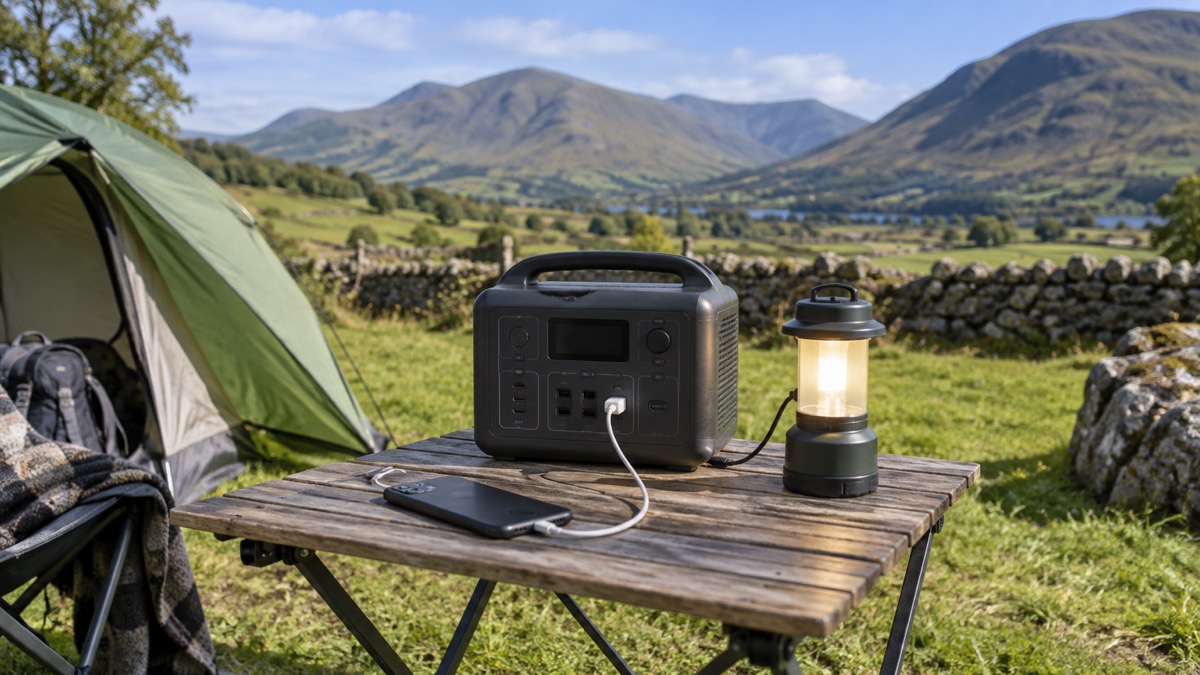
The Anker SOLIX C800 is a portable power station: a battery in a carry case with mains sockets, USB ports and a 12V car socket, which you charge from the mains and then use to run appliances when there is no power. The C800 Plus is the version Anker currently sells in the UK, with a 768Wh battery and a 1200W rated output across 10 outlets, and it can recharge to full in 58 minutes from the mains when UltraFast mode is switched on in the Anker app1.
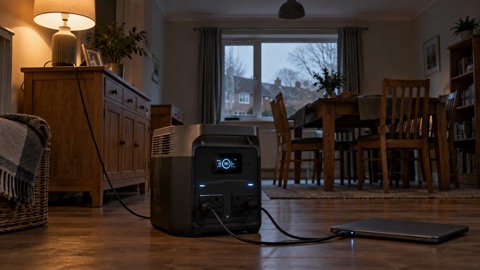
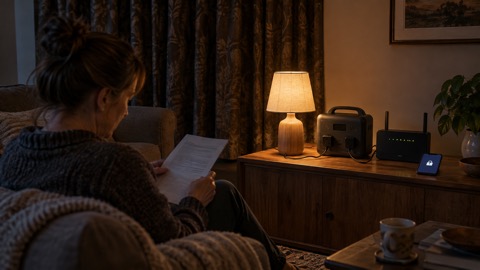
For a household, that means a unit you can keep charged in a cupboard, plug the router and a lamp into during a power cut, and take camping. It is not a generator and it does not connect to your home's wiring; it powers what you plug into it. The Plus adds two rechargeable camping lights and a retractable pole, which matter more at a campsite than in a blackout but are useful as emergency lighting1.
Before anything else, check whether you own a recalled Anker power bank. Anker's safety notice covers specific power bank models, not this power station, and the check takes a minute.
Check your power banks against the recall first
Anker has recalled several power bank models over fire risk, and the recall has been widened since it began. Anker's safety notice asks owners to check the model number, located on the back or side of the power bank, against the listed models: A1647, A1652, A1257, A1681 and A16894. If yours matches, stop using it and follow Anker's recall instructions.
The C800 and C800 Plus are portable power stations, not power banks, and they are not among the recalled models. The distinction matters because the two kinds of product sit next to each other on a shelf and in a search results page, and a household that has bought both may not know which notice applies to which. The recall is about small power banks you carry in a bag; the C800 is a 10.9 kg unit that stays on the floor4.
If you are unsure how to read a model number, or want to know what to do with a battery that is swelling or damaged, our guide to lithium-ion battery safety at home sets out the warning signs and the disposal routes.
C800 and C800 Plus: how the two versions differ
The two versions share the same battery, the same output and the same charging speeds. What separates them is what comes in the box and what is built into the case.
| Feature | C800 | C800 Plus |
|---|---|---|
| Battery capacity | 768Wh5 | 768Wh2 |
| Rated AC output | 1200W5 | 1200W, 1600W with SurgePad1 |
| Battery chemistry | LFP2 | LFP2 |
| Camping lights | Not included | Two camping lights, three modes1 |
| Retractable pole | Not included | 3.3 ft / 1 m pole1 |
| Built-in storage | Yes, 186×149×45 mm compartment5 | Not listed |
| Warranty | 12 months5 | 5 years2 |
The C800's built-in storage is a compartment for charging cables, power banks and action cameras, sized 186×149×45 mm5. Anker notes that this feature is only for the C8001. The C800 Plus instead carries the camping lights and pole, and Anker describes it as the first portable power station with camping lights1.
Both use lithium iron phosphate (LFP) batteries, which Anker rates at 3,000 charge cycles for up to 10 years of everyday use on the Plus1. The standard C800 is listed by Anker with the same 3,000 cycles5. If you are choosing between them for a household, the question is whether you want a storage compartment for cables or a set of lights and a pole; the electrical performance is the same.
Capacity and outputs: 768Wh and 1200W from 10 outlets
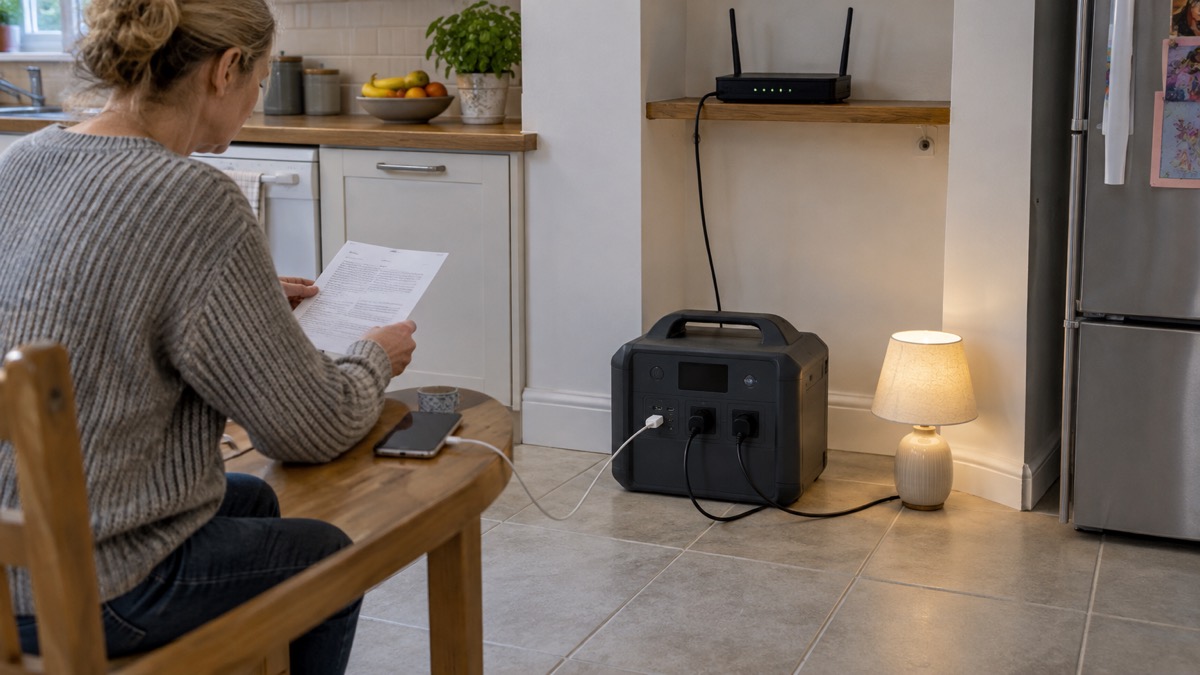
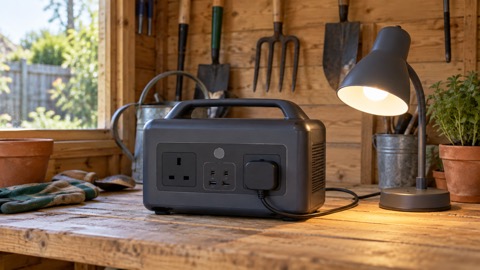
The C800 Plus has a 768Wh battery and a 1200W rated AC output, rising to 1600W with SurgePad1. Ten outlets in total means you can run several small devices at once without unplugging: five mains sockets, two USB-C ports, two USB-A ports and a 12V car socket1.
The mains sockets are rated at 230V, 50Hz, 1200W maximum, which is the UK domestic supply2. The USB-C ports are not equal: one delivers up to 100W, enough for a laptop, and the other up to 30W, enough for a phone or a tablet1. The USB-A ports deliver 12W each, and the car socket delivers 12V 10A1.
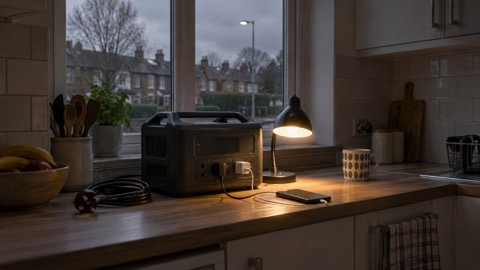
What that means in practice is a station that will run a router, a lamp, a phone charger and a laptop together, and will run one high-draw appliance such as a small heater or a kettle for a short time. It will not run an electric shower, an oven or a whole house. If you are working out what to keep running first, our guide to deciding what to keep running when the mains fails walks through the order.
Running devices with SurgePad
SurgePad is Anker's name for the extra output the station can deliver when a device draws more than the rated 1200W. It activates automatically when the total output exceeds the rated output, and it raises the maximum to 1600W1. Anker says it works best with heat-generating devices, and that usage can affect performance2.
There are limits. Anker states that SurgePad does not support precision instruments and other devices with voltage protection or a strict voltage requirement5. It also does not function in bypass mode, which is when the station is being charged from the mains with the AC output switched on3. If you are running a device with a motor or a heating element, expect SurgePad to help; if you are running anything sensitive, do not rely on it.
Charging: full in 58 minutes from the mains
The headline figure is a full charge in 58 minutes, and it comes with a condition. Anker states that the 58 minute charge to 100% applies when UltraFast mode is activated in the Anker app1. The station accepts 750W in standard charging and 1100W in UltraFast charging from the mains1.
The other charging routes are slower but useful when the mains is out or you are away:
- Mains: 100% in 58 minutes with UltraFast mode in the app1
- Solar: 80% in 2.3 hours from 300W of solar input2
- Car: 100% in 7.2 hours1
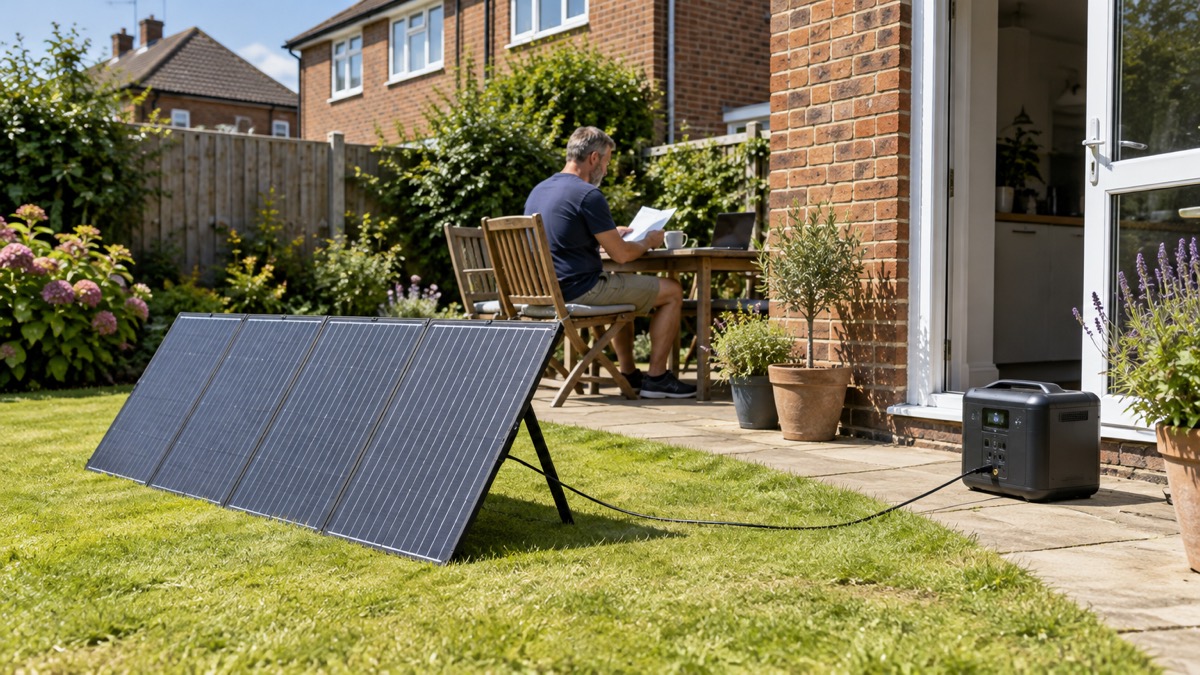
The solar route needs a panel and the right connector. The maximum solar input is 300W through the XT60 input, at 11 to 60V, and Anker says the station is compatible with most solar panels but recommends its own SOLIX panels5. The manual suggests Anker 200W or 400W panels and says you can connect up to two panels3. Our guide to portable solar panels for charging in a power cut explains what to expect from UK sunlight, which is not the same as the test conditions behind a maker's figure.
For car charging, the C800 Plus has a car charger output of 12V 10A1. That is a socket on the station, so you need a suitable cable to connect it to the car. Charging from a car is slow, at 7.2 hours to full, so it suits a long drive or an overnight stop rather than a quick top-up. Our guide to charging a power station from your car covers the practicalities.
Keeping power on in a cut: 20ms switchover and bypass mode
The C800 Plus can act as an uninterruptible power supply. Anker states that you are back online in 20ms for true uninterruptible power, and the manual gives the same 20ms switchover figure1. That is fast enough that a router or a desktop computer may not notice the mains has failed, which is the point of a UPS.
To use it that way, plug the station into the mains, plug the device into the station, and leave it. When the mains drops, the station takes over within 20ms. When the mains returns, the station recharges and passes power through. Anker calls this bypass mode, and it has its own input rating: 2070W maximum on the UK and EU pages1. One regional page lists 1440W for bypass mode, so the two figures disagree; treat the lower number as the safe assumption if you are loading it heavily7.
The 20ms figure is the maker's own claim for its own product, and it is the number to compare if you are weighing up a UPS. Our guide to using a power station as a UPS explains what switchover times mean for different appliances, and our guide to using generators and power stations during an outage covers the wider routine.
Camping lights and pole on the C800 Plus
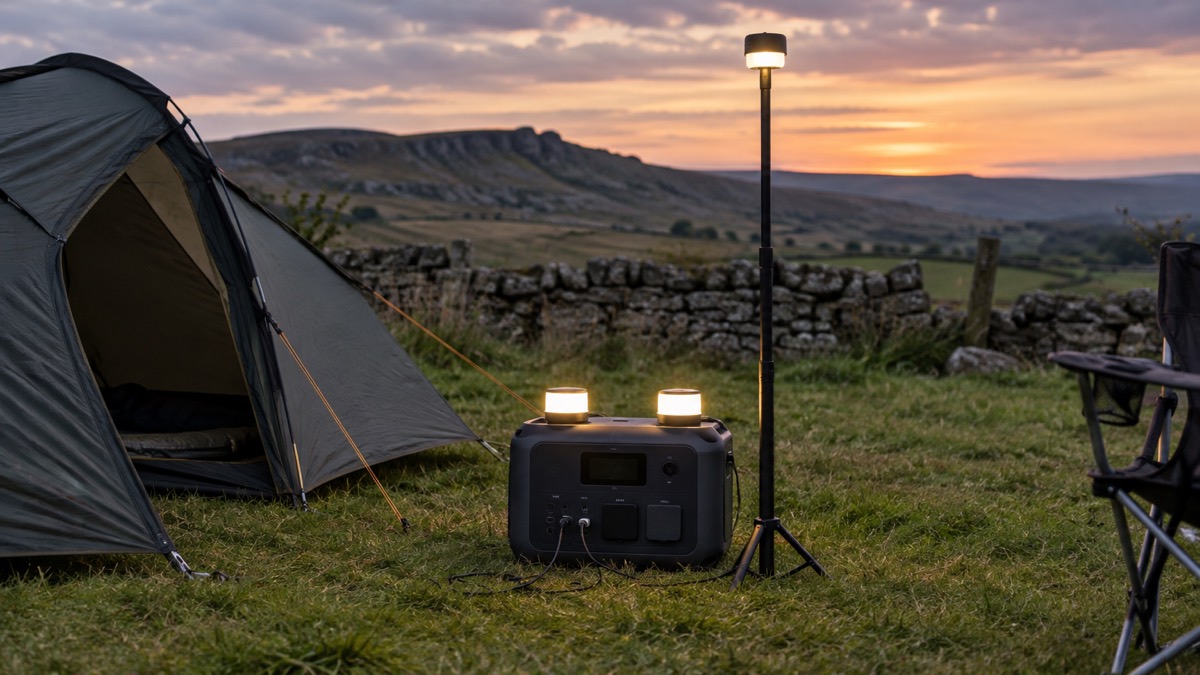
The C800 Plus comes with two camping lights and a retractable pole, and Anker notes that these features are only for the Plus1. The pole is 3.3 ft, or 1 m, and it holds phones and cameras or attaches to a tripod for stable shots1. It carries a load of 3.3 lb to 11 lb, or 1.5 kg to 5 kg2.
The lights have three modes: floodlight, candle and torch, which Anker also calls flashlight mode1. The figures differ by mode:
| Mode | Brightness | Range | Colour temperature |
|---|---|---|---|
| Floodlight | 200 lm max1 | Height 1.5 m, 20 m² max1 | 4500K1 |
| Candle | 100 lm max1 | 10 m² max1 | 3000K1 |
| Torch | Not given | 20 m beam distance1 | Not given |
Anker gives a run time of 8 to 130 hours for the lights, depending on mode1. The lights recharge by being placed back onto the power station, where they charge automatically through the side contacts when the station is switched on6. That is a neat arrangement for a tent: the lights live on the station, and you take one off when you need it.
For a household, the floodlight mode is the one that matters in a blackout. At 200 lm it will light a room enough to move around and find things, and the candle mode at 3000K is a warmer, dimmer light for the evening. Our guide to emergency lighting at home compares torches, lanterns and candles, and explains why a battery light is safer than a flame.
Safe charging and storage temperatures
Anker gives a charging temperature range of 0°C to 40°C and a discharging range of -20°C to 40°C1. Those are the maker's own figures for its own product, and they are the ones to work to. Charging below 0°C or above 40°C is outside the maker's stated range, and a garage or shed in a cold snap can fall below it.
The station checks its temperature up to 10 times per second while charging to avoid the battery overheating, according to Anker2. That is a safety feature, not a licence to charge it anywhere. Charge it indoors, on a hard surface, away from soft furnishings, and not in a cupboard with the door shut. Our safe battery charging at home checklist sets out the routine, and our guide to charging lithium batteries below freezing explains why cold charging is a problem.
For storage, Anker's manual gives the dimensions as 37.1×20.5×25 cm and the weight as 10.5 kg for the standard C8003. The Plus is 371×205×253 mm and 10.9 kg1. Decide where it will live before you need it: somewhere dry, within the temperature range, and where you can reach it without lifting it down from a high shelf. Our guide to storing a power station when not in use covers the longer term.
Battery life, build and the 5-year warranty
Anker rates the C800 Plus battery at 3,000 charge cycles for up to 10 years of everyday use, guaranteed1. The standard C800 is listed with the same 3,000 cycles5. The components are expected to last 50,000 hours, which Anker describes as a 6× longer lifespan1. Those are maker figures, and they assume normal use within the stated temperatures.
The case is a unibody drop-proof design that Anker says protects against bumps, drops, UV light and fire2. That is useful if the station lives in a garage or goes camping, but it is not a reason to treat it roughly. The warranty differs between the two versions: the C800 Plus carries 5 years2, while the standard C800 is listed with 12 months5. If you are buying for a household, the warranty is part of what you are paying for, and it is worth checking which version you are looking at.
Where to get help and what to check before you buy
Anker's UK product pages are the place to confirm which version is on sale and what it includes. The standard C800 was listed as sold out on Anker's UK page when checked on 25 October 2026, and the listing shown was for a refurbished unit5. The C800 Plus is the version Anker's current pages describe in detail1. If you want the standard model, check availability with Anker before relying on it.
The app is the control route for UltraFast charging and for Wi-Fi or Bluetooth connection. The manual explains that you download the Anker Power app from the App Store or Google Play, or scan the QR code, and connect the device to a network before first use, after which you can connect off-grid3. The IoT button turns Bluetooth and Wi-Fi on with one press, off with a two second press, and resets them with a seven second press3. If the app will not connect, that reset is the first thing to try.
For the wider picture, our guide to portable power stations explains how capacity and output translate into run time, and our guide to watts, watt-hours and surge explains why a 1200W rating is not the same as a 1200W limit on every device. If you are weighing a power station against a generator, our comparison of a portable power station or a petrol generator for a power cut sets out the trade-offs. Anker's own brand page is at Anker.
Sources (7)
- Anker SOLIX C800 Plus and C800 product page (UK), Anker SOLIX, 2026-10-25
- Anker SOLIX C800 Plus and C800 product page (EU), Anker SOLIX, 2026-10-25
- Anker SOLIX C800 Portable Power Station user guide (A1753), Anker, 2026-10-26
- Anker power bank safety notice and recall check, Anker, 2026-10-25
- Anker SOLIX C800 Portable Power Station product page (UK), Anker SOLIX, 2026-10-25
- Anker SOLIX camping power station page, Anker SOLIX, 2026-10-25
- Anker SOLIX C800 Plus and C800 product page (Australia), Anker SOLIX, 2026-10-25

 BLUETTI Apex 300 Power Station
 BLUETTI Elite 100 V2
 Anker SOLIX C2000 Gen 2
 Anker SOLIX C1000 Power Station
 EcoFlow DELTA Pro
 BLUETTI Elite 400
 Anker SOLIX C300 Power Station
 EcoFlow DELTA 3
 EcoFlow DELTA 2 and DELTA 2 Max
 EcoFlow DELTA and DELTA Max
 EcoFlow RIVER 3 and RIVER 3 Plus
 EcoFlow RIVER 2 and RIVER 2 Max