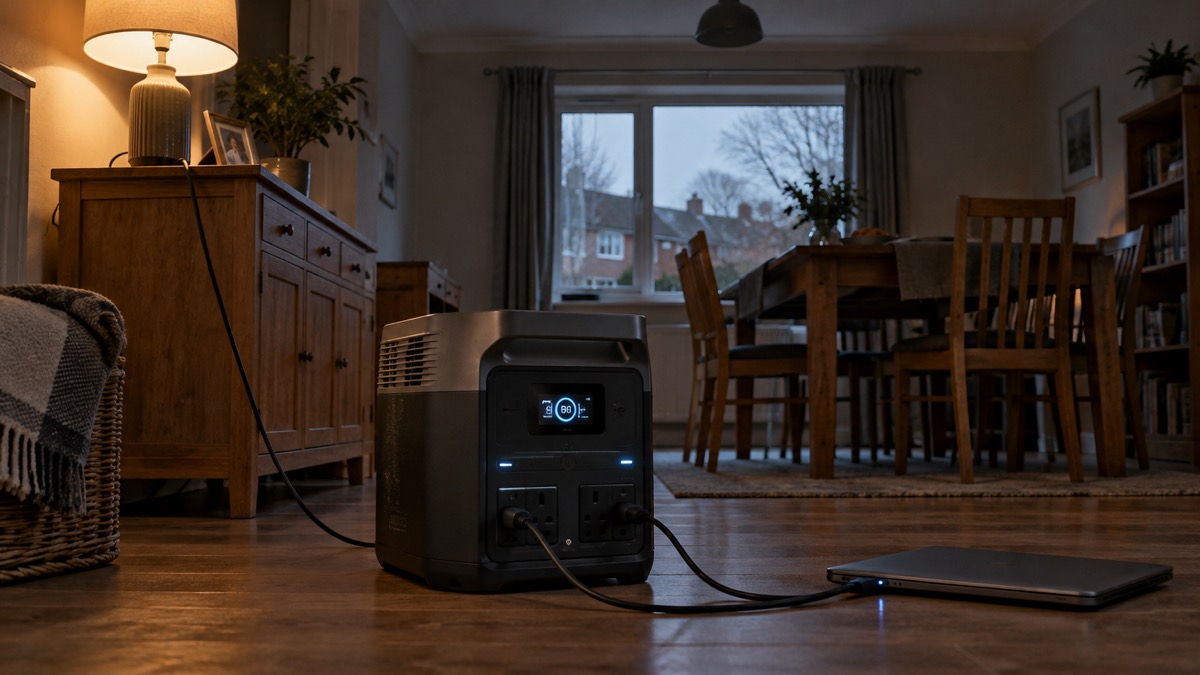
The EcoFlow DELTA 2 and DELTA 2 Max are portable power stations: large rechargeable batteries with mains sockets built in, made by EcoFlow. They store energy from the mains, a solar panel or a car, and give it back to your appliances when the power goes off. The DELTA 2 holds 1024Wh; the DELTA 2 Max holds 2048Wh, and can be expanded to 6kWh with two extra batteries1.
For an ordinary household, the practical question is what each one will keep running in a power cut and for how long. EcoFlow states that a DELTA 2 will power a 60W fridge for 16 hours, and that a DELTA 2 Max will keep a 120W refrigerator running for up to 14 hours1. Both use LFP (LiFePO4) battery chemistry, rated by the maker for 3000 cycles to more than 80% capacity1.
Neither unit is a generator: there is no fuel, no exhaust and no carbon monoxide. That makes them suitable for use indoors, which is where most households will want them during an outage. The sections below set out how the two versions differ, what they can run, how to charge them, how to add capacity, and how to use and store them safely.
DELTA 2 and DELTA 2 Max: how the two versions differ
The two units share a family name but sit at different sizes. EcoFlow describes the range as offering "capacities of 1-3kWh" for the DELTA 2 and "energy storage from 2-6kWh" for the DELTA 2 Max2. In practice that means the DELTA 2 is the smaller, lighter unit for short outages and essentials, while the DELTA 2 Max is the larger one for longer cuts and heavier loads.
| DELTA 2 | DELTA 2 Max | |
|---|---|---|
| Battery capacity | 1024Wh1 | 2048Wh2 |
| Expandable to | 2048Wh (DELTA 2 extra battery) or 3040Wh (DELTA Max extra battery)1 | 6kWh with two extra batteries2 |
| AC output | Not stated on the pages used here | 2400W total, surge 4800W, 4 outlets2 |
| Max device power with X-Boost | Not stated on the pages used here | Up to 3100W2 |
| Weight | Not stated on the pages used here | 23kg2 |
| Dimensions | Not stated on the pages used here | 497 × 242 × 305 mm2 |
| Battery chemistry | LFP (LiFePO4)1 | LFP (LiFePO4)2 |
| Cycle life | Not stated on the pages used here | 3000 cycles to 80+% capacity6 |
| Connectivity | Wi-Fi and Bluetooth1 | Wi-Fi and Bluetooth2 |
The DELTA 2 Max is the more capable of the two on every count that matters in an outage: more stored energy, a higher AC output, more sockets and a higher X-Boost ceiling. It is also nearly twice the weight. If you need to move the unit between rooms or take it in a vehicle, the DELTA 2's 12kg is a real advantage4. If it will sit in one place and run a fridge, a boiler or a few lights for a longer period, the DELTA 2 Max's extra capacity is the reason to choose it2.
EcoFlow states that the DELTA 2 Max is "30% lighter than similar power stations on the market"2. Treat that as the maker's own comparison, not an independent test.
Battery: 1024Wh or 2048Wh of LFP storage, rated for 3,000 cycles
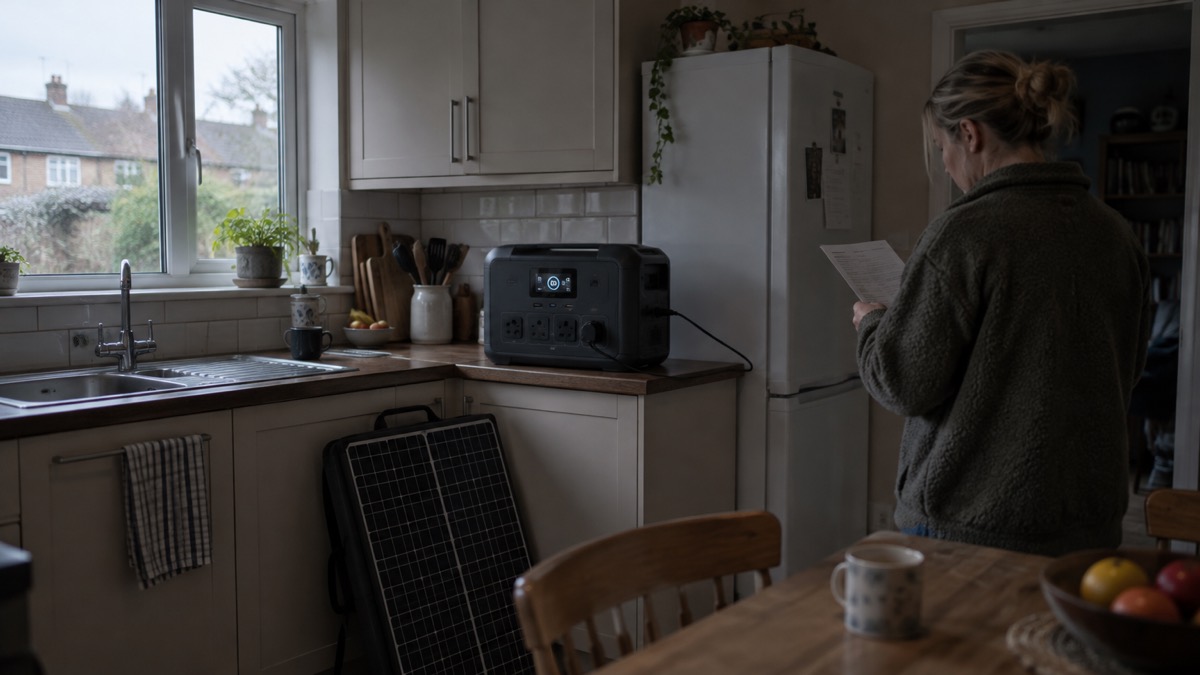
The battery is the part that decides how long the unit lasts, both in a single outage and over its life. Both units use LFP (LiFePO4) chemistry, which EcoFlow rates for 3000 cycles to more than 80% capacity1. A cycle is a full charge and discharge; in ordinary use you will not reach 3000 in a hurry, and EcoFlow states that the DELTA 2 Max will give "pretty much 10 years of power, even if you use it every day"2.
The headline figures are simple: the DELTA 2 stores 1024Wh and the DELTA 2 Max stores 2048Wh1. Watt-hours are the unit that matters for run time: a 100W appliance drawing from a 1024Wh battery will run for roughly ten hours in theory, less in practice because of conversion losses and because appliances cycle on and off. For a fuller explanation of the arithmetic, see Watts, Watt-Hours and Surge Explained.
The DELTA 2 Max adds a built-in battery management system that EcoFlow states "regulates vitals, including voltage, current, and temperature"7. That is a safety feature as much as a longevity one: it is one of the reasons a sealed power station is a different proposition from a bare battery and an inverter.
If you are weighing capacity against what you need to keep running, the section page on Portable Power Stations sets out how to size one for a household.
What it can run in a power cut, and for how long
The most useful figure for most households is fridge run time, because the fridge is the appliance people most want to keep going. EcoFlow states that a DELTA 2 will power a 60W fridge for 16 hours4, and that a DELTA 2 Max will keep a 120W refrigerator running for up to 14 hours1. The DELTA 2 Max figure is based on a 120W refrigerator, so a more efficient fridge will last longer and an older or fuller one will last less.
The DELTA 2 Max's AC output is 2400W total with a 4800W surge across four outlets2. That is enough for most household appliances one at a time, and the surge rating matters for anything with a motor, such as a fridge compressor starting up. EcoFlow also states that X-Boost technology lets the DELTA 2 Max run appliances with an output of up to 3100W2. X-Boost is the maker's way of running a device that draws slightly more than the unit's rated output; it is not a licence to run several heavy appliances at once.
A rough guide to what each unit suits:
- DELTA 2 (1024Wh): phones, laptops, lights, a router, a small fridge or cooler, a fan. EcoFlow describes it as suitable "to tide you over with just the essentials for short blackouts"8.
- DELTA 2 Max (2048Wh): the above plus a full-size fridge for longer, a microwave briefly, a kettle briefly, power tools. EcoFlow states it "powers almost all the devices you need with a large 2400W AC output"7.
- Either, expanded: with extra batteries, longer outages and heavier loads become practical1.
For a worked comparison of how long a power station runs a fridge or laptop, see How Long Will a Power Station Run a Fridge or Laptop?. If you are deciding what to keep running first, Deciding What to Keep Running When the Mains Fails is the place to start.
Using it as an emergency power supply when the grid goes down
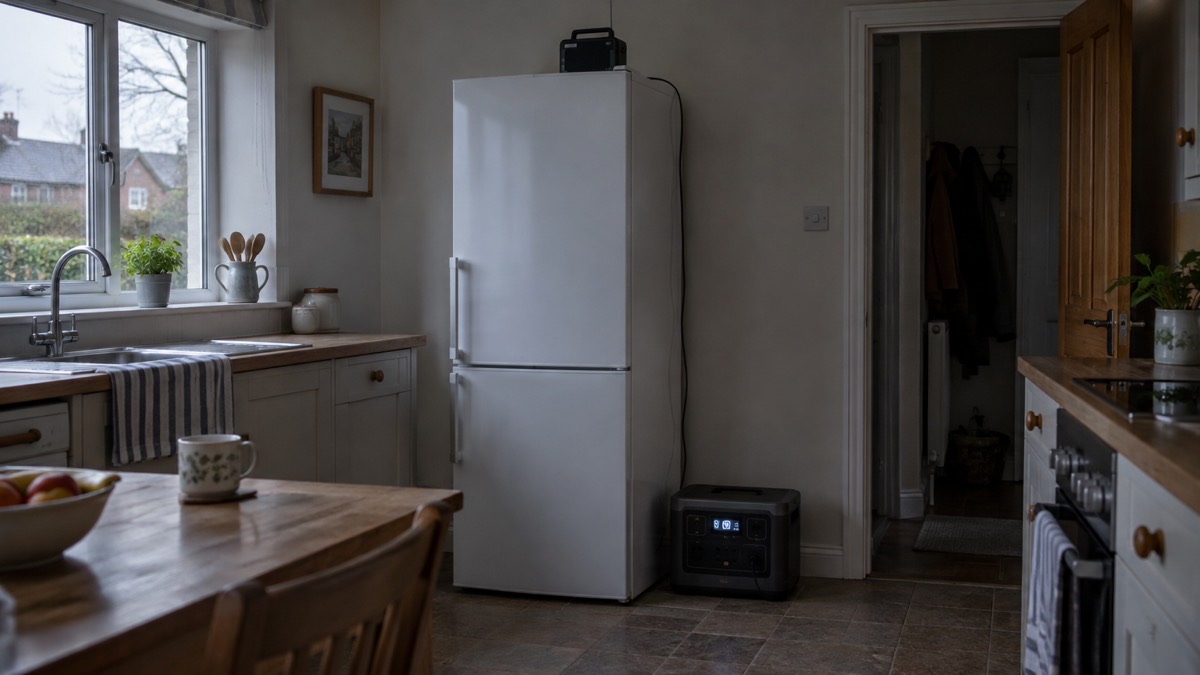
EcoFlow states that the DELTA 2 can be used as an EPS (emergency power supply) to "auto-switch to battery power when the grid goes down"1. In practice you plug the unit into the mains to keep it charged, plug your appliance into the unit, and the unit passes mains power through until the mains fails, at which point it switches to its own battery. The DELTA 2 Max adds an "AC Always On Mode" in which "the AC power button stays on, even during a power cut or after the grid power is back"2.
That automatic behaviour is convenient, but it is not the same as a home battery wired into your consumer unit. A power station powers only what is plugged into it. It will not back up your lighting circuits, your boiler or your sockets unless those are plugged in directly. For the difference between the two approaches, see Home Battery Storage: Does It Keep the Lights On? and Connecting a Generator or Battery to Your Home's Wiring.
A sensible routine before an expected outage, such as a storm warning:
- Charge the unit to full from the mains while you still have power1.
- Plug in the appliances you most want to keep running, prioritising the fridge and any medical device4.
- Turn on the app and check the low battery notification is enabled2.
- Keep the unit in the room where it will be used, on a hard surface, with ventilation around it2.
For the wider picture of using backup power during an outage, see Using Generators and Power Stations During an Outage.
Charging from the mains, solar panels and a car
There are three ways to put energy back into either unit: the mains, a solar panel, or a car's 12V or 24V socket. EcoFlow states that the DELTA 2 Max can be charged by AC, by solar, or by both at once (X-Stream AC plus solar dual charging)9.
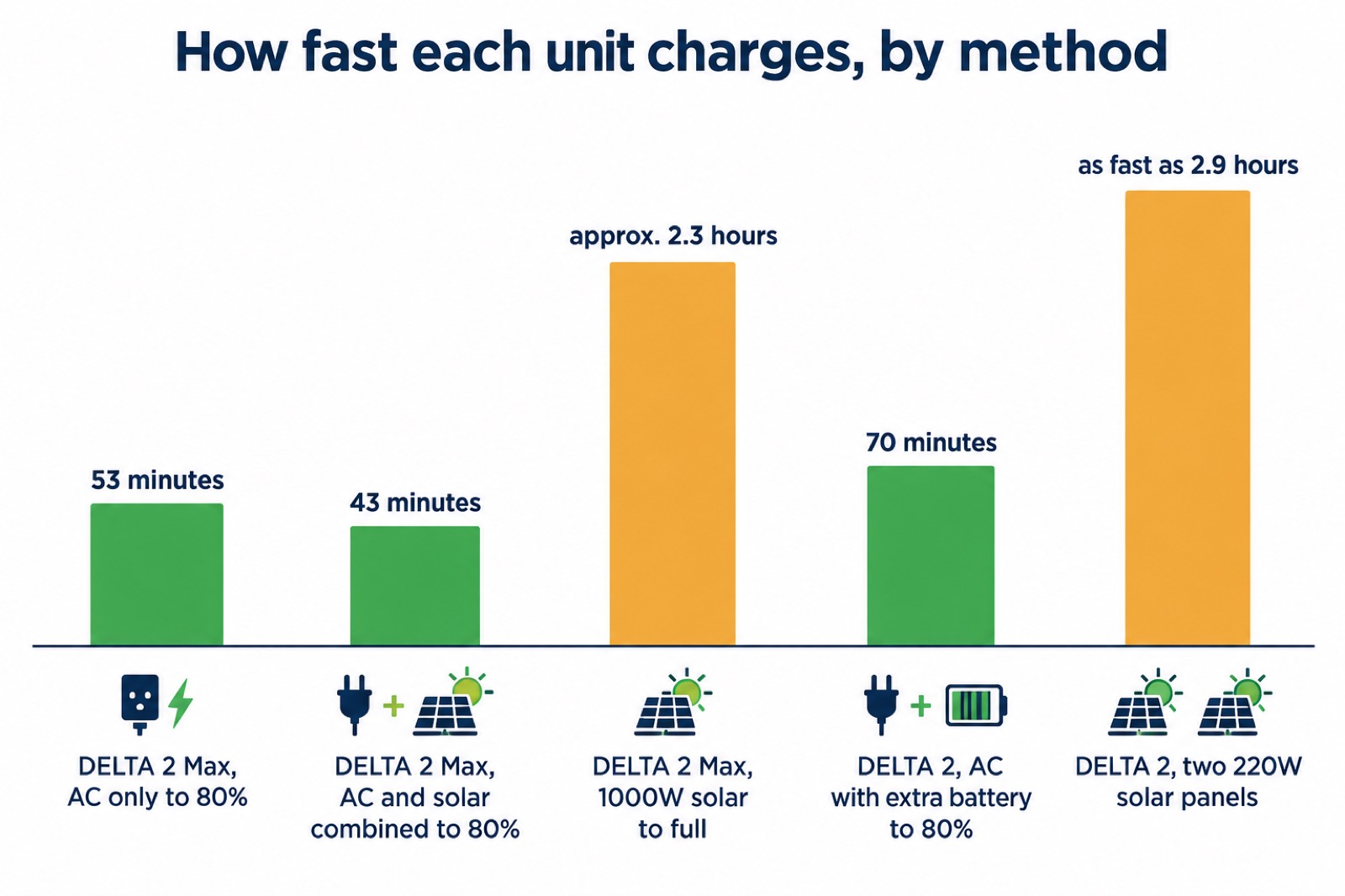
From the mains. The DELTA 2 Max charges to 80% in 53 minutes on AC alone, or in 43 minutes with combined AC and solar input of 2400W using 1800W AC input and a maximum of 600W solar input2. The DELTA 2, with its Smart Extra Battery attached, charges from 0 to 80% in 70 minutes and 0 to 100% in 120 minutes on AC input3.
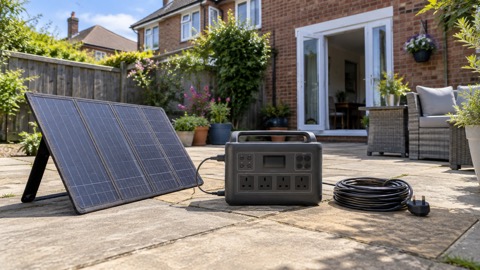
From solar. The DELTA 2 accepts up to 500W of solar input at 11-60V, 15A1, and EcoFlow states it will charge in as fast as 3-6 hours with one 400W or two 220W portable solar panels1, or as fast as 2.9 hours with two 220W panels5. The DELTA 2 Max accepts 11-60V, 15A, 500W on a single port and 1,000W across dual ports2, and EcoFlow gives charge times of approximately 2.3 hours at 1000W, 2.6 hours at 880W and 2.8 hours at 800W2. The DELTA 2 Max has a dual solar input design, each with independent Maximum Power Point Tracking (MPPT)9.
From a car. Both units support car charging from a 12V/24V battery at 8A1. This is slow compared with the mains and best treated as a top-up rather than a primary charging method.
For more on matching a panel to a unit, see Portable Solar Panels for Charging in a Power Cut and What Size Solar Panel Do I Need to Charge a Power Station?.
Adding an extra battery for longer outages
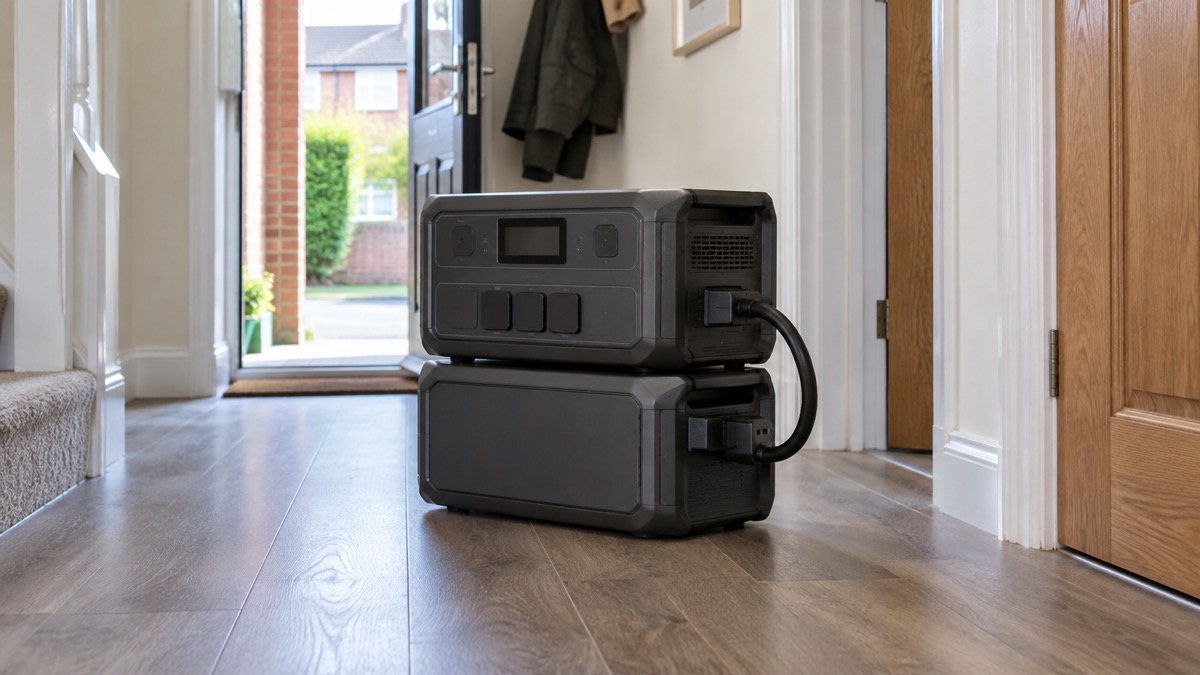
Both units can be expanded, but in different ways and to different ceilings. The DELTA 2 supports one DELTA 2 extra battery or one DELTA Max extra battery1. Adding a DELTA 2 Smart Extra Battery takes it to 2048Wh; adding a DELTA Max Extra Battery takes it to 3040Wh1. The DELTA 2 Max supports up to two DELTA 2 Max Smart Extra Batteries or a DELTA Max Smart Extra Battery, taking it to 6kWh with two extra batteries2.
| Unit | Extra batteries supported | Capacity with extras |
|---|---|---|
| DELTA 2 | One DELTA 2 extra battery or one DELTA Max extra battery1 | 2048Wh with DELTA 2 extra; 3040Wh with DELTA Max extra1 |
| DELTA 2 Max | Up to two DELTA 2 Max Smart Extra Batteries or a DELTA Max Smart Extra Battery2 | Up to 6kWh with two extra batteries2 |
The DELTA 2 Smart Extra Battery charges and discharges in unison with the DELTA 2, so the pair behaves as one larger battery rather than two separate ones3. The DELTA 2 Max Smart Extra Battery has an output port rated at 51.2V, 3200W max10, and EcoFlow states that at 6kWh capacity it will power a 120W refrigerator for up to 42 hours10. It is compatible with the DELTA 2, DELTA Max 2000 and DELTA 2 Max10.
The extra battery is a substantial object in its own right: the DELTA 2 Max Smart Extra Battery weighs 19kg10. Plan where it will live before it arrives. For the general principles of adding capacity, see Portable Power Stations: What They Do and How to Choose.
Outputs and sockets on each version
The sockets decide what you can plug in without an adapter, and how many things at once. The DELTA 2 Max has four AC outlets with 2400W total and a 4800W surge2. It also has two USB-A ports at 12W max each, two USB-A fast-charge ports at 18W max, two USB-C ports at 100W max each, two DC5521 ports at 38W max each, and one car power output at 126W max2.
The DELTA 2 has two USB-A ports at 12W max, two USB-C ports at 100W max, two DC5521 ports at 38W max, and one car power output at 126W max1. EcoFlow states that the DELTA 2 can run up to 13 devices at once4.
| Output | DELTA 2 | DELTA 2 Max |
|---|---|---|
| AC outlets | Not stated on the pages used here | 4 outlets, 2400W total, surge 4800W2 |
| USB-A | 2 ports, 12W max1 | 2 ports, 12W max, plus 2 fast-charge ports at 18W max2 |
| USB-C | 2 ports, 100W max1 | 2 ports, 100W max2 |
| DC5521 | 2 ports, 38W max1 | 2 ports, 38W max2 |
| Car power output | 1 port, 126W max1 | 1 port, 126W max2 |
The 100W USB-C ports will charge a laptop at full speed, which matters if you are working from home during an outage. The car power output is useful for 12V accessories. For the cables and standards behind USB-C charging, see USB-C Charging, Power Delivery and Cables Explained.
Noise, safety and where to put it
One of the reasons to choose a power station over a petrol generator is that it has no exhaust. EcoFlow states that the DELTA 2 has "zero emissions, odor, and noise" and describes it as a "silent, eco-friendly alternative to gas generators, perfect for indoor" use5. The DELTA 2 Max is rated at 30 dB from a distance of approximately 20 inches, with low input and 500W output2. That is a quiet hum, not silence, but it is far below the noise of a generator.
The DELTA 2 Max has a UL94-5VA fire-resistant casing2. That is a rating of the plastic's resistance to burning, not a guarantee that the unit cannot fail. EcoFlow's own safety instructions and the general guidance on lithium batteries still apply: keep the unit away from flammable materials, do not cover it, do not charge it in damp conditions, and do not use a damaged unit.
For the wider safety picture, see Lithium-Ion Battery Safety at Home and Are Portable Power Stations a Fire Risk?. For storage between outages, see How to Store a Power Station When Not in Use.
Warranty, app and support
EcoFlow states that the DELTA 2 Max comes with a 5-year warranty7. The DELTA 2 and its accessories are listed with "Warranty Protection" and "Lifetime Support"8. The exact terms are set by the maker and can change, so check the current warranty card that comes in the box.
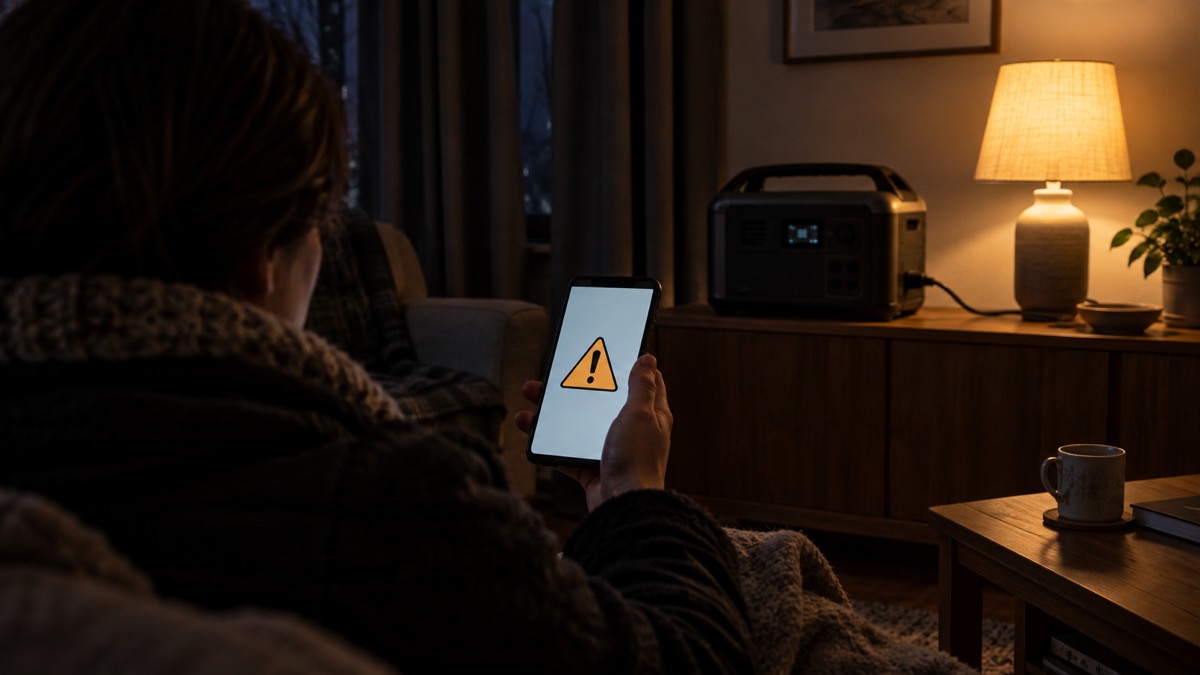
The app is part of how the unit works. Both units connect by Wi-Fi and Bluetooth1. EcoFlow lists app features including Smart Automatic Control, AC Always-on, Energy Management and Low Battery Reminder12. The low battery notification is the one to set up first: EcoFlow states that you get a notification via the app when the battery hits a low level10. That gives you time to switch off non-essential loads or start charging before the unit shuts down.
What comes in the box:
- DELTA 2: the unit, an AC charging cable, a user manual, an app quick start guide and a warranty card1.
- DELTA 2 Max: the unit, an AC charging cable, and a user manual and warranty card7.
- DELTA 2 Smart Extra Battery (refurbished): the battery, a DELTA 2 extra battery cable, and a user manual and warranty card13.
Set the app up and connect the unit to your home Wi-Fi before an outage, not during one. If the broadband goes down with the power, Bluetooth still works at close range.
Sources (13)
- EcoFlow DELTA 2 Portable Power Station, EcoFlow, 2026-10-25
- EcoFlow DELTA 2 Max Portable Power Station, EcoFlow, 2026-10-25
- EcoFlow DELTA 2 Smart Extra Battery, EcoFlow, 2026-10-25
- EcoFlow DELTA Portable Power Stations, EcoFlow, 2026-10-25
- EcoFlow DELTA 2 220W Portable Solar Panel, EcoFlow, 2026-10-25
- EcoFlow DELTA 2 Max + Smart Extra Battery - EcoFlow UK, EcoFlow UK
- EcoFlow DELTA 2 Max 160W Portable Solar Panel, EcoFlow, 2026-10-25
- EcoFlow DELTA Solar Generators, EcoFlow, 2026-10-25
- EcoFlow DELTA 2 Max 220W Portable Solar Panel, EcoFlow, 2026-10-25
- EcoFlow DELTA 2 Max Smart Extra Battery, EcoFlow, 2026-10-25
- EcoFlow DELTA 2 Smart Generator, EcoFlow, 2026-10-25
- EcoFlow DELTA 2 Max | Max Power Anywhere | Portable Power Station - EcoFlow UK, EcoFlow UK
- EcoFlow DELTA 2 Smart Extra Battery (Refurbished), EcoFlow, 2026-10-25

 BLUETTI Apex 300 Power Station
 BLUETTI Elite 100 V2
 Anker SOLIX C2000 Gen 2
 Anker SOLIX C1000 Power Station
 EcoFlow DELTA Pro
 BLUETTI Elite 400
 Anker SOLIX C300 Power Station
 EcoFlow DELTA 3
 EcoFlow DELTA and DELTA Max
 EcoFlow RIVER 3 and RIVER 3 Plus
 EcoFlow RIVER 2 and RIVER 2 Max
 BLUETTI Elite 30 V2