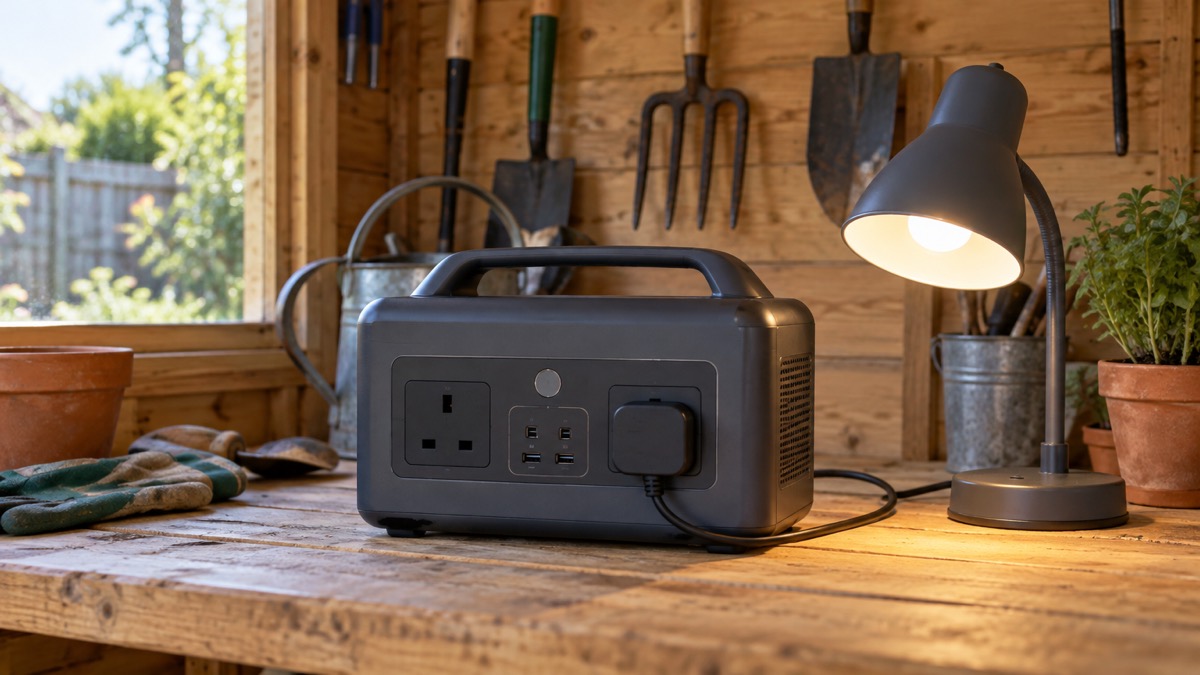
The EcoFlow RIVER 2 and RIVER 2 Max are small portable power stations: rechargeable batteries with mains sockets, USB ports and 12V outputs, made by EcoFlow. They are the two entry models in the RIVER range. The standard RIVER 2 holds 256Wh and delivers 300W of AC output, rising to 600W with the maker's X-Boost mode1. The RIVER 2 Max holds 512Wh and delivers 500W, rising to 1000W with X-Boost3. Both recharge from empty to full in about an hour from a mains socket2.
Neither is a whole-house backup. They are sized for phones, laptops, lights, a router, a small fan or a television, and the Max can manage a short burst on a higher-draw appliance. If you want to know how much capacity your own household needs, work through what capacity power station you need before choosing between the two.
RIVER 2 or RIVER 2 Max: how the two versions differ
The two models share a body of features and differ mainly in size. The RIVER 2 is the lighter, smaller unit, at approximately 3.5kg and 245 x 214 x 142mm1. The RIVER 2 Max is approximately 6kg and 270 x 260 x 196mm3. The maker describes the RIVER 2 Max as using its safest LFP battery, providing 10 years of use2.
The practical difference is how much you can run and for how long. The maker's own run-time figures show the gap clearly:
| Appliance | RIVER 2 | RIVER 2 Max |
|---|---|---|
| Light (10W) | 20.5 hrs1 | 41 hrs2 |
| Laptop (60Wh) | 3.4 charges2 | 6.8 charges2 |
| Camera (16Wh) | 12.8 charges2 | 25.6 charges2 |
| Electric kettle (1500W) | N.A.4 | 0.8 hrs4 |
The RIVER 2 suits someone who wants a light unit for phones, a laptop and a lamp, and who may carry it between rooms or take it away for a weekend. The RIVER 2 Max suits a household that wants to keep a few more things running at once, or to run a higher-draw appliance briefly. The maker also sells the RIVER 2 Max as a solar generator bundle with a 160W panel, and the RIVER 2 with a 110W panel4.
Capacity and output: 256Wh at 300W, 512Wh at 500W
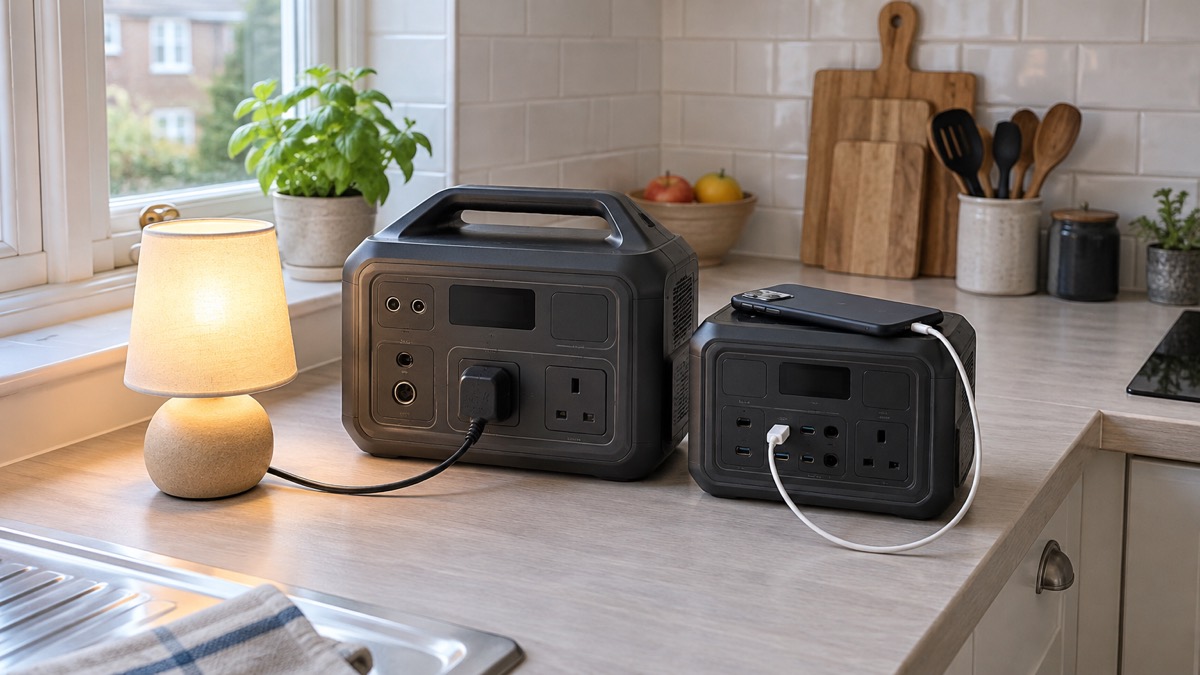
Capacity is the size of the tank; output is the width of the tap. The RIVER 2 stores 256Wh and can deliver 300W of AC output continuously, with a 600W surge for appliances that draw a brief spike at start-up1. The RIVER 2 Max stores 512Wh and delivers 500W continuously, with a 1000W surge3. Both output a pure sine wave at 230V, 50Hz, which is the same shape of mains power your appliances expect1.
The maker's X-Boost mode raises the ceiling further. On the RIVER 2 it takes output to 600W and the maker says it will run up to 99% of consumer electronics1. On the RIVER 2 Max it reaches 1000W and the maker says it runs up to 80% of high-wattage appliances3. X-Boost is a maker feature for resistive loads and simple electronics; it is not a promise that any appliance will work. Check the wattage on the appliance's own label before plugging it in, and read watts, watt-hours and surge explained if the numbers are unfamiliar.
The DC side matters too. The RIVER 2 has a 12.6V, 8A, 100W maximum DC output and USB-A ports at 5V, 2.4A, 12W1. The RIVER 2 Max adds a DC5521 barrel port at 12.6V, 3A, 36W maximum, and a higher-rated DC output of 12.6V, 10A/3A/3A, 126W maximum3. The maker states plainly that the standard RIVER 2 does not include DC5521 output ports5, so if a router or lamp you rely on uses that plug, the Max is the model that has it.
Charging: full in about an hour from the mains
The headline figure is speed. The RIVER 2 goes from 0 to 80% in 48 minutes and 0 to 100% in 60 minutes on mains power, drawing up to 360W1. The RIVER 2 Max reaches 0 to 100% in only 60 minutes, drawing up to 660W3. That matters in a power cut: if the mains returns for an hour, you can refill the battery before it goes again.
There are four ways to charge either unit1:
- Mains AC: about an hour to full, the fastest option1.
- Car charging: 3 hours on the RIVER 2, using a 12V/24V, 8A, 100W maximum car input1.
- USB-C: 6 hours on the RIVER 2, through a 60W maximum USB-C input1.
- Solar: as little as 3 hours with portable panels2.
The RIVER 2 accepts solar input of 11-30V, 8A, 110W maximum1. The RIVER 2 Max accepts 11-50V, 13A, 220W maximum3. The maker's own figures for solar charging vary with the panel and conditions: the RIVER 2 is listed at 2.5 hours with one 110W portable panel1, and the RIVER series is described as charging in 4 to 5 hours in optimal sunlight6. Treat solar times as best-case, and read how long solar charging takes in the UK before relying on it in winter.
Solar and car charging when the power is off
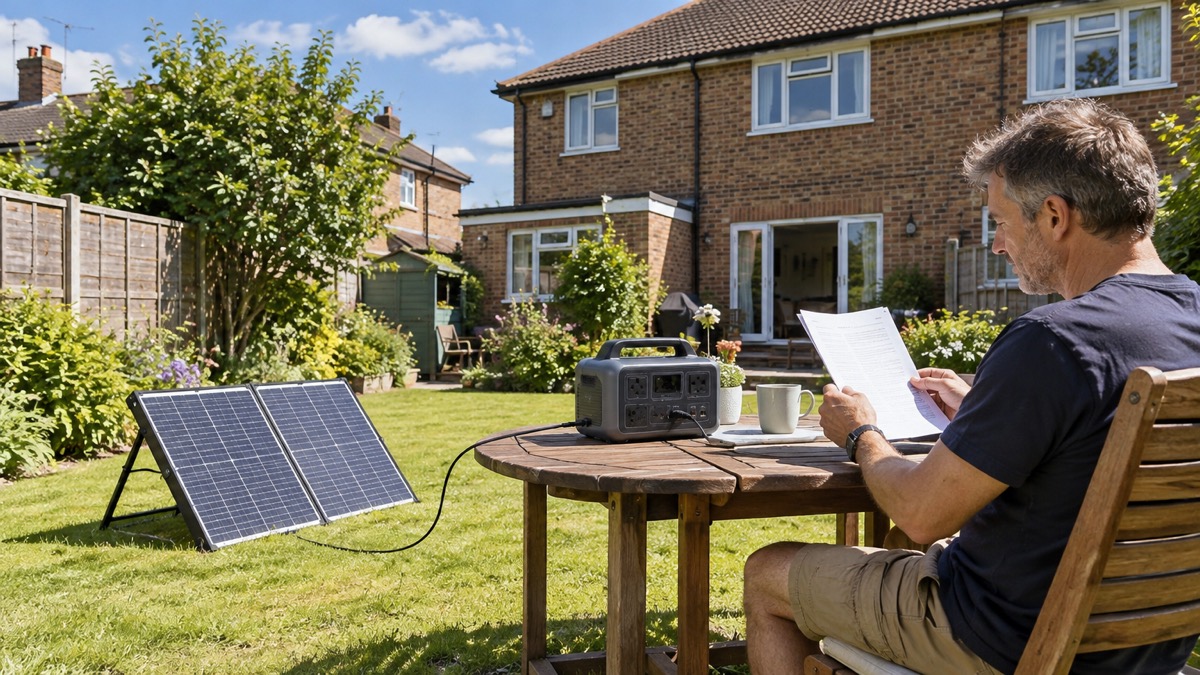
When the mains fails, the RIVER 2 becomes a solar generator if you have a panel. The maker says a RIVER 2 will keep a family going for an entire weekend if just charging phones and tablets, and that combined with a 110W portable panel it can power gear indefinitely7. That is the maker's own claim, and it depends on sunshine. In a UK winter, expect far less than the summer best case.
The car is the other option. Both units accept a 12V/24V car input at 8A, 100W maximum, and the RIVER 2 charges in 3 hours this way1. That makes a car journey, or simply running the engine for a while, a way to top up when the house has no power. The maker also sells a smart auto battery charger for charging from a vehicle battery5. If you are charging from a car, do it with the engine running so you do not flatten the vehicle battery, and read can you charge a power station from your car for the practical detail.
The RIVER series can charge itself and power devices at the same time6, so you can run a lamp from the unit while a panel tops it up. For a wider look at panel choices, see portable solar panels for charging in a power cut.
Keeping power on through a cut with AC Always-On
The RIVER 2 and RIVER 2 Max both have a feature the maker calls AC Always-On. The maker states: "When the power's down, AC Always-On ensures a seamless transition from the grid to backup power and unwavering protection of your fridge and other mission-critical appliances"1. In practice, you plug the power station into the mains and plug an appliance into the power station; while mains power flows, the unit passes it through, and when the mains drops, the battery takes over.
That is useful for a router, a lamp or a small fridge, but it is not a whole-house uninterruptible supply. The RIVER 2's 300W output and 256Wh capacity will not carry a full-size fridge for long, and the maker's fridge claim should be read against the capacity figures. If you need to keep a fridge running, work out the load first with how long a power station runs a fridge or laptop, and read using a power station as a UPS for what switchover means in practice.
For the wider question of what to keep running in an outage, see deciding what to keep running when the mains fails.
Cold, heat and storage: the temperatures that matter
Battery performance depends on temperature, and the maker gives clear limits. For both models, the storage temperature range is -10°C to 45°C, with 20°C to 30°C described as best1. The discharge (use) range is -10°C to 45°C1. The optimal operating temperature is 20°C to 30°C1.
Charging is the tighter constraint. Both models have a charge temperature range of 0°C to 45°C1. That means you should not charge the unit in a freezing garage or shed in winter. Bring it indoors to charge, then return it to storage if you prefer. The maker's own guidance is the authority here, and it is consistent across both models.
| Condition | Range |
|---|---|
| Storage | -10°C to 45°C (20°C to 30°C best)1 |
| Discharge (use) | -10°C to 45°C1 |
| Charging | 0°C to 45°C1 |
| Optimal operating | 20°C to 30°C1 |
For a UK household, the practical points are: keep the unit out of a cold loft or unheated outbuilding if you plan to charge it there; do not leave it in a car in summer; and bring it to room temperature before charging after cold storage. For more on this, see what temperature should batteries be stored at and can you charge lithium batteries below freezing.
Battery life, safety protections and warranty
The maker rates both models at 80%+ capacity after 3000 cycles1. Using the RIVER 2 six times a week, the maker says 3000 full 100% cycles will last 9.6 years until capacity drops to 80%1. The same figure is given for the RIVER 2 Max3. The maker describes the RIVER 2 Max's LFP battery as its safest, providing 10 years of use2. These are maker estimates based on a pattern of use, not a guarantee.
Both units include a battery management system with protection against over-voltage, overloading, over-temperature, short circuit, low-temperature, low voltage and overcurrent1. The RIVER 2 is described as the first portable power station to earn TÜV Rheinland certification, passing more than 20 high-level criteria1. Both carry a 5-year warranty1.
The maker's app control works over Wi-Fi and Bluetooth on both models1, so you can check charge level from your phone. Do not rely on it in a power cut: if your broadband is down, the app may not connect, and the unit's own display and buttons are the fallback.
Where the RIVER 2 fits in a household power cut plan
A power cut is a common event, and the official advice is consistent: keep a torch handy, keep a mobile phone charged, and keep a battery or wind-up radio ready8. The RIVER 2 and RIVER 2 Max are one way to do the phone and light part of that plan, and the Max can add a short burst on a kettle or a small appliance.
The limits are worth stating plainly. Neither unit will run a whole house, a shower, an electric cooker or a heat pump. The RIVER 2 will not run a 1500W kettle at all, and the Max will run one for 0.8 hours4. For heating, cooking and anything high-draw, a portable power station is the wrong tool; see portable power stations: what they do and how to choose for the wider picture, and portable power station or petrol generator for a power cut if you are weighing the two.
If anyone in the household relies on powered medical equipment, a power station can be part of the plan, but the maker's capacity figures must be matched to the device. The independent advice is that backup power sources should be regularly checked and maintained to keep vital equipment powered for several hours during a power cut12. Read powering CPAP, oxygen and other medical devices from a battery before relying on any unit for this.
For a full household checklist, see the power cut backup power checklist and backup power checks before winter.
Sources (12)
- RIVER 2 Portable Power Station, EcoFlow, 2026-10-25
- RIVER Portable Power Stations, EcoFlow, 2026-10-25
- RIVER 2 Max Portable Power Station, EcoFlow, 2026-10-25
- Portable Power Stations for Camping, EcoFlow, 2026-10-25
- Smart Auto Battery Charger, EcoFlow, 2026-10-25
- RIVER Solar Generators, EcoFlow, 2026-10-25
- Solar Generators - EcoFlow UK, EcoFlow UK
- Electricity Supply Emergency Code, SSEN Distribution, 2026-10-25
- Types of Power Cut, Powercut105, 2026-10-25
- Storm Advice, Powercut105, 2026-10-25
- Extreme Weather Winter Guide, London Fire Brigade, 2025-01
- FAQs, Electricity North West, 2026-10-25

 BLUETTI Apex 300 Power Station
 BLUETTI Elite 100 V2
 Anker SOLIX C2000 Gen 2
 Anker SOLIX C1000 Power Station
 EcoFlow DELTA Pro
 BLUETTI Elite 400
 Anker SOLIX C300 Power Station
 EcoFlow DELTA 3
 EcoFlow DELTA 2 and DELTA 2 Max
 EcoFlow DELTA and DELTA Max
 EcoFlow RIVER 3 and RIVER 3 Plus
 BLUETTI Elite 30 V2