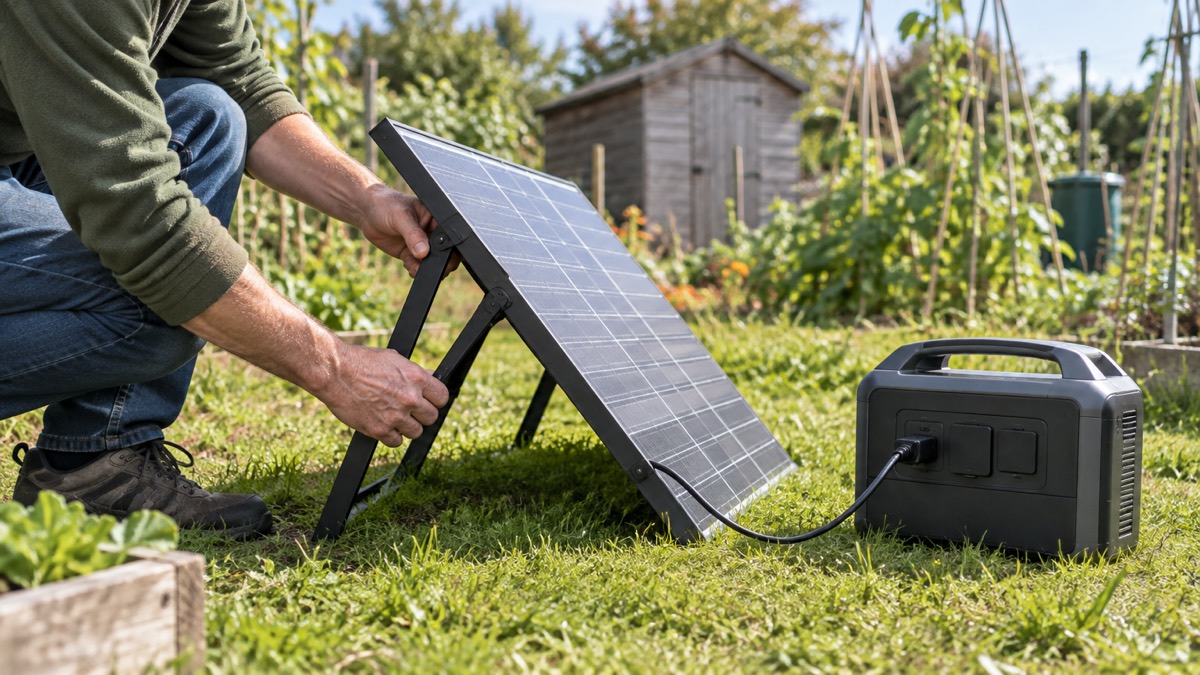
If you are planning to recharge a portable power station from a solar panel, expect it to take longer than plugging into the mains, and longer again on a grey day. The figures makers quote are for perfect sunlight. In those conditions an EcoFlow DELTA charges in 5 to 10 hours from three 110W panels wired in series, or 14 to 28 hours from a single 110W panel1. A larger DELTA Pro can be charged in 2.8 to 5.6 hours from solar at 1600W2. The gap between those two examples is the whole story: panel size and sunshine decide the time, not the power station alone.
The practical answer for a UK household is to size the panel to the job and to treat solar as a top-up rather than a guarantee. Which? advises that battery-powered generators can be hooked up to a solar panel for free off-grid charging, usually with the panel bought separately, and that you should work out how long a full charge takes before you rely on it3. Most power cuts do not last very long, so a unit that is already charged when the power goes is worth more than a fast panel4.
This page sets out what decides solar charging time, how to get the most from a panel, how solar compares with mains and car charging, what a charged unit can run, and where a portable power station should not be relied on at all.
Solar charging takes longer than the 4 to 8 hours from mains
The headline comparison is simple. A mid-size power station charged from the mains fills in a handful of hours, but the same unit charged from solar depends entirely on how many watts of panel you can point at the sun. EcoFlow lists a DELTA as taking 4 to 8 hours from four 110W panels in parallel under perfect sunlight, and 5 to 10 hours from three in series1. Fewer panels means longer: one 110W panel stretches the same charge to 14 to 28 hours1.
Larger units scale up if you give them enough panel. EcoFlow says a DELTA Pro can be charged from solar in 2.8 to 5.6 hours at 1600W2. A DELTA Max 1600 with a 400W panel fully charges in 6 to 12 hours of sunlight7. BLUETTI quotes roughly 4.5 to 5 hours for its B80 from a 200W panel, with prime sunshine, ideal orientation and low temperature8. BioLite says four of its SolarPanel 100 units recharge a BaseCharge 1500 in 4 hours9.
Small kit behaves the same way at a smaller scale. A BioLite Luci Emergency lantern takes 8 hours to charge from its own solar panel10. A Jackery Solar Generator 600 v2 reaches 80 per cent in 6.5 hours from 100W of solar11.
| Power station | Solar input | Maker's charge time |
|---|---|---|
| EcoFlow DELTA | 4 x 110W panels, parallel | 4 to 8 hours1 |
| EcoFlow DELTA | 3 x 110W panels, series | 5 to 10 hours1 |
| EcoFlow DELTA | 1 x 110W panel | 14 to 28 hours1 |
| EcoFlow DELTA Pro | 1600W solar | 2.8 to 5.6 hours2 |
| EcoFlow DELTA Max 1600 | 400W panel | 6 to 12 hours7 |
| BLUETTI B80 | 200W panel | about 4.5 to 5 hours8 |
| Jackery Solar Generator 600 v2 | 100W solar | 6.5 hours to 80 per cent11 |
Every one of those figures assumes perfect sunlight. Jackery states plainly that solar recharging time varies by location, temperature and weather, and that the actual time may be different12. Treat the table as a best case, not a promise.
What decides the charge time: panel size and sunlight
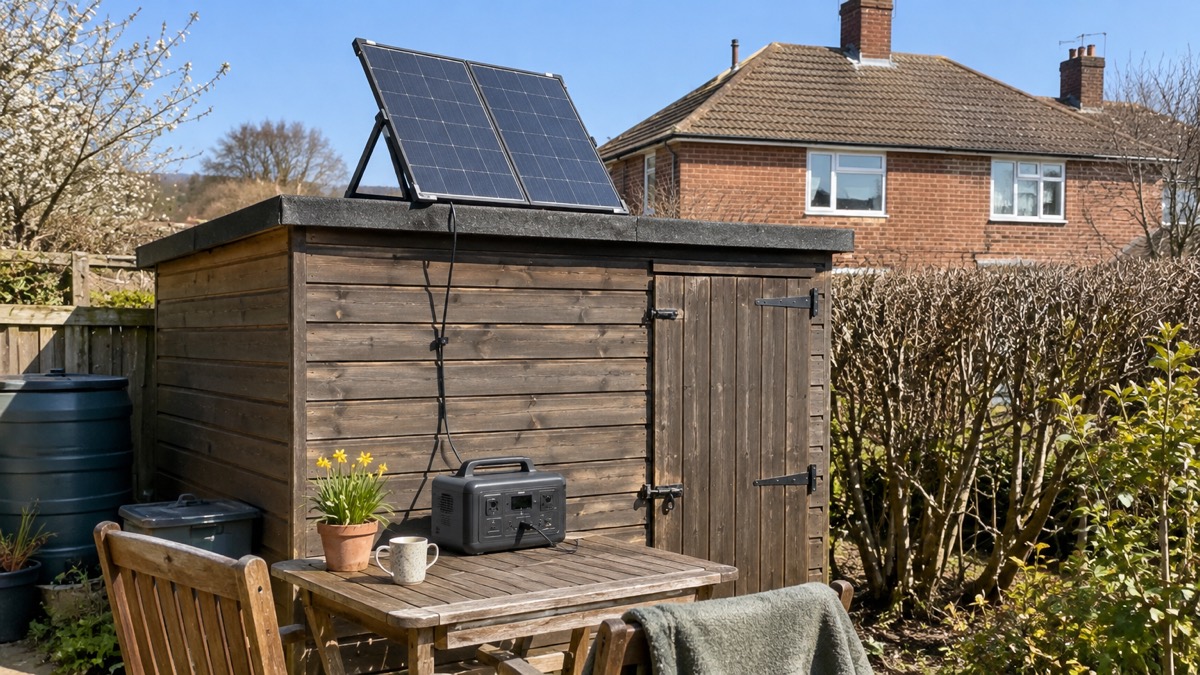
Two things set the time: how many watts of panel you have, and how much sun reaches it. Jackery says solar charging times vary based on the battery model and the number of solar panels13. That is the whole calculation in one sentence. Double the panel wattage and you roughly halve the time, provided the power station will accept the extra input.
Sunlight is the variable you cannot control. BioLite's guidance for its solar lights is that panels always need direct sunlight to charge, and that charging works on cloudy days but at a slower rate, with a higher UV index charging faster6. The same advice appears across its solar products14. In a UK winter, with short days and low sun, plan for the slow end of any range.
Panel quality matters too. EcoFlow says its 220W bifacial panel has a conversion rate of up to 23 per cent15, and Anker says its PS400 panel charges 1.5 times faster thanks to monocrystalline cells and a sunlight-trapping surface16. Those are maker claims for their own products, but they explain why two panels of the same wattage can perform differently.
To work out what an appliance draws from a 12V battery, the Caravan Club advises taking its power rating and dividing by 1217. That is a useful check when you are deciding whether a panel is big enough for the load you want to run.
Clean panels charge faster: up to 15 per cent more output
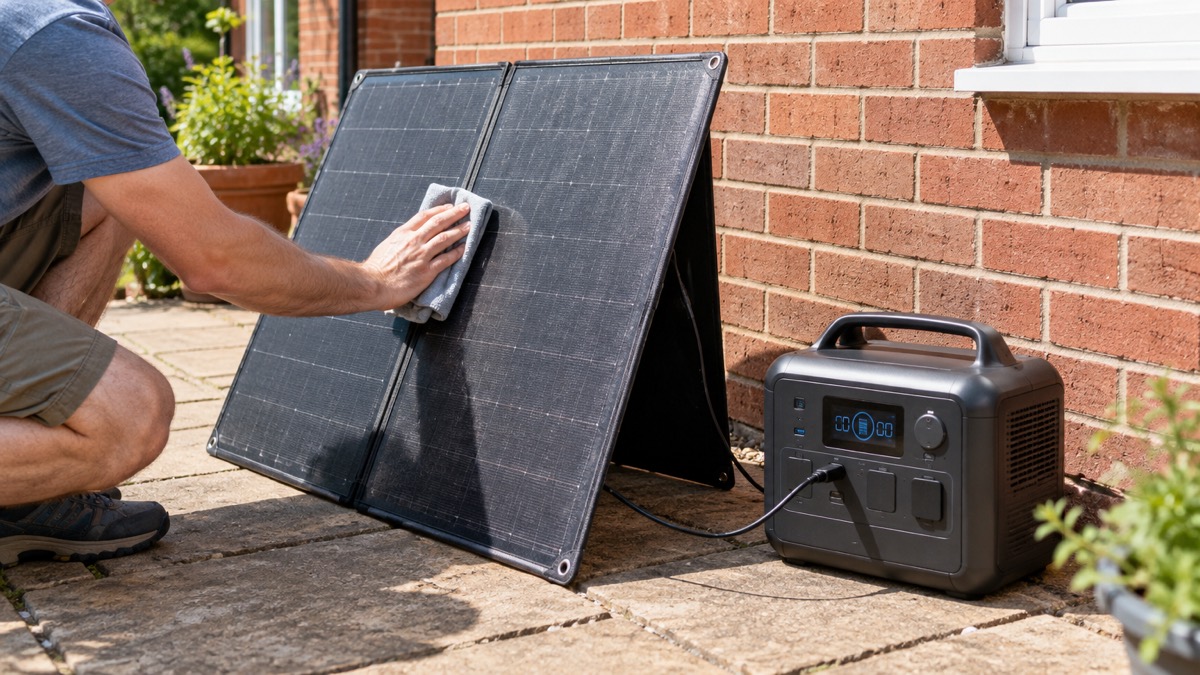
Dirt, dust and debris on a panel cost you charging time. Electrical Safety First says keeping solar panels clean and maintained could increase energy production by up to 15 per cent5. On a slow winter recharge, that is the difference between a panel doing its job and one that never quite fills the battery.
Rain helps. Most panels have a self-cleaning coating which, when installed at a suitable angle, allows rain to clear dirt and debris5. The catch is the angle: a panel lying flat, or tucked behind glass, will not shed dirt the way an angled one does. If yours sits flat, wipe it down before you rely on it.
Do regular visual checks for cracks, breaks, loose connections and cable damage caused by vermin and weathering5. A damaged cable or a cracked panel will charge slowly or not at all, and it is a safety matter as well as a performance one.
Mains, car or solar: three ways to fill a power station
Most power stations can be filled more than one way, and the choice changes how long you wait. Anker's C300 can be charged from a wall outlet, solar panels, a car, or a PD 3.1 USB-C port18. EcoFlow's RIVER series takes an AC wall outlet, a solar panel or a car charger19. The WAVE 2 takes AC, solar, a car or another power station20.
| Method | What it suits | What to expect |
|---|---|---|
| Mains | Filling quickly before a forecast outage | The fastest option, and the one to use when power is on1 |
| Car | Topping up while travelling | Slower than mains; useful when no socket is available18 |
| Solar | Off-grid top-up over hours or days | Depends on panel watts and sun; slowest in winter1 |
Which? advises calculating how long it takes to charge the battery from flat to full and factoring in current electricity prices, and notes that some battery-powered generators can be hooked up to a solar panel for free off-grid charging, usually with the panel bought separately3. That is the trade: solar costs nothing to run but takes time and depends on weather.
For a household preparing for a power cut, the sensible pattern is to keep the unit charged from the mains and use solar to top it up or to keep it topped up through a long outage. If you want to understand the difference between the two approaches in more depth, see Portable Solar Panels for Charging in a Power Cut and Can You Charge a Power Station from Your Car?.
What a charged power station can run in a power cut
A charged power station is most useful for small loads over a short outage. Which? describes battery generators as smaller and more portable than fuel-tank generators, but only really useful if you have low power demand3. That is the honest limit. A unit that runs phones, a router and a few lights for hours will not run an electric shower or an immersion heater.
Most power cuts do not last very long4, so a modest unit charged in advance covers the common case. For longer outages, the question becomes what you have chosen to keep running. Our guide to Deciding What to Keep Running When the Mains Fails sets out how to rank those loads, and How Long Will a Power Station Run a Fridge or Laptop? works through the arithmetic.
Home solar with a battery is a different matter from a portable panel. The Government's Prepare campaign says that if you have solar panels and a battery storage system with power backup capability, some installations can continue to provide power during a power cut if they are designed and configured to operate independently of the electricity grid, which may help keep essential appliances running21. That is not automatic: SSEN warns that during a power cut, systems like solar panels, heat pumps, EV chargers and batteries will automatically switch off to protect your home and engineers working on the network22. Whether yours keeps running depends on how it was designed and configured. See Do Home Solar Panels Work in a Power Cut? for the detail.
Where a portable power station must not be relied on
A portable power station is not a substitute for a generator or a home battery when the load is heavy or the outage is long. Which? is clear that battery generators are only really useful if you have low power demand3. If you need to run heating, cooking or medical equipment for hours, plan on a different basis.
Medical equipment is the sharpest example. If you rely on powered equipment at home, tell your network operator and ask about the Priority Services Register. Kidney Care UK notes that a home haemodialysis machine has a back-up battery that temporarily provides power for around 30 minutes while the patient discontinues the treatment23, so any plan has to cover well beyond half an hour. Our guide to Powering CPAP, Oxygen and Other Medical Devices From a Battery covers the options.
Landlines are another thing not to assume. Ofcom explains that the old landline phone network is being replaced, and that providers must offer a back-up that lasts at least one hour in a power cut, with some providers offering up to seven hours24. Do not count on a cordless phone working when the power is off.
There are practical habits that catch people out. Jackery states that its power stations need to be powered on for solar charging to begin, and will not automatically start charging when the sun rises if the unit is off25. If you leave a unit connected overnight expecting it to fill by morning, check it is switched on.
Plug-in solar and rooftop panels: what is safe
Portable panels charging a power station are one thing; panels connected to your home's wiring are another. Electrical Safety First warns that at present plug-in solar systems supply power to household circuits in a way not permitted by regulations, although the Government announced plans in March 2026 to make them more widely available5. Until the rules change, keep portable panels for charging a battery, not for feeding a socket.
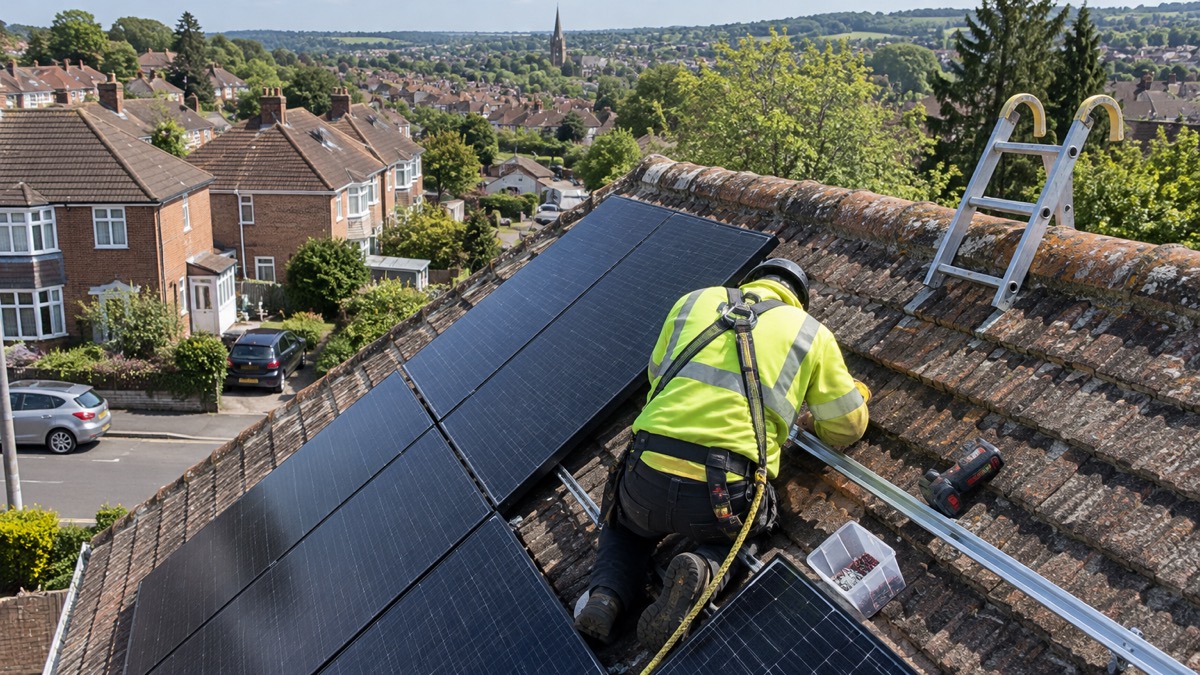
Rooftop solar is a job for a qualified installer. Electrical Safety First says it is vitally important to use a skilled, trained and qualified solar PV installer who is registered with a competent person scheme, and that companies registered with MCS offer an additional level of assurance5. That is also your defence against a cold call: ask for registration details in writing before agreeing to anything.
If you already have rooftop solar, know what it does in an outage. SSEN says solar panels will automatically switch off during a power cut to prevent electricity being sent back into the network while engineers are working, and will usually restart on their own once power returns22. That is a safety feature, not a fault. For a fuller picture of how home solar and batteries behave, see Home Battery Storage: Does It Keep the Lights On?.
Sources (25)
- EcoFlow DELTA Portable Power Station, EcoFlow, 2026-10-25
- EcoFlow DELTA Pro 400W Portable Solar Panel, EcoFlow, 2026-10-25
- How to buy the best generator, Which?, 2026-01-20
- Generators, Wiltshire and Swindon Prepared, 2026-10-25
- Solar panels, Electrical Safety First, 2026-10-26
- BioLite Site Lights, BioLite, 2026-10-25
- Balcony solar generators, EcoFlow, 2026-10-25
- BLUETTI AC60, BLUETTI, 2026-10-25
- BioLite SolarPanel 100, BioLite, 2026-10-25
- Luci Emergency 4-Pack, BioLite, 2026-10-25
- Jackery Solar Generator 600 v2, Jackery, 2026-10-25
- Jackery SolarSaga 80W Solar Panel, Jackery, 2026-10-25
- Small Generators: Camping, Quiet and Portable - Jackery, Jackery
- Luci Candle, BioLite, 2026-10-25
- EcoFlow 220W Bifacial Portable Solar Panel, EcoFlow, 2026-10-25
- Anker SOLIX PS400 Portable Solar Panel, Anker SOLIX, 2026-10-25
- Solar power, The Caravan Club, 2026-10-25
- Anker SOLIX C300 DC and 100W Solar Panel, Anker SOLIX, 2026-10-25
- EcoFlow RIVER Portable Power Stations, EcoFlow, 2026-10-25
- EcoFlow WAVE 2 Portable Air Conditioner, EcoFlow, 2026-10-25
- Be informed about hazards: power cuts, UK Government, 2026-10-21
- Planned power cuts, SSEN, 2026-10-25
- Managing home dialysis during a power cut or energy blackout, Kidney Care UK, 2023-11-29
- Future of landline calls, Ofcom, 2026-08-26
- Jackery SolarSaga 100 Air, Jackery, 2026-10-25
 Power Cut Backup Power Checklist
 Backup Power Before Winter
 Safe Battery Charging at Home
 Running a Generator Indoors
 Carbon Monoxide from Generators
 Generator Sizing for a Power Cut
 Generator Run Time on a Tank
 Storing Petrol at Home
 Diesel Storage at Home
 Storing a Generator
 Generators in Cold Weather
 Generator Noise and Neighbours
 Power Station Capacity Sizing
 Power Station Run Time
 Power Station for a Gas Boiler