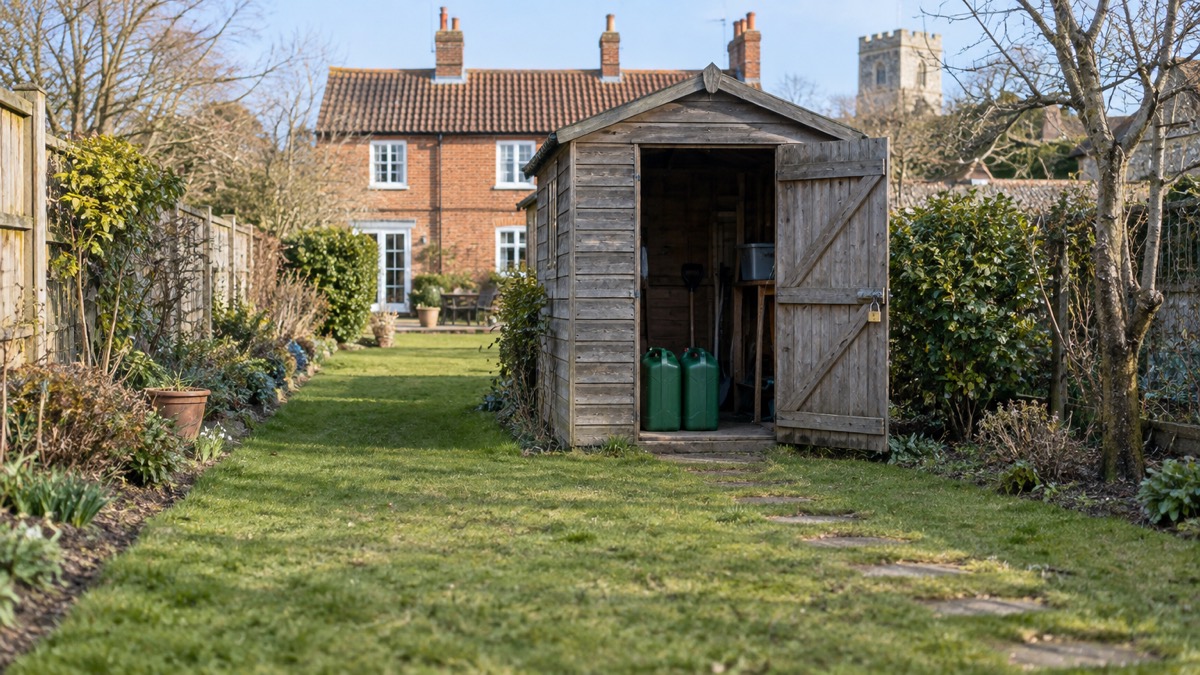
You can legally store up to 30 litres of petrol at home or at non-workplace premises without informing your local Petroleum Enforcement Authority1. That is the figure to work to. You can keep it in suitable portable metal or plastic containers, in one demountable fuel tank, or a combination of the two, as long as no more than 30 litres is kept in total1. Wiltshire and Swindon Prepared, the local resilience guidance, puts the same point plainly: you can legally only store 30 litres of fuel at home2.
The limit is not a target. Petrol is extremely flammable, and fire and rescue services warn that if it is not stored correctly it could start a fire3. Store it outside the living space, in proper containers, away from heat and naked flames, and never smoke near it1. If you want to keep more than 30 litres, the Health and Safety Executive holds the guidance for larger amounts1.
Most households storing fuel are doing it for one reason: to run a generator in a power cut. That brings a second, separate set of rules, because the exhaust from a petrol or diesel generator contains carbon monoxide, which can kill. The Health and Safety Executive is blunt about it: using petrol powered equipment such as generators indoors or in enclosed spaces can create significant levels of carbon monoxide which can kill even after a few minutes4. The fuel limit and the siting rules are two halves of the same job.
The 30 litre limit, and what it actually covers
The 30 litre figure applies to petrol kept at home or at non-workplace premises, and it is the point at which you would otherwise have to inform your local Petroleum Enforcement Authority1. Below it, you can store fuel without notifying anyone. Above it, the Health and Safety Executive's guidance on larger amounts applies1.
Two things follow from that. First, the limit is a total, not a per-container allowance: several smaller cans and a part-full demountable tank still add up to 30 litres1. Second, it is a storage limit, not a licence to keep fuel anywhere you like. The same guidance that sets the number also sets the conditions: suitable containers, no smoking nearby, and the fuel kept properly1.
It is worth being clear about what the limit does not cover. Diesel has no specific legal requirement on the amount you are allowed to store at home, though fire and rescue services advise following the safety guidance around storing it on the government website1. LPG cylinders and cartridges are limited to the storage and use of up to four cylinders or cartridges under independent guidance5. So if your generator is dual-fuel or diesel, the petrol limit is not the one that binds you, and you should check the rules for the fuel you actually intend to keep.
| Fuel | Home storage position | Source |
|---|---|---|
| Petrol | Up to 30 litres without informing your local Petroleum Enforcement Authority | 1 |
| Diesel | No specific legal requirement on the amount stored at home; follow government safety guidance | 1 |
| LPG cylinders and cartridges | Limited to storage and use of up to four cylinders or cartridges | 5 |
Containers you can use, and how they count
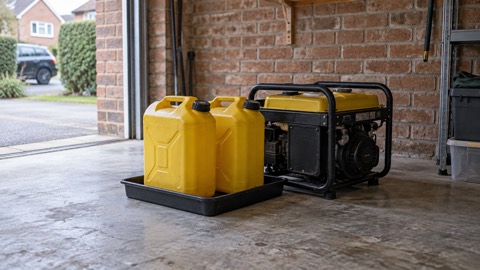
The permitted containers are set out in the same guidance: suitable portable metal or plastic containers, one demountable fuel tank, or a combination of the two, provided the total stays at or under 30 litres1. A demountable tank is a removable tank rather than a fixed installation, and you may keep one as part of your allowance1.
Metal or plastic is therefore a choice the guidance leaves open, as long as the container is suitable for fuel1. What decides safety is not the material but the condition and the placement. A container needs a secure cap, should not be filled to the very brim, and must be kept away from anything that could ignite it. The principle is visible in fire and rescue service advice on other liquid fuels: when filling a paraffin container, fill it to just below the maximum level to allow the fuel to expand when it warms up6. The same reasoning applies to petrol, which expands as it warms.
Where you keep the containers matters as much as what is in them. Fire and rescue service guidance on bio-ethanol, another liquid fuel, recommends storing it in garages and sheds but making sure the fuel cannot be reached by children or pets7. It also says to store it in a cool, dry place, away from direct sunlight and naked flames7. Those are sensible conditions for any liquid fuel kept at home.
Storing petrol for a generator in an emergency
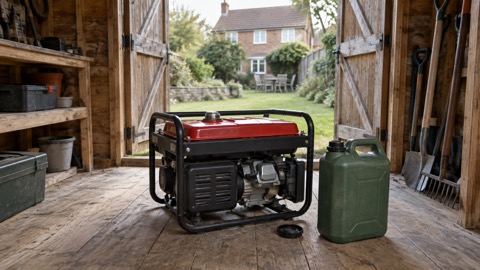
The point of keeping petrol is usually to run a generator when the mains fails. That changes how much you need and how you keep it. A generator's tank sets the scale: Which? describes one petrol model, the DeWalt Dual Voltage generator, as having a fuel tank capacity of around 20 litres8. A tank that size sits comfortably inside the 30 litre home allowance, but leaves little room for spare cans, so plan the split between what is in the generator and what is in store.
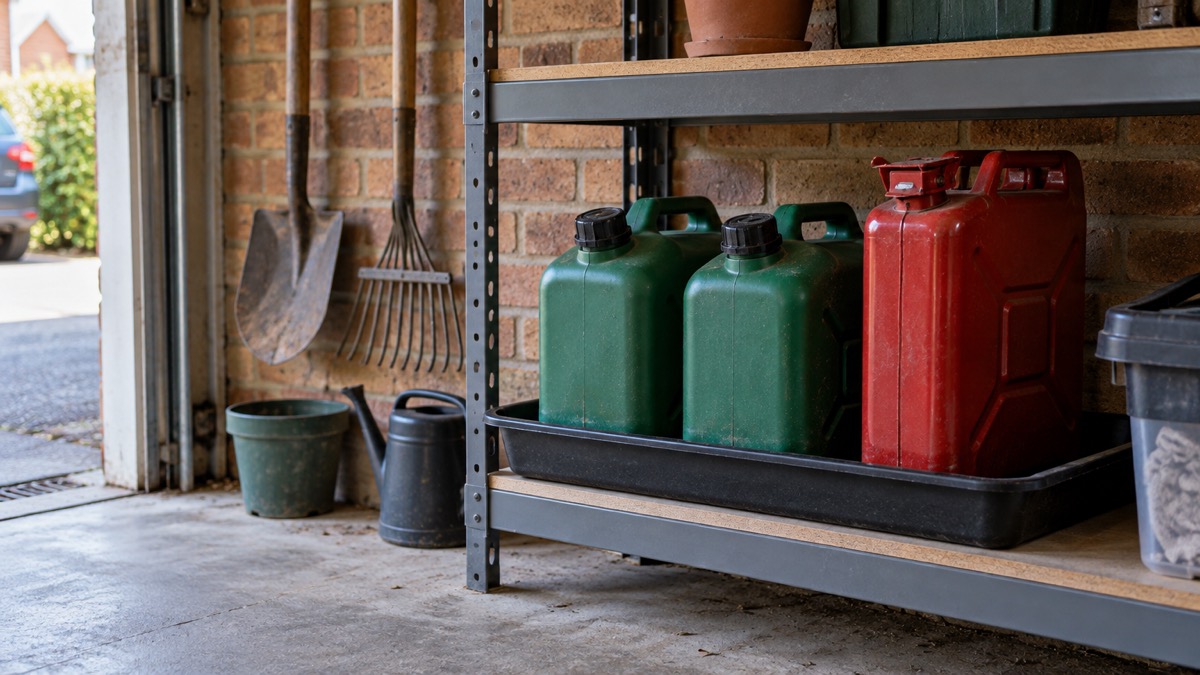
Fire and rescue service guidance on paraffin heaters gives a useful benchmark for how much spare liquid fuel a household should hold: keep spare fuel outside the home, no more than 23 litres (5 gallon), and preferably only 9 litres (2 gallon), in purpose made containers stored away from sources of heat6. That is paraffin guidance, not petrol law, but it reflects the same caution: keep spare fuel outside the home, in purpose made containers, away from heat.
For a generator, the practical sequence is:
- Decide how much fuel the generator needs for the outage you are planning for, and keep the total at or under 30 litres1.
- Store it outside the living space, in suitable containers, away from heat and naked flames1.
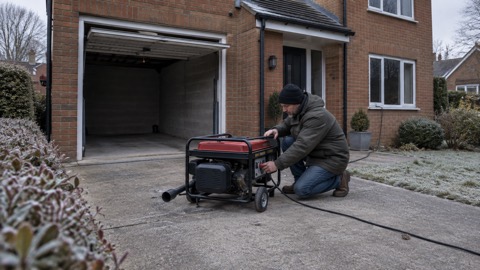
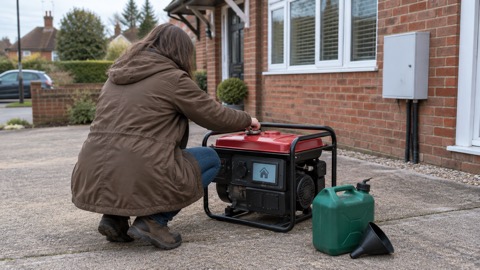
- Keep the generator itself outside, in a well ventilated space, when it is running4.
- Refuel only when the generator is switched off and cool, and never smoke near the fuel9.
- Check the fuel you hold before winter, and rotate it rather than letting it sit for years.
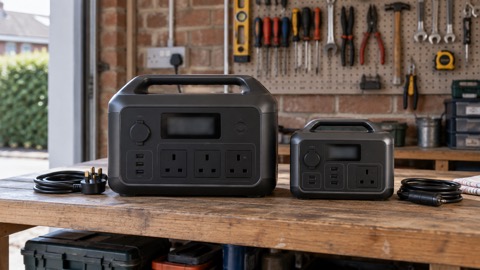
If you are weighing up whether a generator is the right answer at all, the portable generators guide sets out the petrol, diesel, dual-fuel and inverter types, and the generators or power stations comparison sets a fuel-burning generator against a battery alternative that needs no petrol at all.
Where a generator and its fuel must never go
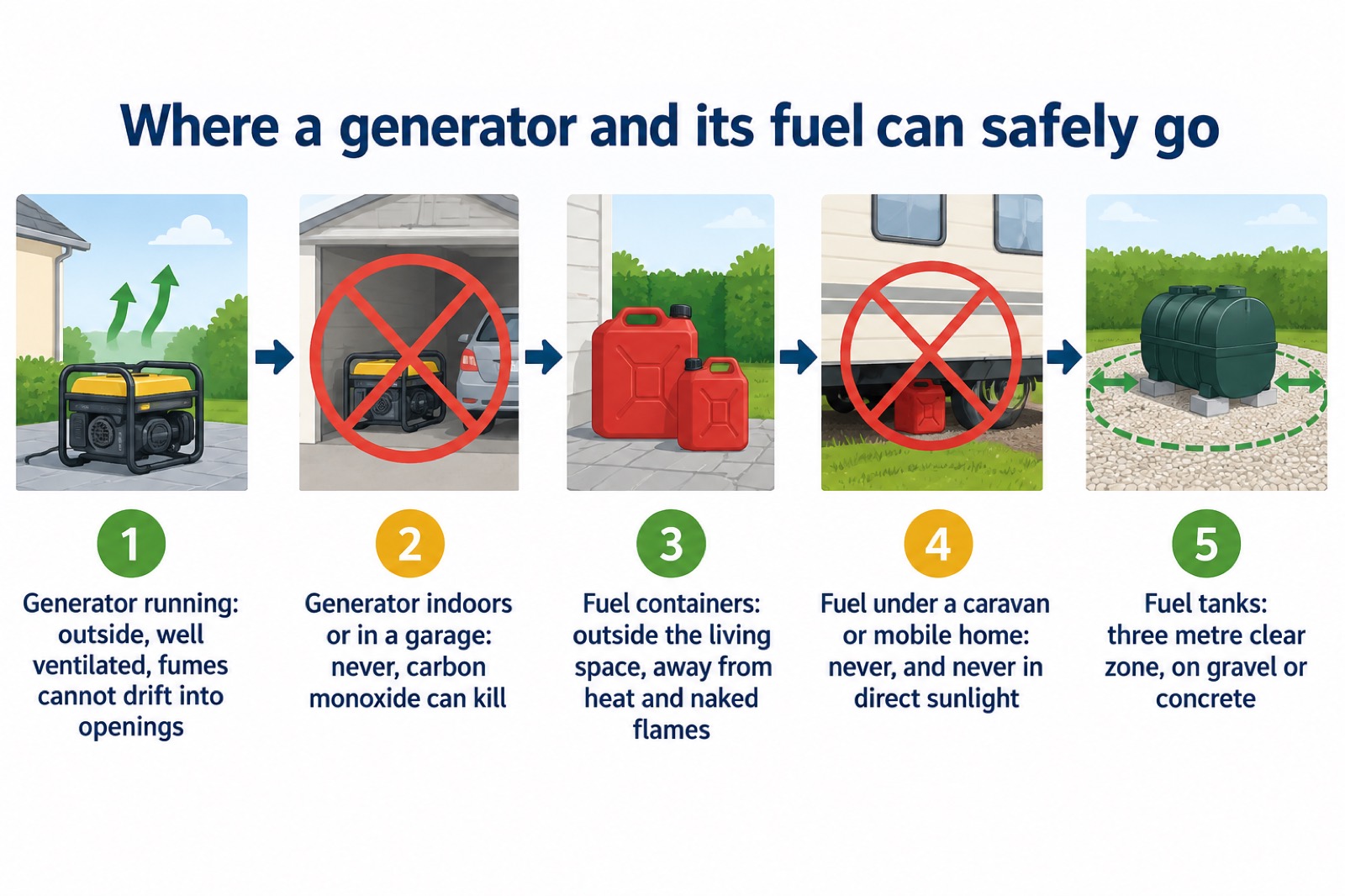
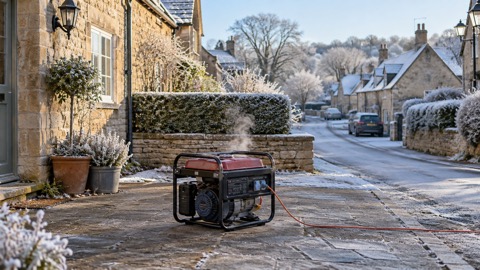
This is the part that matters most, because the consequences are not about property but about life. The Health and Safety Executive advises locating petrol generators and similar equipment outside in well ventilated spaces so that fumes disperse and cannot gather or drift into building openings4. It also says never to use petrol powered equipment indoors or in enclosed spaces unless the ventilation needs have been fully assessed4.
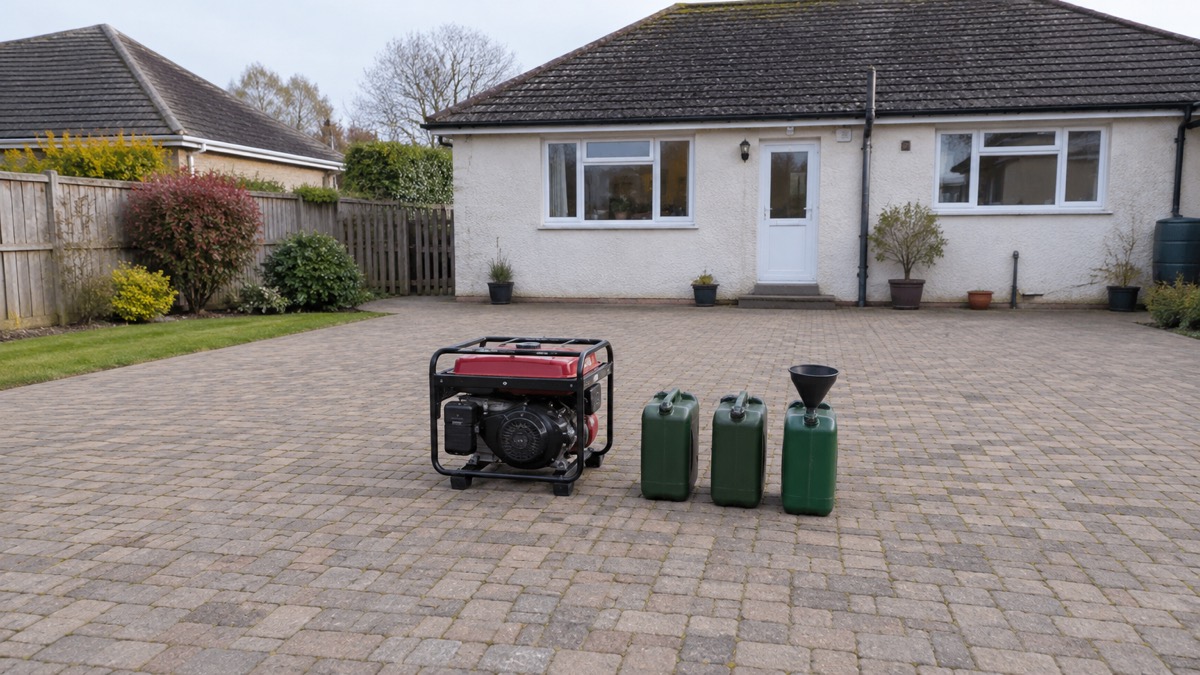
Carbon monoxide is produced by car engines and generators as well as by blocked chimneys, LPG heaters, gas boilers, gas cookers and barbecues12. It is colourless and has no smell, which is why siting matters more than noticing. The fire service's advice is to keep generators outside so fumes cannot gather or drift into openings4.
Fuel has its own no-go areas. Fire and rescue service guidance for caravans and mobile homes says do not store fuel under your home or in direct sunlight13. For fuel tanks more generally, wildfire guidance says to clear at least a three metre space around any fuel tanks, and to store tanks on non-combustible material such as gravel or concrete14. If you keep a demountable tank, that clear zone and hard standing are worth copying at home.
Getting help with a generator during a power cut
If the power goes, the first question is often whether someone will bring a generator. Network operators do use generators, but for their own repairs rather than as loans to households. Electricity North West explains that generators will sometimes be used for temporarily restoring customers while permanent repairs are completed15. For extended repairs, it says, generators are ordered through network partners who ensure a robust refuelling strategy is in place and connect to the network safely15. It also warns that you may experience a short outage while being connected back to the network after the repair15. In other words, a generator appearing in your street is a sign of repair work, not a supply you can plug into.
For households that need more than a torch, the Priority Services Register is the route to help. It lets your electricity, gas and water providers know that you need additional support, including when there is an interruption to your supply16. Eligibility includes people who have refrigerated medicines17. Northern Powergrid describes the practical assistance that may be given as including portable generators, battery packs or backup oxygen18. Contact your supplier to join, and tell them about any equipment you rely on.
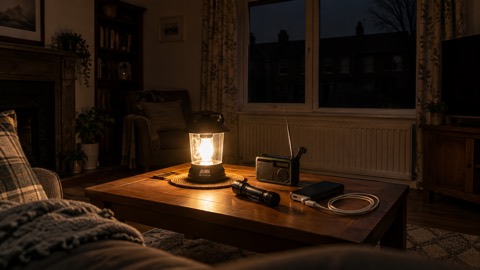
While you wait, the basics still apply. Keep a torch handy in case you are without power during the night19, and keep a charged power bank, a torch and spare batteries at home, with important telephone numbers written down somewhere accessible20. Keep your vehicle's fuel tank at least half full, and fill up if you know a power cut is coming, because many service stations cannot pump fuel during a power failure21. If a planned outage is coming, the power cut backup power checklist walks through what to have ready, and the backup power section covers the wider choices.
Petrol, diesel or LPG: choosing what to store
The fuel you store decides which rules apply, so it is worth choosing deliberately rather than by habit.
- Petrol gives you the widest choice of small generators, but it carries the 30 litre home limit and the strictest handling cautions1. It is the fuel most small open-frame generators run on; Briggs and Stratton describes its portable petrol open frame generators as providing reliable power for tools and household appliances23.
- Diesel has no specific legal requirement on the amount you may store at home, but fire and rescue services advise following the government's safety guidance on storing it1. The diesel storage page covers the detail.
- LPG is limited to storage and use of up to four cylinders or cartridges under independent guidance5, and spare cylinders should be stored outside where possible6. The LPG cylinders guide explains regulators and dual-fuel use, and the LPG or petrol comparison sets the two side by side.
Whichever you choose, the siting rules for the generator do not change: outside, well ventilated, fumes kept away from openings4. The generator safety guide covers carbon monoxide, fuel and electric shock together, and the carbon monoxide warning signs page explains what to look out for.
Sources (23)
- Storing fuel, Devon and Somerset Fire and Rescue Service, 2026
- Generators, Wiltshire and Swindon Prepared, 2026-10-25
- Stay warm safely in winter, Devon and Somerset Fire and Rescue Service, 2026
- Carbon monoxide, Health and Safety Executive, 2026
- LPG storage guidance, Liquid Gas UK, 2022
- Heating and gas, Scottish Fire and Rescue Service, 2024-11-21
- Bio-ethanol and gel fuels, Devon and Somerset Fire and Rescue Service, 2026
- How to buy the best generator, Which?, 2026-01-20
- Generators: Diesel and Petrol, Honda & Clarke - Clarke International, Clarke International
- After a flood, London Fire Brigade, 2026-10-25
- Flooding advice, Runnymede Borough Council, 2026-10-26
- Carbon monoxide safety, London Fire Brigade, 2026-10-25
- Caravans and mobile homes, Devon and Somerset Fire and Rescue Service, 2026
- Wildfires in rural areas, Devon and Somerset Fire and Rescue Service, 2026
- Restoration following a power cut, Electricity North West, 2026-10-25
- Be ready for emergencies, UK Government, 2026-10-21
- About the Priority Services Register, UK Power Networks, 2026-10-25
- Care, Northern Powergrid, 2026-10-26
- Storm advice, Power Cut 105, 2026-10-26
- Be prepared for winter emergencies, NHS Norfolk and Suffolk Integrated Care Board, 2026-10-01
- 12 tips to prepare for a power cut, Horsted Keynes Parish Council, 2026
- Being prepared for a power cut, SP Energy Networks, 2026-10-26
- Open frame generator, Briggs and Stratton, 2026
 Power Cut Backup Power Checklist
 Backup Power Before Winter
 Safe Battery Charging at Home
 Running a Generator Indoors
 Carbon Monoxide from Generators
 Generator Sizing for a Power Cut
 Generator Run Time on a Tank
 Diesel Storage at Home
 Storing a Generator
 Generators in Cold Weather
 Generator Noise and Neighbours
 Power Station Capacity Sizing
 Power Station Run Time
 Power Station for a Gas Boiler
 Power Station UPS Mode