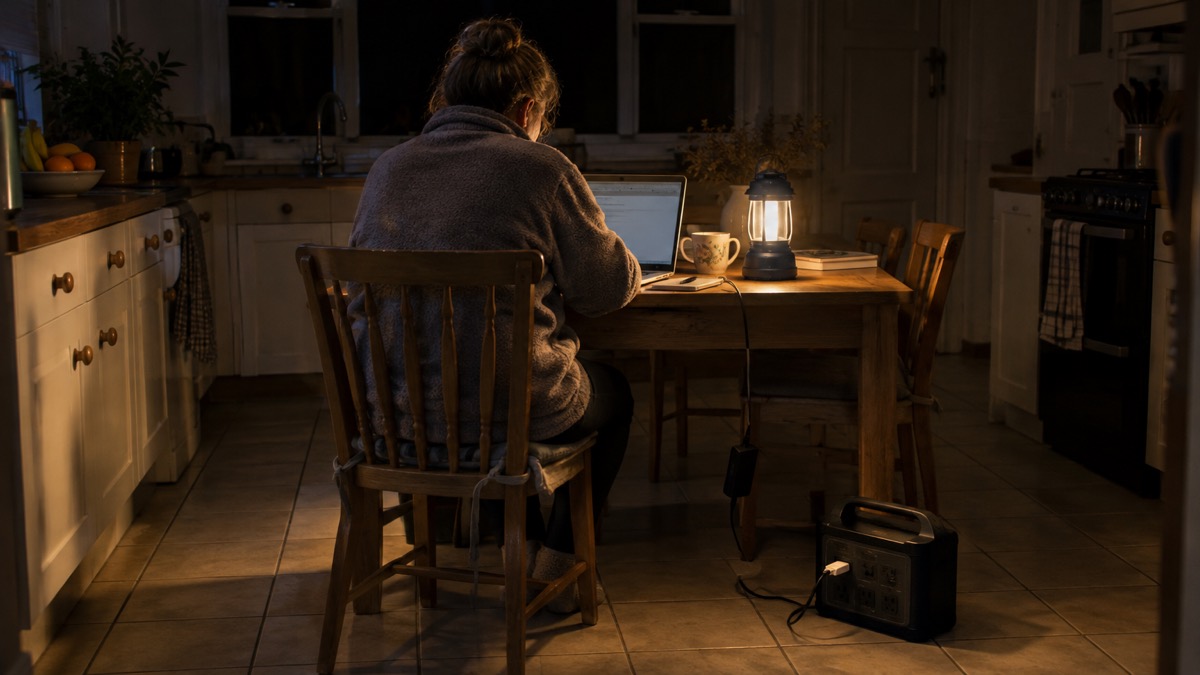
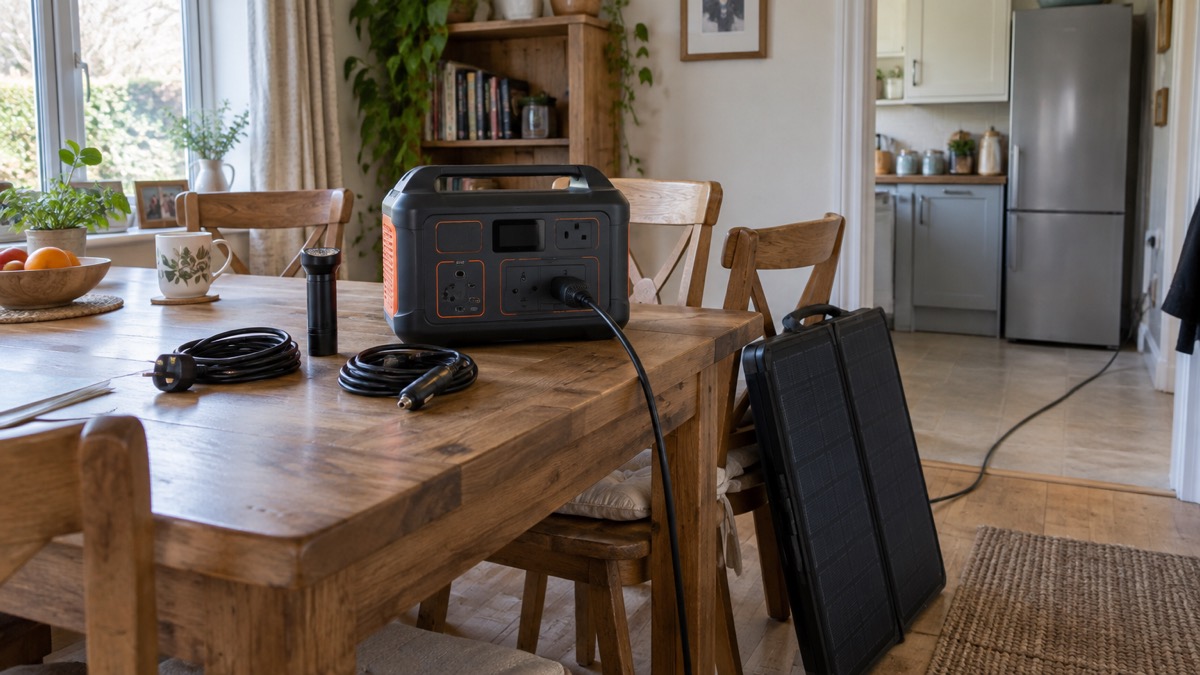
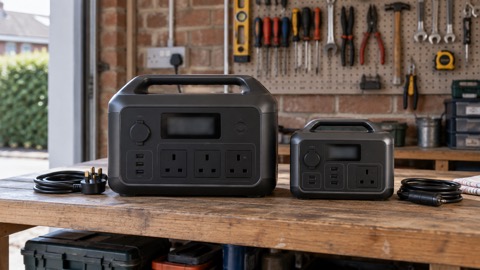
A portable power station is a large rechargeable battery with mains-style sockets and USB ports built in. How long it keeps your appliances going depends on two things: the capacity of the battery, measured in watt-hours, and the power draw of whatever you plug in. A 1000Wh unit, the size many households buy, will keep a fridge running for 8 to 12 hours continuously, or 1 to 2 days when the fridge cycles on and off as normal1. The same unit will run a laptop for far longer, because a laptop draws a fraction of the power.
The maths is simple once you know the numbers. A laptop is rated at up to 100W2, but most draw much less in ordinary use. A phone charger, a set of LED lights, a Wi-Fi router and a laptop together come to roughly 95W combined3. At that load, a mid-sized power station runs for many hours. The mistake households make is buying a unit for the fridge and then finding it cannot also run the kettle, the microwave or a fan heater, because heating appliances draw far more than the battery can supply at once.
This page sets out what each size of power station can realistically run, how to match a device to the right socket, and how to recharge between uses. It also covers where a power station should not be relied on, and what to do if someone in the household depends on powered medical equipment.
Run time: 8 to 12 hours continuously from a 1000Wh power station
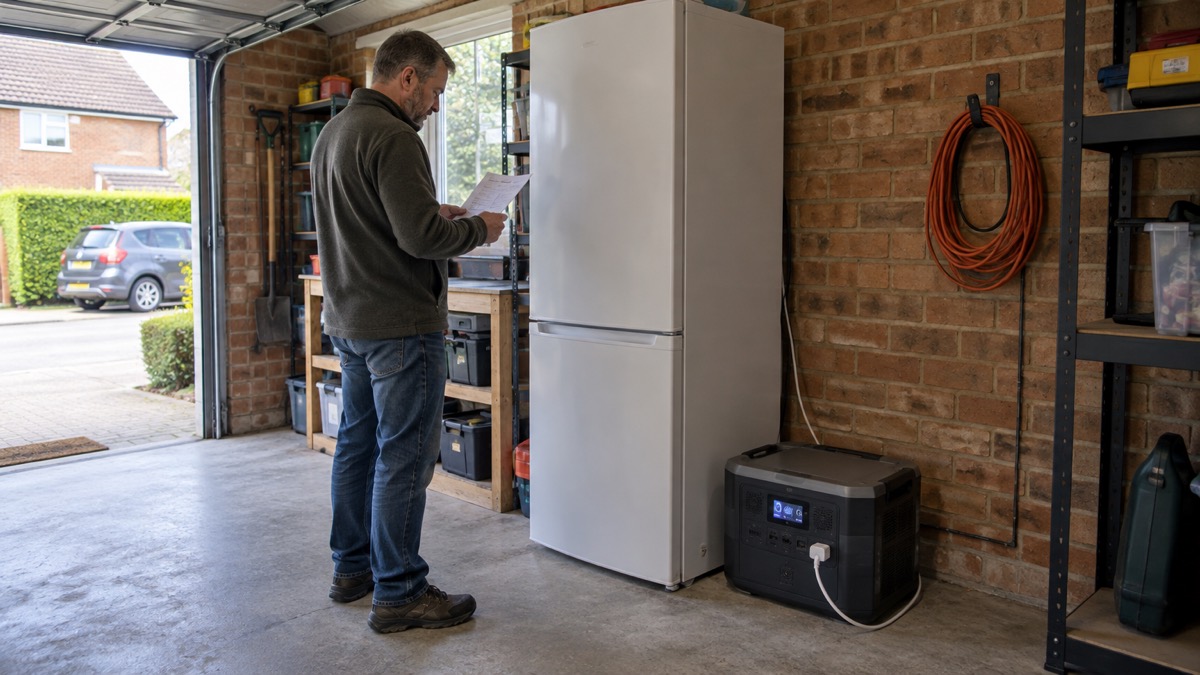
The headline figure for a 1000Wh power station is 8 to 12 hours of continuous fridge running, stretching to 1 to 2 days when the fridge cycles on and off1. That range is wide because a fridge does not draw its rated power all the time. The compressor runs until the cabinet reaches temperature, then switches off, and the duty cycle depends on how warm the room is, how often the door is opened and how full the fridge is.
Other makers give figures for their own products that show the same principle. EcoFlow states that its DELTA 2 Max will keep a 120W refrigerator running for up to 14 hours6. Which? reports that DJI claims its Power 500 can run a refrigerator for up to 22 hours5. BLUETTI's FridgePower is described as providing refrigerator backup for up to 4 days during blackouts and severe weather7. These are maker claims for specific products, not a general rule, and the run time depends on the appliance and the conditions.
What matters for a household is the shape of the trade-off. A fridge is a modest continuous load that adds up over a day. A laptop is a small load that runs for a long time. A heater or a kettle is a large load that empties the battery in minutes. The same 1000Wh battery behaves completely differently depending on which of these you ask of it.
The capacity of the unit is the other half of the equation. A 10kWh home battery is a different class of equipment: Anker states that a typical UK home uses 8 to 12 kWh a day, so 10kWh could last up to 24 hours under moderate consumption8. That is a whole-home figure, not a single-appliance one, and it shows how far a portable unit sits below a fixed home battery. For most households, the portable unit is there to carry the essentials, not the whole house.
A fridge can last 1 to 2 days because it cycles on and off
The reason a fridge gets 1 to 2 days from a 1000Wh unit, rather than the 8 to 12 hours of continuous running, is the cycling1. The compressor is not on all the time. Once the cabinet is cold, it rests, and the battery is not being drained. The practical effect is that a well-insulated, full fridge in a cool kitchen will last longer than an empty one in a warm room with the door being opened.
There is a limit to what a portable unit can do for a fridge, and it is worth being clear about it. A power station will keep the fridge cold for a day or two, which is enough to get through a short outage without losing food. It is not a substitute for a week of refrigeration. If the outage is longer, the food will spoil, and the sensible approach is to use the fridge less, keep the door shut and plan to use or move the contents.
A fridge is also not the only thing worth keeping cold. A freezer draws more when it runs, but it is well insulated and holds its temperature for a while if kept shut. The general principle is the same: the less you open it, the longer the cold lasts, whether the power is on or off.
What a 200 to 500Wh unit can keep going: phones, laptops and small lights
A smaller unit, in the 200 to 500Wh range, is not a fridge battery. It is a personal essentials battery, and it is very good at that job. The loads it suits are the ones a household actually misses first: phones, a laptop, a Wi-Fi router and a few lights. Together these come to roughly 95W3, which a mid-sized unit can carry for many hours.
The table below sets out what each device draws, so you can see why the small unit copes with some and not others.
| Device | Typical draw | What it means for a small unit |
|---|---|---|
| Phone charger | 10W3 | Charges many times over |
| LED lights | 15W3 | Runs for many hours |
| Wi-Fi router | 10W3 | Keeps the connection alive |
| Laptop | up to 100W2 | Runs for hours, not days |
| Microwave | 1000W9 | Beyond most small units |
| Hair dryer | 1600W10 | Far beyond a small unit |
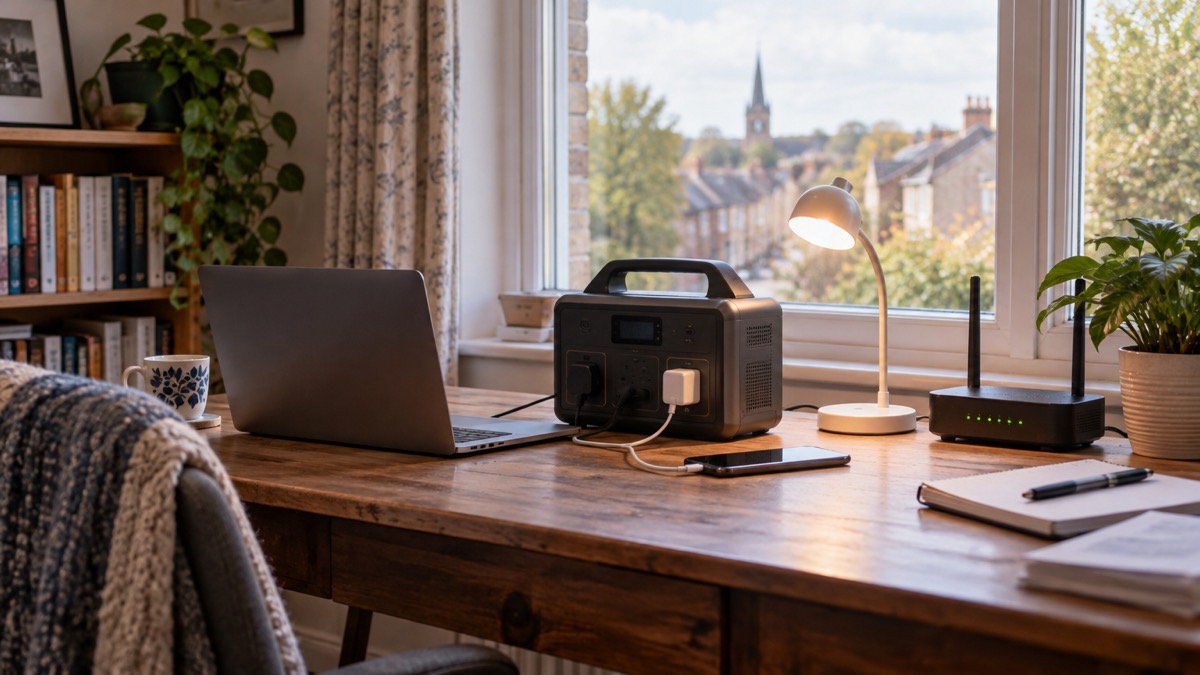
The pattern is clear. Devices that heat, spin a motor or cook draw hundreds or thousands of watts, and a small unit cannot supply that. Devices that charge a battery or light an LED draw tens of watts, and the unit can run them for a long time. A 300W-rated unit can supply up to 300W to its AC sockets, with a short surge allowance above that4, so a laptop and a few lights are comfortably within its range, while a microwave is not.
For phones specifically, a power bank is often the simpler tool, and a dedicated power bank page explains the options. The power station earns its place when you want to run several devices at once, or run something with a mains plug, for longer than a phone battery alone would last.
Sockets and USB ports: matching each device to the right output
A power station usually has two kinds of outlet, and using the right one matters for both safety and efficiency. The AC sockets are the mains-style ones, for anything with a standard plug. The USB ports are for phones, tablets and small devices.
The AC output is the one to check first. A unit rated at 300W can deliver a maximum of 300W to connected devices, with 600W available briefly through a surge feature4. A larger unit such as the Anker SOLIX C1000 Gen 2 is rated at 2,000W output with a 3,000W peak, and a capacity of 1,024Wh11. The peak figure is there to absorb the brief surge when a motor or compressor starts, not to run a 3,000W appliance continuously.
The USB ports have their own limits, and they are easy to overlook. On one Anker model, the USB-C1 and USB-A ports used together deliver a maximum of 20W, and used separately the USB-C1 output is 15W and the USB-A output is 12W12. That is fine for a phone, but a laptop that expects more will charge slowly or not at all. Anker's own guidance for its PowerCore 10000 power bank notes that devices needing above 2.4A input may charge slowly or not at all13, and the same caution applies to the USB ports on a power station.
The practical rule is to match the device to the outlet that suits it: mains plug to the AC socket, phone to USB. If a device has its own power supply brick, use that with the AC socket rather than trying to charge it from USB. The USB charging page explains cables and power delivery in more detail.
Recharging between uses: mains, car socket or solar
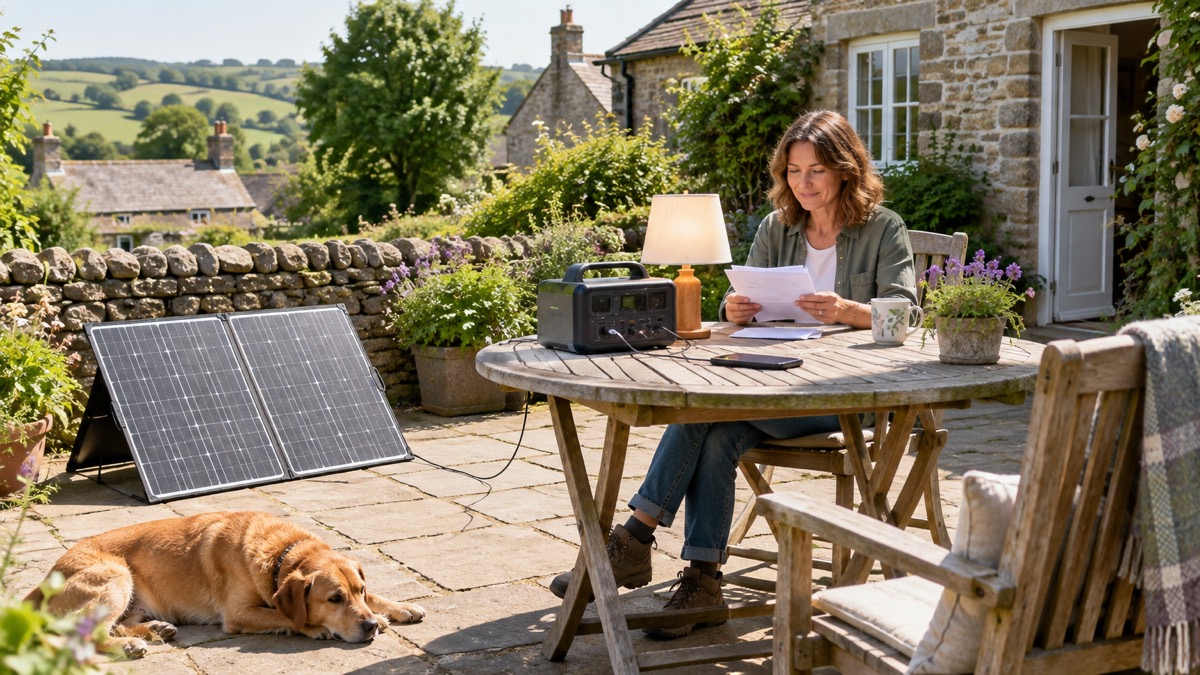
A power station is only useful if it is charged when the power goes off. Most units can be recharged from the mains, from a car socket or from a solar panel. Anker's C300X, for example, is rechargeable via AC mains, solar panels or car socket14. The Fogstar 2kWh unit supports AC charging, solar charging and vehicle charging15.
Mains charging is the fastest and the one to use before an outage is forecast. Some units can be charged from the grid and a solar panel at the same time, with solar power prioritised and the remaining capacity supplied by AC charging11. That is useful in a long outage if you have a panel set up, because it tops the battery up from two sources at once.
Solar charging is slower and depends on the weather. Which? notes that a power station will take a while to charge from solar5. The panel's output sets the pace: a 4W panel generates roughly 24 to 28Wh over 24 hours in summer16, which is enough to trickle a phone but not to refill a 1000Wh battery in any reasonable time. A larger panel is needed for anything more. The portable solar panels page covers sizing, and the solar charging time page explains what UK weather does to the figures.
Car charging is a useful fallback if you have a vehicle and the car socket can supply enough. It is slow, and it works best for topping up a small unit rather than refilling a large one. The car charging page sets out what to expect.
Where a power station should not be relied on
A power station is safe indoors in a way a petrol generator is not, because it has no fuel and no exhaust. That does not make it suitable for everything. There are three areas where households get into trouble: medical equipment, high-draw appliances and anything that involves the home's fixed wiring.
Medical equipment is the first. Northern Powergrid's advice is to talk to your supplier about back-up power if your medical equipment uses electricity17. A power station may not deliver the steady supply some devices need, and a device that draws a sudden high current can trip the unit's safety cut-off. One user of a Jackery Explorer 1000 v2 reported that the unit detected a quick 24 volt pull and, for safety reasons, cut off the current to a CPAP machine, so they switched to using the AC feature instead18. That is a maker's customer describing their own experience, not a guarantee, but it shows why the supplier's guidance matters. The medical devices page covers this in more detail.
High-draw appliances are the second. A microwave draws 1000W9, a hair dryer 1600W10, and a circular saw 1400W10. A small or mid-sized unit will either trip or drain in minutes. Before connecting a power tool, check its voltage, running wattage and starting requirement, because tools with large motors may need substantially more capacity than their normal running wattage suggests19.
The third is the home's fixed wiring. A power station is not designed to be connected to your house's circuits, and doing so is a job for a qualified person with the right equipment. The connecting to the home page explains the options.
There is also a safety point about the electricity network itself. The Health and Safety Executive warns that electricity can flash over from overhead power lines even though machinery or equipment may not touch them, and advises not to work under them when equipment could come within a minimum of 6 metres of a power line without getting advice21. That matters if you are using a power station outdoors near lines, or working at height. Keep tall equipment away from overhead lines, and never enter an electricity substation22.
Where to get help and what to do next
If you are buying a power station for the first time, start with the portable power stations guide, which explains the sizes and what each is for. If you already have one, the power station sizing page helps you work out whether it will carry what you need. The watts and watt-hours page explains the arithmetic behind every figure on this page.
For a power cut itself, the power cuts guide covers what to do and who to contact. If someone in the household relies on powered medical equipment, contact their supplier now, before an outage, and ask about back-up power17. Keep the unit charged, keep the solar panel and cables with it, and check the charge every few months so it is ready when you need it.
Sources (22)
- BLUETTI Portable Power Station, BLUETTI, 2026-10-25
- Ratings of electrical appliances, Electrical Safety First, 2026-10-25
- How to build a 72-hour household emergency power outage plan, Jackery, 2026-10-10
- Anker SOLIX C300 Portable Power Station, Anker SOLIX, 2026-10-25
- Emergency kit packing list, Which?, 2026-09-30
- EcoFlow DELTA 2 Max Portable Power Station, EcoFlow, 2026-10-25
- BLUETTI FridgePower, BLUETTI, 2026-10-25
- Anker SOLIX Home Backup Power, Anker SOLIX, 2026-10-25
- Slow and pressure cookers, Electrical Safety First, 2026-10-25
- EcoFlow DELTA Portable Power Station, EcoFlow, 2026-10-25
- Anker SOLIX C1000 Gen 2 Portable Power Station, Anker SOLIX, 2026-10-25
- Anker SOLIX C300 DC Portable Power Station, Anker SOLIX, 2026-10-25
- Anker PowerCore 10000, Anker, 2026-10-25
- Anker SOLIX C300X DC Portable Power Station, Anker SOLIX, 2026-10-25
- Fogstar 2kWh Portable Power Station, Fogstar, 2026-10-25
- Solar power for caravans and motorhomes, Caravan and Motorhome Club, 2026-10-25
- What to do in a power cut, Northern Powergrid, 2026-10-26
- Jackery Explorer 1000 v2 Portable Power Station (Refurbished), Jackery, 2026-10-25
- Generators, Clarke International, 2026-10-25
- Carbon monoxide, Health and Safety Executive, 2026
- Electricity introduction, Health and Safety Executive, 2026
- Safety, SSEN, 2026-10-26
 Power Cut Backup Power Checklist
 Backup Power Before Winter
 Safe Battery Charging at Home
 Running a Generator Indoors
 Carbon Monoxide from Generators
 Generator Sizing for a Power Cut
 Generator Run Time on a Tank
 Storing Petrol at Home
 Diesel Storage at Home
 Storing a Generator
 Generators in Cold Weather
 Generator Noise and Neighbours
 Power Station Capacity Sizing
 Power Station for a Gas Boiler
 Power Station UPS Mode