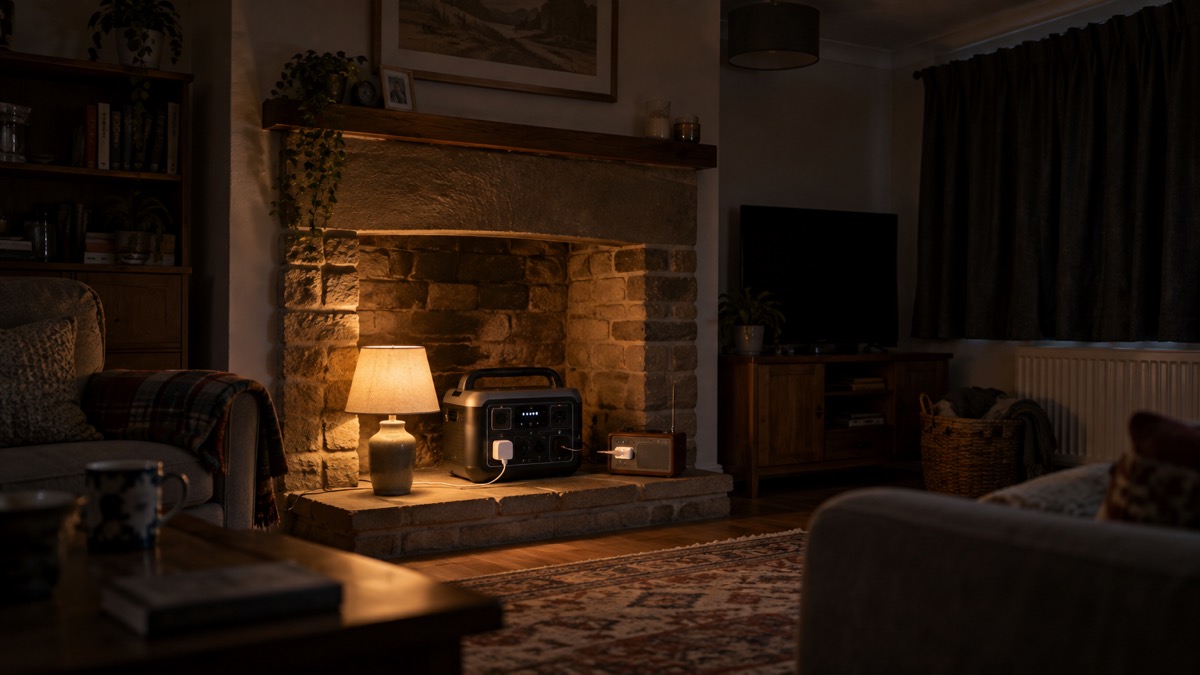
A 2kWh portable power station is a large rechargeable battery you keep charged at home so that a power cut does not leave you without lights, phone charging or a way to run a few essentials. The Fogstar 2kWh Portable Power Station stores 2048Wh and delivers it through a 2500W pure sine wave inverter, with a 5000W peak for the brief surge when a motor starts1. Fogstar lists it for emergency backup power, campervan setups, mobile working, outdoor use and off-grid applications1.
For a household, the practical question is not what it is but what it will run and for how long. A 2048Wh battery is a mid-sized unit: portable power stations on the market range from a couple of hundred Wh to over 3kWh, with inverter outputs up to around 3kW2. That places the Fogstar towards the larger end of capacity while staying movable at 21.6kg1. It is not a whole-house backup, and it is not a generator: it stores energy you have already put into it, so how you recharge it during a long outage matters as much as the capacity itself.
This page sets out what the unit does in an emergency, its specifications, its output and charging limits, how the 2kWh and 5kWh versions differ, where each fits in a home, and what the warranty covers. It also covers the safety points that apply to any lithium battery kept charged indoors.
What the Fogstar 2kWh Portable Power Station does in a home emergency
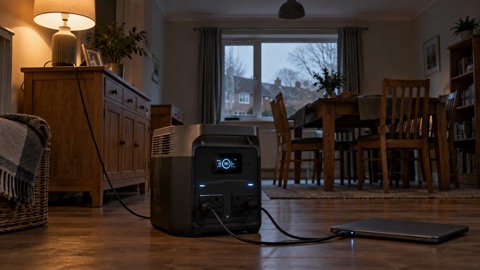
In a power cut, this unit gives a household a small, quiet supply of mains power without fuel, exhaust or the carbon monoxide risk that comes with a petrol generator. Fogstar describes it as suitable for emergency backup power alongside campervan setups, mobile working, outdoor use and off-grid applications1. For prepping, that first use is the one that matters: it is a battery you keep charged so that the lights, the phone chargers and a few small appliances keep working when the mains does not.
It is worth being clear about what kind of device this is. A portable power station is essentially a large, rechargeable battery pack, complete with AC outlets, USB ports and sometimes 12V DC sockets3. It does not generate electricity. Everything it gives you during an outage is energy you put into it beforehand, which is why the charging routine between emergencies is part of the kit, not an afterthought.
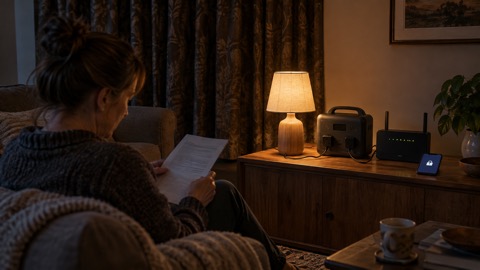
That shapes how a household should plan around it. The unit suits the common pattern of a UK power cut: a few hours without power, often in bad weather, when you want lighting, communications and perhaps a router or a small fridge to keep going. It is not a substitute for a generator in a multi-day outage where you need to run heating or heavy appliances, and it is not designed to be connected to your home's wiring. If you are weighing up the two approaches, our comparison of a portable power station or petrol generator for a power cut sets out the trade-offs, and the portable power stations guide explains the category as a whole.
The unit also supports pass-through operation on the 5kWh model, which Fogstar describes as backup power for compatible devices during power interruptions4. That kind of function is useful for a router or a small device that must not lose power, but it is not the same as a whole-house uninterruptible supply. Our page on using a power station as a UPS explains switchover times and what to expect.
Specifications: 2048Wh battery and 2500W pure sine wave output
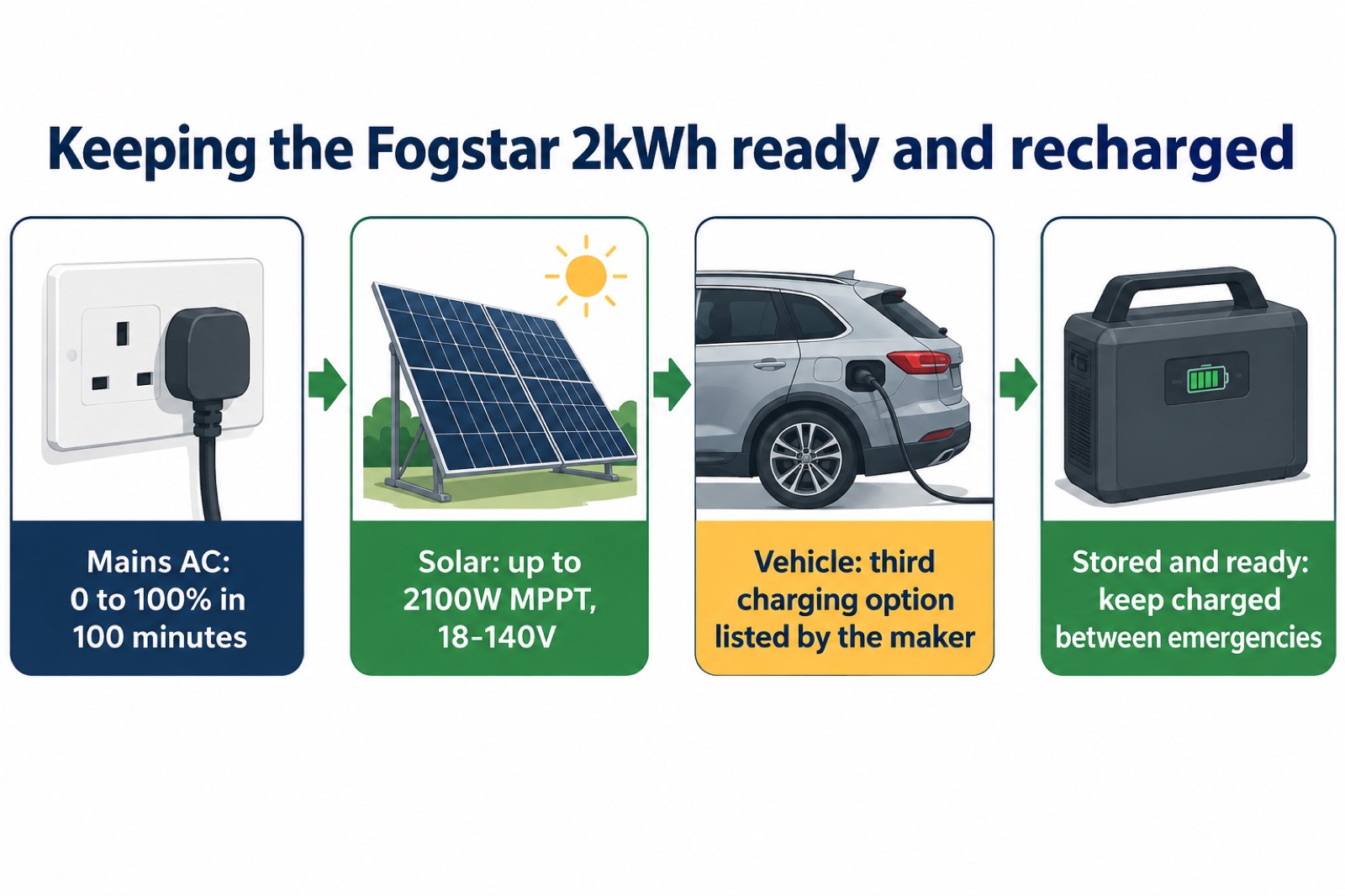
The headline figures are a 2048Wh battery and a 2500W pure sine wave inverter1. The battery runs at 51.2V and uses LiFePO4 chemistry1. Fogstar lists AC charging, solar charging and vehicle charging as the ways to fill it1.
| Specification | Fogstar 2kWh Portable Power Station |
|---|---|
| Energy | 2048Wh1 |
| Battery chemistry | LiFePO41 |
| Battery voltage | 51.2V1 |
| AC output | 2500W pure sine wave1 |
| Peak output | 5000W1 |
| Solar input | 2100W MPPT, 18-140V1 |
| USB-C output | 100W PD1 |
| AC recharge time | 0 to 100% in 100 minutes1 |
| Dimensions | 460mm x 270mm x 305mm1 |
| Weight | 21.6kg1 |
| Expandable | Yes, compatible with Fogstar expansion battery packs1 |
| Warranty | 3 years1 |
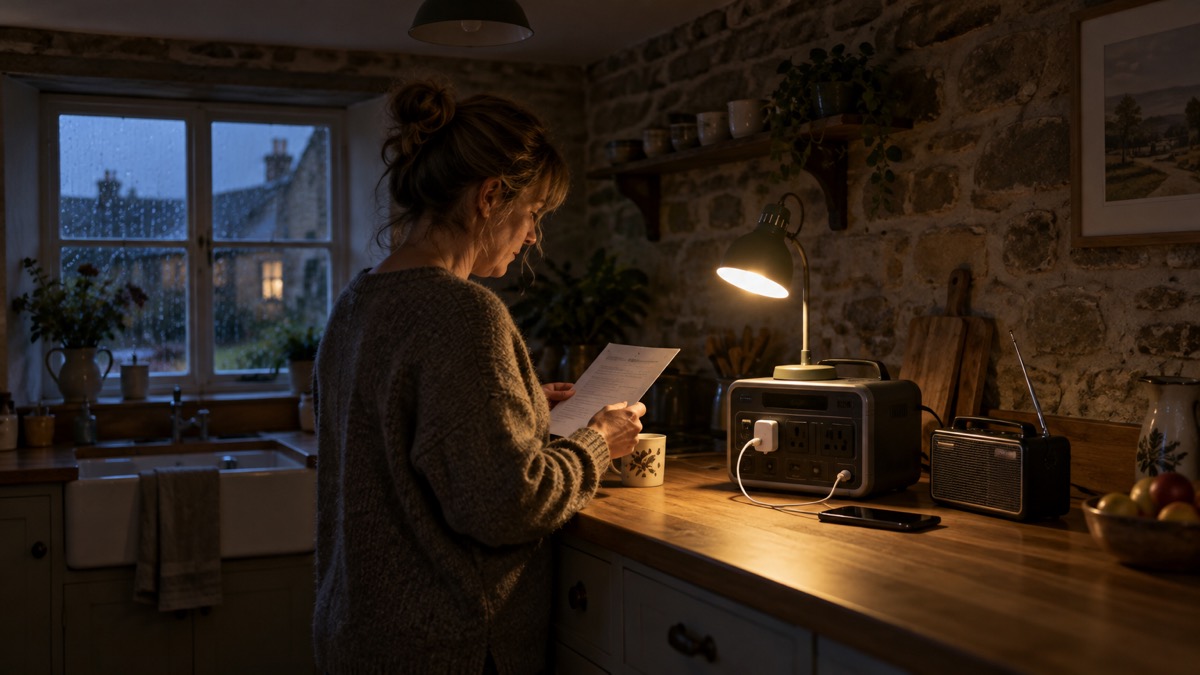
Pure sine wave output matters for household kit. It is the same shape of AC waveform as the mains, which is what appliances with motors or electronics expect. That is why the inverter type is worth checking on any power station you consider for a fridge, a boiler pump or a laptop charger, rather than looking only at the wattage.
The 100W PD USB-C output is the other figure a household will use every day of an outage1. It is enough to charge phones and tablets quickly, and it means you do not need to run the AC inverter just to top up a handset. Our guide to USB-C charging and Power Delivery explains what the wattage means for cables and devices.
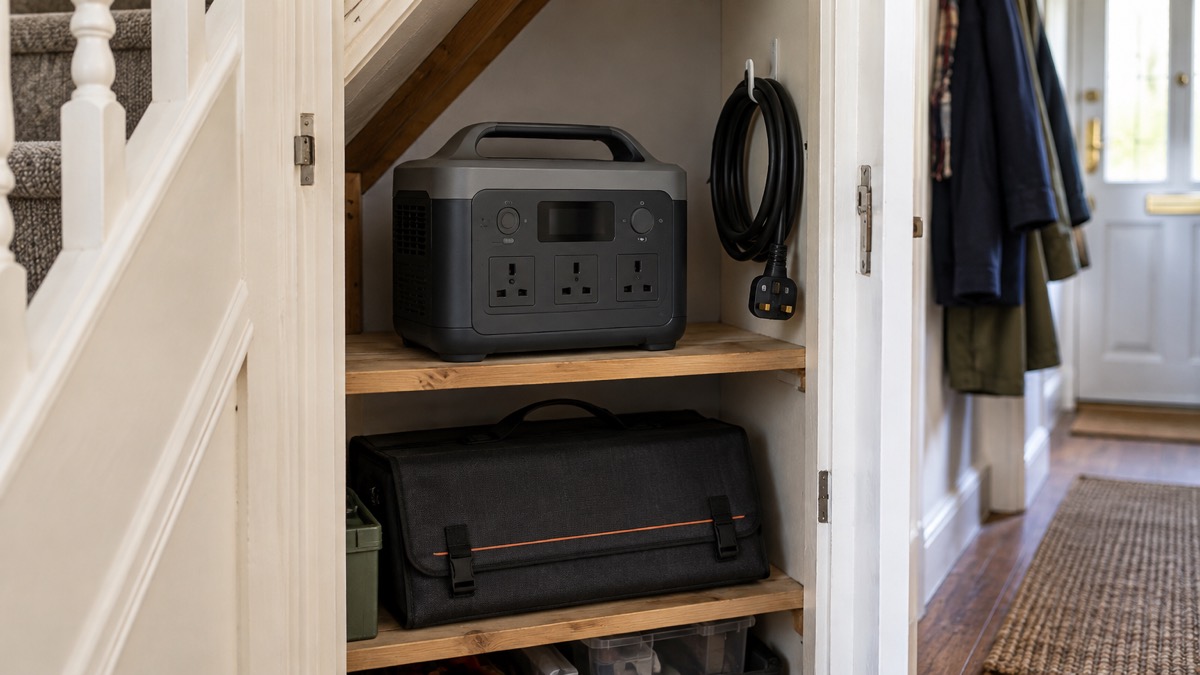
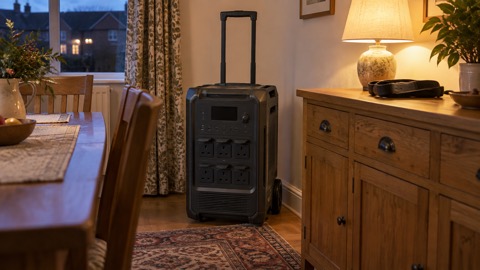
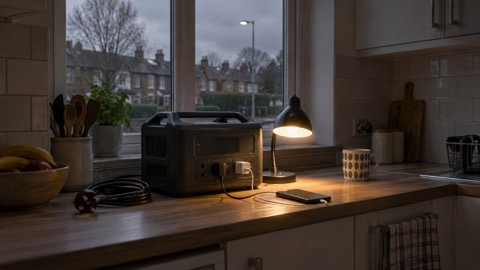
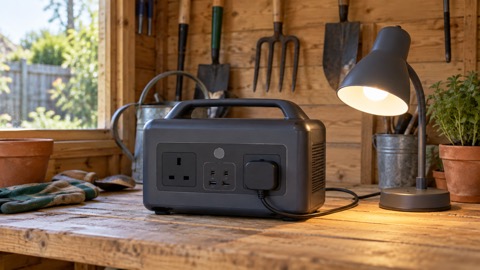
For a sense of scale, the unit is roughly the size of a toaster or air fryer, which is how owners on a consumer forum describe portable power stations generally5. At 21.6kg it is a two-handed lift for most people, and it wants a permanent spot rather than being moved from room to room.
Output limits: 2500W continuous, 5000W surge
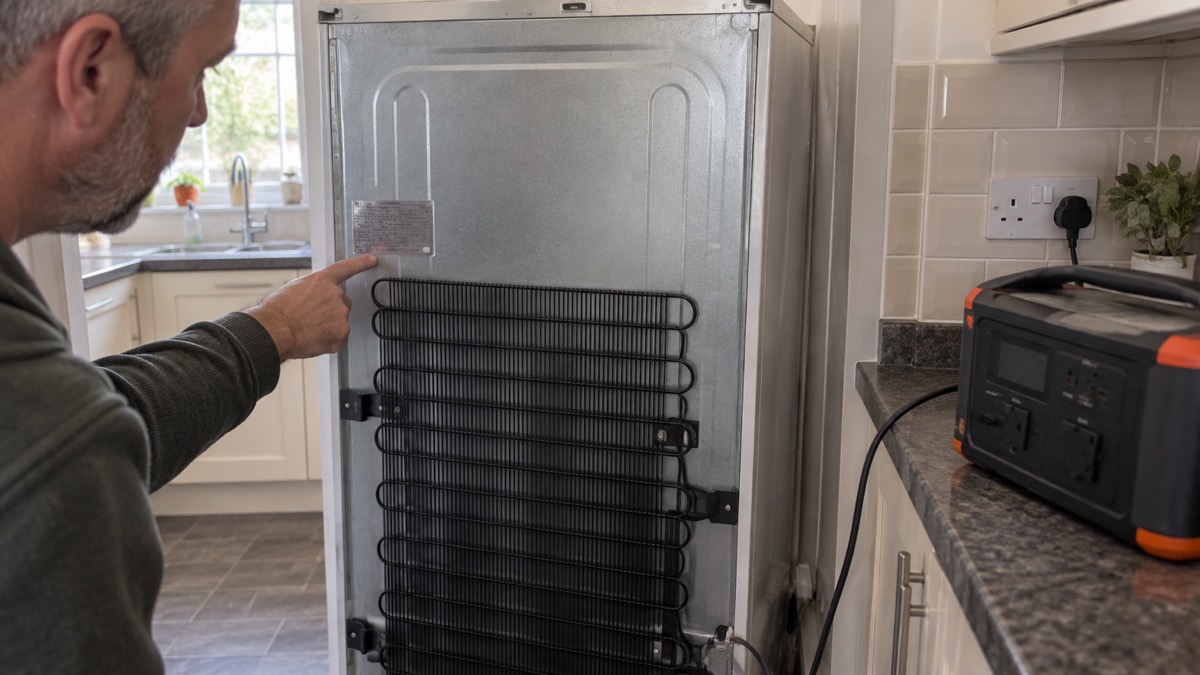
The 2500W continuous rating is the load the unit will carry for as long as the battery lasts1. The 5000W peak is a short burst for appliances that draw a spike of current when they start, such as a fridge compressor or a motor1. Confusing the two is the most common way households overload a power station: an appliance rated below 2500W running watts can still trip the unit if its startup surge is large.
Plan around the continuous figure, not the peak. Add up the running watts of everything you want on at once and keep well inside 2500W, leaving headroom for startup surges. In practice that means choosing a small number of essentials rather than trying to run the house. Our guide to watts, watt-hours and surge works through the arithmetic, and what capacity power station you need helps you size a unit to your household.
How long the battery lasts depends entirely on what you plug in. A phone charge draws a few watts; a heater draws far more. The maker states a 2048Wh capacity for this unit but gives no run-time figures, so treat any estimate as your own arithmetic from that capacity. Our page on how long a power station runs a fridge or laptop explains the method.
Charging from solar: up to 2100W at 18-140V
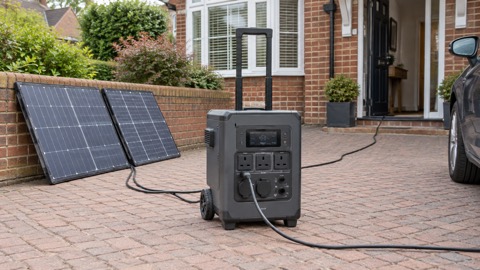
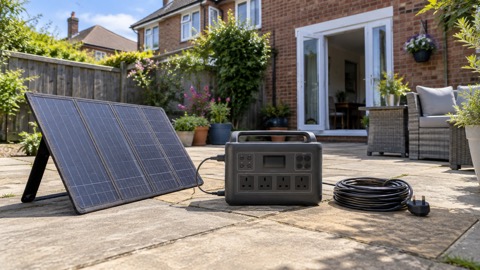
The unit accepts up to 2100W of solar through an integrated MPPT charger, with an input voltage range of 18-140V1. MPPT, or maximum power point tracking, is the electronics that squeeze the most usable power from a panel as light and temperature change. The wide voltage window means the unit can take a range of panel arrangements rather than one fixed specification.
The 2100W figure is a maximum the unit can accept, not a promise about what a typical UK setup will deliver. Panel output depends on panel size, angle, season and weather. For comparison, Jackery's own support guidance works through the expected input from two 100W panels and arrives at approximately 120W combined6. That illustrates the gap between a panel's label and what reaches the battery in real conditions, and it is why solar is a supplement to mains charging rather than a replacement in winter.
If you are building a solar charging setup, our guides to portable solar panels for charging in a power cut and what size solar panel you need cover panel choice and realistic expectations. How long solar charging takes in the UK is the page to read before relying on the sun during an outage.
Vehicle charging is the third option Fogstar lists1. It is slower than mains and depends on the vehicle, but it is a useful fallback if the outage is long and you have a car. Our page on charging a power station from your car explains the limits.
For most households the routine is simple: keep the unit on mains charging so it is full when the power goes, and treat solar and vehicle charging as ways to top it up during an extended outage. The 2kWh unit accepts 18-140V solar input with up to 2100W maximum PV support1, and the 5kWh unit lists 2100W MPPT solar input2, so a panel set can add charge over a long outage rather than only holding what the mains put in.
2kWh or 5kWh: how the two versions differ
Fogstar makes two versions, and the differences decide which suits a household. The 2kWh unit stores 2048Wh through a 2500W inverter with a 5000W peak1. The 5kWh unit stores 5040Wh through a 5000W pure sine wave inverter with a 7000W peak, and lists five AC outputs4. Both use LiFePO4 chemistry and both carry a 3-year warranty1.
| Fogstar 2kWh | Fogstar 5kWh | |
|---|---|---|
| Energy | 2048Wh1 | 5040Wh4 |
| AC output | 2500W pure sine wave1 | 5000W pure sine wave4 |
| Peak output | 5000W1 | 7000W4 |
| AC outlets | Not stated in the specifications summarised here | 54 |
| Battery voltage | 51.2V1 | 48V4 |
| Chemistry | LiFePO41 | LiFePO44 |
| Solar input | 2100W MPPT1 | 2100W MPPT4 |
| Weight | 21.6kg1 | 51kg4 |
| Warranty | 3 years1 | 3 years4 |
| Availability | Listed by the maker | Listed as sold out on 25 October 20264 |
The 5kWh version was listed as sold out when the maker's page was checked on 25 October 20264. If you are planning around the larger unit, confirm availability with Fogstar before you build a plan on it. The 2kWh unit is expandable with Fogstar expansion battery packs, which is one route to more capacity without changing unit1. The 2kWh Expansion Battery is listed as compatible with the Fogstar 2kWh and 3kWh Portable Power Stations and uses LiFePO4 chemistry7.
The voltage difference is worth noting if you plan to add batteries or match solar equipment. The 2kWh unit runs at 51.2V and the 5kWh at 48V1. They are separate systems, and accessories are matched to one or the other. Check compatibility with the maker before buying anything to add to either.
For a household, the choice comes down to what you need to run and for how long. The 2kWh unit is the more movable of the two and suits a flat or a house where the priority is lighting, communications and a few small appliances. The 5kWh unit weighs 51kg and pairs a 5000W pure sine wave inverter with 5 AC outputs2, so it suits a household that needs to carry a larger load or run more appliances at once. Neither is a whole-house solution, and neither should be wired into your home's circuits. Our page on connecting a generator or battery to your home's wiring explains why that is a job for a qualified electrician and what the alternatives are.
Size, weight and where each version fits
The 2kWh unit measures 460mm x 270mm x 305mm and weighs 21.6kg1. That is small enough to sit on a worktop or the floor of a cupboard, and heavy enough that you will want to decide its place once and leave it there. Fogstar describes the format as allowing flexible transport and positioning1.
The 5kWh unit weighs 51kg4. That is a two-person lift and effectively a fixed installation in a home, garage or workshop. Fogstar describes it as delivering high-capacity backup power for homes, workshops, off-grid systems and campervan use4. If you are choosing between them, the weight is the practical dividing line: one person can move the 2kWh unit, and the 5kWh unit stays where it is put.
For context, the most readily available portable generator type in an official report on storm response weighed around 1,000kg and measured 2m long by 1m wide8. A battery unit at 21.6kg or 51kg is a different class of object entirely, which is why it can live indoors and be used without fuel or exhaust.
Where you put it matters for safety as well as convenience. Keep it in a dry, ventilated space, away from damp and away from anything flammable, and follow the maker's storage instructions. Our guide to storing a power station when not in use and our page on what temperature batteries should be stored at cover the conditions that affect both safety and how much charge the battery holds.
For a campervan or mobile working setup, the 2kWh unit is the more practical of the two: it measures 460mm x 270mm x 305mm and weighs 21.6kg, which the maker describes as being for flexible transport and positioning1. EcoFlow's own advice for anyone carrying a power station is to choose a lightweight model9, which is a reminder that weight is the first specification to check when the unit is going to move.
Keeping it ready, and using it safely
A power station is only useful if it is charged when the power goes. The 5kWh unit is described by the maker as combining rapid charging capability with its 5000W pure sine wave inverter and high solar input support2, so the simplest routine is to keep it plugged in and full, checking the charge level as part of your seasonal preparations. Our backup power checks before winter checklist sets out what to check and when.
Safety points apply to any lithium battery kept charged at home, and the maker's instructions come first. The fire and rescue service advises on charging lithium batteries safely, and the general principles are to use the charger supplied or recommended by the maker, to charge on a hard, non-flammable surface, and not to leave charging unattended for long periods or overnight where you can avoid it. Our safe battery charging at home checklist and lithium-ion battery safety at home guide cover this in detail.
Watch for the warning signs that a battery is deteriorating. Our pages on warning signs a lithium battery is dangerous and what to do if a battery starts swelling explain what to look for and when to stop using a unit. If a battery is damaged, do not put it in household waste; our guide to disposing of a damaged lithium battery explains the safe route.
Charging in cold weather is a particular issue for a unit kept in a garage or van. Our page on charging lithium batteries below freezing explains why cold affects charging and what to do about it.
For a household with medical equipment, a power station can be part of the plan but should never be the only plan. Our guide to powering CPAP, oxygen and other medical devices from a battery explains how to register for priority support and what to arrange with your supplier. The Priority Services Register is the main route to extra help during an outage, and our extra help in an emergency section explains who is eligible and how to sign up.
Warranty: 3 years on both versions
Both the 2kWh and 5kWh units carry a 3-year warranty1. That is longer than some competitors: BLUETTI states a 2-year warranty on new units and 6 months on refurbished ones10, and Jackery lists 3+2 years extended on most Pro and Plus series and 2+1 years on its standard series11. Warranty length is one of the few specifications that is directly comparable across makers, and it is worth checking before you buy any unit you intend to rely on.
Keep your proof of purchase and the maker's documentation with the unit. If something goes wrong, the warranty is the route to repair or replacement, and having the paperwork to hand makes that quicker. Fogstar's own brand page is the place to check current product information and support details.
A 3-year warranty also sets a useful review point. Batteries age, and a unit that has been kept charged and used occasionally should still be serviceable at the end of the warranty period, but it is worth testing it under load once a year so that you know it still performs before you need it in an outage.
Where it fits in a household plan
The Fogstar 2kWh Portable Power Station is a mid-to-large battery for a household that wants lighting, phone charging and a few small appliances to keep working through a power cut. It is quiet, needs no fuel and can live indoors, which makes it a sensible first step for a flat or a house where a generator is impractical. It is not a whole-house backup, it will not run heating, and it depends on you keeping it charged.
Build it into a plan rather than treating it as a single purchase. Decide which circuits and appliances matter most, using our guide to deciding what to keep running when the mains fails. Work out the load with watts, watt-hours and surge. Keep it charged, store it safely, and know how you would recharge it in a long outage. Our power cut backup power checklist and the backup power section bring the whole picture together.
Sources (11)
- Fogstar 2kWh Portable Power Station, Fogstar, 2026-10-25
- Portable power stations, MoneySavingExpert forum, 2026
- Can a portable power station run power tools?, Machine Mart, 2026
- Fogstar 5kWh Portable Power Station, Fogstar, 2026-10-25
- What to do in a power cut, MoneySavingExpert forum, 2026
- Jackery user guides, Jackery, 2026-10-25
- Fogstar 2kWh Expansion Battery, Fogstar, 2026-10-25
- Interim report on the review into the networks' response to Storm Arwen, Ofgem, 2022-02-17
- Portable power stations for camping, EcoFlow, 2026-10-25
- BLUETTI portable power station, BLUETTI, 2026-10-25
- Jackery Solar Generator 1000 v2, Jackery, 2026-10-29

 BLUETTI Apex 300 Power Station
 BLUETTI Elite 100 V2
 Anker SOLIX C2000 Gen 2
 Anker SOLIX C1000 Power Station
 EcoFlow DELTA Pro
 BLUETTI Elite 400
 Anker SOLIX C300 Power Station
 EcoFlow DELTA 3
 EcoFlow DELTA 2 and DELTA 2 Max
 EcoFlow DELTA and DELTA Max
 EcoFlow RIVER 3 and RIVER 3 Plus
 EcoFlow RIVER 2 and RIVER 2 Max