Two numbers decide whether a piece of backup power kit will serve your household in a power cut: the watts it can supply, and the watt-hours it holds. Watts measure power, the rate at which electricity is being used at any moment. Watt-hours measure energy, how much of that power is available over time. A power station with a 1,000W output and a 1,000Wh capacity can run a 1,000W appliance for about an hour, or a 100W appliance for about ten. Confusing the two is the single most common mistake people make when buying backup power, and it leads to kit that either cannot start the fridge or runs out far sooner than expected.
The distinction matters because household demands vary enormously. A compact power station with around 300Wh to 500Wh should suffice for light tasks such as charging phones, lighting, and running small gadgets, while medium-duty tasks like powering tool chargers, small appliances, or multiple devices at once call for a unit in the 500Wh to 1000Wh range1. A station that comfortably runs lights and charges phones all evening may still refuse to run a small appliance, because its momentary demand can exceed what the inverter will deliver. Before choosing any kit, work through the three numbers in this guide: running watts, surge watts and watt-hours.
Most power cuts in the UK are short. Which? notes they are "usually over in a matter of minutes"2, and National Grid's Winter Hub says most do not last very long, though some go on longer depending on the weather and where you are3. That shapes what the numbers need to achieve: for most households the job is bridging minutes to hours, not days. Our page on deciding what to keep running helps you choose which devices those hours should go to.
Watts measure power, watt-hours measure how long it lasts
Watts are the measurement of how much power is used in an electrical circuit: amps multiplied by volts equals watts4. The higher the wattage of an appliance, the more power is used to run it4. Generator and power station output is usually shown in watts or kilowatts, with 1kW equal to 1,000W5. So when a maker says a station delivers 1,000W, that is a rate, like the flow rate of a tap. It says nothing about how long the flow can continue.
Watt-hours are the capacity figure, the size of the tank. A battery holding 1,000Wh can theoretically deliver 1,000W for one hour, 500W for two hours, or 100W for ten. In practice you get somewhat less, because converting a battery's direct current into the alternating current your appliances expect loses some energy along the way, a point covered later in this guide. Makers state capacity in watt-hours (Wh) or kilowatt-hours (kWh), where 1kWh is 1,000Wh.
Electrical Safety First gives a worked example of the arithmetic in its heat gun advice: a 1,500-watt tool used for 30 minutes consumes 0.75 kWh9. That is the whole calculation in one line. Multiply watts by hours to get watt-hours, or divide watt-hours by watts to get hours. The Caravan and Motorhome Club applies the same arithmetic to low-voltage batteries: two 8-watt fluorescent lights used for 5 hours equals 80 watt-hours, and dividing the watt-hours by 12 (the battery voltage) gives 6.6 ampere-hours per day10.
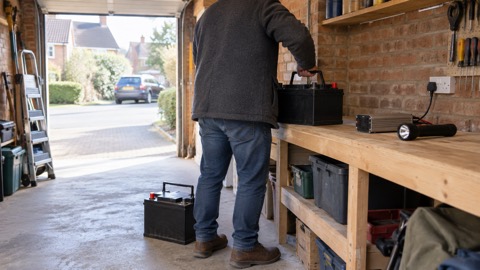
Ampere-hours, or amp-hours (Ah), are the capacity measure used for 12V leisure and car batteries rather than power stations. The conversion is simple: watt-hours divided by volts equals amp-hours, and amp-hours multiplied by volts equals watt-hours4. A 100Ah 12V battery therefore holds about 1,200Wh in theory. Our page on leisure and LiFePO4 batteries goes into what that means in practice.
Continuous output: what a power station can supply steadily
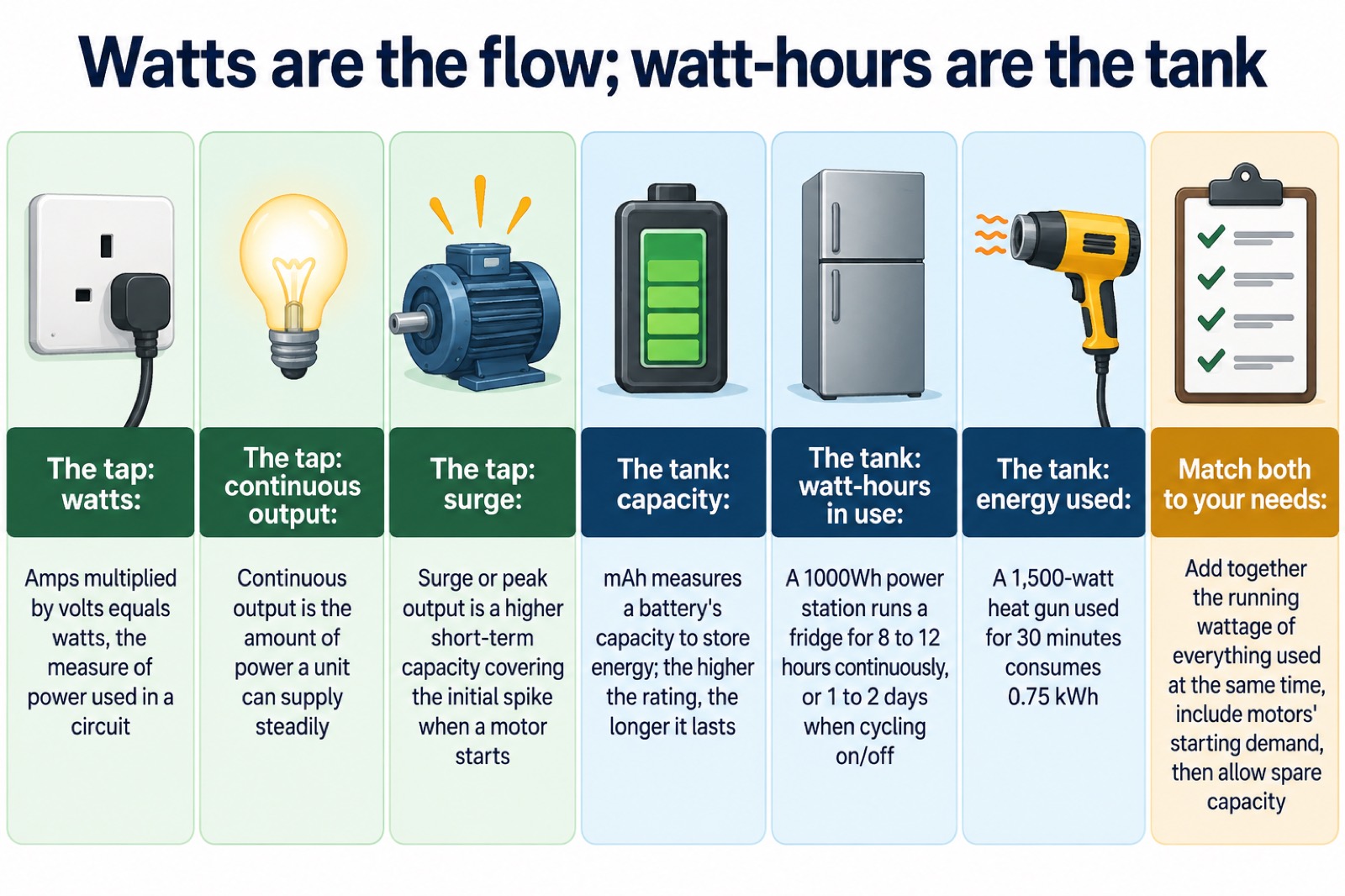
The continuous, or rated, output is what the kit can supply all day without cutting out. For a portable power station it is the inverter's rating; for a generator it is the engine and alternator's rating. Sterling Power's PS124000 inverter, for example, lists a continuous output of 4,000W11. Clarke's generator guidance is direct about how to use these figures: "Add together the running wattage of everything likely to be used at the same time. Include the starting demand of motors, compressors and pumps, then allow spare capacity"5.
That last phrase matters. Running a station or generator at its absolute maximum leaves no room for the unexpected, and some makers advise against running at maximum watts for more than short periods. Spare capacity also covers the small extra draws that creep in: a phone charger here, a light there. A station rated at 1,000W continuous is realistically a comfortable match for a household drawing 700 to 800W at once.
To add up your own household's running watts, use the rating plate on each appliance, or the typical figures Electrical Safety First publishes. Its table of common appliances includes a mini fridge at 100W, an under-counter fridge at 120W, a standard fridge freezer at 150W, a freezer at 200W, a microwave at 1,000W, a mobile phone charger at up to 140W, tool battery chargers at up to 350W, a heated clothes airer at 300W, and an iron at 3,000W1. Which? adds that a typical kettle uses around 3,000 watts7.
| Appliance | Typical running watts |
|---|---|
| LED night light | 0.5 to 2W12 |
| Mini fridge | 100W1 |
| Under-counter fridge | 120W1 |
| Standard fridge freezer | 150W1 |
| Freezer | 200W1 |
| Heated clothes airer | 300W1 |
| Tool battery charger | up to 350W1 |
| Microwave | 1,000W1 |
| Electric fan | 15 to 100W13 |
| Electric blanket | 60 to 100W14 |
| Kettle | up to 3,000W1 |
| Iron | 3,000W1 |
Surge output covers the start-up spike of a motor
Anything with an electric motor draws a burst of extra power at the moment it switches on. Clarke's generator guidance states: "A motor may briefly require two or three times its normal running wattage"5. Which? is more specific about the appliances that matter most in a power cut: "items with an induction motor, such as fridges and drills, have a higher starting wattage of three times the running wattage"15. Sterling Power goes further still for inductive loads on inverters: "In some cases, start up loads can be 5-7 times higher than the rated power of the component"6.
This is why every power station and inverter has two output figures: a continuous rating and a higher surge, or peak, rating that the unit can hold for a few seconds while a motor gets up to speed. If the start-up spike exceeds the surge rating, the station simply shuts down or refuses to start the appliance, even though it could happily run it once started. A fridge freezer with a 150W running draw may briefly demand around 450W at switch-on on the three-times rule1, and possibly more on Sterling's 5 to 7 times figure for some inductive loads6.
The practical rules are these. First, check the surge rating, not just the continuous rating, against any motor-driven appliance you need to run: fridges and freezers, pumps, compressors, fans with motors. Second, start your biggest motor-driven appliance first, on its own, before connecting anything else, so its spike meets a station with nothing else loaded on it. Third, do not plan to start two motor-driven appliances at the same instant. Clarke's sizing advice, adding running wattages together and then including starting demand with spare capacity, is the method to follow5.
A worked example: 1,000W continuous with a 1,500W surge
Consider a small power station rated at 1,000W continuous and 1,500W surge, a common class of unit. What can it actually run?
Its continuous rating comfortably covers lighting and electronics: LED night lights at 0.5 to 2W each12, phone charging at 7 to 10W typically16, an electric blanket at 60 to 100W14, a fan at 15 to 100W13, a mini fridge at 100W1 and a microwave at 1,000W1, though the microwave alone takes it to its limit. Its 1,500W surge gives headroom for a fridge's start-up spike: a 150W fridge freezer demanding three times its running wattage briefly needs around 450W15, well inside 1,500W.
What it cannot do is run the kettle or other high-wattage heating and laundry appliances. An iron at 3,000W1 and a fan heater or radiator at 2,000 to 3,000W1 are equally out of reach. This is the shape of the decision for most households: a mid-sized station covers food safety, lighting, communications and some small heating applied to a person rather than a room, but not high-wattage heating or kettles.
Matching capacity to the job: from 200Wh to 3,000Wh and above
Capacity, in watt-hours, should follow from what you actually need to run and for how long. For light tasks such as charging phones, lighting, and running small gadgets, a compact model with around 300Wh to 500Wh should suffice; medium-duty tasks like powering tool chargers, small appliances, or multiple devices at once point to the 500Wh to 1000Wh range; and heavy-duty applications like running power tools or providing backup for multiple appliances call for 1000Wh and above with high continuous and surge output ratings17. The same hardware lasts wildly different lengths of time depending on the load, which is the whole point of doing the arithmetic.
Roughly speaking, small power banks and mini stations in the low hundreds of watt-hours cover phones, radios, torches and a tablet for a evening or two. Stations around 1,000Wh can bridge a fridge freezer, lighting and device charging through a long evening and night. Units at 2,000Wh and above, or stations paired with expansion batteries, can stretch to a day or more of essential loads, or run somewhat hungrier equipment. EcoFlow's PowerKits range shows how far this goes: 2kWh and 5kWh lithium iron phosphate batteries, pairable to 4,000Wh and 10,000Wh18.
Two cautions when matching capacity. First, high-wattage heating eats capacity astonishingly fast: a 1,500W heat gun used for 30 minutes consumes 0.75 kWh9, three-quarters of a 1,000Wh station, in half an hour. Second, slow cookers and pressure cookers are far more efficient than ovens, which can consume 2,000 to 3,000 watts19, but a slow cooker is "usually on for many hours"19, so its total energy draw is still substantial. The Caravan and Motorhome Club's solar table shows the same trade-off from a different angle: a 40W water pump running 0.2 hours a day needs just 0.7Ah at 12V20, tiny compared with lighting run for hours.
How long will it run? Working out run time from watt-hours
The arithmetic is the same whatever the kit. Divide the capacity in watt-hours by the load in watts to get hours, and remember the answer is a best case. The higher the wattage of an appliance, the more power is used to run it, so a heavier load drains the same battery faster, and a lighter one stretches it further.
Three things shorten the real answer. Inverter losses take a cut of every watt-hour as the battery's direct current becomes mains-style alternating current, so treat the calculated hours as an upper bound. Cold conditions reduce battery performance. And the station's own display, cooling fan and control electronics draw a small standing load. Makers' run-time figures, like BLUETTI's, are calculated under their own test conditions, so expect your results to sit at or below them.
For 12V batteries, convert first: if you know the amp-hours and the voltage, multiply them to get watt-hours, then divide by the load in watts to get the run time in hours. A generator works differently again: its run time depends on the fuel tank, not a battery. Which? records a claimed run time of 11.6 hours for one DeWalt dual-voltage generator model15, a figure to compare against fuel use rather than watt-hours. Our page on how long a power station runs a fridge or laptop works through more examples.
Pure sine wave or modified sine wave: why the inverter matters
Inside every power station, and in every standalone inverter, is the circuit that turns the battery's direct current into alternating current. The quality of that output varies, and it decides what you can safely plug in.
Sterling Power describes the two types plainly. Pure sine wave inverters "gives a true wave form with curved peaks and troughs. This is very similar to grid electrical w[ave forms]", providing a cleaner, smoother power delivery6. Quasi, or modified, sine wave inverters are "lower cost inverters they generate a squared off wave form, with small gaps in between waves, giving a lower but still very usable quality of electricity"6. The mains electricity from your sockets is a smooth sine wave, so pure sine wave output is the closest match to what your appliances were designed for.
Sterling's advice on choosing is pragmatic: "if you're concerned with the efficiency or would just like to not worry about what you can and can't plug in", choose a pure sine wave inverter, bearing in mind the usual wattage restrictions still apply6. Modified sine wave output can cause some equipment to run warmer, noisier or less efficiently, and a few devices may not work at all. For emergency use, where you cannot predict what you will need to power, pure sine wave removes a whole category of doubt, and most quality power stations now provide it.
The same distinction appears on the generator side. Clarke cautions that AVR, automatic voltage regulation, "is not the same as the electronically conditioned pure sine wave output produced by many inverter generators. For hi[ghly] sensitive electronics, choose a generator specifically designed for that purpose"5. If you plan to run sensitive electronics, look for pure sine wave output on the specification, whether from a battery inverter or an inverter generator. Our pages on 12V inverters and inverter versus open-frame generators compare the options.
What a power station cannot run
Some loads are out of reach for any portable kit, and it is better to know now than during a power cut. The clearest cases are the 3,000W appliances: kettles7, irons1, and radiators or fan heaters at 2,000 to 3,000W1. A wall socket itself should carry no more than 3,000 watts7, and plugs for appliances rated from 700 to 3,000 watts represent the maximum rating of a wall socket21. These are the loads the whole house wiring is built around, not something a suitcase-sized battery can imitate.
Whole-house heating and showers are beyond portable backup entirely. Electric ovens can consume 2,000 to 3,000 watts19, and a slow cooker, though far more efficient, is usually on for many hours19. For heating a person rather than a room, low-wattage options work well from a station: an electric blanket at 60 to 100W14, a heated clothes airer at 300W1, and fans at 15 to 100W13 for air movement in warm weather.
There are also limits no kit can cross. UK Power Networks states plainly that it "cannot provide individual generators in the event of a national power emergency"22, and emergency power cut advice explains that with more than one million homes without power at once, "it won't be possible to connect generators"23. Households that depend on powered medical equipment need their own plan: the advice for the Baxter APD home dialysis machine is that "If power is not restored within two hours, the therapy is not allowed to continue"24. If that applies to your household, join your electricity distributor's Priority Services Register and speak to your clinical team in advance; our page on powering medical devices sets out the options.
One further caution for households on older tariffs: NEA warns that after the Radio Teleswitch Service switch-off, "Your electricity supplier won't be able to confirm how much electricity you have used during peak or off-peak times, which means you could end up with higher electricity bills"25. That is a billing matter rather than a power cut one, but it is worth knowing which meter you have.
UK mains voltage: 230 volts and its allowed range
UK mains electricity is nominally 230 volts, but it is not constant. SP Energy Networks states: "In the UK, the declared voltage and tolerance for an electricity supply is 230 volts -6%, +10%. This gives an allowed voltage range of 216.2 volts to 253.0 volts"8. Electricity North West and UK Power Networks give the same figures for single-phase supplies: 216.2 to 253 volts, -6% to +10%26.
What does this mean for backup power? Two things. First, most electrical equipment should work fine within this range26, so small variations during normal operation, or during a controlled voltage reduction by your network operator, are not a fault in your appliances. Second, a power station's inverter aims to reproduce this 230V supply, and appliances rated for UK mains expect it. Knowing which of your devices are mains voltage and which are low voltage helps you understand what an inverter must supply.
The wider voltage picture is a safety matter rather than a kit-choice one. Underground electricity cables "carry voltages ranging from 230 volts (domestic voltage) up to 400,000 volts"28. Never assume a fallen or exposed cable is dead, and report it to your network operator's emergency number, 105, at once. Our power cuts guide covers who to call and when.
Charging the battery: how long, from what
A power station is only as useful as its charge state, so charging times deserve the same attention as run times. From the mains, small USB-C power banks give a sense of the scale: BioLite's Charge 100 Max recharges in 1.5 hours from a 65W USB-C Power Delivery charger, while the smaller Charge 80 PD takes approximately 5 hours by 18W USB-C PD, and the Charge 40 PD about 2.5 hours29. Most portable power stations can be recharged via mains electricity, a car socket, or even solar panels, and a station that is slow to refill is a weaker link in a long outage. The lesson is that the charger's wattage, not just the battery's capacity, sets the speed.
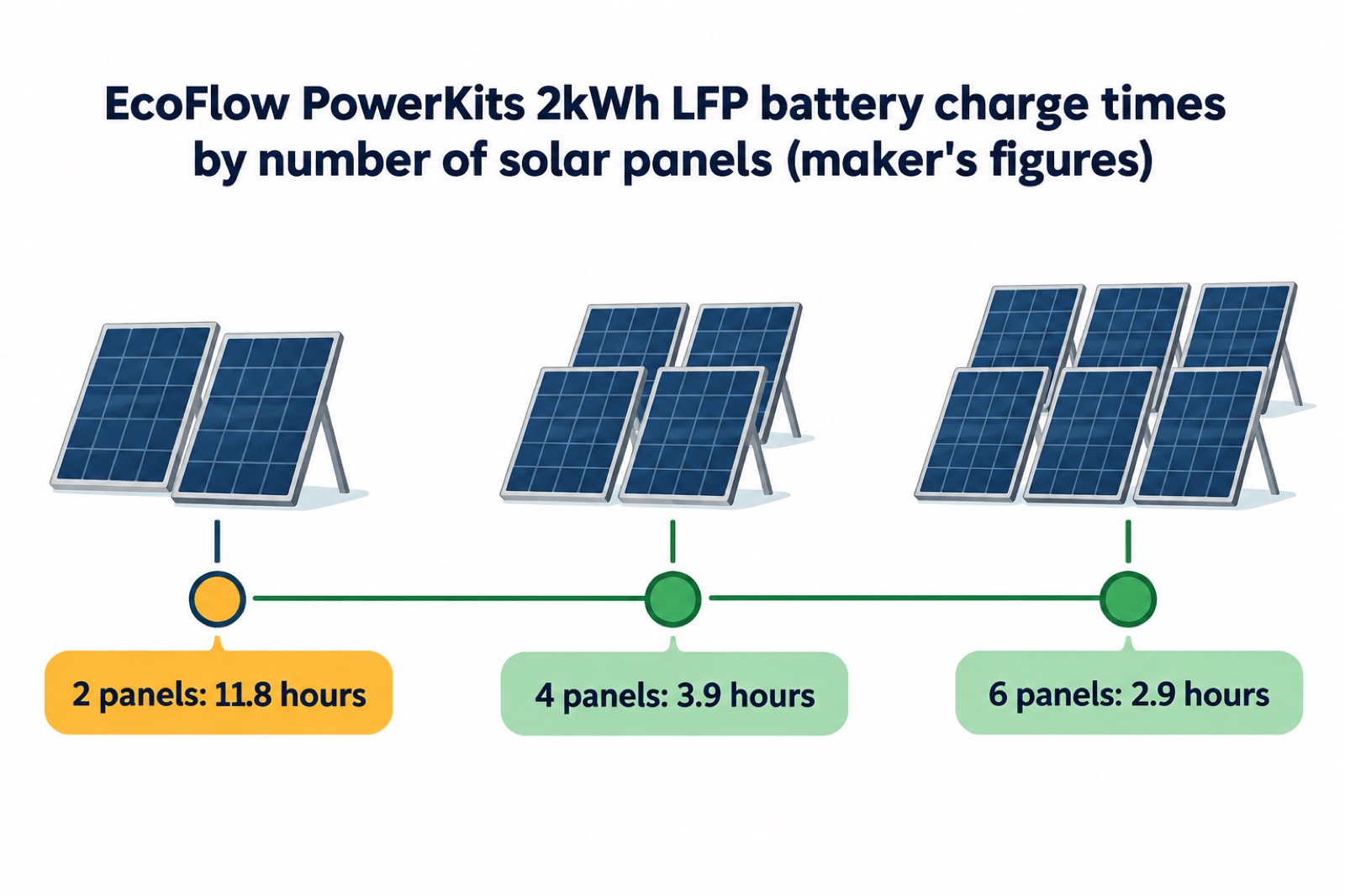
Solar charging is slower and depends on the number of panels. EcoFlow states its DELTA Pro takes 11 to 22 hours from one 400W panel, and 5.5 to 11 hours from two, with a second listing giving 3.5 to 7 hours for two panels30. EcoFlow's rigid solar panel tables show the same pattern for its PowerKits batteries: a 2kWh LFP battery charges in 11.8 hours from two panels, 3.9 hours from four and 2.9 hours from six; two 2kWh batteries, 4,000Wh, take 23.5 hours from two panels and 7.8 hours from four; and two 5kWh batteries, 10,000Wh, take 14.7 hours from two18. Doubling the panels roughly halves the time, and UK weather will push you towards the slower end of each range.
Which?'s emergency kit guidance sums up the reality: power stations "can be charged with solar panels and will take a while to charge", noting that makers such as DJI claim its Power 500 can run a refrigerator for up to an extended period31. The practical approach is to keep a station topped up from the mains before bad weather, and treat solar as the way to extend a long outage rather than the way to fill an empty battery quickly. Our page on how long solar charging takes in the UK covers this in depth.
USB-C, DC outputs and the small loads that matter
Not everything needs the inverter. Power stations and power banks offer USB ports and sometimes 12V DC sockets, which draw on the battery directly and skip the conversion losses entirely. These outputs are the efficient way to run the small loads that matter most in a power cut: phones, radios, torches, headlamps and tablets.
Electrical Safety First notes that fast USB charging "allows devices such as phones and headphones to charge more quickly (typically 7-10 watts)"16, and its appliance ratings list mobile phone chargers at up to 140W and chargers for battery-operated devices at up to 75W1. On the output side, BioLite's Charge 100 Max offers two 100W USB-C PD ports, one 15W USB-C, one 15W USB-A and one 15W wireless charging pad29. A 100W USB-C PD port is enough for a laptop, let alone a phone. Our page on USB-C charging and Power Delivery explains the standards.
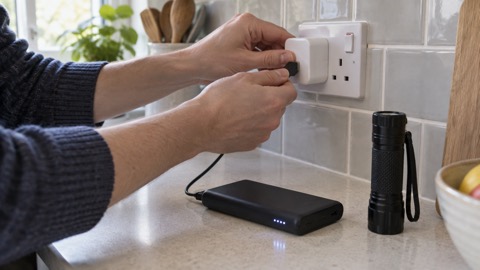
The value of these small loads is easy to underestimate. An LED night light at 0.5 to 2 watts12 is the most energy-efficient lighting option Electrical Safety First lists, and a phone drawing 7 to 10W16 uses a fraction of what a fridge does. A modest power bank can keep a household's phones and a radio going for days, which is why our power banks page treats them as the first piece of backup power kit most households should own. Citizens Advice adds a related point for people who wear a personal alarm: these usually have a battery life of 12 months, but check with the manufacturer32.
Battery chemistry and how it affects the numbers
Most modern power stations use lithium-based batteries. The chemistry affects how the battery ages over repeated charge and discharge cycles, and most units can last several years with proper care, offering hundreds of charge cycles. Makers state a cycle life figure for their own products, so compare the stated figures for the models you are considering rather than assuming all batteries are equal.
For emergency use, the pattern of use matters as much as the cycle count. A station kept fully charged and cycled only during power cuts ages differently from one used daily off-grid. Follow the maker's instructions on storage charge level and periodic recharging, and see our page on how to store a power station when not in use. Battery safety, including the warning signs of a dangerous lithium battery, is covered in our battery safety guide.
Putting the numbers to work
Work through the three figures in order. First, list what you would actually need to run in a power cut, with running watts from the rating plates or the table above. Second, add the running watts of everything likely to be on at once, include the starting demand of any motor-driven appliance at two to three times its running wattage, or more for inductive loads, and allow spare capacity, as Clarke's guidance sets out5. Third, multiply the total running watts by the hours you want to cover to get the watt-hours you need, remembering the answer is a best case.
Then compare kit against the job. A small power bank covers the phone-and-torch list. A mid-sized station with pure sine wave output covers the fridge, lighting and charging list through a night. Nothing portable covers the kettle, the iron or the fan heater, and no network operator will supply individual generators in a national emergency22, so plan around those limits rather than against them. The pages in our backup power section take each option in turn, from portable power stations to generators, and our power cut checklist turns the numbers into a shopping and checking list.
Sources (32)
- Ratings of Electrical Appliances, Electrical Safety First
- How to Find Out If There's a Power Cut, Which?, 2026-06-04
- Winter Hub, National Grid, 2026-10-08
- Electricity Made Easy, Electrical Safety First
- Generators Guidance, Clarke International
- Inverters DC-AC, Sterling Power
- How to Avoid Overloading Your Plug Sockets at Home, Which?, 2026-02-05
- Voltage Changes, SP Energy Networks
- Heat Guns Safety Advice, Electrical Safety First
- Batteries Technical Advice, The Caravan and Motorhome Club
- PS124000 12V 4000W Twin Socket Inverter, Sterling Power
- Night Lights Safety Advice, Electrical Safety First
- Electric Fans Product Safety Guidance, Electrical Safety First
- Electric Blankets Safety Advice, Electrical Safety First
- How to Buy the Best Generator, Which?, 2026-01-20
- Chargers Product Safety Guidance, Electrical Safety First
- Off-Grid Solar Power, BLUETTI
- Rigid Solar Panels, EcoFlow, 2026-10-25
- Slow and Pressure Cookers Safety Advice, Electrical Safety First
- Solar Power Technical Advice, The Caravan and Motorhome Club
- Plugs and Fuses Safety Advice, Electrical Safety First
- Make a Plan to Be Winter Ready, UK Power Networks
- Emergency Power Cuts FAQ, Northern Powergrid, 2025-03
- Managing Home Dialysis During a Power Cut or Energy Blackout, Kidney Care UK, 2023-11-29
- Radio Teleswitch Service Switch-Off, National Energy Action, 2026-07-29
- Managing Voltage Changes in Your Property, Electricity North West
- Voltage Changes in Your Home or Business, UK Power Networks
- Watch Out, Cables About, Energy Networks UK
- Charge 80 PD, BioLite, 2026-10-25
- DELTA Pro 400W Portable Solar Panel, EcoFlow, 2026-10-25
- Emergency Kit Packing List, Which?, 2026-09-30
- Prepare for a Power Cut, Citizens Advice
 Power Cut Backup Power Checklist
 Backup Power Before Winter
 Safe Battery Charging at Home
 What to Keep Running in a Cut
 Power During an Outage
 Portable Power Stations
 Portable Generator Types
 Generator Safety
 LPG Cylinders and Regulators
 Connecting to Your Home's Wiring
 Home Battery Storage
 Portable Solar Panels
 12V Inverters
 Leisure and LiFePO4 Batteries
 Power Banks for Phone Charging