

Sterling Power is a UK-based maker of battery charging and power management equipment, best known for its battery-to-battery (B2B) chargers, portable mains battery chargers, solar regulators and a 12V lithium leisure battery. For a household building backup power for power cuts and off-grid use, its kit sits in the middle of the system: it moves charge between batteries, from the mains, or from solar panels, and keeps that charge safe. This page sets out what the maker's own product pages say each product range does, the specifications that decide which one suits your household, and the official safety advice that applies to fitting, charging and storing batteries and chargers at home.
The range divides into four practical groups. Battery-to-battery chargers take power from a vehicle's starter battery or alternator and use it to charge a second, domestic battery bank1. Portable mains chargers are small 230V units that maintain and rescue batteries at home2. Solar regulators control the charge going from a solar panel into a battery3. And the LP12150 is a complete 12V 150Ah lithium iron phosphate battery with its own built-in battery management system4. Around these sit accessories such as the BBURC remote control with its 10m cable5.
None of this kit produces mains electricity on its own. If your aim is running household appliances through a power cut, the chargers and batteries are one half of the system and an inverter is the other; our backup power guide covers how the pieces fit together and what each can and cannot do.
What Sterling Power makes for UK households
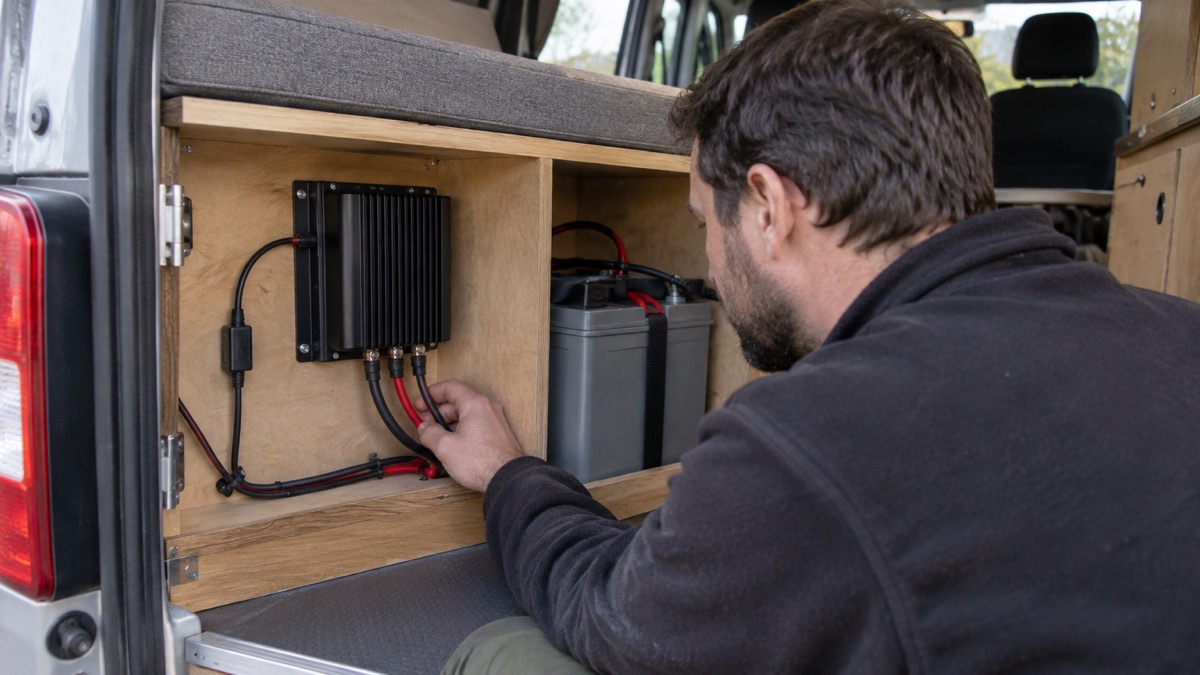
Sterling Power's product pages describe a range built around one job: getting charge into batteries correctly, whatever the source. The maker's own explanation of its battery-to-battery chargers is that they take surplus power, convert it to a higher voltage and use it to charge a secondary battery bank through a digitally controlled, programmable four-step charging curve1. The claimed benefit for the household is twofold: the units de-sulphate batteries, which the maker states increases battery life, and they "at least double the useful power subsequently available" from the battery bank1.
That claim is the maker's own, from its product page, and it is worth treating as a manufacturer's statement rather than an independent finding. What is verifiable from the specifications is that the chargers are engineered to hold the correct charging profile across a wide range of input conditions. The BB range's boost and reduce charging "ensures batteries get the correct charging profile irrespective of high or low input voltages"5, and the non-waterproof battery-to-battery range will deliver the correct charge and float voltage to the domestic battery bank when the alternator voltage is between 13.5V and 15V1.
For an ordinary household, the practical relevance is this: if you keep a second battery in a caravan, boat, campervan or garage to power lighting, a fridge or communications kit during an outage, this is the equipment that keeps that battery healthy and full. A battery that is undercharged or charged with the wrong profile loses capacity long before it fails outright, so the charger matters as much as the battery. Our emergency kit and self-reliance guides cover where such a battery fits in a household plan.
Battery-to-battery chargers
The BB range is the core of Sterling Power's lineup. A battery-to-battery charger connects between a vehicle's starter battery and a domestic battery bank: instead of drawing power directly from the alternator, it takes it from the starter battery and delivers a controlled charge to the second bank. The maker states installation is straightforward: "simply connect to your starter batteries and to your domestic battery", with no direct connections to the standard engine alternator or outboard and no extra wiring for a split charge system on new installations1.
The range covers several voltage combinations, and the model numbers encode them:
| Model | Input to output | Key rating | Notes |
|---|---|---|---|
| BB1260 | 12V | 1.4A input5 | Smallest unit listed |
| BB122470 | 12V to 24V | 70A input5 | |
| BB122470R | 12V to 24V | 70A input5 | Slightly older model with the red stripe, "updated and functioning perfectly"; 1 year warranty; listed as sold out5 |
| BB124865 | 12V/24V to 48V | ~740W continuous output (57V at 13A)6 | Smaller derivative of the BB1248120 with exactly the same features6 |
| BB1248120 | 12V/24V to 48V | 115A input current rating6 | With reverse charging feature and Jump Start Assistance6 |
The BB1248120 and BB124865 are the most capable units in the pack. The BB1248120's output voltage range is 38 to 62VDC6, and the BB124865 delivers a continuous rated output of about 740W at 57V and 13A, with an efficiency rating of 95%6. The reverse charging feature means power can flow back the other way, and the Jump Start Assistance function is there for a flat starter battery6. The maker also states a much larger model, up to 3000W, is coming soon5.
The range's protections are self-recovering: under voltage protection, input over voltage protection, output over voltage protection, over current protection and charge over temperature protection6. Thermal power reduction across the BB range means the units reduce their output rather than shutting down or overheating when they get hot5.
Alternator charging and how the chargers handle it
A household's first question about alternator charging is usually whether the vehicle's alternator voltage has to be exactly right for the charger to work. Sterling Power's answer, for the non-waterproof battery-to-battery range, is no: the alternator voltage can be between 13.5V and 15V and the unit will still deliver the correct charge and float voltage to the domestic battery bank1. That tolerance matters because alternator output varies between vehicles and with engine load, and a charger that needed a precise input would need extra wiring or adjustments.
The BB range goes further than tolerating input variation. Its boost and reduce charging means it can raise the output voltage when the input is low and, on the new external fan model, reduce the output voltage when the input is high1. The maker describes this as ensuring "batteries get the correct charging profile irrespective of high or low input voltages"5. For a household charging a 48V bank from a 12V vehicle system, this is the mechanism that makes the BB1248120's 38 to 62VDC output range usable6.
The non-waterproof range also includes features that affect how it behaves in daily use: a remote control option, alternator temperature sensing on the larger models, battery temperature sensing, an ignition feed if required, and automatic start and shutdown1. The BBURC remote control comes with a 10m cable, long enough to monitor and adjust a charger installed in a boot or engine bay from inside the vehicle5.
Mains battery chargers: the portable 1A maintainer
For households without a vehicle in the picture, Sterling Power's portable chargers are the relevant products. These are small, micro-processor controlled units that run from 230V AC 50Hz only, described by the maker as "portable slow charge battery maintainer" units2. They are maintainers and rescuers rather than fast chargers: the range includes battery maintenance, de-sulphation protection and battery rescue functions2.
The specifications for the 1A model:
| Specification | 1A portable charger |
|---|---|
| Charge voltage | Constant 13.9V2 |
| Battery capacity | Up to 120Ah2 |
| Weight | 0.35 kg2 |
| Protections | Low input voltage and over voltage protection2 |
Two safety points from the maker's own pages deserve attention. First, the portable chargers are "suitable for outdoor use in dry conditions only"2: they are not waterproof, so do not leave them out in the rain or in a damp shed. Second, they are 230V AC 50Hz only, so they are for UK and European mains supply, not for use on other electrical systems.
A 1A maintainer suits a battery that sits unused for long periods, such as a backup battery in the garage, topping it up to a constant 13.9V2. The maker rates it for batteries up to 120Ah2. For charging anything quickly, or for maintaining a large bank, a maintainer is the wrong tool; that is what the battery-to-battery range or a larger mains charger is for.
Inverters, and what this kit will and will not run
It is worth being clear about what Sterling Power's charging products do, because households often arrive at this page expecting a box that runs the fridge. The chargers and regulators in this range manage direct current: they move charge between batteries, from the mains into a battery, or from a solar panel into a battery. They do not by themselves produce 230V AC.
The maker's own battery in the pack, the LP12150, shows what the DC side can do. It is a 12.8V 150Ah lithium iron phosphate battery (4S x 3.2V configuration) that can be put in series for 12V, 24V, 36V or 48V systems4. It has an integrated battery management system, a 200A JBD BMS, M8 terminals, a CC/CV charge curve, and a 100W heater built in for sub-zero charging4. Its maximum charge voltage is 14.6V and its recommended charge voltage is 14.4V4. It can be monitored through the AMPS BMS app4.
To run household appliances from a battery like this you need an inverter, which converts the battery's DC into mains AC. Our backup power guide explains how to size one for the appliances you actually need, and our power cuts guide covers what to do in the first hours of an outage before any backup system comes into play. If you are planning around lighting and phones only, emergency lighting and staying informed may meet the need more simply than a battery and inverter.
Solar charge controllers
Sterling Power's solar regulators sit between a solar panel and a battery, controlling the charge so the panel does not overcharge the battery. The smallest unit in the pack is a 2A switching regulator, and the maker states all Sterling solar regulators are waterproof3.
| Specification | 12V 2A SB122 | 24V 1A SB241 |
|---|---|---|
| Maximum solar cell open circuit voltage | 30V3 | 50V3 |
| 4 step charging | No3 | No3 |
The specifications tell you where this unit fits. A 2A switching regulator is for small panels: trickle-charging a battery that powers a gate, a small light or a monitoring system, not for a household solar array. The open circuit voltage limits, 30V on the 12V variant and 50V on the 24V variant, are the figures to check against your panel before buying, because a panel whose open circuit voltage exceeds the limit can damage the regulator3.
One specification is easy to overlook and matters for a battery that must hold its charge: the quiescent current, the current the regulator itself draws when idle. The maker states that "at Sterling, we try to keep the quiescent current below 1 mA"3. A regulator with a high idle draw can flatten the very battery it is meant to protect over weeks of cloudy weather.
Note that this small regulator does not do 4 step charging3, unlike the BB battery-to-battery range's 4 stage charging5. It is a simple switching regulator for simple jobs. For anything larger, our self-reliance guide covers sizing solar and battery systems for a household.
Choosing the right size for your battery and loads
Three figures decide which Sterling Power product suits your household: the voltage of your battery bank, its capacity in amp-hours, and the current the charger can deliver.
Start with voltage, because the model numbers encode it. A 12V to 24V charger such as the BB122470 charges a 24V bank from a 12V vehicle system5. The 48V units, the BB124865 and BB1248120, take 12V or 24V input, auto-detected across a 9V to 32V input range, and charge a 48V bank6. The LP12150 battery can be configured in series for 12V, 24V, 36V or 48V, so it can grow with the charger you choose4.
Then match the charger's current to the battery's capacity. The maker rates its 1A portable maintainer for batteries up to 120Ah2, which gives a sense of scale: a slow maintainer suits a battery of roughly that size or smaller. At the other end, the BB1248120 has an input current rating of 115A and the BB124865 an output current rating of 13A at about 740W continuous6. A larger current rating charges a larger bank faster, but it also demands heavier cabling and a source battery able to supply it.
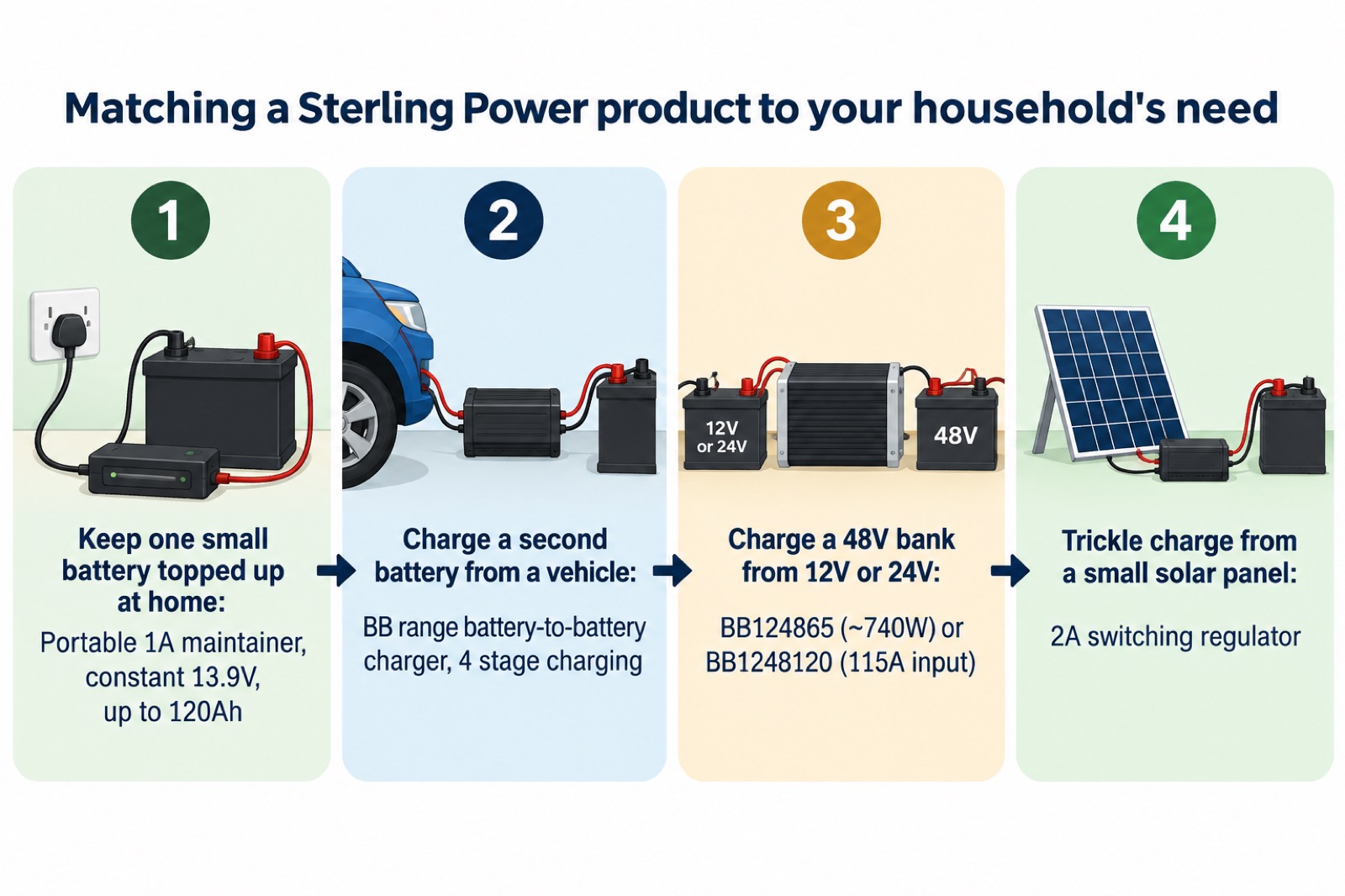
Finally, check the charging profile against your battery's chemistry. The battery-to-battery chargers are fully programmable for different battery types, with the profile chosen on the front panel1. The maker's recommendation for the non-waterproof range is plain: "For best effect, use open lead batteries, avoid gel, sealed and AGM batteries"1. If your bank is gel, sealed or AGM, look instead at the maker's other ranges or another product, and confirm compatibility before buying. For lithium, the LP12150's own figures, a 14.6V maximum and 14.4V recommended charge voltage4, show the profile a lithium battery expects.
Safe installation, charging and storage
The maker's installation instructions for the BB range are the starting point: connect the unit to the starter battery and to the domestic battery, with no direct connection to the engine alternator or outboard1. If you are not confident working with battery terminals and cabling, use a qualified installer. Battery work involves high currents, short circuits and, with lithium batteries, specific fire risks.
The fire and rescue services' advice on batteries and chargers applies to all of this kit, whatever the brand. The London Fire Brigade's guidance on batteries and chargers says that if a battery is swelling, or a charger shows signs of fault, you should "contact the manufacturer or certified technician" rather than continuing to use it8. Electrical Safety First's guidance on power banks and chargers is to buy a known and trusted brand and replacement chargers from the original manufacturer or a reputable retailer9, and, while charging, if you notice any odd smells, sparking or smoke, or any swelling, cracks or damage, unplug immediately and contact the retailer and/or manufacturer9.
For storage and everyday use, three habits follow from the maker's own specifications and the official advice. Keep the portable mains chargers dry: they are suitable for outdoor use in dry conditions only2. Do not exceed the solar regulator's open circuit voltage limit, 30V on the 12V variant and 50V on the 24V variant3. And rely on the units' own protections, which are self-recovering on the 48V models: under voltage, input over voltage, output over voltage, over current and charge over temperature protection6, with thermal power reduction across the BB range5. Those protections are a backstop, not a substitute for correct installation.
Our home emergencies guide covers fire and electrical safety in the home more broadly, including what to check and where to get help.
Support and warranty
Warranty lengths differ across the range, so check the product page for your specific model. The LP12150 lithium battery carries a 5 year warranty4. The BB1248120 carries a 5 year warranty for units from 1st November 20246. The BB122470R, the older red-stripe 12V to 24V 70A model, carries a 1 year warranty5, and was listed as sold out at the time of writing5.
For support, contact the manufacturer through its website, sterling-power.com, where each product page carries the specifications and details for that model. When you contact support, have your model number to hand; the model numbers encode the key ratings, as the table in the battery-to-battery section shows. The BB1248120 carries a 5 years warranty from 1st November 20246, so have your proof of purchase ready when you make a warranty claim.
One step the fire and rescue services repeat across their guidance is worth building into your routine: register your electrical items with the manufacturer so you are informed of any safety recalls7. Registration is what turns a recall notice into an actual message to you, rather than something you have to go looking for.
Safety notices and recalls
No recall or safety notice affecting Sterling Power products appears in the pack. The recalls that do exist in the UK show what to watch for. A recent example is the ESR HaloLock wireless power banks sold via Amazon, recalled in a notice notified by the Office for Product Safety and Standards in November 202513: a reminder that even branded charging products can be recalled, and that registration is how you hear about it.
For a household with a battery and charger as part of its emergency kit, an annual check, alongside testing the battery itself, is a reasonable rhythm. Keep a note of the exact model numbers of everything in the kit so a recall notice can be matched against what you own.
If a fault does appear, the signs the fire and rescue services list for electrical equipment are the ones to act on: overheating, burning smells, buzzing or crackling sounds, visible damage and repeated electrical tripping14. Unplug the unit, do not use it, and contact the manufacturer9.
Sources (14)
- Sterling Power battery to battery charger, non waterproof range, Sterling Power, 2026
- Sterling Power portable battery chargers, Sterling Power, 2026
- Sterling Power small 2A switching solar regulator, waterproof, Sterling Power, 2026
- Sterling Power LP12150, 12V 150Ah LiFePO4 battery, Sterling Power, 2026
- Sterling Power BB range, BB122470R product page, Sterling Power, 2026
- Sterling Power BB1248120, 12V/24V to 48V battery to battery charger, Sterling Power, 2026
- Electrical fire safety: register your appliances, Manchester Fire and Rescue Service, 2026
- Batteries and chargers safety advice, London Fire Brigade, 2026
- Power banks and chargers guidance, Electrical Safety First, 2026
- Lithium battery fire safety in your home, Mid and West Wales Fire and Rescue Service, 2026
- Fire safety at home, including electric vehicle charging, Warwickshire County Council Fire and Rescue Service, 2026
- Electrical items in the home, recalls and alerts, London Fire Brigade, 2026
- Product recall: ESR HaloLock wireless power banks sold via Amazon, Office for Product Safety and Standards, 25 November 2025
- Fire safety at home - Surrey County Council, Surrey County Council (Surrey Fire and Rescue Service)
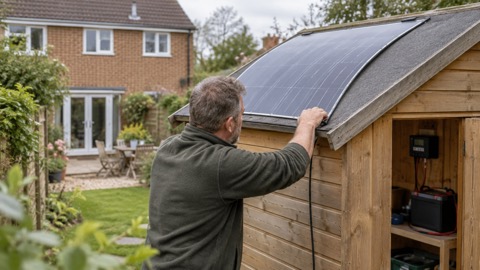 100W Semi-Flexible ETFE Solar Panel