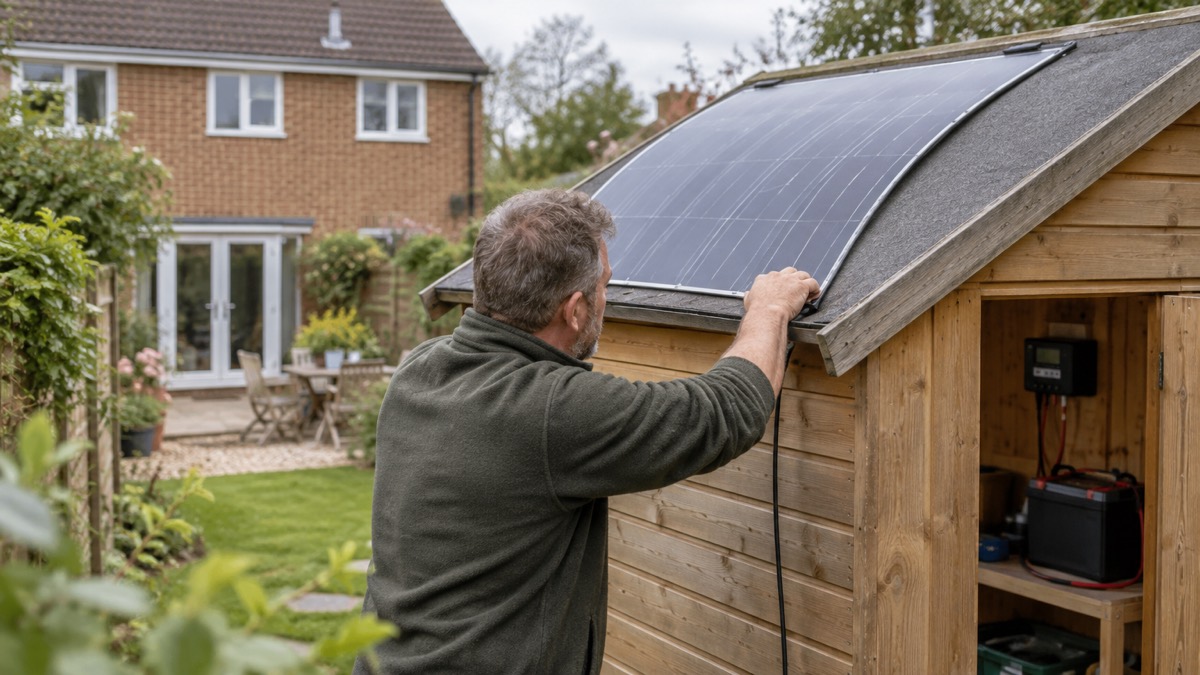
A semi-flexible ETFE solar panel is a thin, bendable panel that a household can keep folded away or fit to a shed, van or balcony, then bring out to charge a portable power station when the mains fails. It does not run your home's wiring and it will not keep a fridge going on its own. What it does is put a slow trickle of power back into a battery you already have, so a power cut that lasts a day or two does not leave you with a flat power station and no way to top it up.
For an ordinary UK household the sensible use is as a supplement, not a replacement. Keep your power station charged from the mains while power is on, and treat the panel as the thing that extends it once the power is off. A panel of this kind is small enough to move, store and set up without tools, which is what makes it useful in an emergency rather than a permanent roof installation.
This page covers what the panel does for a household, the specifications that decide whether it suits you, the versions available, what it can charge in a UK power cut, how to connect it, how to fit and position it safely, how to look after it, and what support and warranty you should expect. It is written around one named product, the Sterling Power semi-flexible ETFE panel, and links to the maker's page where it is listed.
What a semi-flexible ETFE solar panel does for a household
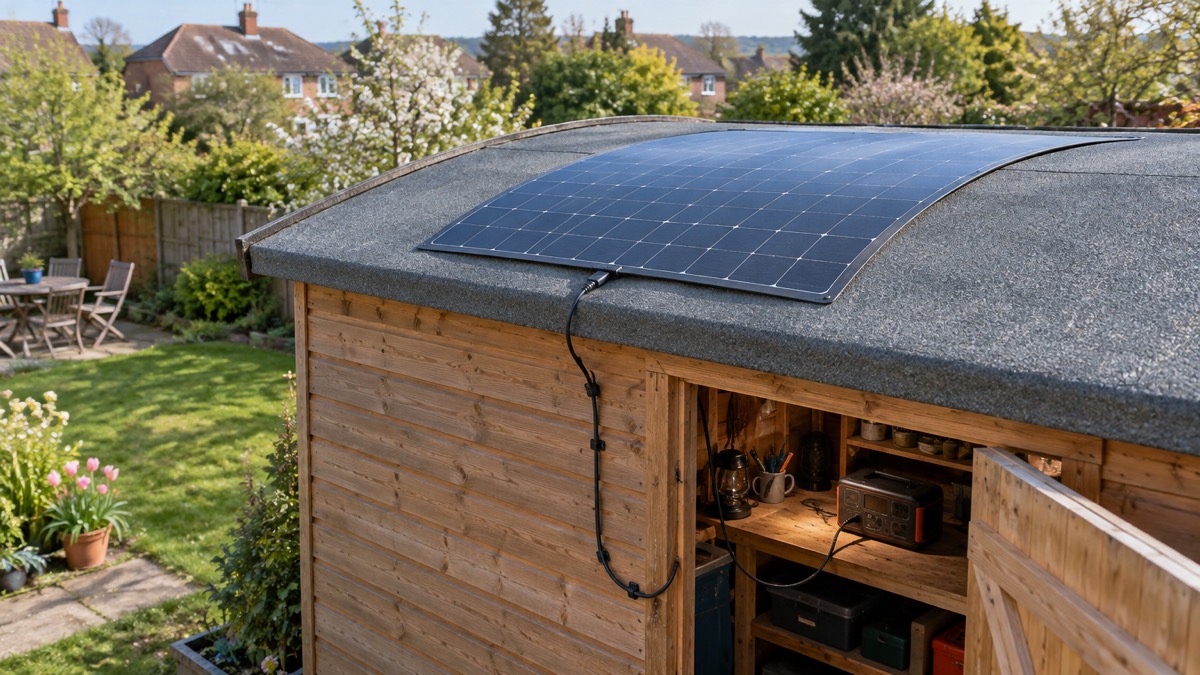
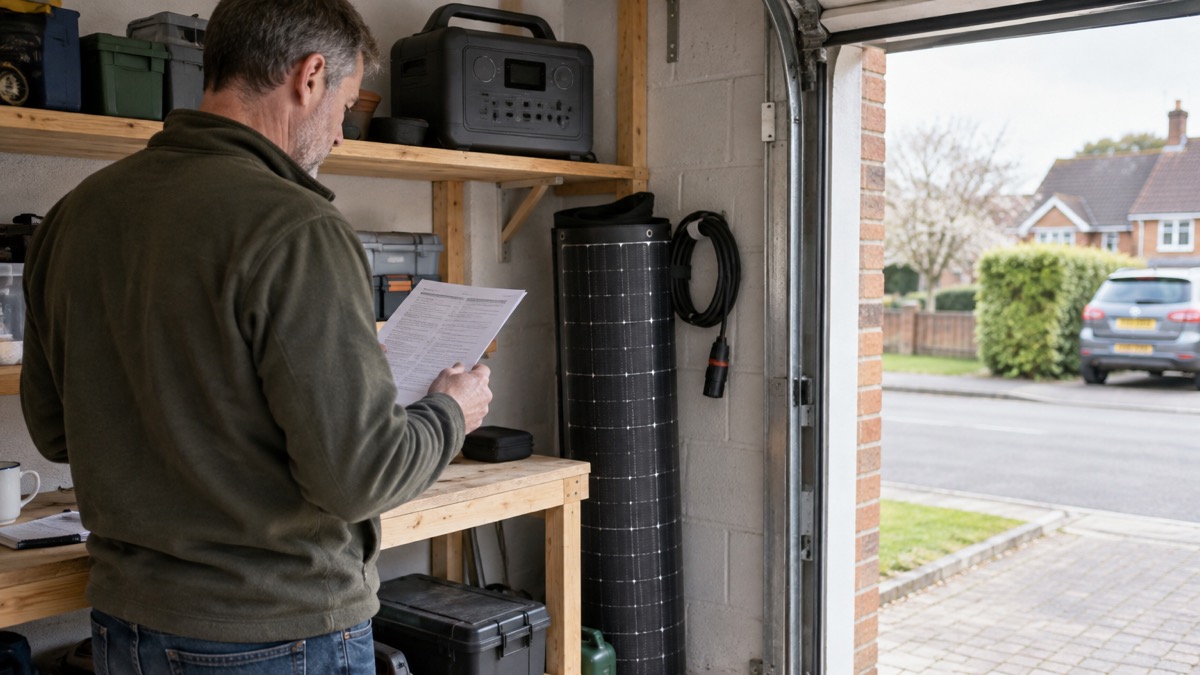
A semi-flexible panel is built to bend to a gentle curve rather than sit in a rigid aluminium frame. That makes it useful to a household that does not want a permanent roof array: it can be laid on a shed roof, strapped to a balcony rail, propped against a wall or carried in a car boot, then packed away. ETFE refers to the tough outer surface, which is there to protect the cells from weather and handling.
In preparedness terms, the panel's job is to keep a battery alive. A portable power station holds a fixed amount of energy; once the mains goes off, that store only goes down. A panel gives you a way to put energy back without a generator, fuel or noise. It will not run a kettle, an oven or a heat pump, and it will not feed your ring main. It charges a battery, and the battery runs the things you have chosen to keep running.
That makes it a good fit for households that already keep a power station for backup power at home, or that want a low-maintenance way to keep a small battery topped up through a long outage. It suits a flat or rented home where a roof installation is not possible, and it suits a caravanner or boater who wants a panel that can be moved. It does not suit anyone expecting to run household appliances directly from the panel.
The wider context is set out in Off-Grid Solar Systems: How They Work and What They Can Power, which explains why a panel is only one part of a system: panel, charge controller, battery and inverter. A semi-flexible panel is the first part of that chain, and on its own it does nothing until it is connected to something that stores or uses the power.
Specifications to check on the panel
Before you buy, the specifications that decide whether a panel suits your setup are the rated power, the voltage and current at which it delivers that power, the connector type, and the physical size and weight. The rated power tells you the most it can produce in ideal conditions; the voltage and current tell you whether it will work with your power station's solar input; the connector tells you whether it will plug in at all.
| Specification | What it means for a household |
|---|---|
| Rated power | The most the panel can produce in strong direct sun; real output is usually lower1 |
Check the panel's own label or datasheet for the exact voltage and current figures, and compare them with the solar input range printed on your power station. A panel that produces more voltage than the input allows can damage the unit; one that produces too little may not charge at all. If the figures do not match, the panel is the wrong one for that battery, however good the panel is.
The Solar Panel Types: Monocrystalline, Polycrystalline, Rigid and Flexible page explains how flexible panels differ from rigid ones in construction and where each is normally used. If you are weighing up a flexible panel against a framed one, Rigid or Flexible Solar Panels? sets the two side by side.
The versions
Semi-flexible panels are sold in a range of sizes and power ratings, and the same family of products usually includes several wattages so a household can match the panel to the battery it owns. A mid-range panel sits in the middle of that spread: small enough to move and store, large enough to make a useful contribution to a modest power station over a sunny day.
When you compare versions, compare them on the same specifications: rated power, voltage and current, connector, bend radius, weight and packed size. A higher-wattage panel in the same family will be physically larger and heavier, which matters if you plan to carry it. A lower-wattage panel is easier to handle but will take longer to put a useful amount of charge back into a battery.
The version you choose should follow from your battery, not the other way round. Work out what your power station's solar input will accept, then pick the panel that fits within it. If you are building a system from scratch rather than adding to an existing power station, Sizing an Off-Grid Solar System From Your Daily Watt-Hours takes you through the arithmetic of how much panel you actually need.
What can charge in a UK power cut
In a UK power cut, the panel's realistic job is to charge a portable power station or a small battery, which then runs low-draw items: phones, a radio, torches, a small light. It is not a substitute for a generator or a home battery, and it will not run heating, cooking or a fridge directly. The panel's output depends on the weather, the season and how well it is aimed at the sun.
A useful way to think about it is in terms of what the battery can store rather than what the panel can produce in a moment. A panel in good sun will put a modest amount of energy into a battery over a day; in cloud or in winter it will put in much less. That is why the panel belongs alongside a battery that is already charged, not instead of one.
- Phones and small devices: the most reliable use, because the draw is small.
- A radio or torch batteries: useful for keeping information and light going.
- A small light or lantern: a low-draw way to keep a room lit in the evening.
- Not heating, cooking or a fridge: these draw far more than a small panel can supply.
For the wider picture of what to keep running and for how long, see Power Cuts: A Household Guide and Backup Power at Home: A Household Guide. The Off-Grid Solar Kit Checklist lists the parts of a small system so you can check you have everything before an outage rather than during one.
Connecting the panel to a power station or battery
Connecting the panel is a matter of matching the connector and staying within the input limits. The panel's cable ends in a connector; the power station has a solar input socket with a stated voltage and current range. If they match, plug in. If they do not, use only an adapter rated for the current, and never force a connector or improvise with household wiring.
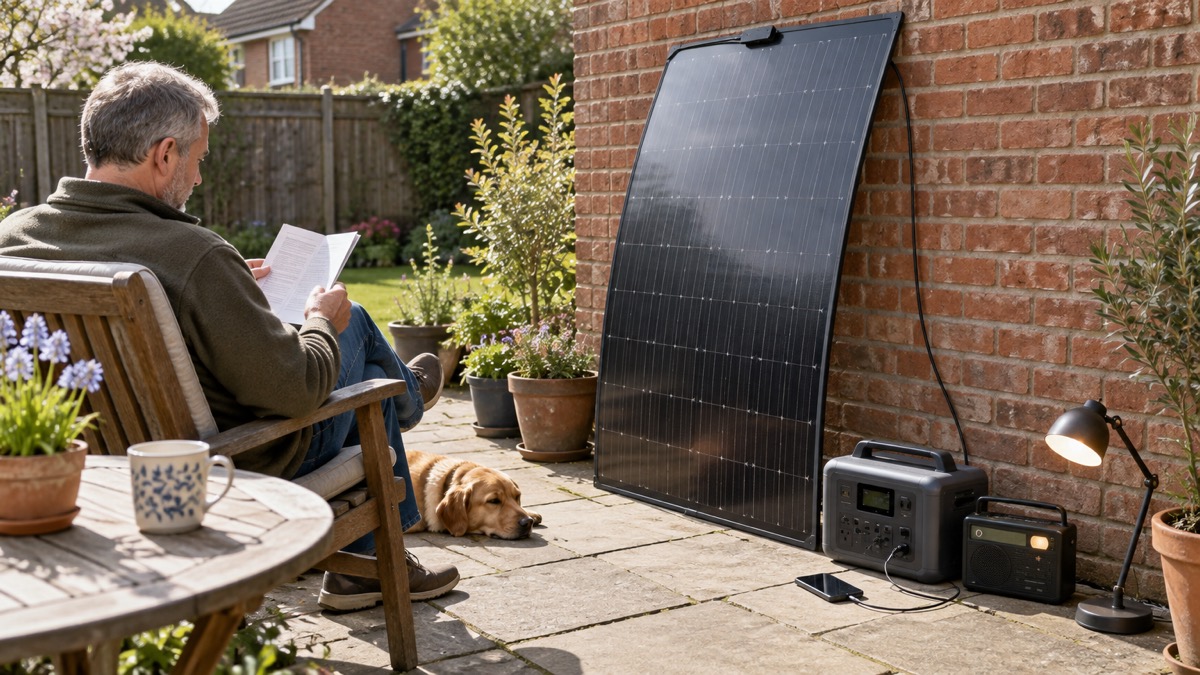
The order of steps matters less than the checks. Before connecting, confirm the connector type, confirm the panel's voltage and current are within the power station's solar input range, and confirm the cable and connectors are undamaged and dry. Then connect the panel to the power station, place the panel in the light, and check the power station's display to see that it is receiving charge.
If you are connecting to a battery bank rather than a power station, a charge controller sits between the panel and the battery. Solar Charge Controllers: PWM, MPPT and Shunt Regulators explains the types and what each does. Mounting and Wiring Solar Panels: Angle, Series, Parallel and Connectors covers series and parallel wiring, which is what you need to understand before linking two panels.
Fitting and positioning the panel safely
Position is the single biggest factor in what a panel produces. It wants an unobstructed view of the sun, facing it as squarely as possible, with no shadow falling across the cells. A shadow on part of a panel reduces output from the whole panel, so a spot beside a chimney or under a tree is a poor choice even if it looks tidy.
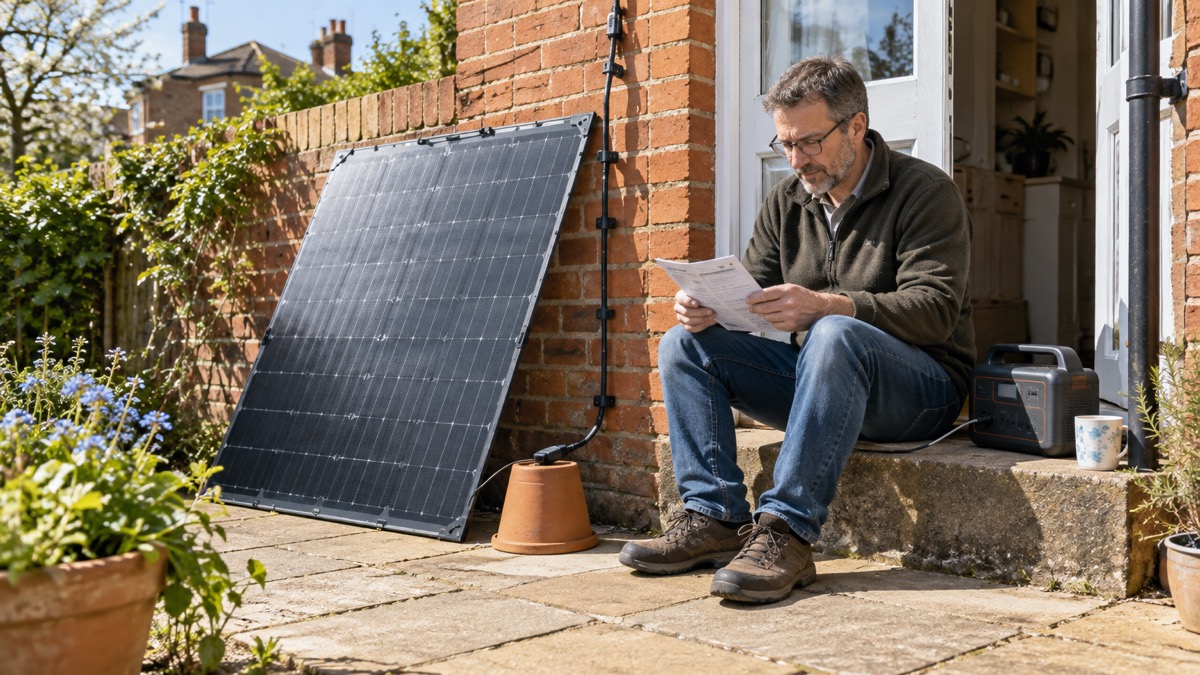
For a semi-flexible panel, fitting means following a gentle curve, not forcing a fold. The panel can be laid on a shed roof, strapped to a balcony, lent against a wall at an angle, or hung in a window. Whatever you choose, secure it so wind cannot take it: a panel that lifts off in a gust is both a loss and a hazard. Keep the cable run short and out of walkways, and keep the connection point out of standing water.
- Face the sun: aim the panel towards the sun and move it during the day if you can.
- Avoid shade: even a small shadow cuts output across the panel.
- Secure against wind: strap or weight the panel so it cannot lift or slide.
- Keep connections dry: raise connectors off the ground and out of puddles.
- Do not bend sharply: follow the maker's bend limit and never crease the panel.
If you are mounting on a roof or a structure, Planning Permission and Building Regulations for Tanks, Turbines, Toilets and Panels explains when permission may be needed. For a portable setup that comes in each night, the main safety concerns are wind, cable trips and water at the connector.
Looking after and storing the panel
A solar panel needs very little maintenance, but it does need to be clean and dry when stored. Most panels have a self-cleaning coating which, when installed at a suitable angle, allows rain to clear dirt and debris2. The maker also notes that rain can wash debris and dust from panels, saving you the job1. That means a panel left out at a sensible angle largely looks after its own surface.
For heavier soiling, clean gently. Wipe with a soft cloth and water when the panel is cool and disconnected, avoid abrasive pads and solvents, and do not scrub the surface. Clean the panel before you store it rather than after, so it is ready to use when you need it. Check the cable and connectors for damage at the same time.
Store the panel flat or rolled to the maker's stated limit, away from sharp edges and heavy objects, and somewhere dry. Do not store it folded or creased, and do not pile things on top of it. A panel kept in a shed or cupboard should be checked once a season: unroll it, inspect the surface and cable, and confirm the connector is clean and undamaged.
Support and warranty
Support and warranty terms come from the maker, Sterling Power, and are set out on its product documentation and its brand page. Before you rely on a panel in an emergency, register the product if the maker asks you to, keep the receipt and the packaging details, and note the serial number. That makes a warranty claim straightforward if the panel fails.
Check what the warranty covers and for how long, and whether it covers the surface, the cells and the cable. Keep the panel's instructions with it, because the bend limit and the connector type are the two things most likely to be needed later. If the panel is damaged, stop using it and contact the maker rather than attempting a repair yourself.
For a household plan, the panel is one line item among several. The Emergency Kit: What a UK Household Should Keep Ready page and the Getting Started: Preparing Your Household for an Emergency section show where a panel and a power station fit alongside water, food, light and warmth. The Self-Reliance at Home section covers the wider set of systems a household can build for itself.
Sources (2)
- Flexible Solar Panels, EcoFlow, 2026-10-25
- Solar Panels, Electrical Safety First, 2026-10-26

 Anker SOLIX PS200 Solar Panel
 EcoFlow STREAM Home Battery
 Morningstar SunSaver Duo
 Victron SmartSolar MPPT RS