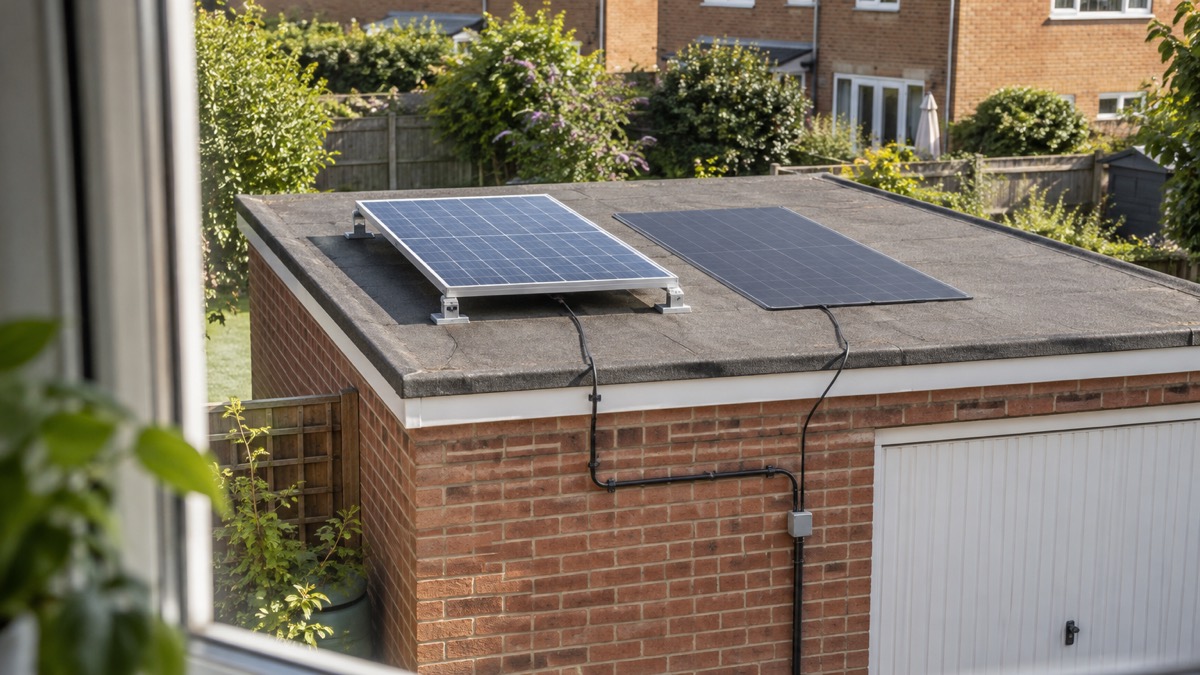
If you are putting a solar panel on a shed, a caravan, a boat or the roof of a van, the first decision is whether to buy a rigid panel or a flexible one. The short answer: rigid panels are the better choice for a permanent, flat or gently sloping surface where weight does not matter, and flexible panels are the better choice where the surface is curved, the weight matters, or you want the panel bonded flat to the roof.
The two types are closer in output than many people expect. One maker states its flexible panel has the same 23% solar conversion rating as its rigid alternative1, and its rigid panels use monocrystalline cells that convert up to 23% of solar into usable energy2. The real differences are in how they are built, how they are fixed down, how much they weigh and how long they last.
This page sets out what each type is for, how to fit a rigid panel with brackets and mounting holes, how flexible panels attach to curved surfaces, and what can go wrong with both. It is written for a household fitting a panel to a vehicle, outbuilding or boat, not for a full roof array on a house, which independent guidance says must be professionally installed and maintained to be safe3.
Rigid or flexible: which suits your roof or surface
The choice comes down to the surface you are fixing to and whether the panel will stay there. One maker's guidance is that rigid panels are better for permanent mounting, such as on the roof of a home, an off-grid cabin or a flat-roofed RV, while flexible panels are lightweight, suit smaller vans or boats and can be moulded to fit any shape1.
Distributor guidance sets out the trade-offs plainly. Rigid panels are described as the most efficient, most durable and least prone to scratches, with a high life expectancy, but heavier, not walkable, needing to be mounted on a flat roof, sitting raised from the surface and possibly requiring holes drilled through the roof9. Flexible panels are described as less heavy, able to sit on slightly curved roofs, walkable, less likely to crack, and low profile when bonded directly to the roof, but more prone to scratches, less durable and with a shorter life expectancy9.
| What matters | Rigid panel | Flexible panel |
|---|---|---|
| Best surface | Permanent, flat or gently sloping roof1 | Curved roof, van, boat, smaller vehicle1 |
| Weight | Heavier; one 100W panel listed at approximately 21.8kg4 | Lighter; one 100W panel listed at 2.3kg6 |
| Walking on it | Cannot be walked on9 | Can be walked on without damage10 |
| Scratches | Less prone9 | More prone9 |
| Life expectancy | High9 | Shorter9 |
| Fitting | Brackets and mounting holes, may need roof holes9 | Bonded, screwed at the corners or hung1 |
If your surface is flat and permanent and you can take the weight, a rigid panel is the straightforward choice. If the surface curves, or you cannot afford the weight, a flexible panel is the one that will actually fit.
Rigid panels: an aluminium frame built for permanent mounting
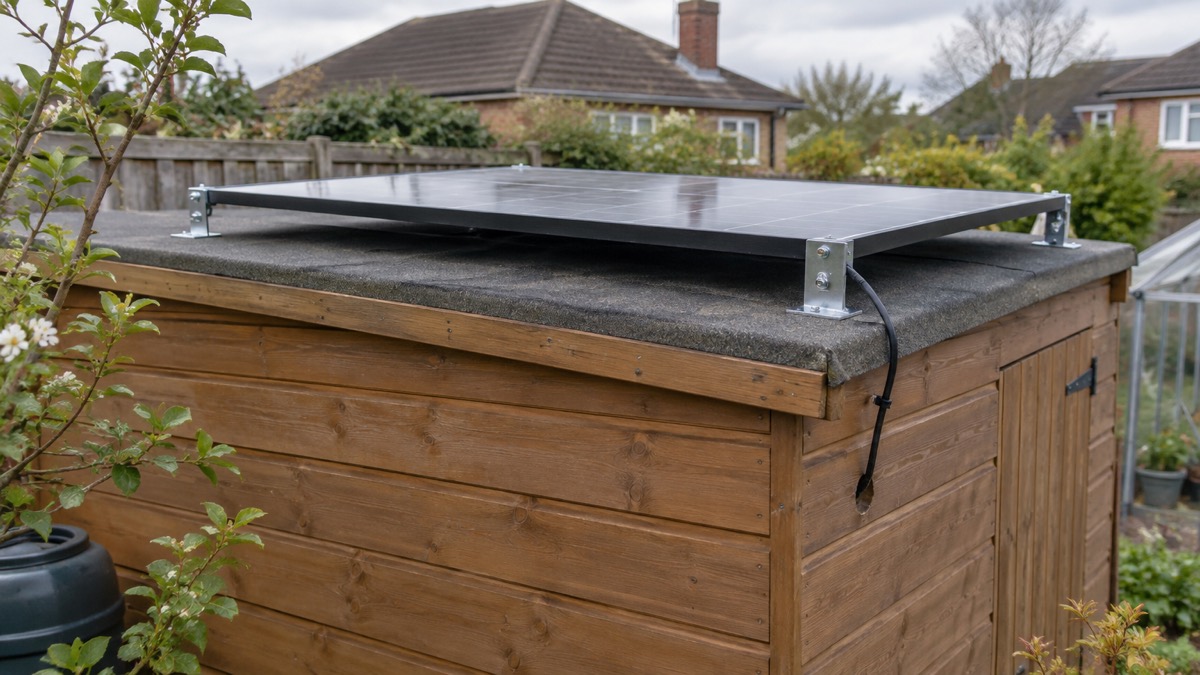
A rigid panel is solar cells housed in a tough aluminium frame that can withstand all weathers and travelling speeds9. Makers describe the frame as anti-corrosive aluminium2, and one maker describes a heavy duty anodised aluminium box and key design built to withstand forces over long-term installation12.
That frame does two jobs. It protects the cells from impact and weather, and it gives you something solid to bolt through. One maker's caravan and motorhome guidance describes rigid panels as having a strong aluminium frame and four mounting holes for installation10. Another maker fits pre-cut holes along the panel's perimeter so it is ready to mount on a van or off-grid build, and pairs it with mounting feet for a secure attachment to any surface13.
Rigid panels are also the type rated for exposed positions. One maker states its 450W rigid panel can withstand a wind speed of up to 130 mph when well mounted11, and rates its rigid panels IP68 waterproof, tested in 3.3 ft of water for 72 hours under controlled laboratory conditions11. That matters on a boat, a coastal shed or an exposed roof.
The trade-off is weight and clearance. A rigid panel sits raised up from the roof surface, which reduces clearance and increases drag, and fitting one may require holes being drilled through the roof9. On a vehicle, that raised profile is what catches the wind, so the fixings have to be right.
Fitting a rigid panel with four mounting holes and brackets
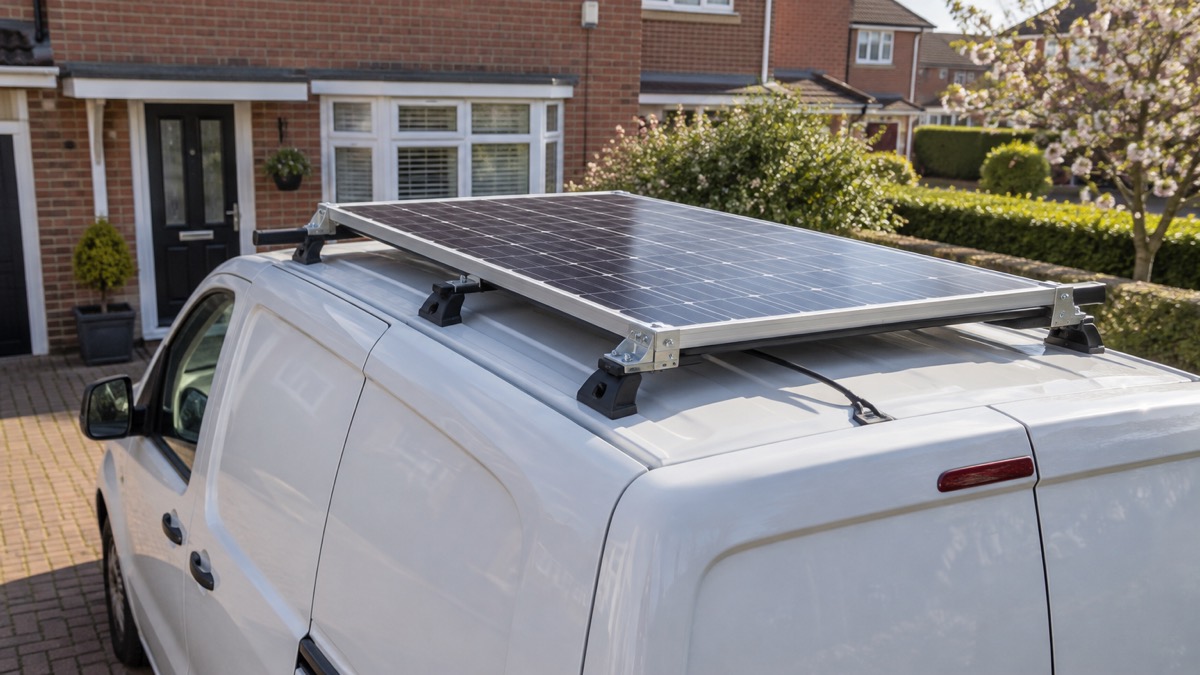
The standard rigid panel fixing is four metal brackets screwed into the roof through the panel's four mounting holes10. One maker supplies a corner fixing kit as a packet of four strong moulded brackets in UV resistant heavy duty material, designed for framed solar panels on caravan roofs15. Another maker sells mounting feet that it says fit 400W panels and match them16.
The safety rule that governs all of this comes from the fire service. London Fire Brigade advises that you only use mounting brackets, fixings and accessories recommended by the manufacturer, because temporary or unsuitable fixings may fail over time and create safety risks7. That rules out cable ties, rope and improvised brackets for anything permanent.
A sensible order of work:
- Check the panel's mounting holes and buy the maker's brackets or feet for that panel10.
- Decide the position: makers say panels are usually mounted on brackets from a pole, wall or roof and should be south facing in the Northern Hemisphere17.
- Fix the brackets to the surface using the maker's fixings, not substitutes7.
- If the panel connects to an outdoor socket, the fire service advises a minimum IP65-rated installation fitted by a competent person7.
- Check the fixings again after the first long journey or storm.
If you are mounting a panel on a caravan or motorhome and are unsure, the caravan guidance is to speak to an expert first14. For the wider picture on angles, series and parallel wiring and connectors, see Mounting and Wiring Solar Panels.
Flexible panels bend to fit curved roofs, vans and boats
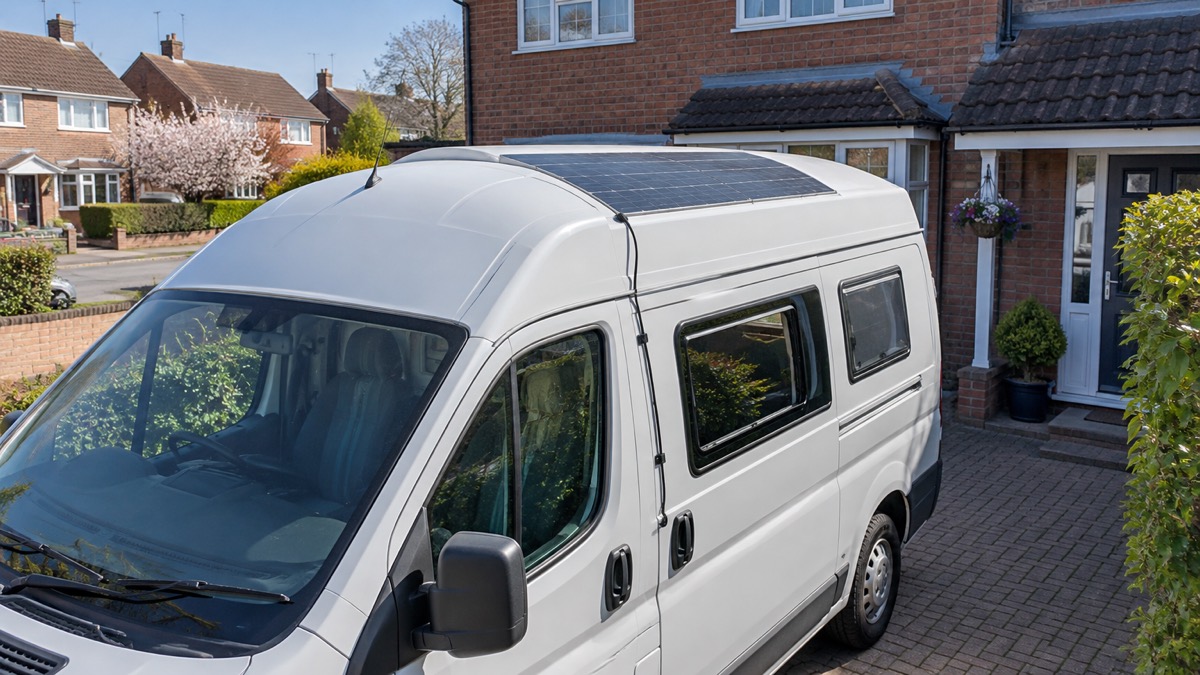
Flexible panels are made differently. Distributor guidance explains that semi-flexible panels comprise solar cells attached to a flexible material that can conform to a slightly curved surface, typically reinforced with aluminium plates and with tough ETFE coatings9. Most panels are rigid, but semi-flexible and fully flexible versions are available thanks to thin-film cells9. One maker describes its flexible panels as thin-film panels about 300 times slimmer than standard silicon panels1.
That construction is what lets them follow a curve. One maker states its semi-flexible panels can be slightly flexed without cell damage, unlike conventional panels18, and another describes a semi-flexible panel with a scratch-proof professional ETFE surface that is sea water resistant19.
Fitting is different too. One maker's flexible panels are ready to attach using pre-drilled mounting holes, but can also be fixed with adhesive, industrial velcro or tape, tied down, or secured permanently with bolts1. Another maker's flexible panel has pre-cut eyelets so it can be hung with hooks or attached to a surface using an adhesive6. Photonic Universe notes that most flexible panels will require self-tapping screws, not supplied, positioned in the white plastic corners of the panel itself10.
Makers also note that panels can be mounted flat, such as on a caravan roof or boat deck, which can mean better performance on overcast days17. For a boat or van where a rigid panel would sit proud and catch the wind, a bonded flexible panel is the neater answer.
Weight, profile and walking on the panel
Weight is where the two types separate most sharply. One maker lists its 100W flexible panel at 2.3kg, 70% lighter than traditional solar panels6, while another maker lists a 100W rigid panel at approximately 21.8kg4. A third maker lists its 100W rigid panel at approximately 6.2kg5, so rigid panel weights vary widely between products and you should check the maker's own figure for the panel you are considering.
| Panel | Type | Weight as listed by the maker |
|---|---|---|
| 100W flexible panel | Flexible | 2.3kg6 |
| 100W rigid panel (one maker) | Rigid | Approximately 21.8kg4 |
| 100W rigid panel (another maker) | Rigid | Approximately 6.2kg5 |
| 175W rigid panel | Rigid | 9.3kg13 |
| 450W rigid panel | Rigid | 22.4kg11 |
| SolarSaga 100 Light | Portable | 2.05kg, 56% lighter than rigid panels20 |
Walking on the panel is the other practical difference. Distributor guidance says flexible panels can be walked on without damage, while rigid panels cannot be walked on9. One maker states its semi-flexible panels are tough enough to be walked on thanks to their robust design18. That matters on a boat deck or a van roof you need to cross.
Profile matters for vehicles. A rigid panel sits raised from the roof, which reduces clearance and increases drag9. One maker states its 130W rigid panel is only 12 mm thick and reduces wind resistance by more than 60% when you are on the road21. A flexible panel bonded flat has the lowest profile of all.
Durability and life expectancy: where flexible panels fall short
Distributor guidance is blunt about the weak point: flexible panels are more prone to scratches than rigid panels, less durable and have a shorter life expectancy9. That does not make them a bad choice, but it does mean they suit a job where the panel is protected or replaced more readily, rather than a permanent exposed roof.
Warranties reflect the difference. One maker gives rigid solar panels a 5-year warranty and flexible solar panels a 3-year warranty, with cables and accessories at 12 months8. Another maker lists a 10-year warranty on its 100W rigid panel4. So warranties vary between makers and panel types, and the maker's own document is the one to check.
Scratches are the everyday risk. One maker advises regular cleaning with soft materials and avoiding hard materials that scratch the surface13. A scratch-proof ETFE surface, as one maker fits, reduces the risk19, but it does not make a flexible panel as tough as a framed rigid one.
That warning is worth taking seriously. A flexible or portable panel hung from a frame for months is exposed to flapping, abrasion and UV, which is exactly where the shorter life expectancy shows.
What can go wrong with each type
Most problems come from the fixing, the wiring or mixing parts that do not match, rather than from the panel itself.
Rigid panels. Drilling through a roof can let water in if the holes are not sealed. And the weight means the roof structure has to carry it. The fire service's rule applies: only use the maker's brackets and fixings, because unsuitable fixings may fail over time and create safety risks7.
Flexible panels. Scratches, shorter life and less durability are the recorded weaknesses9. Bonding a panel flat to a roof leaves no air gap, and a panel hung for long periods is not recommended by one maker22. Check the maker's salt water and waterproof claims for the specific panel, since these are stated per product19.
Mixing panels. One maker states that mixing solar panels of different specifications is possible but not recommended, because different current values in series cause limited output and a short-board effect of 1+1<213. If you add a panel later, match it to what you already have.
Plug-in systems. The Electrical Safety First press office states that only one plug-in solar panel system is permitted per household, and that installing multiple units could reduce the effectiveness of protective devices23. If your panel feeds a plug-in system rather than a battery, that limit applies. For the safety side of plug-in solar, see Are Plug-In Solar Panels Safe at Home?.
Voltage matching. Open circuit voltage varies widely between panels of the same wattage. One maker lists 20.3V for its 100W flexible panel6, another lists 29.2V for a 100W semi-flexible ETFE panel24, and a foldable 100W panel is listed at 22.5V25. Match the panel to your charge controller, and see Solar Charge Controllers for how that works.
Sources (25)
- Flexible Solar Panels, EcoFlow, 2026
- Rigid Solar Panels, EcoFlow, 2026
- Solar Panels, Electrical Safety First, 2026
- Portable Solar Panels, EcoFlow, 2026
- 100W Rigid Solar Panel, EcoFlow, 2026
- 100W Flexible Solar Panel, EcoFlow, 2026
- Plug-In Solar Panels: Safety Advice for Residents and Homeowners, London Fire Brigade, 2026
- 10kWh Power Kits, EcoFlow, 2022
- Solar Power Guide, 12 Volt Planet, 2026
- Solar Panels for Caravans and Motorhomes, Photonic Universe, 2026
- 450W Rigid Solar Panel, EcoFlow, 2026
- Alpex Solar Panel, Marlec, 2026
- 175W Rigid Solar Panel, EcoFlow, 2026
- Solar Power, The Caravan Club, 2026
- Solar Mounting Kits, Marlec, 2016
- Rigid Solar Panel Mounting Feet, EcoFlow, 2026
- Solar Power Explained, Marlec, 2026
- SpectraLite SemiFlex HPBC Solar Panels, Marlec, 2026
- Spectra SemiFlex Zipper 100W Solar Panel, Marlec, 2025
- Jackery SolarSaga 100 Light, Jackery
- 130W RVMax Rigid Solar Panel Combo, EcoFlow, 2026
- 220W Lightweight Portable Solar Panel, EcoFlow, 2026
- Responding to the Roll-Out of Plug-In Solar Panels, Electrical Safety First, 2026
- Solar Panel 100W Semi Flexible ETFE, Sterling Power, 2026
- Spectra Foldable 100W Solar Panel, Marlec, 2026