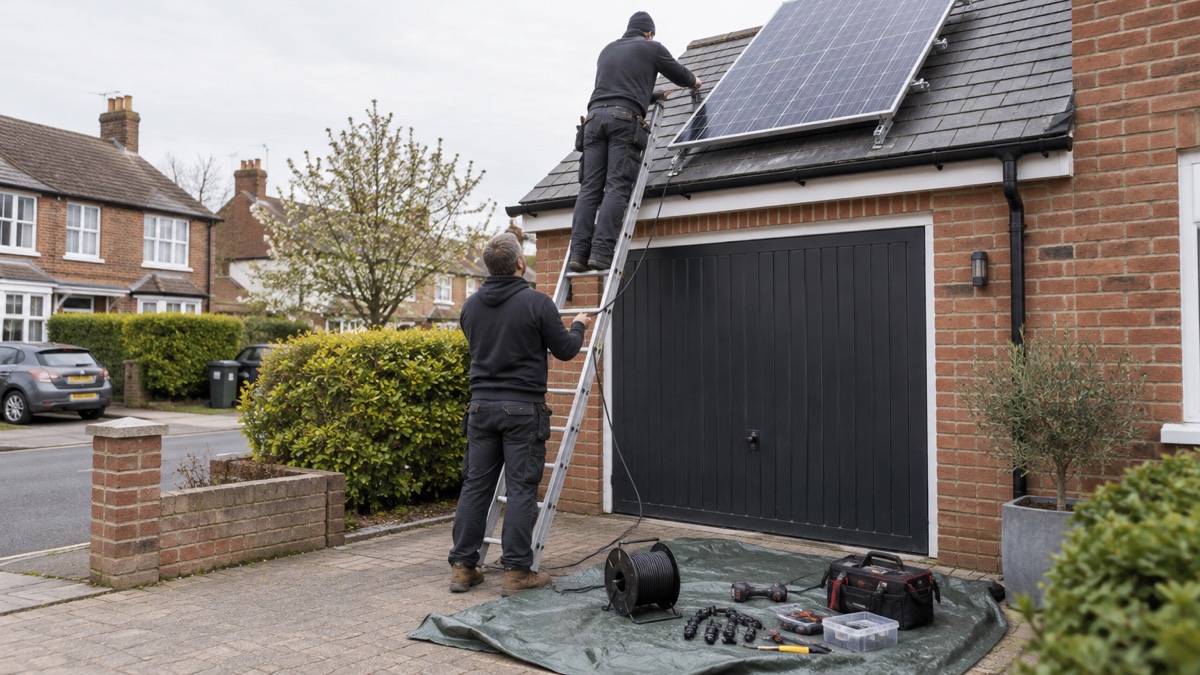
Getting a solar panel to actually charge a battery, day after day, comes down to three things: mounting it at an angle that suits the British Isles, wiring it so current cannot flow backwards at night, and checking the circuit before you rely on it. For a fixed panel in the UK, the solar maker Marlec advises inclining it at between 65° and 75° from horizontal, relative to the latitude of your location1. For the wiring, the same maker's rule is simple: fit a blocking diode when either no regulator is used or more than one panel is connected in parallel2.
This page covers the practical side of mounting and wiring small solar setups: the angle and orientation that work in Britain, what a blocking diode does and when one is needed, what happens if you run panels without a regulator, where the charge you generate actually goes, and how to check the wiring circuit safely. It sits alongside our guides to off-grid solar systems, solar charge controllers and battery banks.
The right angle and orientation for a UK panel
For a permanently mounted photovoltaic panel, Marlec's guidance is that panels "should be inclined at an angle (from horizontal) relative to the latitude of location (between 65° & 75° for" the British Isles1. That is steeper than many people expect, and it is a deliberate choice for Britain: a steeper panel catches the low winter sun better, sheds rain and dirt, and Marlec's own output figures are calculated for modules "mounted at optimum tilt angle facing south"1. Orientation matters as much as tilt: the figures in Marlec's tables assume a south-facing panel, and a panel facing well away from south will produce less.
The reward for getting angle and orientation right is large, and the penalty for ignoring them is larger still. Marlec's figures for London show a 60W module producing 20.9 Ah per day in summer but only 2.29 Ah per day in winter, both at optimum tilt facing south1. In Edinburgh the summer figure for the same module is 19.1 Ah per day1. Plan your winter expectations around the winter column, not the summer one, or you will size the system for a season it cannot deliver in.
| Module size | London, summer | London, winter | Edinburgh, summer |
|---|---|---|---|
| 10W module | 3.51 Ah per day | 0.41 Ah per day | 3.21 Ah per day |
| 30W module | 10.4 Ah per day | 1.14 Ah per day | 9.55 Ah per day |
| 60W module | 20.9 Ah per day | 2.29 Ah per day | 19.1 Ah per day |
All figures are Ah per day at optimum tilt, facing south1.
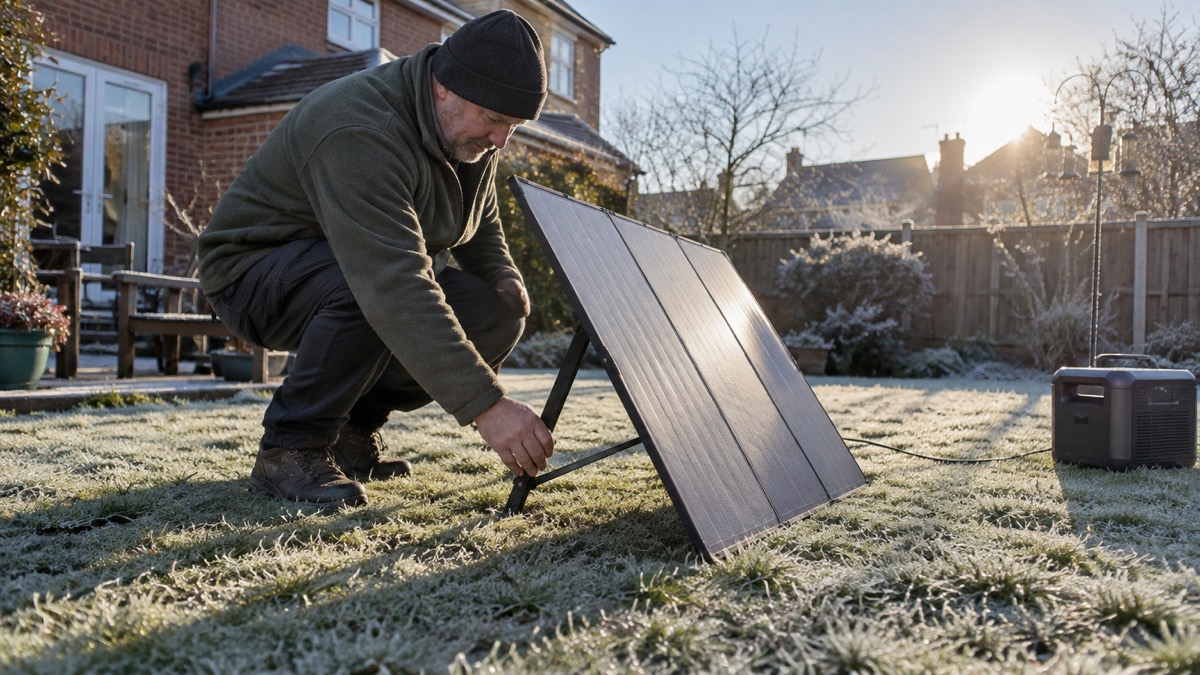
Portable panels work differently, because you move them rather than fix them. Makers build in adjustment and angle guides for exactly this reason. Anker advises users of its PS200 portable panel that "for maximum sunlight and larger output power, adjust the position and angle of the solar charger"5, and its PS400 offers three kickstand positions at 40°, 50° or 60°6. EcoFlow's NextGen 160W panel lets you "adjust the angle of the panel by 30 degrees in seconds to get the most sunshine at all times"7, and its angle guide "keeps sunlight at a 90° angle on the surface of your solar panel to capture the most energy possible"7. EcoFlow also says the integrated angle guide on its portable panel achieves 45% higher power delivery compared to standard panels without the guide8. Jackery likewise tells users of its SolarSaga 200W that "the Sun Angle Indicator, aka bullseye indicator, is a must to be referenced for the best solar charging angle"9.
The practical rule for a portable panel is to keep the sun as close to square-on as you can and to re-aim the panel through the day. Anker states plainly that "solar panel output varies with sunlight intensity, panel orientation, and angle. Due to varying conditions, actual power may be lower than rated"10. Shade is the biggest thief: a Jackery review of the SolarSaga 40W mini panel reports that "if just 10% of the panels is in shade, you lose 90% of the solar power"11.
Why a solar panel can drain your battery at night
A solar panel is not a one-way valve. In daylight it pushes current into your battery, but in darkness a battery can push current back through the panel instead, slowly discharging itself overnight. This is the classic reason a battery that was healthy at dusk is flat by morning, and it is what a blocking diode exists to prevent: the diode allows current to flow from the panel to the battery and blocks it from flowing the other way. Marlec, a UK solar maker, describes the fitting rule this way: "A Blocking Diode is fitted to ensure the correct flow of current and should be fitted when either no regulator is used or more than one solar panel is connected in parallel"2.
The same backwards-flow idea appears in grid-tied plug-in solar, at household scale. Plug-in solar panels, which are available to buy in the UK12, "send electricity in the opposite direction in your property's wiring", as Electrical Safety First put it when responding to their roll-out13. That is their whole purpose when exporting, but it is also why the wiring rules around them are strict, and why our page on plug-in solar safety is worth reading before you buy.
Not every overnight loss is reverse current, though, and it pays to check the obvious first. The Caravan and Motorhome Club advises that "to work out the drain on your battery from an appliance, take its power rating and divide by 12"14, so any appliance left on overnight is drawing from the battery and will empty a small battery over a long night. The Club also warns that "solar panels can actually overcharge the leisure battery, which is just as bad for the battery as undercharging it"14, which is a daytime problem with the same root cause: nothing properly controlling the flow of current between panel and battery. Our page on charging and looking after an off-grid battery bank covers the battery side of this in detail.
Blocking diodes: when one should be fitted
The rule from Marlec, stated on its solar controllers page, is that a blocking diode should be fitted when either no regulator is used or more than one solar panel is connected in parallel, and that on framed solar panels it "fits directly into the junction box"2. That gives you three situations:
- One panel, with a regulator: no separate blocking diode needed. The regulator manages the current.
- One panel, no regulator: fit a blocking diode, in the panel's junction box if it is a framed panel.
- Two or more panels in parallel: fit a blocking diode, whether or not there is a regulator.
Some panels arrive with the problem already solved. Marlec's Spectra SemiFlex Zipper 100W panel lists "built-in blocking diodes" among its features15, so check your panel's specification before buying a separate diode. If you are choosing between panel constructions, our comparison of rigid and flexible solar panels sets out the trade-offs.
Fitting a diode yourself is reasonable at the small scale, on a panel you can safely handle at ground level, following the maker's instructions for that panel. It is not reasonable to improvise. London Fire Brigade's safety advice for plug-in solar is blunt on the wider point: "Never tamper with cables, plugs, inverters, batteries or any other part of the system", because altering equipment can expose live electrical components, cause faults and significantly increase fire and shock risks16. If the wiring runs into your home's electrics, or the panels are anywhere you cannot safely reach and work, use a competent person.
Panels in parallel, and adding a second panel
When you connect more than one panel in parallel, you add their currents together at the same voltage, which suits charging a 12V battery from 12V-class panels. But parallel connection is also the arrangement that demands a blocking diode2. In a parallel group, a panel in shade or darkness becomes a load for the panels in light: current can circulate backwards through the weak panel, wasting your generated power and heating that panel. A blocking diode in each panel's feed stops this, which is why makers like Marlec build them into panels intended for this use15.
Before adding a second panel, check two things. First, the regulator: Marlec recommends a regulator "if working over our recommended minimum ratio of 10W of solar panel to 100AH battery capacity"2, so a second panel can push you over the line where a regulator becomes necessary. Second, the regulator's rating: Sterling Power, for its 100W semi-flexible ETFE panel, advises that "a solar regulator is required" and that you should "divide your total solar panel wattage by your battery voltage to get an amp figure", which gives the minimum regulator amp rating17. Two 100W panels on a 12V battery give 200 divided by 12, so the regulator must be rated for at least that current. Our page on solar charge controllers explains the types available.
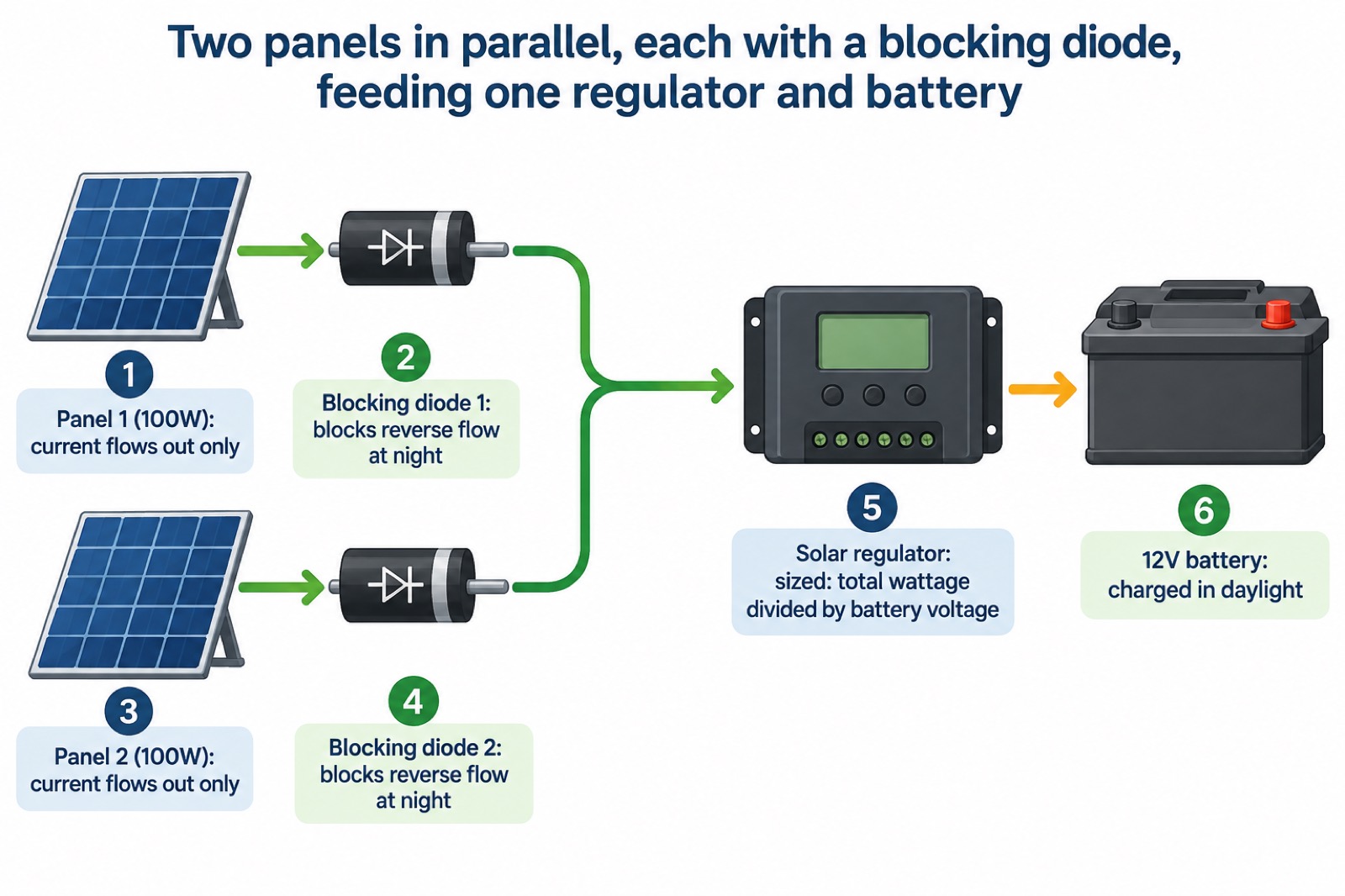
How two panels combine in parallel, with a blocking diode in each feed.
Running panels without a regulator
It is possible to run a small panel straight into a big battery with nothing in between, and in a narrow case it works: Marlec's guidance is that a regulator is recommended only above the ratio of 10W of panel to 100Ah of battery capacity2. Below that ratio, the panel's output is small enough relative to the battery that it cannot push the battery into overcharge. This is the trickle-charge arrangement used on batteries that sit unused, such as a caravan battery in storage over winter.
Go above that ratio without a regulator and two things go wrong. In daylight, the Caravan and Motorhome Club's warning applies: the panel "can actually overcharge the leisure battery, which is just as bad for the battery as undercharging it"14. At night, with no regulator and no blocking diode, the battery discharges back through the panel2. So the no-regulator arrangement always needs a blocking diode, whatever the size of the panel.
There is a third problem with running without a regulator, and it is simply waste. Photonic Universe, a UK solar retailer, explains that "if your 12v solar panel starts charging the battery in the morning and completes the job in 2-3 hours, the rest of the energy generated throughout the day is wasted"3. A regulator holds the battery at a safe full state and stops the charge, rather than letting the panel push current into an already-full battery all afternoon. If your panel is large enough that it finishes charging by mid-morning, you have outgrown the no-regulator arrangement.
Where a battery loses charge in a solar setup
Even a correctly wired system does not deliver everything the panel produces. Photonic Universe states that losses in the solar charge controller, cables and battery self-discharge "are typically kept within 20% of total output"3. So a panel rated to produce a given amount in a day will put noticeably less into the battery, and that is before shade and angle take their share10.
Storing the energy costs more still. The Energy Saving Trust advises that "using stored energy is less efficient than using energy directly from the grid or from your solar panels, so you'll lose some energy by comparison"18. Every step between the panel and the appliance, the controller, the battery, the inverter if you have one, takes a cut. This is why sizing matters: our guide to sizing an off-grid solar system from your daily watt-hours works backwards from what you actually use.
Dirt is a quieter loss. Electrical Safety First advises that "without regular cleaning, anything sticking to the surface could cause permanent damage"4, though it also notes that "most panels have a self-cleaning coating which, when installed at a suitable angle, allows rain to clear dirt and debris"19. That is another reason the steep British tilt angle earns its keep: it lets rain do the cleaning. Marlec adds that photovoltaic panels "are easy to install, having no moving parts and are virtually maintenance free except periodical cleaning"1, and Jackery says of its SolarSaga range that no maintenance is required beyond referring to the user manual for cleaning questions20.
One loss you cannot plan around: severe space weather. The Met Office notes that during solar radiation storms, "solar panels can be degraded reducing the life expectancy of the satellite, surface charging can damage the electronics"21. That is written about satellites, but it is a reminder that output can dip for reasons nothing in your wiring will explain.
Checking the wiring circuit before you rely on it
Before you depend on a solar setup, especially through a storm or a power cut, check the circuit. Electrical Safety First's advice is to "do regular visual checks to identify any cracks, breaks, loose connections, and any cable damage caused by vermin and weathering"4. Beyond the visual checks, it recommends having the system "inspected and tested at least every five years to ensure it remains safe"4.
Your checks should include:
- Cracks or breaks in the panel surface, and loose connections at the panel and battery ends4
- Cable damage from vermin and weathering anywhere the cable runs4
- Dirt, leaves and debris on the panel surface, which reduce efficiency and can cause permanent damage if left4
- That anything bought from a supposed UK retailer has "a three-pin UK plug or charger"22
- For plug-in solar into an outdoor socket, that the socket is "a minimum IP65-rated installation fitted by a competent person"16
If a battery in the system starts to swell, London Fire Brigade's advice on batteries and chargers is to "turn off the device"23 and treat it as a fire risk. If you smell burning from a panel, stop using it and follow the steps on our page about a solar panel that smells of burning. Surrey County Council's fire and rescue service advice on a faulty plug-in solar panel is to "stop using the system immediately and seek advice from a competent person before further use"24.
Two further rules for plug-in solar from London Fire Brigade: do not install plug-in panels if your building is undergoing, or is due to undergo, cladding works or remediation until the work is complete16, and do not let panels or their equipment block shared balconies, walkways, windows or fire escape routes16. And if you have a solar PV system, Electrical Safety First advises you to "register your solar PV system as this keeps the UK electricity network safe"19; our page on telling your network operator about solar panels explains the process.
Getting help with a home solar wiring problem
For anything involving live wiring, tampering is the wrong move. London Fire Brigade's instruction is explicit: "Never tamper with cables, plugs, inverters, batteries or any other part of the system"16. Stop using the system, and take the problem to a competent person: the retailer, the manufacturer, or a qualified repair technician, depending on where the fault seems to sit4.
Free advice exists for households, and it differs across the nations. The Centre for Sustainable Energy's Home Energy Team "offers free advice on domestic energy use to people in central southern and southwest England"25. If your home is in England or Wales, "Citizen's Advice have information about common energy problems and what you can do"26. Age UK has "specialist advisers at over 120 local Age UKs", many offering home visits to discuss living situations and energy suppliers27. The disability charity Scope also runs a disability energy support service26. UK Power Networks contacts its most vulnerable customers with support and advice and urges them to make a personal plan for winter28.
When buying help rather than asking for it, Electrical Safety First advises caution: "be suspicious if you are contacted by solar panel companies out of the blue or put under pressure to buy quickly, especially with time-limited or 'one-off' discounts"19, and "be wary of receiving a quote from a salesperson rather than a specialist surveyor and ensure it includes ongoing costs such as maintenance"19. If a product bought from outside the UK has an unsuitable plug, its advice is that "if the plug is not suitable for conversion, replace the appliance with a UK product"29.
Frequently asked questions
Can I fit a blocking diode myself?
On many framed panels the blocking diode fits directly into the junction box on the back of the panel, so a competent DIYer can fit one there. The maker Marlec advises that a blocking diode should be fitted when no regulator is used or when more than one panel is connected in parallel2. If your panels are on a roof, or the wiring runs into your home's electrics, use a qualified installer instead of working at height or on live circuits.
Do I need a blocking diode with a single panel and a regulator?
No. Marlec's rule is that a blocking diode is needed when either no regulator is used or more than one panel is wired in parallel2. A single panel feeding a proper solar regulator does not need a separate diode, because the regulator controls the flow of current. Some panels, such as the Marlec Spectra SemiFlex Zipper 100W, come with blocking diodes already built in15, so check the specification before buying an extra one.
Why is my battery flat in the morning?
The most likely cause is current flowing backwards from the battery through the panel overnight, which a blocking diode prevents2. Other causes are common: a 12V solar system typically loses up to 20% of its output through the charge controller, cabling and battery self-discharge3, and using stored energy is less efficient than using electricity directly18. Work out the drain from any appliance by dividing its power rating by 1214, and check nothing is running that you forgot about.
I want to add a second panel. What should I check?
If you wire panels in parallel, fit a blocking diode, because Marlec advises one whenever more than one panel is connected in parallel2. Check the regulator too: a regulator is recommended above 10W of panel per 100Ah of battery capacity2, and Sterling Power advises dividing your total panel wattage by your battery voltage to get the minimum regulator amp rating17. If in doubt, ask the panel or controller manufacturer how they intend the panels to be combined.
How do I check for reverse current?
Fit a blocking diode where the rules require one: when there is no regulator, or when panels are in parallel2. Then check the wiring circuit before relying on it. Electrical Safety First advises regular visual checks for cracks, breaks, loose connections and cable damage from vermin and weathering4. Do not ignore burn marks, buzzing or crackling arcing sounds, blowing fuses or tripping breakers: unplug the system and contact the retailer, manufacturer or a qualified repair technician4.
Sources (29)
- Solar Power Explained, Marlec
- Solar Controllers, Marlec, 2024-05-30
- How to Choose a 12V Solar Panel, Photonic Universe
- Solar Panel Safety Advice, Electrical Safety First
- PS200 Portable Solar Panel 200W, Anker SOLIX
- PS400 400W Solar Panel, Anker SOLIX
- NextGen 160W Portable Solar Panel, EcoFlow
- EcoFlow 28W Portable Solar Panel, EcoFlow
- SolarSaga 200W Solar Panel, Jackery
- PS100 Bifacial Portable Solar Panel, Anker SOLIX
- Explorer 240 v2 with Accessories, Jackery
- Plug-In Solar Panels, Electrical Safety First
- Responding to the Roll-Out of Plug-In Solar Panels, Electrical Safety First
- Technical Advice: Solar Power, The Caravan and Motorhome Club
- Spectra SemiFlex Zipper Solar Panel, Marlec, 2025-06-09
- Plug-In Solar Panels: Safety Advice for Residents and Homeowners, London Fire Brigade
- Solar Panel 100W Semi Flexible ETFE, Sterling Power
- Battery Storage Advice, Energy Saving Trust, 2026-10-06
- Green Energy: Solar Panels, Electrical Safety First
- Jackery Solar Panels, Jackery
- Space Weather Impacts, Met Office
- Don't Be Electricked, Electrical Safety First
- Batteries and Chargers, London Fire Brigade
- Fire Safety at Home, Surrey County Council Fire and Rescue Service, 2026-10-15
- How to Stay Warm for Less, Centre for Sustainable Energy, 2023-03
- Disability Energy Support | Disability charity Scope UK, Scope UK
- Well Through Winter, Age UK, 2020-02-24
- Make a Plan to Be Winter Ready, UK Power Networks
- Christmas Safety Tips, Electrical Safety First
 Off-Grid Solar Kit Checklist
 Hydroponic System Parts List
 Year-Round Sowing Calendar
 Off-Grid Battery Banks
 Off-Grid Battery Care
 Solar Charge Controllers
 G98 DNO Notification
 Off-Grid Inverters
 Solar Panel Types
 Sizing an Off-Grid Solar System
 Solar Water Pumping
 Off-Grid System Types
 Small Wind Turbines