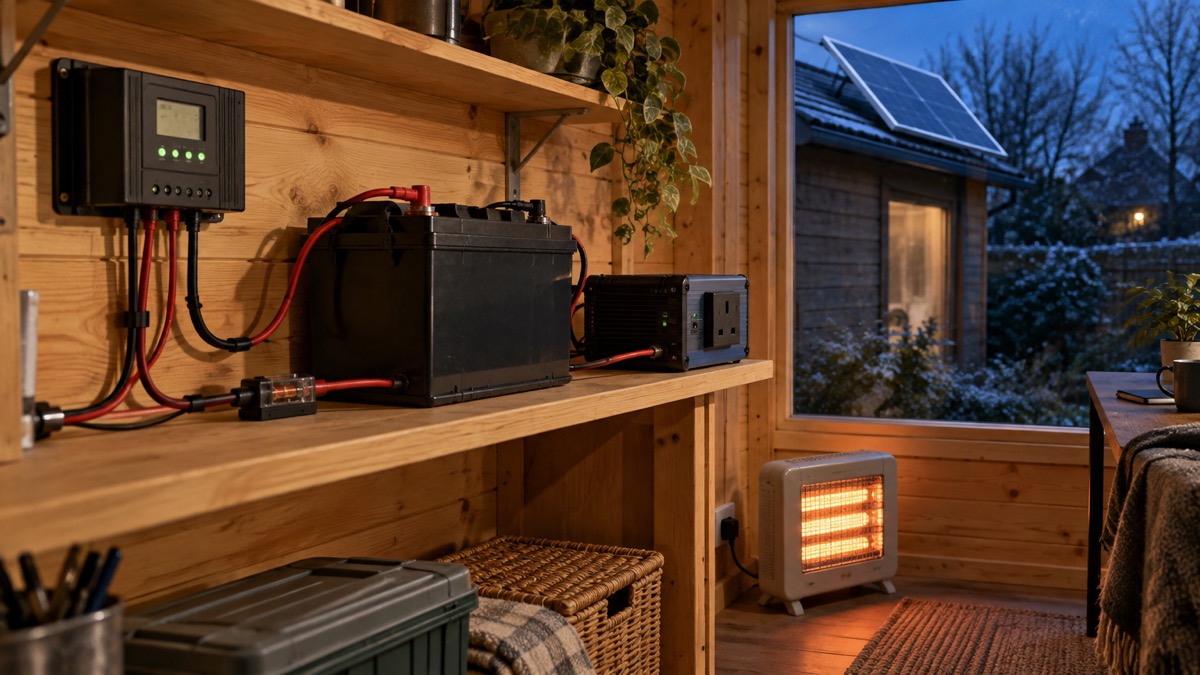
An off-grid solar kit for a shed, cabin or garden office comes down to four parts: a solar panel, a charge controller, a battery and an inverter. The panel makes the electricity, the controller manages the charge going into the battery, the battery stores it, and the inverter turns it into mains-style power for ordinary appliances. Get those four right and the system will run quietly for years. Get the sizing wrong and it will disappoint you in the first dull week of winter.
The order of work matters more than the shopping. Work out your daily need in watt-hours before you buy anything, then choose a system voltage, then size the panel and controller to match. A charge controller is required for all solar panels over 10W, because it controls the voltage and current between the panel and the battery and prevents overcharging and reverse current flow1. That single rule tells you the controller is not an optional extra.
Plan for winter from the start. A 100W panel that might make 600 to 700Wh on a good summer day produces around 90Wh in winter, and smaller panels fall proportionally2. That is the figure that decides whether your kit carries you through January, and it is why a backup matters as much as the panels themselves.
The off-grid solar kit checklist
Here is the full list, in the order you would assemble it. Each item earns its place because of what it does for the household, not because of a brand.
Sizing the kit: work out your watt-hours first
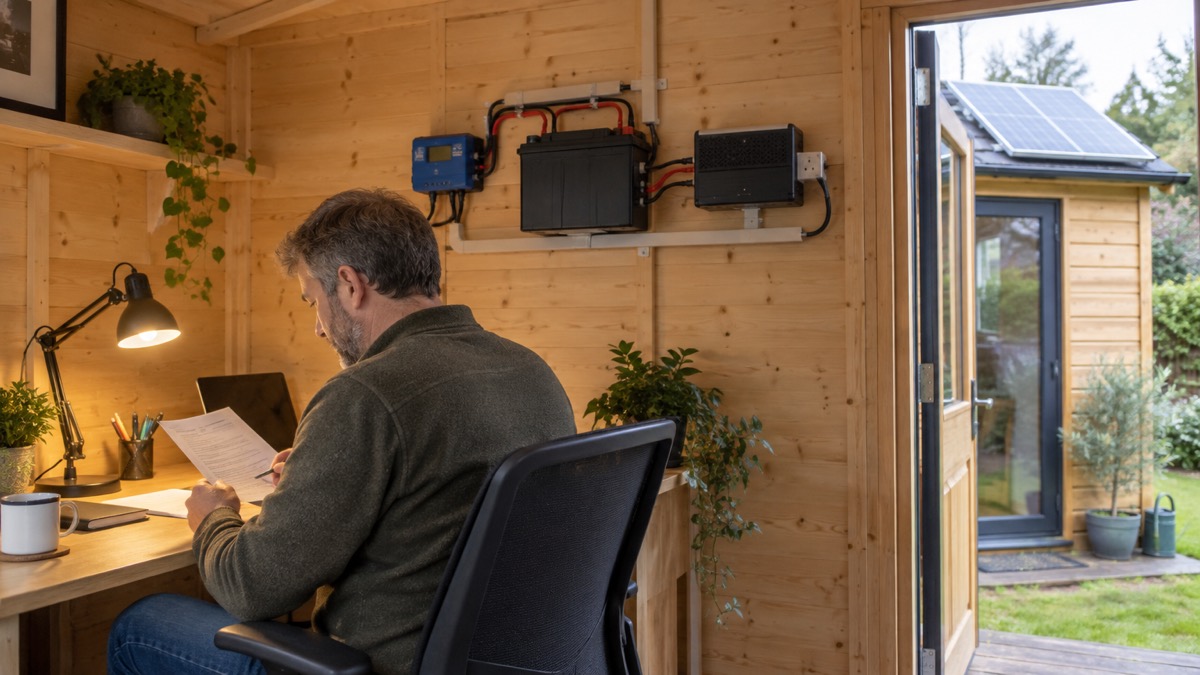
Before choosing any part, list what you want to run and for how long. Watt-hours are the currency: the power something uses multiplied by the hours it runs. A laptop rated at 65W is a useful anchor figure for a garden office4. Add up every appliance's watt-hours for a typical day and you have the number the rest of the kit is built around.
Amp-hours and watt-hours are not the same thing, and mixing them up is the most common sizing mistake. Amp-hours measure charge and only mean something once you know the voltage. To work out the drain an appliance puts on a 12V battery, take its power rating and divide by 122. Do the daily total in watt-hours first, then convert, so every comparison is like for like.
Once you have the daily figure, add margin. It is wise to choose a panel that offers a daily power rate of approximately 20% higher than the daily consumption you require3. That margin covers dull days, dirty panels and the fact that a panel rarely sits at its rated output.
Then size the inverter to the appliances that run at the same time. Add their ratings together and choose an inverter above that total. A kettle is the classic trap: a 1,500W kettle draws hard, and a maker's own figures show an Apex 300 with a 350W solar bundle running one for 0.8 hours4. That tells you more about battery capacity than about the inverter, but it shows how quickly heating appliances empty a store.
| What you are powering | Typical figure | What it means for the kit |
|---|---|---|
| Laptop | 65W4 | Modest, suits a small 12V set-up |
| Energy-saving lighting, stereo, phone charging, low computer use 2 to 3 hours a day | 40W to 50W panel or kit3 | The small-load baseline |
| Non-energy-saving bulbs, large TVs, frequent water pump use | 80W to 100W panel or kit3 | Step up the panel and controller |
| Kettle (1,500W) | 0.8 hours on an Apex 300 with 350W solar8 | Heating appliances need large capacity |
Choosing a system voltage: 12V for sheds, boats and motorhomes, 24V or 48V for larger set-ups
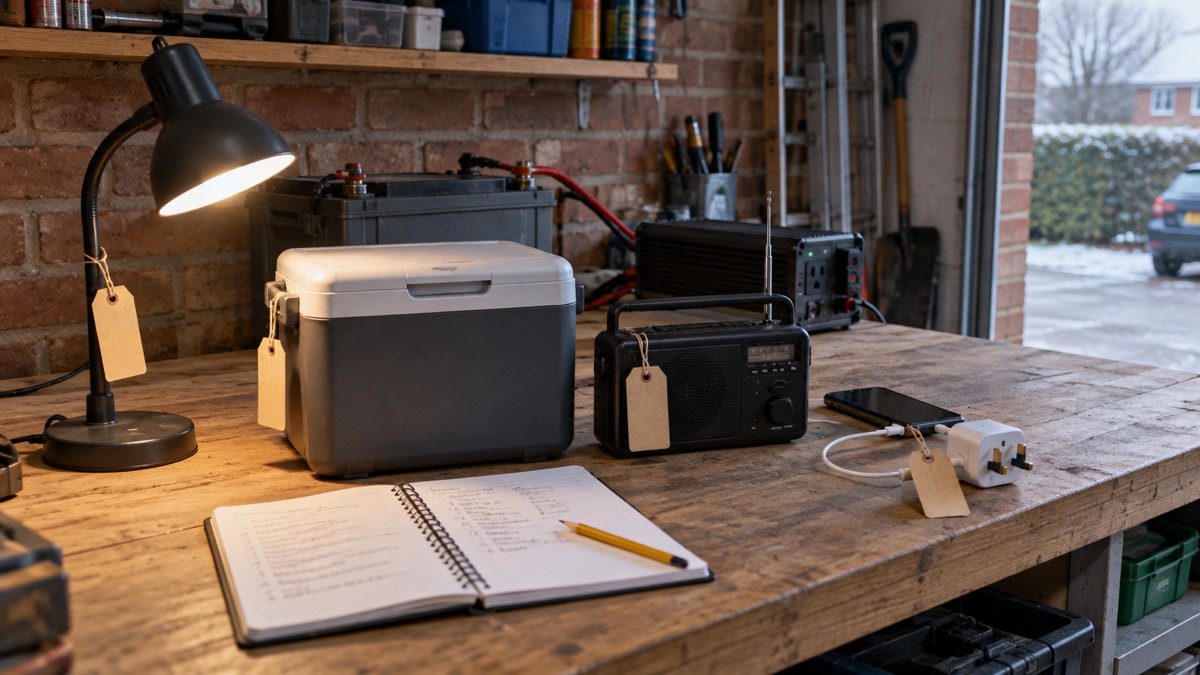
Twelve volts is the natural starting point for a shed, boat, motorhome or small cabin. Solar panels and small wind turbines usually operate at low voltages such as 12 or 24 volts9, and the equipment that suits them is widely available. In a caravan, the 12-volt system powers basically the lighting, water pump and fridge5. That is the scale a 12V kit is built for: lights, small electronics, a pump, a modest fridge.
The current drawn by 12V panels is typically proportionate to their wattage3, which is a tidy way of saying that a bigger panel brings more current and the controller has to be rated for it. Make sure the controller can withstand the total voltage from your panels, and if you plan to add more panels later, buy a controller that can cope with the added voltage1. Buying the controller for the system you might have, not just the one you have today, saves replacing it.
Where the set-up grows, the voltage rises. A 24V system halves the current for the same power, which suits larger arrays and longer cable runs. Guidance on matching panel size to voltage is not settled: one view holds that under 1kW of panels is best in a 12V system, another that 1kW to 3kW suits 24V. Treat that as a sign to size the controller generously and take advice on the specific installation rather than following a single rule.
For a garden office, the load is usually a laptop, lighting, a phone charger and perhaps a router, which sits comfortably in 12V territory. A portable power station with a solar panel is a convenient and practical solution for when the power goes off, with minimal set-up10. If the system is wired into the building rather than plugged in, it is recommended to hire a professional for installation to ensure everything is set up safely and efficiently4.
Winter output can drop by up to 90%, so plan a backup
The single biggest surprise for a new off-grid household is January. The Caravan and Motorhome Club's figures show how far output falls: a 100W panel that might give 600 to 700Wh in summer gives around 90Wh in winter2. The pattern holds across sizes.
| Panel size | Summer | Winter |
|---|---|---|
| 10W | 60 to 70Wh | 8Wh2 |
| 20W | 120 to 140Wh | 16Wh2 |
| 50W | 300 to 350Wh | 40Wh2 |
| 90W | 480Wh | 64Wh2 |
| 100W | 600 to 700Wh | 90Wh2 |
| 150W | 900 to 1,050Wh | 120Wh2 |
Read that table as a planning tool, not a forecast. It tells you that a kit sized exactly to your summer use will fall short in winter, and that the shortfall is large. The answer is either more panel than you think you need, a second charging route, or a backup that does not depend on the sun.
Wind and solar complement each other well, because there is more wind in winter and more sun in summer9. For a household that needs power all year round, that is the argument for a small wind turbine alongside the panels, or for accepting that winter is when the generator or the mains charger earns its place.
A generator is a legitimate backup, and some all-in-one off-grid inverters are compatible with generators as an alternative input power source to ensure power continuity when solar power is insufficient12. If you keep a generator, check and test it before the season when you will need it13. Never run one indoors or in an enclosed space: generators produce carbon monoxide, which is invisible and can kill. The Health and Safety Executive's guidance on generator safety should be read before first use.
When a system stops counting as off-grid
A kit in a shed is genuinely off-grid: it has no connection to the mains and simply does what it does. A system on a house is a different animal, and the difference matters during a power cut.
If you have solar panels and a battery storage system with power backup capability, some installations can continue to provide power during a power cut if they are designed and configured to operate independently of the electricity grid, which may help keep essential appliances running during an outage14. That is the official position, and the phrase "designed and configured" is doing the work. Most grid-connected solar does not do this by default.
During a power cut, systems such as solar panels, heat pumps, EV chargers and batteries automatically switch off to protect the home and engineers, and should not be damaged7. They usually restart on their own once power returns7. This is a safety feature, not a fault: a system that kept pushing electricity into the grid while engineers were working would put them at risk.
If your outage letter says you will be connected to a temporary generator, turn off your solar panels before the planned outage and turn them back on once mains power has been restored15. Solar panels left on may feed electricity into the generator and cause it to stop working15. That is a specific instruction for a specific situation, and it is easy to miss in the small print of a planned outage notice.
Battery systems sold as home backup have their own limits. One maker states that off-grid, its three-phase and single-phase systems support only dual-system and single-system output power ratings respectively16. In other words, the off-grid mode is not the same as the grid-connected mode, and the capacity available to you in a cut is smaller than the headline figure. Check the off-grid rating, not the on-grid one, before relying on a system to carry the house.
"During a power cut, systems like solar panels, heat pumps, EV chargers and batteries will automatically switch off to protect the home and engineers."
Keeping the kit ready through the year
An off-grid kit is only as good as its condition. A few habits keep it working when you need it.
- Check the panels are clear and well lit. Position them in a well-lit area and keep them angled for optimal sunlight exposure4. Shading on one panel drags down the whole array.
- Keep the battery dry and temperate. Site it away from extreme temperatures, moisture and direct sunlight4. Cold reduces what a battery can give; heat shortens its life.
- Test the backup before winter. Check and test backup generators and equipment ahead of the season when storms are likely13.
- Charge devices and make a plan so you know what to do if you have a power cut17. The same discipline applies to the kit: know what it will and will not run.
- Prepare an emergency grab bag in case you need to stay at home for several days without power18. The solar kit is part of the plan, not a substitute for one.
Power cuts can happen during severe winter weather19, and the network operators plan for it. National Grid keeps additional operational and engineering staff ready and on stand-by, as well as extra Contact and Control Centre operatives, during the winter period20. In Northern Ireland, SONI publishes a Winter Outlook every year that provides more information on how likely planned emergency power cuts are21. If you rely on power for health equipment, tell your network operator: customers with critical healthcare needs, along with the agricultural industry and rural communities, should think about how a power cut could affect them and put plans in place22.
For a wider look at living without mains services, see Self-Reliance at Home: Rainwater, Off-Grid Power and Living Without Mains, and for the household side of a cut, Power Cuts: A Household Guide.
Sources (22)
- Caravans and motorhomes, Photonic Universe, 2026-10-25
- Solar power, Caravan and Motorhome Club, 2026-10-25
- 12V solar panel, Photonic Universe, 2026-10-25
- Off-grid solar power, BLUETTI, 2026-10-25
- Batteries, Caravan and Motorhome Club, 2026-10-25
- Flex kits, Photonic Universe, 2026-10-25
- Planned outage, Scottish and Southern Electricity Networks, 2026-10-29
- Solar generator, BLUETTI, 2026-10-25
- Battery storage, CAT, 2025-06-27
- Home backup, Jackery, 2026-10-29
- Solar panels, Electrical Safety First, 2026-10-25
- All-in-one off-grid inverter, CyberPower, 2026-10-29
- Strong winds and heavy rain warning, nidirect, 2026-01-27
- Power cuts, GOV.UK Prepare, 2026-10-21
- Planned power cuts, Scottish and Southern Electricity Networks, 2026-10-25
- X1 energy storage system, Anker SOLIX, 2026-10-25
- Be winter ready, Energy Networks Association, 2026-10-28
- Winter preparedness, Essex Prepared, 2026-10-29
- Prepare for a power cut, Highland Council, 2025-08-05
- Preparing for winter weather, National Grid, 2026
- How likely to happen are emergency power cuts, NIE Networks, 2026-10-25
- Winter ready, NIE Networks, 2026-10-25
 Hydroponic System Parts List
 Year-Round Sowing Calendar
 Preserving Equipment Checklist