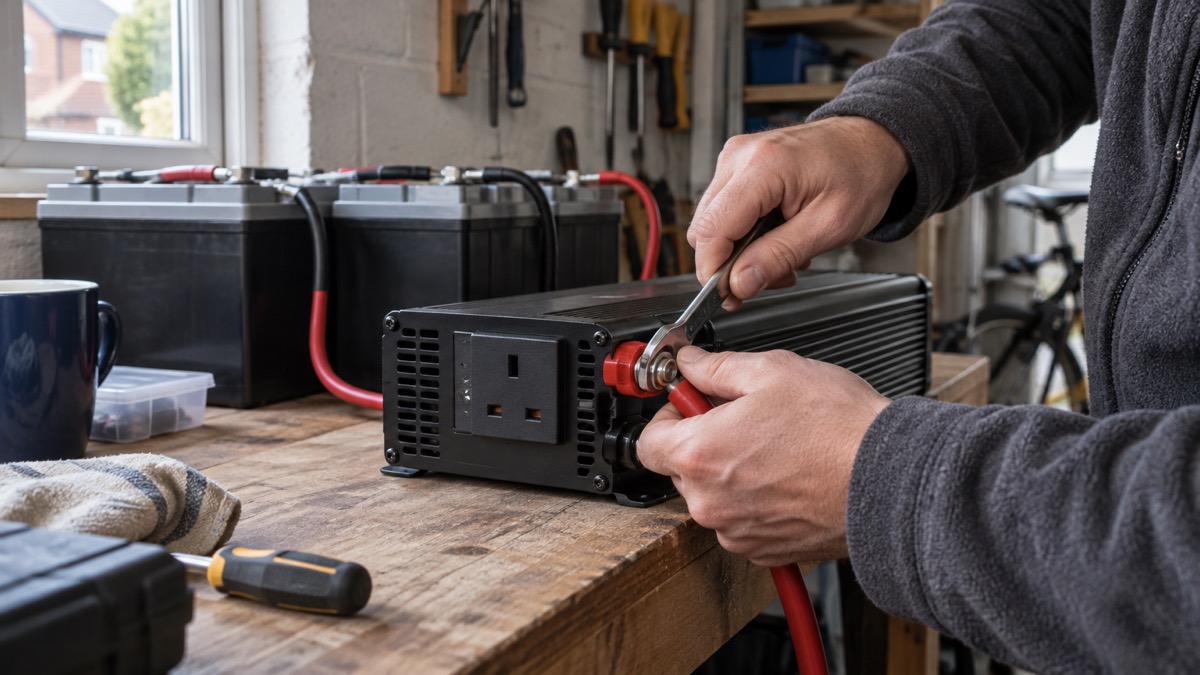
An inverter is a small device that converts the direct current (DC) power stored in a battery bank into standard 230V mains alternating current (AC), the same kind of electricity that comes out of a household socket1. That single function is what lets an off-grid home, a caravan or a battery-backed workshop run ordinary appliances: anything with a three-pin plug needs AC, and the inverter is the piece that supplies it2. If you have solar panels, the same rule applies, because a panel's output is DC and must be converted before it can power a mains appliance3.
Two numbers shape every choice you make. First, inverters typically work at around 85 to 90 per cent peak efficiency, which means they draw 10 to 15 per cent more energy from your battery than the appliance itself uses4. Second, a large inverter running only small loads wastes even more power than its headline efficiency suggests4. Size the inverter to the job, allow for the losses, and the rest of this page explains how.
What an inverter actually does
Batteries store and deliver direct current: electrons flowing one way, at a low voltage such as 12V or 24V. Household appliances in the UK are built for 230V alternating current, delivered through a three-pin socket, with the direction of flow reversing many times a second. An inverter sits between the two: it takes the battery's low-voltage DC and produces 230V AC at its output sockets1. Electrical Safety First makes the same point for solar: to use the electricity generated by solar panels, you need an inverter to convert the DC into AC3.
The practical consequence is that an inverter is the gateway between your battery bank and everything you own that has a normal plug. Without it, an off-grid system can still run 12V lighting, 12V pumps and USB charging directly, and many caravan and boat setups are built exactly that way. The Caravan and Motorhome Club notes that some appliances need an inverter to work off the 12-volt system, and that doing so increases the rate at which the battery is drained5. That drain is the trade-off you accept for mains convenience, and it is why the efficiency figures later in this page matter so much.
A related point: the small USB chargers you use every day do the reverse job. A USB charger converts AC power from a wall outlet into the DC power needed to charge portable electronics6. An inverter converts DC to AC. In an off-grid home you may avoid the double conversion entirely by charging phones and tablets from the inverter's built-in USB ports, which several models offer, rather than plugging a USB charger into the AC socket7.
Choosing an inverter: load, input voltage and type
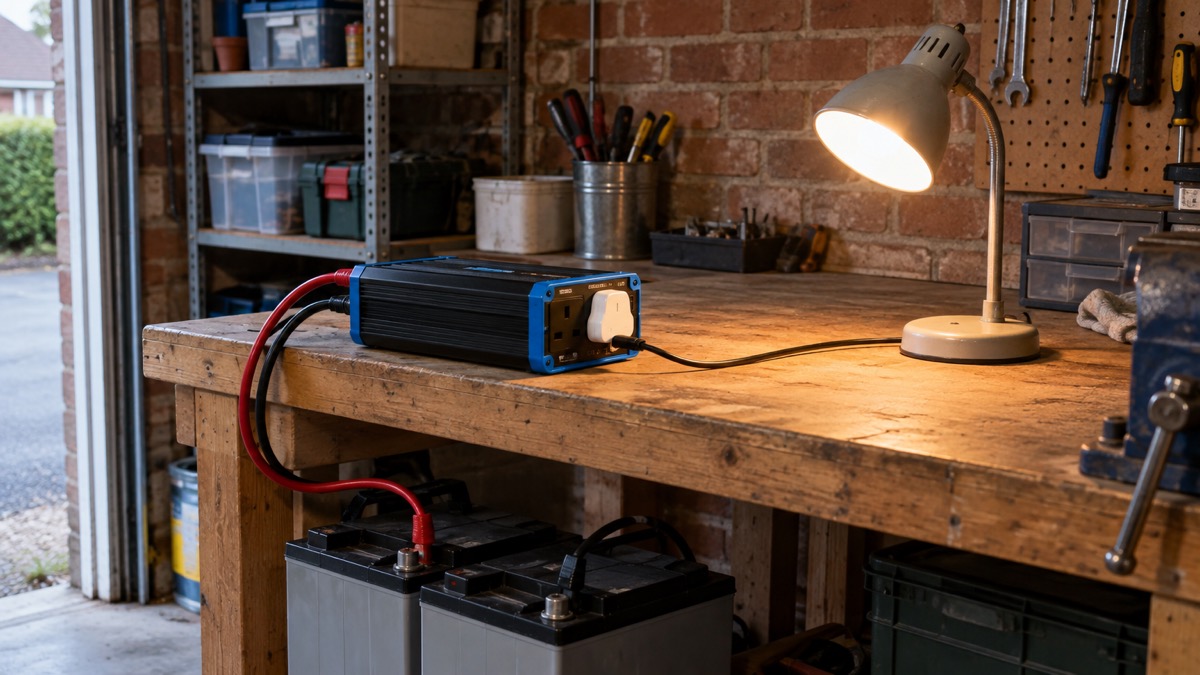
Maker guidance is consistent on the three things to decide first: choose an inverter based on the power consumption of your load, the input voltage, and the type of inverter1. Each of those three decisions rules out most of the market before you look at anything else.
The load. Add up the wattage of everything you want to run at the same time. Electrical Safety First's guidance on appliance ratings gives useful reference points: chargers for battery-operated devices use up to 75 watts, and chargers for tools typically draw 50 to 350W, with faster chargers drawing more8. A 300W inverter covers phone and laptop charging plus a few small items; a 600W unit adds kettles-free cooking aids, pumps and more tools; larger fixed installations run into the kilowatts. Match the inverter's continuous rating to your realistic simultaneous load, not to your total wish list.
The input voltage. Small inverters run from a 12V battery; larger systems move to 24V or 48V banks because the current stays manageable at higher power. The same model range is often sold in both: a 300W pure sine wave inverter is available in 12V and 24V versions, as is a 600W version9. Check your battery bank's voltage before buying, because a 24V inverter will not run from a 12V battery. Some charging accessories are broader in their tolerance: EcoFlow's alternator charger accepts an input voltage range of 11V to 31V, making it theoretically compatible with a wide range of vehicles10.
The type. The main fork is pure sine wave against modified sine wave, covered in the next section. Beyond that, some units are inverters only, while inverter chargers also recharge the battery bank from a mains or generator source, and hybrid units add a solar charge controller. The table below shows how the types differ.
| Type | What it does | Typical use |
|---|---|---|
| Inverter only | Converts battery DC to 230V AC | Adding mains sockets to an existing battery system9 |
| Inverter charger | Converts DC to AC, and charges the battery from AC input | Systems that also recharge from the grid or a generator11 |
| Hybrid inverter | Inverter, mains charger and solar charge controller in one box | Complete small off-grid systems9 |
| All-in-one off-grid inverter | Inverter with built-in solar charger and AC charger, generator-compatible | Whole-home off-grid systems12 |
For scale at the top end, off-grid inverters are sold as complete units for cabins, workshops, remote properties and off-grid homes combining solar charging, battery storage and generator support, and as high-capacity units for larger residential, agricultural and commercial systems supporting solar panels, battery storage and generators completely independent of the grid13.
Pure sine wave or modified sine wave
The waveform an inverter produces determines which appliances run safely on it. Mains electricity in the UK is a smooth sine wave. A pure sine wave inverter reproduces that smooth curve; a modified sine wave inverter produces a stepped, blockier approximation of it.
Pure sine wave output is what sensitive electronics, anything with a motor, and most modern appliances with power supplies expect. It is also increasingly standard even in portable equipment: the Jackery Explorer 500 v2 power station provides a constant voltage pure sine wave output14. At the household end of the market, pure sine wave inverters with UK sockets and USB charging ports are sold in 300W and 600W ratings at both 12V and 24V9, and fixed pure sine wave inverter chargers run to several kilowatts11.
Modified sine wave inverters are usually cheaper and will run simpler resistive loads, but the stepped output can cause humming, heat or misbehaviour in some appliances. Marlec's Spectra modified sine range quotes an efficiency of 89 to 94 per cent across its models, with a built-in USB charging point at 5V 2.1A for mobiles7, which shows the two waveforms overlap on efficiency: the choice between them is about appliance compatibility, not about one being universally more efficient.
| Pure sine wave | Modified sine wave | |
|---|---|---|
| Output shape | Smooth curve matching mains | Stepped approximation |
| Suits | Electronics, motors, most household appliances | Simple resistive loads |
| Typical availability | 300W and 600W units at 12V and 24V with UK sockets9; fixed units to several kilowatts11 | Range models with built-in USB7 |
| Efficiency | Varies by model; one fixed range quotes 93 per cent15 | 89 to 94 per cent quoted across one maker's models7 |
If you are unsure what a specific appliance will tolerate, pure sine wave is the safe default for household use. The cost difference is smaller than it once was, and the risk of damaged or misbehaving equipment sits entirely on the modified side.
Efficiency, battery draw and why oversizing wastes power
Inverters typically work at around 85 to 90 per cent peak efficiency, meaning they draw 10 to 15 per cent more energy from your battery than they deliver to the appliance4. That figure is a peak, reached at a favourable load, not a guarantee across the operating range. Maker guidance is blunt about the common mistake: large inverters used to power small loads will have even lower efficiency4. Match the inverter's size to the loads you actually need to run, rather than buying the biggest unit available, so you are not drawing its overhead from the battery for little return.
Some units mitigate this with a power save mode. Sterling Power's Pro Combi S inverter charger can drop its power consumption to as little as 0.2A when off load, and the maker points out that some competing combi units continue to consume 2A or more even with no load connected11. Over a day, that difference matters: 2A at 12V is a continuous drain on the battery bank whether or not anything is switched on. When comparing inverter chargers, look for the off-load or no-load current figure, not just the headline efficiency.
For comparison, dedicated battery chargers show the same spread. Sterling Power states its Pro Charge Ultra runs at over 90 per cent efficiency with power factor correction, in contrast to a non-PFC charger which runs at approximately 65 per cent efficiency16. Victron's Blue Smart IP22 12V charger is rated at 93 per cent efficiency17. These are charging devices rather than inverters, but they illustrate the range you should expect in DC-to-AC and AC-to-DC conversion equipment: anything much below the high eighties in per cent is leaving energy behind.
When you size a solar panel to supply appliances that run through an inverter, the same loss applies. Maker guidance states that the daily power consumption used to calculate the size of the solar panel should be increased by approximately 10 to 15 per cent to account for the inverter's draw4. Our page on sizing an off-grid solar system works through the daily watt-hour arithmetic; the inverter's share is this 10 to 15 per cent addition on top.
Inverter chargers: one box that also refills the batteries
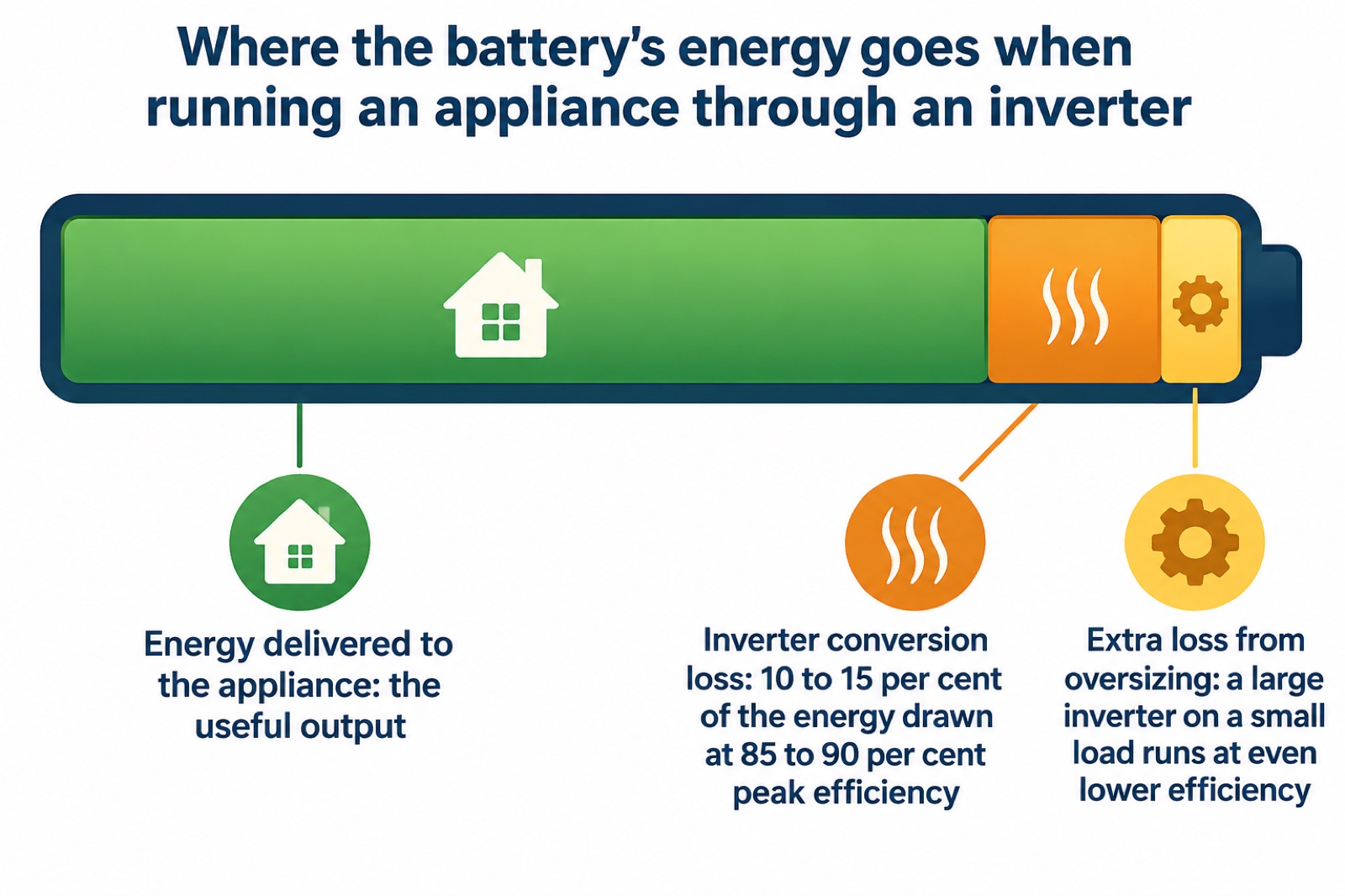
An inverter charger does two jobs. Connected to the battery bank, it inverts DC to 230V AC for your appliances. Connected to a mains supply or a generator, it reverses and charges the batteries. For an off-grid household that also has a backup generator, that dual function removes a separate charger from the system.
Sterling Power's Pro Combi S pure sine wave range shows the shape of the market. The 12V models deliver 2100W or 3200W continuous output with an 80A or 100A charger respectively; the 24V models pair a 35A or 50A charger with the inverter11. The charger accepts a Euro input voltage range of 196 to 245V11, so check that your generator's output sits inside that window before relying on it to charge. Sterling's separate Pro Charge C 24V 20A charger offers automatic 110/230V crossover on its input18, a useful tolerance if your charging source varies.
Hybrid units go further and add solar control. The Iconica 1000W 12V hybrid pure sine wave inverter combines a 50A solar charge controller and a 20A mains battery charger in one unit9. CyberPower's all-in-one off-grid inverter is designed with a built-in solar charger and AC charger, with an integrated maximum power point tracking (MPPT) charge controller so the extended batteries can be charged without connecting an additional solar charger12. It is also compatible with generators as an alternative input power source, to ensure power continuity when solar power is insufficient12, and its power source priority among PV, battery or utility grid is user-defined12.
Two features worth looking for in this class:
- Adjustable charge current. Sterling's VULCAN range lets you adjust the charge limit from 80A down to 10A in 10A increments15, which matters when charging from a small generator that cannot supply the full rate.
- Battery care when idle. Some chargers, such as the Victron Blue Smart IP22, can lower the voltage when batteries remain unused to minimise ageing effects, then periodically refresh the charge to help maintain battery condition19. CyberPower's all-in-one unit charges batteries to a reactivation level to relieve sulfation and extend battery lifespan12.
On charger sizing, maker guidance notes that most companies recommend a battery charger of about 10 per cent of the amp-hour capacity of the batteries requiring charging16. An inverter charger's charging side should be matched to your bank on that basis, separately from its inverting rating.
How off-grid inverters differ from small 12V car inverters
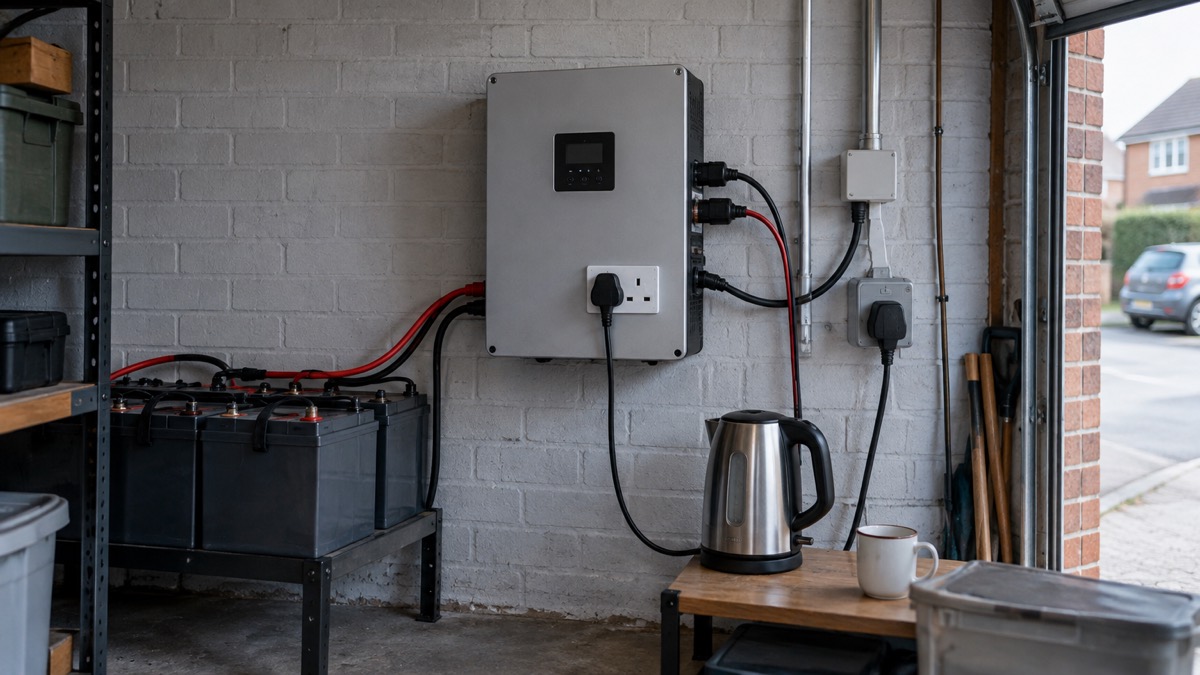
The small inverters sold for cars, with a lighter socket plug and one 230V socket, do the same conversion at a smaller scale, and for occasional use they are a reasonable way to run or charge one item from a vehicle battery. But they are a different class of equipment from a fixed off-grid installation, and the differences decide what each can power.
A fixed off-grid inverter is sized to a battery bank rather than a single starter battery, is wired with proper cable and fusing rather than a lighter socket, and is often part of a system with solar charging. Marlec's guidance for off-grid use is that an inverter enables you to operate mains appliances using the energy stored in your batteries when travelling and off grid7. Many newer inverters also monitor the insulation resistance of the cables, powering down when a fault is detected9.
The portable middle ground is the battery generator, or power station. Which? describes these as smaller and more portable than fuel-tank generators, but only really useful if you have low power demand, and notes some can be charged with solar panels20. The Jackery Explorer 500 v2 is one example, bundling an AC charge cable, a car charge cable and, depending on the bundle, a 100W solar panel, with a constant voltage pure sine wave output14. A power station is an inverter, a charger and a battery in one box: convenient, but bounded by its internal battery capacity in a way a fixed system with a large bank is not.
For a household weighing the options, the choice runs: a small 12V inverter for occasional single-appliance use from a car or leisure battery; a power station for portable, low-demand backup (see our backup power guide); and a fixed inverter or inverter charger, sized to a proper battery bank, when you want household appliances to run off grid for more than a few hours.
Fault protection in newer inverters
Modern inverters carry protection features that older units lacked, and they are worth checking for when you compare models. Electrical Safety First notes that many newer inverters monitor the insulation resistance of the cables, powering down when a fault is detected2. That means a damaged or degraded cable causes a shutdown rather than a shock or a fire, which is a meaningful safety layer for a permanently wired system. Makers also publish isolation resistance figures: Marlec's Spectra range specifies an isolation resistance of 100M Ohms between input and output at 500VDC across all its modified sine models7.
Battery-side protection is equally important, especially with lithium. Sterling's VULCAN range includes high and low lithium battery state of charge disconnect, so the inverter shuts down before the battery is over-discharged or overcharged, alongside low voltage alarms and shutdowns15. These protections protect the battery bank as much as the inverter.
Not everything is protected, and makers are explicit about the limits. Victron's SmartSolar MPPT RS manual states that as long as the unit is installed within the published specifications, the PV input is protected internally against PV reverse polarity, and the solar charger will not indicate an error21. But the same manual warns that the solar charger is not protected against reverse battery polarity, and any damage caused by this is not covered under warranty21. The lesson for any installation: check polarity twice before connecting, because the warranty will not save you.
Where to fit an inverter: avoid hot lofts
Location affects both the inverter's life and your household's safety. Electrical Safety First advises that inverters may be fitted in your loft, but if it tends to get hot in there, you should consider an alternative location such as a garage2. Heat degrades electronics, and an inverter working at several kilowatts produces its own heat on top of the ambient temperature. A cool, ventilated space with clear airflow around the unit is the goal.
If your system includes lithium batteries, the siting rules tighten. The official lithium battery fire safety guidance from Trafford Council advises: "Charge in ventilated areas, avoid enclosed spaces." and to keep batteries away from direct sunlight and heat sources24. Fire and rescue services reinforce the same points for charging generally: Manchester Fire and Rescue Service advises charging on a hard, flat, heat-resistant surface, away from extreme heat, cold, direct sunlight and flammable materials25, and West Yorkshire Fire and Rescue Service says never to charge on beds, sofas or under pillows, and to avoid charging in very hot or cold environments26. Ards and North Down Borough Council's safety leaflet adds to avoid storing or charging batteries in very hot or cold areas27.
A practical checklist for any inverter or inverter charger installation:
- Choose a ventilated space; a garage is a sound alternative to a hot loft2
- Keep the unit and any batteries away from direct sunlight and heat sources24
- Charge batteries on a hard, flat, heat-resistant surface, not on soft furnishings or carpets24
- Keep flammable materials away from the charging area25
- Avoid very hot or very cold environments for charging and storage26
One further point if the inverter will feed heaters. Fire and rescue services are unanimous that heaters must plug directly into a wall outlet or the supply socket, never into extension leads or power strips, because heaters draw a lot of power and can cause cords to overheat, leading to fires. North Yorkshire Fire and Rescue Service puts it plainly: "Plug electric heaters into a wall socket not an extension lead - they can easily be overloaded and cause fires."28 The same advice appears from Manchester29, Warwickshire30 and Armagh City, Belfast and Craigavon councils' safety guidance31. An inverter's output socket is the equivalent of a wall socket in this respect: plug high-draw appliances straight into it, not into a daisy chain of extensions.
Getting the size right: a worked approach
Putting the sections together, the sequence for choosing and installing an inverter runs as follows.
- List the appliances you actually need to run off grid, with their wattages, and add up what will run at the same time1.
- Pick the waveform: pure sine wave for electronics, motors and general household use; modified sine wave only for simple loads you have confirmed tolerate it7.
- Match the input voltage to your battery bank: 12V, 24V or 48V9.
- Allow 10 to 15 per cent extra battery draw for the inverter's losses, and remember a large inverter on a small load wastes more4.
- If you will recharge from a generator or the mains, choose an inverter charger and check its charger input voltage range covers your source11, with the charge rate sized around 10 per cent of the battery bank's amp-hour capacity16.
- If solar will supply the system, add roughly 10 to 15 per cent to your daily consumption figure when sizing the panel4, and consider a hybrid or all-in-one unit with a built-in MPPT controller9.
- Install it in a cool, ventilated space, on hard surfaces, away from heat and flammable materials2.
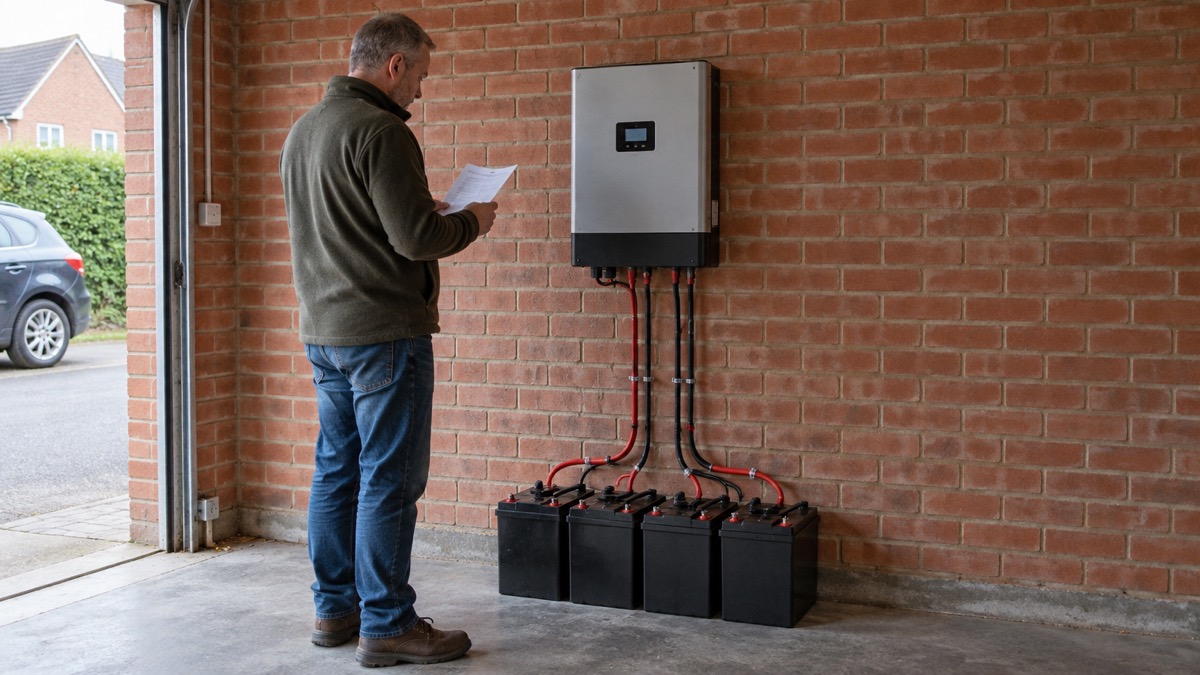
For readers building the wider system, our pages on off-grid solar systems, charge controllers and battery banks cover the pieces either side of the inverter, and 12V DC, AC and AC-coupled systems explains where the inverter sits in the different architectures.
Sources (31)
- Caravans and Motorhomes Applications, Photonic Universe, 2026-10-25
- Solar Panels Safety Advice, Electrical Safety First, 2026-10-26
- Green Energy Solar Panels Safety Advice, Electrical Safety First, 2026-10-25
- How to Choose a 12V Solar Panel, Photonic Universe, 2026-10-25
- Caravan Batteries Technical Advice, The Caravan and Motorhome Club, 2026-10-25
- Chargers Product Safety Guidance, Electrical Safety First, 2026-10-26
- Off-Grid Inverters, Marlec, 2026-08-26
- Ratings of Electrical Appliances, Electrical Safety First, 2026-10-25
- Inverters Product Listing, Photonic Universe, 2026-10-25
- 600W Alternator Charger, EcoFlow, 2026-10-25
- Pro Combi S Pure Sine Wave Inverter, Sterling Power, 2026-10-25
- All-in-One Off-grid Inverter Series, CyberPower, 2026-10-29
- 64-4kWh Modular 48V Battery Inverter Bundle, Fogstar, 2026-10-25
- Explorer 500 v2 with Accessories Cable, Jackery, 2026-10-29
- 48V 5500W Pure Sine Wave Inverters, Sterling Power, 2026-10-25
- Pro Charge Ultra, Sterling Power, 2026-10-25
- Victron Blue Smart IP22 12V 15A Charger, Fogstar, 2026-10-25
- Pro Charge C 24V 20A AC to DC Battery Charger, Sterling Power, 2026-10-25
- Victron Blue Smart IP22 12V 15A 3 Output Charger, Fogstar, 2026-10-25
- How to Buy the Best Generator, Which?, 2026-01-20
- SmartSolar MPPT RS Manual, Victron Energy, 2026-10
- Unplug to Unwind, Dorset & Wiltshire Fire and Rescue Service, 2024-11-21
- Charge Safely for Your Own Safety, Northern Ireland Fire and Rescue Service, 2026-09-21
- Lithium Battery Fire Safety, Trafford Council, 2026-10-29
- Battery Safety, Manchester Fire and Rescue Service, 2026-10-29
- Battery Safety, West Yorkshire Fire and Rescue Service, 2026-10-29
- Stay Warm, Stay Safe Leaflet, Ards and North Down Borough Council, 2025
- Heating Your Home, North Yorkshire Fire and Rescue Service, 2026-03-09
- Stay Fire Safe, Manchester Fire and Rescue Service, 2026-10-29
- Safe Home Heating, Warwickshire County Council, 2026-10-29
- Safe Use of Heaters and Generators, Armagh City, Belfast and Craigavon Council, 2026-10-29
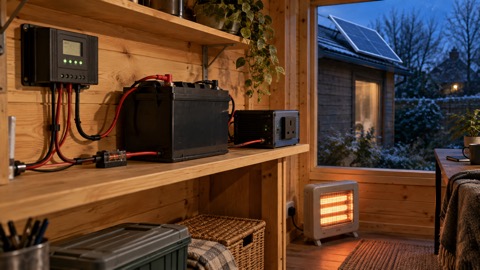 Off-Grid Solar Kit Checklist
 Hydroponic System Parts List
 Year-Round Sowing Calendar
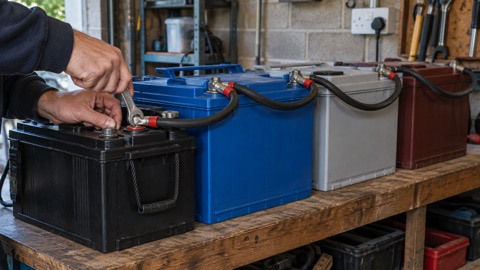 Off-Grid Battery Banks
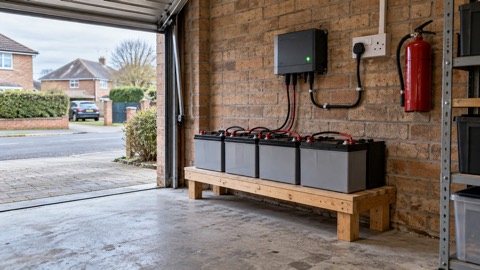 Off-Grid Battery Care
 Solar Charge Controllers
 G98 DNO Notification
 Mounting and Wiring Solar Panels
 Solar Panel Types
 Sizing an Off-Grid Solar System
 Solar Water Pumping
 Off-Grid System Types
 Small Wind Turbines