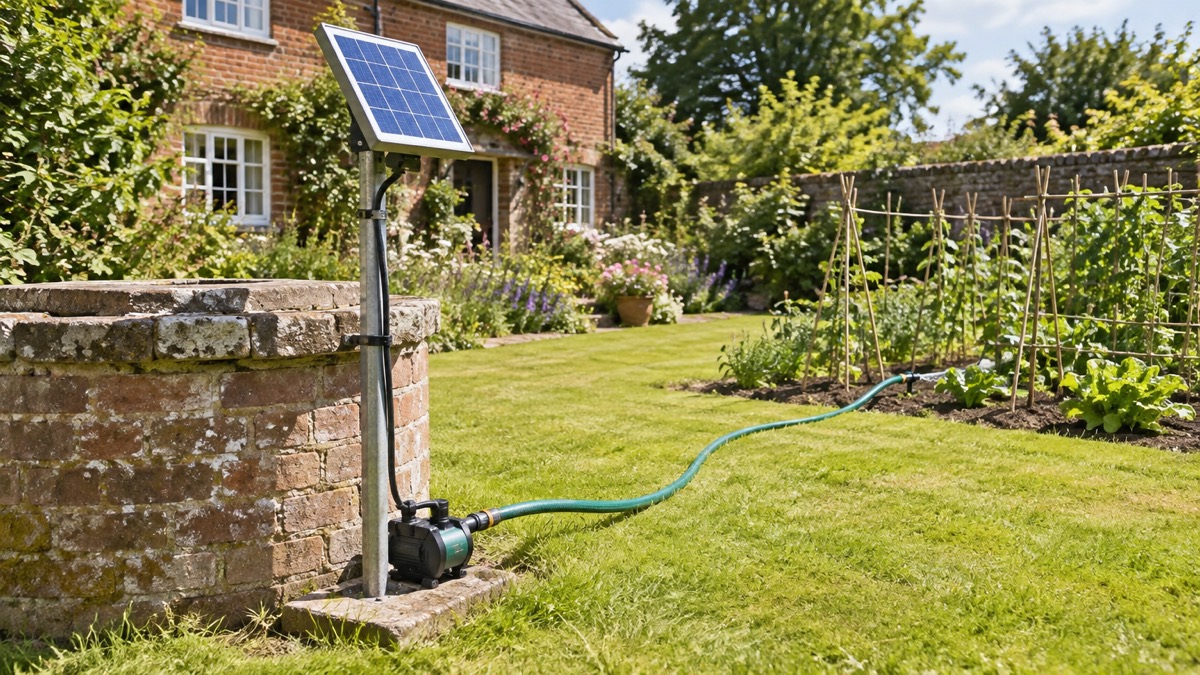
A solar water pump uses a photovoltaic panel to drive a small pump, so you can move water from a well, borehole, water butt, pond or tank without mains electricity1. Two arrangements are possible: solar-direct, where the panel drives the pump only while there is daylight, and battery-backed, where the panel charges a battery and the battery runs the pump on demand, day or night.
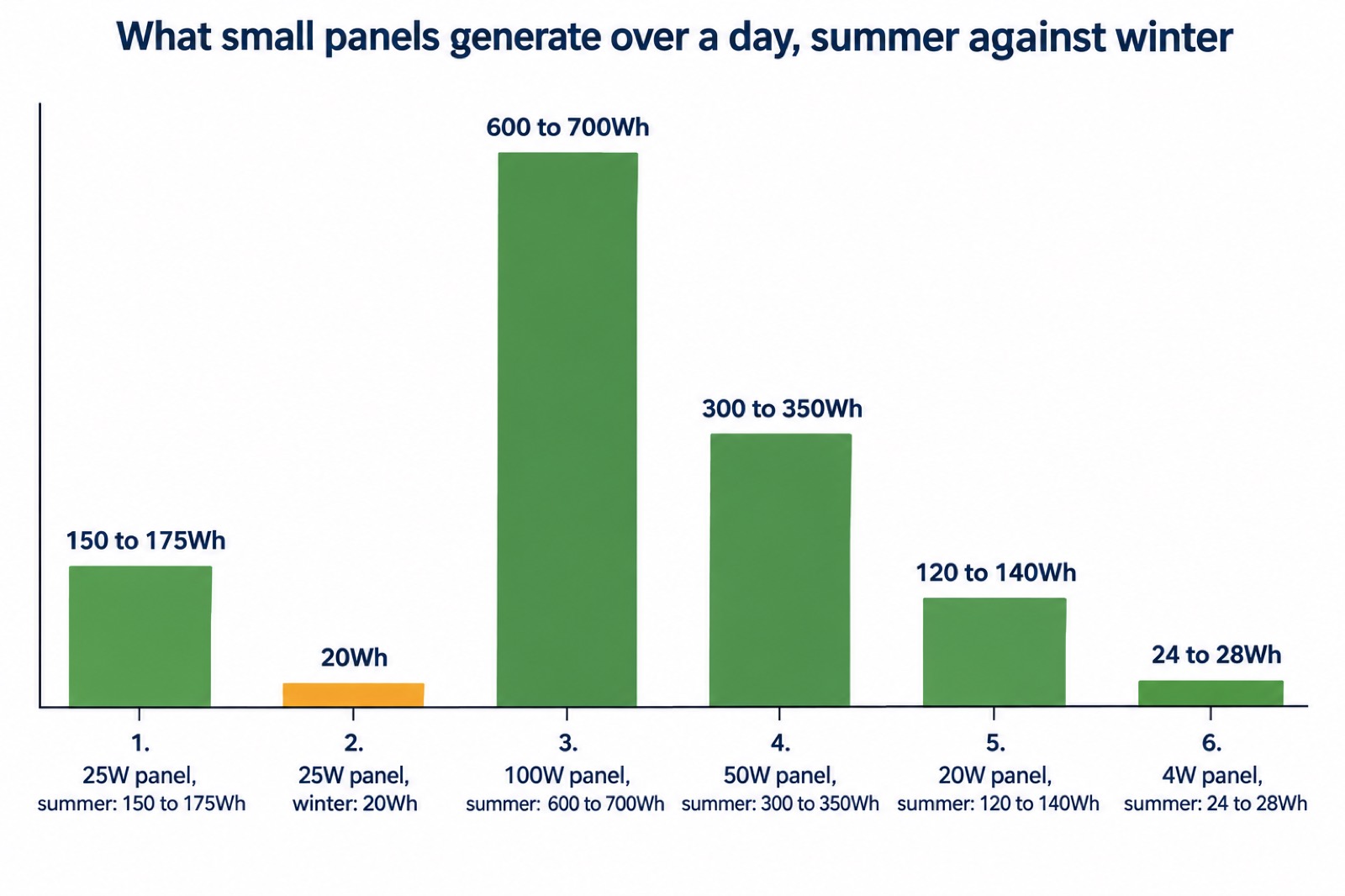
The scale is worth being clear about. Independent guidance for small solar installations lists a 25W panel generating 150 to 175Wh over a summer day but only 20Wh over a winter day2. That gap between summer and winter is the single most important number on this page: a system that comfortably pumps your garden water in July may barely turn over in December.
Solar-direct or battery-backed: two ways the system behaves
A solar-direct system is the simplest thing you can build: a panel, a controller or blocking arrangement, and a pump. When the sun is on the panel, the pump runs; when a cloud passes, the pump slows; when the sun goes down, the pump stops. Nothing is stored, so nothing can go flat, but nothing is available at dusk either. This suits garden watering, filling a tank or trough during the day, and fountain or pond circulation, where a few hours of running is all you want.
A battery-backed system puts a battery between the panel and the pump. The panel charges the battery through a charge controller during the day, and the pump draws from the battery whenever it is switched on. This is what you want if you need water at a chosen time, in a set volume, or after dark. It is also the arrangement that official power cut guidance points to more broadly: if you have solar panels and a battery storage system with power backup capability, some installations can continue to provide power during a power cut if they are designed and configured to operate independently of the electricity grid, which may help keep essential appliances running during an outage5.
One electrical difference matters when choosing a pump. The power generated by a solar panel is direct current (DC), so if you want to power something that uses a three-pin 230V socket, an inverter is needed to convert the panel's DC output to AC2. Small 12V DC pumps avoid that conversion entirely, which is why most small solar pumping setups use them. If your system does feed into the home's wiring, Electrical Safety First notes that it is important the correct type of RCD or RCBO is used with the PV system; this should be verified with the manufacturer and will often be a type B, which can withstand any DC earth leakage6.
| Solar-direct | Battery-backed | |
|---|---|---|
| Runs when | Daylight only | Any time, from stored charge |
| Components | Panel, pump, controller | Panel, charge controller, battery, pump |
| Suits | Daytime garden watering, tank filling, fountains | Water on demand, evening use, outages |
| Weak point | Cloudy and winter days | Battery cost and care |
| Complexity | Low | Higher |
What a solar water pump can do for a household in an emergency
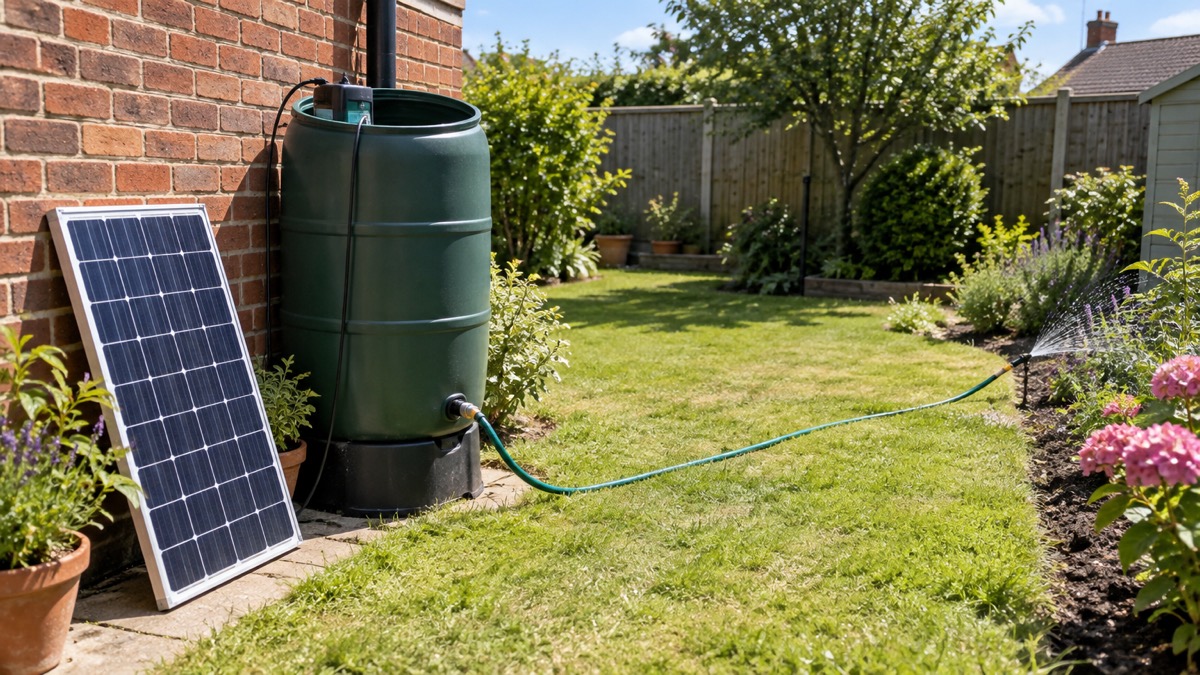
In a mains water interruption, the practical uses of a solar pump are filling containers, flushing toilets and watering plants, not drinking water. Official guidance for water supply interruptions is explicit: whilst there is no mains water supply, use alternative water supplies such as bottled water solely for drinking, washing your hands and food preparation7. Pumped rainwater or untreated well water sits on the other side of that line. Greater Manchester's resilience guidance says collected rainwater can be used for flushing toilets or watering plants, but you must not drink this water as it could contain bacteria or disease8.
That still makes a pump genuinely useful. Toilet flushing is the largest everyday water need a household can meet without mains, and a pump that moves water from a butt or tank to a cistern saves carrying buckets. If your household includes a baby, someone with a medical device, or pets, plan additional bottled water for making up formula, for medical devices and for pets8. A solar pump can also keep a pond oxygenated or a water butt circulating during a long outage, and it can refill a header tank from a lower storage tank by gravity feed afterwards.
If your backup plan is a power station rather than a dedicated panel, the same physics applies: the station's stored watt-hours are the budget, and every hour of pumping draws on it. During a power cut, a solar and battery installation configured to run independently of the grid may keep essential appliances going5, and a small pump is well within that class of load. See our backup power at home and off-grid solar systems guides for the wider picture.
Sizing the panel to the pump and the lift
Sizing means matching three things: the pump's power draw, the hours per day it must run, and the panel's daily generation in the season you actually need the water. Independent guidance gives daily generation figures for small panels over a summer day, and a winter figure for the 25W size2:
| Panel size | Summer generation over 24h | Winter generation over 24h |
|---|---|---|
| 4W | 24 to 28Wh | not stated |
| 20W | 120 to 140Wh | not stated |
| 25W | 150 to 175Wh | 20Wh |
| 50W | 300 to 350Wh | not stated |
| 100W | 600 to 700Wh | not stated |
The same guidance lists a water pump among the typical loads a small photovoltaic panel can supply through a 12V battery2, and a pump used briefly each day is a modest load on paper. Real installations are less tidy. A pump working against a significant lift, a long pipe run or a restricted outlet draws more and runs longer than the label suggests, and a solar-direct pump that starts and stops with passing clouds runs inefficiently. The honest approach is to size the panel for your worst month, not your best, and to treat the summer figures as the ceiling rather than the promise.
For a battery-backed system, the arithmetic works the other way round: add up the pump's daily watt-hours, then choose a panel and battery that deliver them with margin. Our guides on sizing an off-grid solar system from your daily watt-hours, charge controllers and battery banks cover that in detail. Whatever the arrangement, buy the pump before the panel and size the panel to the pump you actually own, not the one you imagine.
Pumping from a well, borehole or water butt
Private water supplies in the UK come from a wide range of sources. Somerset Council lists a spring, a well, a borehole, a river, a stream or a pond9; the Drinking Water Inspectorate adds boreholes, natural springs and watercourses10; Highland Council lists springs, wells, boreholes, rivers and lochs11; and Argyll and Bute Council includes a loch, burn, spring, well, river, pond, borehole, even rainwater collection or a combination of these12. A solar pump can move water from any of them, but each source has its own rules about placement and protection.
The placement rule that saves pumps comes from official guidance on private water supplies in Wales: ensure your pump is positioned below the water level, because a pump can be damaged if it is trying to pump in a dry well or borehole and can be costly to replace; consider lowering the pump if possible13. Check the water level at the end of a dry summer before you commit to a depth, since each summer private supply users call their council as their springs, wells or boreholes have dried up, sometimes for many months9. For the same reason, official Welsh guidance suggests considering deepening your well or borehole to reduce the chances of it drying up, and installing water storage tanks to make the supply more resilient in dry weather14.
For borehole and spring chambers, the Drinking Water Inspectorate advises creating a run to waste facility to prevent contaminated water entering the supply, for instance after pesticide spraying nearby, and notes that discharges to waste may need to be agreed with the environmental regulator15. If your source is rainwater rather than groundwater, Westminster City Council advises installing a water butt for rainwater storage from your downpipes, which can be connected to greywater systems such as toilet flushing and garden watering16. Our pages on water butts, rainwater harvesting and pumps for rainwater tanks go through the fittings and choices.
For garden use, efficiency matters as much as pumping capacity. Wessex Water advice highlighted by Wiltshire and Swindon Prepared is to use watering cans rather than hosepipes, because they use much less and are more efficient at targeting the roots of plants, and to use rainwater rather than tap water if you have a water butt installed17. Scottish ready campaign guidance gives the same advice: use a watering can instead of a garden hose18. A solar pump that fills a watering can barrow slowly all day is doing exactly the right job.
Storing pumped water so it is ready when the sun is not
Storage is what turns an intermittent solar-direct pump into a reliable supply: pump when the sun shines, use the water when you need it. The Drinking Water Inspectorate's guidance for private supply networks is that all storage tanks must be insulated to guard against freezing during the winter and excessive warming during the summer months19. Its guidance on storage tanks and cisterns adds that they should be insulated and not exposed to sunlight and not located near to any source of heat, so the stored water is kept as cold as practicable20. Those two rules, cold and frost-safe, cover most of what can go wrong with a stored tank.
How much to store depends on your household and garden. Our tank sizing page works through roof area, rainfall and demand, and the choice between above-ground and underground tanks is covered separately. If you are keeping bottled water as the drinking portion of your emergency store, remember that additional water might be needed to make up baby formula, for medical devices and for pets8.
Keep the stored water turning over rather than sitting for months. Our page on whether stored rainwater goes off or stagnates covers the signs and the fixes, and keeping a rainwater system clean through the year sets out the routine.
When pumped water is not safe to drink
This is the boundary every household should know before an emergency, not during one. Rainwater and water from an untreated private source must not be drunk. The ready campaign guidance for England is blunt about water butts: do not drink this water as it could contain bacteria or disease; it can be used for flushing toilets or watering plants3. The same rule applies during floods: if the drinking water is unsafe, do not use it to wash children; use tanker or bottled water21.
For babies, the rules around bottled water are specific. Bottled water is not usually recommended for making up formula milk feeds because it is not sterile and may contain too much salt (sodium) or sulphate22. In rare circumstances, such as when drinking water is unavailable or contaminated, you can use still bottled water, but check the label to ensure it does not have more than 200 mg per litre (mg/L) of sodium or 250 mg/L of sulphate; it should be boiled and allowed to cool for no more than 30 minutes3. The same figures and the 30-minute rule appear in the power cut guidance for England and Northern Ireland22.
If your private supply is properly treated and tested, it may of course be drinkable, and that is a matter of testing rather than pumping. See our pages on treating a private water supply and whether harvested rainwater is safe to drink.
Where pumps and wiring must never be placed
The clearest prohibitions concern fuel-driven equipment. Carbon monoxide safety guidance from several fire and rescue services and councils is consistent: do not use any fuel-driven equipment, petrol and diesel generators or pumps, indoors4. Flooding advice from Scottish Borders Council says petrol or diesel generators and other fuel-driven equipment should never be brought indoors23, and Mid and West Wales Fire and Rescue Service gives the same instruction in Welsh4. If you are weighing a petrol pump against a solar pump for this reason alone, the solar pump wins on safety: it produces no exhaust and can run in a shed or outhouse that a fuel pump must never occupy.
Electrical placement rules matter just as much for solar. London Fire Brigade's safety advice for plug-in solar panels says that if you are plugging your solar panel into an outdoor socket, ensure it is a minimum IP65-rated installation fitted by a competent person24. The same advice says do not trap cables in doors or windows, run cables under carpets, or expose cables to sharp edges24. Water and electricity together deserve particular care around a pump: keep connections above water level where possible and use outdoor-rated fittings.
"Stop using the system immediately if you notice: Burning smells Overheating Buzzing noises Visible damage Repeated electrical tripping"
If a fire does occur, London Fire Brigade's instruction is to avoid touching the system or associated equipment, move to a place of safety, call 999, and tell the 999 operator and any firefighters attending that solar panels are installed at the property24. Our narrow guides on plug-in solar safety, outdoor sockets and extension leads and what to do in a fire with solar panels installed cover these situations step by step.
Finally, check for recalls on any pump you already own. A 2025 product recall notice, PSD notification number 2510-0040, covers Tucson circulating pumps, notified by Northern Ireland Environmental Health25. If you own pumps of that type, follow the recall notice rather than continuing to use them.
Keeping the system working through winter
Winter is when the gap between promise and performance shows. The 25W panel that gives 150 to 175Wh on a summer day gives 20Wh on a winter day2, roughly an eighth of the summer figure. A solar-direct pump that ran for hours a day in June may manage minutes in December. If winter watering or winter pumping matters to you, either oversize the panel for the season or accept that the system is a fair-weather tool and store water ahead instead.
Protect the plumbing as well as the panel. Official cold weather advice is to fit insulation for water pipes to prevent them from freezing in cold weather26, and the Met Office WeatherReady winter checklist includes getting the boiler serviced27. Insulate the storage tank against both freezing and warming, as the Drinking Water Inspectorate requires for private supply tanks19, and check before restarting in spring that the pump is still below the water level, since a pump running dry in a well that has drawn down over winter can be damaged and costly to replace13.
Most panels need little winter maintenance. Electrical Safety First notes that most panels have a self-cleaning coating which, when installed at a suitable angle, allows rain to clear dirt and debris6, so winter rain largely does the cleaning for you. If you are running a wider off-grid setup through winter, Wiltshire and Swindon Prepared's gas outage advice includes a useful habit for any heating loss: if you are able to use a camping stove outside, boil some water to keep in a flask so hot soups or a hot drink can be made28. Our rainwater system winter checklist collects the seasonal jobs in one place.
Where to get help with wells, boreholes and water quality
Your local authority is the statutory body for private water supplies. Somerset Council, for example, provides a statutory service for sampling and risk assessing private water supplies in accordance with the Private Water Supplies Regulations 2016 and the Private Water Supplies (Amendment) Regulations 20189, and the same framework applies across England and Wales. If your supply serves the public or a commercial operation, you are required by law to have it tested12. A supply used for domestic purposes that serves two or more dwellings must be risk assessed every 5 years and regularly tested in accordance with the regulatory requirements by the local authority29, and the frequency of testing depends on the supply type29. Our page on private water supply regulations explains who is responsible for what.
In Scotland, arrangements differ. The Scottish Government's policy on private water supplies notes a private water supply connections pilot project, delivered with Scottish Water, Consumer Scotland and local councils, which helped eligible communities affected by water scarcity explore opportunities to connect30. See our guides on private water supplies in Scotland and the private water supply grant in Scotland.
If your well or borehole runs low or dry, Natural Resources Wales advises contacting your water company or local council for information on connecting to a mains supply, and notes the local authority may be able to require water companies to assist where supplies fail in domestic properties under certain conditions14. For context on how much infrastructure sits behind the mains you may be considering, Southern Water alone operates 655 pumping stations alongside 232 service reservoirs across a 13,919-kilometre network31. Households that need extra support can join their water company's Priority Services Register, which can include water support to help with bills, telling you if they are going to turn off your water, and having your meter read for you32. Our extra help in an emergency page explains how to register.
Sources (32)
- Plug-in solar panels, London Fire Brigade, 2026-10-25
- Solar power technical advice, The Caravan and Motorhome Club, 2026-10-25
- Water supply interruptions or outages, Be Ready campaign, 2026-10-12
- Carbon monoxide safety in your home, Tânc GC, 2026-10-29
- Power cuts, Prepare campaign, 2026-10-21
- Solar panels safety advice, Electrical Safety First, 2026-10-26
- Water supply interruptions or outages, Prepare campaign, 2026-10-12
- Loss of essential services, Greater Manchester Combined Authority, 2026-10-29
- Private water supplies, Somerset Council, 2026-08-12
- Private water supplies, Drinking Water Inspectorate, 2026-10-28
- Private water supplies, Highland Council, 2025-10-10
- Private water supplies, Argyll and Bute Council, 2026
- Drought planning and management, Natural Resources Wales, 2026-10-29
- Drought planning and management, Natural Resources Wales, 2026-10-29
- Protecting your private water supply, Drinking Water Inspectorate, 2026-10-28
- Drought advice, Westminster City Council, 2026-08-06
- Spotlight on Wessex Water advice on saving every drop, Wiltshire and Swindon Prepared, 2026-10-25
- Hot weather advice, Ready Scotland, 2026-03-24
- Water storage in private supply networks, Drinking Water Inspectorate, 2025-11-05
- Water Storage Tanks and Cisterns - Drinking Water Inspectorate, Drinking Water Inspectorate
- Keeping children safe during a flood, nidirect, 2025-12-09
- Power cuts, Be Ready campaign, 2026-10-21
- Flooding advice, Scottish Borders Council, 2026-10-29
- Plug-in solar panels safety advice for residents and homeowners, London Fire Brigade, 2026-10-25
- Product recall: Tucson 5m, 6m and 8m pumps, GOV.UK Product Safety, 2025-10-08
- Keeping warm and well in cold weather, GOV.UK, 2026-04-28
- WeatherReady winter checklist, Met Office, 2026-10-28
- What you might need in a gas outage, Wiltshire and Swindon Prepared, 2026-10-25
- Buying a dwelling with a private water supply, Drinking Water Inspectorate, 2026-10-28
- Private water supplies policy, Scottish Government, 2026-10-29
- What we're doing to minimise leaks, Southern Water, 2026-10-28
- Priority Services Register, Surrey County Council, 2026-10-28
 Off-Grid Solar Kit Checklist
 Hydroponic System Parts List
 Year-Round Sowing Calendar
 Off-Grid Battery Banks
 Off-Grid Battery Care
 Solar Charge Controllers
 G98 DNO Notification
 Off-Grid Inverters
 Mounting and Wiring Solar Panels
 Solar Panel Types
 Sizing an Off-Grid Solar System
 Off-Grid System Types
 Small Wind Turbines