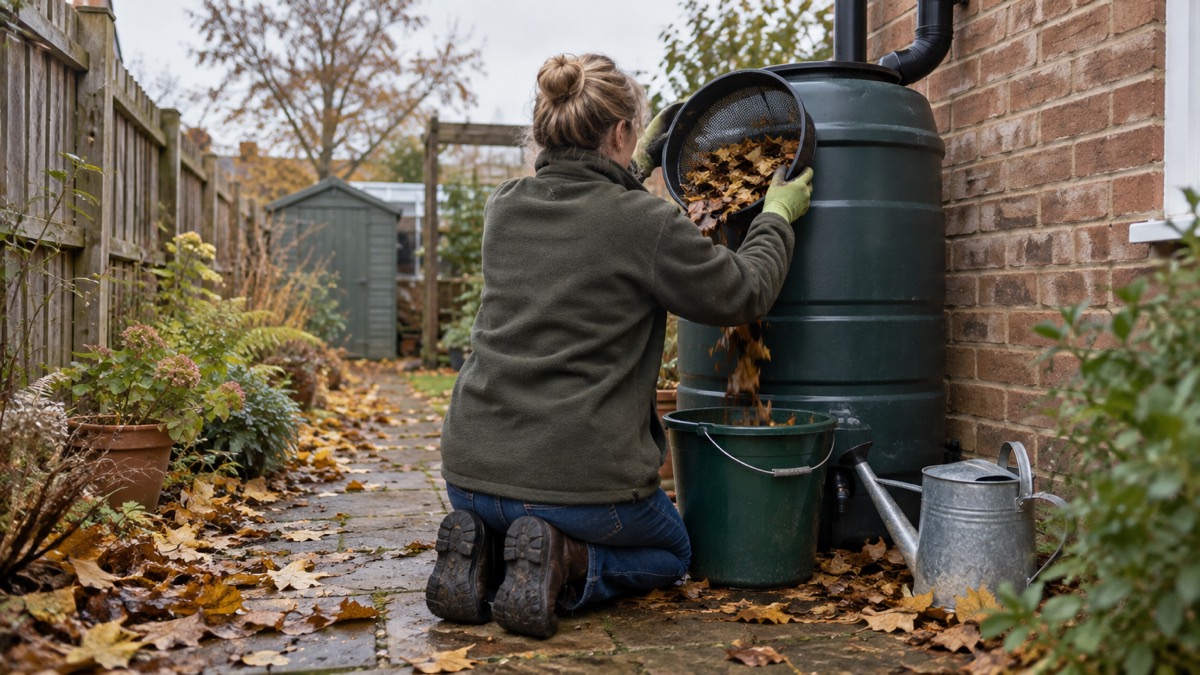
A rainwater system is not a fit-and-forget appliance, but it asks far less of you than most people expect. The filter, the calmed inlet and the overflow between them do most of the daily work of keeping the water in the tank fresh, and makers describe their filter kits as self-cleaning and low maintenance1. One supplier, Rainwater Harvesting Ltd, describes its systems as virtually maintenance free and recommends a full system clean after 10 years, with occasional checks of the self-cleaning filter in between2.
What is left for you is a handful of seasonal jobs: clear the leaf filter so debris never reaches the tank, keep the tank dark and covered so algae cannot grow, leave the sediment layer on the tank floor alone, and make sure the overflow can still discharge freely when heavy rain arrives. Alongside those, there are two rules that never change: rainwater is not drinking water, and every pipe and fitting that carries it must be marked so nobody mistakes it for the mains.
This page walks through each part of the system in turn, what can go wrong with it, and what to do about it. If you are new to rainwater harvesting, start with how a rainwater system works; if you keep a simple butt rather than a tank, the jobs are smaller but the same ideas apply, and cleaning a water butt covers that in detail.
How the system keeps itself clean: filter, calmed inlet and overflow
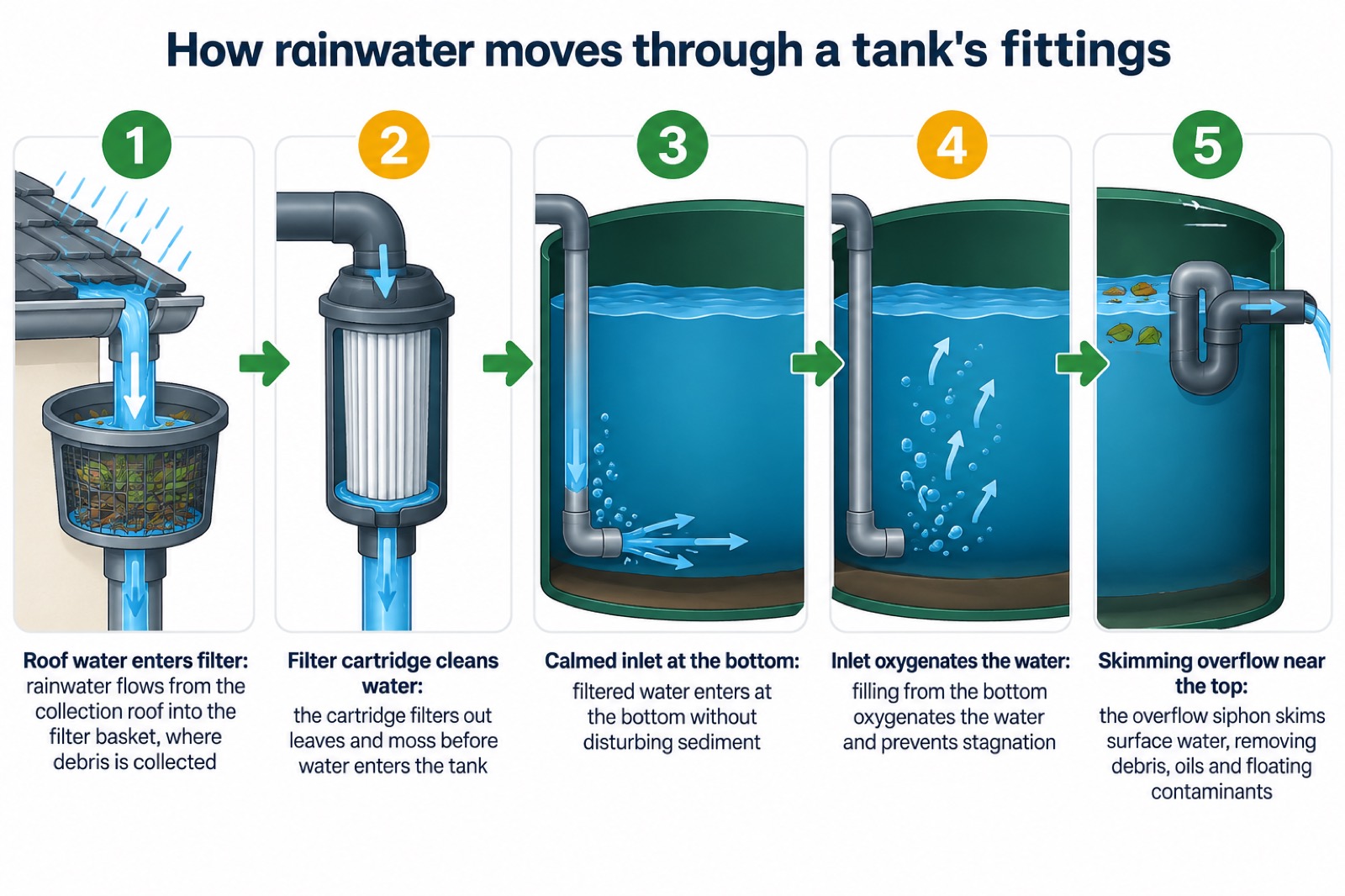
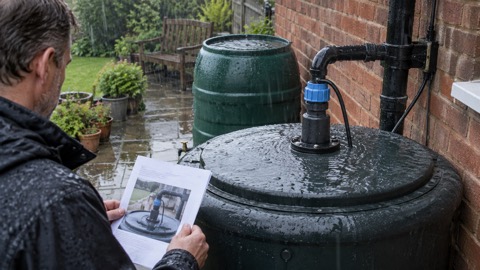
A well-designed rainwater system cleans itself in three stages, and understanding them tells you exactly where your own maintenance effort should go. The first stage is the filter, which sits in the path of the water running off the roof and catches leaves, moss and grit before they enter the tank. The second is the calmed inlet: instead of pouring into the tank from the top and stirring up whatever lies on the bottom, the filtered water enters through a pipe that turns the flow downwards and lets it in gently at the lower part of the tank. The third is the overflow, which carries away the surplus during heavy rain and, with it, any fine material that has floated to the top.
The calmed inlet does more than keep the water calm. According to Enduramaxx, whose filter kits are built around this design, the calmed inlet ensures fresh water is supplied to the lower area of the tank, resulting in complete and regular replenishment of the stored water1. The filtered water enters the tank via the calmed inlet, filling from the bottom and thereby oxygenating the water and preventing it from stagnating1. That oxygenation matters: still, oxygen-poor water is where odours and stagnation begin, a subject covered in more detail in whether stored rainwater goes off.
The practical consequence is that your maintenance should focus on the parts that can block or fail: the filter, which collects everything the roof sheds, and the overflow, which must stay free to discharge. The tank itself, and the water in it, are best left to get on with their work. Different filter types are described in rainwater filters: downpipe, inline and in-tank types.
Clearing the leaf filter so debris stays out of the tank
The leaf filter is the one component that needs your attention repeatedly through the year, because everything the roof sheds heads straight for it. Severn Trent's advice to customers during a flood warning period is to clear out any leaves or other waste so rainwater can more easily flow away, and to check that home and garden drains are free-flowing7. The same logic applies to your harvesting system: a filter clogged with leaves slows the flow into the tank and, in heavy rain, can send water spilling out of the downpipe or gully instead of into storage.
How often you need to clear it depends on your roof and the season. A roof under overhanging trees, or one with heavy moss growth, will shed far more debris than a clear roof, and autumn is the peak season for leaves. Lancashire Prepared's seasonal advice notes that as leaves start to fall, there is a risk that wind will blow leaves into gutters and drainpipes, and recommends clearing gutters and drainpipes before winter because build-up can leak water into the roof and sides of the house8. That is a good moment to check the filter too, since the same leaves are arriving at both.
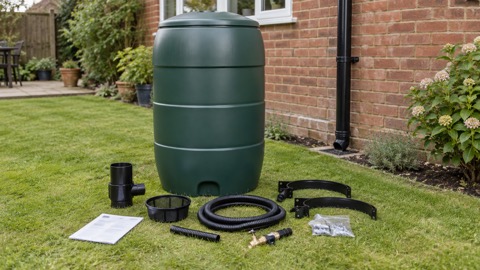
Most filter inserts are designed to make this easy. Enduramaxx describes its 450m2 Combi Rainwater Filter as self-cleaning and low maintenance, with a filter insert that is easily removable for cleaning1. Its smaller filter kits are likewise described as self-cleaning and low maintenance, with the filter cartridge positioned so that dirt is removed continuously1. Self-cleaning here means the design sheds the worst of the debris automatically; it does not mean you never look at it. Rainwater Harvesting Ltd recommends occasional checks of the self-cleaning filter even on its own systems2.
A reasonable routine is a quick look each month, a proper clear in late autumn after the leaves are down, and another check in spring. If water is overflowing from the filter housing or the downpipe rather than passing through, the filter is telling you it is full.
Keeping stored water dark, oxygenated and covered
Algae need two things to grow in a tank: light and warmth. The first defence is therefore to keep the stored water dark. An opaque tank, a solid lid and, for above-ground tanks, a shaded position all deny algae the light they need. The second defence is oxygen, which the calmed inlet supplies continuously as new rain enters from the bottom1. Water that is regularly replenished and oxygenated resists the stagnation that produces odours.
The lid matters for more than darkness. The Drinking Water Inspectorate, the regulator for drinking water quality in England and Wales, warns that water in a storage tank will deteriorate if there is no lid on the storage tank, if the water becomes warm, if too much water is stored and turnover is low, if the tank is made from or lined with an unsuitable material, or if work on the tank is carried out by an unqualified person3. Those five conditions are a useful checklist for your own tank: lid on, water cool, size matched to demand, suitable materials, and any work done by someone competent.
Official guidance on private supplies makes the same points from the other direction. Argyll and Bute Council advises ensuring all water tanks are covered to reduce evaporation, which also reduces the risk of contamination of the supply4. The Drinking Water Inspectorate advises that treated water tanks should be designed, installed and maintained to prevent ingress of contaminants through precipitation such as rain and snow9. Southern Water, explaining why stored water can pick up tastes and odours, notes that storage tanks should be closed with a secure lid to stop dust and debris from falling into the tank10.
If you do find algae or an odour has taken hold, the remedy is a clean-out. A Drinking Water Inspectorate case study records annual maintenance that involved cleaning a raw water storage tank by removing vegetation, algae, sediment or debris, then disinfecting and flushing the tank and distribution network with a diluted sodium hypochlorite solution11. For a garden tank, emptying, scrubbing and rinsing is usually enough; for anything feeding the house, use a qualified person, in line with the Inspectorate's warning above3.
Sediment at the bottom of the tank, and why it should stay there
Every rainwater tank develops a layer of sediment on its floor: fine particles of dust, grit and organic matter small enough to pass the filter but heavy enough to settle. The instinct is to want it out, but in normal operation the sediment is best left exactly where it is. The calmed inlet is designed to deliver water to the lower part of the tank without disturbing that layer, so incoming rain replenishes the water above the sediment rather than stirring it up1. Disturbing it, by stirring, bailing or repeatedly pumping from the very bottom, sends the sediment back into the water column, where it can block pump intakes and discolor the water you draw off.
The Drinking Water Inspectorate's advice on cold water storage tanks supports a light-touch approach: periodic visual checks to make sure there has not been a build-up of scale or deposits on the tank floor, and that the lid and screens are securely in place3. A visual check, not a routine dredging. The sediment only becomes a problem when it builds to the point where the tank needs a clean, which is where the maker's guidance on timing comes in: Rainwater Harvesting Ltd recommends a full system clean after 10 years2.
When a clean-out does happen, it should be deliberate and complete rather than a half-measure. The Inspectorate's case study describes the proper sequence: remove the vegetation, algae, sediment or debris, then disinfect and flush the tank and the network it feeds11. Where a system feeds the house, the Inspectorate also sets out how commissioning disinfection is done: filling the system with a 20 mg/L solution of chlorine, leaving it to stand for several hours, preferably overnight, then draining it off and rinsing thoroughly using treated water12. That is a job for a qualified person, in line with the Inspectorate's warning about unqualified work on tanks3.
Between cleans, two habits protect the sediment layer: draw water from above the tank floor, as a properly sited pump or outlet does, and let the overflow do its work, since fine floating material leaves with the surplus water during heavy rain.
Contamination from birds, animals and the roof itself
The roof is your catchment, and everything on it ends up in the water: bird droppings washed off by rain, debris from overhanging trees, and particles deposited from the air. The Drinking Water Inspectorate's guidance on protecting a private water supply deals with this directly for rainwater harvesting systems. It advises removing or avoiding roof-mounted aerials or overhanging trees in the water collection area, discouraging birds from perching on roof collection areas, and considering diverting the first flush of rainwater to waste9. The first flush is the dirtiest water of any storm, because it is the rain that washes the accumulated droppings and dust off the roof; sending it to waste rather than the tank removes a large share of the contamination before it ever reaches storage.
Materials matter too. The Inspectorate advises that approved materials, WRAS-approved or permitted under regulation 5, should be used to prevent contamination of rainwater during runoff and collection9. That applies to the roof surfaces and guttering the water runs over as well as to the tank and pipes. If you are replacing guttering or adding fittings, choose materials approved for water contact.
The roof itself can be a source of contamination. Work such as construction, plumbing or roofing can generate lead dust or fumes, one of the recognised sources of lead brought into the home13. Advice for rainwater harvesting systems is to remove or avoid roof-mounted aerials and overhanging trees in the collection area, discourage birds from perching on roof collection areas, and consider diverting the first flush of rainwater to waste9.
On the bird question, discouraging perching is about the roof itself: fix or remove the aerials and wires birds sit on, and deal with overhanging branches. Do not attempt to poison or trap birds; the aim is simply to make the collection area a less attractive perch, so the droppings land elsewhere.
Rainwater is not drinking water: keeping it separate from the mains
The single most important safety rule in rainwater harvesting is that the stored water is not drinking water. Greater Manchester's resilience guidance for households losing essential services states it plainly: water collected this way can be used for flushing toilets or watering plants, but do not drink this water as it could contain bacteria or disease5. The same rule covers cooking, brushing teeth and anything else that puts water in your mouth. The full list of what harvested rainwater can safely be used for is covered in what harvested rainwater can be used for, and the drinking question in particular in is harvested rainwater safe to drink?.
Keeping rainwater separate from the mains is a legal requirement, not just good practice. Cambridge Water notes that all grey water installations must comply with the Water Supply (Water Fittings) Regulations 1999 and the Building Regulations, parts G and H14. The core of those rules is that rainwater and mains water must never be able to mix: a rainwater system that tops up from the mains must do so through an air gap or other approved arrangement, so that mains water cannot be siphoned back into the tank.
If you want to drink your harvested rainwater, you are no longer a gardener with a tank; you are the owner of a private water supply, with treatment, maintenance and testing obligations. Scottish Borders Council's guidance for private supply owners is that your water treatment system needs regular maintenance, you should follow the manufacturer's instructions, the maintenance frequency will need to be increased during prolonged periods of heavy rainfall, and you should keep a record of all maintenance carried out on the system15. The rules for private supplies are covered in private water supply regulations and treatment in treating a private water supply.
Pipes and fittings must be marked Not Drinking Water
Separation is not only about plumbing arrangements; it is about making sure that years from now, a plumber, a visitor or your own family can tell at a glance which pipes carry rainwater. Every pipe, tap, outlet and fitting that carries harvested rainwater should be clearly and permanently marked as non-drinking water, so that nobody ever connects a hose to the wrong tap and fills a paddling pool, or tees a drinking outlet off the wrong pipe. The labelling requirements are set out in what pipe to use for rainwater and labelling rules, and the wider legal framework in rainwater systems and the law.
Fittings themselves must be up to standard. Southern Water advises that to keep water safe and fresh, it is important to check that all plumbing fittings meet the Water Supply Regulations, and that any which do not may need to be replaced10. That advice is aimed at mains plumbing, but the principle carries over: fittings that do not meet the regulations can degrade water quality, and in a rainwater system they can also fail in ways that flood the garden or the house.
A useful annual check is to walk the system from the tank to every outlet, confirming that each label is still legible and still attached, that no unlabelled tap has been added, and that any washing machine or toilet fed by rainwater is still connected to the rainwater supply rather than having been silently reconnected to the mains during a repair. On washing machines, whatever water feeds them, Electrical Safety First advises cleaning the filter regularly16.
Using the system in dry spells and hosepipe bans
A rainwater tank earns its keep precisely when the mains supply is under strain. Water companies can bring in hosepipe bans when water is in short supply, usually after a long dry or hot spell17. The government's preparedness campaign explains what a Temporary Usage Ban means: if a hosepipe ban is in place where you live, you cannot use a hosepipe connected to your mains water supply for things like watering your garden, filling a paddling pool or washing your car6. Westminster Council puts the same advice in household terms: during a Temporary Usage Ban you should avoid filling a paddling pool, washing your car and watering your garden18.
Stored rainwater sits outside those restrictions, because the ban applies to the mains supply. Suffolk Fire and Rescue Service's warm weather safety advice makes the connection directly: for keeping your garden maintained and watered in dry spells, consider using water from water butts or wastewater from the home if hosepipe bans are in place19. A tank of harvested rainwater, used with a watering can or a pump and hose fed from the tank rather than the mains tap, keeps the garden alive through a ban.
The catch is that a long dry spell is also when the tank runs low, because no rain is arriving to refill it. That is the argument for sizing the tank against the longest dry period you realistically face, a calculation covered in how to size a rainwater tank. In practice the two problems solve each other, since in dry weather you are drawing the tank down steadily.
One caution: water that has sat in a hot tank through a long dry spell is more likely to have warmed up, another of the Inspectorate's deterioration conditions3. Use it on the garden, use it on the toilets, and let the first decent rain refresh the store.
Overflow to a drain or soakaway in heavy rain
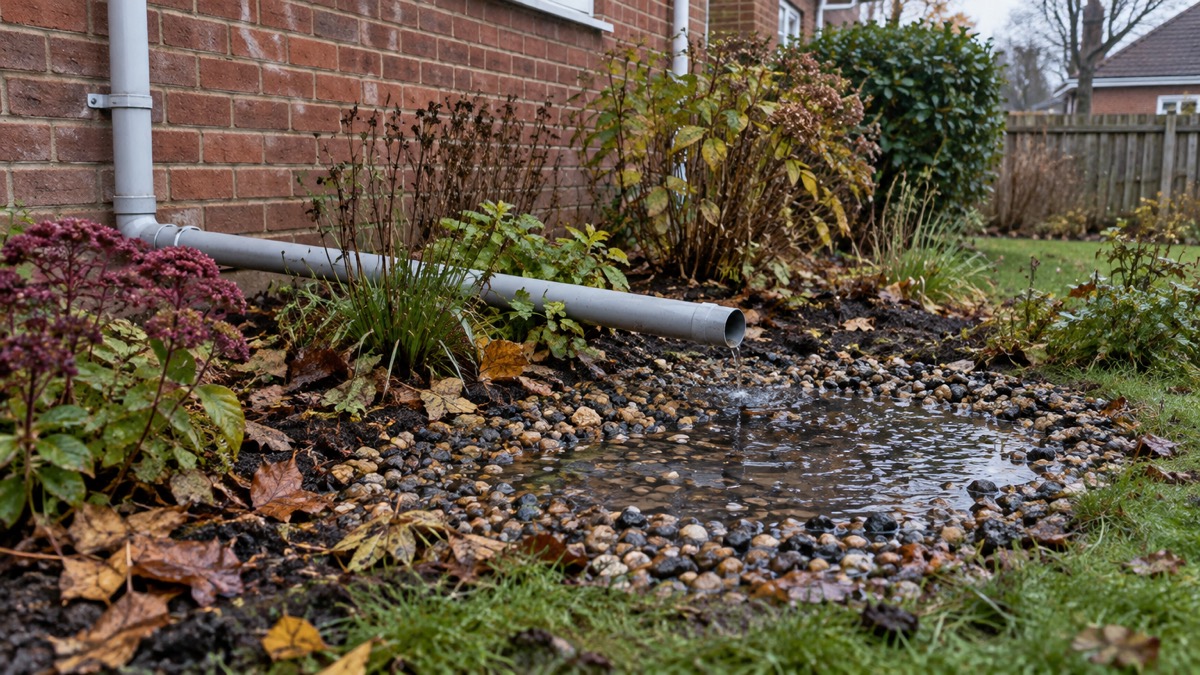
When the tank is full, every further litre of rain must go somewhere, and that somewhere is the overflow: a pipe near the top of the tank that discharges to a drain or a soakaway. If the overflow blocks, the tank pressurises, water backs up the inlet pipework, and the surplus can emerge somewhere you do not want it, around the tank, into the inspection chamber, or against the house wall. Checking that the overflow discharges freely is therefore one of the standing maintenance jobs, alongside the leaf filter.
The wider drainage system has to cope with the same storm. The Greater London Authority explains that surface water flooding happens when heavy rain falls on hard surfaces, overwhelming drainage and sewers, and that if heavy rainfall overwhelms the sewer system the impacts can include surface water flooding of buildings and transport routes, toilets and showers backing up with sewage, flooding of basements, and pollution of rivers and canals20. Essex Prepared describes the mechanism at the household scale: sewer flooding occurs when intense rainfall causes sewers to overflow, leading to contaminated water backing up into streets or properties21. Your overflow discharging into an already overwhelmed sewer contributes to that; a soakaway, which returns the water to the ground instead, does not. Sustainable drainage systems, the GLA notes, manage surface water runoff by capturing, using, absorbing, storing and transporting rainfall in a way that mimics nature20, and a rainwater tank with a soakaway overflow is a small example of exactly that.
If a storm is forecast, the standard severe weather advice applies to the whole property: the Met Office's heavy rain advice includes parking your car outside the flood zone22, and Nottinghamshire Council advises moving vehicles to higher ground23. If you spot a blocked or overflowing drain on the highway, Suffolk Council's reporting tool is the route for that, covering blocked or overflowing drains, flooding on roads, cycle lanes or pavements, and sunken or rattling drain covers24. Remember that the council's responsibility covers the road network: Derbyshire County Council, for example, maintains the drainage system for the road network and routinely clears gullies25, while drains on your own land, including your soakaway, are yours.
Frost, winter and the annual check
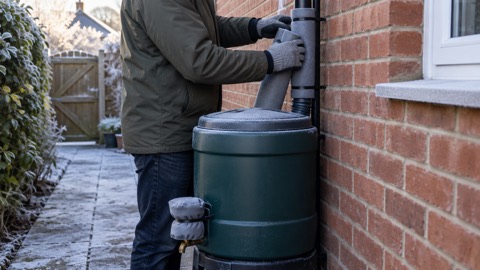
Winter is the season that finds the weaknesses in a rainwater system, so the annual check belongs in late autumn, before the first hard frost. Lancashire Prepared's seasonal advice is to clear gutters and drainpipes before winter, because build-up can leak water into the roof and sides of the house8. While you are up the ladder for the gutters, clear the leaf filter, check the tank lid is secure, and confirm the overflow discharges freely, so that winter rain and thaw water can move through the system without obstruction.
Inside the tank, an annual look is enough for most households. A torch down the inspection port, a look at the water surface and the floor, and a sniff for odd odours takes minutes and catches most problems early. The Inspectorate's list of deterioration conditions is worth running through each year: no lid, warm water, too much water stored with low turnover, unsuitable tank material, and unqualified work on the tank3.
For the pump and any header tank or control unit, follow the maker's winter instructions, since a pump left dry or a header tank left full in a freezing loft can be damaged. The seasonal jobs are gathered in one place in the rainwater system winter checklist. And keep a note of what you checked and when: Scottish Borders Council's advice to private supply owners to keep a record of all maintenance carried out15 is a good habit for a garden system too, because it tells you, and any future owner or plumber, when the 10-year full clean is due2.
Standards, new builds and grants
Rainwater harvesting equipment manufactured in the UK is covered by a British Standard: Cambridge Water notes that BS 8515 provides criteria for rainwater harvesting equipment manufactured in the UK14. Choosing equipment that meets the standard is the simplest way to ensure the tank, filter and fittings are made of suitable materials, one of the Drinking Water Inspectorate's conditions for stored water not deteriorating3.
On the legal side, Cambridge Water reports that all installations must comply with the Water Supply (Water Fittings) Regulations 1999 and the Building Regulations, parts G and H14, and the Drinking Water Inspectorate confirms that new plumbing systems, and alterations and additions to older systems, must comply with the Water Fittings Regulations 19993. Planning and building rules for tanks are covered separately in planning permission and building regulations for tanks, turbines, toilets and panels. Cambridge Water also makes a practical observation about where these systems make most sense: rainwater harvesting systems are typically more suited to new-build properties, where the cost of plumbing them in is negligible, while retrofitting into an existing property can be expensive14. If you are draining to a soakaway or doing works to a watercourse rather than a sewer, Somerset Council notes that works to a watercourse may require Land Drainage Consent26.
Grants specifically for rainwater harvesting are scarce; the help that exists is aimed at flood resilience. In Northern Ireland, the Homeowner Flood Protection Grant can give owners financial help to install physical barriers and equipment such as door barriers, air brick covers, non-return drainage outlets and waterproofing walls; the Rivers Agency appoints a building surveyor to carry out a water entry survey, recommends protection measures, and an experienced contractor installs them27. In England, Property Flood Resilience grants help households install measures that reduce future flood damage, and Lincolnshire County Council has offered a grant scheme for properties affected by the January 2025 floods28. Neither scheme is a rainwater subsidy, but a household installing flood measures may find a rainwater tank with a soakaway fits the same project. In Scotland, help exists for private water supplies rather than harvesting: see the private water supply grant in Scotland.
Sources (28)
- Enduramaxx rainwater harvesting filters, Enduramaxx, 2026
- Essential questions answered, Rainwater Harvesting Ltd, 2026
- Water storage tanks and cisterns, Drinking Water Inspectorate, 2026
- Loss of supply: private water supply users, Argyll and Bute Council, 2026
- Loss of essential services, Greater Manchester Combined Authority, 2026
- Droughts: be informed about hazards, UK Prepare Campaign, 2026
- Severn Trent issues advice to customers as region has flood warnings, Severn Trent Water, 2025
- Top tips to stay safe from the Met Office, Lancashire Prepared, 2026
- Protecting your private water supply, Drinking Water Inspectorate, 2026
- My water looks, smells or tastes unusual, Southern Water, 2026
- Change of use of a private supply case study, Drinking Water Inspectorate, 2022
- Water storage: private supply networks, Drinking Water Inspectorate, 2025
- Indoor air pollution, NHS inform, 2026
- Saving water FAQs, Cambridge Water, 2026
- Private water supplies, Scottish Borders Council, 2026
- Washing machines, Electrical Safety First, 2026
- Stay safe during hot weather, London Borough of Bexley, 2026
- Drought advice, Westminster City Council, 2026
- Warm weather safety advice, Suffolk County Council, 2026
- Surface water flooding and climate adaptation, Greater London Authority, 2026
- Flooding: ongoing risks, Essex Prepared, 2026
- Stay safe in heavy rain, Met Office, 2026
- During a flood, Nottinghamshire County Council, 2026
- Report a flood in Suffolk, Suffolk County Council, 2026
- Personal responsibility for flooding, Derbyshire County Council, 2026
- Flooding, Somerset Council, 2025
- How to protect your home from flooding, nidirect, 2025
- Apply for a Property Flood Resilience grant, Lincolnshire County Council, 2026
 Composting Toilet Kit Checklist
 Garden Harvesting Kit Checklist
 Rainwater Winter Checklist
 Above-Ground Rainwater Tanks
 Composting Toilets
 Direct vs Gravity Feed Systems
 Planning Permission for Systems
 Private Water Supply Running Low
 Private Water Supply Regulations
 Private Water Supplies Scotland
 Treating a Private Water Supply
 Rainwater Filter Types
 How Rainwater Harvesting Works
 Pumps for Rainwater Tanks
 Rainwater Systems and the Law