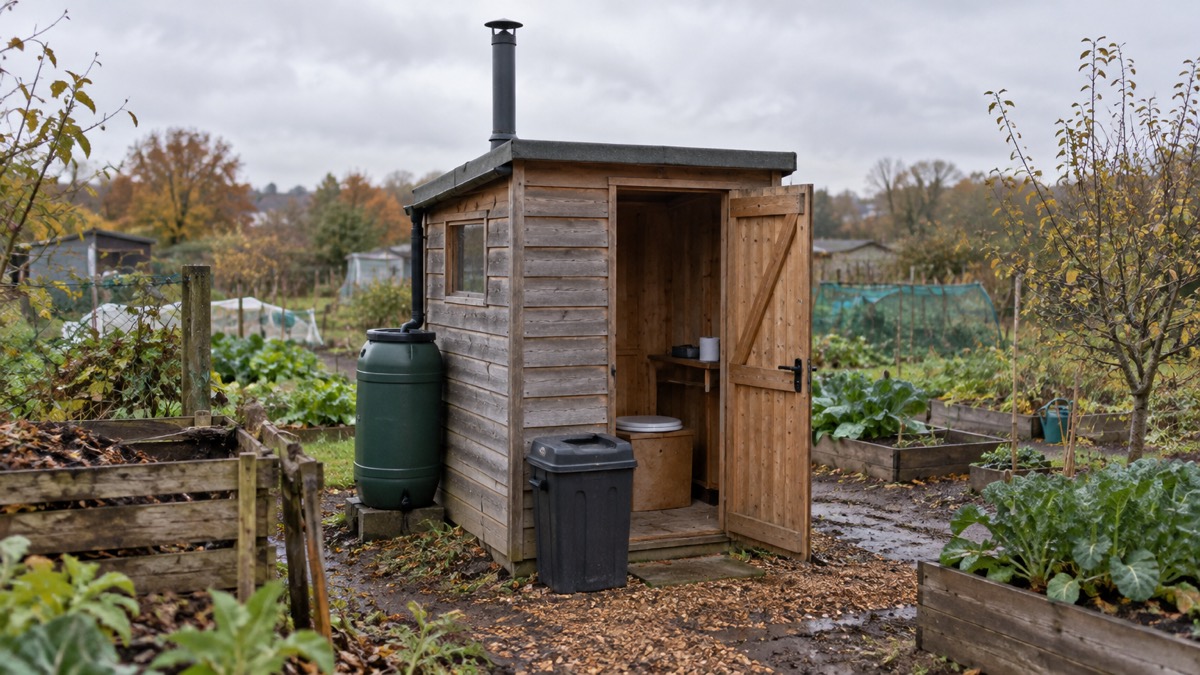
A composting toilet needs no water and no drain, which is why it suits a garden room, an outbuilding, a remote plot or a house whose plumbing has failed. What it does need is a short list of kit and a few rules about where it goes. Get those right and it works quietly. Get them wrong and you get smells, flies and a health risk.
The single most important item is a urine diverter. Keeping urine out of the solids is what stops the smell, and it is the difference between a toilet that works and one nobody wants to use. The second is a pair of chambers used in turn, so one side rests while the other fills. A reliable and robust approach for the UK climate is to alternate annually between two separate chambers1.
Then there is siting. A composting toilet must never be placed close to a well, spring or borehole. Official guidance on private water supplies says to prevent storage and the spreading of manure within 50 metres of the water source, and a composting toilet holds material of the same kind2. Treat that 50 metres as a hard line, not a target.
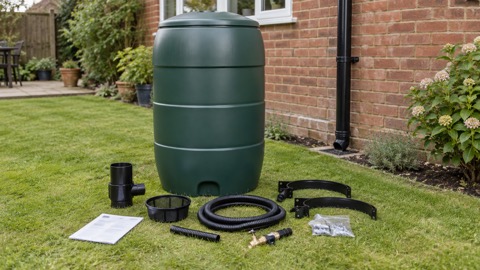
The kit list
Work through this before you build or buy anything. Each item has a job, and leaving one out is what causes most of the trouble later.
Keep urine separate to stop smells
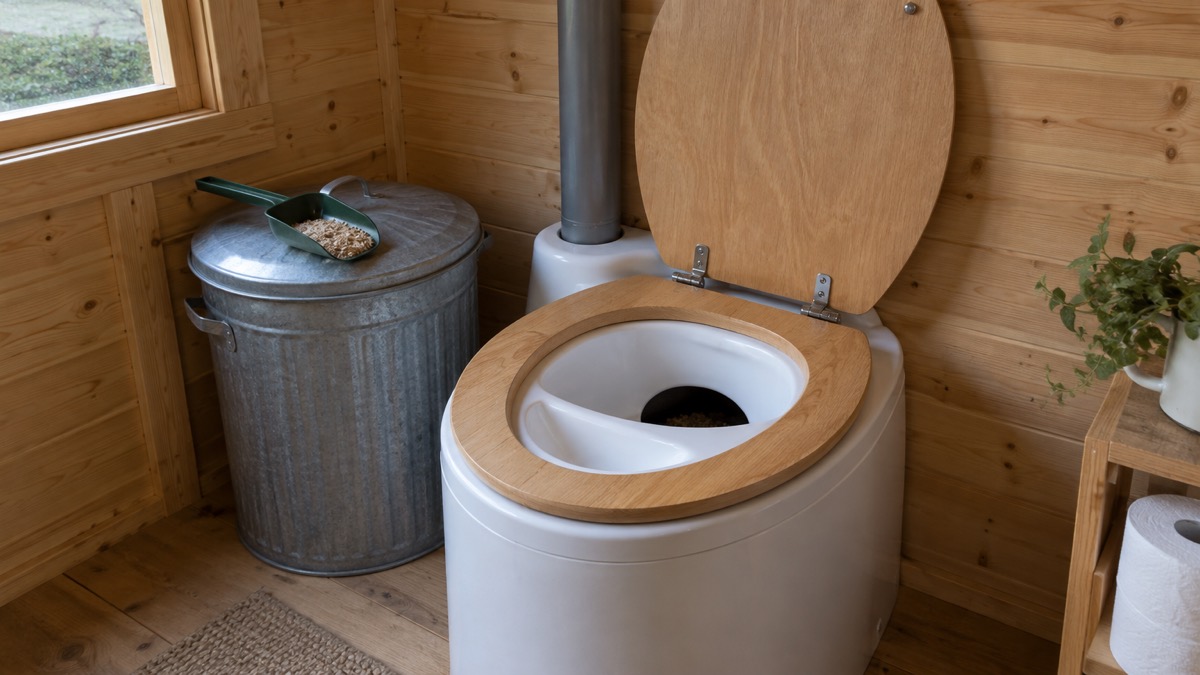
Smell is the complaint that ends most composting toilet experiments, and it almost always comes from mixing urine into the solids. Urine is mostly water. Add it to a heap that is meant to be aerobic and you get a wet, airless mass that turns anaerobic and smells accordingly. A diverter solves it at source.
The heap itself needs the right mix. Keep a good balance of green and brown materials1. That is why the soak material store is on the list as a piece of kit rather than an afterthought: if it is not within reach, it does not get used.
There is a hygiene side too. Wear gloves while gardening, especially when handling compost, because Legionella bacteria can be found in compost, and consider a mask for dusty work, washing your hands afterwards6. The same care applies when you empty a chamber or turn material.
Urine itself is not waste to be poured down a drain in every case. It can be used in the garden, but only with care and never on ground where it could reach a water source. See Using Urine as Garden Fertiliser Safely for how to do that properly.
Two chambers, alternated yearly, suit the UK climate
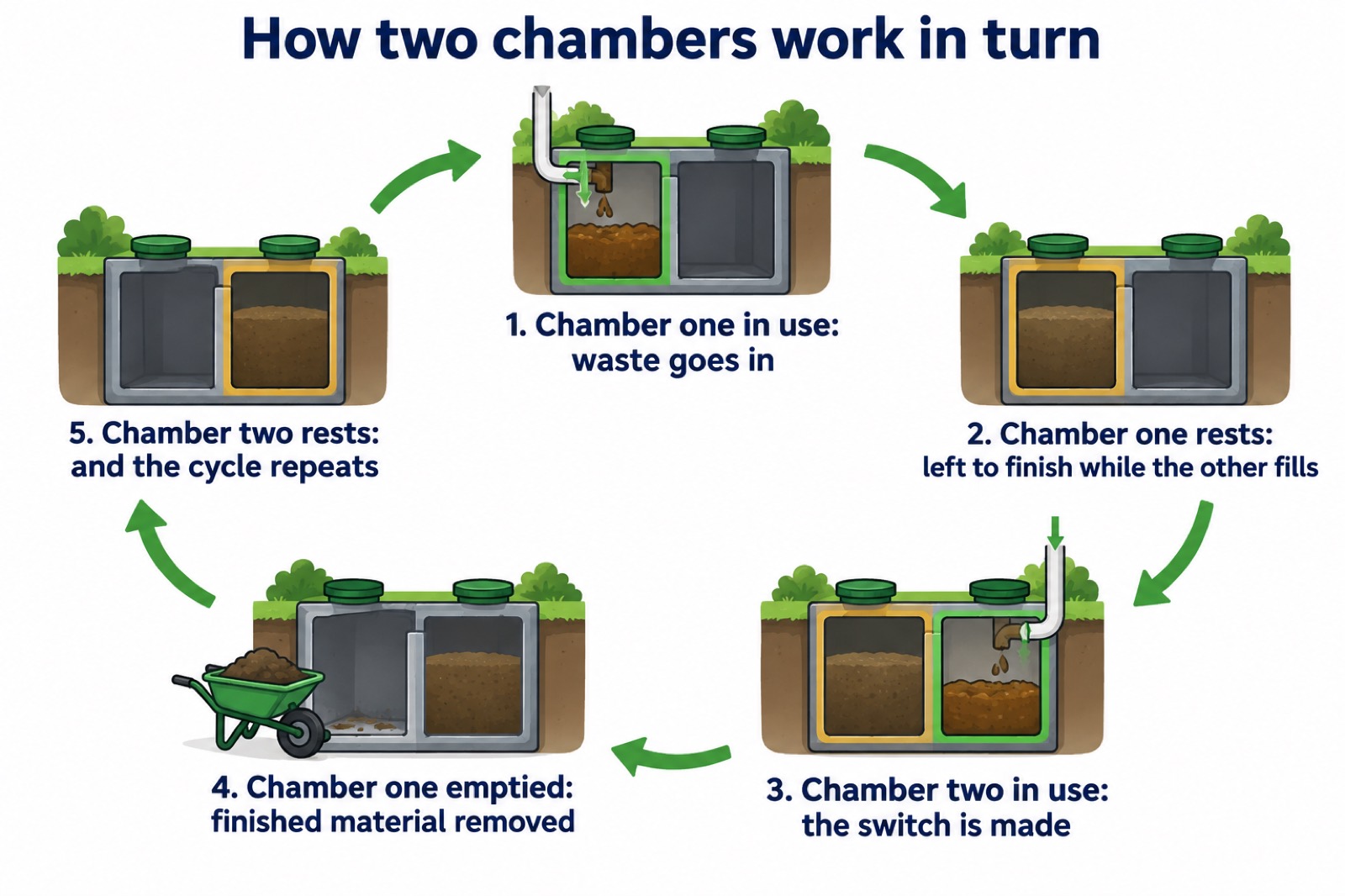
A single-chamber composting toilet asks you to stop using it while the contents finish. A pair of chambers lets you keep using the toilet while the other side rests. In a UK climate, where the heap is cool for much of the year, that resting period is what makes the difference between finished material and a half-rotted mess.
The principle is simple: fill one chamber over a season, then switch to the other and leave the first to finish. By the time the second is full, the first should be ready to empty. The size of each chamber is what decides whether that works, and it depends on how many people use it. Work that out before you build, using Composting Toilet Chamber Size Per Person.
| Approach | How it works | What it suits |
|---|---|---|
| Single chamber | Fill, then stop using while it finishes | A garden or occasional use |
| Two chambers, alternated | One in use, one resting | A household using it every day |
| Continuous system | Added at the top, drawn from the bottom | Steady use, once it has settled |
A continuous system, where material is added at the top and finished compost is drawn from the bottom, needs time to settle before anything comes out. Plan for that settling period and keep a fallback toilet available while it does.
Where a composting toilet must never go
This is the part that matters most for health, and it is the part most often got wrong. A composting toilet concentrates material that can carry disease, and it must be sited so that it cannot reach drinking water.
The official rule for private water supplies is clear: prevent storage and the spreading of manure within 50 metres of the water source2. A composting toilet and its soak material store hold material of the same kind, so keep both at least 50 metres from a well, spring or borehole. That distance is not a suggestion. Groundwater moves, and a supply that looks fine can be contaminated months later.
Sandy soil is the case people ask about, because water travels through it quickly and a plume can spread further than expected. The 50 metre figure is the one to work to, and sandy ground is a reason to hold to it rather than shorten it. For the full reasoning, see How Far a Composting Toilet Should Be From Wells and Water Supplies.
If your supply is a private one, the rules around it are set out in Private Water Supply Regulations: Risk Assessments, Testing and Who Is Responsible. In Scotland the arrangements differ, and they are covered in Private Water Supplies in Scotland: Rules, Councils and Connecting to the Mains.
Avoid toilets that heat compost with electric elements
Some composting toilets use an electric heating element to speed up breakdown or to dry the material. They work, but they tie the toilet to mains power, and that brings a set of fire risks that official guidance is consistent about.
Electric heaters should be plugged into a wall socket, not an extension lead, because leads can be overloaded and cause fires10. Plug directly into a wall outlet and do not use extension cords or power strips, because heaters draw a lot of power and can cause cords to overheat, leading to fires11. Avoid using extension leads as a permanent solution and give high-energy consuming devices such as space heaters their own dedicated circuit12. Keep any heater away from curtains and furniture, and unplug it when you go out or go to bed13.
A composting toilet with a heating element is, in electrical terms, a heater in a small outbuilding. The same rules apply. Add the fact that it sits next to combustible material, and the case for a passive design becomes straightforward: no power, no lead, no element, nothing to fail.
Adding soak material, and what to keep beside the toilet
Soak material is the working part of a composting toilet. It absorbs excess moisture, adds the carbon that balances what goes in, and keeps air moving through the heap. Without it, the contents compact, go airless and start to smell.
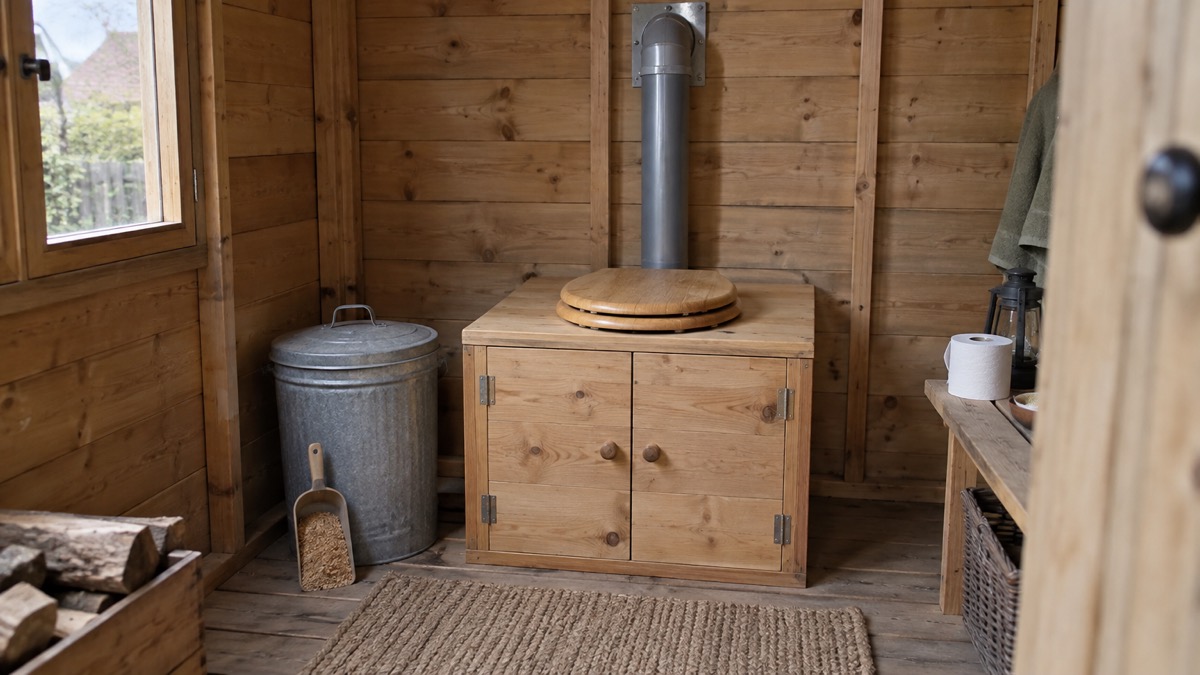
Keep a good balance of green and brown materials1. A lidded bin beside the seat, refilled before it empties, is the practical way to make sure it is used every time. A bulk store, kept dry and covered, sits further away.
The same principle applies to any organic waste you are storing. Some residents put food waste in compostable liners into their freezers between collections, which prevents smells, pests and vermin14. The lesson for a composting toilet is the same: smell and pests come from material that is wet, warm and exposed. Keep it dry, keep it covered, keep it balanced.
If flies do become a problem, the causes and the fixes are set out in How to Stop Flies in a Composting Toilet.
Shared use, remote use and when the toilet cannot be used
A composting toilet used by one household is a different proposition from one used by a site, a community building or a bothy. More people means more material going in, a faster fill rate and more frequent emptying. Size the chambers for the number of users, not the number of residents, and plan the rotation around the busiest period.
Where a toilet cannot be used at all, official advice is to use toilets belonging to unaffected family, friends, neighbours, public toilets, rest centres, local shops, supermarkets and hotels7. Chemical toilets can be hired from hire companies and camping and caravan stores15. Portable bag-in-a-bag products designed for solid and urine waste may also be provided in some situations7.
In a remote place, the kit list is what makes the toilet viable, because there is no mains water and no drain to fall back on. Carry in your soak material and carry out finished compost. Keep the 50 metre distance from any water source, and remember that a remote supply is often a private one with its own rules.
If you are weighing up whether a composting toilet is right for your household at all, start with Composting Toilets: How They Work and How to Choose One. For the wider picture on living without mains services, see Self-Reliance at Home: Rainwater, Off-Grid Power and Living Without Mains.
Sources (15)
- Wildfires: protecting your home and garden, London Fire Brigade, 2026-10-25
- Protecting your private water supply, Drinking Water Inspectorate, 2026-10-28
- Composting Toilets - cat.org.uk, Centre for Alternative Technology (CAT)
- Droughts, UK Government Prepare campaign, 2026-10-19
- Property flood resilience case studies, Derbyshire County Council, 2024
- Summer health, NHS Inform Scotland, 2026-08-06
- How to recover from flooding, UK Health Security Agency, 2023-12-19
- Water risks message, NHS Community Pharmacy Scotland, 2024
- Poisoning, NHS South Yorkshire and Bassetlaw, 2026-10-29
- Stay fire safe, Greater Manchester Fire and Rescue Service, 2026-10-29
- Safe use of heaters and generators, Armagh City, Banbridge and Craigavon Borough Council, 2026-10-29
- Electrical fire safety, Warwickshire County Council, 2026-10-29
- Keeping your home warm in winter, Met Office, 2026-10-26
- Bins, recycling and waste: services and weather, Somerset Council, 2025-08-13
- Further support after a flood, Nottinghamshire County Council, 2026-10-29
 Garden Harvesting Kit Checklist
 Rainwater Winter Checklist
 Hydroponic System Parts List