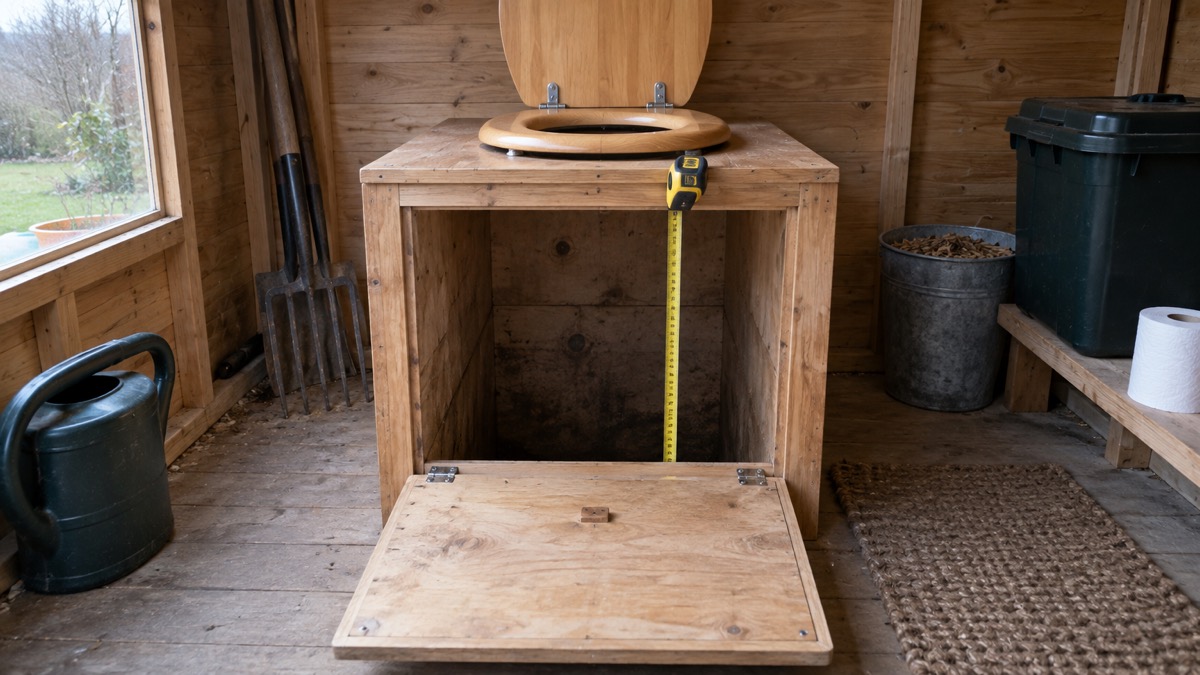
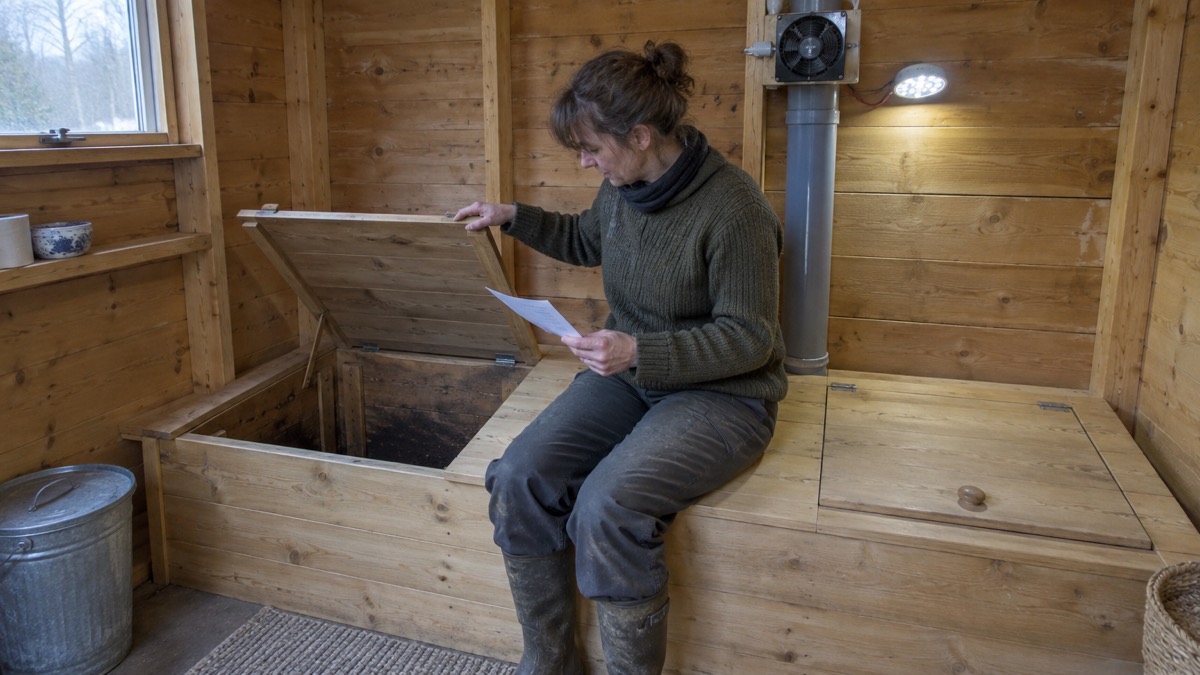
If you are planning a composting toilet for a household, the first question is how much chamber space each person needs. The Centre for Alternative Technology (CAT), which has run composting toilets at its own site, gives the working figure: a composting chamber may need to be about one-third to one half of a cubic metre per person, equal to a box about 70 to 80 cm on each side1. That is the volume to plan for, per person, before you think about anything else.
The second decision is how many chambers. For the UK climate, CAT's advice is that a reliable and robust approach is to alternate annually between two separate chambers1. One chamber is in use while the other rests and finishes composting, so you are never trying to empty a heap that is still working. That single choice shapes the whole system: the footprint, the cost and how often you handle the material.
The third is urine. Keeping urine separate is usually the key to successful composting, CAT says, otherwise the mass can become anaerobic and smelly1. Get those three things right, chamber volume, two chambers in rotation and urine diversion, and the rest of the system, ventilation, soak material and siting, falls into place.
Two chambers used in alternate years suit the UK climate
The UK climate is the reason for the two-chamber approach. Our winters are getting wetter: UK winters are now, on average, 12% wetter than between 1961 and 1990, and the latest UK Climate Projections point to hotter, drier summers and warmer, wetter winters in future2. A composting toilet has to keep working through damp, cool conditions, and a single chamber that is never rested gives the material no time to finish.
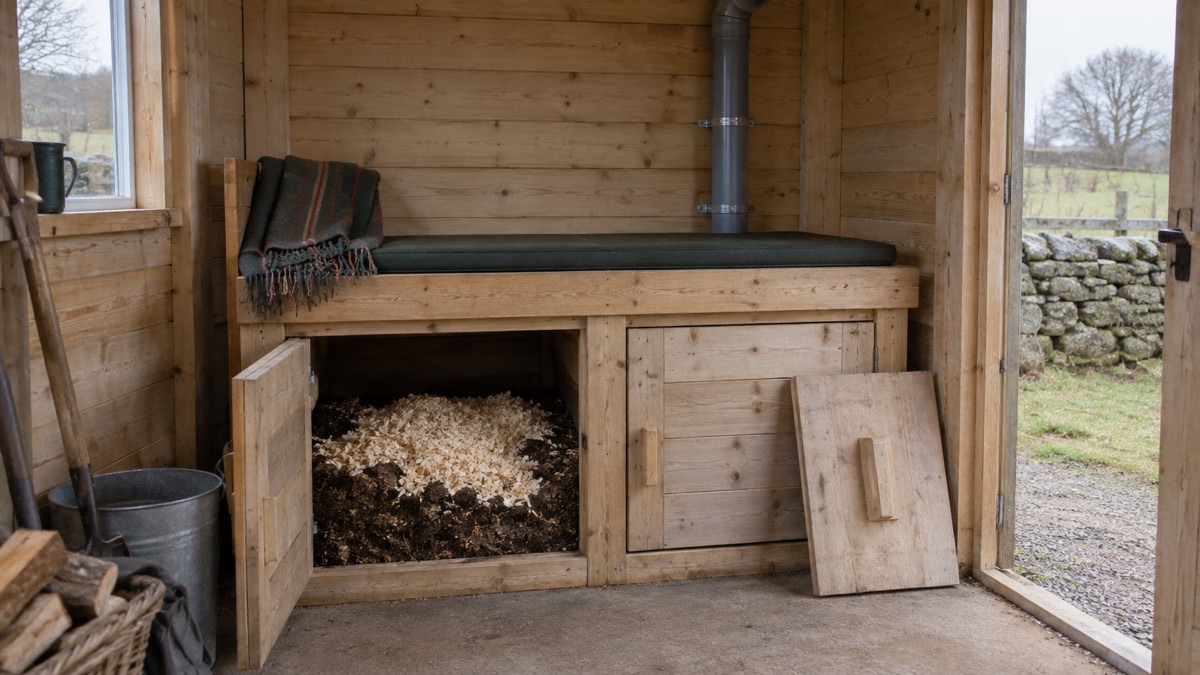
Alternating annually between two separate chambers solves that. One chamber takes the household's waste for a year while the other sits closed, finishing its composting undisturbed. When you switch, the rested chamber is emptied and the cycle begins again. You are never digging into an active heap, and each chamber gets a full year to break down.
The volume figure and the two-chamber approach work together. If each person needs about one-third to one half of a cubic metre, a household of four is planning for roughly one and a third to two cubic metres of chamber volume in total, split across the two chambers. That is a box about 70 to 80 cm on each side per person, so the pair of chambers is a substantial structure, not a bucket in a shed. Plan the space before you buy anything.
Keep urine separate or the chamber turns smelly
Urine is the single biggest cause of a composting toilet that smells. CAT is direct about it: keeping urine separate is usually the key to successful composting, otherwise it can become anaerobic and smelly1. A chamber that turns anaerobic is not just unpleasant; it stops composting properly, and the smell is hard to reverse once it has set in.
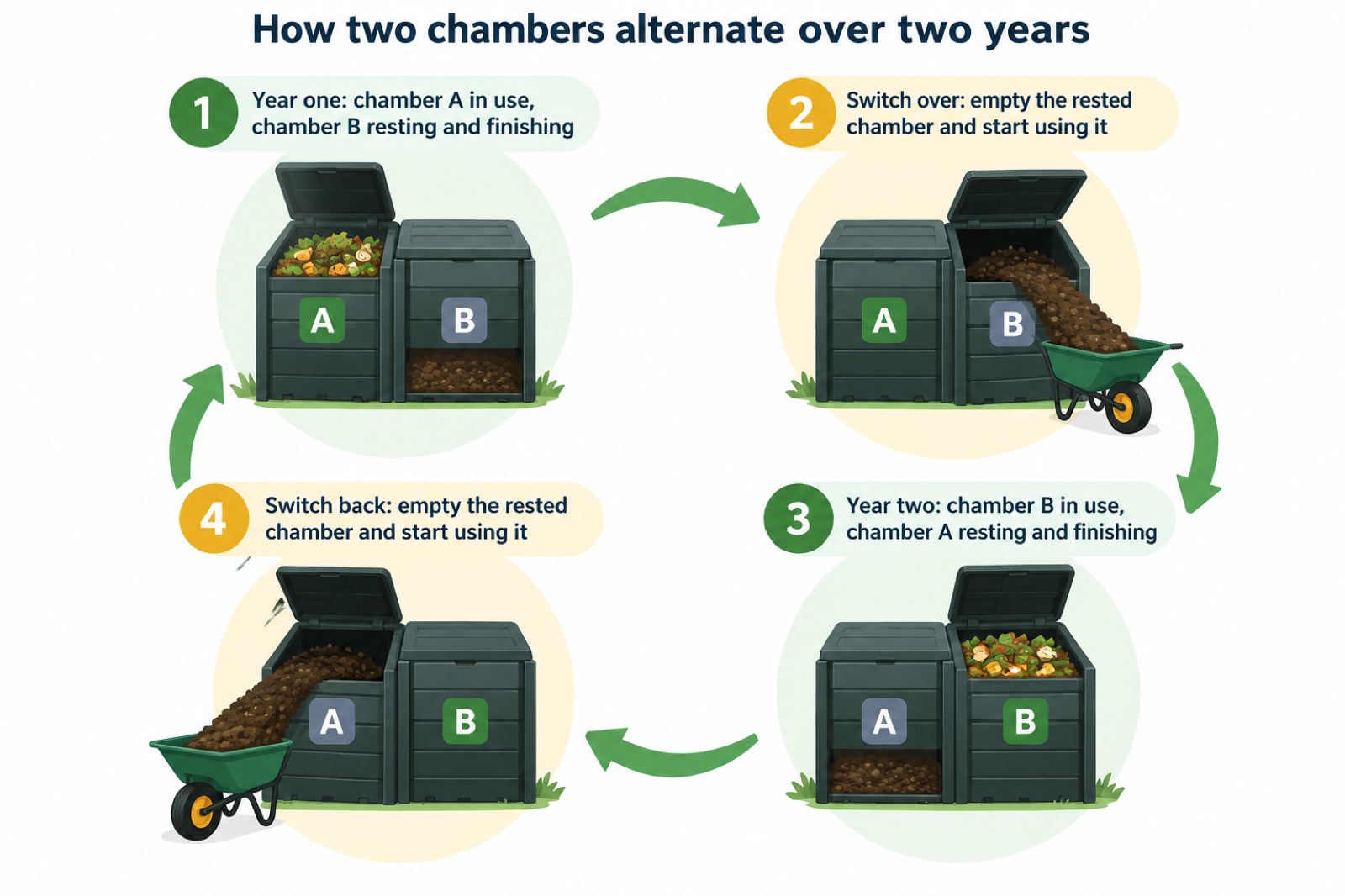
The fix is a urine-diverting seat or pedestal, which sends urine to a separate container or soakaway and keeps solids in the chamber. That is a design decision made at the start, not something you can easily add later, so decide before you build.
If a smell does appear, work through the causes in order. First check the diversion is working and urine is not reaching the chamber. Then check the balance of the heap: keep a good balance of green and brown materials, as you would in any compost heap4. Soak material is the brown part, and the next section covers who adds it.
Continuous chambers: settling in over a few months
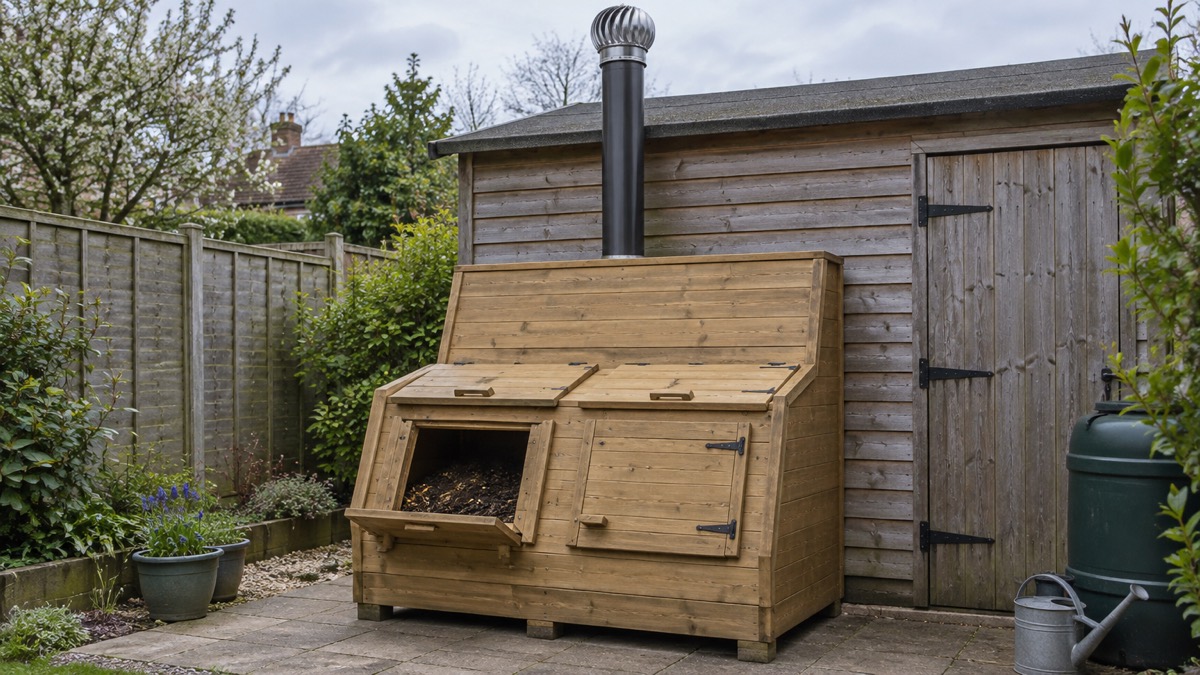
Not every system uses two chambers. A continuous composting toilet has a single chamber that is never emptied in one go: material is added at the top and finished compost is drawn off at the bottom. It suits a household that wants a smaller footprint and is prepared to manage the heap continuously.
The good news is that a continuous system should settle down within a few months, after which no intervention in terms of adding worms or other decomposers should be necessary1. The microbial life and the worms establish themselves, and the heap finds its own balance. The first few months are the settling-in period, when you watch it more closely.
Ventilation is what makes a continuous chamber work indoors. A simple unpowered (passive) vent is a straight pipe of at least 110mm diameter, reaching well above the roof line and with a rotating cowl1. The cowl uses the wind to draw air up and out, so smells go up the pipe rather than into the room. Where a passive vent is not enough, a small fan can be added: CAT uses a 10 watt fan in its composting toilets1.
| Chamber type | How it works | What it suits |
|---|---|---|
| Two chambers, alternate years | One in use, one resting for a year1 | Households wanting a robust approach for the UK climate1 |
| Continuous chamber | Single chamber, material drawn off the bottom | Smaller footprint, managed continuously |
| Volume to plan for | About one-third to one half of a cubic metre per person1 | Sizing either type |
| Ventilation | Passive 110mm pipe with rotating cowl, or a 10 watt fan1 | Indoor installations |
Adding soak material: who adds it and how often
Soak material, the brown, carbon-rich material added to the chamber, is what keeps the heap aerobic and stops it turning smelly. In a household system, the people using the toilet add it as they go. The chamber needs enough to cover each deposit and keep the balance right.
In a shared or public toilet the picture changes. CAT's experience is that a daily or even weekly addition of soak by the operator may be better than leaving users to add it indiscriminately1. Someone has to own the job, and in a public setting that is the operator, not the passing user. If you are setting up a shared facility, build that routine into whoever looks after the building.
The same principle applies at home: decide who checks the chamber and how often. A household of four sharing one toilet will get through soak material quickly, so keep a store close at hand and top it up as part of the routine.
Flies are the other thing to watch. If flies become a persistent problem, an insecticidal strip hung inside the chamber will control flying insects without affecting the other decomposers in the compost mass1. For wooden pedestals, a simple fly trap can be made from a jam jar with a 2-3mm diameter hole drilled in the middle of the lid and a cone of clear plastic to funnel the flies up1. Our page on how to stop flies in a composting toilet covers the options in more detail.
Where a composting toilet should not go
Siting decides whether a composting toilet works. The first rule is about power. Composting toilets should not be connected to an energy source other than for purposes of ventilation or sustaining the composting process1. A small fan for ventilation is fine; heating the compost is not.
CAT goes further on heated models: it would not recommend dry toilets that use electrical elements to heat the compost1. If you were considering a heated electric dry toilet to speed things up, the guidance is against it. Ventilation and a well-balanced heap do the work instead.
The second rule is about water. Keep the toilet away from wells and water supplies, and check the separation distance for your soil. If the soil is sandy the separation distance could be reduced to 7.5m1. Our page on how far a composting toilet should be from wells and water supplies sets out the full distances.
The third is about buildings and rules. Composting toilets are mentioned in part G of the Building Regulations1, so check before installing one in or attached to a building. Our page on planning permission and building regulations covers what applies to toilets, tanks and other self-reliance kit.
Water use, remote sites and shared facilities
A composting toilet uses no water to flush, which matters more than it might seem. Older cisterns use as much as 13 litres per flush, while current modern models use 6 litres per flush or less8. A water displacement device in the cistern saves 1 to 2 litres every flush9, and older toilets that use about 9 litres or more benefit from one10. But a dry toilet removes the flush altogether.
That is useful in a drought or a supply interruption. During an interruption you can use a water butt or stored water to flush the toilet by filling a bucket and pouring it into the bowl11, and a water butt can save around 1,000 litres of water every year12. A composting toilet sidesteps the problem entirely. Our section on self-reliance at home covers rainwater, off-grid power and living without mains.
For a remote site with no mains power, keep the electrical demand low. CAT advises using low voltage (12 or 24 volt DC) to reduce equipment costs when off-grid, and a motion detector to minimise power demand1. A small fan is the usual load, and the guidance cites a 10 watt fan1. If you need to size a small off-grid supply for a fan and a light, our page on sizing an off-grid solar system works through the arithmetic.
For a shared or public toilet, the operator takes on the soak routine1, and the Building Regulations point applies1. Decide who checks the chamber, who adds soak and who deals with flies before the facility opens.
Sources (12)
- Composting toilets, Centre for Alternative Technology, 2025-06-27
- Staffordshire's changing local climate, Staffordshire County Council, 2026
- Get climate ready: home improvements, Met Office, 2026-10-28
- Wildfires: protecting your home and garden, London Fire Brigade, 2026-10-25
- Tastes and odours, Affinity Water, 2026-10-28
- Taste and odour in drinking water, Drinking Water Inspectorate, 2024-08-13
- What should I do if there's a flood?, Consumer Council for Water, 2026-10-28
- Droughts, Prepare (UK Government), 2026-10-19
- Draft drought plan 2027: customer and stakeholder summary, Anglian Water, 2026-05
- Reducing water use, Centre for Alternative Technology, 2025-06-27
- Preparing for an incident, South West Water, 2026-10-28
- Guidance for incidents, Wessex Water, 2026-10-28
 Composting Toilet Kit Checklist
 Garden Harvesting Kit Checklist
 Rainwater Winter Checklist
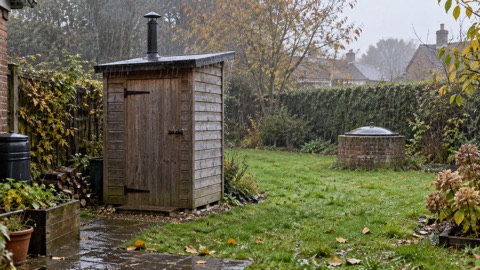 Composting Toilet Near Wells
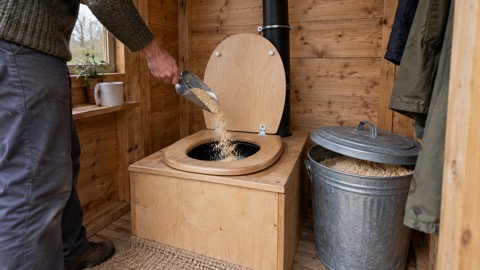 Flies in a Composting Toilet
 Is Harvested Rainwater Safe
 Garden and Lawn Water Needs
 Grey Water Disposal Off Mains
 Rain and Grey Water in Garden
 House With a Private Supply
 Rainwater Pipe Types and Labels
 Private Water Supply Visitors
 Rainwater Systems in a Power Cut
 Does Stored Rainwater Stagnate
 Underground Tank Dig Depth