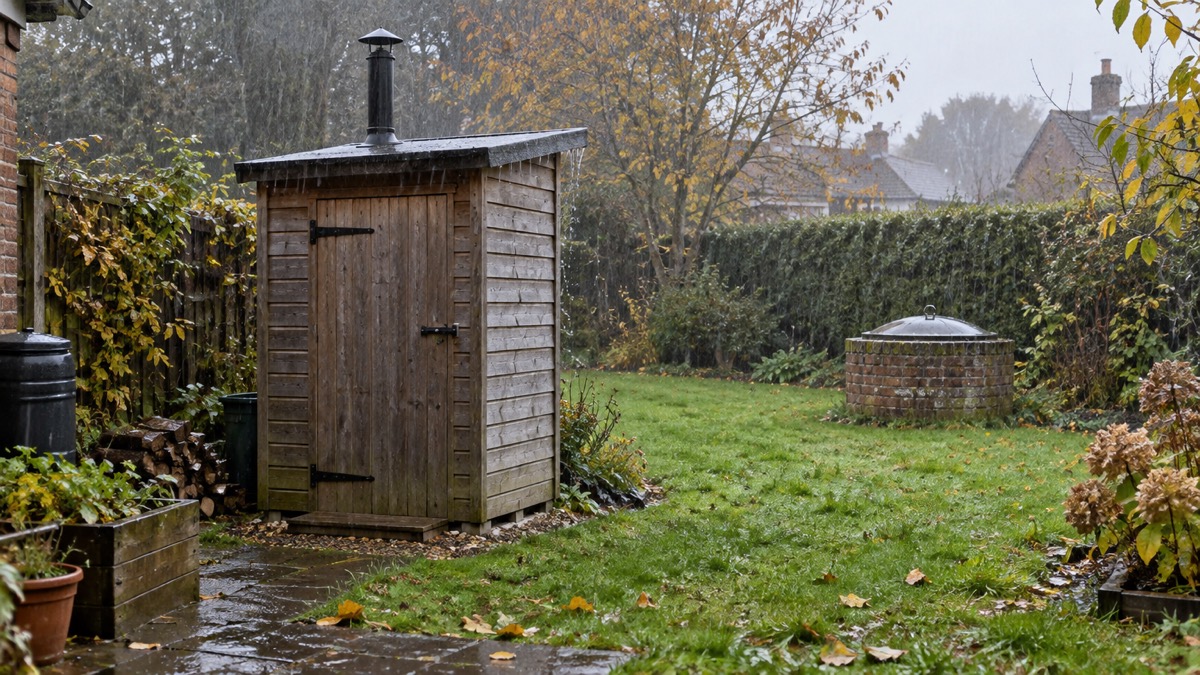
If you are planning a composting toilet and your household drinks from a well, borehole or spring, the first question is how far away it should sit. Treat any separation you can achieve as a minimum, not a target: the further the toilet sits from the source, the less chance there is of anything reaching your drinking water. For the toilet itself, a reliable and robust approach for the UK climate is to alternate annually between two separate chambers1.
The distance matters because a composting toilet is not a sealed bin. Liquids move down through the ground, and a private water supply draws water up from it. Official guidance on oil storage already requires secondary containment within 50 metres of a drinking water source such as a well, borehole or spring, which shows how far contamination can travel through ground2. Your toilet is not an oil tank, but the same principle applies: give the source room.
The good news is that a well-run composting toilet is a low-risk, water-free way to deal with waste, and the steps that protect your water are the same ones that keep the compost working: keep urine separate, keep the heap aerobic, and give the chamber time. This page sets out the distances, the soil question, how to run the system in the UK climate, and where to get help if your supply is affected.
The separation distance, and why sandy ground changes it
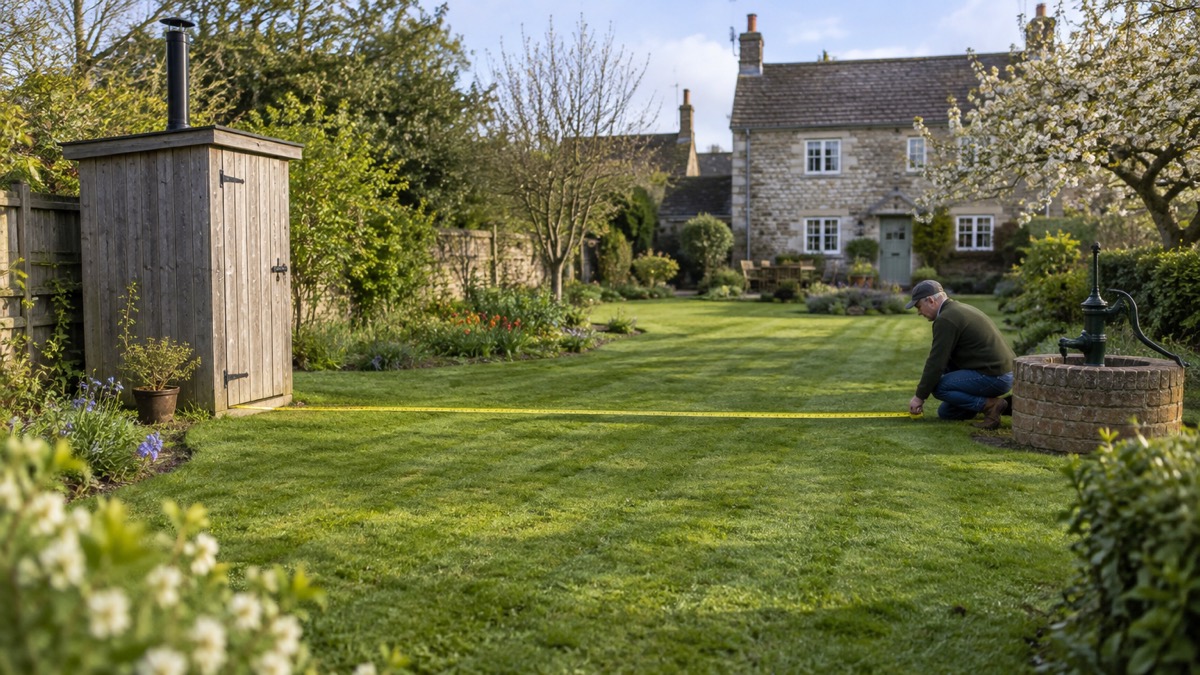
The headline figure is 7.5 metres. Independent guidance from the Centre for Alternative Technology states that if the soil is sandy the separation distance could be reduced to 7.5 metres1. In other words, 7.5 metres is the figure you can work to on sandy ground, and on other ground you should keep at least that distance and preferably more.
Why does soil type matter? Sandy ground drains quickly, so liquid moves down and away faster, and the risk of it pooling near a well is lower. Clay and heavy ground hold water, so anything that seeps out stays closer to the surface and can travel sideways towards a source. If you do not know your soil, assume it is not sandy and keep the greater distance.
The 50 metre figure from the oil storage rules is a useful reality check2. It applies to bunded tanks, not toilets, but it tells you that official bodies think in terms of tens of metres when a drinking water source is nearby. If your well is shallow, if the ground slopes towards it, or if you are unsure, move the toilet further away rather than closer.
Checking your soil type before you site the toilet
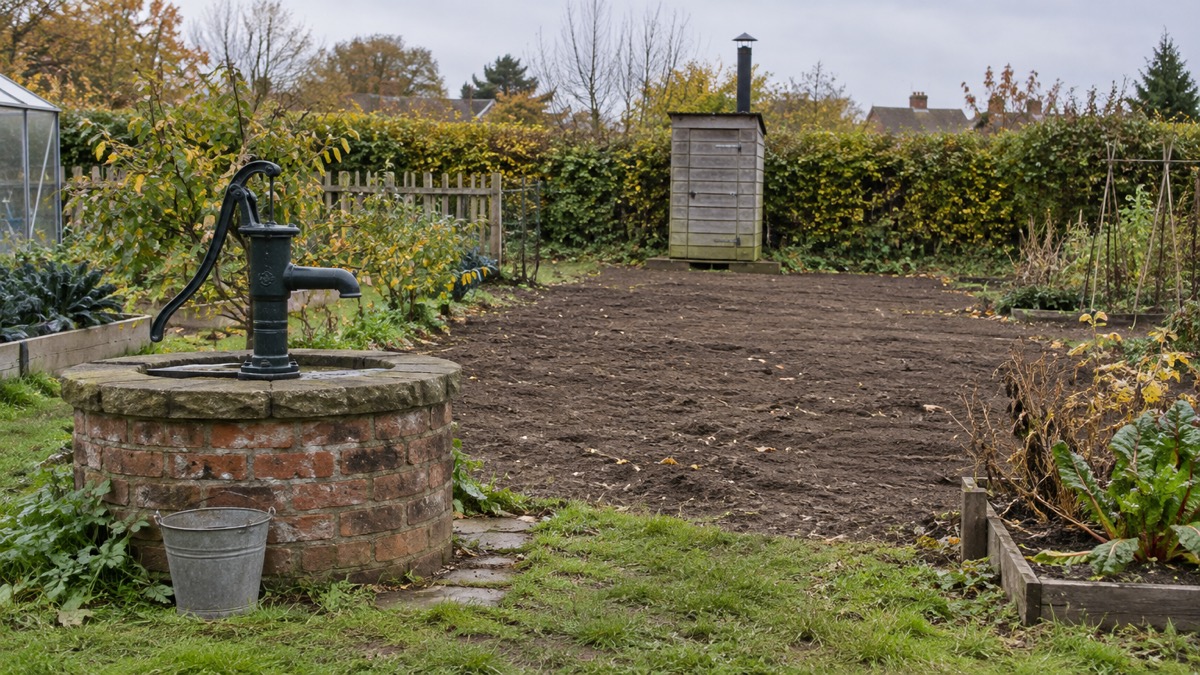
You do not need a laboratory to get a working idea of your ground. Dig a small hole where the toilet will go and feel the soil. Sandy ground is gritty, light and drains fast. Clay is sticky, heavy and holds water. Loam sits between the two. If the hole fills with water after rain, treat the ground as poorly draining and keep the full distance.
The separation distance can drop to 7.5 metres only where the soil is sandy1. If your ground is clay or you cannot tell, keep the toilet at least 7.5 metres from the source and add margin. The same caution applies if your well is downhill from the proposed site.
Your local council may be able to help with advice. Official guidance notes that you may be able to access discounted compost bins and advice from your local council3. That is about compost bins rather than toilets, but council environmental health teams are the people who deal with private water supplies, so a phone call is worthwhile before you dig.
If your supply is a private one, the Drinking Water Inspectorate advises restricting livestock access from the vicinity of the source, which may be up to 50 metres depending on ground conditions, topography and the presence of swallow holes4. The same logic applies to a composting toilet: keep it out of the immediate catchment of the source, and further away where the ground is cracked or sloping.
Keeping urine separate so the compost stays aerobic
Distance protects the water; how you run the toilet protects the compost. Independent guidance is clear that keeping urine separate is usually the key to successful composting, otherwise it can become anaerobic and smelly1. A urine-separating pedestal does this, but it only works when users are sitting down1. If your household will not sit, plan for a different approach or accept more frequent emptying.
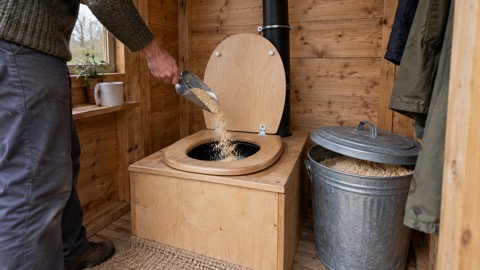
Aerobic means the heap has air. Anaerobic means it does not, and that is when smells and slower breakdown appear. The fix is simple: keep the balance right. Official guidance on compost heaps says to keep a good balance of green and brown materials5. In a composting toilet, the brown material is your soak: sawdust, shredded paper or similar dry matter added after each use.
- Add soak after every use: dry, carbon-rich material keeps the heap aerobic.
- Keep urine out of the chamber: separation is the key to success1.
- Watch for smells: a smelly heap is usually too wet or too rich in nitrogen.
- Wear gloves when handling compost: Legionella bacteria can be found in compost, and you should consider a mask for dusty work and wash hands afterwards6.
Two chambers alternated each year suit the UK climate
The UK climate is not kind to a single composting chamber. It is cool and wet for much of the year, which slows breakdown. Independent guidance recommends a reliable and robust approach for the UK climate: alternate annually between two separate chambers1. One chamber rests and finishes while the other is in use.
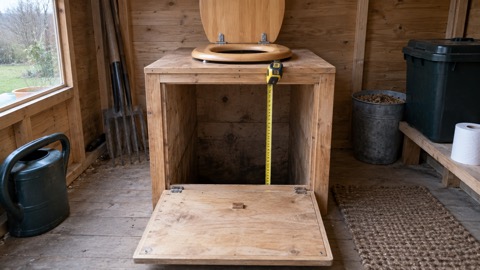
How big should each chamber be? Guidance suggests a composting chamber may need to be about one-third to one half of a cubic metre per person, equal to a box about 70 to 80 centimetres on each side1. That is a useful starting point for sizing, and you can read more on our page about composting toilet chamber size per person.
The two-chamber approach also gives you a natural rhythm. Fill one chamber over a year, then switch to the other and let the first finish. By the time you return to it, the material has had a full year to break down. This is slower than an electrically heated system, but it needs no power and no intervention beyond adding soak.
What a continuous system needs once it settles
A continuous system works differently: waste goes in at one end and finished compost comes out at the other, without the annual switch. Independent guidance says a system like this should settle down within a few months, after which no intervention in terms of adding worms or other decomposers should be necessary1. That answers a common question: you do not need to keep adding worms.
What a continuous system does need is a steady environment. Keep the urine separate, keep the soak going in, and keep the vent working. Flies can be drawn up the vent pipe and trapped at the top if the vent runs vertically upwards with a metal gauze over the top1. For a persistent fly problem, an insecticidal strip hung inside the chamber will control flying insects without affecting the other decomposers in the compost mass1. Our page on stopping flies in a composting toilet goes further.
If the system is off-grid, keep the electrical demand low. Independent guidance suggests using low voltage, 12 or 24 volt DC, to reduce equipment costs when off-grid, and a motion detector to minimise power demand1. That is ventilation and lighting, not heating.
Where electrically heated dry toilets must not be used
Some dry toilets use electrical elements to heat the compost, speeding up breakdown. Independent guidance is direct: we would not recommend dry toilets that use electrical elements to heat the compost1. Composting toilets should not be connected to an energy source other than for purposes of ventilation or sustaining the composting process1.
The reason is safety and simplicity. A heated chamber draws continuous power, which is a problem off-grid and a fire risk if the wiring or installation is poor. If you have any electrical equipment near a toilet, keep it dry. Fire and rescue services advise not using electrical items if wet7. Standard electric heaters should not be used in bathrooms or laundry rooms unless specifically rated for moist environments8.
"However, we would not recommend dry toilets that use electrical elements to heat the compost."
If you want power at the toilet, keep it to ventilation and low voltage lighting, and have the wiring installed properly. For the wider picture on choosing a system, see our guide to composting toilets.
Protecting a private water supply, and what to do if it fails
If your drinking water comes from a well, borehole or spring, you are responsible for protecting it. The Drinking Water Inspectorate advises restricting livestock access from the vicinity of the source, which may be up to 50 metres depending on ground conditions, topography and the presence of swallow holes4. Keep the toilet out of that zone too.
Private supplies can run low or fail. If your supply is lost, your council can advise. Argyll and Bute Council publishes guidance for private water supply users who lose supply9. In Scotland the arrangements and support differ from England, so check with your local authority. Our pages on private water supply rules and private water supplies in Scotland set out who is responsible.
If a toilet is unusable because of a blockage or supply failure, official guidance says to use toilets belonging to unaffected family, friends, neighbours, public toilets, rest centres, local shops, supermarkets and hotels10. That is the practical fallback while you fix the problem.
Water use, shared toilets and the questions people ask
A composting toilet uses no water to flush, which is its main advantage where water is scarce. You can also save water elsewhere: official guidance says to check and fix leaking toilets11, and to use grey water from a rainwater butt for flushing toilets to conserve drinking water12. Keep any rainwater or grey water well away from drinking water sources.
Shared and public toilets need more planning. More users means faster filling, so size the chamber generously and keep the vent clear. If the pedestal separates urine, make sure users sit down, because separation only works when users are sitting down1.
For the kit itself, our composting toilet kit checklist lists what to have ready. And if you are weighing up water storage alongside the toilet, our section on self-reliance at home covers rainwater, off-grid power and living without mains.
Sources (12)
- Composting toilets, Centre for Alternative Technology, 2025-06-27
- Oil storage regulations and safety, GOV.UK, 2026-10-29
- Bonfires and burning waste, Cheshire Fire and Rescue Service, 2026-10-14
- Protecting your private water supply, Drinking Water Inspectorate, 2026-10-28
- Wildfires: protecting your home and garden, London Fire Brigade, 2026-10-25
- Summer health, NHS Inform, 2026-08-06
- Electrical safety, Mid and West Wales Fire and Rescue Service, 2026-10-29
- Safe use of heaters and generators, Armagh City, Banbridge and Craigavon Borough Council, 2026-10-29
- Loss of supply for private water supply users, Argyll and Bute Council
- Weather and health - Public Health Wales, Public Health Wales
- Camping and caravanning safety, Devon and Somerset Fire and Rescue Service, 2026
- Advice and support: drought, Westminster City Council, 2026-08-06
 Composting Toilet Kit Checklist
 Garden Harvesting Kit Checklist
 Rainwater Winter Checklist
 Flies in a Composting Toilet
 Composting Toilet Chamber Size
 Is Harvested Rainwater Safe
 Garden and Lawn Water Needs
 Grey Water Disposal Off Mains
 Rain and Grey Water in Garden
 House With a Private Supply
 Rainwater Pipe Types and Labels
 Private Water Supply Visitors
 Rainwater Systems in a Power Cut
 Does Stored Rainwater Stagnate
 Underground Tank Dig Depth