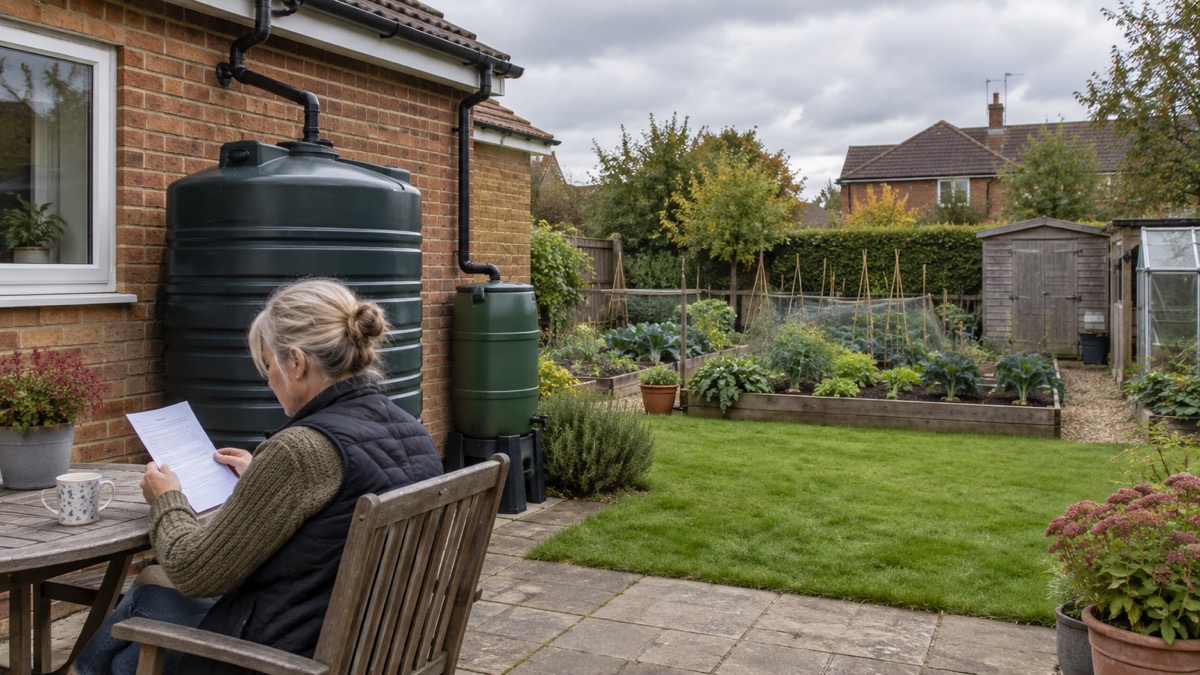
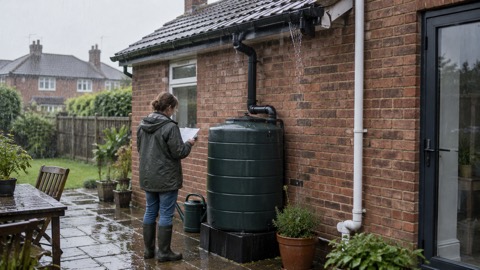
No. Untreated rainwater collected from a roof is not safe to drink. The makers of rainwater harvesting systems say so plainly on their own product pages: "Untreated rainwater is not for human consumption"1. That applies to the water in your butt, the water in an underground tank and the water coming out of a downpipe filter. It is fine for flushing toilets and watering plants, and official guidance says exactly that, but it is not drinking water2.
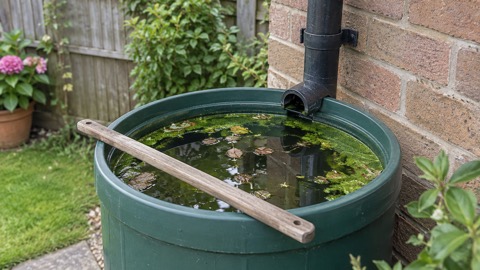
The reason is what a roof collects. Rain washes bird droppings, dust, grit and whatever else is on the roof into your gutter and down the downpipe. Once stored, that water sits at ambient temperature in a tank that is rarely sterile. Official guidance on private supplies lists the risks as animal waste, fertiliser or pesticide runoff, high mineral levels such as iron or manganese, and changes in water colour3. A downpipe filter catches leaves and debris. It does not make the water potable.
If you want to drink harvested rainwater, you are running a private water supply, and the law treats it as one. The Private Water Supplies Regulations require water intended for human consumption to be wholesome and not a danger to human health4. That is a higher bar than "it looked clear". This page sets out what contaminates collected water, what filters can and cannot do, how to store it, and where to go for testing and advice.
Why untreated rainwater is not drinking water
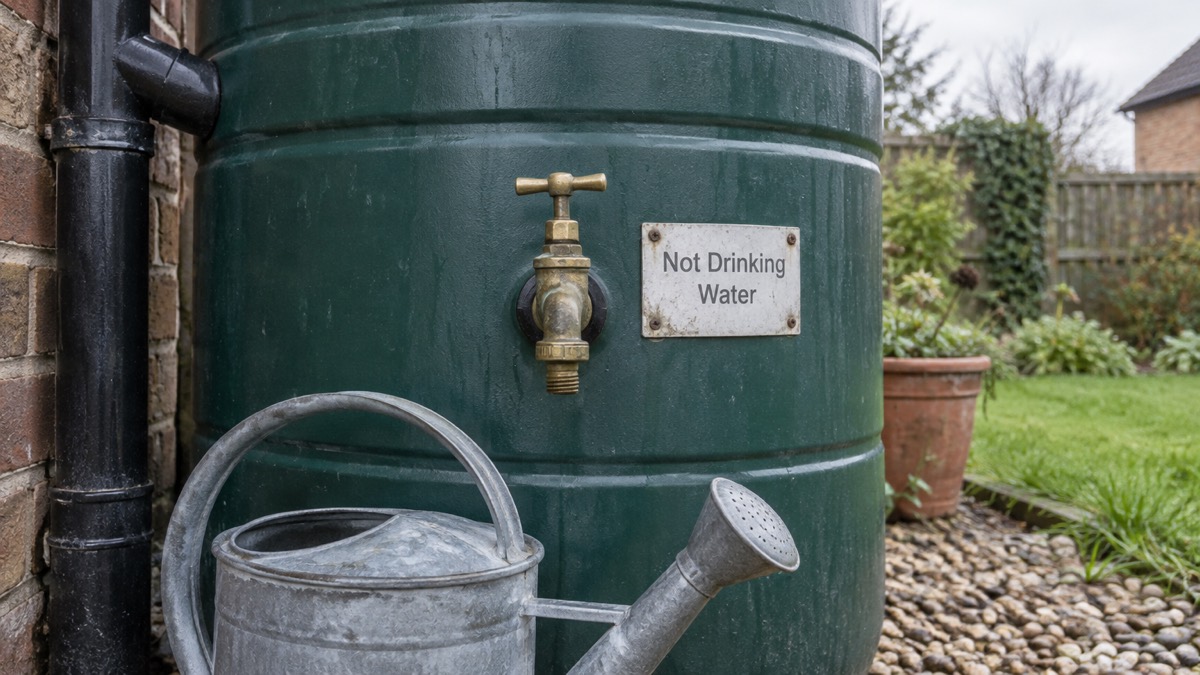
The gap between "rain" and "drinking water" is the journey. Rain falling in open air is relatively clean; rain landing on a roof, running through gutters and sitting in a tank is not. Every surface it touches adds something. The makers of harvesting systems are explicit that the collected product is untreated and not for human consumption, and they recommend that the point of use be clearly labelled to show rainwater is the source7. That labelling matters: it stops a visitor, a child or a plumber mistaking a rainwater tap for a mains tap.
Official guidance draws the same line. Water collected in a butt can be used for flushing toilets or watering plants, but you should not drink it because it could contain bacteria or disease2. The same advice appears in the government's own guidance on water supply interruptions8.
There is a second, quieter risk: cross-connection. If a rainwater system is plumbed into a house, the pipework and fittings have to keep rainwater and mains water apart. The Drinking Water Inspectorate says approved materials (WRAS approved or permitted under regulation 5) should be used to prevent contamination of rainwater during runoff and collection10. The makers go further, noting that water companies recommend, and in some cases require, black and green HDPE pipe, with the point of use clearly labelled7. If you are planning any of this, the rules are set out in rainwater systems and the law and the pipework in what pipe to use for rainwater and labelling rules.
How animal waste and runoff get into collected water
The contamination that matters most is biological, and it arrives from above and from the ground. On the roof, bird droppings are the obvious source. Around the tank, runoff from yards, fields and drains can carry far more. Official guidance on private supplies lists animal waste, fertiliser or pesticide runoff, high mineral levels such as iron or manganese, low or high pH, and changes in water colour as the things that affect a supply3.
Floodwater is the extreme case. It can be contaminated with sewage, chemicals and animal waste11, and public health guidance warns that flood water may be polluted by sewage, chemicals and animal poo that can cause a wide range of disease12. If floodwater has reached your tank, butt or downpipe, assume the contents are contaminated. A specific hazard named in official guidance is rats' urine in flood water, which can lead to Weil's disease (leptospirosis) if ingested or in contact with open wounds; initial symptoms are similar to flu, so consult a doctor, wash all cuts and cover them with waterproof plasters13.
There is a documented pattern of exactly this happening to small supplies. A risk assessment found a supply source contaminated with animal faeces and frogs, confirmed by failed microbiological samples, after the water turned brown following heavy rainfall. In another case, slurry spread on a hillside contaminated a spring within hours, and the owner issued boil water advice and diverted the affected spring to waste. These are the mechanisms that turn a clear-looking supply brown after a storm, and they apply just as much to a roof catchment as to a spring.
What a downpipe filter can and cannot do
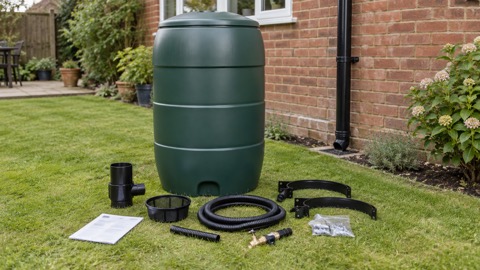
A downpipe filter is a debris separator, not a water treatment device. The maker's description of its Downpipe Filter and Connector Kit explains the mechanism: rainwater flows from the filter entrance into the filter cartridge, where debris is forced to the sides and on down the drainpipe, while filtered water flows out of the cartridge to the tank inlet15. In other words, the leaves and grit go one way and the clearer water goes the other. It has an automatic overflow and a removable filter cartridge for cleaning15. It is designed for roofs under trees, where debris and overflow water will exit down the drainpipe15.
That is genuinely useful. It keeps sludge out of the tank, reduces the organic load that feeds bacteria, and makes the stored water easier to manage. What it does not do is remove dissolved contamination, bacteria that pass through the mesh, or anything already in the water. The distinction matters because a filter can make water look clean while leaving it unsafe.
The same principle applies to finer filters. Scottish guidance on water filter candles states that the filter should remove bacteria, but they can regrow or re-contaminate the water further downstream of the filter, so you should disinfect downstream of the filter16. A filter is a barrier, not a steriliser, and anything that grows after it is unprotected.
| Filter type | What it does | What it does not do |
|---|---|---|
| Downpipe debris filter | Forces leaves and grit to the sides and sends clearer water to the tank15 | Remove dissolved contamination or make water drinkable |
| Removable cartridge | Can be taken out and cleaned15 | Sterilise the water passing through |
| Water filter candle | Should remove bacteria16 | Stop bacteria regrowing or re-contaminating downstream16 |
If you are choosing between filter types, the differences are set out in rainwater filters: downpipe, inline and in-tank types. Whatever you fit, keep it clean: a clogged filter bypasses or overflows, and a neglected one becomes a source of contamination itself. The maintenance routine is covered in keeping a rainwater system clean and working through the year.
Storing rainwater in a tank
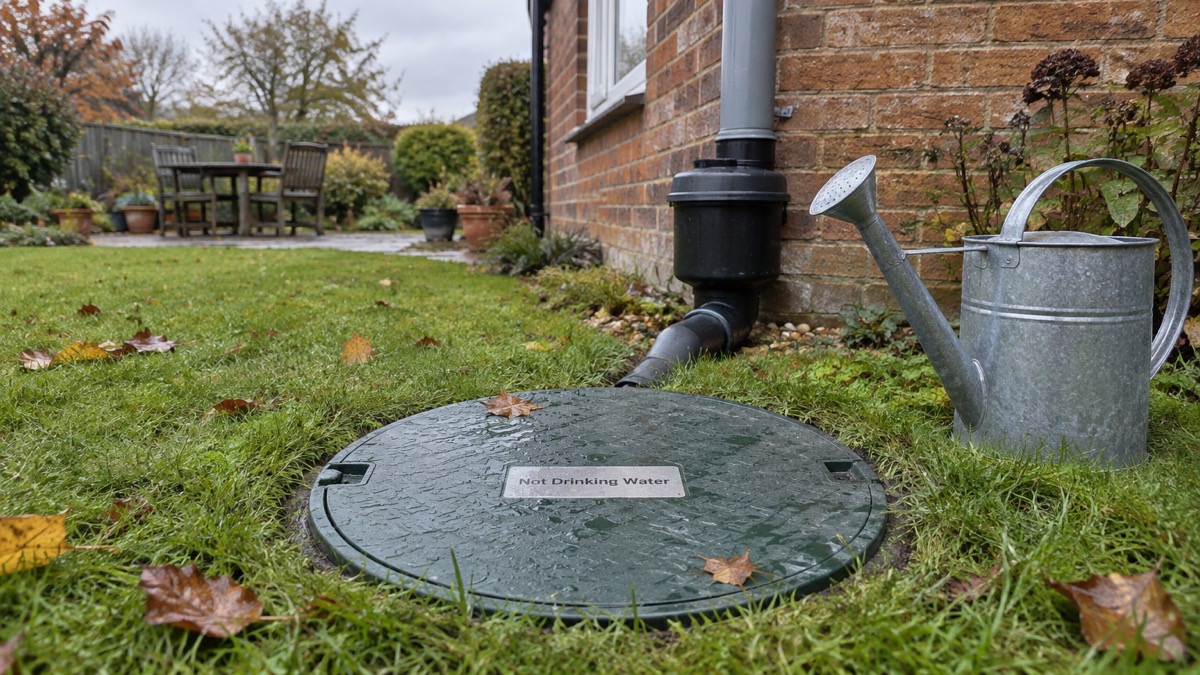
Storage decides whether a system is manageable or a breeding ground. The Drinking Water Inspectorate's advice on tanks is aimed at drinking water storage, but the principles carry over: if your drinking water comes from a storage tank, it will be safe to use if the tank is properly designed, correctly installed and kept in good condition17. For a tank storing drinking water, it recommends checking annually for the condition of the tank and the quality of the water17. For rainwater, the same discipline applies with more reason, because the water is untreated.
The key requirement is exclusion. Treated water tanks should be designed, installed and maintained to prevent the ingress of contaminants through precipitation (rain or snow)10. In practice that means a close-fitting, insect-proof lid, sealed inlets, and an overflow that does not allow backflow. A tank that lets in daylight and leaves will grow algae; one that lets in rodents is worse.
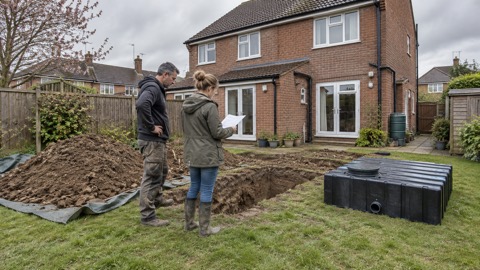
Underground tanks stay cooler and darker, which slows biological growth, but they are harder to inspect. One maker's underground tanks come in a range of sizes from 1,500 litres to 15,000 litres7. Sizing is a separate question from safety, and it is covered in how to size a rainwater tank and underground rainwater tanks. Above-ground butts are easier to check and clean; the trade-offs are set out in water butt or underground tank?.
Using rainwater for washing and around the house
The safe uses are well established. Official guidance says rainwater can be used for flushing toilets or watering plants, but should not be drunk because it could contain bacteria or disease2. That covers the garden, the toilet and the car. It does not cover the kitchen, the bathroom basin or the baby's bottle.
Washing is the grey area. If the mains supply itself is unsafe, official guidance is clear: do not use it to wash children; use tanker or bottled water instead18. The same caution applies to any water of uncertain quality. For handwashing and personal washing, use water you know is safe. For garden use, rainwater is ideal, and the detail is in using rain and grey water in the garden.
There is one reassuring counterpoint. During sewer flooding, mains drinking water remains safe to use because the pipes are sealed and kept under pressure and will not let anything in19. So a sewer flood outside does not mean your tap water is contaminated. The risk is to your rainwater system, not your mains supply.
Where to get your water tested and advised
If you rely on a private supply, including a treated rainwater system you intend to drink from, testing is how you find out whether it is safe. The Drinking Water Inspectorate gives consumer advice on water standards and has a range of water quality advice leaflets to help if you are worried20. In Northern Ireland, the Drinking Water Inspectorate for Northern Ireland provides independent assurance of the quality of drinking water provided by Northern Ireland Water21.
For lead specifically, if you suspect lead pipes you can ask your water company to test the water at your kitchen tap, and if they find lead they should provide written advice on what to do22. In Northern Ireland, contact Northern Ireland Water to request a lead sample to be taken at your property if you are concerned about lead pipework23, and a sample of your water supply can be tested if you are concerned about lead, with Waterline able to advise on replacing lead pipes23.
For a private supply, the local authority is the first port of call. The regulations do not require a risk assessment or testing for a single-dwelling supply unless requested by the owner or occupier, the dwelling is in Wales and rented to tenants, the dwelling is in England, rented to tenants and meets the criteria in the guidance on regulation 9, or the local authority believes there to be a risk to health24. In other words, you can ask, and in some circumstances the council must act. The full picture is in private water supply regulations: risk assessments, testing and who is responsible.
If your water looks wrong, report it. Brown, black or orange water should be reported to your supplier if it also has an unusual taste or odour, has been discoloured for more than 24 hours and is not clearing, or is not brown, black or orange in colour25. In Northern Ireland, discoloured drinking water should be reported to Northern Ireland Water21.
When the water looks or smells wrong
Colour and smell are warning signs, not proof either way. Official guidance says that if water is discoloured, cloudy or smells, check with your water supply company before drinking it or using it for baby formula or brushing teeth, as it may be contaminated26.
Mains water is a different case. Water companies say discoloured water is usually harmless: one says that although the water may look unappealing, there is no risk to your health27; another that levels of iron are not likely to be harmful but you should wait until the water runs clear before drinking and cooking28; another that discolouration during mains cleaning is temporary and safe to drink, and running taps for a few minutes will help clear it29; and another that in most cases discoloured water is not harmful and does not usually last long30. That reassurance applies to mains water, not to rainwater you have collected yourself.
If you decide to treat rainwater for drinking
Treating rainwater to drinking standard is possible, but it is a system, not a gadget. Boiling is the simplest step and the one official guidance names: bring water to the boil and leave it to cool before drinking, using for food preparation or giving to pets6. It kills organisms but does not remove chemicals or metals. Filtration and disinfection are the other components, and the options are set out in treating a private water supply: UV, filters and spring protection.
Boil water advice is common after heavy rain. If you are on a private supply and your water turns brown after a storm, treat that as the trigger to check with your supplier or, in Northern Ireland, with Northern Ireland Water before drinking it26.
"The water should be brought to the boil and left to cool before it can be drunk, used for food preparation or giving to pets."
If you are staying somewhere with a private supply, the visitor's view is in staying somewhere with a private water supply. If you are buying a property with one, the questions to ask are in buying a dwelling with a private water supply.
Sources (30)
- F-Line 7500 Litre Garden System, Rainwater Harvesting, 2026
- Loss of essential services, Greater Manchester Combined Authority, 2026
- Private water supplies, Highland Council, 2025
- Private water supplies, Cornwall Council, 2026
- Staying healthy and safe after flooding, Surrey County Council, 2026
- Flooding advice for properties using a private water supply, Shropshire Council, 2026
- Rain Activ Dual Garden System, Rainwater Harvesting, 2026
- Water supply interruptions or outages, UK Government, 2026
- Water supply interruptions or outages, UK Government, 2026
- Protecting your private water supply, Drinking Water Inspectorate, 2026
- What to do after a flood, Natural Resources Wales, 2026
- Flooding and health, Public Health Wales, 2026
- Information about specific safety concerns, Northumberland County Council, 2026
- Clearing flood water, Oxford City Council, 2026
- Downpipe Filter and Connector Kit, Rainwater Harvesting, 2026
- Water filter candles, Drinking Water Quality Regulator for Scotland, 2026
- Water storage tanks and cisterns, Drinking Water Inspectorate, 2026
- Keeping children safe during a flood, nidirect, 2025
- What to do during sewer flooding, Thames Water, 2026
- Check drinking water quality, UK Government, 2026
- Dealing with drinking water problems, nidirect, 2026
- Lead in Drinking Water - Drinking Water Inspectorate, Drinking Water Inspectorate
- Report water quality issues, Northern Ireland Water, 2026
- Buying a dwelling with a private water supply, Drinking Water Inspectorate, 2026
- Brown, Black or Orange Water - Drinking Water Inspectorate, Drinking Water Inspectorate
- Prepare yourself, Greater Manchester Combined Authority, 2026
- Water appearance, Bristol Water, 2026
- Mains cleaning, Affinity Water, 2026
- Appearance of your water, South Staffs Water, 2026
- Private water supplies after floods or storms, Argyll and Bute Council, 2026
 Composting Toilet Kit Checklist
 Garden Harvesting Kit Checklist
 Rainwater Winter Checklist
 Composting Toilet Near Wells
 Flies in a Composting Toilet
 Composting Toilet Chamber Size
 Garden and Lawn Water Needs
 Grey Water Disposal Off Mains
 Rain and Grey Water in Garden
 House With a Private Supply
 Rainwater Pipe Types and Labels
 Private Water Supply Visitors
 Rainwater Systems in a Power Cut
 Does Stored Rainwater Stagnate
 Underground Tank Dig Depth