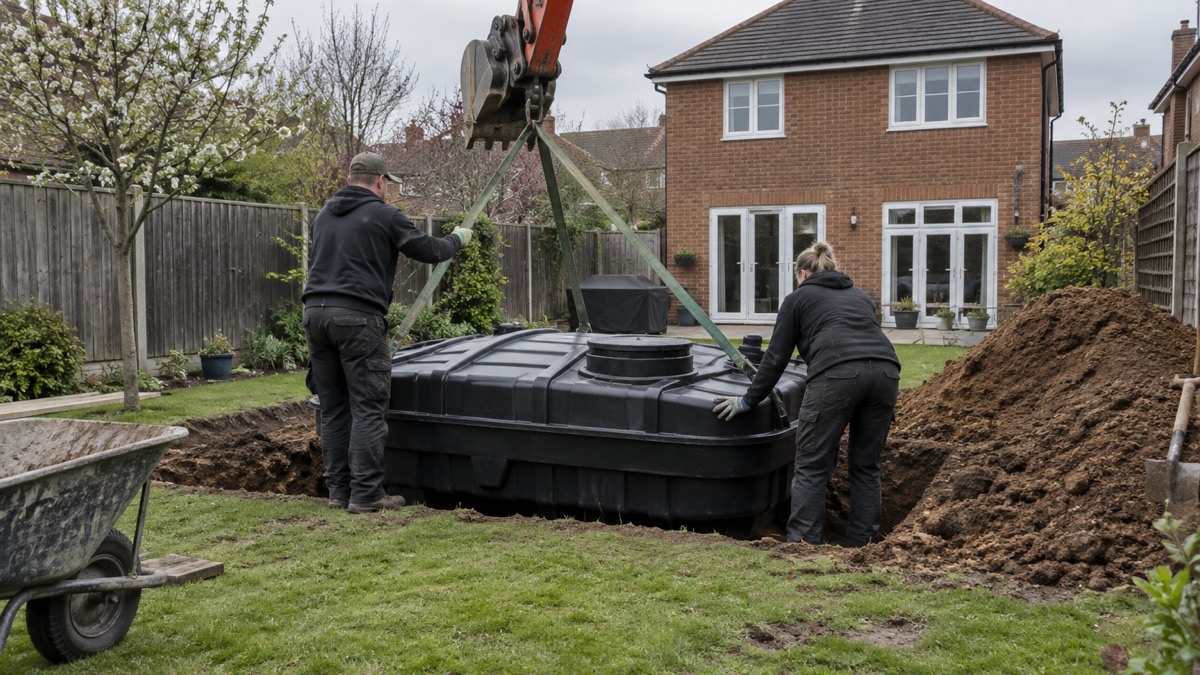
An underground rainwater tank buries your water storage out of sight: the tank sits in a hole in the garden, rainwater runs into it from the roof downpipes, and a pump lifts it back out when you need it. Below ground rainwater tanks are available from 180 litres to 10,000 litres1, and the same maker's full rainwater range runs to 30,000 litres above ground in 40 sizes2. For a household, the practical choice is usually between a small tank for garden watering and a larger one feeding toilets and a washing machine.
The reason most people go underground rather than buying a water butt or an above ground tank is space and appearance. A buried tank takes no garden space, hides entirely under a lawn or patio, and holds far more water than anything you would want standing beside the shed. The trade-off is the dig: you are excavating a hole, managing groundwater, and installing a pump, because underground rainwater harvesting tanks require a pump to work as part of a rainwater harvesting system1.
The design that has changed this calculation most is the flat, shallow dig tank. The F-Line flat tanks need an installation depth 60% less than other rainwater tanks, with excavation up to 70% less3, and they can go into much higher water tables than a standard round tank4. That means less digging, less spoil to dispose of, and less trouble on wet clay. This page sets out the sizes, the three basic shapes, the pump arrangements, the lids and turrets, and what an underground tank can do for you in an emergency.
What an underground tank does for a household
An underground tank is the store at the heart of a rainwater harvesting system. Rain falls on the roof, runs through gutters and downpipes, passes a filter, and collects in the buried tank. From there it is pumped back out on demand: to a garden tap, to toilets, to a washing machine. The makers describe the systems as designed for homeowners who want to collect, filter and store rainwater for domestic use and garden irrigation8.
What that buys a household is a buffer against dry weather and, to a degree, against supply problems. Above and underground water tanks fitted with a pump and filter can provide water supplies for the dry spring and summer months2, which is exactly when gardens need most water and when hosepipe restrictions tend to arrive. The average UK roof collects around 90,000 litres of water a year7, so a tank of a few thousand litres refills repeatedly through the year in most of the country. How to match tank size to your roof area and demand is covered in tank sizing.
The uses makers list for these tanks are broad: landscape watering for parks and recreational purposes, fire sprinkler water storage, horticultural and market garden applications, irrigation and wash-down facilities, and rainwater harvesting9. Some underground tanks in the range are also rated for potable water storage10, though harvested rainwater itself is not drinking water, and what rainwater can safely be used for is a separate question with its own rules, covered in rainwater uses and drinking rainwater.
Against an above ground tank, the underground option costs you an excavation and a pump, and saves you the visual footprint, the UV exposure and the frost exposure. Above ground plastic tanks are UV stabilised for many years of outside use1, but a buried tank avoids that weathering entirely and, at a depth of a metre or more, sits in ground that stays cool. The pipework and any above ground sections still need frost protection: Northern Ireland Water advises householders to insulate water tanks and pipes in unheated areas like lofts, roof spaces, garages and outbuildings11.
Sizes: from 150 litres to 15,000 litres
The size ranges differ slightly between the makers' own category pages, so it is worth reading them together. Enduramaxx's below ground rainwater tanks run from 180 litres to 10,000 litres1; its underground water tank range runs from 800 litres to 9,500 litres5; and its overall rainwater harvesting range spans 150 litres to 30,000 litres across 40 sizes2. The smallest dedicated underground tank is a 150 litre model, listed as available from August 20255. At the top of the household scale, a 15,000 litre rainwater tank has a nominal capacity of 15,000 litres and a brim full volume of 15,387 litres12.
| Tank | Capacity | Notes |
|---|---|---|
| 150 litre underground tank | 150 litres | Smallest below ground model, available from August 20255 |
| 1,100 litre underground tank | 1,100 litres | Rainwater and septic installations; 450mm plastic or 600 x 600mm galvanised lid13 |
| 1,500 litre underground tank | 1,500 litres | Rainwater, potable water and septic installations10 |
| 2,500 litre underground tank | 2,500 litres | Rainwater and potable water; listed as a top seller5 |
| 7,500 litre round tank | 7,370 litres | Diameter 2,085mm, height 2,530mm14 |
| 10,000 litre underground tank | 10,000 litres | Subject to a +/- 3% size variation15 |
| 15,000 litre rainwater tank | 15,000 litres nominal, 15,387 litres brim full | 2 inch standard male outlet; +/- 3% variation12 |
Two practical points sit behind these numbers. First, quoted tank sizes are subject to a +/- 3% variation12, so the tank that arrives may hold slightly more or less than its nameplate. Second, the nameplate capacity is not the same as the brim full volume: the 15,000 litre tank holds 15,387 litres to the brim12, because the working level sits below the inlet and overflow. Neither point changes what you buy, but both matter if you are calculating storage precisely.
For comparison with the mains world: most domestic fuel tanks have a capacity of at least 1,000 litres16, and a typical household loft cold water tank holds around 250 litres, which official guidance describes as quite sufficient for most homes17. United Utilities' water tankers, used in supply emergencies, carry 5,000 litres in smaller trucks to 30,000 litres in larger tankers18. Those figures give a sense of scale: a 2,500 litre underground tank holds ten times a loft tank; a 10,000 litre tank holds twice a small water tanker.
Most UK homes choose between 1,000 and 10,000 litres
For a household system, the working range is roughly 1,000 to 10,000 litres. Below about 1,000 litres you are storing enough for garden watering over a dry fortnight but not enough to matter for the house; above 10,000 litres the excavation, offloading and groundwater handling grow faster than the benefit for most gardens. The makers' own kits sit in this band: the Rain Activ Dual Garden System uses underground tanks from 1,500 to 15,000 litres4.
Where you land in that band depends on two things you can work out for yourself: your roof area and your demand. The roof yield is generous, at around 90,000 litres a year for the average UK roof7, so the constraint is rarely how much rain you can catch but how much you can use between refills. A garden-only system can be smaller and refill often; a whole-house system flushing toilets and feeding a washing machine draws down faster and justifies the larger tank. The tank sizing page works through the calculation.
One design worth knowing about if your demand is seasonal is the dual-purpose tank. In the Rain Activ dual garden system, the bottom portion of the tank stores the required rainwater for use within the garden, while the top portion acts as attenuation capacity, temporarily holding storm water6. That suits a household that wants both a watering supply and some help with surface water run-off, and the underground tanks in that range come in sizes from 1,500 litres to 15,000 litres6.
Shallow dig, deep dig and flat: choosing a design
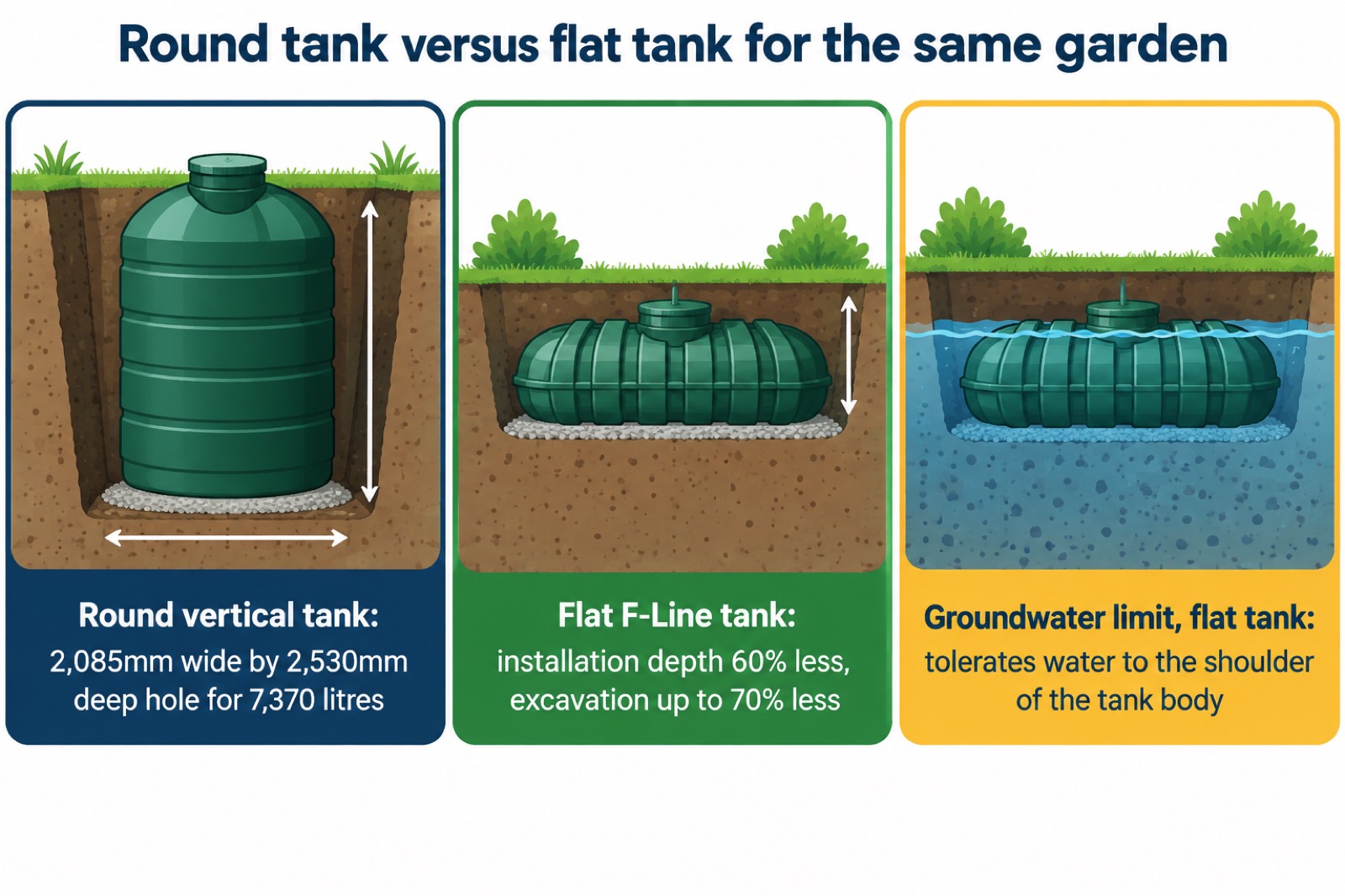
Underground tanks come in three broad shapes, and the shape determines the hole.
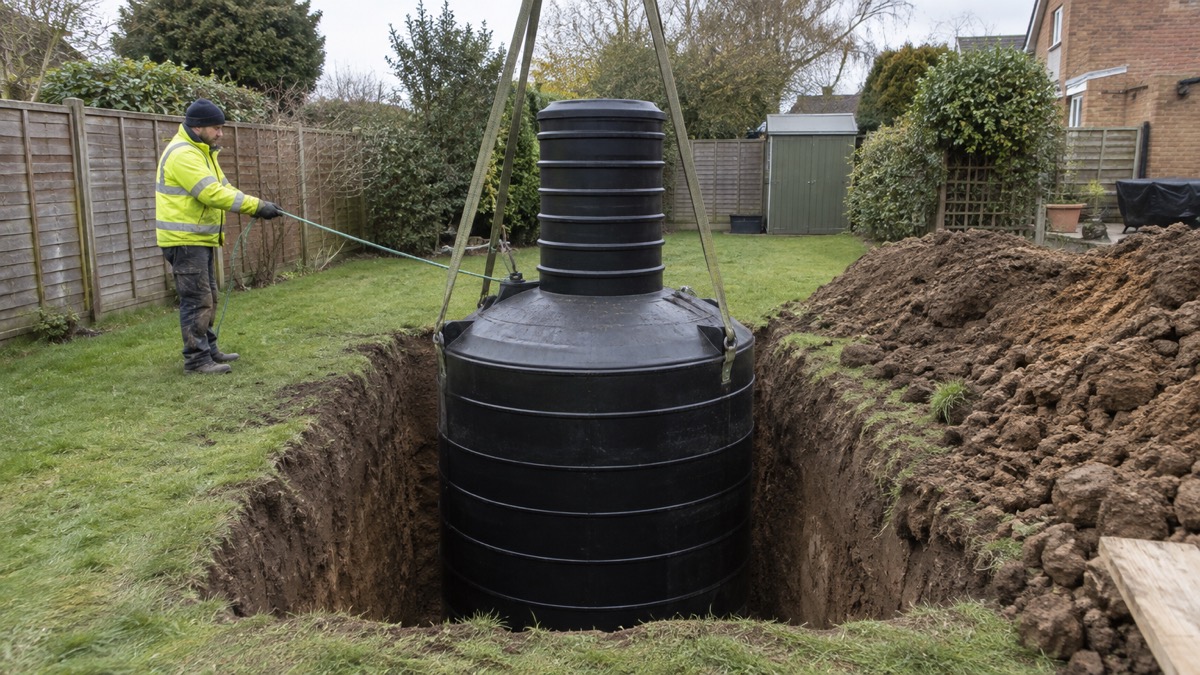
Round vertical tanks are the traditional form: a cylinder sunk upright in the ground, so the excavation has to match the tank's height. On a site with a high winter water table, a hole that deep can fill with groundwater before the tank goes in, and a round tank can be pushed upwards by water pressure if it is empty. Round tanks suit sites with free-draining ground and a known low water table.
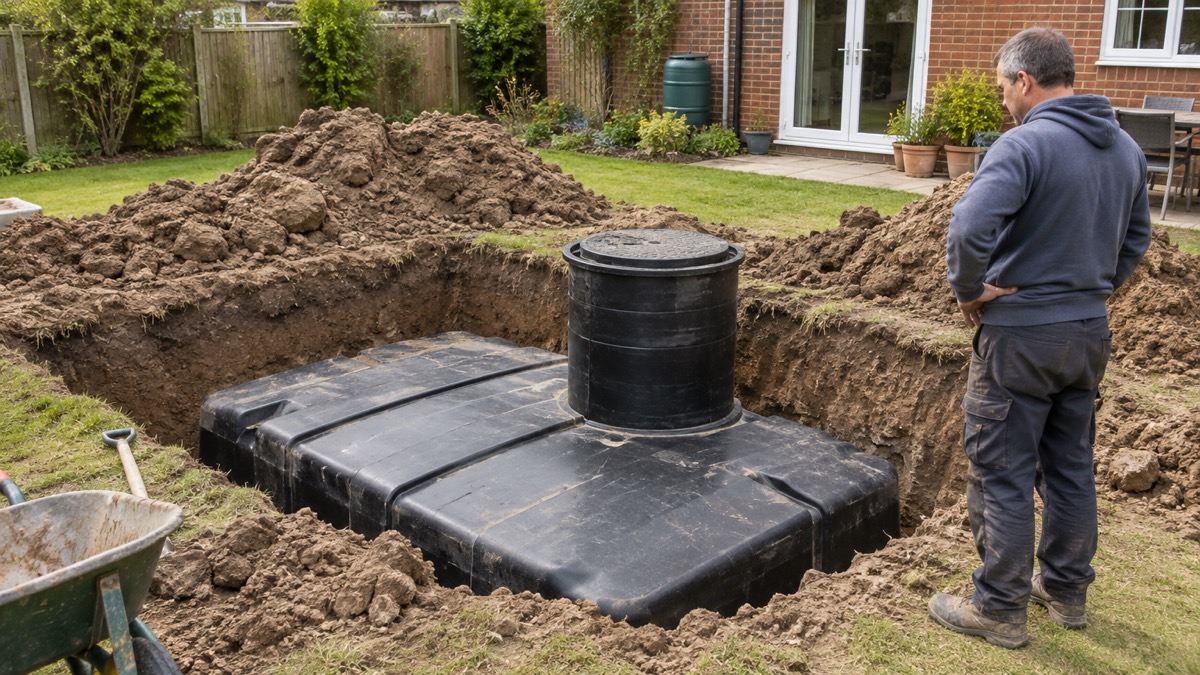
Flat tanks, such as the F-Line range, are wide and shallow. The F-Line tanks are flat and the installation depth is 60% less than other rainwater tanks, and the excavation can be up to 70% less3. They are rotationally moulded, one piece tanks, installed without the need for concrete6, which removes both the concrete delivery and the curing wait from the job. The flat shape also changes the groundwater maths: the F-Line flat tank can be installed into much higher water tables than a standard round tank4, and can be installed in ground water up to the shoulder of the tank body6. The maker's advice is blunt on the point: if you don't know what your water table will be like in the winter, you're safer to install a flat tank19.
Shallow dig systems package a flat tank with the shaft, lid, pump and pipework as one kit. A standard shallow dig F-Line direct feed system includes the underground storage tank, tank shaft, pedestrian lid, submersible pump, filter, calmed inlet and overflow siphon, 25m of 25mm rainwater pipe, a label pack and the mains water backup20. The 15,000 litre garden system goes further and pairs two 7,500 litre shallow dig tanks in one kit3.
| Design | Typical form | Dig | Groundwater | Suits |
|---|---|---|---|---|
| Round vertical | Cylinder, e.g. 2,085mm x 2,530mm for 7,370 litres14 | Deepest | Needs a low, known water table | Free-draining sites, largest single capacities |
| Flat (F-Line) | Wide, low one-piece tank | 60% less depth, up to 70% less excavation3 | Up to the shoulder of the tank body6 | Unknown or high winter water tables |
| Shallow dig kit | Flat tank plus shaft, lid, pump and pipework20 | As flat tank | As flat tank | Households wanting one complete package |
Ground conditions deserve a paragraph of their own before you order anything. Clay holds water, and a winter water table can rise close to the surface; the maker's own guidance to prefer a flat tank when the winter water table is unknown19 is the single most useful sentence in this decision. And if standing surface water rather than groundwater is the issue, the flooding pages cover the wider household response.
Delivery and offloading are part of the design choice too. A 10,000 litre tank is a large, heavy object that arrives on a lorry: the maker states these tanks are stocked for collection or fast delivery throughout the UK, with Hiab crane deliveries priced on request where clients cannot offload the tank21. A flat tank that needs no concrete6 also means no ready-mix lorries on the day. Plan where the lorry will stop, how the tank gets from kerb to hole, and whether you need the crane, before you commit to the biggest tank the garden will hold. How deep each design actually needs to go is covered in detail in underground tank depth.
An underground tank needs a pump to deliver water
Water in a hole in the ground does not come out on its own. Underground rainwater harvesting tanks require a pump to work as part of a rainwater harvesting system1, and the choice of pump arrangement shapes the whole system. There are two standard arrangements, and the makers set out the difference plainly in their direct feed and gravity feed systems guidance.
Direct feed pushes water straight from the tank to each appliance. Water is fed directly from the submersible pump in the underground tank to each appliance20. The submersible pump is pressure-sensitive, so it automatically reacts when water is needed8: open a tap or flush a toilet, the pressure drops, the pump starts. It is simple, and it delivers at mains-like pressure, but every drop passes through the pump, so a power cut stops the supply.
Gravity feed pumps from the underground tank, through a control unit, into a Smart Header Tank within the loft space, from which water is gravity fed to toilets and washing machines22. The loft header tank gives you a small stored head that works even when the pump does not: the maker states that toilets and washing machine keep working even during low rainfall, pump failure, or a power cut8. The trade-off is loft space and a second tank to maintain, and the usual physics of gravity: water pressure is lost the higher water has to be lifted, so the height of your water tank relative to the underground supply pipe affects how quickly it refills23.
Both arrangements handle the dry-tank problem with a mains top-up. In direct feed systems, when the tank becomes too low the control unit opens a solenoid valve and allows approximately 200 litres of mains water to enter the tank8; the maker's product pages describe the same device as putting about 250 litres of mains water into the tank when the level runs dry24, so the two figures differ slightly and you should expect a top-up in the 200 to 250 litre range. In the gravity system, if rainwater runs low the system automatically registers and delivers mains water directly to the Smart Header Tank22. How these top-ups must be plumbed to keep mains and rainwater separate is a regulatory matter covered in rainwater regulations.
One limitation to understand before you rely on a top-up for garden watering: with two garden taps running on a high power pump, such as the HydroForce, Steel Pumps or Divertron 1100 watt pumps, the outflow of water is higher than the inflow from the backup device, and when the tank is empty the pump's dry-run protection will turn it off, with some pumps needing resetting at the mains19. The maker's advice for garden use is to have mains water taps available alongside the rainwater outlet so you can switch to mains when the tank is empty, while the backup keeps up with demand in the house for toilets and the washing machine4. Pump choices are compared in rainwater pumps.
Lids and turrets: plastic or galvanised
Every below ground tank needs a way in: for installing and lifting the pump, cleaning the filter, and inspecting the inside. All below ground tanks have the option of a plastic or galvanised lid and a range of turret sizes1. The turret is the vertical shaft that carries the lid from the tank body up to finished ground level; the lid is what you see and stand on at the surface.
Across the maker's below ground range, tanks have the option of a plastic or galvanised lid and a range of turret sizes13, and its underground water tanks are also available with a raised turret for AB Air Gap installations10. The 10,000 litre underground tank comes with a lid, with the choice of no lid, a 450mm plastic lid or a 600 x 600mm galvanised lid15. In practice a plastic round lid suits a lawn or border, where it can sit flush and be hidden; a galvanised square lid is the tougher choice where the turret sits in a paved or trafficked area. If the tank will go under a driveway, confirm with the maker that the lid and turret are rated for vehicle loading before you order.
Turret size follows from the installation depth and the equipment. Optional turrets are available for housing control sets or weir housings, or where the tank is being installed deeper underground, with a facility to fit an additional lid if required5. A raised turret option exists for AB Air Gap installations5, which is the arrangement used to keep mains top-up water physically separated from rainwater. When choosing, check three things: that the turret reaches your finished ground level, that the opening is wide enough to lift the pump and filter through, and that the lid sits flush and secure.
Whatever lid you choose, keep it watertight. Official guidance on private water supply tanks is that storage tanks should have watertight walls and lids25, and the same logic applies to a rainwater tank: a lid that lets in surface water, pests or debris contaminates the store and blocks the pump. Check the lid and turret seal as part of your routine rainwater maintenance, and after any period of heavy rain.
Using stored rainwater in an emergency
An underground tank is one of the few substantial water stores an ordinary household can hold, and in a supply interruption it earns its keep. The water is not drinking water, but it flushes toilets, washes, and keeps plants alive when the mains is off. Makers list the storage of water in case of a fire emergency among the uses of underground tanks5, and fire sprinkler water storage among the uses of specific models9. For what rainwater can and cannot safely be used for, see rainwater uses; for making stored water drinkable, drinking rainwater.
The pump is the weak point in a power cut, so plan around it. Official guidance on adapting a home to flooding risk says to check with an electrician before using an electric pump, and that you may need a back-up generator if there are power cuts26. A gravity feed system with a loft header tank keeps toilets and washing machine working during pump failure or a power cut8, which is the strongest argument for gravity feed if emergency resilience is part of your reason for installing a tank. A small pump need not be a large load: a 40W water pump is listed among the low-power devices that solar set-ups can run27, so a modest off-grid solar arrangement can keep a rainwater system alive through an outage, a combination explored in solar water pumping and rainwater in a power cut.
Alongside the tank, use what the house already holds. Some houses have a cold water tank located in the loft, which will allow some water for a short period in an outage; official preparedness guidance is to use it only for critical purposes28. A typical loft tank holds around 250 litres17, so it is hours of careful use, not days. If you keep animals, South East Water notes that installing simple gutter systems and storage tanks, such as a 50-gallon polytank, on small sheds or outbuildings is an effective way to maintain a backup water supply for non-domestic animals29.
Garden systems and whole-house harvesting
The last choice is what the tank feeds, and the kits on sale divide cleanly into two kinds.
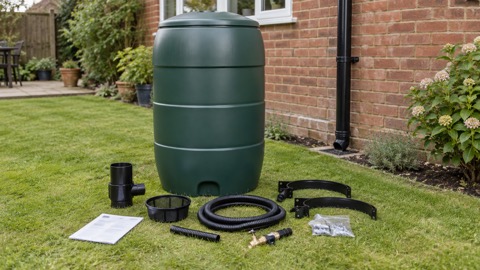
Garden systems store rainwater for watering only. They range from a 7,500 litre above ground kit supplied for horticultural, agricultural or garden use to the F-Line 15,000 litre underground garden system, a complete kit built on two 7,500 litre shallow dig tanks with inline filter, overflow kit and pump3. A garden system feeds a garden tap rather than the house plumbing: there is no loft header tank, no connection to the house's water system, and no mains top-up to arrange. If your aim is dry-spell watering, this is the simpler installation, and the garden harvesting checklist lists what a complete garden kit contains.
Whole-house systems feed toilets and washing machines as well as the garden. The direct feed versions at 1,500, 3,000 and 7,500 litres are sold as underground domestic rainwater harvesting system kits with mains water backup19; the gravity feed version pumps to a loft Smart Header Tank and feeds toilets and washing machine by gravity22. A whole-house system needs the rainwater plumbing separated and labelled from the mains plumbing, a compliant mains top-up arrangement, and a filter that keeps debris out of the pump, all covered in rainwater filters and rainwater regulations.
| Garden system | Whole-house system | |
|---|---|---|
| Feeds | Garden taps and irrigation14 | Toilets, washing machine and garden20 |
| Typical sizes | 1,500 to 15,000 litres6 | 1,500, 3,000 and 7,500 litre kits19 |
| Pump | Submersible, direct to tap20 | Direct feed to appliances, or to a loft header tank22 |
| Mains top-up | Optional; maker advises mains taps alongside4 | Included: about 200 to 250 litres per top-up8 |
| Power cut behaviour | Pump stops; dry-run protection may need resetting19 | Gravity feed keeps toilets working8 |
The honest summary of the choice: a garden system is worth installing for the watering alone; a whole-house system adds resilience and cuts mains consumption further, at the cost of more plumbing, a header tank or a more elaborate pump arrangement, and the regulatory care that comes with connecting anything to the house's water system. Either way, the tank itself is the same buried object, and the dig, the lid and the groundwater rules above apply to both.
Sources (29)
- Enduramaxx Rainwater Harvesting Tanks, Enduramaxx, 2026-10-29
- Enduramaxx Rainwater Harvesting, Enduramaxx, 2026-10-29
- F-Line 15,000 Litre Garden System, Rainwater Harvesting Ltd, 2026-07-07
- F-Line 7500 Litre Direct Feed System, Rainwater Harvesting Ltd, 2026-07-07
- Enduramaxx Underground Water Tanks, Enduramaxx, 2026-10-29
- Rain Activ Dual Garden System, Rainwater Harvesting Ltd, 2026-07-01
- Reduce Your Risk of Flooding, United Utilities, 2026-10-28
- Direct Feed or Gravity Feed, Rainwater Harvesting Ltd, 2026-04-10
- Enduramaxx 2,500 Litre Underground Tank, Enduramaxx, 2026-09-28
- Enduramaxx 1,500 Litre Underground Tank, Enduramaxx, 2026-09-28
- Winter Proof Your Home, Northern Ireland Water, 2026-10-28
- 15,000 Litre Rainwater Harvesting Tank, Enduramaxx, 2026-10-05
- Enduramaxx 1,100 Litre Underground Tank, Enduramaxx, 2026-09-28
- 7500 Litre Garden System, Rainwater Harvesting Ltd, 2026-03-24
- Enduramaxx 10,000 Litre Underground Tank, Enduramaxx, 2026-09-28
- Are You Insured for a Fuel Tank Leak?, OFTEC, 2026-10-29
- Water Storage Tanks and Cisterns, Drinking Water Inspectorate, 2026-06-09
- United Utilities Water Tankers, United Utilities, 2026-10-28
- F-Line 1500 Litre Direct Feed System, Rainwater Harvesting Ltd, 2026-07-07
- Rainwater Harvesting Direct Feed Systems, Rainwater Harvesting Ltd, 2025-10-23
- Enduramaxx 10,000 Litre Rainwater Tank, Enduramaxx, 2026-09-24
- Rainwater Harvesting Gravity Feed Systems, Rainwater Harvesting Ltd, 2025-10-23
- Low Water Pressure, Affinity Water, 2026-10-28
- F-Line 3000 Litre Direct Feed System, Rainwater Harvesting Ltd, 2026-07-07
- Private Water Supplies, Scottish Borders Council, 2026-10-29
- Adapting Your Home or Business to the Risk of Flooding, GOV.UK, 2009-10-01
- Solar Power Technical Advice, The Caravan Club, 2026-10-25
- Failure of Water Infrastructure or Loss of Drinking Water, Wiltshire and Swindon Prepared, 2026-10-25
- Livestock Support for Household Customers, South East Water, 2026-10-28
 Composting Toilet Kit Checklist
 Garden Harvesting Kit Checklist
 Rainwater Winter Checklist
 Above-Ground Rainwater Tanks
 Composting Toilets
 Direct vs Gravity Feed Systems
 Planning Permission for Systems
 Private Water Supply Running Low
 Private Water Supply Regulations
 Private Water Supplies Scotland
 Treating a Private Water Supply
 Rainwater Filter Types
 How Rainwater Harvesting Works
 Rainwater System Maintenance
 Pumps for Rainwater Tanks