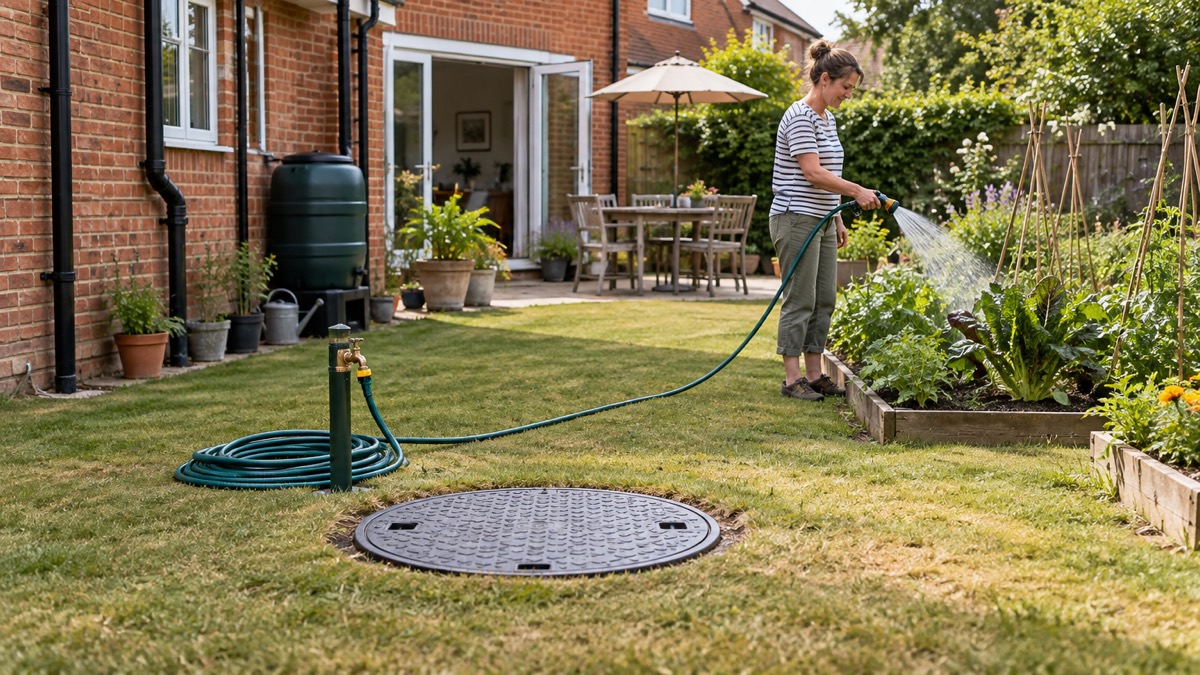
The Rain Activ Dual Garden System is an underground tank that does two jobs at once. The bottom portion stores rainwater for the garden, and the top portion is attenuation capacity that holds storm water back and releases it slowly, so the tank eases pressure on drains during heavy rain while giving you water to use in dry spells1. It is made by RainWater Harvesting Ltd and sold as a bespoke system, calibrated to each site rather than picked off a shelf1.
For a household thinking about emergencies, that combination matters in two directions. In a drought or a hosepipe ban, you have stored water for the garden without drawing on the mains. In a storm, the tank holds water back instead of sending it straight to the drains. The maker offers tanks from 1,500 litres to 15,000 litres, with discharge calibrated between 0.05 and 1.95 litres per second1.
This page sets out what the system does, how the versions differ, the specifications, which sites it suits, what the calibration needs from you, how to keep rainwater separate from drinking water, upkeep, and what to arrange before delivery. It is a garden and drainage system, not a drinking water supply, and the maker is clear about that1.
What the Rain Activ Dual Garden System does
The system is a storm attenuation tank with garden rainwater harvesting built in. Rainwater from the roof is heavily filtered as it enters the tank, removing any particles larger than 1mm, and the tank then divides its work: the bottom portion stores the rainwater you want for the garden, and the top portion is the attenuation capacity that holds storm water back1. The maker describes it as a Rain Activ storm attenuation system that controls the rate of storm water discharge1.
That dual role is the point. A tank that only stored garden water would fill and overflow in a storm. A tank that only attenuated storm flows would hold water you cannot use. Splitting the volume means the household gets a usable store at the bottom and a buffer at the top, and the controlled discharge means water leaves the site at a rate the drainage system can cope with rather than all at once.
Why does that matter for an ordinary household? Because the two pressures on a garden arrive at different times of year. In dry weather, official guidance is to use a watering can instead of a hosepipe and to install a water butt if you can to capture rain2, and to connect rainwater storage from downpipes to garden watering3. In wet weather, the problem reverses: paving over front gardens creates more impermeable surfaces which increase the risk of flooding4, and permeable surfaces and planted gardens slow, store and absorb rainfall at source, easing pressure on drainage systems6. A tank that does both jobs sits across the whole year rather than one season.
The idea is well established in public guidance. Maidstone Borough Council's rainwater harvesting campaign found that harvesting reduces peak flow pressure on drainage systems, lowers the risk of surface water damage, supports water conservation during summer, reduces demand on mains supply, and improves garden resilience during hosepipe bans7. The Rain Activ Dual Garden System is a manufactured version of that principle, buried rather than mounted on a downpipe.
Rain Activ, Rain Activ Dual and the Dual Garden System: how the versions differ
The names overlap, so it helps to be clear about what each one is. The Rain Activ range is the maker's storm attenuation system, and the maker states that the systems can be calibrated to provide a calculated discharge value as low as 0.05 litres per second up to 2 litres per second1. The Dual Garden System is the version that adds garden rainwater harvesting to the attenuation function, with the tank split between a garden store at the bottom and attenuation capacity at the top1. The Dual Garden System's own discharge range is given as 0.05 to 1.95 litres per second1.
| Version | What it does | Discharge range | Best thought of as |
|---|---|---|---|
| Rain Activ storm attenuation system | Controls the rate of storm water discharge from a site | 0.05 to 2 litres per second1 | A drainage and flood risk measure |
| Rain Activ Dual Garden System | Storm attenuation plus a garden rainwater store in the same tank | 0.05 to 1.95 litres per second1 | A drainage measure that also waters the garden |
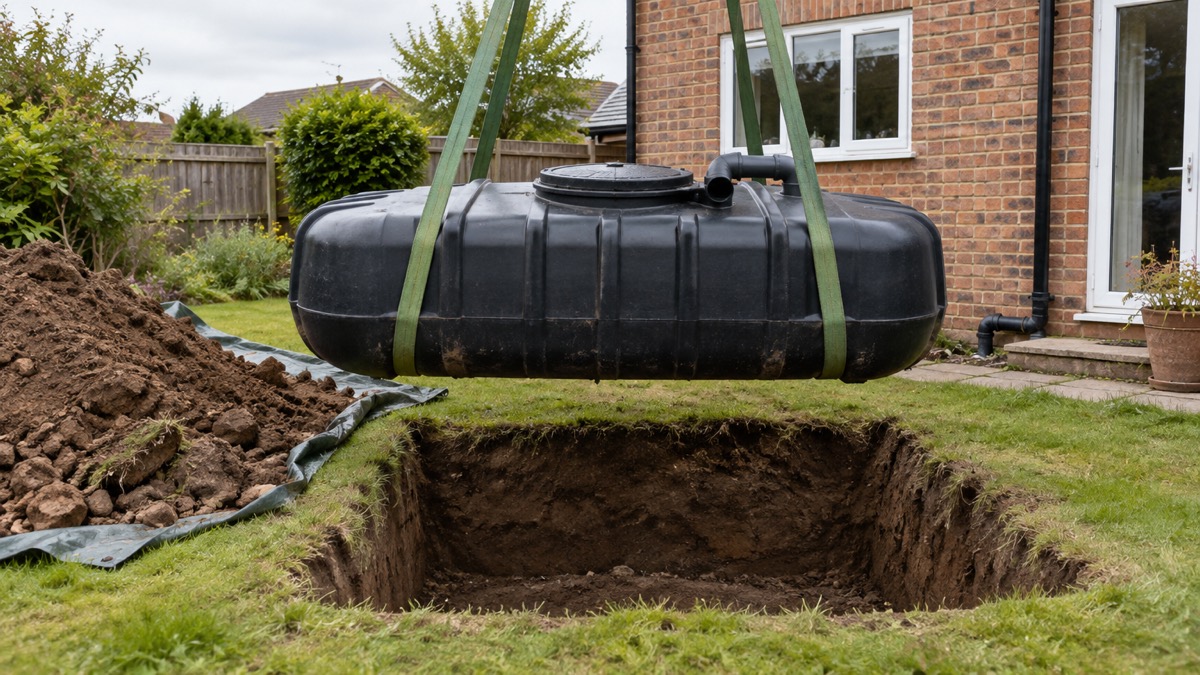
The practical difference for a household is what you get out of the tank between storms. If your only concern is the rate at which water leaves your site, the attenuation function is the whole story. If you also want water for beds, pots and a lawn in summer, the Dual Garden System adds that store. The maker's specification form asks for potential water usage if you are combining the system with rainwater harvesting1, which is the question that decides how much of the tank should be given over to garden storage.
If you are weighing up whether an underground tank is the right choice at all against a simple butt on a downpipe, our comparison of a water butt and an underground tank sets out the trade-offs, and the Rain Activ brand page covers the maker's range as a whole.
Specifications: 1,500 to 15,000 litre tanks, discharge from 0.05 litres per second
The headline numbers are the ones a household needs to hold in mind when planning. Tank capacity runs from 1,500 litres to 15,000 litres, and the discharge rate is calibrated between 0.05 and 1.95 litres per second1. The lower end of that discharge range is very slow: 0.05 litres per second is a trickle, and it is chosen where a site or a planning condition demands it.
| Specification | Figure | Source |
|---|---|---|
| Tank size range | 1,500 to 15,000 litres | 1 |
| Discharge rate, Dual Garden System | 0.05 to 1.95 litres per second | 1 |
| Discharge rate, Rain Activ attenuation range | 0.05 to 2 litres per second | 1 |
| Filtration at tank entry | particles larger than 1mm removed | 1 |
| Moving or consumable parts | none, fully self-cleaning | 1 |
| Assembly on arrival | fully assembled and ready to install | 1 |
| Pipework included | 25mm black and green HDPE pipe and labels | 1 |
| Delivery time | 7 to 10 days from receipt of order | 1 |
| Delivery terms | kerbside, offloading by the customer | 1 |
| Stock location | Peterborough warehouse | 1 |
Two of those lines deserve a second look. The first is the filtration: rainwater is heavily filtered as it enters the tank, removing any particles larger than 1mm1. That is a coarse filter by any standard, and it is appropriate for a garden store, not for water destined for a tap. The second is the absence of moving or consumable parts, with the maker describing the system as fully self-cleaning1. That matters for a household that wants a piece of resilience kit it does not have to service every month.
The tank arrives fully assembled and ready to install1, which shifts the work to the groundworks: the excavation, the base and the connections. If you are still deciding between tank designs, our pages on underground tanks and on how deep to dig for an underground rainwater tank cover the groundworks side.
Which sites it suits
The maker lists the sites the system is designed for: smaller developments of 1 to 10 homes where the rate of storm water is not great enough for effective use of vortex flow controls, greenfield sites, sites with very low discharge rates stipulated by planning, and contaminated sites1. That is a useful list because it tells you where the system fits and, by implication, where a different approach would be taken.
For a single household, the relevant entries are the low discharge rate and the greenfield site. If your planning authority has set a very low rate at which water may leave your site, a calibrated tank with a slow discharge orifice is one way to meet it. If your garden is a greenfield plot with nowhere for surface water to go quickly, the attenuation volume gives it somewhere to sit while it drains.
The maker also notes that rainwater harvesting systems are generally more suited to new-build properties, where the cost of plumbing them in is negligible, and that retrofitting into an existing property can be expensive8. That is a general point about harvesting systems rather than this tank specifically, but it bears on the decision: if you are building or renovating, the pipework and tank can go in as part of the work. If you are retrofitting, the excavation and connections are the bulk of the job.
There is a garden benefit too. In hard water areas, rainwater avoids the high pH or alkalinity of mains water, helping sensitive plants like rhododendrons, camellias and other container-grown plants flourish9. If your soil or your tap water is alkaline, a rainwater store is not only an emergency reserve but a better water for certain plants.
Sized to your site: what the calibration needs and what you receive
Every system sold is bespoke and calibrated to each site's requirements1. That is not a marketing phrase: it means the tank volume and the discharge orifice are worked out for your roof, your ground and your local rules, and the maker cannot quote a standard unit. The maker asks for four details to specify the correct system: the required run off rate, the roof size, the geographical location, and the potential water usage if you are combining the system with rainwater harvesting1.
Have those four ready before you call the sales team on 01733 405 1111. The required run off rate is the one most households will not know, because it comes from your planning condition or your drainage design. If you do not have it, say so: the maker's specification service exists to work it out with you, and full specification service and planning authority recognised Micro Drainage calculations are supplied with each system1.
What you receive is a tank sized to those inputs, arriving fully assembled and ready to install1, with 25mm black and green HDPE pipe and labels included and the option to buy further rolls of pipe1. The Micro Drainage calculations are the document your planning authority will want to see, and the maker states they are recognised by planning authorities1. That is the maker's statement; your own authority makes its own decision, so check before you order.
If you want to understand the arithmetic behind tank sizing more generally, our page on how to size a rainwater tank walks through roof area, rainfall and demand, and the garden rainwater harvesting kit checklist lists what a garden system needs alongside the tank.
Garden pipework: keep rainwater separate from drinking water
This is the section to read twice. The maker states that untreated rainwater is not for human consumption, and that water companies are recommending, and in some cases requiring, that black and green HDPE pipe be used and that the point of use be clearly labelled1. The kit supplies 25mm black and green HDPE pipe and labels for exactly that reason1.
The wider rules point the same way. Approved materials, WRAS approved or permitted under regulation 5, should be used to prevent contamination of rainwater during runoff and collection10. Where a system has a mains water back-up, it should go through an appropriate, properly installed backflow prevention device, and garden tap and rainwater pipe labelling should be kept in place11. On garden taps, fit a compliant double check valve12. Our page on pipe labelling rules sets out what to mark and where.
There is a second, quieter risk that catches households out. If you have lead pipes, run the tap to remove water that has been standing in the pipes, drawing off a washing-up bowlful from the kitchen tap; that water can be used on the garden but not for drinking or cooking11. It is a short term measure, and it is a reminder that water from a tap and water from a tank are different things with different rules.
If you are thinking about using harvested water indoors as well as in the garden, read what harvested rainwater can be used for and is harvested rainwater safe to drink before you plan any connection. The rainwater regulations page covers BS 8551, the water fittings rules and mains top-up.
Filtration and upkeep: no moving or consumable parts
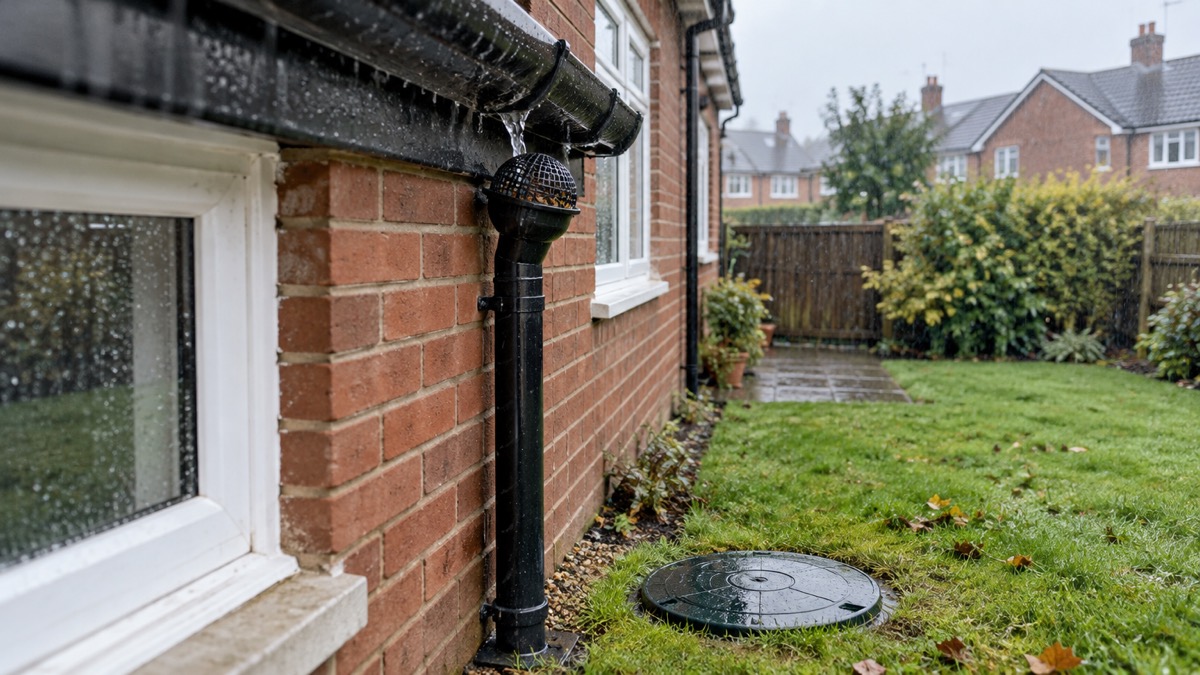
The maker states that the system has no moving or consumable parts and is fully self-cleaning1. For a household building resilience, that is one of the most useful facts on the page: a tank you do not have to open, clean or replace parts in is a tank that will still be working after a storm when you need it.
The filtration happens as water enters the tank, removing particles larger than 1mm1. That keeps leaves and grit out of the store, but it puts the burden on the roof and gutter above. Keep gutters clear and check the tank and its inlet after heavy weather. If you want the detail on filter types, our page on rainwater filters explains downpipe, inline and in-tank designs, and keeping a rainwater system clean covers the yearly routine.
A blocked or partly blocked discharge orifice is the failure mode to watch for on any attenuation system, because the whole point is a controlled release. The maker's self-cleaning design is intended to prevent it, but a tank that sits under a tree or below a gutter that sheds moss will collect debris regardless. Check the inlet and the outlet after the first few storms of autumn, and again after winter.
Delivery and getting the tank off the vehicle
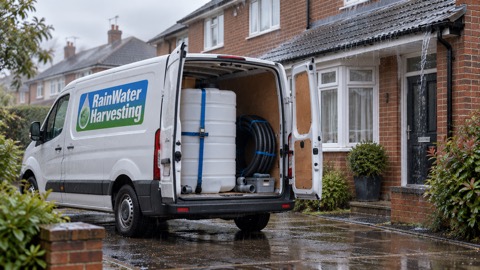
Delivery is kerbside and offloading is the responsibility of the customer1. That single sentence decides how your delivery day goes. A tank of 1,500 litres or more is heavy, and it will be left at the kerb unless you have arranged otherwise. The maker notes that shallow dig tanks can be lifted off the vehicles by hand with enough people1, so for the smaller sizes a group of neighbours and a clear path may be all you need.
Plan the route before the day. Measure the gap between the kerb and the excavation, check for steps, gates, planters and low walls, and decide where the tank will sit while the base is prepared. If the tank cannot be lifted by hand, arrange lifting equipment and people who know how to use it. The maker's delivery time is normally 7 to 10 days from receipt of order1, and systems are held in stock at the Peterborough warehouse1, so you have a short window to get the ground ready.
Delivery to Mainland UK is included in the standard kit1. If you are outside Mainland UK, ask the sales team before ordering, because that statement does not cover you.
Where the system fits a household plan
A garden tank is not a substitute for the basics of household preparedness, but it earns its place alongside them. In a drought, official guidance is to use a watering can rather than a hosepipe and to capture rain where you can2, and to connect rainwater storage from downpipes to garden watering3. In a flood or storm, the attenuation volume holds water back and releases it slowly, which is the same principle local authorities use when they design green features that act as a sponge to absorb rainwater13.
The wider picture is one of pressure on water in both directions. The Environment Agency has activated its incident response arrangements, with Gold Command structures in place and drought plans being implemented14, and is working on 10 Drought Permit applications15. On the flood side, the Agency has 250 high volume pumps available and is ready to operate flood defences and erect temporary barriers16. Households sit at the receiving end of both, and a tank that stores in dry weather and attenuates in wet weather is a small piece of local resilience.
If you are building out a household plan, the self-reliance section covers rainwater, off-grid power and living without mains, and the rainwater harvesting guide explains how a system works from roof to outlet. For the wider emergency picture, see water in an emergency and flooding: a household guide.
Sources (16)
- Rain Activ Dual Garden System, RainWater Harvesting Ltd, 2026-07-01
- Droughts, UK Government, 2026-10-19
- Advice and support: drought, Westminster City Council, 2026-08-06
- Be flood aware, London Assembly, 2026-10-26
- Paving over front gardens, London Assembly, 2026-10-26
- Green fingered Brits sleepwalking into flooding crisis, Flood Re, 2026-05-19
- Borough rainwater harvesting campaign, Maidstone, Local Government Association, 2026-03-19
- Saving water FAQs, Cambridge Water, 2026-10-28
- 2026: a year we prepare, not react, Waterwise, 2026-03-05
- Protecting your private water supply, Drinking Water Inspectorate, 2026-10-28
- Water in the home, SES Water, 2015
- Hosepipes and hidden health risks, Met Office, 2026-10-29
- Surface water flooding, London Assembly, 2026-10-25
- Dry weather and drought in England, 9 to 15 October 2026, Environment Agency, 2026
- England's reservoirs continue to feel drought strain, Environment Agency, 2026-10-02
- Flood Action Week, Environment Agency, 2023-11-20
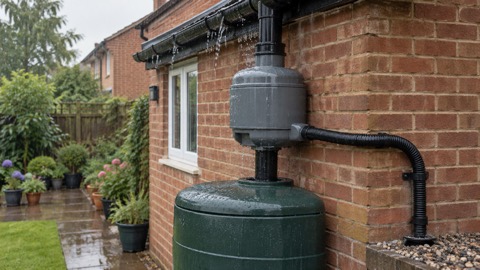 Enduramaxx Rainwater Filter Kit
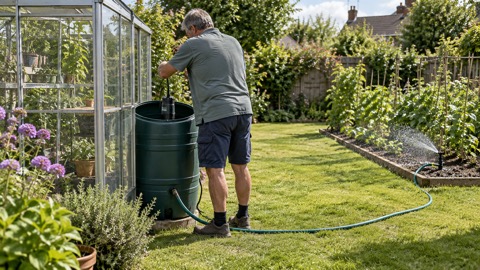 GARDENA Tank Pump 4000/1
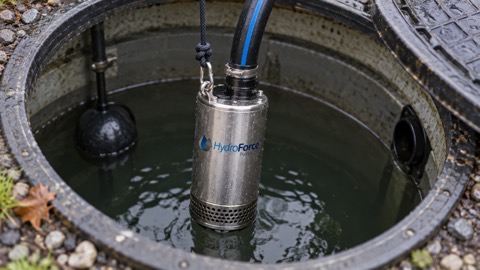 HydroForce Series 3 Clean Water Pump
 HydroForce Series 4 Pump
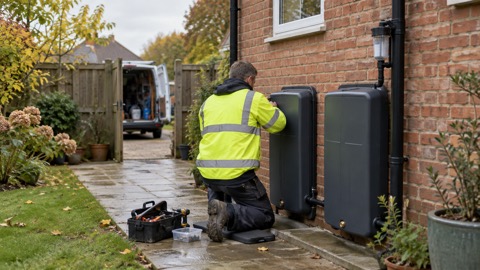 Multitank Rainwater Wall Tank
 Rainwater Harvesting Rain Backup
 Rain Director
 Rainwater Harvesting Header Tank