
Rain Activ is a buried storm water attenuation device made by Rainwater Harvesting Limited. It is designed for sites that cannot use a soakaway and need to discharge rainwater to the local drainage network instead. The tank holds storm water back during heavy rain and releases it at a controlled rate, which the maker can calibrate as low as 0.05 litres per second and up to 2 litres per second1.
For a household, the practical point is this: if your extension, new build or drainage scheme has been told by the planning authority that run-off must be limited, Rain Activ is one way to meet that limit. It is not a flood barrier and it will not keep water out of your home. What it does is slow the rate at which rainwater leaves your site, so the sewer or watercourse downstream is not hit all at once.
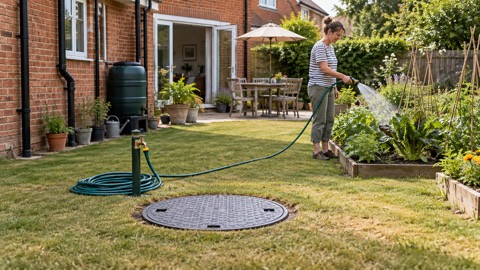
The same tank can also be specified as the Rain Activ Dual Garden System, which stores rainwater in its lower portion for garden use while the top portion does the attenuation work2. That makes it relevant to a household plan for drought and hosepipe bans as well as for storms. This page covers what the system does, when it applies, how it is specified, and how to get support.
What Rain Activ does: slowing rainwater before it reaches the drains
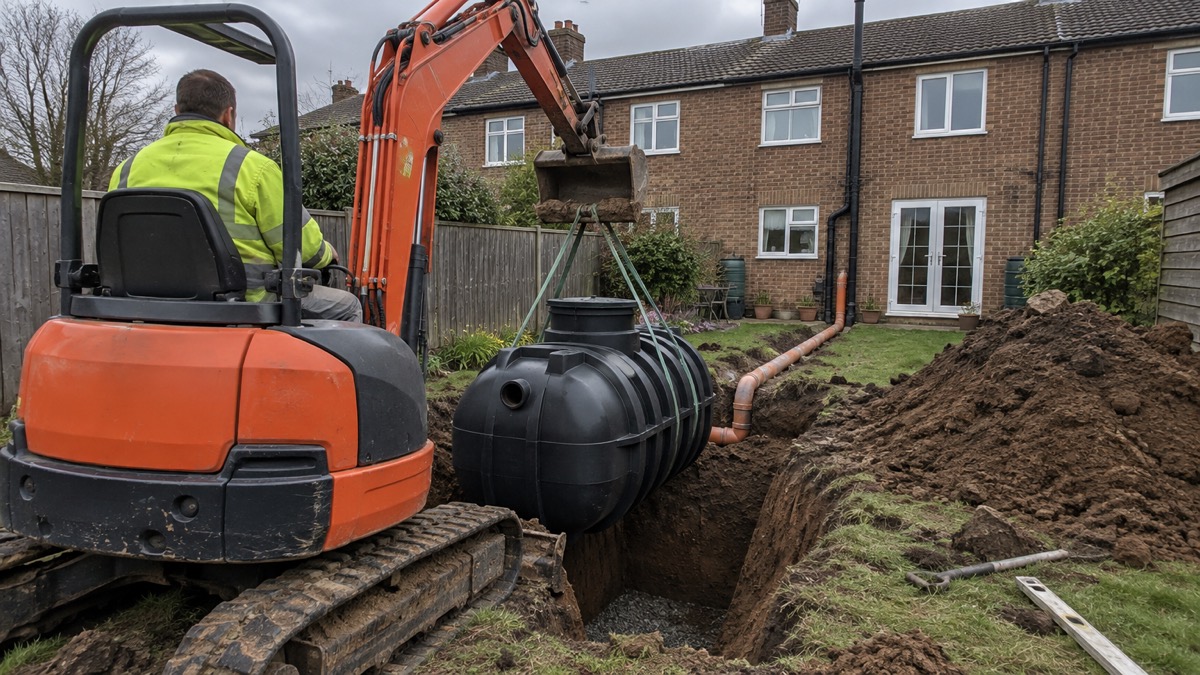
Rain Activ is described by its maker as an ultra low discharge storm attenuation device1. In plain terms, it is a tank buried in the ground that receives rainwater from a roof or surface, holds it temporarily, and lets it out through a controlled outlet at a rate far slower than it arrived. The maker says the system controls the rate of storm water discharge2.
This matters because surface water flooding is a recognised risk in UK towns and cities. The Mayor of London's office notes that sustainable drainage systems slow the flow and reduce the amount of rainfall that drains into sewers, streams and rivers, and can also treat and reduce pollutants in runoff3. A device that holds water back on your own site does the same job at the scale of one property.
The government's flood guidance for households points people towards being informed about the hazards they face4, and the Environment Agency's flood warning service covers river and sea flooding but not surface water flooding, sometimes called flash flooding5. That gap is exactly where attenuation on individual sites helps: it reduces the volume arriving at the drains during a downpour, rather than warning you about it.
When it applies: sites that cannot use a soakaway
The maker is direct about the use case. Rain Activ is, in its words, "Perfect for those sites that cannot use a soakaway and need to discharge to the local drainage network"1. A soakaway relies on the ground being able to take water away; where soil is clay, where the water table is high, or where the site is too small, that route is not available and the water has to go to a sewer or watercourse instead.
The Dual Garden System is aimed at particular kinds of site. The maker lists smaller developments of 1 to 10 homes where the rate of storm water is not great enough for effective use of vortex flow controls, greenfield sites, sites with very low discharge rates stipulated by planning, and contaminated sites2.
If you are building or extending, your drainage strategy is likely to be part of the planning process. The maker supplies full specification calculations recognised by planning authorities with each system2, which is the document your designer or installer will need.
| Site situation | Why Rain Activ suits it |
|---|---|
| No soakaway possible | Designed for sites that must discharge to the local drainage network1 |
| Small development, 1 to 10 homes | Listed by the maker as a suitable site type2 |
| Planning sets a very low discharge rate | Rates can be calibrated as low as 0.05 litres per second2 |
| Greenfield site | Listed by the maker as a suitable site type2 |
| Contaminated site | Listed by the maker as a suitable site type2 |
Discharge rate: as low as 0.05 litres per second
The headline figure is the discharge rate. The maker states that Rain Activ can provide rates of discharge as low as 0.05 litres per second2, and that systems can be calibrated to provide a calculated discharge value from 0.05 litres per second up to 2 litres per second2. The Dual Garden System is calibrated between 0.05 and 1.95 litres per second2.
To put that in perspective, a tap running at full flow delivers far more than that in a minute. The point of such a low rate is that the receiving drainage network sees a slow trickle rather than a surge, even during a storm. The tank does the waiting.
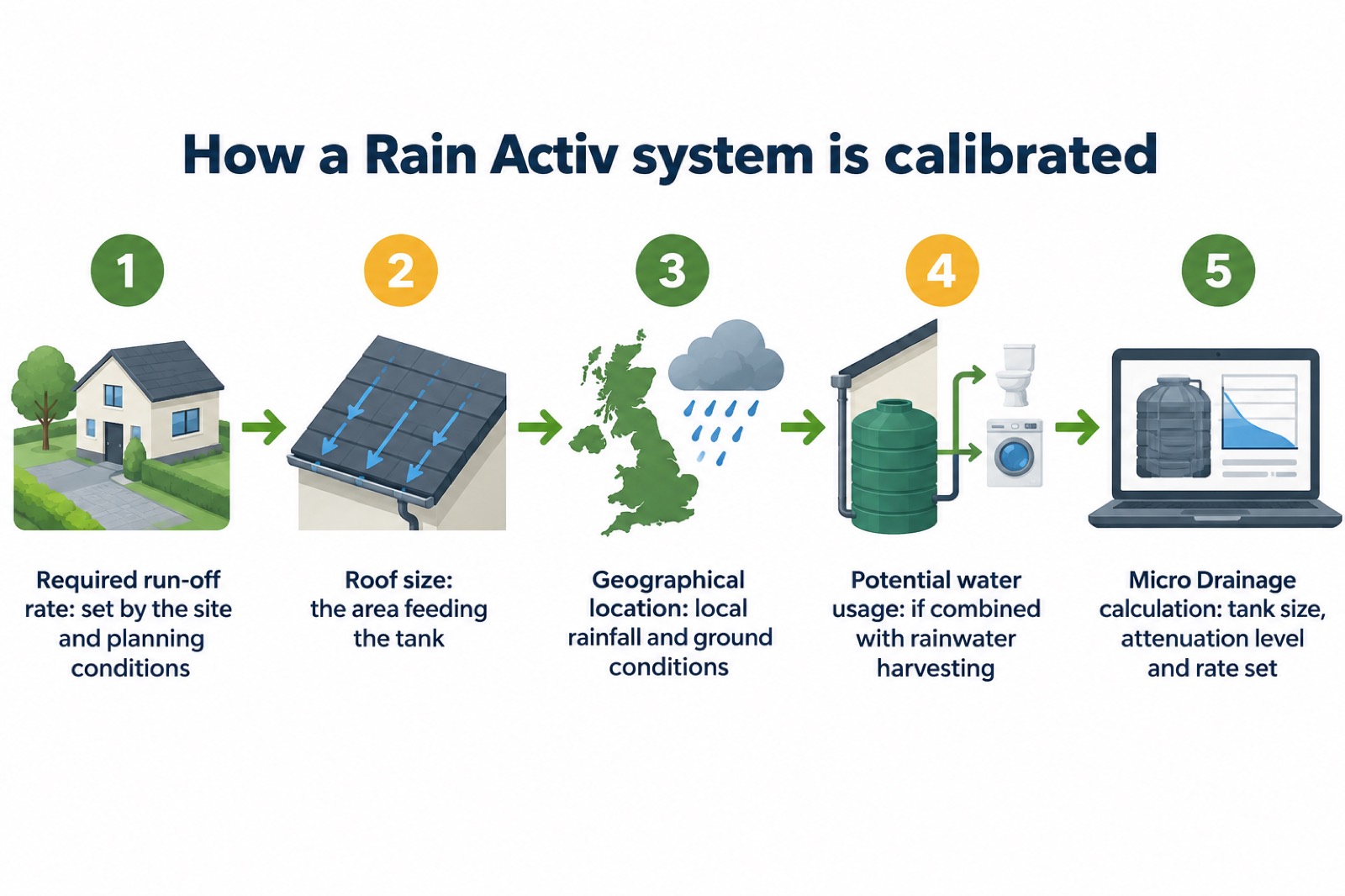
The rate is not chosen by the householder. It is calculated for the site, and the maker describes every system sold as bespoke and calibrated to each site's requirements2. Four inputs drive the calculation: the required run-off rate, the roof size, the geographical location, and potential water usage if the system is combined with rainwater harvesting2.
How the tank holds and releases rainwater
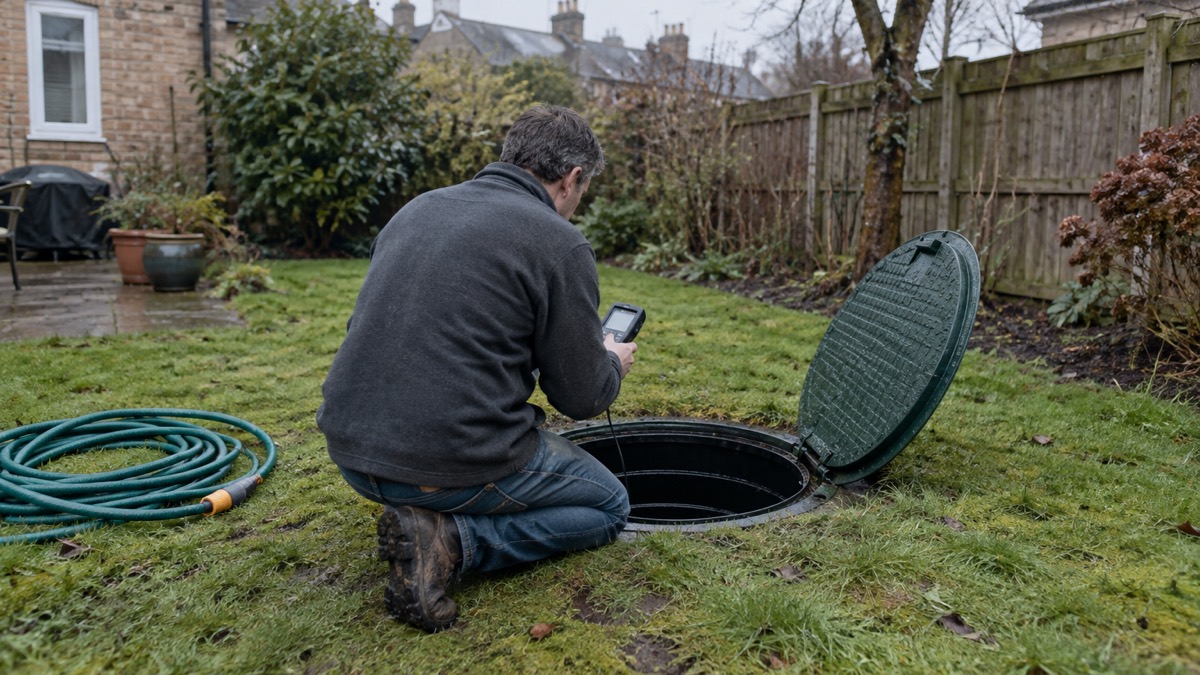
The tank is the working part of the system. On the Dual Garden System, the maker splits its job in two: the bottom portion stores the required rainwater for use within the garden, and the top portion is attenuation capacity2. Rain fills the tank; the attenuation volume at the top holds the storm peak; the calibrated outlet releases it slowly; and the stored volume at the bottom stays available for watering.
Tank sizes on the Dual Garden System run from 1,500 litres to 15,000 litres2. The maker says the system arrives on site fully assembled and ready to install2, and that it has no moving or consumable parts and is fully self-cleaning2. For a household, that last point matters for keeping it ready: there is no filter cartridge to replace on a schedule and no pump to fail, according to the maker.
If you want to know the water level in the tank, the maker offers the Rain Acculevel, a smart meter for rainwater tanks that measures the water level and gives readings you can view on a PC or smart device1. The maker says it uses wireless technology and works on tanks below or above ground and over long distances1.
Filtration: particles larger than 1mm removed
Water entering the tank is filtered. The maker states that rainwater from the roof is heavily filtered as it enters the tank, removing any particles larger than 1mm2. That keeps grit, leaves and moss out of the stored volume and out of the outlet, which is what protects the low discharge rate from blockage over time.
Filtration is not a substitute for material standards. The Drinking Water Inspectorate advises that approved materials, WRAS approved or permitted under regulation 5, should be used to prevent contamination of rainwater during runoff and collection6. If you are combining attenuation with harvesting, ask your installer to confirm the materials used in the parts that touch stored water.
A very small orifice without the blockage risk
A very low discharge rate implies a very small opening. The maker's answer to the blockage question is the combination of heavy filtration at the inlet and a design with no moving or consumable parts, described as fully self-cleaning2. Water arrives already screened to 1mm, so the outlet is not asked to pass debris.
That is the theory, and it is worth checking in practice. Ask your installer how the outlet can be inspected and cleared if it ever does silt up, and keep the inlet filter clear of leaves, especially after autumn. A tank that cannot discharge is a tank that stays full, and a full tank has no attenuation capacity left for the next storm.
The same principle of holding water back and letting it go slowly appears in other household-scale measures. United Utilities describes a Slow the Flow garden designed to demonstrate ways to capture rainwater and slowly release it into the sewer system to reduce potential flooding problems, including a low maintenance grass roof that acts as a sponge during heavy rain7. The London Fire Brigade's flood prevention guidance likewise lists green roofs as a way to help hold rainwater8. These are surface measures; Rain Activ is the buried version of the same idea.
Each system is bespoke to its site
There is no off-the-shelf Rain Activ. The maker states that every system sold is bespoke and calibrated to each site's requirements2, and that tank size, attenuation level and attenuation rate are all calibrated using Micro Drainage software1. Full Micro Drainage calculations are supplied with each system and are recognised by planning authorities2.
For a householder, this changes the buying process. You do not order a size from a list; you supply site information and the maker specifies the system. The maker asks for the required run-off rate, roof size, geographical location and potential water usage2, and asks you to call the sales team with that information so the correct system can be specified2.
The systems are held in stock at the maker's Peterborough warehouse, and delivery to mainland UK is included in the standard kit2. The Dual Garden System kit includes 25mm black and green HDPE pipe and labels, with the option to buy further rolls of pipe2.
| What the maker needs from you | Why |
|---|---|
| Required run-off rate | Sets the discharge calibration2 |
| Roof size | Determines the volume of water arriving2 |
| Geographical location | Local rainfall and conditions2 |
| Potential water usage | If combining with rainwater harvesting2 |
Turning it into a full rainwater harvesting system
Attenuation and harvesting are two jobs, and the Dual Garden System does both. The maker describes rainwater harvesting in general terms: water is collected from the roof, filtered, stored in a tank and then re-used within the home and garden, which can provide savings on water bills1. On the Dual Garden System, the lower part of the tank holds that stored water for garden use while the upper part handles the storm peak2.
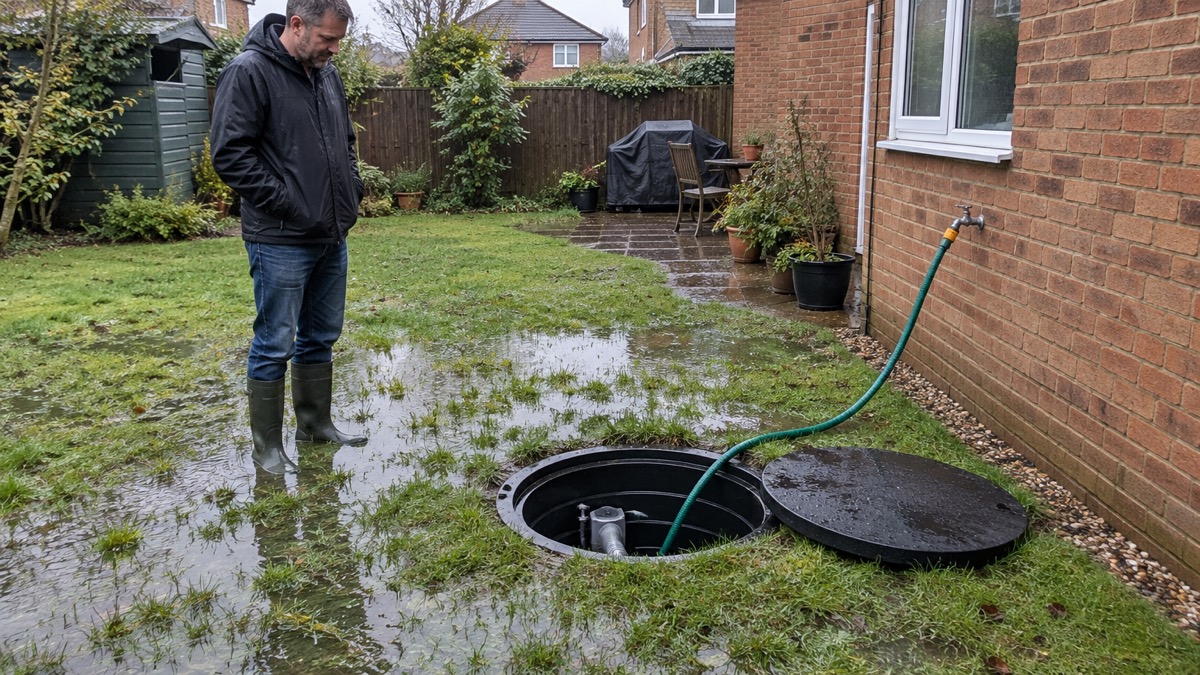
For a household preparing for drought, this is the part that earns its keep. During a hosepipe ban, the Environment Agency's advice includes installing a rain butt to collect rainwater and using water from the kitchen, such as washing up water, to water your plants9. A buried tank with a garden draw-off does the same job at a larger scale. Maidstone Borough Council's rainwater harvesting campaign found that harvesting reduces peak-flow pressure on drainage systems, lowers the risk of surface water damage, supports water conservation during summer, reduces demand on mains supply, and improves garden resilience during hosepipe bans10.
The council's case study also offers a lesson for anyone specifying a system: it recommends a data-driven approach, retailer partnerships, clear installation guidance, and piloting within smaller catchments before scaling10. In household terms, get the specification right for your site before you dig.
Support, specification help and who to contact
The maker's route for quotes, help specifying a system and sales is the main line, 01733 405111, with Option 1 to talk to a human1. The Dual Garden System product page gives the sales team number as 01733 405 111 and asks you to call with your site information so the correct system can be specified2.
If your question is about flooding rather than drainage, other organisations can help. The National Flood Forum can be reached on 01299 40305511. The Environment Agency's Floodline is 0345 988 1188, available 24 hours11, and its incident hotline for river and tidal flooding is 0800 80 70 6012. For severe river or coastal flooding in England, the Environment Agency's 24-hour reporting line is 0800 80 70 60, with Typetalk on 0345 602 63404.
If you are dealing with water in your property, Nottinghamshire County Council advises contacting your home insurer to request assistance, or the Environment Agency on 0345 988 1188 for advice13. The Met Office's WeatherReady campaign runs annually to help individuals, families and communities prepare for and cope with severe weather, and can be contacted at WeatherReady@metoffice.gov.uk14.
Keeping the system working through a flood or storm
A Rain Activ tank is underground and largely passive, but the household still has a part to play when severe weather is forecast. Clear leaves and debris from gutters and from the tank inlet so water can reach the tank at the rate it was designed for. Check that the outlet area is clear1.
After a flood, safety comes first. Runnymede Borough Council advises not to use any mains powered electrical appliances in areas affected by flooding until a registered electrician has advised it is safe, and not to assume the electricity in a flooded property is off15. If standing water remains on a road near you, Devon County Council says it will not investigate standing or running water during prolonged heavy rain, and will act 24 hours after the rain has stopped if the road is impassable, if water is forcing road users more than one metre from the nearside, or if vehicles have to cross the centre line16.
For the wider picture of preparing a household for storms and floods, see the guides to storms and snow and self-reliance at home, which covers rainwater, off-grid power and living without mains.
Sources (16)
- Rainwater Harvesting Ltd, Rainwater Harvesting Limited, 2026-07-17
- Rain Activ Dual Garden System, Rainwater Harvesting Limited, 2026-07-01
- Surface water flooding, Greater London Authority, 2026-10-25
- Flooding, Prepare campaign, 2026-10-12
- Sign up for flood warnings, GOV.UK, 2026-10-29
- Protecting your private water supply, Drinking Water Inspectorate, 2026-10-28
- Reduce flooding risk, United Utilities, 2026-10-28
- Planting and flooding, London Fire Brigade, 2026-10-25
- Why do we have hosepipe bans during a drought?, Environment Agency, 2025-06-12
- Borough rainwater harvesting campaign, Local Government Association, 2026-03-19
- Flooding useful links and numbers, Cornwall Council, 2026-10-29
- Preparing yourself for flooding incidents, London Resilience Partnership, 2026-10-25
- During a flood, Nottinghamshire County Council, 2026-10-29
- WeatherReady winter partner toolkit, Met Office, 2026-10-28
- Flooding, Runnymede Borough Council, 2026-10-26
- Report standing water, flooding or blocked drains, Devon County Council, 2025-11-19
 Rain Activ Dual Garden System