

GARDENA is a garden and water brand whose pump range covers three jobs a UK household preparing for emergencies will recognise: draining floodwater out of a home, moving collected rainwater to where the garden needs it, and supplying water around the home from a tank or barrel. Its drainage pumps, including the Flood Protection Set 20000 BASIC and the 2in1 Clear/Dirty Water Submersible Pump 20000 BASIC, can each move up to 20,000 litres of water per hour and handle particles up to 35 mm in size1. Its rainwater tank pumps, such as the Rain Water Tank Pump 4000/1, move up to 4,000 litres per hour for garden irrigation3, and the Battery Rainwater Tank Pump 2000/2 P4A runs on its own battery rather than mains power4.
This page sets out what each piece of GARDENA kit does, its specifications as the maker states them, how it fits into household flood and water preparedness, and how to use and store it safely. It sits alongside our wider guides on flooding, water in an emergency and self-reliance at home, which cover the broader picture.
What GARDENA makes for UK households
GARDENA's pump range falls into three families, each aimed at a different water problem around the home. The drainage pumps are submersible, meaning they sit in the water they are pumping, and are built for clearing floods from cellars, basements and rooms1. The watering pumps sit in a rainwater tank or water butt and push collected rainwater out to a hose for garden use3. The accessories, such as the Push In Tank Connector, join pumps and hoses to tanks and barrels6.
For a household building its preparedness, the range maps onto two of the main risks in our flooding and water guides: getting water out of the home when it should not be there, and having an alternative supply of water for the garden and for non-drinking uses when the mains supply is interrupted or restricted. The table below shows the products covered on this page side by side.
| Product | Type | What it is for | Power |
|---|---|---|---|
| Flood Protection Set 20000 BASIC | Submersible clean and dirty water drainage pump set | Clearing floodwater from homes, cellars and outdoor spaces | Mains |
| 2in1 Clear/Dirty Water Submersible Pump 20000 BASIC | Submersible drainage pump with float switch | Home, cellar and basement flooding, ponds, pools, drainage, plumbing leaks | Mains |
| Rain Water Tank Pump 4000/1 | Watering pump | Garden irrigation from collected rainwater; also suitable for draining | Mains |
| Battery Rainwater Tank Pump 2000/2 P4A | Battery watering pump | Pumping rainwater from tanks and butts without mains power | Battery |
| Push In Tank Connector | Tank accessory | Connecting a pump or hose to a water tank or barrel | Not applicable |
The two drainage pumps share a maximum delivery capacity of 20,000 l/h and a maximum delivery head of 9 m, which is the height they can lift water1. The Rain Water Tank Pump 4000/1 is a smaller, finer machine: 4,000 l/h, a 13 m delivery head and a 1.3 bar maximum pressure, suited to steady garden watering rather than rapid flood clearance3. The battery pump is smaller again, with a 20 m delivery head and three selectable power levels4.
Drainage: moving water out of the home
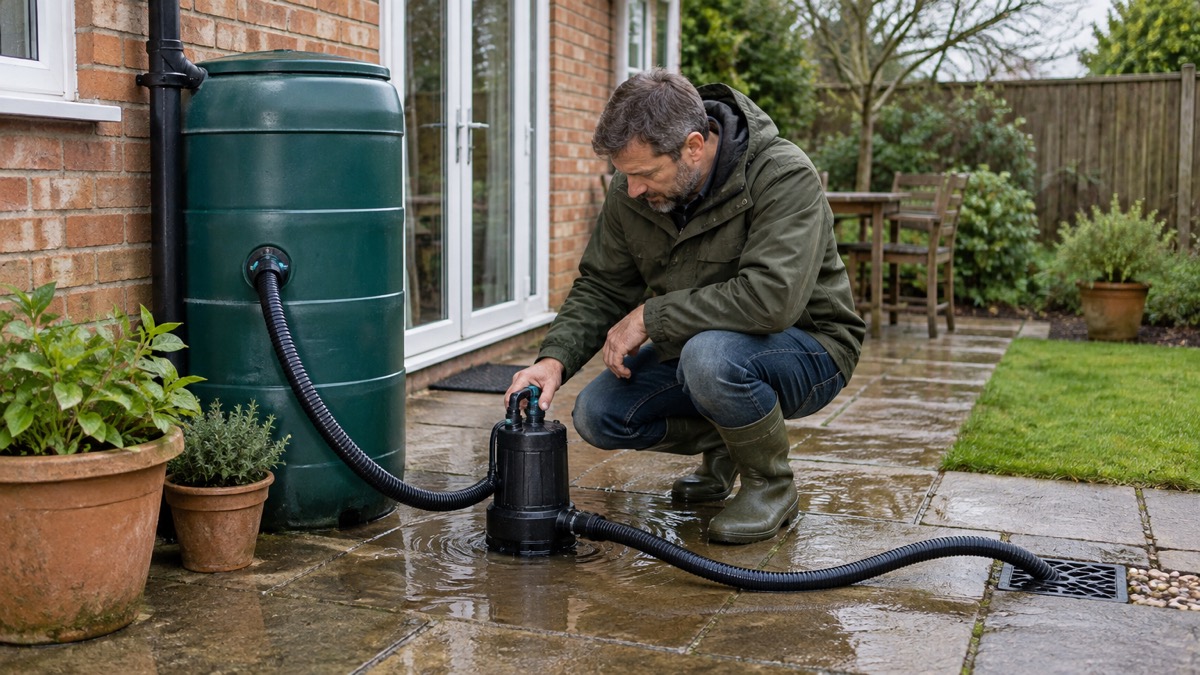
The Flood Protection Set 20000 BASIC is GARDENA's package for household flood response. It is a two-in-one pump designed to drain both clean and dirty water, able to accept particles up to 35 mm in size, and the maker states it can be used to clear most types of indoor and outdoor spaces1. The set includes a 10 m lay flat hose and a transport box that doubles up as a filter when the pump is in use and as a storage box between uses1. Its maximum delivery head is 9 m, its power cable type is H05RN-F, and its IP code is IPX81.
The 2in1 Clear/Dirty Water Submersible Pump 20000 BASIC is the same pump family sold on its own rather than as a set. It is suitable for home, cellar and basement flooding, and also for ponds, swimming pools and garden use, indoor and outdoor drainage, plumbing leaks and dredging garden ponds2. It can pump dirty water with up to 35 mm grain size, delivers up to 20,000 l/h, has a maximum pressure of 0.9 bar and a maximum delivery head of 9 m, and leaves just 1 mm of water residue after use2. It has a stainless-steel pump shaft and housing, a 10 m cable, a float switch that switches the pump on and off with the water level, and a maximum liquid temperature of 35 °C2. It comes with connections for 25 mm (1") and 38 mm (1 1/2") hoses2.
When and how you use these pumps matters as much as which one you own. Official flood guidance is clear about the sequence. Before floodwater enters, turn off your gas, electricity and water supplies if it is safe to do so5. Never run a mains-powered pump in standing water you are standing in, and never reconnect the power until the area is dry and the equipment has been checked.
Once the flood has passed, the pump becomes part of the clean-up. Surrey County Council advises that before you can properly move back into your home you need to make sure all standing water has been removed, particularly from the under floor area, using a pump or buckets followed by a wet/dry vacuum, then shovelling out mud and hosing down or using a garden sprayer7. nidirect adds a timing rule: once water levels are lower outside than inside your property, you can begin to get rid of the water by using a pump or bucket, and you can hire or buy a pump and generator from a DIY shop8. Derbyshire County Council likewise advises removing all dirty water and silt from the property, including from the space under downstairs floorboards, which may require pumping out9. After pumping, heating, dehumidifiers and good ventilation help to dry out your home10.
Two further points from official guidance are worth acting on. If you plan to pump flood water into public sewers, check with your water company first5. And once the water levels are lower outside than inside your property, begin to get rid of the water using a pump or bucket; you can hire or buy a pump and generator from a DIY shop8. Our flooding guide covers the full before, during and after sequence.
Irrigation: getting water where it is needed
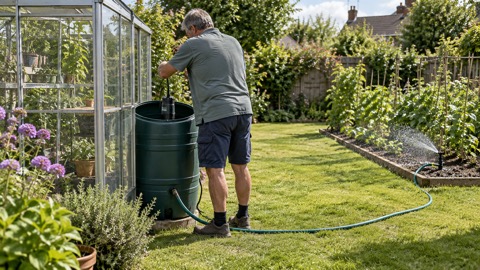
The Rain Water Tank Pump 4000/1 is GARDENA's mains-powered watering pump. It sits in a rainwater tank or water butt and pumps collected rainwater out to a hose for garden irrigation, and the maker states it is also suitable for draining, making it a versatile, low-maintenance choice3. Its continuous-on function allows a tank to be emptied down to a water depth of just 5 mm3. It comes with a regulating valve for adjusting or stopping the water flow, an integrated fine filter and an aluminium telescopic pipe3. Its specifications are a 4,000 l/h maximum delivery capacity, 1.3 bar maximum pressure, 13 m maximum delivery head, a 10 m cable and an IPX8 rating3.
The Push In Tank Connector is the accessory that makes tank connections straightforward. It connects a water pump or hoses to a water tank or barrel for pumping and drainage, with a quick 4-step installation from the outside of the water barrel, butt or tank6. The maker's installation instructions are specific: drill a 43-44 mm hole from the outside, insert the barrel from the outside into the hole, hold it in place, and tighten the nut, which automatically tightens on the inside6. It can be pushed in by hand or fitted with 41 mm mounting bushes, and its EPDM gasket is leakproof and maintenance-free6.
Collecting and using rainwater is also official advice in dry conditions. Cornwall Council, whose area includes many private water supplies, advises households to water gardens in the early morning or late evening to reduce evaporation, and to collect rainwater for gardens, pots and outdoor plants whenever possible11. The Scottish Government's ready.scot campaign adds simple water-saving habits such as fixing dripping taps12. During hot, dry weather, the Northern Ireland Fire and Rescue Service advises keeping a bucket of water or garden hose nearby when using barbecues or fire pits13, a job a filled water butt and a tank pump can support. Our heatwaves and drought guide and self-reliance guide cover rainwater collection in more depth.
Home water supply: how the kit is used
The Battery Rainwater Tank Pump 2000/2 P4A Ready-To-Use Set is the range's battery-powered option, and it is the one that keeps working when the mains does not. It pumps rainwater from tanks and butts on its own battery, with three selectable power levels so the pump adapts to different tasks, and built-in dry-running protection that prevents damage if the pump runs dry4. Its maximum delivery head is 20 m, its cable length is 2 m, and it stands 60 cm high and 14 cm long4. An optional extension provides extra reach for deeper tanks4.
For household preparedness, this is the pump to think about for water supply during a power cut. The three mains-powered pumps all stop when the mains stops; the battery pump does not. That matters if you rely on a rainwater tank for flushing, washing and garden water and want that supply to keep flowing through an outage. It is not a drinking water solution: none of GARDENA's pumps treat water, so keep a separate store of bottled water for drinking, as covered in our water guide and emergency kit guide.
If your mains water supply is interrupted or runs at low pressure, a rainwater tank and pump give you a buffer for non-drinking uses while the supply is restored. A pump with a regulating valve lets you adjust or stop the flow as needed, and a fine filter protects it from debris in the tank.
Choosing the right type of GARDENA kit for your household
Which pump suits your household depends on what you are preparing for, not on power figures alone. The two 20,000 l/h drainage pumps are for flood response: fast clearance of large volumes from cellars, basements and rooms. The Flood Protection Set adds the 10 m lay flat hose and the filter-and-storage box, so it is the more complete package to keep ready1. The 2in1 pump sold alone suits households that already have hose and fittings, or that want a pump for ponds, pools and garden drainage as well as floods2. The Rain Water Tank Pump 4000/1 is for irrigation and tank emptying3, and the battery pump is for households that want water pumping to continue through a power cut4.
| If you need to... | The kit that does it | Key figure |
|---|---|---|
| Clear floodwater from a cellar fast | Flood Protection Set 20000 BASIC | 20,000 l/h, particles to 35 mm1 |
| Drain a pond, pool or plumbing leak | 2in1 Clear/Dirty Water Pump 20000 BASIC | 20,000 l/h, 1 mm residue after use2 |
| Water the garden from a rainwater tank | Rain Water Tank Pump 4000/1 | 4,000 l/h, empties to 5 mm depth3 |
| Keep pumping through a power cut | Battery Rainwater Tank Pump 2000/2 | Battery powered, 20 m delivery head4 |
| Connect hose to tank or butt | Push In Tank Connector | 43-44 mm hole, 4-step fit6 |
Preparedness around the home supports whatever pump you choose. Surrey County Council's property flood resilience advice includes checking access points for pipes, such as washing machine connections, for gaps and filling them14. In winter, Lancashire County Council advises stocking up on salt or grit for paths, and keeping a snow shovel, torch, batteries and a first aid kit handy15; Flintshire County Council similarly recommends winter items such as rock salt, sand, snow shovels, plus a stock of food and extra drinking water16. Households wishing to buy sandbags for private use should do so from a local builder's merchants or garden centre17. North Yorkshire Fire and Rescue Service also advises positioning garden structures, such as sheds and compost heaps, away from the house to reduce wildfire risk18. These measures sit alongside the pump, not instead of it: the pump moves water that has got in, while resilience measures keep more of it out.
Using water and electricity safely
Three of the four pumps are mains-powered, and water and electricity together demand care. The Health and Safety Executive's guidance on electricity is blunt: ensure everyone knows how to use the electrical equipment safely, and stop using equipment immediately if it appears to be faulty, having it checked by a competent person19. Apply that to any pump that has been stored a long time, dropped, or used in silty floodwater: check it before reuse, and have it inspected if anything looks wrong.
The battery pump carries its own precautions. Lithium-ion batteries, which the South Wales Fire and Rescue Service notes are found in devices from mobile phones and vaping devices to e-bikes, scooters, vacuum cleaners, tablets and ear pods, demand careful charging and storage20. Follow the maker's charging instructions for the battery pump's battery, charge it with the supplied charger, and do not leave it charging unattended or in a way that blocks ventilation. Our backup power guide covers battery safety in more depth.
If you are working around water and pumps during a power cut, prefer torches and lanterns to any open flame: our lighting guide explains why an open flame near pumping operations is a poor mix. If you use a generator to run a mains pump during an outage, keep it outdoors, away from doors and windows, because of carbon monoxide; our heating and cooking guide covers this hazard.
Storing kit so it is ready for an emergency
A pump you cannot find, or that has seized over winter, is no use when water is rising. Store the Flood Protection Set in its transport box, which the maker designed to double as a storage box between uses1. Keep hoses coiled with the pump so the whole set can be carried out in one trip. Store the battery pump's battery and charger indoors, and keep everything somewhere you can reach it in the dark and in a hurry.
Being ready is wider than the pump. Nottinghamshire City Council advises keeping a bag of items you might need in an emergency, whether in your car, your home, or simply a list of where to find the items21. Lincolnshire's emergency advice includes water for drinking and sanitation, and a can opener for canned food if you keep pets' canned food22. The Scottish Government's ready.scot campaign lists a blanket and a whistle among car and home emergency kit items23, and Neath Port Talbot Council advises keeping spare keys to your home and car at home, plus a blanket and warm clothes in the car24. Our emergency kit guide sets out the full list, and our storms and snow guide covers winter readiness.
Before each flood season, check the pump works: run it briefly in clean water, check the cable for damage, confirm the hose connections fit, and check the float switch moves freely. The Health and Safety Executive's rule applies here: stop using equipment immediately if it appears faulty, and have it checked by a competent person19.
Support, warranty and safety notices
GARDENA's warranty terms differ by product, and both require registration. The Rain Water Tank Pump 4000/1 carries a 5-year GARDENA warranty after registration at gardena.com/registration within 3 months of purchase3. The Flood Protection Set 20000 BASIC carries a 2-year warranty on the same registration terms, with batteries excluded1. Register promptly: the 3-month deadline is short, and registration is also how the maker can contact you about a safety notice.
| Product | Article number | Warranty | Registration deadline |
|---|---|---|---|
| Flood Protection Set 20000 BASIC | See the maker's product page | See the maker's terms | See the maker's terms |
| 2in1 Clear/Dirty Water Pump 20000 BASIC | See the maker's product page | See the maker's terms | See the maker's terms |
| Rain Water Tank Pump 4000/1 | 1762-203 | 5 years3 | Within 3 months of purchase3 |
| Battery Rainwater Tank Pump 2000/2 | See the maker's product page | See the maker's terms | See the maker's terms |
| Push In Tank Connector | See the maker's product page | See the maker's terms | Not applicable |
Keep your receipt and note the article number and GTIN from the product page or packaging when you contact GARDENA or a retailer about spares or service. The Push In Tank Connector is made in Europe, to the maker's stated standards6.
On recalls, the advice from London Fire Brigade's Total Recalls campaign applies to any electrical appliance in the home:
"The most important thing you can do is to regularly check if your appliances have been recalled."
London Fire Brigade advises using the Government's product recall site, the manufacturer's website or Electrical Safety First's recall register25. Check the GARDENA website periodically for notices affecting your pump, and register it so the maker can reach you directly.
Sources (25)
- GARDENA Flood Protection Set 20000 BASIC product page, GARDENA, 2026-10-29
- GARDENA 2in1 Clear/Dirty Water Submersible Pump 20000 BASIC product page, GARDENA, 2026-10-29
- GARDENA Rain Water Tank Pump 4000/1 product page, GARDENA, 2026-10-29
- GARDENA Battery Rainwater Tank Pump 2000/2 18V P4A Ready-To-Use Set product page, GARDENA, 2026-10-29
- Help during a flood, GOV.UK, 2026-10-25
- GARDENA Push In Tank Connector product page, GARDENA, 2026-10-29
- Flooding: after, Surrey County Council, 2026-09-23
- After a flood: clearing up, nidirect, 2026-05-06
- Cleaning up and returning home after flooding, Derbyshire County Council, 2026-10-29
- Flooding and health: safely cleaning your home, Wiltshire and Swindon Prepared, 2026-10-25
- Private water supplies, Cornwall Council, 2026-10-29
- Hot weather advice, ready.scot, Scottish Government, 2026-03-24
- Stay safe this summer: essential tips from NIFRS, Northern Ireland Fire and Rescue Service, 2026-06-22
- Getting back into your home following flooding, Surrey County Council, 2026-10-28
- Be winter ready, Lancashire County Council, 2026-10-29
- Extreme weather: emergency planning, Flintshire County Council, 2026-10-29
- Emergency preparations you can do, Moray Council, 2026-10-29
- Protecting your home from wildfires, North Yorkshire Fire and Rescue Service, 2026-06-15
- Electricity and electrical equipment hazards, Health and Safety Executive, 2026
- Lithium-ion batteries guidance, South Wales Fire and Rescue Service, 2026-01-13
- Preparing for an emergency, Nottinghamshire City Council, 2026-10-29
- Get help and advice in an emergency, Lincolnshire County Council, 2026-10-29
- Emergency kit, ready.scot, Scottish Government, 2026-10-22
- NPT Prepared emergency kit checklist, Neath Port Talbot Council, 2026-10-29
- Total Recalls: making white goods safer, London Fire Brigade, 2026-10-25
 Rain Water Tank Pump 4000/1