The 3P Filter Collector and Tank Connector Kit is a downpipe rainwater diverter and filter with a tank connection pipe, sold by Rainwater Harvesting Ltd. It fits round downpipes from 68mm to 100mm and square downpipes from 65mm to 75mm, and the maker rates it for roof areas up to 90 square metres1. Rain runs into the filter cartridge, debris is forced to the sides and carries on down the drainpipe, and the cleaner water is diverted sideways into your tank1.
The kit is the filter plus a 1m flexible pipe with a 32mm (1¼ inch) internal diameter, which connects the filter to a hole cut in the tank1. The maker describes it as a do-it-yourself installation on UK size household drain pipes, and says it is adaptable to nearly all downpipes1. It has an automatic overflow and a removable filter cartridge1.
If you are weighing up whether a downpipe filter is worth fitting at all, the maker's own guidance is that a filter in the pipe to the tank is essential for larger tanks where water may be stored for a longer time, because it helps prevent the water becoming smelly and discoloured by removing leaves and other debris2. This page sets out what the kit does, whether it fits your house, how to fit it and how to keep it working.
What the 3P Filter Collector and Tank Connector Kit does
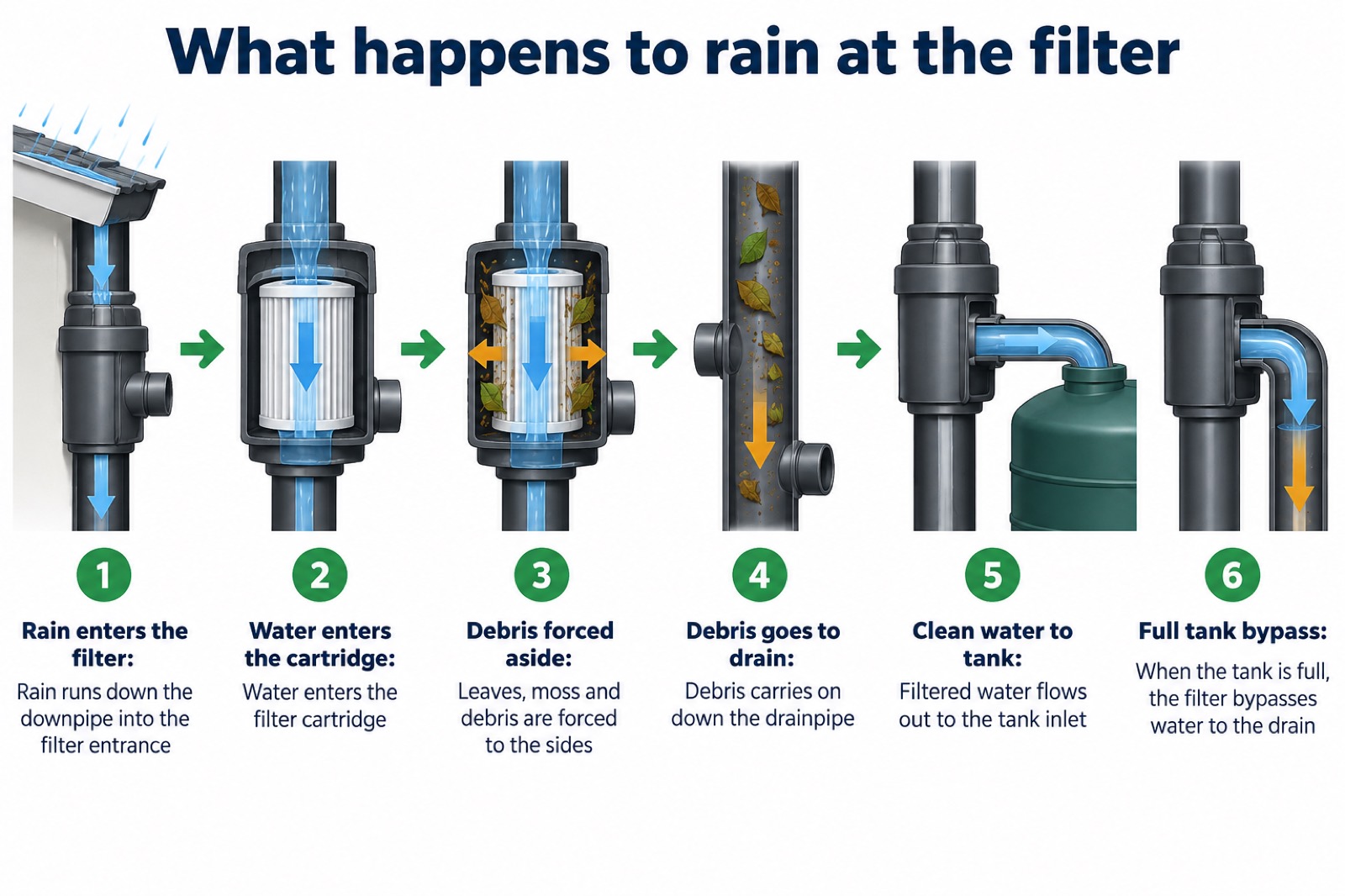
The kit is two jobs in one product. It is a rainwater diverter and filter, and it comes with the pipe that takes the filtered water from the filter into your tank1. The filter sits in the downpipe. Rain flows from the filter entrance into the filter cartridge, where debris is forced to the sides and on down the drainpipe, while the filtered water flows out of the cartridge to the tank inlet1. The maker's description of the same mechanism on its larger garden systems is that the filter cleanses the rain before diverting it sideways into the tank while leaves, moss and debris continue down the drain4.
That matters for what ends up in the tank. The maker states the filter helps eliminate sludge in storage tank joints so that watering cans and sprinkler nozzles will not clog, and there is less likelihood of odour1. Sediment is the usual reason a watering can spout or a sprinkler head blocks, and a filter that keeps leaves and moss out of the tank reduces the build-up in the first place6.
The kit also handles the tank once it is full. The filter bypasses the water to the drain when the tank is full, so the downpipe keeps working as a drainpipe and the tank does not back up1. The maker describes the same behaviour on its other filter collectors as the filter acting as the overflow outlet once the tank is full7.
Will it fit your downpipe and your roof?
Two measurements decide whether the kit suits your house: the size and shape of the downpipe, and the area of roof draining into it.
| What to measure | The kit suits | Source |
|---|---|---|
| Round downpipe | 68mm to 100mm | 1 |
| Square downpipe | 65mm to 75mm | 1 |
| Roof area draining to the downpipe | up to 90 square metres | 1 |
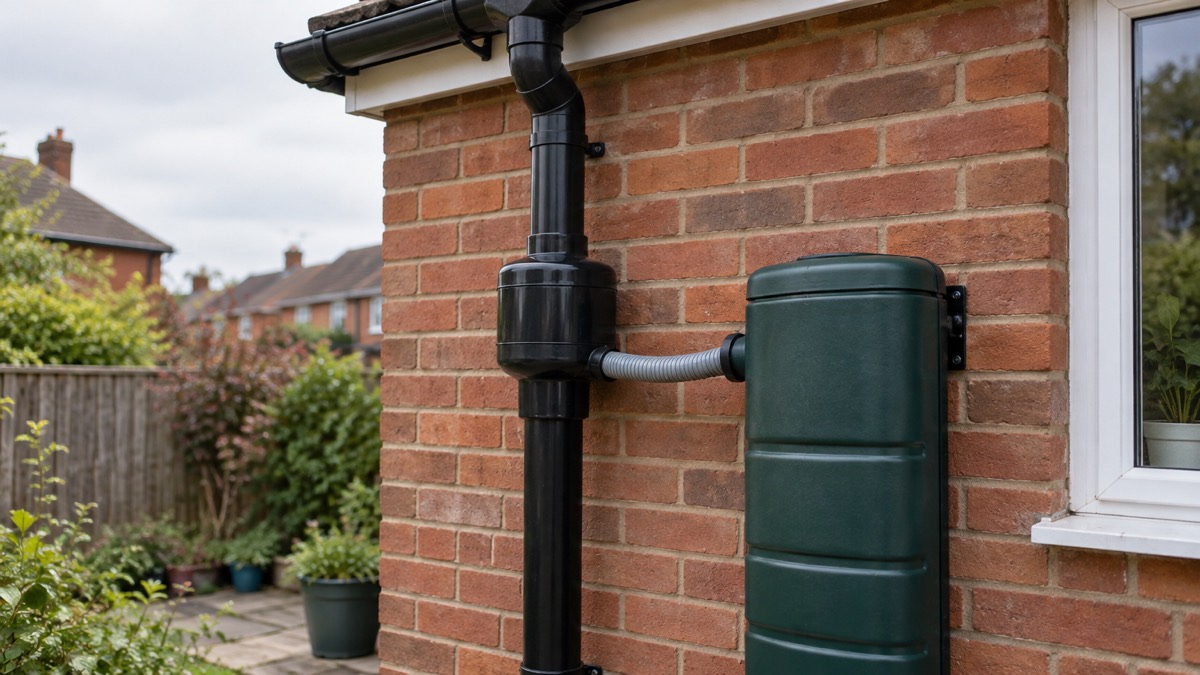
The maker describes the filter as adaptable to nearly all downpipes1. Measure the outside of the downpipe where you intend to fit the collector, and check the shape: a round pipe and a square pipe of the same width are not interchangeable. If your downpipe falls outside both ranges, this kit is not the right one and you should look at a filter rated for a wider range of downpipes.
The roof figure is a maximum, not a target. The maker rates the kit for roof areas up to 90 square metres1. If the roof feeding that one downpipe is larger, the filter will be handling more water than it is rated for in heavy rain, and you should look at a filter with a higher rating rather than fitting this one and hoping.
How the filter separates leaves and debris from tank water
The separation happens inside the cartridge, and it relies on the water changing direction rather than on a mesh alone. Rainwater flows from the filter entrance into the filter cartridge, where debris is forced to the sides and on down the drainpipe, and the filtered water flows out of the cartridge to the tank inlet1. Leaves, moss and the heavier grit keep going the way they were already travelling, down the drain, while the cleaner water is drawn off sideways.
The maker's wider guidance on rainwater filters is that they filter the leaves and moss out of the water coming off the roof to save a build-up of sediment in the tanks6. On its tank systems the maker goes further, describing a leaf filter as filtering debris from rainwater as it flows from the collection roof before it enters the storage tank, with calmed inlets oxygenating the water and helping prevent stagnation9. The same principle applies here: the cleaner the water entering the tank, the less sediment settles at the bottom and the less the water sits and turns.
When the tank is full, the overflow goes back down the drainpipe
A rainwater diverter that keeps diverting after the tank is full will either overflow the tank or push water back up the pipe. This kit avoids both. The filter bypasses the water to the drain when the tank is full1. The maker describes the same behaviour on its other collectors as the filter acting as the overflow outlet once the tank is full7, and on its garden systems as the filter automatically sending excess rainwater to the drain4.
In practice that means the downpipe never stops doing its original job. In a long, heavy spell of rain the tank fills, the filter stops sending water sideways and the surplus runs away down the drain as it always did. You do not need a separate overflow pipe from the tank for the filter to work, because the filter itself is the overflow path7.
The one thing to check is where that overflow goes. Because the maker advises this filter where debris and overflow water will exit down the drainpipe1, the discharge point needs to be somewhere water can safely run to, such as a drain or a soakaway, and not somewhere it will pool against the house or flood a doorway. If your downpipe currently discharges onto a surface that cannot take the extra flow, deal with that before you fit the kit.
Fitting the kit yourself on a UK downpipe
The maker describes the kit as a do-it-yourself installation, easy to install on UK size household drain pipes1. The work is in three parts: cutting the downpipe and fitting the collector, cutting a hole in the tank for the connector, and running the 1m flexible pipe between the two1.
- Measure the downpipe and confirm it is round at 68mm to 100mm or square at 65mm to 75mm1.
- Check the roof area draining to that downpipe is no more than 90 square metres1.
- Decide where the overflow will discharge, and confirm it is a safe place for water to run1.
- Cut the downpipe and fit the filter collector into the run, following the maker's instructions for the kit.
- Cut a hole in the tank at the height the pipe needs to enter, and connect the 1m flexible pipe, which has a 32mm (1¼ inch) internal diameter, between the filter and the tank1.
- Set the flow setting for the season, summer or winter1.
- Run water through and check the joints before the next heavy rain.
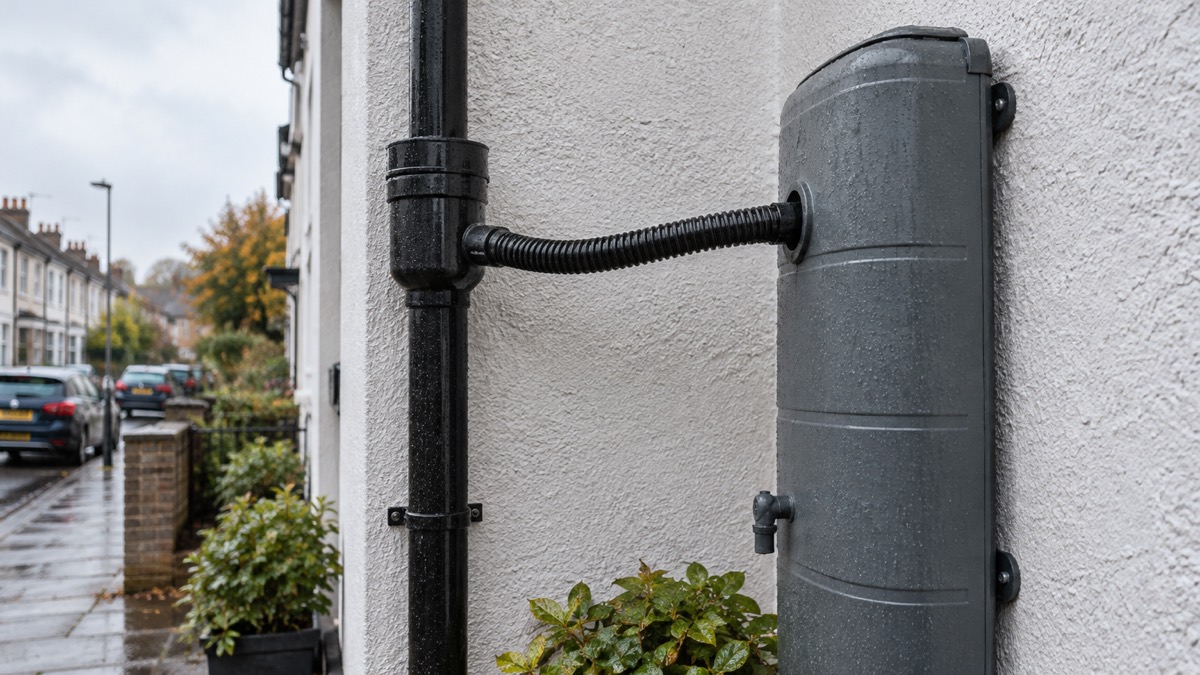
The kit connects to any wall tank with the 2000820 downpipe filter, so you can pre-filter rainwater from the downpipe into the tank1. If you are fitting a new tank at the same time, the above-ground tanks page covers the types available, and how to size a rainwater tank covers matching capacity to your roof and your use. If you are connecting to a water butt rather than a wall tank, the water butt downpipe connection page covers that job.
Connecting to a wall tank with the 1m, 32mm pipe
The connector is a 1m long flexible pipe with an internal diameter of 32mm (1¼ inches), and it connects the filter to a hole cut in the tank1. The length is the constraint to plan around: the tank needs to sit within about a metre of the filter, measured along the route the pipe takes, including any bend. If the tank is further away, this kit's pipe will not reach and you need a different arrangement.
The pipe is flexible, which helps with a small offset between the filter outlet and the tank inlet, but it should not be kinked or pulled tight. A gentle sweep from the filter down to the tank lets the water run freely and keeps the joint under less strain. Cut the hole in the tank at a height that lets the pipe fall gently towards it rather than running uphill.
The filter itself is listed with 32mm and 50mm outlets3. The kit uses the 32mm connection to the tank1. If you want to run a hose from the outlet as well, the maker's outlet adapter is listed as fitting 1¼ inch and 2 inch hosepipes7, and an adapter is listed fitting 75mm, 50mm (2 inch) and 32mm (1¼ inch) hosepipes8. Where the maker and the other listing give different adapter sizes, the maker's figure is the one to work from.
Cleaning the removable filter cartridge
The kit has a removable cartridge for cleaning, and the maker describes it as easy to install and maintain1. On its garden systems the maker says the filter cartridge can be taken out in seconds for cleaning, allowing easy maintenance4, and on its other collectors it describes the cartridge as easily removable for cleaning6.
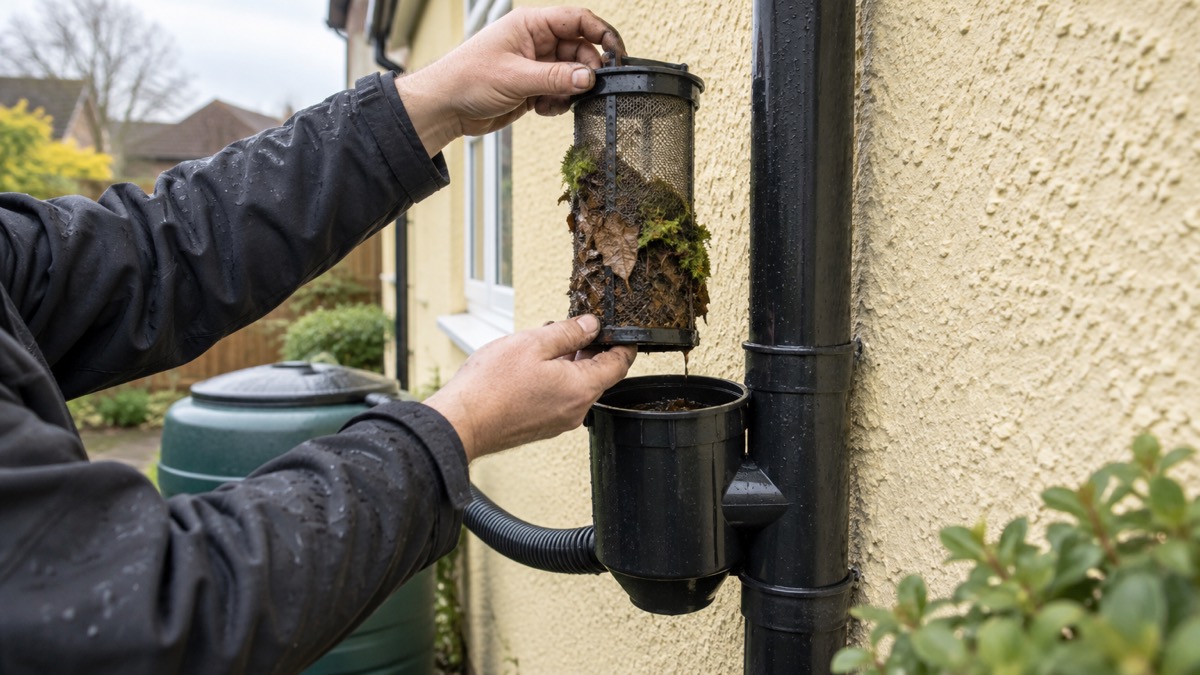
Cleaning is not optional housekeeping. The official guidance on private water supplies is that cartridge filters need to be cleaned or replaced according to the manufacturer's instructions11, and a filter left full of leaves and moss will stop passing water and start sending it all down the drain instead. The maker's own guidance on tank systems is that a filter in the pipe to the tank is essential for larger tanks where water may be stored for a longer time, because it helps prevent the water becoming smelly and discoloured2. A blocked filter cannot do that job.
- Check the cartridge after heavy leaf fall and after storms, when the roof is shedding most debris.
- Take the cartridge out, clear the debris and rinse it, then refit it seated properly in the housing.
- The cartridge is designed to come out in seconds for cleaning, so there is no need to force it1.
- Check the pipe joints and the tank inlet for drips at the same time.
- If the cartridge is damaged or no longer clears, replace it rather than refitting it.
The rainwater maintenance page sets out a fuller year-round routine, and the rainwater filters page explains how downpipe, inline and in-tank filters differ. If you are storing water for longer periods, the stored rainwater page covers what happens when water sits.
Summer and winter settings, colours and outlets
The kit has flow settings for either summer or winter1. The setting changes how the collector handles water through the year, so it is worth checking when you clean the cartridge and setting it for the season you are in rather than leaving it where it was fitted.
The filter comes in three colours, each with its own code: Brown (2000810), Grey (2000820) and Black (2000840)3. The tank connector kit is built around the 2000820 downpipe filter1, so if you are matching an existing grey installation, that is the code to look for. Choose the colour that blends with your downpipe; the codes identify the colour, not different products.
| Feature | What the maker lists | Source |
|---|---|---|
| Colours | Brown (2000810), Grey (2000820), Black (2000840) | 3 |
| Outlets | 32mm and 50mm | 3 |
| Flow settings | summer or winter | 1 |
| Overflow | automatic | 1 |
| Filter | removable cartridge | 1 |
Delivery, stock and where to get help
The maker states that most items are normally in stock and shipped on a next day service, providing the order is received by midday1. The kit is delivered by parcel carrier unless it is delivered with a larger order1. Those are the maker's statements about its own stock rather than a guarantee, so if timing matters, confirm the position when you order.
Larger rainwater systems from the same maker are held in stock at its Peterborough warehouse, with delivery normally 7 to 10 days from receipt of order12. That longer lead time applies to the tank systems, not to this kit, but it is worth knowing if you are ordering a tank to connect the filter to at the same time.
For help with a kit you have bought, go back to the seller you bought it from, with your order details and the model code3. For questions about how a filter fits into a wider system, the rainwater harvesting page explains how the parts work together, and the garden rainwater harvesting kit checklist lists what a basic set-up needs. If you are planning to use harvested water indoors as well as in the garden, read the rainwater regulations page before you plumb anything in.
Sources (15)
- 3P Filter Collector and Tank Connector Kit, Rainwater Harvesting Ltd, 2026-10-01
- Rainwater Harvesting FAQ, Rainwater Harvesting Ltd, 2025-11-06
- 3P Filter Collector, Rainwater Harvesting Ltd, 2026-03-10
- 1650 Litre Garden System, Rainwater Harvesting Ltd, 2026-07-17
- 2400 Litre Garden System, Rainwater Harvesting Ltd, 2026-01-06
- Rainwater Harvesting Filters, Enduramaxx, 2026-10-29
- Filter Collector with 1m Link Kit, Enduramaxx, 2026-09-28
- 800 Litre Rainwater Tank with Pump and Filter, Tanks Direct, 2026-10-29
- 30000 Litre Rainwater Tank, Enduramaxx, 2026-09-28
- Rainwater Tank Filter Kits, Enduramaxx, 2026-10-29
- Protecting Your Private Water Supply, Drinking Water Inspectorate, 2026-10-28
- 5700 Litre Rainwater Tank, Rainwater Harvesting Ltd, 2026-03-24
- Carat 2700 Litre Rain Director System, Rainwater Harvesting Ltd, 2026-07-01
- F-Line 7500 Litre Garden System, Rainwater Harvesting Ltd, 2026-07-03
- Carat 2700 Litre Garden System, Rainwater Harvesting Ltd, 2026-07-01