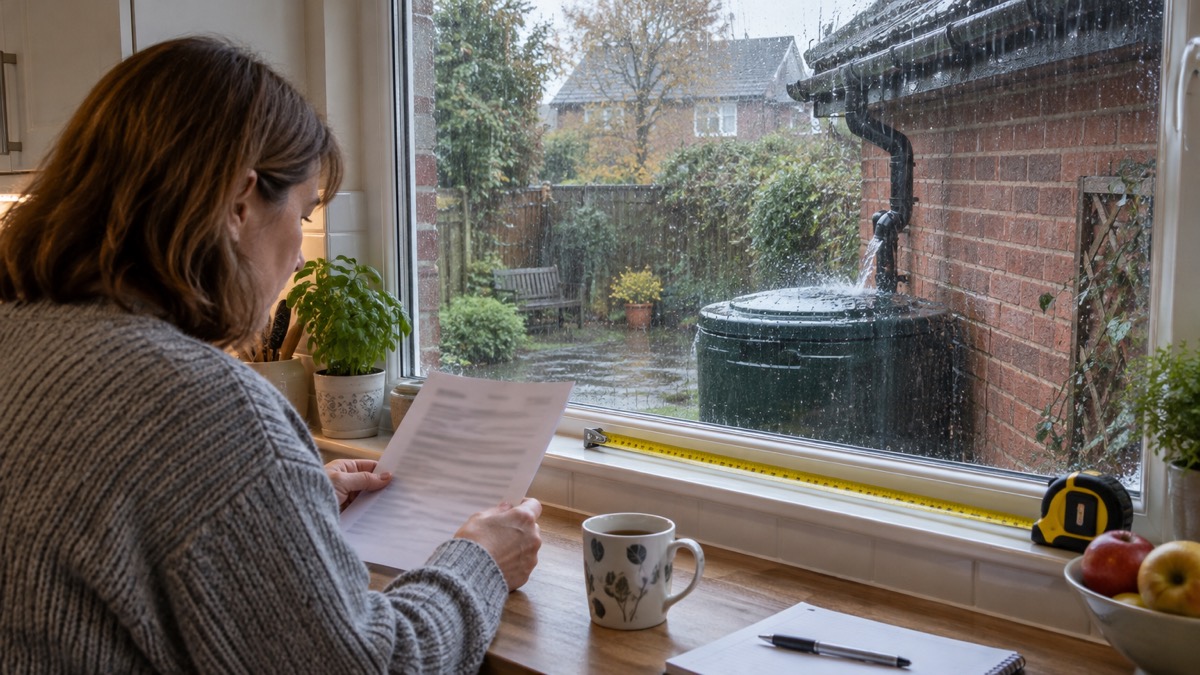
Sizing a rainwater tank comes down to three numbers: how much roof you have draining into it, how much rain falls on that roof where you live, and how much water your household will actually take back out of it. There is no point buying a tank bigger than your roof can fill, and no point buying one smaller than your household will drain dry in a fortnight.
The good news is that you do not need to do the arithmetic yourself. Online tank size calculators, such as the one from RainWater Harvesting, take your roof measurements, your region and your household's water use, and return a recommended tank size1. What the calculator cannot do is know your house, your garden or your habits. This page explains what to measure, what the standard assumptions are, where they may not fit your home, and how to turn the calculator's answer into a real tank that fits the space you have.
If you are new to rainwater harvesting generally, start with how a system works before sizing one.
What you need before you start
Before you touch a calculator or a tape measure, gather three pieces of information. The RainWater Harvesting team asks for your collectable roof area, your geographical location, and the number of bedrooms if the water is for use within the home1. The calculator itself needs the approximate dimensions of your house in metres1.
Each of the three matters for a different reason. Roof area sets the ceiling on what you can collect: rain falls on the roof, runs down the downpipes, and only the roof area connected to the tank counts. Location sets how much rain there is to collect, and it varies enormously across the UK, which is why the calculator asks you to select a region rather than a country. Household size, which the calculator approximates through bedroom count, sets how much water you will draw back out for toilet flushing, laundry and the garden.
The maker of the Rain Activ garden system lists the same four inputs for calibrating a system: the required run off rate, the roof size, the geographical location, and the potential water usage3. Different calculators phrase it differently, but the underlying logic is the same everywhere: supply from the roof, demand from the household, and a tank sized to balance the two.
One more thing to know before you start: how much rainwater storage you require depends on the roof area of the buildings, sheds or garage you are looking at, the amount of water you want to save, and the space and budget you have, as tank maker Enduramaxx puts it4. In other words, the arithmetic gives you a target, but the space you have available may adjust it. Both matter, and this page covers each in turn.
Measuring your roof area, including extensions
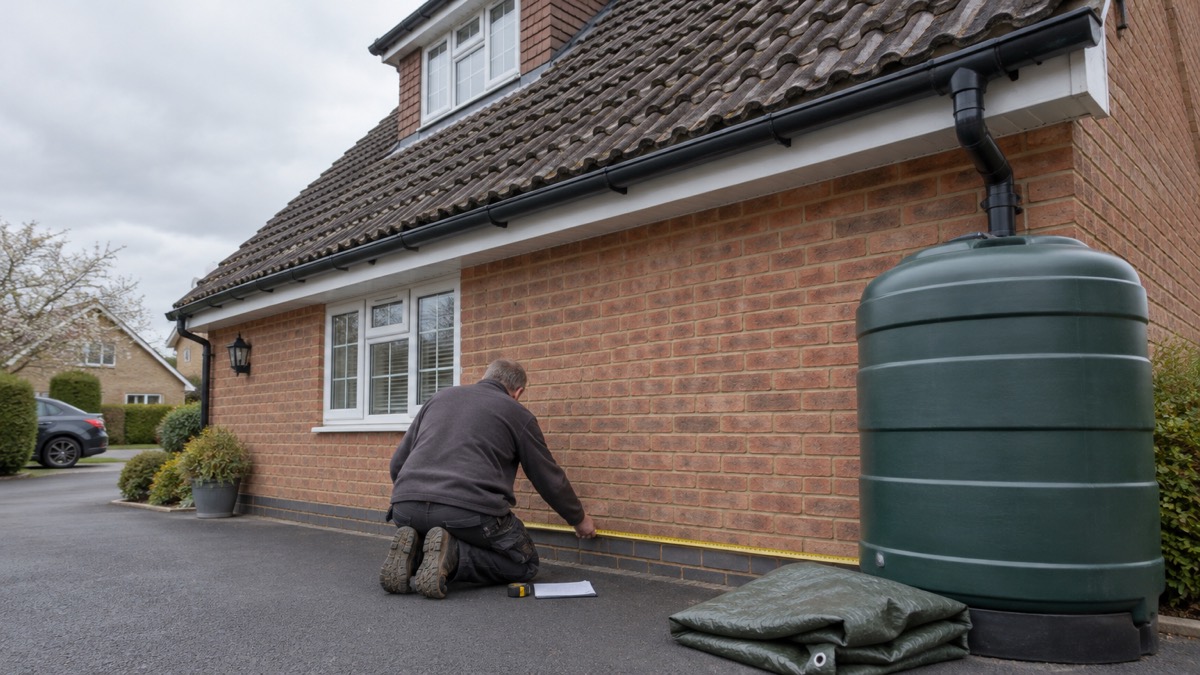
Measure the footprint of your house in metres. You need the approximate dimensions of the house, length and width, from which the plan area of the roof follows1. It is the plan area, the roof as seen from above, that catches rain, not the sloping surface area, so measure the outline of the building at ground level.
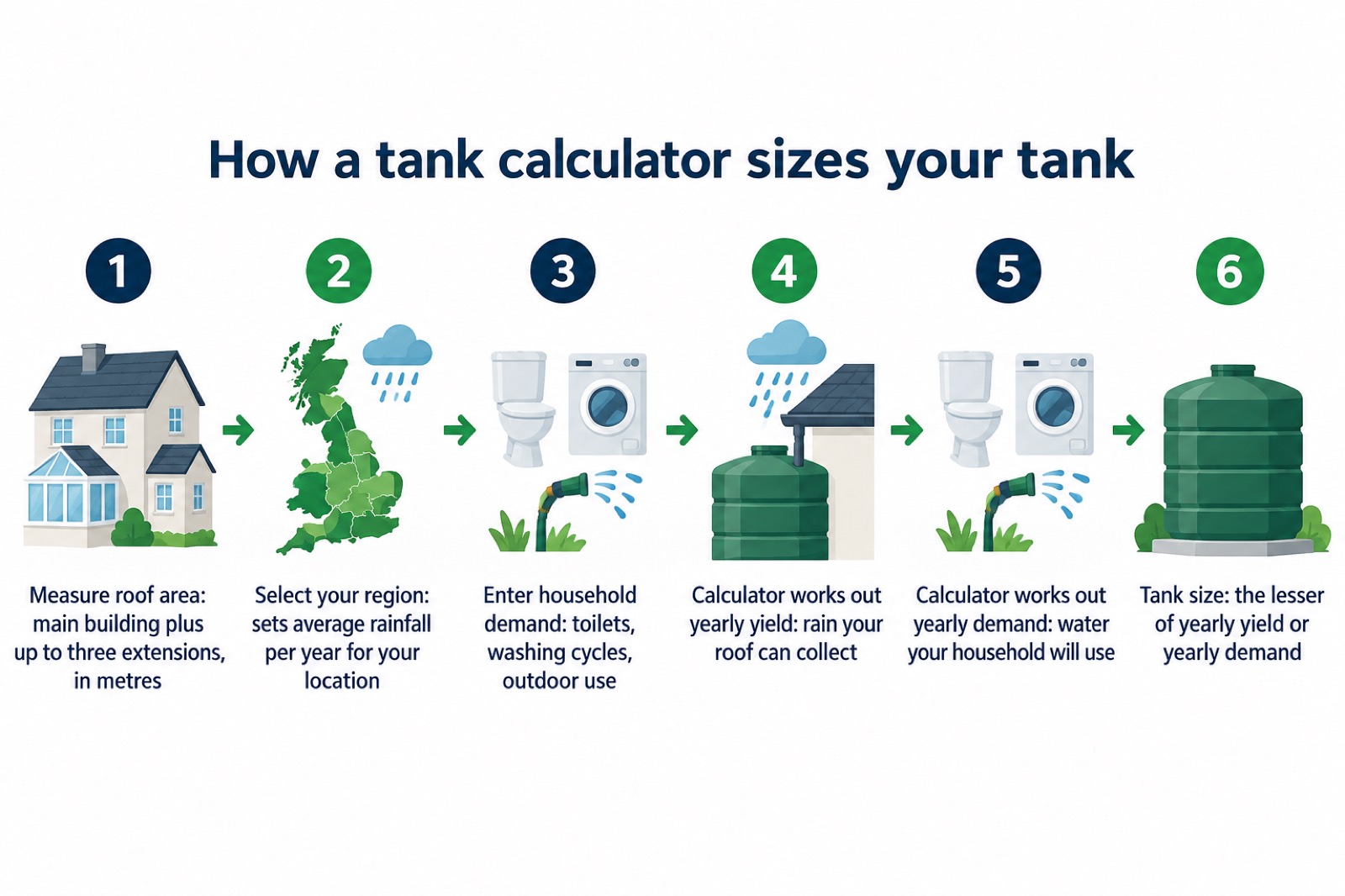
Do not stop at the main building. The RainWater Harvesting calculator accepts measurements for a main building and up to three extensions, so a rear extension, a conservatory or a garage roof that drains to a downpipe can all be included1. If you already know the total collectable roof area, you can enter that directly instead, and it overrides the individual building measurements1.
Two practical points are worth checking. First, only roof area that you can actually pipe into the tank counts. A garage on the far side of the house may need long pipe runs, and if you are not going to connect it, leave it out of the measurement. Second, if you are buying a filter kit as part of the system, check its rated roof area. Enduramaxx's rainwater harvesting Kit B is designed for roof sizes up to a maximum of 450 square metres per kit5, and its filter kits include versions rated for 450 square metres and, for pilot shaft installation, up to 800 square metres per kit6. A filter undersized for your roof will not cope with the flow in heavy rain.
Sheds and garage roofs are also fair game for smaller set-ups, and Enduramaxx's garden tank guidance explicitly includes them when working out how much storage you require4. Even a shed roof feeding a water butt adds to what you can collect through the year.
Working out yearly demand: toilets, washing and garden
Demand is the water your household will take out of the tank. The calculator breaks it into three parts, each with a standard assumption you can adjust.
Toilets. The calculator uses an average of 4.42 flushes per person per day, at an average of 5 litres each1. That 5 litre average is worth testing against your own home. Official government guidance on water use notes that older cisterns use as much as 13 litres per flush, whilst current modern models use 6 litres per flush or less7. If your toilets date from before the low-flush era, your per-flush figure will be well above the calculator's default, and your demand with it.
Washing machines. The calculator assumes 50 litres per clothes washing cycle, and you enter the number of cycles per day your household runs1. A family doing a wash most days has a steady, predictable laundry demand that rainwater covers well, because unlike garden watering it does not cluster in dry weather.
Outdoors. The calculator recommends allowing 5 litres per person per day for outdoor use1. Treat that as a floor rather than a ceiling if you are a keen gardener, because outdoor demand is highest precisely when the tank is lowest. For a sense of scale, the average person uses 176 litres of water a day in total, according to Welsh Water8, though that figure covers all uses, including showers and cooking, which a rainwater system does not normally serve.
| Use | Calculator assumption | Notes |
|---|---|---|
| Toilet flushing | 4.42 flushes per person per day, average 5 litres each1 | Older cisterns use as much as 13 litres per flush; modern models 6 litres or less7 |
| Clothes washing | 50 litres per cycle1 | Enter your household's cycles per day |
| Outdoor use | 5 litres per person per day, recommended1 | Garden demand rises in dry spells |
| Whole-house average | 176 litres per person per day8 | All uses, not just rainwater-suitable ones |
One demand-side check before you size anything: fix leaks first. Even a small trickle of water can waste up to 200 litres of water per day, Thames Water warns9, which is water and money down the drain whether it comes from the mains or your tank. There is more on what harvested rainwater can and cannot be used for in our page on rainwater uses.
The sizing rule: lesser of yield or demand
Once you have supply and demand, the rule is simple. The volume of rainwater storage required is based on the lesser of the annual yield from your roof and the annual demand from your household1. The calculator shows both and sizes the tank to the smaller figure.
The logic is straightforward in both directions. If your roof yields less per year than your household demands, a tank larger than the yield is dead capacity: it can never fill, because the rain simply is not there. If your household demands less than the roof yields, a tank larger than the demand is also wasted, because the surplus has nowhere to go and overflows away. The tank is a buffer between the two, not a reservoir for everything the roof can catch.
This is also why the region selection matters so much. The calculator offers selectable regions for average rainfall per year including East Anglia, England E and NE, England N, England NW and Wales N, England S, England SE and Central S, England SW and Wales S, the Midlands, Scotland E, Scotland N, Scotland W, and Northern Ireland, alongside whole-country options for the UK, England, Wales and Scotland1. The same roof in East Anglia and in western Scotland produces very different yearly yields, and so very different tank sizes.
Drought protection: how many days of cover to build in
The calculator asks one more question: how many days of drought protection you need1. This is the number of days your stored water can carry the household through a dry spell when nothing new is coming in. There is no single right answer: it depends on how long a dry spell you want to ride out, and how much demand the tank is covering. Bear in mind that droughts do not end the moment the rain returns, as it can take many months for water resources to recover and reservoirs may take several months to refill even while it is raining.
Drought protection is worth building in seriously, because dry spells in the UK can bite harder than people expect. Wiltshire and Swindon Prepared rates the impact of drought as Moderate (3)10. United Utilities' draft drought plan for 2027 notes that it can take many months for water resources to recover after a period of dry weather, so drought measures may need to remain in place even once the rain returns, and reservoirs may take several months to refill11. A tank sized only for average conditions will be empty exactly when you need it most.
For households on a private water supply, the stakes are higher still, and the Drinking Water Inspectorate's guidance on private supply storage tanks is that the storage tank must be inspected regularly, at least annually and preferably every six months12. If your rainwater or storage tank is part of a private supply, see private water supply rules and what to do when a private supply runs low.
For mains households, a modest store of mains water alongside the tank is sensible. Wessex Water's guidance for incidents advises that 10 litres per person per day should cover drinking, cooking and hygiene needs, plus extra for medical needs or pets13. That is a separate emergency store, not something the rainwater tank substitutes for, as the section on drinking below makes clear.
The British Red Cross adds a simple, relevant habit: get a water butt, so that when it does rain, you have a supply especially for your garden and car14. Even if a full harvesting system is years away, a butt gives the garden its own stored supply to draw on between rains, and our water butts page covers choosing one.
Matching the result to a real tank
The calculator gives you a litre figure. Real tanks come in fixed sizes, so the last step is matching the two, and the main constraint is usually the space you have.
Tank sizes are not exact even when you have chosen one. Enduramaxx notes on its tank pages that tank sizes quoted are subject to a +/- 3% variation15, so the tank that arrives may hold slightly more or less than its nominal capacity. Build a little slack into your reasoning rather than treating the nominal figure as precise.
The range available is wide. Enduramaxx's rainwater tanks run from 180 to 10,000 litres underground and 150 to 30,000 litres above ground18, and its dedicated rainwater harvesting tank range extends to much larger vertical tanks, including 50,000 and 90,000 litre models aimed at commercial, agricultural and institutional uses such as toilet flushing in industrial, commercial, hospital or school environments19. A household will almost always land in the smaller part of that range.
| Nominal capacity | Footprint and height | Notes |
|---|---|---|
| 240 litres | 960 L x 740 W x 490 H mm, 255mm lid18 | Water-butt scale |
| 400 litres | 1625 L x 720 W x 510 H mm20 | Low, horizontal |
| 1,250 litres | 1200 dia x 1245 h mm20 | Compact vertical |
| 2,500 litres | 1400 dia x 1845 H mm20 | Vertical, or 1350 L x 760 W x 1300 H horizontal20 |
| 4,500 litres | 1700 dia x 2520 h mm20 | Vertical |
| 7,000 litres | 2600 dia x 1370 h mm20 | Wide and shallow |
| 10,000 litres | 2600 dia x 2290 h mm18 | Vertical |
| 15,000 litres | L 2400 x W 2400 x H 3720 mm20 | Large household or small commercial |
Two space checks before you order. First, height: a 7500 litre garden system tank stands 2,530mm tall with a 2,085mm diameter21, and a 30,000 litre tank has a diameter of 3.45m and a total height of 3.6m19. Measure the spot, including headroom for the lid and any pipework above it. Second, the base: Enduramaxx specifies a concrete base of 102mm (4 inches) for tanks up to 2,500 litres, 152mm (6 inches) for tanks of 4,000 to 10,000 litres, and 204mm (8 inches) for tanks over 10,000 litres19. An undersized base is a common and avoidable failure.
Access matters too. All tanks in one maker's 7500 litre garden range have a 500mm access opening with a manhole lid21, which is what you will use for inspection and cleaning, so make sure the opening remains reachable once the tank is installed.
Underground or above ground, and slimline options for small gardens
Where the tank goes is a choice in its own right, and it interacts with size. Underground rainwater tanks are available from 180 litres to 10,000 litres20, and the Rain Activ dual garden system uses underground tanks in a range of sizes from 1,500 to 15,000 litres3. Underground tanks keep the garden clear, keep the water dark and cool, and free you from height restrictions, but they need excavation; our underground tanks page covers the digging options.
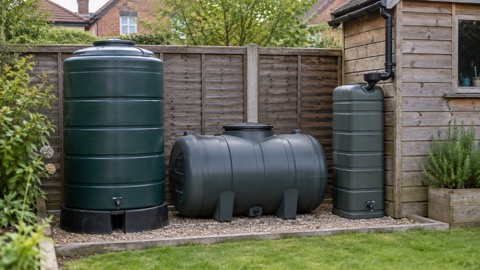
Above ground, the choice is between vertical, horizontal and slimline shapes, covered in detail on the above-ground tanks page. Slimline tanks trade depth for a small wall-adjacent footprint. Enduramaxx's 4,000 litre slimline tank measures 1700 x 1700 x 2300 mm with a 620mm diameter lid and a 2 inch standard male outlet22, and its 10,000 litre slimline tank measures 1900 dia x 3770 h23. Both are UK manufactured and 100% rust proof, the maker states22.
For a small garden, start smaller. Enduramaxx recommends its 500, 720 and 1000 litre vertical tanks for larger volume rainwater storage in the garden4, and Southern Water notes that fitting a water butt to collect and reuse rainwater could save more than 800 litres of water a year24. A butt connected to a downpipe is an afternoon's work: connecting a water butt to a downpipe explains how, and water butt or underground tank sets the two side by side.
Keeping stored rainwater clean while it sits
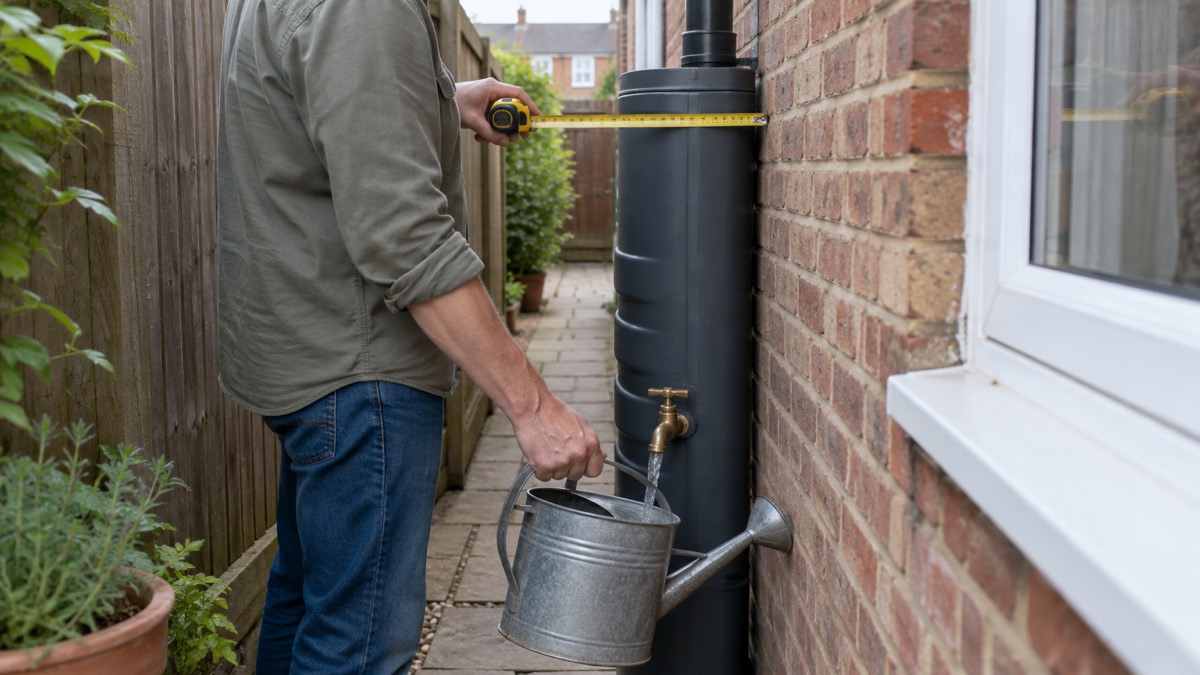
A tank that is the right size still needs to keep the water in usable condition, and the sizing decisions affect that. Stored rainwater stays best when it is dark, filtered, and not stirred up by every incoming flow.
Filtering happens before the water enters the tank. In the Rain Activ system, rainwater from the roof is heavily filtered as it enters the tank, removing any particles larger than 1mm3. Filter kits are sized to roof area, as noted above, with Enduramaxx's kits rated at up to 450 square metres and 800 square metres per kit25. Our rainwater filters page compares the downpipe, inline and in-tank types.
Inside the tank, a calmed inlet does two jobs. Enduramaxx describes it as preventing incoming water from disturbing any sediment in the tank, and also ensuring fresh water is supplied to the lower area of the tank, resulting in complete and regular replenishment of stored water5. In other words, the inlet slows the incoming flow so it does not stir up what has settled, while still pushing fresh water through the stored volume so it does not go stale. This matters more in an oversized tank, where water sits for longer, which is one more reason not to buy capacity your roof cannot fill.
The siphon overflow in Enduramaxx's filter kit fits a 130mm hole in the storage tank wall6, so the tank and the overflow fitting need to match. Whether stored rainwater can go off, and how to prevent it, is covered in does stored rainwater go stagnant, and the routine jobs are listed in keeping a rainwater system clean through the year.
Untreated rainwater is not safe to drink
Whatever size of tank you choose, be clear about one limit: untreated rainwater is not for human consumption. The maker of the Rain Activ system states this plainly, and notes that water companies are recommending, and in some cases requiring, black and green HDPE pipe for rainwater systems, with the point of use clearly labelled3.
"Untreated rainwater is not for human consumption and so water companies are recommending (and in some cases requiring) t"3
That is the maker's own warning on its own product, and it matches the wider principle that rainwater systems serve toilets, washing machines and outdoor taps, not kitchen taps. If you want to understand the whys, see is harvested rainwater safe to drink, and for the pipe and labelling rules, what pipe to use for rainwater and labelling rules.
For emergency drinking water, plan separately. Wessex Water's incident guidance is to store 10 litres per person per day to cover drinking, cooking and hygiene needs, plus extra for medical needs or pets13. That store should be mains water in sealed containers, refreshed and kept for emergencies, not the contents of a garden tank. Size for turnover, not just volume: water that sits too long in any tank is water that deteriorates.
Sources (25)
- Tank Size Calculator, RainWater Harvesting, 2026-08-12
- Rainwater Harvesting Catchment Calculator, Enduramaxx
- Rain Activ Dual Garden System, RainWater Harvesting, 2026-07-01
- Garden Rainwater Tanks and Water Butts, Enduramaxx, 2026-10-29
- Rainwater Harvesting Kit B, Enduramaxx, 2026-09-28
- Rainwater Tank Filter Kits, Enduramaxx, 2026-10-29
- Droughts: Be Informed About Hazards, Prepare Campaign, 2026-10-19
- Save Water, Dŵr Cymru Welsh Water, 2026-10-28
- Identifying Leaks at Home, Thames Water, 2026-10-28
- Drought Risk, Wiltshire and Swindon Prepared, 2026-10-25
- Summary of Our Draft Drought Plan 2027, United Utilities, 2026
- Private Supply Networks: Water Storage, Drinking Water Inspectorate, 2025-11-05
- Guidance for Incidents, Wessex Water, 2026-10-28
- Drought: Prepare for Emergencies, British Red Cross, 2024-07-31
- 50,000 Litre Vertical Rainwater Harvesting Tank, Enduramaxx, 2026-09-28
- 75,000 Litre Rainwater Harvesting Tank, Enduramaxx, 2026-09-28
- 90,000 Litre Vertical Rainwater Harvesting Tank, Enduramaxx, 2026-09-28
- Rainwater Tanks Range, Enduramaxx, 2026-10-29
- 30,000 Litre Rainwater Tank, Enduramaxx, 2026-09-28
- Rainwater Harvesting Tanks, Enduramaxx, 2026-10-29
- 7,500 Litre Garden System, RainWater Harvesting, 2026-03-24
- 4,000 Litre Slimline Rainwater Harvesting Tank, Enduramaxx, 2026-09-28
- 10,000 Litre Slimline Rainwater Tank, Enduramaxx, 2026-09-28
- Save a Little Water, Southern Water, 2026-10-28
- RWH Filters Kits for Rainwater Harvesting Tanks - Enduramaxx, Enduramaxx
 Composting Toilet Kit Checklist
 Garden Harvesting Kit Checklist
 Rainwater Winter Checklist
 Above-Ground Rainwater Tanks
 Composting Toilets
 Direct vs Gravity Feed Systems
 Planning Permission for Systems
 Private Water Supply Running Low
 Private Water Supply Regulations
 Private Water Supplies Scotland
 Treating a Private Water Supply
 Rainwater Filter Types
 How Rainwater Harvesting Works
 Rainwater System Maintenance
 Pumps for Rainwater Tanks